

1. Introduction
Economic historians of Europe and North America have long been interested in wealth accumulation and transmission across generations. Gathering information on the wealth of individuals from a variety of sources, such as wills, tax records, census schedules and probate inventories, they have examined the distribution of wealth in earlier societies and analyzed how wealth levels and inequality varied over time and between regions. They have also explored whether personal characteristics and social institutions have contributed to the growth of individual wealth and studied how poverty and prosperity were inherited from one generation to the next. These studies provide the key methods of analysis and the bases for comparison for those interested in examining the accumulation and transmission of wealth in other societies.Footnote 1
Comparable research on the Ottoman Empire has been slow to develop. Although a number of recent quantitative studies have portrayed wealth inequality and economic stratification in various Ottoman communities (Ergene and Berker Reference Ergene and Berker2008; Gerber 1998; Pascual and Establet Reference Pascual and Establet1994; Gradeva Reference Gradeva and Anastasopoulos2005; Establet et al. Reference Establet, Pascual and Raymond1994), no attempt has been made until now to systematically examine how factors such as parental wealth, inheritance practices, socioeconomic status, or length of time affected the accumulation of wealth. Identifying the determinants of wealth is particularly important for the Ottoman Empire because it might give clues as to the relative economic backwardness of the region. Kuran (Reference Kuran2003, Reference Arrondel and Grange2004, Reference Kuran2010) has recently offered an explanation centered on, among other institutional variables, the Islamic law of inheritance, an evolutionary bottleneck that inhibited capital accumulation.Footnote 2 To examine relevant phenomena quantitatively, we need to identify the mechanisms of wealth accumulation in the Ottoman Empire and compare them with those of other societies.
This article studies the accumulation and intergenerational transmission of wealth in early modern Ottoman Anatolia by employing data from probate estate inventories (terekes) as found in the court records (sicils) of eighteenth-century Kastamonu, a town located in northern Anatolia. Extracting information on the wealth levels and personal characteristics of father–son pairs in the period between 1710 and 1806, we conduct regression analysis of factors determining the wealth of sons. In this first attempt to simultaneously analyze the estate inventories of parents and children in the Ottoman Empire, we also compare our results with those obtained for regions that were growing rapidly in this era and discuss the implications of our findings for the prospects of capital accumulation in the Ottoman context.
Our results indicate a significant correlation between the wealth levels of fathers and sons in eighteenth-century Kastamonu, although this relationship was weaker than what has been observed for eighteenth-century England. We have also determined that wealth-holding was more equal in Kastamonu than in England, possibly due in part to the relatively rapid regression to the mean among Ottoman sons. Finally, our calculations cast doubt on the suggestion that Islamic inheritance practices led to excessive levels of wealth fragmentation.
2. Context and data
This study is based on information found in the estate inventories as recorded in the eighteenth-century (1710–1806) court records of Kastamonu, a medium-sized town in northern Anatolia. By the mid eighteenth century, the Kastamonu subprovince (sancak), located on the Black Sea coast and part of the province (eyalet) of Anatolia, probably had a population of about 30,000 households. The town of Kastamonu – the legal and administrative center of the subprovince – had a population of 3,500 to 4,000 households, including the inhabitants of its 41 quarters and the villages located nearby (Ergene Reference Ergene2003, ch. 2). Little is known about the town's demographic composition, especially in the eighteenth century. Based on the observations of European travelers of the nineteenth century and our impressions from court records, we can surmise that Kastamonu was inhabited primarily by a Muslim, Turkish-speaking population. Kastamonu has received less attention in modern scholarship than some of the other Anatolian urban centers such as Ankara, Bursa and Kayseri. Because the town's court records are quite complete relative to its size, however, it is perfectly suited to the quantitative analysis presented here.
Our sample includes about 1,500 estate inventories of Muslim male adults from 63 court registers,Footnote 3 covering the 96-year period from 1710 to 1806.Footnote 4 An estate inventory typically provides detailed information about the wealth possessed by an individual at the time of his or her death, containing an itemized listing and monetary appraisal of the cash, property and debt left behind by the deceased as well as the names of heirs and their inheritance shares. Prepared by court officials at the request of the heirs, estate inventories list the private holdings (mülk) of the deceased.Footnote 5
The limitations of terekes as historical sources for quantitative research on economic conditions need to be acknowledged in a study such as this one (Ergene and Berker Reference Ergene and Berker2008; Gradeva Reference Gradeva and Anastasopoulos2005; Pascual and Establet Reference Pascual and Establet1994, pp. 31–2). These documents tend to under-represent female testators, non-Muslims, rural populations and the poor, and to over-represent the elderly. It is likely that many tried to avoid the court's involvement in the appraisal and division of estates since courts charged a fraction of the estate's overall value as an ‘inheritance tax’ (resm-i kısmet), in addition to a number of lump-sum fees for its service. In fact, the court's appraisal and division of estates was not always desired, especially when there was no dispute among heirs; it was often disagreements over inheritance shares that necessitated the court's involvement in estate divisions. Unfortunately, it is impossible to determine, even roughly, what percentage of the deaths in a particular location ended up in estate inventories.
Furthermore, we cannot be absolutely sure that the inventories accurately reflect the real worth of the deceased at the time of their death. Heirs often tried to conceal portions of their estates from court officials in order to reduce the ‘inheritance tax’ portion of court fees. There is also the issue of the reliability of the court's monetary appraisal of estates. We lack information about real market prices of the majority of items listed in inventories, and we cannot be sure about the motivations of court officials in preparing them – they may have inflated appraisals to increase their fees. However, such problems are not specific to Ottoman estate inventories (cf. Arrondel and Grange Reference Arrondel and Grange2006; Main Reference Main1975; Jones Reference Jones1980, introduction, Reference Jones1982), and they have not thwarted the development of a rich and illuminating economic-history literature on many Western contexts based on similar types of documents. Indeed, terekes constitute a unique and underutilized data source for the period under study; because of the type of information found in them, they remain irreplaceable for reconstructing the economic and social history of Ottoman provincial life before modern times.
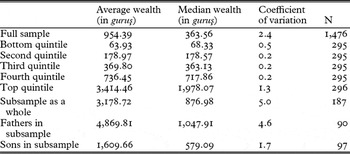
We calculated the net value of individual estates by deducting the debts and outstanding obligations of the deceased from the monetary value of their assets.Footnote 6 To remove price effects from the data, we deflated these nominal figures to real values by using the consumer price index constructed by Özmucur and Pamuk (Reference Özmucur and Pamuk2002). Table 1 summarizes the distribution of net real wealth in Kastamonu by showing the average and median wealth and the coefficient of variation in the population as well as a quintile analysis of these statistics.
Net real wealth in Ottoman Kastamonu (1710–1806) – full and subsample comparisons

Base period: 1740–9.
2.1. A subsample of fathers and sons
The next step was to scan the terekes of approximately 1,500 adult male Muslims and identify those that belonged to fathers and sons. This was a tedious process which took about six months of uninterrupted work. In identifying father–son tereke pairings, we utilized the information found in the individual terekes, including, first and foremost, the names of the fathers and their sons, but also the names of their common heirs, family nicknames (neseb), their quarter or village of origin and the year of their death. We included in the sample of tereke pairings only those that could be identified as father and son with a reasonable degree of certainty. To do so, we sought at least three pieces of corroborating information in tereke pairings, in addition to the names of potential fathers and sons listed in both inventories.Footnote 7
An example may help to clarify this procedure. Assume that we found two terekes which might indicate a father–son pair. The first one, let's say, was recorded in 1755 and belonged to a certain Ahmed bin (son of) Hasan from the Muzaferredin quarter in Kastamonu, who left behind as his only heir an adult son named Ismail. The second tereke, recorded in 1776, belonged to Ismail bin Ahmed, again from the Muzaferreddin quarter, who left behind a wife, Aişe bint (daughter of) Süleyman; an adult son, Hüseyin; and an adult daughter, Neslişah.Footnote 8 Since in Kastamonu many families lived in the same quarter or village for generations and since most fathers and sons died within 15 to 25 years of one another, we have reason to suspect that these terekes belonged to a father and his son. But because the same information could also have come from two unrelated individuals, it alone is not sufficient for us to include Ahmed and Ismail in the subsample.
Now suppose that the tereke of Ahmed also reported that he had the family name ‘Kıbrısizade’, the neseb of a well-known family in eighteenth-century Kastamonu, and that he was survived by a wife named Zeyneb bint Mehmed. If the tereke of Ismail bin Ahmed also identified him as a Kıbrısizade, or mentioned a surviving mother named Zeyneb bint Mehmed among his heirs, the likelihood would be much stronger that he was in fact Ahmed's son, and we would include the two terekes in the sample. In this case the three criteria for inclusion would be (1a) the common neseb of Ahmed and Ismail or (1b) the common name of Ahmed's wife and Ismail's mother, (2) the common quarter of residence, and (3) the plausible time lapse between their deaths.
Some pieces of information in the terekes are stronger indicators of a father–son relationship than others. For example, whereas the names of common heirs are fairly powerful indicators of such a relationship, common quarters/villages of origin, or a reasonable time span between the deaths of testators are merely suggestive. Thus we adopted a strategy for evaluating and comparing the strength of evidence of possible father–son relationships. Let us illustrate again by using the above example: suppose that Ismail's tereke identified him as a Kıbrısizade (just like the tereke of Ahmed) and gave the name of his surviving mother as Zeyneb bint Mehmed (the same name as Ahmed's surviving wife), but identified his quarter of origin as Seydiler and not Muzafereddin. In such a situation we would still include Ahmed and Ismail's terekes in the sample because fathers and sons could have lived in different quarters, villages, or even towns and regions. If, however, Ismail's tereke identified him as a Kıbrısizade and gave the name of his surviving mother as Zeyneb bint Mehmed but, at the same time, identified a ‘brother from his father's side’ named, say, Ibrahim, among his heirs, this would rule out the possibility of his being the son of Ahmed, since the latter's tereke did not list another son named Ibrahim among his living heirs. In this case, a single piece of disqualifying information outweighs the otherwise consistent information between the terekes.
After subjecting 1,500 or so terekes of Muslim male adults to this form of comparative breakdown, we identified 208 terekes (104 pairs) as belonging to adult fathers and sons. Of these 104 pairs, five were excluded because the sons had died before their fathers (making them irrelevant to a study about intergenerational wealth accumulation). Two more were excluded because the net values of the sons’ inherited estates were not clear. Our final subsample of adult fathers and sons thus consists of 97 pairs. To be sure, the rigorous method we employed to identify father and son terekes has led to a fairly small sample size. Nevertheless, we preferred to err on the side of caution rather than risk including in the subsample a potentially high number of false pairings.Footnote 9
We doubt that significantly larger samples of father–son tereke pairings can be constructed for other comparable Ottoman contexts using a similar data-extraction methodology. Our sample comes from a chronologically unbroken collection of sicils that spans almost 100 years and contains more than 2,200 terekes of male and female Muslims. Such a rich, complete and temporally long-ranging collection of court records is rare for urban centers the size of eighteenth-century Kastamonu. For larger urban centers such as Istanbul, Bursa or Damascus, on the other hand, the problem is that most of these locations contained multiple courts, each with its own archive. Thus, identifying father–son tereke pairings for a 100-year period in these places would be an enormous undertaking, requiring a comparison of hundreds of court registers, each containing possibly tens of thousands of terekes. While such an effort might well produce a larger sample of pairings, there is no guarantee that it would be more representative than our sample for eighteenth-century Kastamonu, given the population sizes of these cities.
Table 1 presents some general observations for the full and subsamples, including separate calculations for fathers’ and sons’ estates.Footnote 10
The differences between the full sample and the subsample of fathers and sons raise questions about the subsample's overall representativeness. According to Table 1, the subsample is more reflective of the richer inhabitants of Kastamonu than of the entire community. The differences observed between the full and subsamples are not unique to our study. For example, Arrondel and Grange (Reference Arrondel and Grange2006, p. 216) observe that their ‘selected sample of father–child pairs . . . concerns a richer population than the population. . . overall’. In a more recent study, Clark and Cummins (Reference Clark and Cummins2009, p. 25) choose to correct for a bias in their data set induced by missing father–son wills by estimating the parent–child wealth relationship ‘from the cases of richer fathers and their sons’. In fact, selection processes in all such studies, by definition, focus exclusively on married individuals, who were likely to be wealthier than others. In our case, the difference must also have been amplified by the criteria used for matching fathers and sons. As described, we relied heavily on information about siblings and well-known family designations (neseb) to match fathers and sons. It is likely that this process selected individuals associated with large and powerful families, whose members often constituted the local elite and occupied influential and prestigious positions. If such families were wealthier than others, this would explain the higher average wealth of individuals in the subsample.Footnote 11
Aside from the discrepancies between the full and subsamples, a comparison of the calculations made for fathers’ and sons’ estates also reveals striking variations between their wealth levels.Footnote 12 Fathers’ estates are on average about three times larger than sons’, indicating a considerable degree of wealth fragmentation among subsequent generations of parents and children. In fact, in only 24 of the 97 pairs (25 percent) do sons’ estates appear to be larger than those of their fathers. It is possible that the egalitarian Islamic inheritance system played a role in intergenerational wealth dispersion, though we cannot determine this role by comparing averages alone (see below for more on this). The observed pattern could simply be indicative of a regression to mean, also documented in other historical contexts with different inheritance practices.
3. Analysis: accumulation and transmission of wealth across generations
The literature on cross-generational wealth comparisons has identified various trends in the accumulation and intergenerational transmission of wealth by examining influences on the wealth levels of children at the time of their death (Clark and Cummins Reference Clark and Cummins2009; Menchik Reference Menchik1979; Arrondel and Grange Reference Arrondel and Grange2006; Harbury and Hitchens Reference Harbury and Hitchens1979). Consistent with these studies, we use data from the subsample of father–son pairs for a regression analysis of the determinants of wealth. The dependent variable is the real net wealth of the son, entered in natural logarithmic scale.
In our analysis, we divide the factors determining the son's wealth into three general categories: inheritance, socioeconomic status, and the duration of wealth accumulation. The main factor of interest in the first category is the (natural log of) wealth inherited from the father. The logarithmic specification allows us to separate the influence of the wealth inherited from the father into two channels. The first is ‘through mechanisms such as genes, culture, and social position that are independent of the number of children’ (Clark and Cummins Reference Clark and Cummins2009, p. 20). But since inheritance is often shared with others, there is also a second mechanism, which operates through the direct transfer of wealth from father to son: the son's share of resources inherited from the father.
Although in the English society that Clark and Cummins (Reference Clark and Cummins2009) studied the son's share depended simply on the number of children, things were more complicated in the Ottoman Empire. According to the Islamic inheritance system, the surviving sons, wives, daughters and more distant relatives of the deceased were entitled to different shares of the estate, as specified by intricate rules. For example, whereas the wife of the deceased received a variable portion of the estate depending on the number of children surviving the deceased, the daughters were always entitled to half of the shares of the sons.Footnote 13 Therefore, if a deceased man were survived by no wives but only a son and two daughters, the ‘effective’ number of equivalent shares corresponding to the son's portion was two, not three. We used these intricate rules to calculate the ‘effective’ number of inheritance shares that each estate generated (also equivalent to the division of the value of the father's estate by the value of son's actual inheritance share as reported in the father's tereke).
To identify the individual effects of the two components of inheritance, we enter the total real net wealth of the father and the effective number of inheritors as separate variables. As Clark and Cummins (Reference Clark and Cummins2009, p. 20) state, the relative magnitudes of the effects of these variables ‘will dictate how strong the quality–quantity tradeoff is’. In the next section we discuss in more detail how conceptualizing these components of inheritance as two separate mechanisms allows us to determine the relative importance of various factors in inhibiting capital accumulation and long-term development in the Middle East.
We enter both variables into the regression equation in natural logs, so the coefficient of fathers’ wealth represents the elasticity of sons’ wealth with respect to fathers’ wealth, and the coefficient of the number of inheritance shares shows the elasticity of sons’ wealth to changes in the number of effective co-inheritors. An elasticity measure of one with respect to fathers’ wealth would indicate that wealth in a society is completely immobile and sons inherit the same relative economic positions as their fathers, while a measure of zero would conversely mean perfect mobility where the father's wealth has no influence on the son's economic position whatsoever. An elasticity measure between zero and one obtained for fathers’ wealth indicates a phenomenon known as reversion to mean. The elasticity of sons’ wealth with respect to the number of effective co-inheritors has a similarly straightforward interpretation. An elasticity measure of zero, for example, would indicate that the son's wealth is independent of the way inheritance is divided among heirs.
In the second category, we consider the socioeconomic status of the son and the father. Since terekes do not provide any direct information about an individual's class or (for the most part) occupational background, we employ in the following analysis honorary titles to make inferences about the social standing of the deceased. Honorary titles appear in terekes as parts of men's names and, in the absence of surnames and along with other markers of identification (such as birthplace, family nickname and personal traits), they distinguish individuals with reference to their affiliation with the provincial administrative structure and relative positions within the community.Footnote 14 Technically, these titles signify individuals who possessed specific types of professional training or education, who performed various sorts of military/administrative or judicial/religious functions, and who enjoyed the socioeconomic privileges associated therewith. In addition to exemption from specific taxes, these benefits included economic compensation for specific services as well as varying degrees of communal influence associated with their involvement in the provincial administration.
Based on honorary titles we can determine if a man belonged to the military/administrative establishment (seyfiyye, in Ottoman Turkish) or the judicial/religious one (ilmiyye). If a man had no title attached to his name, he belonged to neither group. Seyfiyye included those men with military/administrative responsibilities or affiliations, such as governors, members of the police force, and the officers as well as the rank-and-file of the provincial militia. In this study we identify the following honorary titles as the primary indicators of military/administrative status: Ağa, Beşe and Beğ.Footnote 15Ilmiyye, on the other hand, was composed of individuals with religious and judiciary responsibilities or affiliations, such as local qadis (magistrates), muftis (jurisconsults) and mosque imams. Such individuals carried the following titles: Efendi, Molla, Halife, Çelebi and Dede.Footnote 16 Both military and religious title-holders, who possessed elevated standing in their communities, were generally exempt from taxes, which made their positions economically as well as socially attractive. Men-without-titles, on the other hand, were considered to be the masses and were responsible for paying taxes.Footnote 17
Recent research on eighteenth-century Kastamonu has also demonstrated that Ağas were significantly more prosperous than other military title-holders. The same research has also revealed that Efendis were considerably wealthier than the rest of the religious title-holders (Ergene and Berker Reference Ergene and Berker2008). Given that Ağas and Efendis also occupied the most prestigious provincial positions relative to other military/administrative and religious/judicial title-holders in Kastamonu, we may regard them as the highest-ranking members of the two establishments, respectively. Therefore, in the following analysis we identify Ağas as ‘elite military/administrative title-holders’, and Efendis as ‘elite religious/judicial title-holders’.
The third determinant of one's wealth is the duration of accumulation. Based on economic theories and quantitative studies of wealth accumulation, we would expect an individual with more time to accumulate wealth to be wealthier than others, all else being equal. Ideally, we could determine the beginning of wealth accumulation from the date of employment or marriage, for instance, but this information is not available from our sources. Instead, we included the number of years between the deaths (the dates of the terekes) of the father and the son.Footnote 18
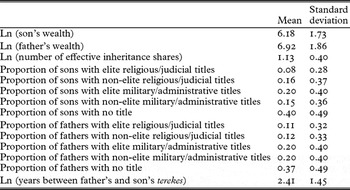
Table 2 shows descriptive statistics for the fathers and sons in the sample for variables used in regression analysis. As seen in the table, despite the significant difference in the natural logarithms of average wealth between sons and fathers, the distribution of titles is very similar. Overall, military title-holders constituted 39% of the fathers and 35% of the sons, while religious title-holders constituted 24% of the fathers and 25% of the sons, and those without titles constituted 37% of the fathers and 40% of the sons.
Descriptive statistics: father–son pairs

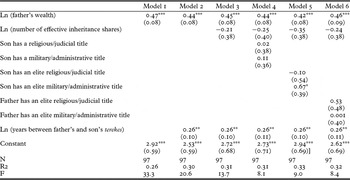
For a regression analysis of how inheritance, socioeconomic status and the duration of accumulation affected wealth, we regressed these variables on the sons’ wealth. To ensure that results are robust to how the model is specified, we included various combinations of these variables into the regression equation, and show the results in Table 3. As discussed earlier, since the father's wealth and the number of inheritors have been transformed into natural log values, their coefficients represent the elasticity of the son's wealth, also in natural logs, with respect to changes in these variables. The coefficient of father's wealth is consistently positive and significant across specifications. The values of this coefficient are very close across models, hovering around 0.45, as we control for different combinations of other variables. The coefficient of the number of inheritors, by contrast, is consistently negative as one would expect, but the effect is insignificant in all models, an intriguing finding that requires our attention. Overall, the results observed for the first two coefficients reveal that the total wealth of the father, more so than how his inheritance was divided among his heirs, influenced intergenerational wealth accumulation. We will return to the implications of this result for the relationship between inheritance laws and wealth accumulation.
Regression analysis of the determinants of wealth (dependent variable: Ln (son's wealth))

Note: Figures in parentheses are standard errors. *** indicates significance at 1%, ** at 5%, * at 10%.
To consider the effect of socioeconomic status on wealth, we included honorific titles in the regression analysis in various combinations (models IV to VI). In model IV, we included them as dummy variables that distinguish between the differential effects of the son having a religious/judicial or a military/administrative title as compared to having no title at all (the reference category). In the next model, we focused on the effect of elite titles by specifying dummy variables based on whether the son had an elite religious/judicial or elite military/administrative title, the reference category being those with non-elite titles or no title at all. The final model considers the same effect for the father's titles. We included honorific titles in various other combinations that are not reported here. Surprisingly, the effect of titles was generally insignificant in all specifications except for the effect of the elite military/administrative status of the son in model V. The same effect was insignificant for the fathers’ titles.
Given that Ottoman historians have traditionally considered honorific titles to be representative of social and economic privilege, these results raise the question of why status did not affect wealth.Footnote 19 Even if we assume that the coefficients for fathers’ wealth capture the economic import of fathers’ titles, it is not easy to explain why we do not observe statistically significant associations between sons’ wealth and their own titles. It is possible that this is a peculiarity of our subsample. Perhaps the wealth of the sons of the rich, influential and well-established families was not directly associated with their religious, administrative or judicial position. Their affluence may have resulted more from their privileged circumstances than from the human capital associated with the training and/or education required to attain these titles. We need further research to determine the accuracy of these inferences.
Finally, our results show that the effect of duration was positive and significant, just as one would expect. The greater the time lapse since his father's death, the more likely a son was to accumulate wealth and demonstrate upward intergenerational wealth mobility. The accumulation may reflect not just the fruit of his own economic labor but also his inheritance from relatives and family members who died during this period. The magnitude and significance of duration is remarkably consistent across models, confirming the robustness of the effect of duration on the son's wealth.
4. Comparisons and implications
Our results offer mixed support for some of the well-known arguments made in recent literature about the greater uniformity of wealth distribution in the Middle East and the institutional causes and economic consequences of this phenomenon. Since most of our results have been estimated in unit-free statistics, they are directly comparable with other studies of wealth inequality and transmission. To explore the implications of these estimates for the relationship between wealth inequality and economic underdevelopment, we compare our measures with those given for various regions of Great Britain, particularly England, a society that was growing rapidly during this period. These comparisons will help locate where the distribution and transmission of wealth in Kastamonu fits into the range of possibilities and whether the slow accumulation of wealth can be attributed to institutional factors such as the system of inheritance.
Neoclassical theories of economic development identify capital accumulation as a major factor of growth (Solow Reference Solow1956; Jorgensen and Griliches Reference Jorgenson and Griliches1967). Historically, the link between economic inequality and capital accumulation could also be direct. Therefore, it is possible to observe positive associations between inequality and economic development for specific contexts. For example, in eighteenth- and early nineteenth-century Britain economic inequality was useful for channeling scarce sources to those whose marginal propensity to save and invest was higher, a process which, in return, contributed to economic development (Galor and Moav Reference Galor and Moav2004; Zhang Reference Zhang2005, p. 167; Allen Reference Allen2009).Footnote 20 A similar association between inequality and accumulation is also conceivable for the Ottoman society, especially because of its institutional characteristics: in an environment where capital markets were underdeveloped and economic organizations that could facilitate capital pooling did not exist (Kuran Reference Kuran2003, Reference Arrondel and Grange2004), concentration of wealth in the hands of a small group of individuals must have been critical to generate investment into the economy and new technologies. Thus, the following comparisons of inequality across various regions are presented with the intention to make inferences about differential potentials of accumulation and development in these areas.
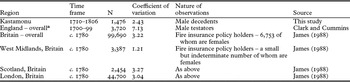
Table 4 shows how the coefficient of variation of wealth in Kastamonu, calculated by using the entire sample of 1475 observations, compared with various estimates given for England, Scotland and Britain as a whole in the eighteenth century. James’ (Reference James1988) estimates show a wide range of inequality in different parts of Britain, the coefficient of variation changing from 1.21 in West Midlands to 3.04 in London and 3.27 in Scotland. Because these estimates are based on fire insurance evaluations, however, they most likely understate the true wealth variation substantially (supposing wealth elasticity of demand for housing and other types of insurable properties to be less than one).Footnote 21 The coefficient of variation calculated from Clark and Cummins’ (Reference Clark and Cummins2009) sample is significantly higher for England. Comparing these estimates with ours, we see that wealth distribution was more uniform in Kastamonu than in London, Scotland, England and Britain as a whole. Although further studies are needed on other regions of the Ottoman Empire to generalize these results, these comparisons support the argument about the greater inequality of wealth in England than in Ottoman Anatolia in this era.
The variation of Ottoman wealth in comparative perspective

aThe coefficient of variation for England overall has been estimated from data supplied by Gregory Clark and Neil Cummins through personal communication, for which we are very grateful.
To identify factors responsible for differences in wealth inequality, we compare the results of our regression analysis for Kastamonu with those of Clark and Cummins (Reference Clark and Cummins2009) estimated for eighteenth-century England. As discussed earlier, both studies separated the mechanism determining the intergenerational transmission of wealth into two components, namely the effects of the father's wealth and the number of inheritors, making their results directly comparable. When we compare estimates of the first effect between the two studies, we see that the total elasticity of the sons’ wealth with respect to fathers’ was significantly higher in England (0.66) than in Kastamonu (0.45) after controlling for other factors (cf. Clark and Cummins Reference Clark and Cummins2009, p. 20).Footnote 22 The wealthy members of one generation in Kastamonu were thus less successful in transferring their wealth to the next generation than their counterparts in England. Kastamonu must have been a more open society in which sons’ wealth was less likely to be determined by their fathers, with the consequence that wealth was less likely to be concentrated in a small segment of the society over successive generations, generating lower inequality overall.Footnote 23
Our results also indicate that the difference in wealth inequality was not caused by the egalitarianism of the Islamic inheritance practices. We derive this implication from the second mechanism affecting the intergenerational transmission of wealth, namely the effect of the number of inheritance shares, which is consistently insignificant in Kastamonu in all models. To ensure that our results were not biased from the way we calculated inheritance shares according to the intricate rules of Islamic law, we ran the same regressions with alternative measures of the quantity of inheritors by giving everyone equal weights. Regression results based on these specifications may be more directly comparable to those of Clark and Cummins (Reference Clark and Cummins2009), since in their model the number of inheritance shares is simply the number of children with equal weights. To consider a range of possibilities, we calculated the number of inheritors as the total number of adult sons and daughters, or the number of all children including minors, or even as the number of all inheritors including relatives. Regardless of how we specified the model and included the number of co-inheritors, the effect of this variable was consistently insignificant. Moreover, the magnitude of this effect was consistently smaller in these models (with alternative indicators of inheritor numbers) for Kastamonu than in England. Whereas Clark and Cummins's (Reference Clark and Cummins2009) estimated the elasticity of the son's wealth with respect to the number of inheritors to be between 0.15 and 0.19 in England in different models, this measure ranged between 0.06 and 0.11 (not reported in Table 3) in our models for Kastamonu. We thus conclude, based on Table 3 and numerous other regression results not reported, that the number of inheritors did not have a significant effect on the wealth accumulated by the sons in Kastamonu. Put strongly, it would not have mattered significantly whether a son inherited wealth under a system that allocated all of his father's wealth to him, say under primogeniture, or if he alternatively inherited a small share as one of many inheritors under an egalitarian system.
The insignificance (and in some models, the small magnitude) of the elasticity of the son's wealth with respect to the number of inheritors is certainly a surprising result that requires further investigation. It is also a result with significant implications. Particularly relevant in this regard is the attention that Kuran (Reference Kuran2003, Reference Kuran2004, Reference Kuran2010) has recently brought to excessive fragmentation of family wealth in the pre-modern period – a consequence of the relatively egalitarian Islamic inheritance system – which he interpreted as one structural factor that hindered capital accumulation in the Middle East and contributed to the long-term economic ‘retardation’ of the region. Our results, however, fail to support the importance of the postulated relationship between inheritance system and wealth accumulation. Although wealth was more evenly distributed in Kastamonu than in England and the poor transmission of wealth across generations contributed to this result, the number of inheritors and by implication the system of inheritance did not have a significant effect on the accumulation of wealth.
Of course, this does not completely refute Kuran's thesis about the lack of capital accumulation in the Islamic Middle East in general. It only means that additional studies are needed on other parts of the region to investigate how it applies to other contexts. Our quantitative analysis of wealth accumulation in Kastamonu offers a way to test this hypothesis systematically.
5. Conclusion
Using data from the probate estate inventories of father–son pairs in eighteenth-century Kastamonu, this study explored patterns of wealth accumulation and transmission in Ottoman Anatolia. The analysis presented here represents the first systematic attempt to examine the inventories of Ottoman parents and children simultaneously, results offering important new clues for capital accumulation and long-term economic dynamics in the Ottoman Empire. Future research that uses comparable methods will show whether the results based on eighteenth-century Kastamonu can be generalized to the Ottoman Empire as a whole.
Overall, our results indicate that the wealth level of the father and the duration of time between fathers’ and sons’ deaths were positively related to the wealth level of the son. But the number of inheritors, regardless of how we obtained them, and, for the most part, honorary titles did not affect the son's wealth significantly. In addition to providing valuable insights into wealth accumulation patterns in Kastamonu, these findings allowed us to make meaningful comparisons with Britain and infer the distinct contours of economic development in the Middle East.
It is our impression that the distribution of wealth was more uniform in Kastamonu than in London, Scotland, England or Britain overall during the eighteenth century, which provides some support to arguments made in the literature about the lower inequality of wealth in the Ottoman Empire compared to other societies that grew faster in this era. We suggested that a primary factor reducing wealth inequality in Kastamonu was the lower elasticity of sons’ wealth with respect to fathers’, indicating that rich members of this society were less successful than those in England in transferring their wealth to the next generation. Our results also indicate that the inheritance system was not a major factor in wealth accumulation and inequality as evidenced by the insignificant elasticity of the son's wealth with respect to the number of inheritors.
Acknowledgements
The authors are grateful to Febe Armanios, Ali Berker, Gregory Clark, Neil Cummins, Timur Kuran, Cormac Ó Gráda, Şevket Pamuk, Charlotte Weber and the three anonymous referees of EREH for their criticisms and suggestions in the earlier stages of the preparation of this article.