Introduction
Detection, prevention, and long-term management of invasive species are increasing concerns of natural resource managers (Aukema et al. Reference Aukema, McCullough, Von Holle, Liebhold, Britton and Frankel2010). This is especially true of introduced phloem-feeding insects, which can cause tree mortality over relatively short time periods. In 2002, emerald ash borer (EAB), Agrilus planipennis Fairmaire (Coleoptera: Buprestidae), a beetle native to central Asia, was first identified in North America near Detroit, Michigan, and Windsor, Ontario, Canada (Cappaert et al. Reference Cappaert, McCullough, Poland and Siegert2005). This metallic wood-boring beetle feeds on the phloem tissue of ash trees (Fraxinus Linnaeus species (Oleaceae)) and has spread throughout northeastern North America, primarily through anthropogenic movement (Cappaert et al. Reference Cappaert, McCullough, Poland and Siegert2005; Poland and McCullough Reference Poland and McCullough2006). The extreme susceptibility of North American ash to EAB colonisation has caused considerable concern because of ecological and economic implications (MacFarlane and Meyer Reference MacFarlane and Meyer2005; Poland and McCullough Reference Poland and McCullough2006; Kovacs et al. Reference Kovacs, Haight, McCullough, Mercader, Siegert and Liebhold2010). Ash is a dominant or codominant canopy tree in many forest types in eastern North America, and horticultural ash hybrids are frequently planted in urban and suburban settings (Eyre Reference Eyre1980).
Early detection of infestations has proven to be one of the most challenging steps in implementing effective management of EAB. Low densities of EAB are difficult to identify for three primary reasons: (1) ash species are common in many eastern North American ecosystems but they have experienced landscape-level decline in recent decades (Castello et al. Reference Castello, Silverborg and Manion1985; Sinclair and Griffiths Reference Sinclair and Griffiths1994) and it is difficult to determine causes of symptoms, (2) at low population levels, infested trees do not exhibit easily discernible external symptoms of EAB colonisation until the tree has been infested for multiple years (Cappaert et al. Reference Cappaert, McCullough, Poland and Siegert2005), and (3) adult feeding and mating occur in the tree canopy (Lelito et al. Reference Lelito, Fraser, Mastro, Tumlinson, Borocsky and Baker2007), making it difficult to detect direct signs of an infestation.
Research continues for improving efficacy of traps for detecting infestations, e.g., trap position, trap type, trap colour, lure (Crook and Mastro Reference Crook and Mastro2009; Francese et al. Reference Francese, Fraser, Rietz, Crook, Lance and Mastro2010, Reference Francese, Fraser, Lance and Mastro2011; Marshall et al. Reference Marshall, Storer, Fraser and Mastro2010; Ryall et al. Reference Ryall, Silk, Mayo, Crook, Khrimian, Cosse, Sweeney and Scarr2012). In the United States of America, the protocol for the national EAB detection program required cooperating states to deploy purple prism traps (PPTs) constructed of purple corrugated plastic, covered in transparent insect trapping glue, and baited with lures comprising manuka and/or phoebe oil (Crook and Mastro Reference Crook and Mastro2009). These traps are suspended in the canopy of ash trees (United States Department of Agriculture, Animal Plant Health Inspection Service 2011).
Girdled ash trees have also proven effective as a detection tool (Rauscher Reference Rauscher2006; Hunt Reference Hunt2007; McCullough et al. Reference McCullough, Poland, Anulewicz and Cappaert2009a, Reference McCullough, Poland and Cappaert2009b). Girdling or severing the phloem completely around the tree circumference cuts off the flow of photosynthate to the roots, thereby stressing trees and making them attractive to dispersing EAB. Use of girdled trap trees enhances detection of infestations, provides information on within-tree densities upon debarking, and the trap trees serve as population sinks (McCullough et al. Reference McCullough, Siegert and Bedford2009c). Their principal drawbacks are the time and expense involved with tree destruction.
Slow ash mortality (SLAM) procedures aim to extend the timeline of ash mortality by limiting EAB population growth in outlier populations (Poland and McCullough Reference Poland and McCullough2010). Direct and indirect approaches to managing EAB include spatial and temporal quarantines on ash movement, EAB detection, population reduction, and classical biological control with parasitoid releases. The goals of SLAM are to provide time for land managers and municipal officials to develop and implement management protocols and educate private landowners (Poland and McCullough Reference Poland and McCullough2010).
With more than 900 million ash trees (United States Department of Agriculture, Forest Service 2012), New York State has much to lose. Adult EAB were first discovered in flight around infested trees near Randolph, New York on 14 June 2009 (Whitmore and Fierke Reference Whitmore and Fierke2010). This infestation was at least 50 km from other known infested sites, suggesting EAB was introduced to this site via inadvertent human transport. More than 200 trees were subsequently removed and destroyed by the New York Department of Environmental Conservation over the following six weeks. Thirty-nine of these trees were confirmed EAB-infested (New York Department of Environmental Conservation 2011) and their location provided an initial infestation centre from which to base our research.
McCullough et al. (Reference McCullough, Siegert and Bedford2009c) emphasised the necessity of applying and evaluating SLAM procedures at different infestations with varying conditions (e.g., tree species, habitats, etc.) and pointed out there is considerable knowledge to be gained from additional management studies. Here we present a case study in which we implemented and modified previously developed methods for detecting and delimiting EAB as well as SLAM strategies for reducing local populations at the site of the first EAB infestation detected in New York State. Our specific research objectives were to (1) delimit the infestation using girdled trap trees and implement advanced detection by deploying PPTs in trap trees and checking them weekly, (2) evaluate the efficacy of clusters of girdled trap trees for concentrating EAB attack on fewer trees, and (3) develop other management techniques for reducing populations.
Methods
Study area
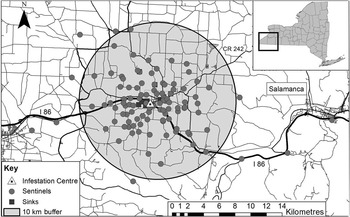
Delimitation and management of EAB occurred in and adjacent to the town of Randolph, Cattaraugus County, New York, United States of America (42°09′N, 78°58′W; Fig. 1). The town covers an area of ∼94 km2 and the surrounding landscape is a heterogeneous mix of farmland, wetlands, and forested area, characterised by rolling hills with large tracts of abandoned farmland recolonised by 20–60-year-old white (Fraxinus americana Linnaeus; Oleaceae) and green ash (Fraxinus pennsylvanica Marshall). The forested area is defined by the New York Natural Heritage Program as rich mesophytic forest in the uplands with primary components of sugar maple (Acer saccharum Marshall; Sapindaceae), red maple (Acer rubrum Linnaeus), red oak (Quercus rubra Linnaeus; Fagaceae) and white ash; and silver maple-ash swamp in the lowlands with primary components of silver maple (Acer saccharinum Linnaeus), green ash, black ash (Fraxinus nigra Marshall), and red maple (Edinger et al. Reference Edinger, Evans, Gebauer, Howard, Hunt and Olivero2002).
Delimitation and management of an emerald ash borer infestation in Randolph, New York, United States of America. The large shaded circle indicates a 10 km radius from the presumed centre of the infestation. The open triangle represents the purported centre of the infestation. Grey circles (n = 106) represent sentinels (girdled trap trees) deployed for delimitation. Black squares (n = 18) represent population sinks (clusters of girdled trap trees). Note there are eight black squares, which underlie sentinel trees.

Delimitation
Seventy ash trees, either green or white ash, primarily within a 10 km radius of the initial infestation, were identified for use as girdled trap trees (sentinels) to delimit the infestation (Fig. 1, Table 1). Sentinels were dispersed on the landscape ∼1–2 km apart and were mostly open grown trees along roadways, fencerows, or forest edges. Trees with exposed canopies were preferentially selected because of their attractiveness to gravid females (McCullough et al. Reference McCullough, Poland, Anulewicz and Cappaert2009a). In May 2010, just after leaf flush, a handsaw and chisel were used to remove a 20–30 cm strip of outer bark and phloem tissue circumventing each tree ∼1.5 m above the base.
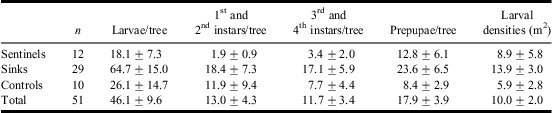
Descriptive tree statistics (mean ± SE) for girdled trap trees deployed in 2010 for delimitation (sentinels) and management (sinks) as well as ungirdled control trees in an outlier emerald ash borer infestation near Randolph, New York, United States of America.

Notes: *Three control trees were taken adjacent to nine sinks in order to evaluate efficacy of sinks, see methods.
DBH, diameter at breast height.
Unbaited PPTs were hung from a branch next to the bole of each girdled sentinel tree at a height of 3–5 m from the ground. Traps were not baited with the standard manuka oil lures as volatiles from the girdled trees acted as the lure for these traps. Traps were checked weekly from 17 May to 3 September 2010 to facilitate rapid management response and an adaptive approach to delimitation. In response to detecting EAB early in the flight season (10–28 June) on the original PPTs/sentinel trees, we deployed 36 additional sentinel trees beyond the core of the infestation for further delimitation. In addition, several trees were girdled to create additional population sinks (see definition below) adjacent to sentinel trees found positive for EAB during peak flight season.
Management
Five clusters of 3–8 trap trees (sinks) were girdled in late May (Fig. 1). These original sinks were deployed 0.2–1.5 km from the centre of infestation and were adjacent to known infested trees, which had been identified and destroyed in 2009. Numbers of trees per sink varied with availability of nearby ash, ability to fell trap trees for disposal, and landowner permission. Five sinks were deployed in early June based on finding and removing additional infested trees south as well as east of the initial infestation. Eight additional sinks were also deployed as adult EAB were caught on PPTs in sentinel trees (10 June to 9 July), for a total of 18 sinks. The second round of sinks deployed were 0.5–1.7 km and the last sinks were 0.38–4.2 km from the centre of the infestation, respectively.
During the summer of 2010, additional trees with heavy woodpecker damage were discovered and confirmed as being heavily infested by EAB. Because they represented concentrated sources of EAB, a thorough search of the core infested area for trees with heavy woodpecking was conducted and additional management implemented. A total of 74 heavily infested trees were identified and as time and availability of personnel permitted, 69 trees were felled, bucked into 1 m sections, and the bark removed using a bark spud to expose larvae to the elements and predation.
Larval sampling
Sentinel and sink trees were felled between January and March 2011 (Table 1). Three of the girdled trap trees were chosen randomly from each of the 18 sinks for larval sampling. Three ungirdled trees located within about 20 m of each of the nine sinks closest to the purported centre of infestation, were also felled to serve as controls. Species, height, diameter at breast height (dbh), tree age, presence/absence of epicormic branching, and evidence of woodpecker activity were recorded for all trees. Bolts, 2 m in length, were cut from the tree base to a top diameter of ∼6 cm. For trees with multiple stems, the larger-diameter stem was selected. Branches off the main bole >6 cm diameter were peeled on the first 20 trees felled and those < 6 cm diameter visually inspected; however, no evidence of infestation was found on any of these branches. Bolts were stored in an unheated building at ambient temperatures. Sampling was completed by 12 April 2010. If a tree was identified as infested through sampling, remaining tree material at the site of felling was chipped to destroy any remaining beetles.
Bolt height from tree base was noted along with bolt diameter at the midpoint. Larval infestation was assessed by complete peeling (or debarking) of all samples using drawknives: the outer bark and phloem were removed using successive passes of a drawknife, exposing larval feeding galleries. Larval stage was categorised as early instar (1st/2nd instar), late instar (3rd/4th instar), or prepupa (j-shaped larvae in pupal chambers). Larval densities were standardised by bolt surface area. Presence of EAB exit holes, old larval feeding galleries (i.e., prior to 2010), and woodpecker damage indicative of predation on EAB larvae were also noted. Peeled bolts and shavings were allowed to desiccate under ambient outdoor conditions.
Data analyses
Linear mixed models were used to assess differences in larval densities and tree characteristics between treatment and control trees as well as proportions of larvae, which were early instars, late instars, and prepupae within sampled trees. Proportion data were square-root transformed when conditions of normality were not met and to homogenise variances. Cluster site was the sampling unit and it was treated as a random effect. An a priori α-level of 0.05 was used for all tests of statistical significance. Note two bolts from one control tree were inadvertently chipped and so this tree was not used in data analyses. Analyses were completed using the nlme package within R (ver. 2.15.0; R Development Core Team 2009). Standard errors are reported with means.
Inverse distance weighting interpolation (ArcGIS 9, Environmental Systems Research Institute, Redlands, California, United States of America) was used to create isograms based on numbers of larvae within infested trees. Categories were derived using Jenks natural breaks within the dataset, except that a category was added at zero and all values were rounded to the nearest factor of 5.
Results
A total of 171 ash trees (91 sentinel, 54 sink, and 26 control) were felled, sectioned, and completely debarked (Table 1). Of these, 134 were white ash, 30 green ash, and seven were identified only as Fraxinus sp. A total of 51 trees were infested (12 sentinel, 29 sink, and 10 control) and 2353 EAB larvae or prepupae collected from bolt dissections (Table 2). Fifteen sentinel trees at the furthest extent from the presumed infestation core were not assessed as there were multiple negative sentinels between them and the core.
Descriptive statistics (mean ± SE) for emerald ash borer larvae found in positive infested girdled trap trees deployed in 2010 for delimitation (sentinels) and management (sinks) as well as 10 infested ungirdled control trees in an emerald ash borer infestation near Randolph, New York, United States of America.
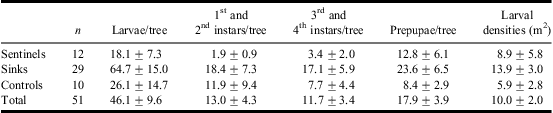
Proportion of early instars, late instars, and prepupae did not vary significantly among treatments (F 1,8 = 2.48; P = 0.10). In total, there were 609 1st/2nd instars, 554 3rd/4th instars, and 842 prepupae within infested trees. Sixty-one trees had epicormic shoots (Table 1) and 17 trees (2 sentinel, 14 sink, and 1 control) had woodpecker damage. Of the 51 positive trees, only two sink trees, located within the originally identified infested area, had exit holes indicating they were infested prior to girdling. Number of larvae found within trees (t 49 = 0.410, P = 0.68) or larval density (t 49 = 0.405, P = 0.69) did not differ between ash species (green vs white ash).
Delimitation
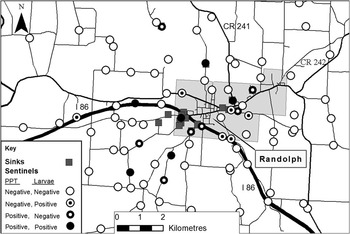
Our results indicate the EAB-infested area near Randolph, New York, United States of America, was ∼48 km2 (6.4 km north to south and 7.5 km east to west; Fig. 2) based on catches of EAB on PPTs placed in sentinel trees as well as complete debarking of sentinel trees to find larvae. A total of 15 EAB adults were caught on unbaited PPTs in 13 sentinel trees (out of 106) over the summer. The first adult was identified on a PPT on 7 June 2010, which corresponded to 539 growing degree days at the nearest (22.5 km) weather station in Jamestown, New York (base 10°C; Northeast Regional Climate Center 2010). Five of the 13 sentinel trees positive for an EAB on the PPT did not harbour larvae upon debarking the tree bole and seven sentinel trees that were negative for EAB on PPTs contained EAB larvae.
Sinks, clusters of girdled trap trees, are indicated by grey squares. Circles indicate sentinels, or girdled trap trees, that were positive or negative for an adult emerald ash borer on the purple prism trap (PPT) deployed in it and were positive or negative for larvae found upon debarking the entire tree. Note sinks underlie eight sentinels positive for an emerald ash borer (EAB) on its PPT early in the flight season.

In total, 12 of the 91 debarked sentinel trees were positive for EAB larvae with a mean of 18.1 ± 7.3 (SE) larvae/tree (range 1–85) and a mean density of 8.9 ± 5.8 larvae/m2 in EAB-positive trees. Two of the seven sentinel trees that had larvae, but which were negative for EAB on the PPTs, had the highest total larval counts (85 and 44 larvae). These trees were 2 km and 2.5 km from the purported centre of the infestation. The furthest sentinel tree positive for larvae (two larvae) was 3.6 km southwest of the purported centre of the infestation. The closest negative sentinel tree, for an adult on the PPT as well as larvae under the bark, was 1.2 km from the infestation center. Two of the 36 sentinel trees that were added in response to early season catches were positive for EAB larvae.
Management
Of the 18 sinks, 11 were positive for EAB with 29 (of 33) positive trees and a mean of 64.7 ± 15.0 larvae/tree (range 1–251 larvae/tree). All 15 of the girdled trap trees sampled from the first five sinks deployed were positive for EAB larvae. All five of the sinks deployed near the infested trees discovered (and destroyed) in May 2010 were also positive for EAB larvae. Only one of the eight sinks deployed in response to EAB captured on PPTs in sentinel trees was positive. This sink was within 0.38 km of the presumed core of the infestation while the other seven negative sinks were >0.6 km away from the presumed core.
Girdled sink trees (n = 27) from nine positive clusters near the core of the infestation had a mean of 42.4 ± 11.6 larvae/tree while control trees (n = 26) sampled nearby each sink had a mean of 10.1 ± 6.0 larvae/tree. Mean larval densities differed significantly between sink (9.4 ± 2.1 larvae/m2) and control trees (2.1 ± 1.1) (F 1,8 = 24.0; P < 0.0001). Sink and control trees did not differ significantly in dbh; F 1,8 = 2.87, P = 0.09) or tree height (F 1,8 = 1.08, P = 0.30).
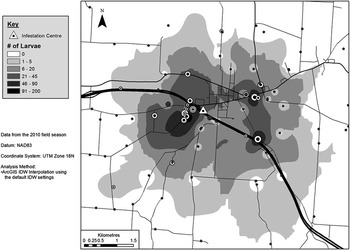
The spatial distribution of infested trees based on within-tree larval densities indicates variability at the landscape level (Fig. 3). Generally, the most heavily infested trees were closer to the purported centre of the infestation and trees furthest away harboured fewer larvae. A notable exception was a sentinel tree 1.9 km southeast of centre, which had 85 larvae/pupae and was the highest within-tree density (71.8 EAB/m2) of all trees sampled. Larvae in this tree were especially concentrated below the girdle (n = 72).
Isogram depicting spatial distribution of emerald ash borer (EAB)-infested trees based on numbers of larvae per tree. Black dots indicate trap trees without larvae present and open circles indicates infested trees with larger circles indicating more larvae within the tree. Note several infested trees overlie one another within a sink.

Discussion
Delimitation efforts employed in this outlier infestation were considered effective. Poland and McCullough (Reference Poland and McCullough2010) suggest that hanging PPTs in girdled trap trees may be more effective at detecting EAB at low population densities than using baited PPTs. Our results support this premise but must be interpreted with caution since we did not directly compare PPTs in girdled trees with baited PPTs in ungirdled trees. However, PPTs hung in 12 (of 106) girdled sentinel trees successfully caught EAB, whereas 225 PPTs baited with Manuka oil and deployed in ungirdled ash trees within 100–500 m of our sentinel trees in the same year (2010) as part of an operational survey by a United States Department of Agriculture contractor were all negative for EAB (J.C., personal observation).
There were no sentinel trees with EAB exit holes or galleries made prior to 2010 (no galleries were darkened with callus overgrowth), indicating these trees were not infested prior to girdling and that the captured EAB had dispersed from other infested trees. Complete debarking of sentinel trees associated with an EAB-positive PPT also revealed five (of 12) that did not harbour larvae suggesting PPTs in those girdled trap trees were particularly attractive (females were caught prior to oviposition). Several of these sentinels were fairly distant from the presumed centre of infestation, including one tree just over 4 km away that was not particularly large (14.6 cm dbh) located at the edge of a green ash swamp. The two female beetles caught on this trap were early fliers (these were some of the first beetles caught, 10 June) and if they emerged from trees known to be infested in 2010, they would have flown >1 km over a green ash-dominated swamp to land on the PPT.
Checking PPTs early in the flight season allowed adaptive delimitation through establishment of additional sentinels within the same year. Two of the 36 sentinels (5%) deployed to further delimit the infestation were positive for larvae. This was not as high a detection rate as the original sentinels (10 of 70, or 14%), but it is reasonable considering most of the additional sentinels were deployed further from the infestation and later in the flight season. Detecting EAB presence early in the flight season also allowed deployment of additional sinks in an effort to limit EAB population growth on the outer edges of the infestation. As seven out of eight were negative for EAB, however, this may not have been an efficient use of resources. The one positive sink deployed in response to an EAB on a PPT was <0.5 km from the centre of the infestation and so it was not surprising that two of the three trees assessed from this sink were positive for EAB larvae. Sinks negative for larvae were 0.6–4.2 km from the infestation centre. There were, however, several sentinel trees positive for larvae beyond two of these negative sinks. Checking PPTs weekly also reduced the probability of losing beetles from traps over the summer (i.e., minimised false negatives). In a pilot study testing whether placing dead EAB on traps would increase trap catches, we affixed six dead beetles on each of 10 traps and found that beetles were missing from three of the traps on subsequent trap checks early in the flight season.
Recent work indicates trap catches, at least of male beetles, can be increased using green sticky traps hung in the canopy and baited with (3Z)-hexenol, a green leaf host volatile, and (3Z)-dodecen-12-olide, a volatile EAB pheromone (Silk et al. Reference Silk, Ryall, Mayo, Lemay, Grant, Crook, Cosse, Fraser, Sweeney and Lyons2011; Ryall et al. Reference Ryall, Silk, Mayo, Crook, Khrimian, Cosse, Sweeney and Scarr2012). Testing this pheromone as a lure within traps deployed in sentinel trees may be a useful next step in developing an even more effective delimitation tool.
Girdled trees have been shown to be attractive to ovipositing EAB females at low population densities (McCullough et al. Reference McCullough, Poland, Anulewicz and Cappaert2009a, Reference McCullough, Poland and Cappaert2009b). Indeed, we found four times as many larvae in girdled trap trees than in ungirdled control trees. McCullough and Siegert (Reference McCullough and Siegert2007) estimated an optimal larval density for EAB to be 89/m2 with mortality from intraspecific competition occurring at densities of 100–300 larvae/m2. Less than 3% of our infested sample bolts had densities higher than 89/m2 and only 8.3% of those had densities > 50/m2. This suggests population densities were low to moderate at this site, even within the known infestation core.
Identification and targeting of heavily infested trees to destroy the brood prior to adult emergence will reduce the numbers of EAB adults available to disperse and spread from outlier sites. The 69 trees removed in this management effort had a mean dbh and height of 20.4 cm and 25.6 m, respectively. Using a conical frustum equation to estimate surface area and multiplying the result by 88.9 (the average number of EAB developing/m2, McCullough and Siegert Reference McCullough and Siegert2007), results in an estimated 65 000 + EAB eventually emerging from these trees if they were left standing. Infested trees were easily found by field technicians listening for woodpeckers preying on late instar EAB larvae or by visual inspections for woodpecker foraging followed by bark removal and inspection. In our experience, surveys for heavily infested trees are most effective in the winter. Once found, these trees can be felled, bucked, and debarked. A further safeguard would be to girdle one or more nearby trees to serve as a sink to attract adults emerging from nearby trees the following flight season. These trap trees could then be felled and destroyed the following winter.
This study provides a method for delimitation with real-time assessment of EAB presence and provides a case study of implementing SLAM procedures at an outlier infestation. Though recent simulations indicate treating trees with TREE-Age® (Arborjet, Woburn, Massachusetts, United States of America) is an effective means of population control (Mercader et al. Reference Mercader, Siegert, Liebhold and McCullough2011a, Reference Mercader, Siegert, Liebhold and McCullough2011b), that particular product was not licensed for use in New York at the time this study was initiated. Identification and disposal of heavily infested trees in the landscape is strongly encouraged and is currently being implemented in several newly identified New York infestations. Results also suggest that deployment of sinks (girdled trap trees) in areas with heavily infested trees to attract beetles emerging from surrounding trees, followed by destruction of trap trees, should slow population growth and reduce dispersal. Using these approaches will contribute to slowing ash mortality and provide landowners and adjacent municipalities time to prepare for EAB. A suggested next step is to determine the number of sinks necessary within a particular stand to reduce populations to a point where a more substantial difference can be made in the growth and spread of an outlier infestation.
Acknowledgements
The authors thank Michael Griggs (United States Department of Agriculture, Agricultural Research Service), John Welsh, Kimberly Dean, and Chris Standley (all State University of New York, College of Environmental Science and Forestry) for field work. They also thank Kaytlynn Walters (State University of New York, Fredonia) for field work and acquiring landowner permissions. Rurik Fencl (State University of New York, College of Environmental Science and Forestry) designed and developed maps. We appreciate field assistance from Robert Cole, Josh Payette, Tucker Money, Jessica Cancelliere, and other New York State Department of Environmental Conservation personnel. Additional cooperation and support was provided by the New York Department of Transportation, New York State Parks, National Grid, Randolph town officials and many cooperative landowners. They would also like to thank Deborah McCullough (University of Michigan), Jon Sweeney and two anonymous reviewers for invaluable edits and comments on this manuscript. Funding was provided by the United States Department of Agriculture Forest Service and New York State Department of Environmental Conservation provided field vehicles critical for data collection.