1. Introduction
Prior research on argument structure development – the syntactic mapping of the number of semantic elements present in an event (Bowerman & Brown, Reference Bowerman, Brown, Bowerman and Brown2008) – has examined connections between verb meanings and syntactic frames and suggested that verbs with similar meanings tend to be associated with the same argument structures (e.g., Fisher, Gleitman, & Gleitman, Reference Fisher, Gleitman and Gleitman1991). More recently, and coming from a different tradition, the neurolinguistic perspective shows growing evidence of a strong link between the processing of verbs and the neural processes that underlie body movement and perception in both adults (for a review, see Carota, Moseley, & Pülvermüller, Reference Carota, Moseley and Pülvermüller2012) and children (James & Maouene, Reference James and Maouene2009). There is also evidence of connections between verbs and body parts in the deterioration of action verb processing in early stage Parkinson (see a review in Cardona et al., Reference Cardona, Gershanik, Gelormini-Ozama, Houck, Cardona, Kargieman, Trujillo, Arévalo, Amoruso, Manes and Ibáñez2013) and aphasia (Arévalo, Baldo, & Dronkers, Reference Arévalo, Baldo and Dronkers2012). These findings link verbs to actions via a concrete core meaning related to body parts (e.g., licking is about tongue, giving is about hand, kicking is about leg). Here we build upon these relationships – we use the link between verbs and syntax, and the link between verbs and body parts, to suggest a link between syntax and body parts, using new evidence from a corpus study of infant and maternal naturalistic speech. This new link between body regions and syntax provides the infant with a developmental path which has not been previously examined, between the early and concrete perception-action system and later abstract, syntactic achievements.
We follow a three-step process to examine the link between the early use of verbs, association with body parts, and syntactic expression: (i) we analyze the naturalistic speech of young children and their mothers for the use of specific syntactic patterns; (ii) we link the verbs used in those syntactic patterns to the most-associated body parts (associations taken from children’s and adults’ judgments, collected in an independent study); and (iii) we examine what body parts are most represented in the verbs used in each of these syntactic patterns. Our results show specific and strong patterns of contingencies between these argument structure patterns and three main regions of the body, namely head, arm, and leg, as well as three subregions of the head, eye, mouth, and brain-mind.
The link between body regions and syntax provides a new, theoretically important developmental path between early concrete, experiential, and observable information and later abstract syntactic expression. This is significant, because many theoretical accounts have proposed that the abstract and relational meaning of adult verbs is too hard for children to acquire using concrete, observational cues (Gentner, Reference Gentner1978; Gleitman, Reference Gleitman1990; Gillette, Gleitman, Gleitman, & Lederer, Reference Gilette, Gleitman, Gleitman and Lederer1999; Nicol Medina, Snedecker, Trueswell, & Gleitman, Reference Nicol Medina, Snedeker, Trueswell and Gleitman2011), with the consequence that researchers have focused much effort on examining the role of syntax and other surface cues in developing further linguistic achievements (Naigles, Reference Naigles1990; Fisher et al., Reference Fisher, Gleitman and Gleitman1991; Pine & Lieven, Reference Pine and Lieven1993; Goldberg, Reference Goldberg1995; Hirsh-Pasek, Golinkoff, & Naigles, Reference Hirsh-Pasek, Golinkoff, Naigles, Hirsh-Pasek and Golinkoff1996; Akhtar & Tomasello, Reference Akhtar and Tomasello1997; Gómez & Gerken, Reference Gómez and Gerken1999; Saffran, Reference Saffran2002; Cameron-Faulkner, Lieven, & Tomasello; Reference Cameron-Faulkner, Lieven and Tomasello2003; Goldberg, Sethuraman, & Casenhiser, Reference Goldberg, Casenhiser and Sethuraman2004; Gómez & Maye, Reference Gómez and Maye2005; Bannard, Lieven, & Tomasello, Reference Bannard, Lieven and Tomasello2009).
A connection between attention to the body and early perception-action and later abstract acquisitions in language learning is supported by a smaller body of work, particularly in studies of pragmatics (Bates, Reference Bates1976; Acredolo & Goodwyn, Reference Acredolo and Goodwyn1985, Reference Acredolo and Goodwyn1988; DuBois, Reference DuBois1987; Clancy, Reference Clancy and Clark1993; Butcher & Goldin-Meadow, Reference Butcher, Goldin-Meadow and McNeill2000). One recent study found that gesture-speech productions, in which a gesture conveys one semantic element and speech another (e.g., point at jar +open), help children’s first two-word generation (open jar) (Iverson & Goldin-Meadow, Reference Iverson and Goldin-Meadow2005). Other studies have examined other connections between language learning and perception-action, such as studies of iconic gestures (Özçalışkan, Gentner, & Goldin-Meadow, Reference Özçalışkan, Levine and Goldin-Meadow2013), eye-gaze and joint attention in learning verbs (in older children, see Allen, Reference Allen2000; Allen, Reference Allen, Bowerman and Brown2007; Skarabela, Reference Skarabela2007), and studies of verb imageability and verb individuation (e.g., Golinkoff & Hirsh-Pasek, Reference Golinkoff and Hirsh-Pasek2008).
The position we take here is that argument structure develops not just from the linguistic system, but from complex interactions and constraints between all the systems involved in communicative acts, including the attention-perception-action systems. The idea of explaining development through the interaction of multiple constraints has a long history, both in different approaches to cognitive psychology and language development (Slobin, Reference Slobin, Feguson and Slobin1973; Bates & MacWhinney, Reference Bates, MacWhinney, Ochs and Schieffelin1979; for a review, see Laakso, Reference Laakso2011), and now in non-linear approaches of developmental dynamic systems, which posit that cognition is inextricably linked to perception, action, and attention (Thelen & Smith, Reference Thelen and Smith1994). However, the idea that concrete observational and proprioceptive cues such as bodily effectors and their sensors may be helpful to young children in learning verb meaning and syntax has not yet been examined. As such, this study constitutes a first step in considering the role of body parts as a possible leverage for young children in learning argument structure.
We examine whether relevant correlations between body parts, verbs, and argument structure patterns can be found in a corpus analysis of the spontaneous speech of toddlers and their caregivers in real situations. This allows us to inspect a large number of verbs, as compared with the typically smaller samples of verbs used in experimental studies with young children. The type of analysis in the current study goes further than classical studies investigating the relationship between the first words and their semantic associations, as the semantic features analyzed here are not semantic roles, nor semantic schemas or semantic cases (which are subject to interpretation), but rather associated body regions, which are independent from grammatical knowledge.
1.1. verb meaning and bodily effectors
Recently, embodiment, the notion that the body and its morphology are partners in higher cognitive processes, has been examined in the study of verb processing in adults and children. The findings support embodied cognition, the idea that lexical-semantic knowledge is grounded in the cortical brain areas involved with bodily movement and body perception (Thelen & Smith, Reference Thelen and Smith1994). The link between verb semantic processing and activation of corresponding body regions in the premotor and motor cortex of the adult brain is now well documented in imaging studies (e.g., processing a verb, for example, kick, has been shown to activate the cortical premotor and motor areas relevant to moving the appropriate body part, legs or feet. For a neural map of the results of a dozen of studies in adults, see p. 1502 in Carota, et al., Reference Carota, Moseley and Pülvermüller2012; but see Bedny & Caramazza, Reference Bedny and Caramazza2011; Meteyard & Vigliocco, Reference Meteyard, Vigliocco, Calvo and Gomila2008, for other perspectives). In children, an fMRI study with four- to six-year-olds has replicated these findings for blocks of hand-related and leg-related verbs pitted against blocks of neutral adjectives (James & Maouene, Reference James and Maouene2009). Further, in a study combining behavioral and neuroimaging measures with five- to six-year-olds, who were shown novel actions and objects accompanied by sentences with made-up verbs (e.g., Look, I ’m yocking it, wow cool, I ’m yocking it. What am I doing?), found that only active participation but not observation created sensorimotor systems in the brains of these children over one visit to the lab (James & Swain, Reference James and Swain2011).
The idea that there is a strong relation between early-learned verbs and body parts in younger children falls under the larger theory that sensorimotor experiences matter for cognitive development (Piaget, 1936/1952). Although verb learning has not been directly studied in terms of embodied cognition in two-year-olds, we find several experimental results beginning to examine embodiment as a possible avenue into language development. For example, previous research shows that with the onset of independent walking, infants increase interaction with their mothers (Gustafson, Reference Gustafson1984; Clearfield, Reference Clearfield2011). Further, a change in infants’ locomotor status – e.g., walking – has consequences for object sharing, and researchers found an increase in infants’ meaningful ‘bids’ such as ‘infants extending an object toward their mothers to show or offer it’. This in turn has consequences for the type of answers infants obtain from their mothers (Karasik, Tamis-Lemonda, & Adolph, Reference Karasik, Tamis-Lemonda and Adolph2013, p. 391). It appears that the benefits connected to walking – including the freeing up of the hands and the ability to find the mother and walk in her direction (Karasik et al., Reference Karasik, Tamis-Lemonda and Adolph2013) – launches a cascading effect that shapes the language that infants hear and participate in, and ultimately what infants learn.
A result from a prior study that makes predictions about the importance of bodily experience for verb development in children comes from an associative task with four- to six-year-old children (Nesheim, Sepsey, Maouene, & Maouene, Reference Nesheim, Sepsey, Maouene and Maouene2012) and adults (Maouene et al., Reference Maouene, Hidaka and Smith2008). These participants were asked to name the body part used with each of 101 early-learned verbs. Preliminary data from the children indicates a strong positive correlation (r = .85, p < .001) with the verb–body part pairings from the completed adult data. Additionally, systematic and coherent associations were revealed between the verbs and five main regions of the body for both adult and child speakers of English, namely eye, mouth, ear, hand, and leg. The same five main body regions were found in the judgments for 124 verbs by five-year-old speakers of Telegu, an Indian language, (Maganti & Maouene, Reference Maganti and Maouene2014) and also found by an independent lab examining adult speakers’ judgments on the body part associated with 100 verbs in Telegu and in two other Indian languages, Hindi and Dakkhini-Urdu (50% of the verbs were translational equivalents of the English verbs) (Duggirala et al., Reference Duggirala, Viswanatha, Bapi, Jigar, Alldi, Jala and Richa2011). Finally, a similar study using a different method of relative embodiment ratings, in which adult participants were asked to judge the degree to which the meaning of 687 verbs (not limited to early-learned verbs) involved the human body on a scale from 1 (low) to 7 (high), found that bodily experience was judged to be more important to the meanings of some verbs (e.g., dance, breathe) than to others (e.g., evaporate, expect) (Sidhu, Kwan, Pexman, & Siakaluk, Reference Sidhu, Kwan, Pexman and Siakaluk2014). They then had these verbs used in different tasks and found a facilitatory effect of relative embodiment in lexical decision, action picture naming, and syntactic classification.
Although these results are with older child and adult participants, support that toddlers might also have similar associations between body parts and verbs comes from results showing that the adult verb–body part pairings in English (Maouene et al., Reference Maouene, Hidaka and Smith2008) correlate with the age at which these verbs were acquired by English-learning children (r = .69), as shown by an analysis using a 15 unit age-of-acquisition vector (month 16 through month 30) with age-of-acquisition data taken from the MacArthur-Bates Communicative Development Inventory (this data provides the proportion of children in the normative sample with the verb in their productive vocabulary at each of these monthly intervals; Fenson et al., Reference Fenson, Dale, Reznick, Bates, Thal and Pethick1994). Specifically, examining the data from adult speakers of English more closely, verbs with similar body part associations have similar acquisition patterns: verbs associated with leg and mouth are acquired first by 21 months of age; then, over the next six months, verbs associated with hand are learned; then, many more verbs related to multiple body parts are acquired (fall, bump, cover, etc.), as well as verbs associated with head and its internal parts, such as mind and brain (think, pretend, wish) and verbs linked to emotions and heart (e.g., like, love). The data also suggests that the strength in association with a particular body region, that is, how localizable the action is to a specific body region, plays a role in how verbs are learned. That is, verbs strongly associated with one body region are learned earlier; for example, look (100% eye) is learned earlier than sleep (52% eye). These results and those discussed in the previous paragraph point to the evidence that many early-learned verbs have a systematic, consistent, and meaningful link to body parts; similar judgments are shared by both mature and immature speakers of the language; and adult usage continues to reflect basic body relations important to the young infant.
1.2. relationship between verbs and argument structure
Prior work has focused on a set of verbs, called light verbs, which some suggest are the core meanings of other verbs and help children break into argument structure, a scaffold sometimes referred to as semantic bootstrapping because the structure of these verbs exemplifies the general semantic structure of the syntactic frame (Pinker, Reference Pinker1989; for a review, see Theakston, Lieven, Pine, & Rowland, Reference Theakston, Lieven, Pine and Rowland2004). Other work has also noticed the strong relation between the meaning of verbs and the argument structures in which they are used (e.g., Pinker, Reference Pinker1989; Naigles, Reference Naigles1990; Fisher et al., Reference Fisher, Gleitman and Gleitman1991; Lederer, Gleitman, & Gleitman, Reference Lederer, Gleitman, Gleitman, Tomasello and Merriam1995; Goldberg, Reference Goldberg and Tomasello1998; Gillette et al., Reference Gilette, Gleitman, Gleitman and Lederer1999; Gleitman, Cassidy, Nappa, Papafragou, & Trueswell, Reference Gleitman, Cassidy, Nappa, Papafragou and Trueswell2005), and numerous studies have shown that children use syntactic information in learning new verb meanings in a process called syntactic bootstrapping (for a review, see Gleitman et al., Reference Gleitman, Cassidy, Nappa, Papafragou and Trueswell2005). For example, these theorists suggest that children can use the number of arguments a verb is heard used with and how these arguments are arranged in the utterance to make a good guess about the verb’s meaning. For example, “A novel verb used in a frame like X_______Y prep. Z (e.g., John gorped the ball onto the table) is likely to pick out an action of causing something to go somewhere in a certain manner (e.g., throw); in contrast, a novel verb with a complementizer (e.g., John gorped that the ball was on the table) is likely to specify an event of cognition or perception (e.g., ‘think’, ‘see’)” (in Bowerman & Brown, Reference Bowerman, Brown, Bowerman and Brown2008, referring to Fisher et al., Reference Fisher, Gleitman and Gleitman1991).
Additionally, some argument structure patterns are argued to be connected to particular verb meanings, because the meaning of highly frequent verbs ‘bears striking resemblance’ to the meaning of the syntactic patterns in which they occur (Goldberg, Casenhiser, & Sethuraman, Reference Goldberg, Casenhiser and Sethuraman2004). For example, put occurs most frequently in the [Verb Object Locative] pattern because the constructional meaning of [V NP Loc] is ‘X moves Y’ and corresponds to a basic pattern of experience, namely put means someone causing something to move; similarly give occurs most frequently in the [Verb NP NP] pattern because the constructional meaning of [V NP NP] is ‘X cause Y to receive Z’ and a basic pattern of experience, namely give means someone causing someone to receive something (p. 299). Together, these earlier results suggest not only that argument structure and verb meaning are related, but also that children can use each of these cues in learning the other.
1.3. relevance of body parts for early syntactic development
Why do we think body parts would provide children with a useful scaffold for learning verbs and syntax? Body parts have one fundamental characteristic relevant for our claim here, namely that they provide a concrete link between the world of events and the world of linguistic symbols, the two types of contexts that matter for language acquisition.
In the world of events, body parts continually connect infants and toddlers through their senses to the outside world. Body parts are involved in transporting bodies, in playing and creating, in handling tools, in ingesting and drinking, in protecting or attacking, in sensing and feeling, and in connecting socially by communicating desires, needs, and preferences. Additionally, the body and its parts are an always-present link across contextual changes (Ulmann, Harari, & Dorfman, Reference Ulmann, Harari and Dorfman2012). Children’s hands have been linked to causality (Leslie, Reference Leslie1984) and body parts differentiate affordances (e.g., hands afford prehension, manipulation, etc.; legs afford kicking objects, movement on different surfaces, etc.). Even neonates use body parts and their sensors in information processing and exploration of the world. Piaget and others before him noticed that infants “mouth, eye and hand objects”, such that the sensorimotor outputs of these activities create referential, body-linked categorical knowledge that culture and language will later label and reorganize (Choi, Reference Choi1998). The bodies of others share similarities in terms of morphology (unless some accident happened), helping to establish cognitive and social comparisons, a fundamental aspect of cognition (Gentner, Reference Gentner1983). These are all fundamentals of communication about events.
In the symbolic world, body parts are among the earliest words understood (Tincoff & Jusczyk, Reference Tinkoff and Jusczyk2011; Bergelson & Swingley, Reference Bergelson and Swingley2012). The number of terms referring to body parts is quite restricted, particularly for young children, making them resemble a closed class of words, possibly facilitating their acquisition. Body parts are referred to by nouns (as well as by verbs, e.g., back it up, and prepositions, e.g., at the head of the line, usages that are very systematic in some languages) and are explicit or implicit semantic components of verb meanings (Bowerman, Reference Bowerman, Gershkoff-Stowe and Rakison2005). As nouns, body parts can play many syntactic roles, not only as subjects and direct or indirect objects, but also as obliques such as instrumental and locative (she paints with her toes, she counts on her fingers). Body parts, including the whole body, are implicit in many of the categories that are of interest to young children (e.g., proper nouns (Tom, Sheila), kinship terms (mom, dad), animal names, locations, etc.), and recurring links in agency and dynamics. They can help with metaphors and extended verb use in English (e.g., When Taylor spilled his milk on the table, he vacuumed it up with his mouth; example from Seston, Michnick Golinkoff, Ma, & Hirsh-Pasek, Reference Seston, Michnick Golinkoff, Ma and Hirsh-Pasek2009), as well as other languages (e.g., orientation in Tzotzil children: de Leon, Reference de León1994; counting in Oksapmin: Saxe, Reference Saxe1981). They can potentially facilitate certain situations of selection restriction, as in the snake throws the ball (for an application to texts describing scenes, see Bron, Corfu-Bratschi, & Maouene, Reference Bron, Corfu-Bratschi and Maouene1989; for a model and its implementation, see Maouene, Reference Maouene1992). Body parts have a hierarchical structure and include parts and whole (see, for example, the importance of part–whole structure in ontologies, and in meaning differentiation for verbs such as run, walk, hop, etc.; Malt, Gennari, Imai, Ameel, Tsuda, & Majid, Reference Malt, Gennari, Imai, Ameel, Tsuda and Majid2008). Body parts constitute an immediate and portable device constantly available to children, reducing the Gavagai problem, as they participate in verb meaning categorization through their affordances with objects (Piaget, 1936/1952), and their many degrees of freedom are ideal to get co-opted for coding more abstract and metaphorical meanings, for example in early gestures (Angrave & Glenberg, Reference Angrave and Glenberg2007), in sign language (Iverson & Goldin-Meadow, Reference Iverson and Goldin-Meadow2005), and gestures with spoken language (e.g., Novack, Congdon, Hemani-Lopez, & Goldin-Meadow, Reference Novack, Congdon, Hemani-Lopez and Goldin-Meadow2014).
The versatility of body parts speaks for their adaptive function, their ubiquitous presence in numerous contexts of interest to infants and young children, and, most relevantly for the current study, the seriousness of its candidacy as providing a potential framework for early grammatical development. The idea that body parts may be important for early syntactic understanding is suggested by several studies. First, body parts may provide a first proxy for referentiality, a possible precursor of the adult concept of reflexivity in verbs and in pronouns (e.g., wash yourself!). Additionally, body parts may provide a possible early scaffold for the adult concept of ‘subject’ by participating in the development of the sense of self, of identity, of agency, the ‘I’ of ‘am eating’ (Kemmerer, Reference Kemmerer2014), and for the adult concept of ‘object’, as the mouth, eyes, and hands have been linked to attention to objects and early word development (Yu & Smith, Reference Yu and Smith2013). Indeed, the shifting of attention from the face to the hand of the caregiver is considered a precursor of joint attention (Amano, Kezuka, & Yamamoto, Reference Amano, Kezuka and Yamamoto2004), which has been shown important for later syntactic development (Allen, Reference Allen2000; Skarabela, Reference Skarabela2007). It would therefore seem to be, at the very least plausible, that early on, the regular way regions of the body (as well as other integrative bodily experiences) get used in activities would contribute to the scaffolding of early understanding and use of relational meaning: by this proposal, repeated leg events and their associated bodily experience would set neural pathways for the oblique locative relation; repeated hand events between objects and people would set up neural pathways for ditransitive relations. We return to these ideas in the ‘Discussion’.
1.4. current study
The key question for the current work is whether argument structure patterns and the verbs predominantly used in those patterns are contingent to specific regions of the body. Contingency theory proposes that, for learning to take place, a stimulus must provide the child with information about the likelihood that certain events will occur (Rescorla & Solomon, Reference Rescorla and Solomon1967). Contingency learning is an early learning mechanism in infants, and looking at whether the relationship between body parts, verbs, and syntax form robust patterns in naturalistic speech is a meaningful first step. To that effect, we examined a corpus of transcripts of speech of two-year-olds and their mothers in CHILDES (MacWhinney, Reference MacWhinney2000) for evidence of contingencies among these relations in the speech of both children and their parents. Specifically, we coded children’s and mothers’ naturalistic speech for the use of six target syntactic patterns, examined the body parts associated with verbs used in those patterns, and looked at the body part associations occurring in each of the syntactic patterns.
Because the connections between body parts, verbs, and syntax might change with age, we examined the Bates Corpus in CHILDES, which includes speech from twenty-seven children and their mothers at two moments of early development of the verbal system, when the children are 20 and 28 months of age. To increase the data available for analysis for the youngest age, we added data from the speech of 20-month-olds from six smaller CHILDES corpora.
For the selection of the body regions, we used arm, head, and leg, the three most frequently associated regions in adults’ associations (Maouene et al., Reference Maouene, Hidaka and Smith2008). These regions form the largest visual discontinuities of our bodies, a criterion that has been found relevant in many languages, as languages seem to rely on the visual discontinuities of joints to segment the body into parts (Majid, Reference Majid, Malt and Wolff2010). These three regions are easily distinguishable by the perception-action system (but see Majid, Reference Majid, Malt and Wolff2010, for a review of the cross-cultural relativity of these discontinuities). We also looked at the eye, mouth, and brain-mind subregions of the head, as many verbs clustered around these more specific body part terms, to make sure that patterns of contingencies in our results were not due to our system of categorization.
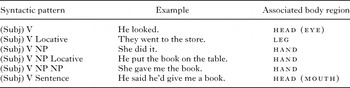
For the selection of the argument structure patterns, we focused on six ways in which children and caregivers talk about activities and states, objects, and space (locations). We looked at these elements of event structure as they appeared in six English argument structure patterns: [Verb], [Verb Locative], [Verb Noun Phrase], [Verb Noun Phrase Noun Phrase], [Verb Noun Phrase Locative], and [Verb Sentence] (henceforth, Verb will be abbreviated as V; Noun Phrase as NP; Locative as Loc; and Sentence as S). The first three structures were selected because of their high frequency in caregivers’ and young children’s speech and their frequent examination in prior studies of early language development (Naigles Reference Naigles1990; Ninio, Reference Ninio1999a, Reference Ninio1999b; Goldberg et al., Reference Goldberg, Casenhiser and Sethuraman2004; Bowerman & Brown, Reference Bowerman, Brown, Bowerman and Brown2008). These three patterns have a simpler structure in terms of number of arguments (zero or one argument): bare intransitive [V], an action with no specified object, intransitive with a location [V Loc], an action with a specified location, and simple transitive [V NP], an action with a specified object (see Table 1 for examples). Additionally, we also examined three more complex structures (with two or more arguments), which occur more rarely in children’s and caregivers’ speech: a transitive action on an object with location specified, [V NP Loc], transitive action with two specified objects [V NP NP], and complex sentences indicating an action followed by another action [V S]. Having syntactic patterns that occur with different frequencies in children’s and caregivers’ speech allows comparison between early-learned versus later-learned syntactic patterns in terms of their body region contingencies.
Syntactic patterns investigated and associated body regions

The current study provides a first descriptive examination of the link between body regions and argument structure – a prerequisite to understanding the extent and nature of the possible relations between verb meaning, parental input, the body, and the structure of the grammatical frames in early language development. We ask three main questions: (i) Are there specific patterns of contingencies between argument structures and verb–body region associations? (ii) Do the patterns of contingencies between argument structures and specific body regions vary between the four groups of speakers (older versus younger children and mothers)? (iii) Are these patterns of contingencies driven by a few highly frequent verb(s) occurring in these argument structures, rather than being driven by associations with bodily effectors?
2. Corpus analyses
2.1. method
2.1.1. Corpora
In order to test the developing relationship between verbs, body parts, and argument structure in children’s speech and in maternal speech to children, we examined the speech of four groups of native American English speakers. We examined transcripts of the naturalistic speech of twenty-seven 20-month-olds and twenty-even 28-month-old children and their mothers from the Bates corpus (Bates, Bretherton, & Snyder, Reference Bates, Bretherton and Snyder1988) in the Child Language Data Exchange System or CHILDES (MacWhinney, Reference MacWhinney2000). The transcripts consist of mothers’ free play interactions with their children at 20 months of age and interactions in three contexts (free play, reading the book Miffy in the Snow, snack time) with their children at 28 months of age. The speech produced by the 20-month-old children in the Bates Corpus was considerably less frequent as compared with the older age groups.
In order to supplement the speech of the youngest age group for our statistical analyses, we sampled speech from a further six corpora, limiting our sampling to the forty children in those corpora who were 20 months of age: the child Eve in the Brown corpus (Brown, Reference Brown1973); the child Haas from the Cornell corpus (Hayes, Reference Hayes2000); thirty-five children from the New England corpus (Ninio, Snow, Pan, & Rollins, Reference Ninio, Snow, Pan and Rollins1994); one child from the Post corpus (Demetras, Post, & Snow, Reference Demetras, Post and Snow1986; Post, Reference Post1992); the child Naima from the Providence corpus (Demuth, Culbertson, & Alter, Reference Demuth, Culbertson and Alter2006); and the child Naomi from the Sachs corpus (Sachs, Reference Sachs and Nelson1983). We chose these children based on their age rather than their mean length of utterance (MLU) so that their speech would represent similar levels of sensorimotor experience with the world (i.e., 20 months and 28 months of experience). Some have argued that MLU is not a direct measure of grammatical development in early language development, but a measure of the size of the lexicon (see Rollins, Snow, & Willet, Reference Rollins, Snow and Willett1996, who sampled spontaneous speech and measured MLU growth between 14 and 32 months, and found that, for an important percentage of the children, MLU growth was accounted for by growth in words alone and not in morphological or other grammatical elements). That is, MLU for very young children may reflect the greater expressive possibilities afforded by a larger vocabulary, and not necessary a growth in grammar. For our purpose, age was thus better justified than MLU. The length of the transcripts and the contexts in which they were recorded varied depending on the corpora (see ‘Appendix I’ for a description of the seven corpora used).
2.1.2. Verb list
For our verb list, we used the MacArthur-Bates Communicative Development Inventory for American English (MCDI: Fenson et al., Reference Fenson, Dale, Reznick, Bates, Thal and Pethick1994), a list of 102 verbs that occur in the productive vocabulary of at least 50% of 30-month-old children learning American English (data from a normative study of over 1600 children). We did a key-word search for these 102 verbs and pulled out all uses of these verbs that were complete utterances (i.e., did not end in ‘+…’ or ‘+/.’) and which did not include any unintelligible speech (i.e., xxx or yyy). Using these criteria, 89 verb types were used by the four age groups (see ‘Appendix II’) in 3321 complete utterances in the seven corpora. Specifically, a total of 2460 uses of these verbs were collected from the Bates Corpus – 33 produced by the 20-month-olds, 624 produced by the 28-month-olds, 529 produced by the mothers speaking to the 20-month-olds, and 1274 produced by the mothers speaking to the 28-month-olds; an additional 861 uses of these verbs were collected from the 20-month-olds in the six additional corpora. For a description of the number of verb types by corpus, see ‘Appendix I’.
2.1.3. Verb–body part associations
Each of the 89 verbs produced in these corpora was categorized by its most typical body region, mostly following verb–body part associations established by Maouene et al. (Reference Maouene, Hidaka and Smith2008), which lists the maximum percentage of a single-body part and the maximum percentage of a body region for 101 early-learned verbs.
We departed from these established associations in the following ways. First, we collapsed smaller body parts into larger body regions (e.g., ear, eye, mind, brain, mouth, tongue, head, etc., collapsed into the single region of head; finger, nail, hand, arm, etc. into arm; and toes, ankle, knee, leg, buttock, etc. into leg). For example, the verb kiss, which was associated 100% with different parts of the mouth region (62% agreement with lips, 30% with mouth, 6% with tongue, 2% with cheek), was taken as associated with the head region in the current study. Additionally, the cognitive verb think (40% mind, 34% brain, 26% head), which was produced almost exclusively by the mothers and only once by a 28-month-old child, was also categorized as related to the head region.
Second, if a verb spanned two or more body regions, we took the region that had the highest percentage of association. For example, eat, a verb that spanned two regions (82% mouth, 6% teeth, 4% tongue, and 8% hands) was taken in the current study as associated with the head region (92% association with the mouth region), despite minimal association with the hand region (8%). Additionally, the verb find (88% eye, 2% brain, and 6% hand, 2% finger, and 2% leg) was categorized as associated with the head region (90%), despite its minimal association with hand (8%) and leg (2%). No other internal body parts were mentioned, such as stomach or belly.
We followed this rule of taking a verb as associated with the region that most people agreed with, even if it was not an overwhelming association with that particular body region. For example, the verbs work (66% hand region), play (44% hand region; 36% leg region), and hide (44% head region) were coded with the following verb–body part associations: work – hand, play – hand, and hide – head. Such a categorization only works against us. It may very well be that verbs associated with multiple body regions in fact appear in syntactic frames associated with multiple body regions, or even mostly appear in syntactic frames associated with other body regions, both of which would only make our final results weaker as we code each verb as only associated with one syntactic frame in this study (e.g., play, which in the current study is taken as associated with hand, may appear in both the [V NP] and [V Loc] frames, which we hypothesize are associated with the hand and leg regions, respectively; play may also mostly appear in just the [V Loc] frame.) The complete list of verb–body part associations used in this study is given in ‘Appendix II’.
It is important to remind the reader that the five original main body regions of eye, mouth, ear, hand, and leg in Maouene et al. (Reference Maouene, Hidaka and Smith2008) had been formally obtained by a correspondence analysis (a dimension reduction analysis like the principal component analysis but for discrete data, described in detail in the ‘Results’), and not by experimenter classification. That is, the original data was put into a correlation matrix consisting of the 61 unique body parts originally offered by the participants for the 101 verbs. The current rationale for collapsing these five regions into three – namely arm, head, and leg – is to have enough verbs to compare between regions. Additionally, body parts such as eye, mouth, ear, brain, mind, and so on, physically belong to the head, and using the typical region rather than its entire vector approximates the ROI (region of interest maximally activated neuronally). We kept the subdivisions of the head in their original mouth and eye region splits for control, to ensure we did not lose any information in collapsing these regions.
2.1.4. Coding of utterances for argument structure
Argument structure classifications were based primarily on form, following the criteria outlined by Goldberg et al. (Reference Goldberg, Casenhiser and Sethuraman2004). Categorizing an utterance as an instance of the simple intransitive [V] pattern (e.g., He is playing) required a verb used alone; the simple transitive [V NP] pattern (e.g., She did it) required a verb used with an object NP; the [V Loc] pattern (e.g., She walked to the library) required that there be a verb and some type of locative: a preposition phrase indicating location, a particle indicating location (e.g., down, in), a locative (there, here), a noun (e.g., home, park), or some combination; the [V NP Loc] pattern (e.g., They put the book on the table) required a verb with an object NP and some type of locative phrase; the [V NP NP] pattern (e.g., He gave me a book) required a verb and two NPs; and the [V S] pattern (e.g., He wanted to give me a book) required a verb and a sentential complement. The coded patterns and our hypotheses regarding which body regions are most associated with each pattern are given in Table 1.
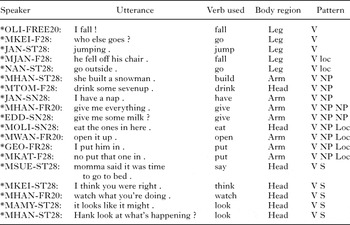
We ignored variability in word order, such as in questions and topicalizations. Questions such as What did she put in his eyes?, for example, were considered instances of the [V NP Loc] pattern. Utterances considered unacceptable or ungrammatical to adults were not included in the coding. We did not attempt to distinguish arguments from adjuncts because we did not want to assume 20- and 28-month-old children had mastered a distinction which is not agreed upon by all linguists (Koenig, Mauner, & Bienvenue, Reference Koenig, Mauner and Bienvenue2003). Examples of how we organized the data, with child’s name, context of speech, and age (child name preceded by M indicated the child’s mother); utterance; verb used; associated body region as described above; and syntactic pattern coded as described here; are given in Table 2.
Coding examples of the utterances in terms of body regions and frames

2.2. results
The analyses were conducted on the utterances of four groups of speakers: 20-month-olds, the mothers of the 20-month-old infants, 28-months-olds, and the mothers of the 28-month-olds. We first provide a brief description of the overall patterns in the data, followed by the results for our three specific questions: (i) Are there specific patterns of contingencies between argument structures and verb–body region associations? (ii) Do the patterns of contingencies between argument structures and verb–body region associations vary between the four groups of speakers? (iii) Are these patterns of contingencies driven by a few highly frequent verb(s) occurring in these argument structures, rather than being driven by associations with bodily effectors?
2.2.1. Overall patterns in the data
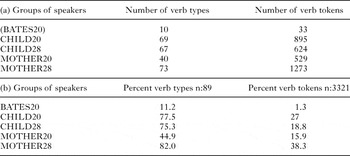
Table 3 lists, for each group of speakers, the percentages of verb types and verb tokens. In the Bates Corpus’s 20-month-old data, we see that the mothers are driving the acquisition of verb types, producing four times more verb types (40 verb types) than their children (10 verb types). However, the mothers speaking to their 20-month-old children used around half as many verb types as compared with mothers speaking to their 28-month-old children (73 verb types), corresponding to a feature of child-directed speech where speech to younger children is simpler and less varied than speech to older children (Snow, Reference Snow, Bornstein and Bruner1989, Reference Snow, Fletcher and MacWhinney1995).
Verb types and verb tokens, given in raw numbers (a) and percentages (b). For calculation of percentages, each raw number is divided by 89 for verb types and by 3321 for verb tokens in each age group.

2.2.2. Verbs and body regions
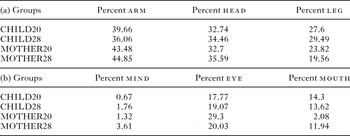
Next, we calculated the proportion of arm-, head-, and leg-related verbs within each age group. Table 4 shows that the proportions of verb–body region pairings are almost evenly distributed in the older children’s utterances (36% of the verbs are associated with arm, 35% head, 30% leg). The older mothers’ utterances (45% arm, 36% head, 20% leg) show much more differentiation, and are more in line with results from the prior study of adult judgments of body regions associated with these early-learned verbs (51% arm, 21% head, 14% leg; and 14% associated with multiple body regions; Maouene et al., Reference Maouene, Hidaka and Smith2008). Although leg verb types are fewer in maternal speech, they were produced by the older children nearly as frequently as the arm verbs or head verbs. We will make the case in the ‘Discussion’ that this is important in order for children to learn syntactic patterns associated with leg, such as oblique intransitive locatives patterns. The younger children (40% arm, 33% head, 28% leg) closely resemble their own mothers (44% arm, 33% head, 24% leg), perhaps due to the fact that they have significantly fewer verbs in their speech than the three older groups. The younger children may be reflecting their mother’s speech more than the older children, who are starting to depart a bit from strictly conservative uses (Tomasello, Reference Tomasello2003).
(a) Percentages of verbs associated with arm, head, and leg: rows add up to 100%; (b) Percentages of verbs associated with head(=100%) into mind-, eye-, and mouth-related percentages.

If we consider the subparts of the head region (Table 4), the results indicate that, both proportionally and identically in all four groups, the verb tokens related to the eye region were the most numerous (look, see, watch), followed by verbs related to the mouth region (lips and teeth included; talk, say, tell, etc.), and finally verbs related to the head (brain and head included; think). We observe that verbs associated with head are increasing only in the speech of the mothers of the 28-month-olds. More abstract verbs are used by the mothers as the children grow older and have a larger comprehensive vocabulary, relying more and more on conventional linguistic cues such as I think that, I don’t know, I guess so, etc.
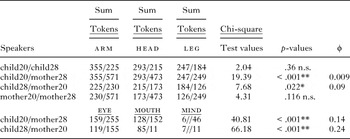
Given these descriptive data, we wondered if there was a significant difference between age and the overall use of verbs associated with particular body regions, as found in the raw data (Table 4). However, an overall chi-square test of independence was not possible, since some of the groups of speakers were dependent on one another. Since the grouping variables (groups of speakers) needed to be composed of two independent groups, we ran the test on four comparisons: the two groups of children; the two groups of mothers; and two cross-groups, the 20-month-old children with the mothers of the 28-month-olds; and the 28-month-old children with the mothers of the 20-month-olds. Shown in Table 5, the results yielded no association between age and body regions for three groups out of four. The only significant relationship between age and body regions was between the younger children and the mothers of older children. Thus, an inference can be made that the associations of the body regions with the verb tokens produced by the speakers is similar within and across children and mothers early in development. It differs most between the younger children and the mothers of the older children, but the effect size is really small (ϕ = .01); this trend of maximum differentiation across age groups is confirmed and present for the other cross-group when the sub-regions of eye, mouth, and mind were included in the test.
Multiple chi-square tests of independence comparing age pairs and body regions

notes: n.s. = non significant, * = significant at p < .0125, ** = significant at p < .001 with Bonferrroni corrections.
2.2.3. Correspondences between verbs and argument structures
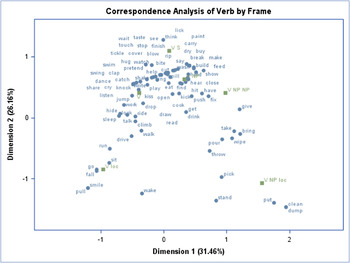
Next, we looked for correspondences between the individual verbs and the sentence frames using a correspondence analysis (hereafter CA) using the program R on the full data set of 3321 sentences. This method, first introduced by Hirschfeld (Reference Hirschfeld1935) and later developed by Benzécri (Reference Benzécri1973), is a reduction dimension technique, similar to a principal component analysis but for categorical data. Dimension reduction techniques such as CA serve the purpose of discovering and describing structure. The CA is not sensitive to variance (as is the Principal Component Analysis: PCA) but to correlation, in this case, the correlation between verbs, body parts, and frames (i.e., only the data pattern is analyzed). This technique provides a means of summarizing a set of data in two-dimensional graphical form. The CA is performed on a contingency table C of size r × c, where r is the number of rows (verbs and their frequencies) and c is the number of columns (the frames). The CA decomposes the chi-squared statistics associated with the contingency table into orthogonal factors (dimensions) based on the chi-square distance. Part of the output from the CA is the correspondence map that allows researchers to visualize the relationships among categories spatially on dimensional axes, which represent which categories are closer to other categories on empirically derived dimensions. For example, in this particular corpus, a verb like smile (Figure 1, lower left quadrant), has 1 occurrence total, in [V Loc], and thus this verb contributes a maximum to the dimension 1 (horizontal) and nothing to dimension 2 (vertical). The goal here is to reduce the data in a high-dimensional dataset into a lower-dimensional description, while maintaining the variance structure among the individual instances. In this way, one can discover the ‘dimensions’ that account for most of the similarity structure among instances.
Correspondence analysis (CA) graphic solution for body-part related verbs by frames.

The dimension reduction analysis was conducted on a matrix composed of 89 verbs and their respective frequencies by 6 frames. The results, shown in Figure 1, indicate a reduction from the 89 dimensions (verbs) to 5 dimensions (or clusters); most of the variance (57.6) was accounted for by two dimensions. The results suggest that there is a dependence between the verbs and the frames, following similar results from prior studies (e.g., Fisher et al., Reference Fisher, Gleitman and Gleitman1991), although there is not a perfect one-to-one correlation, as there is overlap between the verbs and frames (e.g., the verb go is used in both [V] and [V Loc]).
2.2.4. Argument structures
To make the structure revealed by the CA more intuitive, we examine the structure of the argument structures described by each dimension. Points further away from the centroid (0,0) suggest more contribution to the test statistic, and points on the centroid contribute very little or nothing to this statistic. Dimension 1 accounts for 31.46% of the chi-square and Dimension 2 accounts for 26.16%. From inspection, Dimension 1 (horizontal) separates the orthogonal space between frames that have a locative meaning and those that do not: frames with a locative, [V LOC] and [V NP LOC], are situated in the lower half of the space; frames without a locative component, [V], [V NP], [V NP NP], and [V S], are situated in the upper half of the space. Dimension 2 (vertical) divides the space into frames that have one or two objects and frames that have no objects: frames with objects (including sentential objects), [V S], [V NP], [V NP NP], and [V NP Loc], are in the right half of the space; frames without objects, [V Loc] and [V], are in the left half of the space. The frame [V] is the closest to the centroid and is the one frame which contributes the least to the chi-square statistics of both dimensions, which makes sense because many verbs are used in the bare form of the verb, in addition to occurring with more complex frames.
2.2.5. Verbs
Three clusters of verbs are distinguished by the CA analysis. First, the top, largest cluster displays verbs that take an object, and verbs used in the bare infinitive [V], but are low in frames containing locatives. This large cluster can be separated further along the frames into three subclusters. The lower left part shows verbs that are more correlated with [V] (bare verbs), and occur infrequently in frames with objects and frames with locatives; the most frequent verbs (raw occurrences out of 3321) are go (90), look (90), see (81), cry (79), play (79), eat (78), read (31), open (23), sit (20), jump (19), sleep (18), and talk (17). Verbs higher in the top cluster are those strongly correlated with the frame [V S] and with frames with NP objects, but do not occur often in frames with locatives; the most frequent verbs are say (28), think (28), see (23), look (10), and find (9). Verbs in the right central cluster are those strongly correlated with [V NP] and other frames that take objects, but are not associated with frames with locatives; the most frequent verbs are give (19), get (8), make (5), bring (4), build (4), show (4), read (3), and pour (2).
The second cluster (lower left) is formed by the verbs that are strongly correlated with [V Loc] and thus do not occur with objects but do occur with locatives; the most frequent verbs are go (445), look (68), sit (67), fall (51), and get (39). The third cluster (lower right) consists of the verbs that occur frequently in frames with both objects and locatives; the most frequent verbs are put (245), take (32), have (20), stand (11), throw (9), bring (9), and open (7).
Overall, the CA indicates that verbs can be clearly and strongly segregated by syntactic frames, such as whether or not they express a locative meaning and whether or not they are followed by one or two objects.
Following these first results, the next logical question and, indeed, the most important question that this paper addresses, is whether the body regions associated with the verbs correlate with this type of criteria.
2.2.6. Are there specific patterns of contingencies between argument structures and verb–body region associations overall?
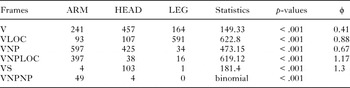
We examined whether there was an association between the three body regions and the sum frequency of the six frames across all speakers. Figure 1 shows that the [V] frame was used 862 times, and was primarily contingent with head; [V Loc], used 791 times, was overwhelmingly associated with leg; [V NP], used 1056 times, was contingent with arm and head; [V NP Loc], used 451 times, with arm; [V NP NP], used 53 times, showed a contingency with arm; and [V S], used 108 times, was contingent with head. A chi-square test of independence yielded a significant relationship between the three body regions and the sum frequency of the frames tokens (Χ 2 (2, N = 3321) = 29.59, p < .01, ϕ = .09).
Next, multiple single sample chi-square tests for goodness-of-fit were run on the sum frequency of the tokens for each region of the body to determine for each frame whether there was a non-random association with a particular body region. The results show that, for each frame, a significant non-random association was found. Table 6 reports the sum frequency of the token for each region of head arm, and leg within each frame, the critical values of chi-square tests, the degree of freedom, and the p values for the two-tailed tests. For [V NP NP], since there were no leg answers for this particular frame, the test was binomial and indicates a non-random association of the arm region with this frame (comparing 49 sentences related to arm with 4 sentences related to head) (p < .001).
Summary table of the chi-square goodness-of-fit statistics comparing verbs (tokens frequencies) for each frame

Next, multiple single sample chi-square tests for goodness-of-fit were run on the sum frequency of the tokens for each region of the body to determine for each frame whether there was a non-random association with a particular body region. The results show that, for each frame, a significant non-random association was found. Table 6 reports the sum frequency of the token for each region of head arm, and leg within each frame, the critical values of chi-square tests, the degrees of freedom, and the p values for the two-tailed tests. For [V NP NP], since there were no leg answers for this particular frame, the test was binomial and indicates a non-random association of the arm region with this frame (comparing 49 sentences related to arm with 4 sentences related to head) (p < .001).
2.2.6.1. Simpler vs. more complex argument structures.
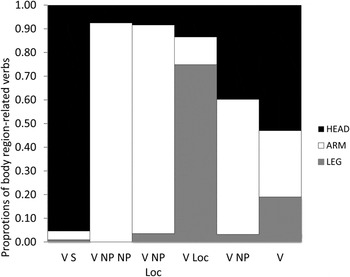
Following these analyses, we examined the body regions associated with simpler versus more complex argument structures, as defined by the number of arguments (0, 1, or 2) in the frame. Figure 2 indicates that the frames with two postverbal arguments or with a sentential complement were more strongly tied to a particular body region than the more frequent and simple patterns with zero or one verbal argument, a point we will return to in the ‘Discussion’. Specifically, the [V S] frame showed the strongest relationship to one specific body area, with 95% of the 108 sentences related to the head region; next strongest was the [V NP NP] pattern, with 92% of the 53 sentences connected to the arm region; and the complex pattern with the least strong relationship was [V NP Loc] pattern, with 88% of the 451 sentences linked to the arm region. Examining the simpler syntactic patterns, the [V Loc] frame showed the strongest body association, with 75% of the 791 sentences associated with the leg region; this was followed by the [V NP] pattern, with 57% of the 1056 sentences related to the arm region and 40% related to the head region; and the weakest relationship was shown by the [V] pattern, with 53% of the 862 sentences linked to the head region.
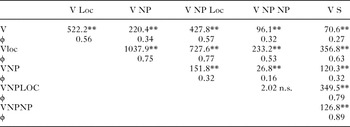
The six frames ordered from highest to lowest proportions of a main body region. The most ‘complex’ frames, [V S], [V NP NP], and [V NP Loc], have the highest proportion of association with one specific body region. Chi-square tests of independence for pairs of comparisons between the frames indicate that all syntactic patterns differ from one another in terms of associated body regions, after Bonferroni corrections.

Chi-square tests of independence on the pairs of comparisons between the frames (Table 7) indicate that all syntactic patterns differ from one another in terms of associated body regions, after Bonferroni corrections, with the exception of the VNPNP and VNPLOC pair (both highly related to the ARM region).
Pairs of frames analysis with chi-square tests of independence

note: ** Critical values of the paired chi-square independent test, significant at p < .01 with Bonferroni corrections.
2.2.7. Do the patterns of contingencies between argument structures and verb–body region associations vary within and between the four groups of speakers?
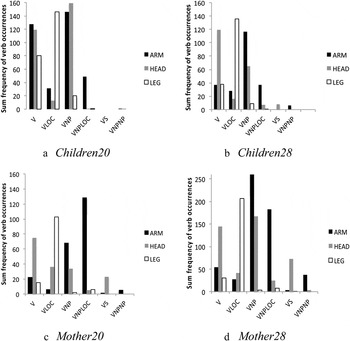
Figure 3a–d presents the data and results in terms of the distribution of the body regions of head, arm, and leg, as a function of the sum frequencies of the verb tokens that appeared in each frame, such that the total number of tokens equals 3321. Overall, the three older groups of speakers displayed the same specific patterns of associations detailed above, when the data was collapsed. The youngest speakers look somewhat different from the other three older groups for the frames [V] and [V NP], showing a more distributed pattern where, compared to the older groups, verbs associated with both head and arm dominate roughly equally ([V]: arm verbs (128 occurrences = 41%), head verbs (119 occurrences = 36%); [V NP]: head verbs (159 occurrences = 54%), arm verbs (146 occurrences = 41%)). The older children resemble both groups of mothers, where arm verbs are used more frequently in [V NP] and head verbs are used more frequently in [V]. These differences, however, did not challenge the relationship between the transitive frames and the head and arm regions, and the intransitive locative and the leg region. This is a very strong pattern seen in all four groups, with statistical analyses revealing a significant relation for each age group between body regions and frames. Given that too many of the cells (more than 20% of the cells) had a count less than 5, chi-square tests of independence would not be valid, and multiple Fisher chi-square tests were run. The results indicate that the general pattern of associations remains strong for the six argument structures for each group of speakers, as the same p values (< 2.2e-16) were obtained for all four groups of speakers, indicating that the frames still varied significantly in terms of body regions.
The proportions of head-, arm-, and leg-related verbs used in each of the six frames across the four groups of speakers, ordered from most simple frame to most complex, for 20-month-olds (children20); 28-month-olds (children28); mothers of 20-month-olds (mother20); and mothers of 28-month-olds (mother28) (clockwise from top left quadrant).

2.2.7.1. Frame by frame analysis for each group.
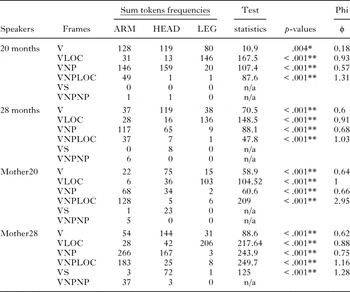
Next, we conducted multiple single sample chi-square tests for goodness-of-fit on the data in Figure 3 (raw data in Table 8), to determine whether the distribution of verbs by body regions within each frame was at chance. The analyses yield a significant non-random relation for each frame. Table 8 reports the sum frequency of the verb tokens for each body region within each frame, the critical values of chi-square goodness-of-fit tests, and the p-values for the two-tailed tests and ϕ. Because no verbs associated with the leg region were used with [V NP NP], the test was binomial and indicates a non-random association of body region (arm) on 45 sentences (p < .001). All together, the results indicate that for all speakers, each of the six argument structures (for which enough data was available to conduct an analysis) is likely to be associated with a specific body region.
Frame by frame analysis in terms of body parts associates within each group

note: With Bonferroni corrections, p = .0125 for the two groups of children and the mothers of the 20-month-olds, and at p = .01 for the mothers of the 28-month-olds.
2.2.7.2. Pairs of comparisons.
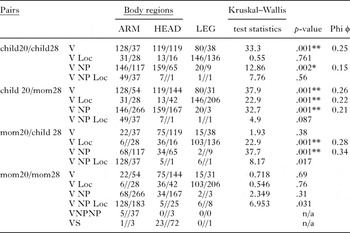
Here again, in order to perform the chi-square tests of independence, the grouping variables (groups of speakers) needed to be composed of two independent groups, so we ran the test on the same four comparisons as previously: the two groups of children, the two groups of mothers, and two cross-groups: the 20-month-old children with the mothers of the 28-month-olds, and the 28-month-old children with the mothers of the 20-month-olds. Shown in Table 9, multiple Kruskal–Wallis tests of a 2 (Age) by 2 (Speaker Type) by 3 (Body Region) for each frame indicate, after Bonferroni corrections, that mothers did not differ from each other on any frame (4 frames tested, 2 omitted due to low numbers).
Cross-group comparisons frame by pair by body region

notes: ** Significant at p < .001 with alpha value set at .0125 with Bonferroni corrections.
* Significant at p < .002 with alpha value set at .0125 with Bonferroni corrections.
Developmentally, the 20-month-old group varies the most of all groups, initially showing more distributed associations: [V NP] is associated with arm and head by the younger children, whereas the older groups show a more focused association with arm; similarly, [V] is associated with head and arm by the younger children, compared with a more focused association by head shown by the older groups. We also see developmental changes for the [V Loc] frame where, although all groups most strongly associate it with leg verbs, in children other associated regions are mostly arm then head, whereas in adults, other associations are mostly head then arm. These effects are moderate, indicating that although some differences exist, they are likely to be small. No group differed on [V NP Loc], with agreement across all groups that this frame is arm-related; this is the most complex and least frequent frame produced by the youngest group, a point we return to in the ‘Discussion’.
In brief, a non-random relationship is revealed when we examine the body region associations of the verbs used in each argument structure pattern, both overall (Question i) and by speaker (Question ii). We also find a developmental pattern, where initially young speakers show a more distributed pattern, with frames associated with multiple body regions, and older speakers show more narrow associations between frames and specific body regions. A summary of these body region–argument structure relations for each group of speakers is given in Table 10.
Summary of the contingencies between body regions and frames for each age group

2.2.8. Are the patterns of contingencies between argument structures and specific verb–body region associations driven by the most frequent verb(s) used in those argument structures, or by associations with bodily effectors?
It may be that the patterns of contingencies found in the analyses above were based only on the most frequent verb appearing in each frame. Prior work has shown that children associate the meaning of the most frequently occurring verb with each of three argument structure constructions respectively, specifically, go with [V Loc], put with [V NP Loc], and give with [V NP NP] (Goldberg et al., Reference Goldberg, Casenhiser and Sethuraman2004). It may well be that our results are driven by the most frequently used verbs in the frames we examined, rather than overall associations with specific body regions. In order to address this possibility, we removed the top most frequent verbs from each argument structure, as follows: [V], go (90/862 raw occurrences) and look (90/862); [V Loc], go (444/791); [V NP]: get (117/1056) and eat (115/1056); [V NP Loc]: put (245/451); [V NP NP]: give (19/53); and [V S]: say (28/108) and think (28/108).
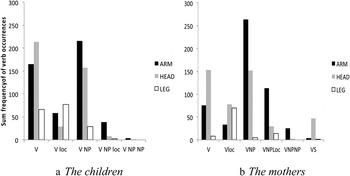
Using the remaining verbs, we re-examined the body regions associations for each argument structure. To have enough datapoints, we collapsed the two groups of children and the two groups of mothers. The figures that follow display the sum frequencies of the verb occurrences in each frame on which two chi-square tests were run. The data for the children (Figure 4a) and mothers (Figure 4b) when the main verbs were removed indicate that the general pattern of associations remains strong for the argument structures for each group of speakers (six frames for the mothers; five for the children, omitting [V S] due to their lack of production of this frame). The chi-square test of independence yielded a significant relationship between the three body regions and the sum frequency of the frames tokens for the children’s group when the principal verbs were removed (Χ 2 (8, N = 1067) = 186.04, p < .001, ϕ = .42). Similarly, the chi-square test of independence yielded a significant relationship between the three body regions and the sum frequency of the frames tokens for the mothers’ group when the principal verbs were removed (Χ 2 (10, N = 1078) = 412.4, p < .001, ϕ = .62). It is important to note that these principal verbs exactly represent the adult frame–body region associations the children are learning, and the other verbs in these frames reflect the earlier associations (Figure 3a and b), albeit less strongly. That is, the most frequent verb is not the sole driver of our results, for either mothers or children. However, the significant but moderate effect size in the children’s utterances might indicate that although body region associations play an important role, the most frequently occurring verbs may still provide a concrete, salient, and intermediate cue for this group to help them associate sensorimotor information with the highly abstract syntactic information they are still learning, a point we return to in the ‘Discussion’.
The sum frequency distribution of the six frames by the three body regions with the main verb tokens removed for children and mothers.

In summary, the relationship found earlier with the full dataset continues to hold even after the most frequent verbs are removed, that is, the same non-random relationship between verbs associated with a particular body region and specific argument structures holds, whether the most frequent verb per frame is included or not. However, when the verb go is removed from the frame [V Loc], a head-eye substructure emerges in the mothers (e.g., look here). We can thus hypothesize that the eye region is important for other intransitive frames besides [V], namely [V Loc]. However, we note that a very different kind of sensory experience happens for leg-associated [V Loc] versus eye-associated [V Loc], that presumably even young children would learn quite quickly, and that only one of these develops into the adult Intransitive Motion construction.
3. Discussion
We find three main results that show contingencies between verbs, their most likely body part pairing, and the argument structures they are used in. First, the findings affirm strong relations between three specific body regions and six argument structures in maternal speech (four argument structures in child speech.) Second, a developmental difference is observable between the utterances of the youngest speakers and those of the three other groups of speakers, with the youngest speakers showing less differentiation between head and arm for two specific frames. Third, the patterns of contingencies between body regions and argument structures hold even when the most frequent verbs are removed from the analysis. We discuss each of these results in turn.
3.1. specific patterns of contingencies
Overall, our results provide initial evidence that the six argument structures are each strongly associated with one of three regions of the body, as linked by the body regions associated with the verbs used in those syntactic patterns. While showing a connection between syntax and body parts via verb use is not the same as investigating whether child and adult speakers’ uses of argument structure are linked to their moment-to-moment implicit attention to body parts, or – even better – the alignment of the proprioception of the infant with the speech in the environment, nevertheless, the current study constitutes a first step in showing knowledge of argument structure developing out of a connection to the body. Our results provide some testable predictions, particularly that, over many observations, actions involving the leg region (also encompassing feet, toes, knee, thigh, and bottom) predict the accompanying language containing the intransitive locative; that uses of the arm region predict communication involving transitive locatives and ditransitives; and that actions involving the head region predict the use of both an intransitive and a transitive, in the form of the bare infinitive [V] or the relative clause of reported speech or thought in the form of [VS]. Why do we predict these particular patterns of contingencies?
A possibility, close to a strong embodiment perspective, and also to the Piagetian perspective on the sensorimotor origin of our intelligence, is that children first learn the referential meaning of events through sensory and motor activities. In that perspective, the repeated leg events and their associated bodily experience would set neural pathways for the oblique locative relation. In particular, the child may hear locative expressions taking the syntactic form [V Loc], such as don’t run/jump/go there, or stay/wait/stand here from the caregiver, while the child’s leg activity in space is either encouraged or restrained. This can occur over multiple contexts – which provides referential continuity – while motor control of the legs (activation of inhibition) is a central attentional focus of the child’s embodied mind. These multimodal signals coupled with attentional resources may get connected particularly strongly in semantic memory (see Pülvermüller & Gargagnani, Reference Pulvermüller and Garagnani2014, for a simulation). In the same way, repeated hand events between objects and people would set up neural pathways for ditransitive relations. An association with hands would typically occur as the child hears sentences such as Let’s build a tower [V NP], Don’t put it here [V NP Loc], and Give it to mommy [V NP NP], while trying to satisfy the request of the caregiver by controlling her motor activity particularly in that body region. Associations with head would emerge out of repeated mouth events of producing sounds (even without a tactile component), setting the neural pathways for reported speech, reported thoughts, reported feelings, and other proprioceptions corresponding to the [V_that] sentence structure (see the origin of abstract talk of mothers to children and the correlation with the tactile sense in Dueker, Portko, & Zelinsky, Reference Dueker, Portko and Zelinsky2011). Similarly, repeated eye events involving inanimate and animate beings in space and intersubjectivity checks would set the neural pathways for [V NP] and [V NP Loc], transitive and transitive locative relations, such as Watch, Look, Don’t look! Attention and control around the head region (mouth, eye, and other parts) would be maximal when the children hear See/Watch/Eat/Drink this [V NP] or I think you are right, He said he is going now [V S].
The connection between the body and syntactic patterns could happen when the child hears transitive structures with an accompanying inhibition or activation of the hands, mouth, eyes, ears, and other bodily effectors. It goes without saying that very young visually impaired children would use their sense of touch more than their eyes. But they hear and make associations with language that would have many contextual references (why blind children can use verbs such as see and watch, use color terms, etc.). The process used by Helen Keller, who was blind, deaf, and mute from childhood, to first associate physical water and the sign for water, provides an example of the connection between the body and abstract knowledge via the highly contextual use of language during relevant experience. Helen Keller used the continuity of tactile sense from her hand sensing the water, the tactile sense of her teacher’s handshape for water, and the tactile comparison of her hand gesture for water, as guided by her teacher in the same time and space, to learn the sign for water. This example provides one explanation for how the typical neural representations of actions verbs may develop without vision (Bedny, Caramazza, Pascual-Leone, & Saxe, Reference Bedny, Caramazza, Pascual-Leone and Saxe2012).
The position of strong embodiment is supported by growing evidence suggesting a strong link between verbs and the neural processes that underlie body movement and perception in adults and in children (James & Maouene, Reference James and Maouene2009; Carota et al., Reference Carota, Moseley and Pülvermüller2012). New directions in social embodiment and embodied attention also provide converging evidence (for a review, see Yoshida & Burling, Reference Yoshida and Burling2011; Yu & Smith, Reference Yu and Smith2012).
An alternative hypothesis, following a weaker embodied perspective, would claim that the semantic representations of intransitivity and transitivity are ‘supra-modal representations’, possibly innate, as a result of evolutionary pressures. On this account, these representations may activate sensorimotor features (including body parts, among other cues), depending on the demand of the task via “higher forms of attention and semantic memory” (Meteyard & Vigliocco, Reference Meteyard, Vigliocco, Calvo and Gomila2008, p. 295). However, results in developmental psycholinguistics only partially support this weak embodiment theory. Although some studies indicate that, by the end of the first year, English-speaking toddlers can associate transitive argument structure with causal events in laboratory settings (using the Infant Preferential Looking Paradigm), mixed results have been found for intransitivity, although infants produce intransitives in life situations (for a review, see Noble, Rowland, & Pine, Reference Noble, Rowland and Pine2011). Further, although consistent with adult fMRI data, which locate attentional control and semantic memory together but in different, separated regions from sensorimotor regions (Meteyard & Vigliocco, Reference Meteyard, Vigliocco, Calvo and Gomila2008), recent experimental data in real time of very early noun learning indicates that attentional control is embodied in toddlers, such that when the child is initially learning new names for referents, their short arms and the holding of the objects with both hands near their bodies create an embodied window for attention (Yu & Smith, Reference Yu and Smith2012). Thus, an adult model of attentional control separated from semantic memory may be difficult to invoke in infants.
Finally, an amodal account of word meanings would state that verb comprehension depends on brain regions that are neither connected to a specific sensory modality nor with the motor system. These brain regions distinguish between verb types along abstract dimensions (e.g., transitivity, intransitivity), and not along sensory dimensions (e.g., tactile versus auditory) or basic inhibition/activation processes (Bedny & Carammazza, Reference Bedny and Caramazza2011).
The weak embodiment and amodal accounts would be compatible with the claims of Pinker (Reference Pinker1984, Reference Pinker1989) and Gleitman (Reference Gleitman1990), where the core meaning of verbs is totally abstract and categories of semantic–syntactic correspondence are universal and inborn. However, in that case, we wonder where the regularities reported here between three body regions and six syntactic patterns would come from? One possibility is that body parts terms are selectively present in different syntactic structures, for example, as direct object in Wipe your nose, Don’t bite your fingers, or as subject as in My leg hurts, etc., or metaphorically and idiomatically, as in I love you sweetheart or The child was eyeing the candy. Although body parts terms themselves were extremely infrequent in the corpora examined here, it cannot be ruled out in larger corpora. However, this explanation of overt use of body parts would likely only hold for languages like English, where verbal arguments are regularly expressed, as opposed to languages such as Japanese (Rispoli, Reference Rispoli, Tomasello and Merriman1995), Tamil (Sethuraman & Smith, Reference Sethuraman and Smith2010, Reference Sethuraman and Smith2013), Tzeltal (Brown, Reference Brown, Bowerman and Brown2008), and others, which regularly drop arguments. Future work should look into the frequencies of body parts terms in parental and children’s speech in different syntactic structures to see whether there would be enough of those regularities in language itself to serve as a scaffold for alignment between semantics and syntax for young learners. The strong embodiment theory looks like a more robust explanation, because children have continuous access to their body parts, as well as close contact with the body parts of others in many cultures. This system of references, including parental speech input, enriches the child’s environment, a claim that could be addressed in future work, particularly in cross-linguistic studies.
3.2. developmental differences
Our results suggest developmental differences, in that the older children resemble their mothers more closely than younger children resemble their mothers in the correlations of the body-region verb pairings and the six argument structures examined here. Although the utterances of the 20-month-olds mostly show the same patterns of associations as the older groups for three frames, namely [V Loc] with leg and both [V NP Loc] and [V NP NP] with arm, we find that [V] and [V NP] were undifferentiated in terms of head and arm. For [V], it is a possibility that the younger children, who produce shorter utterances overall, are producing a more varied set of verbs without arguments because they are more likely to drop the arguments of the verbs in their more limited speech. This claim is supported both by the literature on the abundance of the [V] frame at the beginning of children’s language production (see, for example, Bloom, Reference Bloom1991), as well as by the fact that the youngest speakers use verbs associated with the leg region in the [V] frame much more often than the three older groups.
Children appear to be more discriminating in their verb use in the [V NP] frame, as they prefer to use head and arm verbs over leg verbs in this transitive structure. In fact, the four transitive frames overall were strongly associated with hand or arm but not with leg, and the intransitive structure [V Loc] was strongly associated with leg but not with head or arm, a differentiation already in place by the 20-month-olds in our sample. Clearly, there are exceptions. Look, an eye-related verb, and talk, a mouth-related verb, are used in the [V Loc] intransitive pattern (e.g., Look at the building, Talk to the phone), and kick, a leg-related verb, is regularly used in a [V NP] pattern (e.g., Kick the ball). However, in a probabilistic perspective, our data suggest that there are enough typical body part-related regularities in parental speech for these regularities between verbs, body parts, and argument structures to be learned by the infant. Although some argue that information about causality helps children learn transitivity, we suggest that body effectors offer children more robust support than causality (for a complete review of the problems with causality, see Noble et al., Reference Noble, Rowland and Pine2011). The most important issue with children learning these structures from information about causality is that, in our view, intransitive locatives are also ‘causal’ (He jumped = He caused himself to jump). Causality is therefore not necessarily solely associated with transitivity.
Looking at possible explanations for these developmental differences, a strong embodiment explanation would interpret this early lack of differentiation between head and arm as originating in the alignment of the eye–hand–head involved in the action labeled by many of these early-learned verbs (for the importance of the child’s eye–hand–head coordination for early noun learning in real time, see Yu & Smith, Reference Yu and Smith2013). Alternatively, in support of a weak embodiment hypothesis, we do not know of any culture where speakers do not involve their hands as they talk (Feyereisen & Lannoy, Reference Feyereisen and de Lannoy1991; for its appearance in children, see Acredolo & Goodwyn, Reference Acredolo and Goodwyn1985, Reference Acredolo and Goodwyn1988; Butcher & Goldin-Meadow, Reference Butcher, Goldin-Meadow and McNeill2000; Iverson & Goldin-Meadow, Reference Iverson and Goldin-Meadow2005). Even people who are blind from birth and have never seen others gesture still move their hands meaningfully as they talk (Iverson & Goldin-Meadow, Reference Iverson and Goldin-Meadow1998), such that links to body parts would come from an already symbolic as well as iconically ingrained code for language. A third possibility, a non-embodied hypothesis, would argue that from very early on, children do not rely on their body parts per se, but instead must discover the contingencies between body parts and syntactic frames from the presence of body parts terms in specific frames in the speech patterns of their mothers. Distinguishing between these three claims will necessitate further investigation, as our purely descriptive study cannot disentangle these three hypotheses. However, these developmental results are important theoretically because they offer a new child-friendly contender – concrete cues such as bodily effectors – as a central cue used by young children to learn abstract syntactic structures.
Finally, the results indicate that the more complex frames which have the highest number of words and thus the most linguistic information, and which are also produced by all age groups least frequently, are the frames which are most strongly related to particular body regions at each age: compare [V NP Loc], [V S], and [V NP NP] with [V], [V NP], and [V Loc] (Figure 1). Developmentally, the results suggest that the role of body regions as a leverage into new, more complex argument structures is particularly strong when the frequency of the frames is low.
3.3. the most frequent verbs
Prior work has shown that highly frequent verbs occur most often in some of the argument structure patterns examined here, and that children associate the meaning of these high-frequency verbs with the particular argument structures they occur in most frequently (Goldberg et al., Reference Goldberg, Casenhiser and Sethuraman2004). In our data, we find these same high-frequency verbs are used in these same argument structure patterns: go, associated with leg, is the most frequent verb used in [V Loc]; put, a hand verb, is the most frequent verb used in [V NP Loc]; and give, a hand verb, is the most frequent verb used in [V NP NP]. This raises the question of whether the particular contingencies found in this study are simply driven by these most frequent verbs. However, after removing the most frequent verbs from the analysis, we find that that the same body part contingencies hold. That is, there appears to be a strong overall relationship between the verbs associated with a particular body region and the specific argument structures they are used in.
The presence of a high token frequency of a single verb in a particular syntactic pattern may help children learn the meaning of the abstract pattern (Goldberg et al., Reference Goldberg, Casenhiser and Sethuraman2004) but it does not address the question of how the child learns to productively use other verbs in these argument structure patterns or what these other verbs are. Following Goldberg et al. (Reference Goldberg, Casenhiser and Sethuraman2004), go is the most frequent verb used in the pattern [V Loc] because it corresponds with the abstract meaning of this pattern, ‘X moves Y’, and is a highly frequent basic verb in the language in general. Since both semantically general and semantically specific verbs are learned at the same time, it has been argued that additional verbs are used in this pattern because they have meanings similar to go (see Pinker, Reference Pinker1984, Reference Pinker1989). However, sit, fall, jump, stand, or wait, all verbs present in [V Loc] in this corpus, do not have the same primitive abstract meaning as move.
It may be that go is used in [V Loc] because the kind of meanings associated with go or don’t go necessitates the child’s attention and control (whether automatic or not) on a particular region of the body, such as the legs. We find support for this hypothesis by taking go out of our analysis and still finding that most verbs used in [V Loc] are associated with legs. We suggest that additional verbs are used in this pattern because there is something intrinsic about [V Loc] – possibly around attention and control on legs – connecting it to the legs, and so leg-related verbs tend to be used in this pattern more often than head- and arm-related verbs, supporting an embodied hypothesis.
Similarly, by removing the most frequent items from the list of the verbs used in each of the four transitive frames related to head and arm, we still find that most verbs used in each particular transitive frame are associated with the same body region of head or arm. For instance, we removed the verb give in the analysis of [V NP NP], a pattern with the abstract meaning of ‘transfer’ – and verbs like get, make, and read, some with different abstract meanings, still make [V NP NP] contingent with the arm region. We removed think and say from the analysis of [V S], a pattern with the abstract meanings of ‘mental act’, such as think, and ‘communication’, such as say (e.g., Papafragou, Cassidy & Gelman, Reference Papafragou, Cassidy and Gleitman2007), and verbs like find, look, and see still make [V S] contingent to the head region. If put is removed from the list of verbs connected with [V NP Loc], a pattern with the abstract meaning of ‘cause to move or change of location/possession’, we find that verbs such as have, take, and get still make [V NP Loc] contingent to the arm region. If we remove eat and get from the analysis of [V NP], which has a number of abstract meanings (e.g., Dowty Reference Dowty1991; Davis Reference Davis1996; Goldberg et al., Reference Goldberg, Casenhiser and Sethuraman2004), many verbs, such as bite, build, climb, close, open, etc., still make [V NP] contingent to the arm region. See Table 9 for the full list of contingencies between body regions and associated syntactic patterns.
A complementary hypothesis is that it is not uniquely control of and attention to the motor aspect of the effectors that provides differential experience, but also the emotional experiences and sensory quality of the information relayed by the effectors that is different: compare the sensors for vision, audition, smell, taste, and touch, as well as the emotions accompanying an event of object prehension (or stopping this event) and how different sensors and emotions get involved in an event such as self-locomotion (or stopping oneself). Finally, a disembodied hypothesis would argue for a unique top-down process where it is not the effectors or the regions that give rise to the conceptual meanings, but the result of an evolutionary pressure on our brain (Bedny & Caramazza, Reference Bedny and Caramazza2011).
One could argue that the present results are compatible with the hypothesis that it is the conceptual meanings that guide children to find the contingencies in events using their arm, leg, or head. The difficulty of checking such a claim involves resolving issues such as the fact that even early-learned verbs have multiple meanings, independent authors differ on categorizations (e.g., Mandler, Reference Mandler1992; Goldberg, Reference Goldberg2006), and many categorizations are based on adult meanings (e.g., Levin, Reference Levin1993) or are borrowed from theorization on adults (e.g., Pinker, Reference Pinker1989). Even more importantly, it is unclear what meaning representations are formed by toddlers (for a review, see Golinkoff & Hirsh-Pasek, Reference Golinkoff and Hirsh-Pasek2008) or, indeed, if any are formed (Ninio, Reference Ninio2011).
3.4. future work
The current study seeks to understand the regularities that are available in the input to and occur in the speech of young children. We do not directly link the use of verbs and verb arguments to specific body parts, which would require examination of videos of babies’ actions and co-occurring parental speech. Additionally, we do not demonstrate that the relationship found between syntactic frames and body parts is used by children to learn syntactic frames. However, we have shown in this study that this implicit connection could be nested in the regularities that exist in the maternal speech input and that young children reflect these regularities in their own speech, suggesting that children attend to the connection between body parts and syntactic patterns.
Further support for this link would come from examination of videotapes of infants’ and caregivers’ actions for possible connections between actions and speech – that is, for stable relationships between words and how they are used by the child and adults. This would not address the learning issue, but would show a more direct link between body effectors, verbs, and argument structures – adding further support to the idea that not only do such correlations exist in the young learner’s world, but that they are also informative.
The next step is to assess these ideas experimentally and examine learning directly, using tasks other than naturalistic production. Our hypothesis predicts that children should learn novel verbs more easily when they are paired with one specific body effector rather than when they are paired with multiple bodily effectors. Additionally, children should learn a novel syntactic pattern more easily when it is paired with one verb associated with one body effector than when paired with one or more verbs associated with multiple effectors. One suggestive experiment has already been performed, showing that young children and adults do learn a novel syntactic pattern more easily when it is paired with one verb (Goldberg et al., Reference Goldberg, Casenhiser and Sethuraman2004), but this study did not consider the role of the body.
Finally, other techniques such as eye-tracking to examine where on the body young children and adults look when they hear verbs and sentences would provide corroboratory evidence from a different method that these verb–body part, verb–syntactic pattern, and syntactic pattern–body part correlations in language influence our visual attention. Neuroimaging studies already suggest verb–body part associations; future work could also examine what cortical areas show activation when older children and adults hear sentences with different syntactic patterns and different proposed body part associations.
4. Conclusion
We have shown that (i) there are large regularities between argument structures and body regions in maternal speech to young children; and (ii) young children appear to pay attention to these regularities, insofar as the patterns in their speech show remarkable similarity to the patterns in their mothers’ speech. The highly frequent and early appearance of these correspondences between argument structures and specific body regions supports the hypothesis that these regularities help children in learning argument structures. Granted, this is a correlational study and further work is needed to examine this hypothesis, but our strong results suggest that in complement to the growing literature arguing that verb meaning and argument structure develop out of contingencies in linguistic experience, contingencies between verbs, body regions, and frames may also contribute to children’s developing knowledge. We suggest that these contingencies support early learning, in a three-part network of interactions between the brain–body network, the language network, and the environment network, as follows.
4.1. the brain–body network
Following Clark (Reference Clark1997), the brain and the body can be represented as an extended network that goes beyond the boundaries of the physical nervous system. Sporns (Reference Sporns2011) proposes that internal and external bodily movements produce changes in sensory inputs, and sensory inputs produce changes to bodily movements. These connections cause neurons to causally affect other neurons, neural states other neural states. Thus, developmentally, children’s nervous systems work, adapt, and create via their bodies’ sensors and effectors: sensors relay information about body signals that perturb network states of the brain, and network activity triggers effectors, resulting in bodily movement and repositioning the sensors (adapted from Sporns, Reference Sporns2011).
Further, body parts are robustly implanted in the brain. They have been described in the sensory and the motor system (Penfeld & Rasmussen, Reference Penfield and Rasmussen1950; for supportive data examining the extrastriate body area-EBA (Extratriate Body Area), see Downing, Jiang, Shuman, & Kanwisher, Reference Downing, Jiang, Shuman and Kanwisher2001; for supportive data examining the fusiform body area-FBA (Fusiform Body Area) involved in vision, see Peelen & Downing, Reference Peelen and Downing2005; for a model linking the EBA/FBA to new regions such as the insular cortex, the temporal regions, and the prefrontal cortex in the integration of context with the meaning of actions, see Amoruso, Couto, & Ibáñez, 2011) and in the thalamus and cerebellum (for a review of the findings on the role of the cerebellum in the mediation of higher cognitive processes, including language, see Murdoch, Reference Murdoch2010; for a model encompassing the basal ganglia, see Cardona et al., Reference Cardona, Gershanik, Gelormini-Ozama, Houck, Cardona, Kargieman, Trujillo, Arévalo, Amoruso, Manes and Ibáñez2013). In that regard, the proprioception system of the child (first perspective in pragmatics), what it feels to be running, is very different from the perception she has of others running, and future research should investigate how these differ in terms of verb meaning acquisition.
4.2. the language network
Language is inherently a multichannel activity, of which the three primary channels are motor, auditory, and visual. Why does this matter? Our intuition is that the oral and signed forms of language developed as social codes that are easily accessible, transportable, and available for everyone across all situations. In principle, we could have jumped to some other kind of support, but it could be forgotten, stolen, lost, all major drawbacks, a huge advantage of our body, and further the body offers many degrees of freedom, in the mouth–throat and in the hands, such that codes could be developed via these points of articulation effectors. In the case of oral language, we rely on the vocal tract and associated parts (lips, mouth, tongue, throat, lungs, diaphragm, etc.), and in the case of signed languages, we rely on our hands and associated parts (fingers, eyes, face, wrists, elbow, etc.) In both communication systems, the body assimilates and refers contingently (Piaget, Reference Piaget1952; Varela, Thompson, & Rosch, 1983). We take the position of Sporns (Reference Sporns2011), who proposes that language belongs to the vast family of environmental signals that can cause changes in sensory inputs, and argue that the extended networks of brain and body richness mentioned before extends to the language network, with its rich phonological, pragmatic, syntactic, and semantic functions. Future work will need to describe and identify how these multiple networks get created, and interact to create and develop into an adult conception of verb meaning.
4.3. the environment network
Finally, the last part of this extended embodied network is the richness of the environment and its family of signals, among which are the similarities noticed by the two-year-old between the bodies of social actors of all ages, their bodily movements, the artifacts they create, the natural objects they come across, the elements in the background, and so on. All of these cues and many others produce a large reservoir of comparisons of similarities and differences, as well as second and third view perspectives, which are so important in pragmatics. Recent research has started to document where adult speakers focus on in their general attention in the world just from their language; and, whereas most results seems to indicate that we focus on what is encoded in our own language, there are also indications of the opposite: for example, Papafragou, Hulbert, and Trueswell write that “Participants spontaneously studied those aspects of the scene that their language did not routinely encode in verbs” (2008, p.155; in children, see Sethuraman & Smith, Reference Sethuraman and Smith2010, Reference Sethuraman and Smith2013). Ultimately, the study of how children get to build a network of interactions between all the systems reviewed above is essential to verb acquisition and a fortiori language acquisition.
Appendix I
Description of the seven corpora examined

APPENDIX II
Verbs present in the corpus, their main body part in adults’ judgments, and their collapsed body region ( head, arm, leg), organized by body region HEAD, ARM, LEG.