Parental reflective functioning (PRF) is the ability of parents to understand their child’s behavior in light of underlying mental processes and intentions (Slade, Reference Slade2005). Parents with a high level of RF can take their child’s perspective and acknowledge the separation of the minds, leading to differences in perceptions. Furthermore, RF is crucial for self-regulation for both parents and children; through the parent’s ability to perceive difficult emotions as mental states, the negative feelings become more manageable, which enables parents to modulate their own and their child’s behavior, emotions, and experience over time (Grienenberger et al., Reference Grienenberger, Slade, Bernbach, Levy and Locker2005). Moreover, studies have shown that there is a relationship between PRF and child behavior, including child internalizing and externalizing behavioral problems and child social skills (Kapeleris, Reference Kapeleris2014; Smaling et al., Reference Smaling, Huijbregts, Van der Heijden, Van Goozen and Swaab2016; Wong et al., Reference Wong, Stacks, Rosenblum and Muzik2017). Therefore, RF has become a target of change in child therapy, specifically for parental intervention (Slade, Reference Slade2006; Slade et al., Reference Slade, Sadler, De Dios-Kenn, Webb, Currier-Ezepchick and Mayes2005).
Over the last decade, reflective parenting interventions have been an interest of study, and several studies have demonstrated improvement of RF due to reflective-aimed interventions for parents (e.g., Pajulo et al., Reference Pajulo, Pyykkönen, Kalland, Sinkkonen, Helenius, Punamäki and Suchman2012; Slade et al., Reference Sleed, Baradon and Fonagy2013, Reference Slade, Holland, Ordway, Carlson, Jeon, Close, Mayes and Sadler2020; Suchman et al., Reference Suchman, DeCoste, McMahon, Dalton, Mayes and Borelli2017). PRF-based group intervention is in the early stages of investigation. Although programs such as Connecting and Reflecting Experience (CARE; Zayde et al., Reference Zayde, Prout, Kilbride and Kufferath-Lin2021), Family Minds (Adkins et al., Reference Adkins, Luyten and Fonagy2018), and Families First (Kalland et al., Reference Kalland, Fagerlund, von Koskull and Pajulo2016) have become well known in the last few years, so far there have been few empirical findings regarding their outcomes (Adkins et al., Reference Adkins, Luyten and Fonagy2018; Author citation). However, in a meta-analysis review that examined the effectiveness of parenting programs aimed at RF and attachment in regard to improving PRF, a significant intervention effect with a small pooled effect size on parental RF was found (Lo & Wong, Reference Lo and Wong2020).
Improvement in the parent–child dyad and child outcome have been reported following reflective parenting programs (e.g., Hertzmann et al., Reference Hertzmann, Target, Hewison, Casey, Fearon and Lassri2016; Suchman et al., Reference Suchman, DeCoste, McMahon, Dalton, Mayes and Borelli2017). In a recent study, in which mechanisms of change during PRF-focused therapy were examined, researchers found that improvement in maternal RF led to an improvement in parental sensitivity and was associated with improvement in child attachment (Suchman et al., Reference Suchman, DeCoste, Borelli and McMahon2018). Our study set out to expand this knowledge by examining whether improvement in PRF was related to improvement in both the parent–child interaction outcome and the child outcome (including child behavioral problems) and by identifying which aspect of PRF improvement is related to each improvement in outcome.
Theoretical support exists for the assumption that improvement in PRF may lead to an improvement in the parent–child relationship and child development. For example, Fonagy (Reference Fonagy1998) suggested that the capacity of parents to observe the moment-to-moment changes in their child’s mental state lies at the root of sensitive parenting, promoting the establishment of secure attachment, which will later facilitate a more positive parent–child interaction and adaptive child behaviors. Moreover, Fonagy suggested that the process in which parents address their child’s mental state enables the child to develop an image of his or her own beliefs, feelings, and intentions and, later on, an image of another’s mental world (Fonagy, Reference Fonagy1998). Thus, the enhancement of PRF should be at the core of preventing maladaptive behavior in early childhood. The parents’ ability to address their child’s intrinsic motivations, emotions, and beliefs helps to build child mentalization abilities, more positive parent–child interactions, and eventually, more adaptive child behavior (Fonagy, Reference Fonagy1998). These ideas, despite their clear and in-depth descriptions, have only been partially studied and, to the best of our knowledge, there has yet to be a study that comprehensively examines these variables while focusing on the assessment of change in PRF and its consequences.
PRF is a multifaceted construct that can be measured in different ways. We comprehensively assessed PRF, referring to two main aspects: parental use of spontaneous reflective language and parental perceptions about RF. Spontaneity can be measured while examining parental-language use in a parent–child interaction using the mind-mindedness (MM) coding system (Meins & Fernyhough, Reference Meins and Fernyhough2010). MM is a parent’s tendency to refer to his/her child’s mental world, and with the MM coding system, the accuracy of these referrals is measured during play interactions. RF comments are classified as “accurate” or “nonattuned.” Parental perceptions can be measured using the Parents’ Beliefs about Feelings Questionnaire (PBAF; Dunsmore & Karn, Reference Dunsmore and Karn2001), which measures a parent’s declarative perceptions regarding his/her child’s emotions.
In the last decade, some studies have found links between PRF and child RF abilities during preadolescence (Ensink et al., Reference Ensink, Normandin, Target, Fonagy, Sabourin and Berthelot2015, Reference Ensink, Normandin, Plamondon, Berthelot and Fonagy2016; Rosso et al., Reference Rosso, Viterbori and Scopesi2015; Scopesi et al., Reference Scopesi, Rosso, Viterbori and Panchieri2015) and adolescence (Benbassat & Priel, Reference Benbassat and Priel2012). Researchers have also found that in addition to maternal RF, paternal RF was significantly correlated with adolescent RF (Benbassat & Priel, Reference Benbassat and Priel2012). Moreover, the relationship between PRF and child attachment in early childhood has been established (Borelli et al., Reference Borelli, St John, Cho and Suchman2016). However, the link between PRF and child RF during early childhood, when relationships are formed, has yet to be investigated. Furthermore, all the studies described above focus on concurrent correlations between PRF and child RF; to the best of our knowledge, no previous studies have addressed the question of how improvement in PRF is related to improvement in child RF. Guided by Sameroff’s transactional model of intervention, we hypothesize that changes in parents following intervention will create changes in the parent–child relationship as well as in child behavior and cognition (Sameroff, Reference Sameroff2004). Thus, we examined whether improvement in PRF was related to improvement in child RF as well as to improvement in the parent–child interaction and in child adaptive behavior.
Individual differences in child temperament as an indicator of improvement following intervention: The vantage sensitivity model
Because parenting involves a bidirectional process (Sameroff, Reference Sameroff1975) – the child is an active participant and his/her response shapes parenting – child temperament also needs to be considered when examining changes following PRF intervention: will all children be affected similarly or will individual differences in child temperament need to be considered? Extensive research indicates that child characteristics, in particular temperament, moderate the association between parenting quality and child outcome (Gallitto, Reference Gallitto2015; Kochanska et al., Reference Kochanska, Aksan and Joy2007; Van Leeuwen et al., Reference Van Leeuwen, Mervielde, Braet and Bosmans2004). Based on an ecological model (Bronfenbrenner & Morris, Reference Bronfenbrenner and Morris1998) and extensive research on parenting and child temperament (e.g., Putnam et al., Reference Putnam, Sanson and Rothbart2002), it is accepted that the quality of parenting might predict different outcomes for children with different temperaments. Gallagher (Reference Gallagher2002) suggested that individuals might respond differently to their environment according to their reactivity.
Pluess and Belsky (Reference Pluess and Belsky2013) introduced the vantage sensitivity model, which is the notion that some individuals are more sensitive and thus more responsive to the positive environmental factors (e.g., higher levels of parental attuned and sensitive behavior) to which they are exposed (Pluess & Belsky, Reference Pluess and Belsky2013). Moreover, variations in the effects of psychological interventions have also been found that support the vantage sensitivity model (e.g., Dinkel et al., Reference Dinkel, Herschbach, Berg, Waadt, Duran, Engst-Hastreiter, Henrich and Book2012; Forbes et al., Reference Forbes, Stepp, Dahl, Ryan, Whalen, Axelson and Silk2012). Due to greater levels of sensitivity, even the most common interventions may benefit some individuals more than others (e.g., Ginsburg et al., Reference Ginsburg, Kendall, Sakolsky, Compton, Piacentini, Albano, Walkup, Sherrill, Coffey, Rynn, Keeton, McCracken, Bergman, Iyengar, Birmaher and March2011; Kennard et al., Reference Kennard, Silva, Vitiello, Curry, Kratochvil, Simons and March2006). Indeed, a growing number of studies report that some people benefit more from psychological intervention than others as a function of their temperament. These studies support the vantage sensitivity model in the context of a psychological intervention which proposes that treatment response is influenced by factors associated with heightened sensitivity to environmental influences (de Villiers et al., Reference de Villiers, Lionetti and Pluess2018). Over the past few years, research has shown that personality and temperament traits can also reflect vantage sensitivity by moderating intervention effects and predicting treatment response (de Villiers et al., Reference de Villiers, Lionetti and Pluess2018). With regard to child personality and temperament traits, one of the traits that is most often related to child development is effortful control (EC). EC is the ability to suppress a dominant response in order to perform a subdominant response, and it plays a critical role in developmental outcomes (Rothbart et al., Reference Rothbart, Ellis, Rosario Rueda and Posner2003). We, therefore, investigated whether child EC would moderate the link between improvement in PRF and child outcomes.
We suggest that children with lower levels of EC will be more affected by improvement in PRF following intervention. That is, these children will exhibit a greater improvement in RF and a larger decrease in problem behavior than children with higher levels of EC, when their parents show improvement in PRF following intervention.
The present study
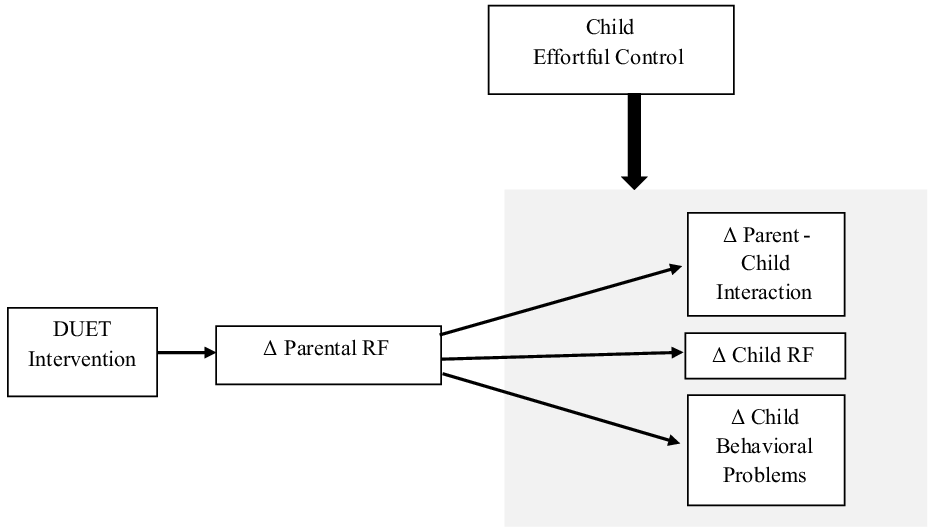
The aim of our study was to understand how improvement in PRF after participation in the DUET intervention group might be related to improvement in parent–child interactions, child RF, and child adjustment and to examine whether these improvements were distinct for children with different temperamental traits. Parents and children were assessed twice: before (T1) and after (T2) the intervention. Using a multimethod approach – including questionnaires and observations – we examined the following hypotheses (see Figure 1. Schematic Depiction of the Present Study): (a) improvement in PRF would be related to improvement in the parent–child interactions; (b) improvement in PRF would be related to improvement in child RF; (c) improvement in PRF would be related to a decrease in child behavioral problems; and (d) child temperament would moderate the links presented above. Specifically, children with lower levels of EC, whose parents exhibited greater improvement in RF following intervention, would exhibit themselves higher levels of RF and fewer behavioral problems and their relationship with their parents would improve more, compared to children with higher levels of EC. However, children with lower levels of EC, whose parents showed less improvement in RF following intervention, would exhibit a lower increase in RF and a lower decrease in behavioral problems, and their relationship with their parents would improve less, compared to children with higher levels of EC. The PRF construct was assessed using three predictors reflecting different aspects of PRF: (a) parent-appropriate MM; (b) parent-nonattuned MM; and (c) PBAF.
A schematic depiction of the present study’s conceptual model.

Method
Procedure
Families were recruited from a community clinic as well as from the general population through kindergartens and general advertisement in the community; they were offered participation in a parent group that would focus on understanding their child’s and their own behaviors during everyday situations, while considering the thoughts and feelings behind that behavior. All parents reported parent–child relationship challenges and concerns and were interested in better understanding their child’s behaviors as well as working on their relationship with their child. Children were aged 1–6 years old, in accordance with the DUET program for early childhood (i.e., for toddler and preschool ages; see [Author citation] for more detailed description of the intervention). Parents who were interested were contacted and a home visit was arranged. All families who met the inclusion criteria were invited to participate in the study and were assigned to the intervention and study. Inclusion criteria included (a) parents’ ability to speak and understand the local language and (b) a typically developing child without diagnosis of autism spectrum disorder. The study received Institutional Review Board approval. Parents who were interested in participating in group intervention signed a consent form.
Two trained researchers collected data from the parents and their child. Parents were asked to play with their child for 15 min while being videotaped. Thereafter, parents were interviewed and completed a questionnaire while their children were assessed.
Intervention
Each DUET group was led by two trained professionals (e.g., psychologists or social workers). Their training included an introductory 2-day training of the DUET reflective parenting program and was followed by weekly supervised meetings, where they learned to promote reflective processes by studying the DUET manual. More specifically, once the facilitators started the program, they received the DUET reflective parenting manual (Author citation; Grienenberger et al., Reference Grienenberger, Popek, Stein, Solow, Morrow and Levine2004) and met weekly for an hour of supervised discussion on reflective practices. The trained facilitators conducted 12 group sessions according to a structured manual; each group included, on average, six participants.
The DUET program encourages parental engagement in an in-depth experiential learning process designed to enhance critical parenting skills in a series of 12 workshops. Each of the workshops is organized around a central parenting topic, such as temperament, distress, separation, play, discipline, anger, or trauma. Each meeting includes a short topic introduction (e.g., psychoeducation), group discussion, and exercises to enhance parental reflective thinking while inviting parents to relate to issues in their own families. A special emphasis is given to the notion that children’s feelings and thoughts are important and valid and require attention and validation. The meetings are based on the premise that parents need to connect to their own feelings and thoughts before they can relate to their child’s inner world. Parents are encouraged to discover new ways of thinking about the links between behaviors while learning strategies and techniques designed to enhance PRF. Parents are inspired – through role play and brainstorming – to think about their own thoughts and feelings and their children’s thoughts and feelings, in a daily situation.
In addition to the weekly supervised group meeting (which included careful examination of the meeting protocol), fidelity measures were taken by an external examiner. All sessions were recorded, allowing an assessment of fidelity to the manual. Twenty percent is most commonly used to measure fidelity (Bammens et al., Reference Bammens, Adkins and Badger2015; Rosenblum et al., Reference Rosenblum, Lawler, Alfafara, Miller, Schuster and Muzik2018), and therefore two meetings (out of 12) were randomly selected from each group, and a checklist of fidelity was examined. In this sample, 91% of the items on the checklist were performed.
Sample
Overall, 110 parents were invited and agreed to participate in the study; 22 parents dropped out of the study before the intervention began, due to time constraints; four parents declined to participate in the T2 assessment, leaving 84 parents: for 14 families, both mothers and fathers participated; for 50 families, only the mothers participated; and for 6 families, only the fathers participated. In total, 64 mothers and 20 fathers successfully completed the intervention program. T-test analysis indicated that parents who dropped out of the intervention program were lower in socioeconomic status (SES), t(80) = 3.18, p < .05, and in their initial PRF level, t(82) = 3.47, p < .05, than other parents, but did not differ in regards to their child’s age or in the severity of their child’s behavioral problems.
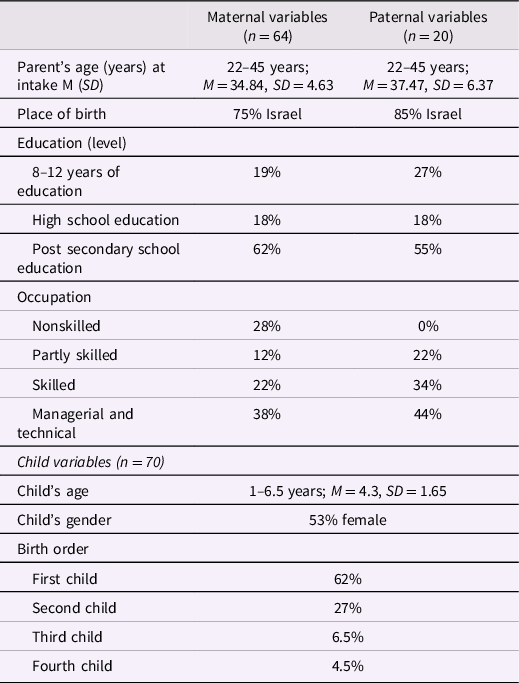
Little’s MCAR (Missing Completely at Random) test was computed for all study variables, and results supported data missing at random (p > .05). To account for missing data, we used a maximum likelihood estimation. Demographic information regarding parents and their children are reported in Table 1. (Demographic Information).
Parental and child demographic information

As seen, most parents had a postsecondary school education. In addition, occupations were diverse for parents. Child’s mean age was 4.3 years (SD = 1.65), and most children were either first or second born (see Table 1).
Parental measures
Parental Reflective Functioning. PRF was assessed in two ways: an observation (Meins & Fernyhough, Reference Meins and Fernyhough2010) and a questionnaire (Dunsmore & Karn, Reference Dunsmore and Karn2001).
Mind-Mindedness (MM; Meins & Fernyhough, Reference Meins and Fernyhough2010). MM is a parent’s ability to reflect his/her child’s mental states during real-time, ongoing parent–child interactions. Each interaction was transcribed and coded using the Interactional Mind-Mindedness Coding System (Meins & Fernyhough, Reference Meins and Fernyhough2010). Most of the children in this study were verbal, thus we adjusted the coding system to include both the child’s use of mental state in speech as well as the parents’ use of mental state in speech. Parents’ speech and child’s speech were first transcribed and the total number of utterances each parent and child made was counted. Afterward, all comments in which the parent or the child used mental-state language were marked as mind-related comments. Finally, coders classified each mind-related comment as “appropriate” (one that reflected a plausible interpretation of a mental state) or “nonattuned” (comments that did not seem to match the current mental state, as interpreted by his or her behaviors). To control for verbosity, MM scores were calculated as a proportion of the total number of utterances each parent and each child made during the interaction (regardless of whether they were mind-related or not). For children, the nonattuned comments score was equal to zero, therefore, we had three final scores: parent-appropriate comments, parent-nonattuned comments, and child-appropriate comments. Eighteen percent of the total number of videos were coded by all three coders, blinded to any information regarding the participants, group belonging, and study hypotheses. Intraclass correlation coefficients were high (.79–.97).
Parental Beliefs About Feelings. The Parents’ Beliefs about Feelings Questionnaire (PBAF; Dunsmore & Karn, Reference Dunsmore and Karn2001) is a 23-item questionnaire assessing two parental characteristics: emotional language and parents’ developmental beliefs (e.g., “It’s good for parents to let their children know when they are feeling angry”). Parents rated their degree of agreement with each item on a Likert-scale ranging from 1 to 6 (α = .71).
Interaction measures
Parental Emotional Availability Scale (EAS; 4th edition; Biringen, Reference Biringen2008). The EAS was used to assess the parent–child interaction. The EAS is conceptualized as a dyadic interactive construct thus the coding system includes four scales assessing parental behaviors (sensitivity, structuring, nonintrusiveness, and nonhostility) and two scales assessing child behaviors (child responsiveness and child involvement with the parent). Each variable was coded on a scale ranging from 1 to 7. Three trained research assistants coded the interactions, blinded to any information regarding the participants, group belonging, and study hypotheses. Interrater agreement calculated on 20% of the dyads coded by the three coders was high (ranging between .86 and .94). Principal component analysis revealed good internal consistency between all six scales, with 66% of the variance accounted for by parent–child interactions (loadings from 0.62 to 0.91). Therefore, all six scales were averaged into a single “EA parent–child interaction” score.
Child behavior
Child Behavior Checklist (CBCL; Achenbach & Edelbrock, Reference Achenbach and Edelbrock1983). The CBCL is a questionnaire measuring parental reports of child behavioral problems. Parents were asked to indicate how true different statements were about their child’s behavior within the past 6 months, using a 3-point scale ranging from (0) Not true through (1) Somewhat true or sometimes true to (2) Very true or often true. The 113 items forming this questionnaire measure delinquent behavior, aggressive behavior, withdrawn behavior, anxious/depressed behavior, attention problems, social problems, thought problems, and somatic problems. The CBCL has good validity and is a common and effective measure for assessing pre- and posttreatment changes (Achenbach & Edelbrock, Reference Achenbach and Edelbrock1983). Furthermore, it discriminates between clinic- and nonclinic-referred children with relatively good accuracy (Achenbach & Edelbrock, Reference Achenbach and Edelbrock1983). The total behavioral problem scale (total CBCL) was used in this study, reflecting overall severity of child dysfunction and adjustment difficulties as reported by parents (α = .96).
Child temperament was assessed using the EC scale from the children’s behavioral questionnaire (Putnam & Rothbart, Reference Putnam and Rothbart2006). The EC scale has good validity, with low-to-moderate correlations found between the EC scale and observational measures and moderate-to-high correlations found between the EC scale and parental reports measures (see Backer-Grøndahl et al., Reference Backer-Grøndahl, Nærde, Ulleberg and Janson2016). Parents were asked to rate their child based on how they felt that their child was likely to react in a variety of situations (e.g., “My child concentrates when painting or drawing”). Responses are given on a 7-point scale ranging from 1 (extremely untrue of my child) to 7 (extremely true of my child). Intraclass correlation coefficients were high (mothers = .78 and fathers = .74).
Analyses plan
The analyses plan included three parts. First, preliminary analyses examined bivariate correlations between all study variables in T1 and T2. Next, hierarchical regression models were computed to test whether changes in the predictors (i.e., parent-appropriate MM, parent-nonattuned MM, and PBAF) explained changes in the predicted variables (i.e., child-appropriate MM, parent–child interaction, child behavioral problems). As each of the three PRF measures (i.e., parent-appropriate MM, parent-nonattuned MM, and PBAF) reflects different aspects of PRF, and they were analyzed separately (i.e., entered separately to each regression). For clarification of the data analysis plan, the regression models are described using the “parent-appropriate MM” and the “parent–child interaction” as an example. In the first step, child age and gender were entered in all models. In the second step, the predictor assessed in T1 (e.g., parent-appropriate MM) as well as the predicted variables measured at T1 (e.g., parent–child interaction) were entered. In the third step, the predictor variable (e.g., parent-appropriate MM) measured at T2 was entered. Prediction of change in the predicted variables (e.g., parent–child interaction) was inferred when the third step of the regression was significant. Nonsignificant effects were trimmed for the sake of parsimony. All models were tested separately for each PRF measure. Multiple comparison was carried out with Bonferroni adjustment of p < .02.
Finally, to test the moderation hypotheses proposing that child temperament (EC) would moderate the relationship between improvement in PRF and the parent–child interaction and child RF and child behavioral problems, moderations of regression were performed using Hayes’ PROCESS macro for SPSS (Hayes, Reference Hayes2013). Moderation analysis of improvement was analyzed using change score (improvement score; Wykes et al., Reference Wykes, Reeder, Huddy, Taylor, Wood, Ghirasim, Kontis and Landau2012). For each variable, delta score (change score, Δ) was calculated: the variable score in T1 was subtracted from the variable score in T2, such that the Δ score reflected the change in the variable over time. Significance was determined at 95 % bias-corrected confidence intervals and each analysis used a bootstrapping approach. To avoid multicollinearity, all variables were centered prior to analysis, and the estimated effects reported were unstandardized regression coefficients (Hayes, Reference Hayes2013). Child age and gender were controlled for in all models. For each model, a hierarchical regression was conducted. Child age and gender (as control variables), Δ PRF, and child temperament (EC) variables were entered. Interaction terms were added to the regression (EC × Δ PRF). The moderation analysis and post hoc analyses of simple slopes at 1 standard deviation above and below the mean of child temperament (EC) were calculated to uncover the nature of the significant interactions and were accompanied by Johnson–Neyman regions of significance (RoS) analyses, using PROCESS tool for SPSS (Hayes, Reference Hayes2013; Preacher et al., Reference Preacher, Rucker and Hayes2007).
All analyses included both mothers and fathers. As per common practice, potential dependence of data was accounted for through clustering by family (Hanley et al., Reference Hanley, Negassa, Edwardes and Forrester2003) as well as through a dummy covariate for each intervention group (1 = member; 0 = no member; Robinson, Reference Robinson2003). In addition, child sex, child age, and parent gender/role were controlled for in all analyses; however, to limit power-related bias, covariates were removed from the model if they did not significantly contribute to it (i.e., p > .05).
Results
Preliminary analyses
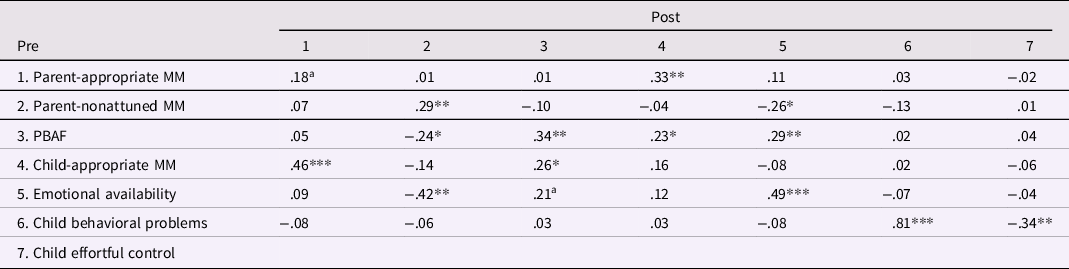
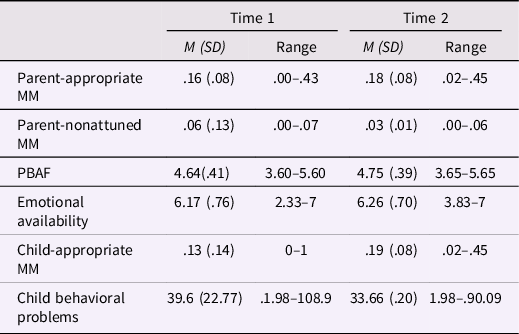
Baseline bivariate correlations between the variables at T1 and at T2, separately, are presented in Table 2 (Bivariate Correlations for Study Variables). As seen at T1 (see figures below diagonal) correlations between parent-appropriate MM and child-appropriate MM were significantly positive. Parent-nonattuned MM was significantly negatively related to emotional availability. At T2, as at T1, correlations between parent-appropriate and child-appropriate MM were significantly positive. Parent-nonattuned MM was significantly negatively related to PBAF and emotional availability. The examination of the correlations between T1 and T2 (see figures on the diagonal) revealed positive correlations for all variables between T1 and T2, except for parent-appropriate MM (which was close to significant) and child-appropriate MM (which was not a significant correlate over time). Means and SD for outcome variable for T1 and T2 are presented in Table 3.
Bivariate correlations for study variables at time 1 and time 2

a p < .10;
*p < .05; **p < .01; ***p < .001.
Means and SD for outcome variables by time

Improvement in PRF and its association with improvement in emotional availability and child outcome
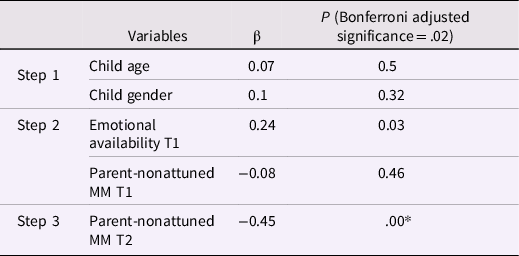
To test our first hypothesis proposing that the improvement in PRF would predict improvement in parental emotional availability, a series of hierarchical regression analyses was conducted. As seen in Table 4 (Emotional Availability by PRF Regression), decline in parent-nonattuned MM predicted improvement in emotional availability, while controlling for SES. Overall, the models were significant, accounting for 32% of the variance (adjusted R 2 ), with medium effect size (see Table 4). The same models were not significant when considering changes in parent-appropriate MM and PBAF.
Sequential regression results for the prediction of improvement in emotional availability by PRF (n = 84)

Note. R 2 adjusted = .32; post hoc power analysis = .99; effect size f 2 for step 3 = .23.
* p < .001.
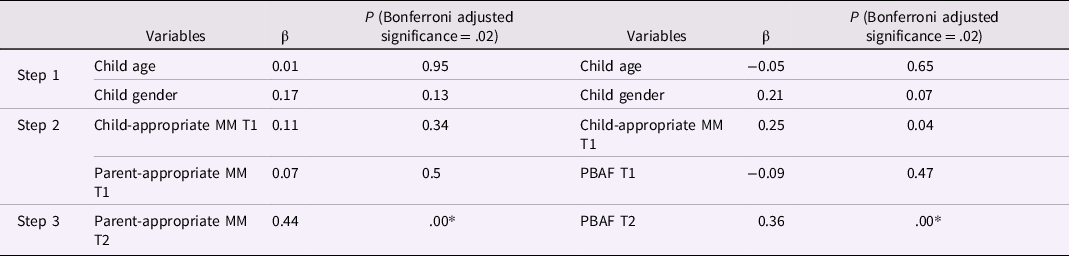
To test our second hypothesis suggesting that improvement in PRF would predict improvement in child RF, a series of hierarchical regression analyses was conducted. As seen in Table 5 (Child-Appropriate MM by Parent-Appropriate MM and PBAF Regressions), improvement in parent-appropriate MM as measured during the parent–child interaction and PBAF as reported by the parent predicted improvement in child-appropriate MM, while controlling for child age and gender. Overall, the models were significant, accounting for 23% and 14% of the variance (adjusted R 2 ), respectively, with medium effect sizes, (see Table 5). The same models were not significant when considering changes in parent-nonattuned MM.
Sequential regression results for the prediction of improvement in child-appropriate MM by parent-appropriate MM and PBAF (n = 84)

Note. For parent-appropriate MM: R 2 = .23; post hoc power analysis = .82; effect size f 2 for step 3 = .22; For PBAF: R 2 adjusted = .14; post hoc power analysis = .45; effect size f 2 for step 3 = .10.
* p < .001.
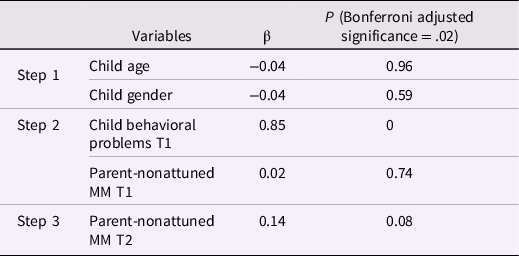
To test our third hypothesis suggesting that improvement in PRF would predict improvement in child behavioral problems, a series of hierarchical regression analyses was conducted. Results show a trend toward statistical significance; decline in parent-nonattuned MM predicted decline in child behavioral problems, while controlling for child age and gender. Overall, the model was significant, accounting for 66% of the variance (adjusted R 2 ) and small effect size, (see Table 6. Improvement in Child Behavioral Problems by Parent-Nonattuned MM Regression). The same models were not significant when considering changes in parent-appropriate MM and PBAF.
Sequential regression results for the prediction of improvement in child behavioral problems by parental-nonattuned MM (n = 84)

Note. R 2 adjusted = .66; post hoc power analysis = 1; effect size f 2 for step 3 = .01.
The moderating role of child temperament in the link between PRF and child outcome
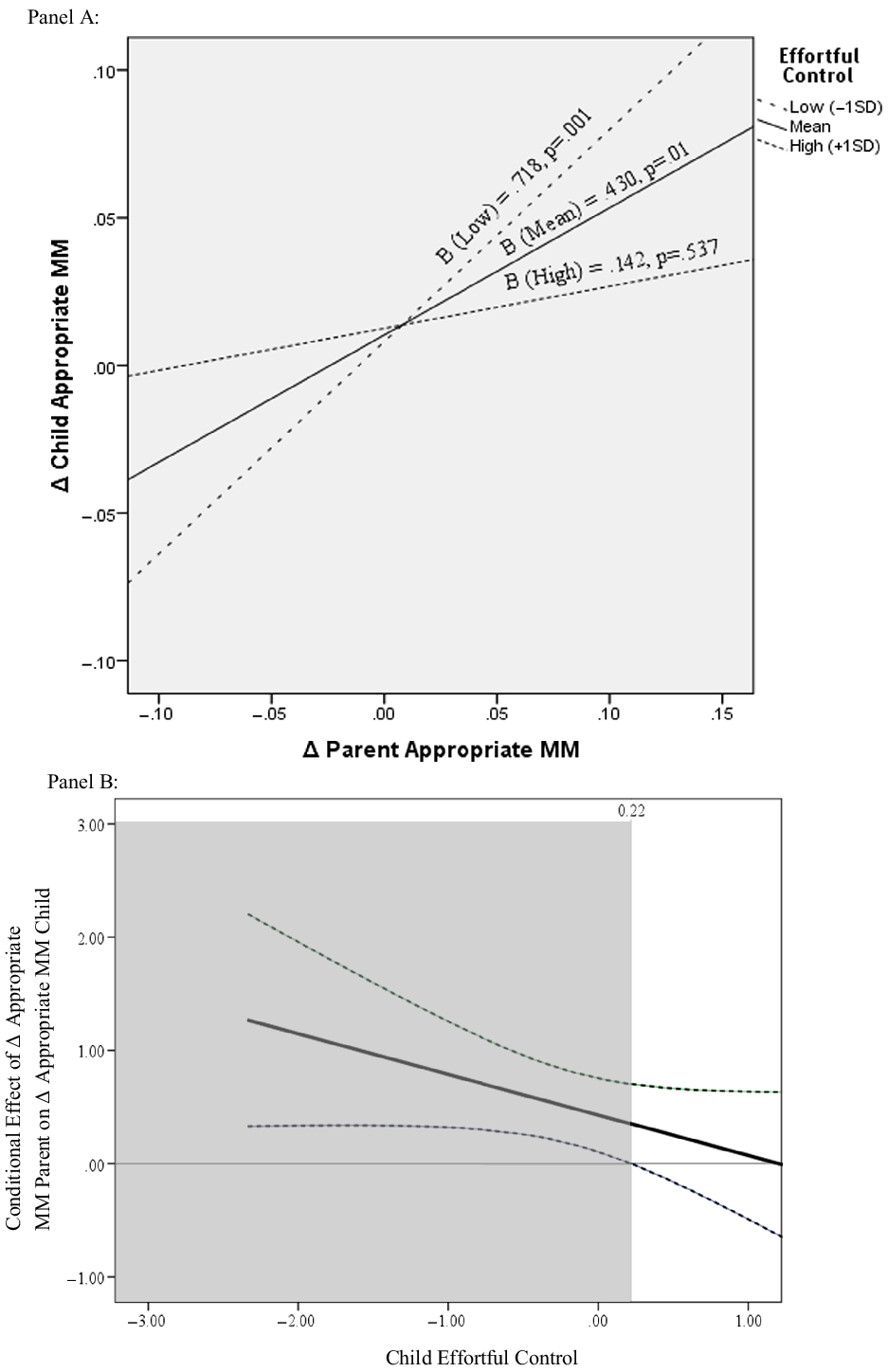
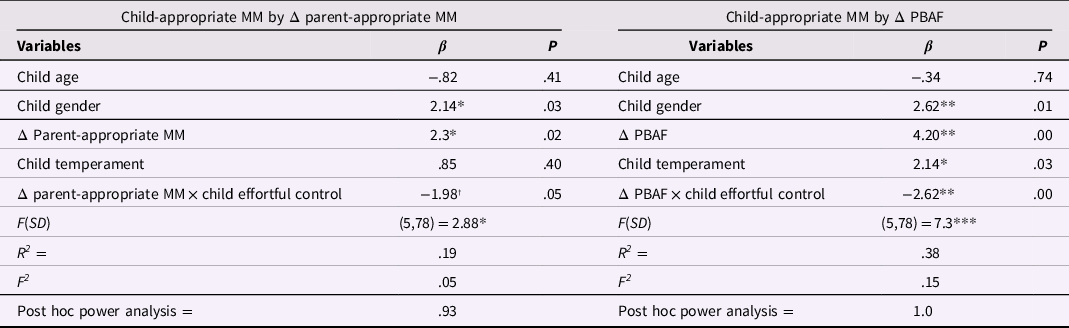
To test the moderating role of child temperament in the link between Δ RF and Δ emotional availability and child outcome (Δ child RF and Δ child behavioral problems), multiple regression analyses were conducted. Results revealed a close to significant interaction effect in the interaction between Δ parent-appropriate MM× child temperament (EC) interactions with small and medium effect size, respectively (see Table 7). Thus, a simple slope analysis was conducted. The link between Δ parent-appropriate MM and Δ child-appropriate MM was examined for children with low or high EC levels, while holding mean levels of child age and gender constant. A simple slopes analysis (see Figure 2, Panel A: Moderating Child EC in the Link Between Δ Parent-Appropriate MM and Δ Child-Appropriate MM) revealed that the link between Δ parent-appropriate MM and Δ child-appropriate MM was significant when children had low levels (−1 SD) and medium levels of EC, b = .718, p < .001; b = .430, p < .01, respectively. However, no significant link was evident for children with high levels of EC (+1 SD; b = .14, p = .57). A Johnson–Neyman analysis revealed that the link between Δ parent-appropriate MM and Δ child-appropriate MM was significant for EC values less than .22 (64.28% of the sample; see Figure 2, Panel B).
The moderating role of child temperament (effortful control) in the link between Δ parent-appropriate MM (independent variable) and Δ child-appropriate MM (dependent variable). Panel A presents simple slopes at levels of low, mean, and high levels of child effortful control. Panel B presents the results of the Johnson–Neyman analysis, depicting the point-estimate of the slope linking Δ parent-appropriate MM and Δ child-appropriate MM as a function of child effortful control, and dotted lines indicate the upper and lower limits of the 95% confidence interval. Values in the gray area are significantly different from zero. Note. MM = mind-mindedness.

Regression results for the prediction of Δ child-appropriate MM by Δ parent-appropriate MM/Δ PBAF and child temperament (effortful control)

† p < .09;
*p < .05; **p < .01; ***p < .001.
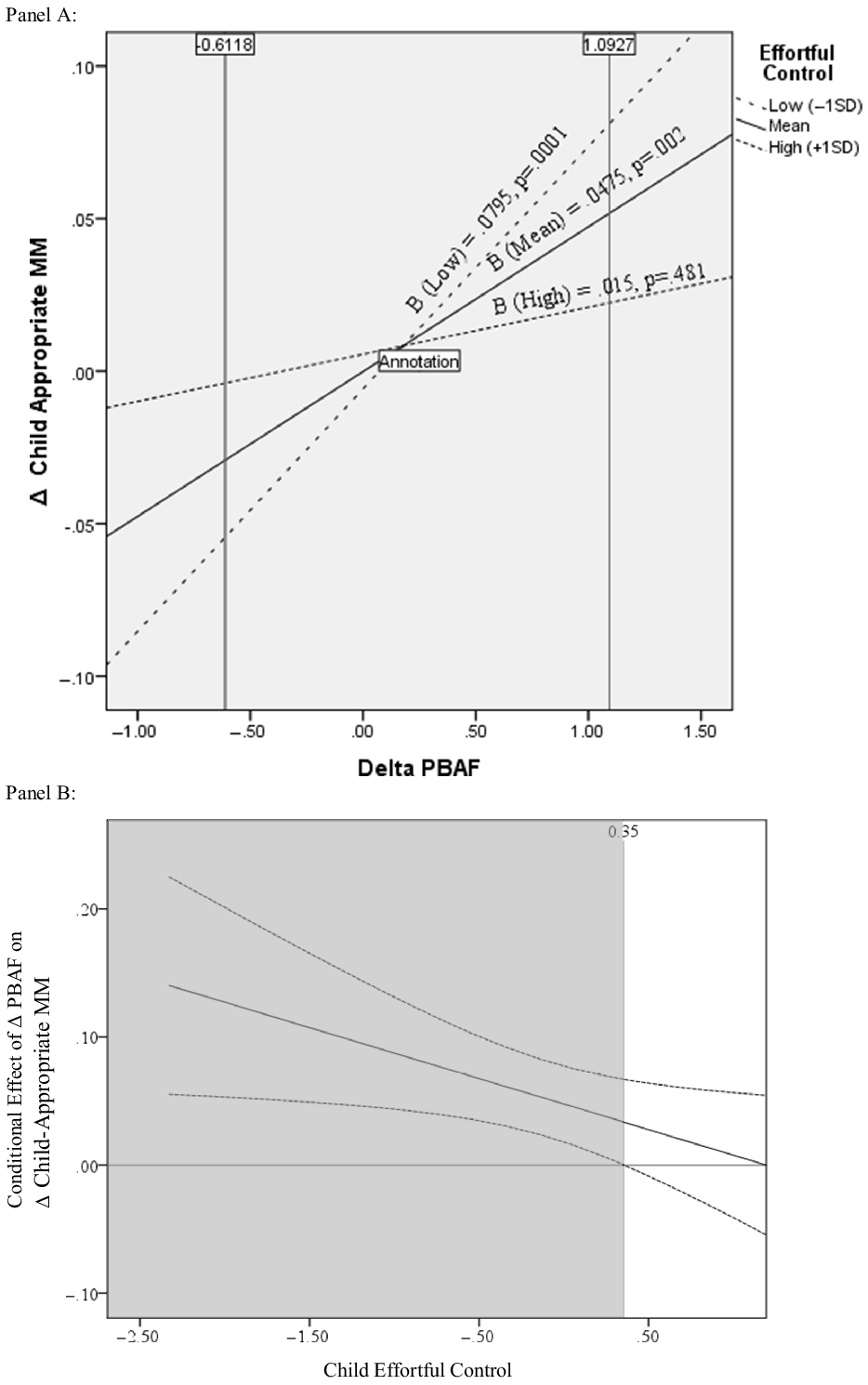
Regarding Δ PBAF and Δ child-appropriate MM, results revealed a significant interaction in Δ PBAF× child temperament (EC) with medium effect size. Thus, a simple slope analysis was conducted. The link between Δ PBAF and Δ child-appropriate MM was examined for children with low or high levels of EC, while holding mean levels of child age and gender constant (see Table 7). A simple slope analysis revealed that the link between Δ PBAF and Δ child-appropriate MM was significant when children had low (−1 SD) and medium levels of EC, b = .079, p < .001; b = .047, p < .01, respectively. However, no significant link was evident for children with high levels of EC (+1 SD; b = .015, p = .48; see Figure 3, Panel A: Moderating Child EC in the Link Between Δ PBAF and Δ Child-Appropriate MM). Following that, RoS was calculated. We found that the lower and the upper bounds of RoS of Δ PBAF were −0.612 and 1.093, respectively. This indicates that the regression line of low EC was significantly different from the regression line of high EC for all possible points, when the score of the Δ PBAF was higher than 1.093 or lower than −0.612. A Johnson–Neyman analysis revealed that the link between Δ PBAF and Δ child-appropriate MM was significant for EC values less than .35 (69.05% of the sample; see Figure 3, Panel B). Finally, nonsignificant results were found in the models, including the interaction between Δ emotional availability and child EC when predicting Δ child behavioral problems and Δ child-appropriate MM.
The moderating role of child temperament (effortful control) in the link between Δ PBAF (independent variable) and Δ child-appropriate MM (dependent variable). Panel A presents simple slopes at levels of low, mean, and high levels of child effortful control. Panel B presents the results of the Johnson–Neyman analysis, depicting the point-estimate of the slope linking Δ parental PBAF and Δ child-appropriate as a function of child effortful control, and dotted lines indicate the upper and lower limits of the 95% confidence interval. Values in the gray area are significantly different from zero. Note. PBAF = parental beliefs about feelings. MM = mind-mindedness.

Discussion
The goal of our study was to understand the relation between improvement in PRF following participation in the DUET intervention and changes in parent–child interactions and child outcomes and how these links may be important, particularly for children with low levels of EC.
Improvement in PRF and child RF
Our analysis indicated that improvement in child RF was related to improvement in PRF. These findings align with previous studies, which have shown that PRF was positively related to child RF (Ensink et al., Reference Ensink, Normandin, Target, Fonagy, Sabourin and Berthelot2015; Rosso et al., Reference Rosso, Viterbori and Scopesi2015; Scopesi et al., Reference Scopesi, Rosso, Viterbori and Panchieri2015), and provide support for the hypothesis that changes in PRF may, in fact, influence child RF. Child RF plays a crucial part in the development of child adaptive behavior or, conversely, psychopathology (Fonagy, Reference Fonagy1998). Therefore, improving child RF is a main target of change in treatment. Our results support Sameroff’s transactional model (Sameroff, Reference Sameroff1975, Reference Sameroff2004), suggesting that changes in the parent can lead to changes in the child and specifically highlight the importance of working with parents on PRF in therapy as a port of entry leading to better child RF. Because PRF was assessed using different measures (each assessing distinct aspects of RF), our study uncovered more specific links between PRF and improvement in child RF. That is, we found that the links between the improvement in PRF and the improvement in child RF existed only when assessing parent-appropriate MM comments (medium effect size) and parents’ perceptions of their child’s emotions (i.e., parents’ belief that their children were developmentally ready to control or talk about emotions; medium effect size). This more specific and accurate understanding of PRF suggests that to promote an improvement in child RF, more focus should be given to parents’ perceptions of their child’s developmental and emotional ability and to parents’ abilities to observe and speak in real time to their child in an accurate manner reflecting their child’s mental state.
Improvements in the parent–child interaction and PRF
Improvement in the parent–child interaction was related to the improvement in PRF. Specifically, reduction in parent-nonattuned MM following the intervention was found to be related to an increase in emotional availability (small effect size). This finding may also be viewed in light of Sameroff’s transactional model (Sameroff, Reference Sameroff1975, Reference Sameroff2004) showing that the changes in parents’ perception and behaviors may lead to changes in the parent–child interaction. This is not the first study to demonstrate that PRF was related to the parent–child interaction among preschool children (McMahon & Meins, Reference McMahon and Meins2012) nor the first study to indicate that PRF intervention can improve parent–child interactions (Hertzmann et al., Reference Hertzmann, Target, Hewison, Casey, Fearon and Lassri2016; Suchman et al., Reference Suchman, DeCoste, McMahon, Dalton, Mayes and Borelli2017, Reference Suchman, DeCoste, Borelli and McMahon2018). However, in this study, we demonstrated that it was the improvement specifically in the parent-nonattuned MM measure that was related to the improvement in the parent–child interaction. This means that as parents make fewer misattributions of their child’s inner world during interactions, the parent–child interaction becomes more positive.
Improvements in child behavioral problems and PRF
Addressing our final and perhaps most significant outcome measure – child behavioral problems – we found a trend in results, suggesting that an improvement in PRF (particularly in parent-nonattuned MM comments) might be related to a decrease in child behavioral problems (small effect size). This finding supports previous findings indicating the links between PRF and child behavioral problems (e.g., Benbassat & Priel, Reference Benbassat and Priel2012; Camoirano, Reference Camoirano2017) and expands them to the process of intervention. That is, the novelty of our finding is in assessing the change in PRF and child behavioral problems after intervention and identifying the specific aspect of RF that is related to the decrease in the behavioral problem, namely, the parent-nonattuned MM comments. Not much is known about nonattuned comments from previous studies. In a still-face paradigm study, researchers found that nonattuned comments (rather than the appropriate comments) predicted child dysregulated and negative behavior (McMahon & Newey, Reference McMahon and Newey2018). We can therefore speculate that parent-nonattuned comments may be the RF factor that contributes to the development of behavioral problems; a decrease in parent-nonattuned comments may lead to a reduction of the child’s negative behavior. It seems that parents’ misinterpretation of their children’s cues and a failure to appropriately address their child’s inner worlds (by making false assumptions [“biased mirroring”]) may impair their child’s self-regulation. Following intervention, parents made fewer nonattuned comments. This change was related to the child’s ability to better understand their inner world, leading to better self-regulation and fewer behavior problems. Of note, similar to previous studies on PRF-focused interventions (Byrne et al., Reference Byrne, Murphy and Connon2020), the effect sizes of the links between PRF and the outcome variables varied and ranged from small to large.
Child temperament as a moderator of the relation between improvement in PRF and child outcome: Vantage sensitivity model
Results indicate that child temperament acted as a moderator in the link between PRF and child outcome. More specifically, improvement in parent-appropriate MM comments was related to improvement in child-appropriate MM comments, only when the level of child EC was low to average (small effect size). Similarly, when the level of child EC was low to average, the improvement in the relationship between parental beliefs regarding child feelings and the improvement in child-appropriate MM comments was significant (medium effect size), meaning that it was the more vulnerable children who benefitted the most as a result of a positive change in their parents’ RF.
These results can be viewed considering the vantage sensitivity model, which suggests that certain child traits may contribute to a more positive outcome under positive and adaptive parenting. Research has found this theory to be true, not only in developmental studies but also in interventional studies. For example, in an attachment-based intervention, researchers found that intervention was more effective for highly irritable infants (Cassidy et al., Reference Cassidy, Woodhouse, Sherman, Stupica and Lejuez2011).
How do individual differences in child EC result in some children being more responsive to parental improvement in RF? EC has been linked to the regulation and modulation of emotions and emotionally relevant behaviors (Eisenberg et al., Reference Eisenberg, Spinrad and Eggum2010). One possible explanation may be that if children with poor emotional and behavioral regulation – children who are struggling with understanding and controlling their own emotions and behaviors – have parents who, following intervention, are better able to pause, observe, and react appropriately (thus becoming more attuned to their environment and responding more sensitively) then this positive change could be exactly what their children need to better adjust and develop. However, if parents are unable to be more reflective following a 12-week intervention program focusing precisely on enhancing PRF, if parents fail to increase their ability to understand their children’s emotions, thoughts, desires, and wishes, then their children might continue to experience a less attuned, less positive environment and therefore continue to exhibit behavioral problems.
Over the last decade, extensive study has stressed the importance of tailored therapy, that is, the examination of “what works for whom” or providing specific therapy according to each individual’s needs. Researchers have found that tailored therapy increases the effectiveness of treatment, resulting in a greater efficacy overall (Insel, Reference Insel2009; Simon & Perlis, Reference Simon and Perlis2010). Our results expand existing knowledge regarding tailored therapy, adding the vantage sensitivity of child temperament as an important characteristic that needs to be considered when considering parenting intervention.
Study limitations and future directions
This study has several limitations to consider. First, child temperament and child behavioral problems were assessed using parental reports. Future studies using observational assessments or other independent reports (e.g., teachers), in addition to parental reports, may provide important replication for these findings. Second, due to a relatively small sample size, our analyses were conducted on both mothers and fathers. Future studies should consider an examination of the differences between mothers and fathers. Third, in this study, due to the complexity of conducting interventional research, only two time points were assessed. Therefore, we cannot assume causality. Future studies should investigate causality by having multiple time points, which may thus better refer to mechanisms of change due to the intervention. Finally, in this study, we did not have a randomized controlled trial nor a comparison sample. This was due to the difficulty in recruiting parents to the study. Future studies examining the DUET program may wish to employ a randomized controlled trial study design.
Clinical implications
Our study has several important clinical implications. First, the importance of PRF as a valuable target of change in therapy was shown. Therefore, intervention programs for parents should emphasize the importance of PRF and find ways to enhance this function. Secondly, results (regarding the PRF component) that were correlated with changes in child outcome, in particular parent-appropriate MM and parents’ beliefs regarding their children’s feelings, can help therapists specifically address these aspects, as opposed to generally addressing PRF in therapy. Our results suggest that intervention should focus on helping parents use more adequate reflective thinking and language during interactions with their children and on addressing the issue of parents’ beliefs regarding their children’s feelings. Another important implication is the moderation model and the vantage sensitivity that was found for child temperament suggest that children with low levels of EC can benefit more when their parents’ RF is enhanced.
Acknowledgments
This research was supported by Judge Leon S. Kaplan, who donated funds to the DUET center. We would like to thank the group facilitators, the students who collected and coded data, and to the parents and their children for their ongoing participation in this study. Professional English-language editing and review services were provided by Ms. Havah Strickler Kalati.
Funding statement
This research was supported by Judge Leon S. Kaplan, who donated funds to DUET center.
Conflicts of interest
None.