INTRODUCTION
The phosphorylation of tyrosine (Tyr) residues in proteins is the key element of the signalling pathways induced by environmental stimuli that regulate cellular responses such as growth, proliferation, differentiation, metabolism, and migration. The level of protein tyrosine phosphorylation appears to be modulated within the cell by both protein tyrosine kinases (PTKs) and protein tyrosine phosphatases (PTPases). The PTKs are enzymes responsible for phosphorylation of Tyr residues and the PTPases dephosphorylate Tyr residues (Tonks, 2003). It has been shown that these protein kinases and phosphatases also influence survival, internalization, and replication of pathogens by affecting phosphorylation of host cells and thus interfering with many signal transduction pathways (DeVinney, Steele-Mortimer and Finlay, 2000).
PTPases have been identified in bacteria, such as Salmonella and Yersinia, and in parasites such as Ascaris suum, Trypanosoma brucei and Entamoeba histolytica (Guan and Dixon, 1990; Schmid et al. 1996; Fu and Galán, 1998; Bakalara et al. 2000; Aguirre-García, Anaya-Ruiz and Talamás-Rohana, 2003). The PTPases of Salmonella and E. histolytica have been shown to disrupt actin fibres in epithelial cells resulting in cytoskeletal rearrangements (Fu and Galán, 1998; Aguirre-García et al. 2003). Furthermore, proteins identified as docking protein Cas and Fyn-binding (FYB) protein are dephosphorylated by the PTPases of Yersinia and this was associated with disruption of focal complexes (Hamid et al. 1999). The PTPase of Yersinia inhibits phagocytosis and the oxidative burst in macrophages (Bliska and Black, 1995; Green et al. 1995; Andersson et al. 1996).
Little is known regarding the presence of PTPases in Leishmania, a protozoan parasite that causes a wide range of cutaneous and visceral diseases in humans worldwide. Leishmania is able to survive and replicate within host macrophages. It is becoming increasingly evident that Leishmania evades host defence mechanisms by disrupting important target cell functions and has evolved mechanisms that modulate host cell signalling pathways in order to facilitate invasion and survival. It has been postulated that Leishmania interferes with signal transduction in macrophages. It has also been shown that infection of human monocytes with Leishmania donovani selectively attenuates the gamma interferon (IFN-γ) – activated Jak-Stat1 signalling pathway by inhibiting tyrosine phosphorylation of Jak1, Jak2 and Stat1 (Nandan, Lo and Reiner, 1999). Recent studies have suggested that the PTPase SHP-1 plays a role in the pathogenesis of Leishmania infections through PTPase activation in macrophages by Leishmania (Blanchette et al. 1999; Nandan et al. 1999; Forget et al. 2001).
Here we report the detection of PTPase activity in Leishmania promastigotes in 2 stages of its life-cycle: procyclic and metacyclic promastigotes. We achieved total inhibition of the enzymatic activity of metacyclic promastigotes with both PTPase and serine/threonine phosphatase inhibitors, whereas the enzymatic activity in procyclic promastigotes was considerably inhibited only with PTPase inhibitors. Additionally, using Western blotting we identified a Leishmania 55–60 kDa PTPase by means of 2 independent antibodies: a monoclonal antibody directed against the catalytic site of human placental PTPase 1B, and a polyclonal antibody directed against a PTPase from T. brucei. We also analysed its ultrastructural localization in both procyclic as well as metacyclic Leishmania major promastigotes.
MATERIALS AND METHODS
Cell culture
L. major promastigotes strain MHOM/SU/73/5-ASKH (a generous gift from Dr H. Moll, University of Würzburg, Germany) were grown in blood agar (NNN medium) overlaid with Schneider's Drosophila medium (Life Technologies) supplemented with 10% heat-inactivated FBS at 28 °C. Parasites were subcultured every 3–4 days and grown to a density of 1×10⁷/ml. All parasites used in this study were taken from stationary-phase cultures before harvesting. Prior to harvesting, the parasites were transferred for 24 h to a serum-free RPMI liquid culture medium. Metacyclogenesis was determined with peanut agglutinin (PNA) as described by Sacks, Hieny and Sher (1985), incubating 2–5×10⁸ promastigotes with 100 μg/ml PNA for 1 h at 25 °C, after which the parasites were centrifuged at 150 g for 5 min and the non-agglutinated metacyclic parasites were obtained in the supernatant, whereas procyclic parasites were obtained from the agglutinated pellet.
Preparation of the soluble detergent-extracted fraction
For the detergent-extracted fraction 7×10⁸ procyclic or metacyclic promastigotes were suspended in buffer A (10 mM imidazole-HCl, pH 7·2, 5 mM EDTA, 0·1% 2-β mercaptoethanol, 1 mM benzamidine, 2 μg/ml leupeptin, 10 μg/ml aprotinin) and disrupted by sonication (3 cycles of 3 min [Model VCX 650, Ultrasonic processor, Ultrasonics, Inc.]). The homogenate was centrifuged at 16000 g for 15 min at 4 °C to obtain a supernatant containing soluble components and a pellet. The pellet was suspended in buffer B (buffer A plus 2% Triton X-100), and centrifuged at 16000 g for 15 min at 4 °C, to obtain a soluble detergent-extracted fraction and an insoluble pellet, as previously described (Aguirre-García, Cerbon and Talamás-Rohana, 2000). Soluble components, soluble detergent-extracted fraction, and pellets were used to analyse acid phosphatase and PTPase activities.
Acid phosphatase activity
Acid phosphatase activity was determined as described (Dissing, Dahl and Svensmark, 1979). Briefly, samples were incubated for 60 min at 37 °C in 200 mM sodium acetate, pH 5 for procyclic, and pH 6·0 for metacyclic parasites containing 10 mM of p-nitrophenyl phosphate (p-NPP) in a final volume of 120 μl. After stopping the reaction with 2 M NaOH (20 μl), the absorbance of p-nitrophenol was measured at 405 nm and its concentration determined using absorptivity of ε=1·78×104 M/cm. One unit is defined as the amount of enzyme that hydrolyses 1 μmol substrate/min. Specific activity is expressed as enzyme units per mg of protein. Protein concentration was determined by the method of Bradford (1976) with bovine serum albumin as standard.
Phosphotyrosine phosphatase (PTPase) activity
PTPase activity was assayed using Promega's non-radioactive tyrosine phosphatase assay system. This system determines the amount of free phosphate generated in a reaction by measuring the absorbance of a molybdate:malachite green:phosphate complex. The solubilized detergent-extracted fraction was passed through spin columns in order to remove free phosphate and other low molecular weight inhibitors from the sample. Samples containing the same amount of protein were incubated during 30 min at room temperature in a total volume of 100 μl assay buffer containing 200 mM sodium acetate, pH 5·0 for procyclic and pH 6·0 for metacyclic promastigotes. The reaction was started by adding 50 μM Tyr phosphopeptide-1 substrate [END (pY) INASL], and was stopped with 50 μl molybdate dye/additive mixture. The optical density of the samples was read at 630 nm.
Inhibitors
Soluble detergent-extracted fraction was analysed with specific PTPase inhibitors such as sodium orthovanadate, ammonium molybdate, sodium tungstate at 200 μM and dephostatin at 100 μM. Additionally, serine/threonine phosphatase inhibitors such as calyculin (5 nM), okadaic acid (1 μM), and trifluoperazine (100 μM) were added to the samples containing the enzyme. The reaction mixture (100 μl) was pre-incubated for 15 min at room temperature before adding the Tyr phosphopeptide-1 substrate and incubation was continued thereafter for another 30 min at room temperature. The PTPase activity was determined as described above.
Western blot
Samples from the soluble detergent-extracted fraction of procyclic (5 μg) and metacyclic (1 μg) promastigotes were analysed by SDS-PAGE in 10% acrylamide gels. The gels were stained with Coomassie blue and transferred to nitrocellulose paper (NCP). Blots were incubated with the polyclonal rabbit anti-recombinant protein Petase7 (containing the N-terminal part of TryAcP115 from T. brucei) at a 1/1000 dilution or with the monoclonal antibody (oncogene, PH01) generated against the catalytic domain of a recombinant human placental PTPase 1B (1 μg/ml), followed by incubation with secondary antibodies: peroxidase-conjugated goat anti-rabbit IgG (Biomeda Corp.; dilution 1/5000), HRP-conjugated goat anti-mouse IgG (Zymed; dilution 1/5000) and alkaline-phosphatase (AP)-conjugate goat anti-mouse IgG (Santa Cruz Biotechnology; dilution 1/5000). Blots were developed by chemiluminescence (Pierce) for HRP and according to Sambrook, Fritsch and Maniatis (1989) for AP.
Ultrastructural localization of Leishmania PTPase
Procyclic and metacyclic L. major promastigotes were instantly fixed with a combination of 4% parformaldehyde/0·5% glutaraldehyde in 0·1 M sodium cacodylate buffer (pH 7·4) during 2 h at 4 °C. After washing 3 times in the same buffer with 5% sucrose, they were post-fixed in 1% osmium tetraoxide for 5 min at 4 °C. After being washed, parasites were processed for transmission electron microscopy. Promastigotes were embedded in LR White medium to preserve the antigenicity of the PTPase (Bozzola and Russell, 1998). Ultrathin sections were mounted in nickel grids and immunogold labelling procedures were carried out directly, using modifications of the method described previously (Varndell et al. 1982). Major modifications included: no etching of parasite sections with hydrogen peroxide to expose hidden antigenic sites, 10% normal goat serum for blocking non-specific sites, and the primary antibody was TryAcP115 (a rabbit polyclonal antibody against PTPases of T. brucei) diluted 1[ratio ]100 in Tris-HCl, 0·05 M (pH 7·2)/2% BSA/0·01% Triton X-100. A biotinylated secondary antibody (goat anti-rabbit IgG H+L) was employed following the manufacturer's instructions (Zymed Laboratories Inc.). Finally, grids were incubated in streptavidin coupled to 10 nm gold particles (Sigma) diluted 1[ratio ]50 in Tris-HCl, 0·05 M (pH 8·3)/0·5% BSA/0·01% Triton X-100 during 1 h at room temperature and then were thoroughly washed with Tris-HCl, 0·05 M without BSA and deionized water. After being contrasted with 2% aqueous uranyl acetate, sections were observed in a Zeiss EM-10 electron microscope. Incubation with rabbit normal serum (diluted 1[ratio ]100) as primary antibody or omission of rabbit polyclonal antibody specific to PTPases, were used as controls.
RESULTS
Fractionation of procyclic and metacyclic promastigotes and detection of acid phosphatase and PTPase activities
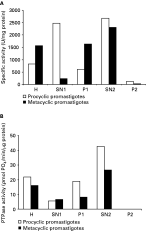
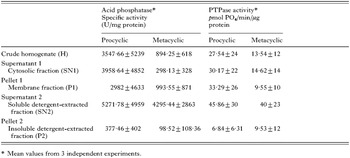
Solubilization and fractionation of procyclic and metacyclic L. major promastigotes revealed the presence of a specific acid phosphatase activity that was detected in the different fractions (Table 1). In procyclic promastigotes we observed an increase in the specific activity of the acid phosphatase in both SN1 and SN2, whereas metacyclic promastigotes had the highest level of acid phosphatase activity in SN2. The results of a representative experiment are shown in Fig. 1A, where we obtained values for the crude homogenate (H): 831 U/mg protein for procyclic and 1563 U/mg protein for metacyclic; supernatant (SN1): 2482 U/mg protein for procyclic and 237 U/mg protein for metacyclic; membrane bound acid phosphatase activity (P1): 616 U/mg protein for procyclic and 1627 U/mg protein for metacyclic; soluble detergent-extracted fraction (SN2): 2678 U/mg protein for procyclic and 2309 U/mg protein for metacyclic; insoluble detergent-extracted fraction (P2): 124·5 U/mg protein for procyclic and 18·5 U/mg protein for metacyclic promastigotes.

Fig. 1. Acid phosphatase activity (using pNPP as substrate) (A) and PTPase activity (using tyrosine phosphorylated peptide [END (pY) INASL]) (B) of different fractions of Leishmania major promastigotes. Crude homogenate (H), supernatant (SN1), pellet 1 (P1), soluble detergent-extracted fraction (SN2), insoluble detergent-extracted fraction (P2). Data represent 1 of 3 independent experiments.

Besides the acid phosphatase analysis, these same fractions from procyclic and metacyclic promastigotes were also analysed for PTPase activity. As seen in Table 1, the SN2 fraction obtained from procyclic promastigotes showed a higher dephosphorylation activity than that of metacyclic promastigotes. Therefore this fraction was used for further analysis. A representative experiment for the analysis of PTPase activity of the different fractions is shown in Fig. 1B. In this representative experiment the PTPase activity was as follows: (H): 21·96 pmol PO4/min/μg protein for procyclic and 16·04 pmol PO4/min/μg protein for metacyclic; (SN1): 5·62 pmol PO4/min/μg protein for procyclic and 6·52 pmol PO4/min/μg protein for metacyclic; (P1): 18·96 pmol PO4/min/μg protein for procyclic and 8·26 pmol PO4/min/μg protein for metacyclic; (SN2): 42·66 pmol PO4/min/μg protein for procyclic and 26·54 pmol PO4/min/μg protein for metacyclic; (P2): no activity was detected for both procyclic and metacyclic promastigotes.
These data show that the SN2 fraction had both, the highest acid phosphatase, as well as PTPase values and, in both cases, these values were higher in procyclic promastigotes than in metacyclic promastigotes.
Effect of specific inhibitors on the PTPase activity of procyclic and metacyclic promastigotes
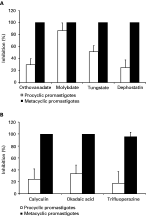
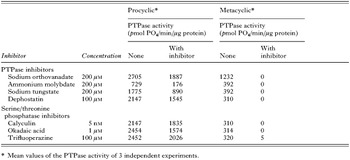
The effects of different PTPase and serine/threonine phosphatase inhibitors on the SN2 fraction of procyclic and metacyclic promastigotes were tested using the tyrosine phosphatase assay system that contained the peptide: [END (pY) INASL]. Metacyclic PTPase activity was completely inhibited by specific PTPase inhibitors such as sodium orthovanadate, ammonium molybdate, sodium tungstate and dephostatin. Metacyclic PTPase could also be inhibited by serine/threonine phosphatase inhibitors such as calyculin, okadaic acid and trifluoperazine. The PTPase activity in the procyclic SN2 fraction was considerably inhibited by the PTPase inhibitor ammonium molybdate and to a much lesser degree by the other PTPase inhibitors, whereas serine/threonine inhibitors had a low inhibitory effect on the procyclic PTPase activity (Table 2). The mean values of the percentage inhibition achieved by the different PTPase and serine/threonine phosphatase inhibitors on the SN2 fractions of procyclic and metacyclic promastigotes are shown in Fig. 2A and B, respectively.
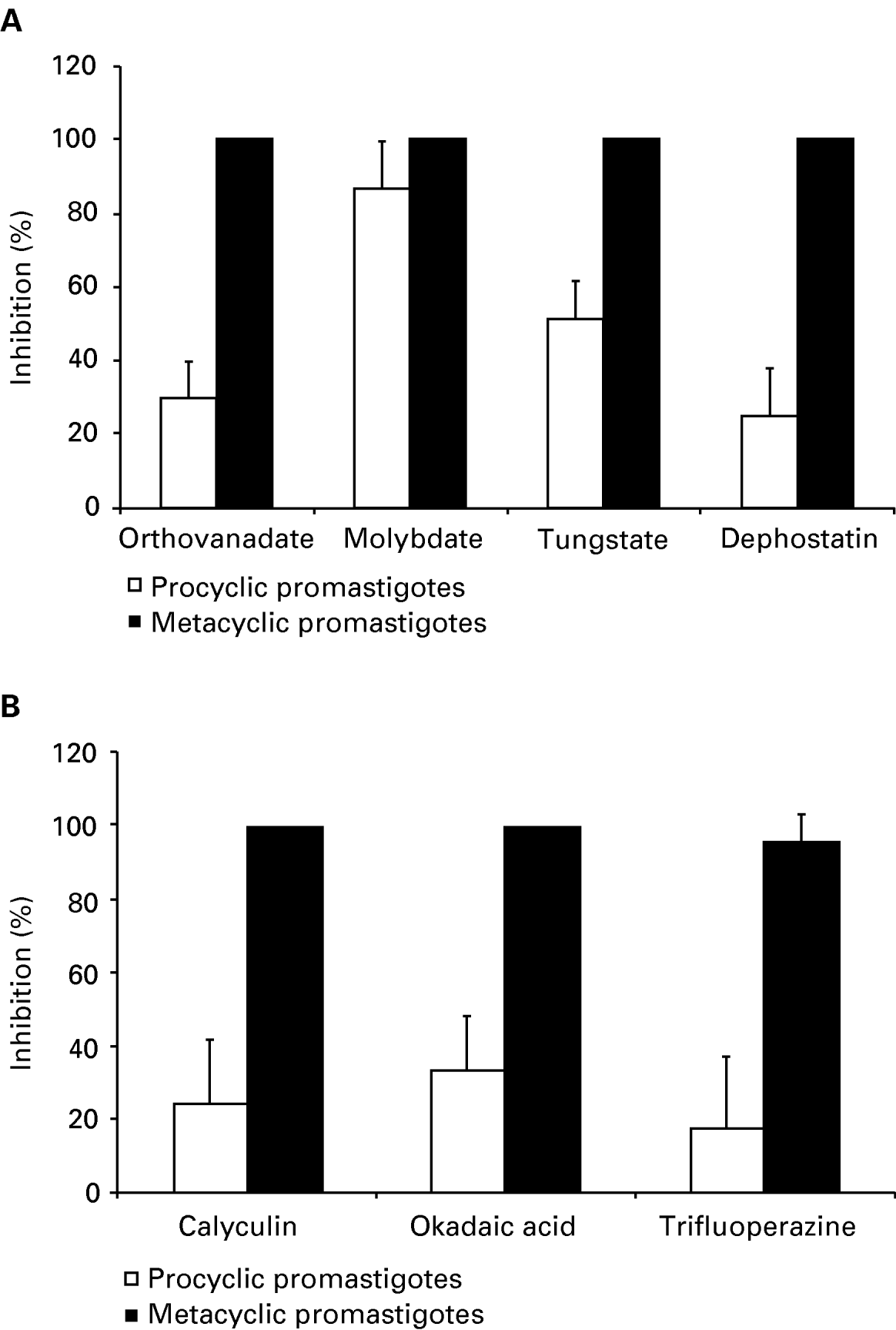
Fig. 2. Effect of different inhibitors on PTPase activity of procyclic and metacyclic Leishmania major promastigotes. PTPase inhibitors (A) and serine threonine phosphatase inhibitors (B). The bars represent the mean values of the percentage inhibition obtained separately in 3 different experiments.

Identification of a Leishmania major PTPase
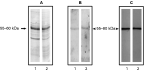
The presence of a PTPase in the SN2 fraction of L. major promastigotes was analysed in 10% SDS gels, showing an intense band of 55–60 kDa (Fig. 3A) in both procyclic (lane 1) and metacyclic promastigotes (lane 2). Western blotting with a monoclonal anti-human placental PTPase 1B antibody (Fig. 3B), which is directed against the catalytic site of the enzyme, and a polyclonal antibody, directed against a PTPase from T. brucei (Fig. 3C), showed that both antibodies recognized a 55–60 kDa molecule present in the SN2 of procyclic (lanes 1) and metacyclic (lanes 2) L. major promastigotes. A higher amount of the 55–60 kDa protein was found in metacyclic promastigotes, when compared to procyclic parasites, since 5 μg protein of the latter were required to achieve the same level of detection observed with 1 μg protein of the former.

Fig. 3. Western blot reactivity of the detergent-solubilized fraction (SN2) of procyclic and metacyclic Leishmania major promastigotes was analysed with anti-human placental and TryAcP115 from Trypanosoma brucei antibodies. Coomassie blue staining of the soluble detergent-extracted fraction of procyclic (lane 1) and metacyclic (lane 2) promastigotes after 10% SDS-PAGE (A). Western blotting with anti-human placental PTPase 1B (α-PTPase) (B) and with anti-TryAcP115 from T. brucei (C) recognized a 55–60 kDa molecule present in the detergent-soluble, detergent-extracted fractions of both procyclic (lanes 1) and metacyclic (lanes 2) promastigotes. Results in (B) and (C) are representative of 3 independent experiments.
Ultrastructural localization of a PTPase in metacyclic and procyclic L. major promastigotes
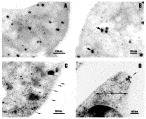
Ultrastructural immunolocalization of the PTPase in both growth phases of L. major promastigotes showed that in procyclic promastigotes the immunogold staining was evenly distributed throughout the cytoplasm (Fig. 4A). Occasionally, immunogold stain was detected in a concentrated form within larger particles, which are easily detected using a higher magnification as seen in Fig. 4B. The PTPase localization in metacyclic L. major promastigotes differed in its distribution, since the staining in the cytoplasm was scarce and instead tended to focalize peripherally on the microtubules of the ectoplasm (see arrows Fig. 4C) or was concentrated on the tip that usually establishes contact with host macrophages (Fig. 4D). In control stains, using a non-specific primary antibody or only secondary antibodies, very few scattered particles could be detected which correspond to background staining which is non-specific (data not shown).

Fig. 4. Ultrastructural localization of a PTPase in procyclic (A and B) and metacyclic (C and D) Leishmania major promastigotes using TryAcP115 antibody. In procyclic promastigotes the PTPase is localized in the cytoplasm and within larger particles as shown by the arrow in (B). In metacyclic promastigotes the staining was more intense in the peripheral tubules of the ectoplasm as shown by arrows in (C) and on the tip as shown in (D).
DISCUSSION
The catalytic domain of diverse PTPases share sequence similarities as has been described for human placenta, bacteria such as Yersinia and bovine PTPases (Fauman and Saper, 1996). In parasites, such as Ascaris suum, more than one PTPase has been purified (Schmid et al. 1996). In L. donovani promastigotes, the presence of a cytosolic Ca2+ and calmodulin-dependent protein phosphatase has been previously reported (Banerjee, Sarkar and Bhaduri, 1999). Inhibitors of protein phosphatases, such as okadaic acid, EGTA, calmidazolium, and fluphenazine inhibited the Ca2+/calmodulin-dependent phosphatase activity in these parasites, indicating that this phosphatase has broadly similar properties to the protein phosphatase 2B (Banerjee et al. 1999). Additionally, it has been shown that L. donovani promastigotes can trigger host PTPase activity leading to dephosphorylation of macrophage protein tyrosyl residues and inhibition of protein tyrosine kinases (PTK) in these cells. These studies have suggested that PTPases play a role in the pathogenesis of Leishmania infection, since the treatment of the infected macrophages with orthovanadate, a PTPase inhibitor, reverses the deactivated phenotype of the infected cells (Nandan et al. 1999). A PTPase activity has also been reported in L. donovani (Cool and Blum, 1993), yet in this study the authors did not identify the enzyme responsible for the PTPase activity. Previous studies have reported that some acid phosphatases can have a PTPase activity (Ansai et al. 1998; Bakalara et al. 2000).
In the present work we initially determined the presence of an acid phosphatase activity in procyclic and metacyclic L. major promastigotes. This activity was enriched in the Triton X-100 solubilized fraction, as has been reported for other parasites (Bakalara et al. 2000; Aguirre-García et al. 2003). By eliminating the cytosolic fractions in the soluble components (SN1), the specific activity of the acid phosphatase increased 148% in procyclic and 480% in metacyclic promastigotes in the SN2 fraction. Only procyclic promastigotes showed a high acid phosphatase activity in SN1, which may correspond to the presence of a cytosolic protein phosphatase activity, as has been reported in other micro-organisms, such as Coxiella burnetii (an obligate intracellular rickettsial parasite), where the enzyme was localized at or near the parasite surface, in the periplasmic space (Baca et al. 1993). PTPase activity was also detected when the fractions were tested using a peptide phosphorylated in tyrosine, showing that the PTPase activity in SN2 increased 166% in procyclic and 295% in metacyclic promastigotes, when compared to crude homogenate. In our study, the soluble detergent-extracted fraction of procyclic and metacyclic L. major promastigotes contained the highest acid phosphatase activity as well as the highest PTPase activity, even though there were differences between the growth phases, since the PTPase activity was higher in procyclic than in metacyclic Leishmania promastigotes. Western blots with 2 different anti-PTPase antibodies (against the active site of human placenta PTPase and against a T. brucei PTPase) detected a 55–60 kDa protein in both procyclic and metacyclic L. major promastigotes. This molecular weight has also been reported for PTPases of other microorganisms (Schmid et al. 1996; Ansai et al. 1998; Bakalara et al. 2000; Aguirre-García et al. 2000). The recognition of the L. major enzyme by a specific monoclonal antibody directed against the conserved catalytic site of the human placenta PTPase-1B, strongly suggests that this epitope may also be present in the PTPase of L. major. A more intense recognition was observed in SN2 of metacyclic over procyclic promastigotes, since 5 times more procyclic than metacyclic protein was required for the immunodetection of the 55–60 kDa protein. This indicates that metacyclic promastigotes have more PTPases that share sequences that cross-react with a 55 kDa molecule also present in PTPases of human placenta, T. brucei, A. suum and E. histolytica (Bakalara et al. 1995; Schmid et al. 1996; Aguirre-García et al. 2003).
Specific inhibitors of protein phosphatases have been widely used for the preliminary characterization of this enzyme (Fukami and Lipman, 1982; Zhang and Van Etten, 1990; Hardie, 1993; Zhang and Dixon, 1994). We used specific inhibitors for both PTPases and serine threonine phosphatases (Ser/threo) and found that their inhibitory effect differed between procyclic and metacyclic promastigotes. Whereas nanomolar and micromolar concentrations of both PTPase and Ser/threo phosphatase inhibitors completely abolished (100% reduction) the PTPase activity of the soluble detergent-extracted fraction of metacyclic promastigotes, in procyclic promastigotes the only inhibitor that showed considerable inhibition of the enzyme was ammonium molybdate, a specific PTPase inhibitor. These results suggest the possible presence of 2 different PTPases in both phases of the life-cycle of L. major promastigotes. Whereas metacyclic promastigotes possibly have PTPases with dual activities of both protein tyrosine and serine/threonine phosphatases, procyclic promastigotes only seem to have activity of protein tyrosine phosphatases. This opens questions regarding the functions of these different Leishmania phosphatases. The parasite undergoes developmentally regulated, stage-specific biochemical and morphological changes during its differentiation from a non-infective avirulent procyclic promastigote, which adheres to the sandfly midgut during its maturation, to an infective virulent metacyclic form that detaches from the sandfly midgut in order to migrate and be expelled during the bloodmeal of the sandfly. During this differentiation process of metacyclogenesis, which occurs in the sandfly vector, the parasite has to adapt to its complex life-cycle in the sandfly vector and in the mammalian host. Striking modifications seem to occur in the type of PTPase molecules expressed during the transformation from the non-infective procyclic stage to the highly infectious metacyclic stage, as has been reported for other L. major molecules, such as LPG (lipophosphoglycan) (Becker et al. 2003). The modifications observed during metacyclogenesis include changes in the ultrastructural localization of PTPase and in the activity of the enzyme. In procyclic promastigotes the PTPase is scattered throughout the cytoplasm, and the enzyme has a high specific activity, even though the 55–60 kDa protein recognized by anti-PTPase antibodies seems to be less expressed, when compared to metacyclic extracts. After metacyclogenesis, there is a shift in the PTPase localization from the cytoplasm towards the membrane, thus moving the enzyme in close proximity to the host cells. During this adaptation process, there is also an increase in the expression of the 55–60 kDa protein recognized by the anti-PTPase antibodies, even though the enzymatic activity seems less pronounced than in procyclic extracts. Yet there is a change in the activity of the enzyme, since a dual activity of the PTPase is detected only in the metacyclic form. It is tempting to speculate that these modifications in enzyme localization and activity that occur during the metacyclic infective stage of the parasite represent an adaptation process preparing the parasite to confront effector mechanisms of the host cell. The ectoplasmic localization of the PTPase could possibly be indicative of external membrane expression or, possibly, the release of Leishmania PTPases, in order to modulate host cell functions. Additionally, the presence of a PTPase with dual activity present during the infective stage may broaden the targets modulated by the enzyme, thus facilitating the invasion process of Leishmania in mammalian host cells. It will be important to establish the role of Leishmania PTPases in the parasites life-cycle in the insect as well as in the mammalian host.
It has previously been shown that a heterologous expression of the mammalian PTP-1B gene (placental PTPase) in Leishmania has a measurable and relevant phenotypic influence on the parasite, inducing its differentiation from promastigote to amastigote, thereby increasing its virulence and promoting its survival inside the macrophage (Nascimento et al. 2003). Thus, Leishmania PTPase possibly not only regulates the parasite's adaptability to the host cell environment but also regulates the host cell functions. One of these functions could be the impairment of signal transduction pathways required for the different aspects of cell immune functions such as phagocytosis, where the recruitment of cytoskeleton proteins and polymerization of cell actin are necessary for the extension of pseudopodia around a particle requiring the involvement of protein tyrosine kinases (Ghosh and Chakraborty, 2002). These functions could be negatively regulated by parasite PTPases.
To the best of our knowledge, this is the first demonstration of a PTPase present in L. major parasites that differs in expression, activity, and ultrastructural localization in different stages of the life-cycle of the promastigote. Since protein tyrosine phosphorylation and dephosphorylation control various functions of host-parasite interactions, the Leishmania PTPases could be associated with invasion and intracellular replication by controlling important host cell functions, such as cytokine production or NO production, a potent leishmanicidal effector mechanism of macrophages. The analysis of the effect that Leishmania PTPase exerts on macrophage signalling cascades represents an interesting new challenge in the study of Leishmania evasion mechanisms.
We thank Dr Patricia Talamás-Rohana and Dr Ruy Pérez Montfort for critical reading of the manuscript. Laura Irigoyen García, José Delgado Dominguez, Jenny Gómez Sandoval, Marco Gudiño Zayas, Norma Salaiza Suazo and Adrián Rondán Zárate for technical assistance. Lucía Alvarez Trejo for secretarial support. Additionally, we are grateful to Dr Manuel Gutiérrez Quiroz for his generous support. This work was supported by grants IN210602-3 from DGAPA-UNAM and 45052-M from CONACyT. Escalona-Montaño, A. R. was recipient of a CONACyT México fellowship.