The aim of the present article is to identify factors influencing the choice of the adversative conjunction (da, no, and odnako) in Russian using multivariate analysis of corpus data from the Ogonek Corpus, a collection of magazine articles and interviews written between 1996 and 2000 (Berger, Betsch, & Bremer, Reference Berger, Betsch and Bremer2001). Following Poplack and Tagliamonte (Reference Poplack, Tagliamonte, Baker and Syea1996) and Torres Cacoullos and Schwenter (Reference Torres Cacoullos and Schwenter2008), I make the case for using quantitative variationist methods to study semantic differences between constructions. Implications for semantics, productivity, and sentence processing are drawn by examining the consequences of the conjunctions' patterns of distribution for perception and production. Although previous work has attempted to determine “the degree to which each [variant] may appropriately be characterized as marking a given function” (Poplack & Tagliamonte, Reference Poplack, Tagliamonte, Baker and Syea1996:72), the aim of the present article is to connect the results of the quantitative analysis to both the extent to which a particular form signals a particular meaning/function for the listener and the extent to which a speaker is likely to use the form to express the meaning/function in question, both of which are essential to “reveal the true relationship between form and function,” as noted by Poplack and Tagliamonte (Reference Poplack, Tagliamonte, Baker and Syea1996:72) as well as to make predictions about form productivity (Schwenter & Torres Cacoullos, Reference Schwenter and Torres Cacoullos2008). Because semantic factors clearly play a role in conjunction choice in Russian and because the use of the variationist method in cases when such differences do or may exist has been controversial (Cheshire, Reference Cheshire1987; Lavandera, Reference Lavandera1978; Sankoff, Reference Sankoff and Newmeyer1988), I review the literature on the semantics of adversative conjunctions and justify the application of variationist methods to the study of semantic influences on syntactic variation in the following section.
The semantics of adversatives
Lakoff (Reference Lakoff, Fillmore and Langendoen1971) identified two basic meanings for the adversative conjunction but in English: the adversative of semantic opposition illustrated by (1) and the denial of expectation adversative illustrated by (2). Unlike in (1), the second conjunct of (2) contradicts certain assumptions that the listener may be expected to make based on the first conjunct. Thus, one might assume that John is good at basketball when hearing that John is tall, an assumption that is contradicted by the conjunct following but.
(1) John has a yacht, but Bill is deep in debt. (Russian: a)
(2) John is tall but he's no good at basketball. (Russian: no/da/odnako)
Payne (Reference Payne and Shopen1985:8–9) identified a third basic meaning of the adversative conjunction, the preventive adversative where the event described by the second conjunct prevents the event described by the first conjunct from taking place (or running its course to completion), as in (3) and (4). In (3), the agent's leaving is prevented by the detention. In (4), the going is prevented by lack of money. Even though Malchukov (Reference Malchukov2004:182), Payne (Reference Payne and Shopen1985), and Uryson (Reference Uryson2006) considered the preventive to be a separate meaning, Foolen (Reference Foolen1991) disagreed, considering it reducible to one of the other meanings.Footnote 1
(3) He wanted to leave but was detained. (Russian: no/da/odnako)
(4) I would go but I don't have the money. (Russian: no/da/odnako)
A classic argument for distinguishing two meanings is the existence of a language or languages in which the two meanings are represented by different lexical items (e.g., Malchukov Reference Malchukov2004:182). For instance, but used in the semantic opposition sense cannot be rephrased using “although” without a change in meaning, as shown in (5) and (6). Similarly, the sentence in (1) cannot be translated into Russian using the adversative conjunctions da, no, or odnako: the conjunction a is used instead (Lang, Reference Lang1984). If the semantic opposition sense and the denial of expectation sense are represented by different lexical items in a certain language, then one can argue that the two senses must be distinguished by the speakers of the language.Footnote 2 Thus, the existence of a and although supports the hypothesis that the distinction between semantic opposition and denial of expectation is psychologically real for speakers of English and Russian. The existence of the semantic distinction in Russian or English does not mean that the distinction is also made by speakers of other languages but rather that the distinction is strong enough to be acquired and maintained by speakers of a human language.
(5) ?Although John has a yacht, Bill is deep in debt.
(6) Although John is tall, he is no good at basketball.
In the present article, we consider the choice between the adversative conjunctions da, no, and odnako in Russian. These conjunctions can all be used to signal denial of expectation as well as the preventive. Previous researchers disagree on whether there is a distinction between the denial of expectation meaning and the preventive meaning (cf. Foolen, Reference Foolen1991; Payne, Reference Payne and Shopen1985). Because da, no, and odnako can carry both meanings, qualitative analysis would consider them irrelevant to this debate. However, the present study shows that da has a strong quantitative association with the preventive meaning (as hypothesized by Sannikov, Reference Sannikov1989:177; and Serebrjanaja, Reference Serebrjanaja1976), supporting Payne's (Reference Payne and Shopen1985) hypothesis of the preventive/denial of expectation distinction (see also Sannikov, Reference Sannikov1989; Uryson, Reference Uryson2006, for Russian). Although quantitative evidence has not been typically used to argue for the psychological reality of semantic distinctions, categorical form-meaning associations are not required by this argument. If we find that speakers of some language are able to use different forms at different rates depending on the intended semantic function, they must distinguish the semantic functions in question in the course of language production. Therefore, quantitative analysis of lexical choice can increase the set of data constraining semantic theory. As Givón (Reference Givón1979:26–31) pointed out, grammatical theory should pay attention to gradient phenomena because categorical rules and gradient tendencies appear to have the same motivations and go in the same direction, so that a structure that is prohibited in some languages is likely to be statistically underrepresented even in languages where it is allowed. For instance, in many languages, the subject of a declarative clause cannot be referential-indefinite (as in A man in the yard is asking for you.), but the same tendency is present even in languages in which it is not obeyed categorically (Givón, Reference Givón1979:26–28).
Aside from stylistic influences, there is no agreement as to why Russian speakers would choose one adversative conjunction over the others. The definitive Russian Academy Grammar (Shvedova, Arutjunova, Bondarko, Ivanov, Lopatin, Uluxanov, Filin, & Institute for Russian Language, 1980:621–625) gives no indication of semantic differences between the conjunctions, noting only that da is characteristic of colloquial speech. Shuba, Germanovich, Dolbik, Karaban', Maxon', Pipchenko, Rabchinskaja, Koxno, Tarasevich, Tixomirova, Fedotova, Pleshchenko, Chechet, and Shevchenko (Reference Shuba, Germanovich, Dolbik, Karaban', Maxon', Pipchenko, Rabchinskaja, Koxno, Tarasevich, Tixomirova, Fedotova, Pleshchenko, Chechet and Shevchenko1998) maintained that da and no are synonymous, not mentioning odnako at all. Lekant, Gol'cova, Zhukov, Kasatkin, Klobukov, Malashenko, Tuzova, Fomenko, and Xolodov (Reference Lekant, Gol'cova, Zhukov, Kasatkin, Klobukov, Malashenko, Tuzova, Fomenko and Xolodov1982) wrote that odnako has a “more intense” meaning of contradiction than no, which is in the middle, and da, which has a “softened” one. Kruchinina (Reference Kruchinina1988) identified da with the denial of expectation adversative (Lakoff, Reference Lakoff, Fillmore and Langendoen1971): by “VPXda VPY,” the speaker is taken to say “given X you might expect that not Y, nonetheless Y.” Finally, Serebrjanaja (Reference Serebrjanaja1976) and Sannikov (Reference Sannikov1989:178) identified da with the preventive adversative, where the event denoted by X fails to run its course due to the event denoted by Y. This variability in proposed semantics suggests that da, no, and odnako are semantically very close and quantitative analysis may be necessary to determine what semantic differences if any hold between them.
In the present study, I use the quantitative variationist method to examine the choice between the conjunctions. Thus I attempt to predict conjunction choice by treating the set of competing conjunctions as the dependent variable and the presence/absence of particular contextual elements as independent variables in a logistic regression analysis. The application of the quantitative variationist method to lexical and syntactic variation has been controversial (e.g., Cheshire, Reference Cheshire1987; Lavandera, Reference Lavandera1978). Much of the criticism has been leveled against the notion of the linguistic variable as applied to levels above morphophonology. Labov (Reference Labov1966) originally defined the linguistic variable as a set of variants that serve as different ways of “saying the same thing.” Because it is almost always possible to come up with a semantic difference between two constructions, the applicability of the variationist method for the study of lexical and syntactic variation has been disputed (e.g., Cheshire, Reference Cheshire1987). Sankoff (Reference Sankoff and Newmeyer1988:153) defended the practice by pointing out that “While it is indisputable that some difference in connotation may, upon reflection, be postulated among so-called synonyms whether in isolation or in context … there is no reason to expect these differences to be pertinent every time one of the variant forms is used” (emphasis in the original). I would like to argue that even if, contrary to Sankoff's neutralization in discourse hypothesis, speakers are always aware of semantic distinctions when making lexical choices, the putative existence of a semantic distinction between two variants should not prevent the analyst from using multivariate analysis to study the choice between them, although the set of forms studied would not constitute variants of a linguistic variable in the classic sense (Poplack & Tagliamonte, Reference Poplack, Tagliamonte, Baker and Syea1996:78, fn. 9).
Even if there is a semantic difference between two variants and the speaker chooses the variant based exclusively on the semantics, the context of use may provide information about the semantics of the chosen variant. Therefore, the coding of contextual elements with which a given variant co-occurs provides an objective (and replicable) way of coding the semantic distinction.Footnote 3
In the present study, I argue that there is a semantic difference between the conjunctions da and no, such that da is strongly associated with the preventive adversative meaning, that is, X da Y is much more likely to mean that Y prevented X from going to completion than X no Y. This semantic difference is often reflected in the context surrounding the conjunction: if Y prevents X from going to completion, X is realized as an irrealis VP while Y is realized as a realis VP (Payne, Reference Payne and Shopen1985). Given that da co-occurs with the irrealis-realis construction much more than no does, we can conclude that da is associated with the preventive meaning more than is no. To the extent that semantic distinctions can be coded in a reliable and replicable manner, the variationist method allows for investigation of semantic distinctions between constructions that would otherwise remain obscure (cf. Aaron & Torres Cacoullos, Reference Aaron and Torres Cacoullos2005; Poplack, Reference Poplack, Lauefer and Morgan1992; Poplack & Tagliamonte, Reference Poplack, Tagliamonte, Baker and Syea1996, Reference Poplack and Tagliamonte1999; Torres Cacoullos & Schwenter, Reference Torres Cacoullos and Schwenter2007, Reference Schwenter and Torres Cacoullos2008).
It is important to note that although the contextual reflections of semantic distinctions are coded as independent variables influencing variant choice in the multivariate analysis, they do not have to and perhaps should not be interpreted as such. Thus, even though the irrealis-realis construction is a factor group in the multivariate analysis, it does not have to be interpreted as an independent factor influencing conjunction choice. Upon finding a statistically significant co-occurrence of da and the irrealis-realis construction, we do not have to claim that the choice of the irrealis-realis construction precedes and influences the choice of the conjunction. It is quite possible that da and the irrealis-realis pattern are part of a single construction (in the sense of Construction Grammar, Goldberg, Reference Goldberg1995, Reference Goldberg2006) and selected simultaneously based on the semantics that the speaker wishes to express. For instance, Torres Cacoullos and Schwenter (Reference Torres Cacoullos and Schwenter2008:1470–1471) found that the choice of the Spanish marker se after verbs subir ‘get on’ and bajar ‘get off’ is favored when the following prepositional phrase refers to a vehicle and interpret se as being a part of the “enter-exit a vehicle” construction of the form {subir;bajar} + se (50%–83%) + a/de + ‘vehicle’.
The syntax of adversative conjunctions and sentence production
On the syntactic level, Payne (Reference Payne and Shopen1985) distinguished between sentential and phrasal adversatives, the former conjoining clauses, and the latter phrases. He identifies (a) adversatives that can only conjoin clauses; (b) adversatives that can conjoin clauses, verb phrases, and adjectival phrases; and finally (c) adversatives that can also conjoin noun phrases and prepositional phrases, yielding the following implicational hierarchy: PP, NP → AP, VP → S. That is, if an adversative can conjoin prepositional phrases and noun phrases, then it can conjoin any of the other phrase types, and if it can conjoin APs or VPs it can conjoin sentences. Payne (Reference Payne and Shopen1985) proposed that the Russian a and no are restricted to conjoining APs, VPs, and Ss. However, an interesting feature of Russian adversative conjunction is that the conjoined elements do not have to be of the same type (Sannikov, Reference Sannikov1989:20–23; Uryson, Reference Uryson2006:36), as shown in (7)–(11), which are drawn from the Ogonek corpus (Berger et al., Reference Berger, Betsch and Bremer2001).
(7) Otrezvljus', da pozdno.
‘I will sober up but too late’.
(8) Poka zemlja ešče vertitsja: slaboe, da utešenie.
‘The Earth is still spinning: though weak, it is a reassurance’. (literally: weak, but reassurance)
(9) Prognala b duraka, no nekuda.
‘[I] would have thrown the fool out but [there is] nowhere [to throw him out]’.
(10) Kot, da ne tot.
‘[It is] a cat, but not [the] right [one]’.
(11) Xot' v redkie, xot' v svjatye dni, da nužna.
‘Though [only] in rare, in holy days, but [she is] needed’.
The existence of examples similar to the ones in (7)–(11) presents an interesting opportunity for this corpus investigation of conjunction choice to shed light on the processes of sentence production. It is logically possible for the choice of the conjunction to be influenced only by the type of the preceding constituent, the type of the following constituent, or both. If the two constituents were always of the same type, there would be no way to distinguish between the three possibilities. The existence of asymmetric constructions like the ones in (7)–(11) allows us to investigate this question. In particular, if we find that the choice of the conjunction depends on whether the conjoined constituents are of the same type, we must conclude that the speaker must know the types of both of the conjoined constituents when the conjunction is chosen. Thus, as proposed by Uryson, (2006:35, fn. 10), “the coordinating conjunction is chosen and added to the already assembled construction containing homogeneous constituents at one of the latest stages” of sentence production. More specifically, it would not be possible for the conjunction to be chosen before the type of the second conjunct is known or after the type of the first conjunct becomes inaccessible to the lexical selection system and, if the conjuncts are assumed to be underlyingly of the same type, then the lexical selection of the conjunction would have to occur at a processing stage during which the conjuncts no longer belong to the same syntactic category.
METHODS
Sentences containing da, no, and odnako were obtained from the Ogonek Corpus, a 7,660,000 word collection of articles and interviews from a popular magazine by the same name written or recorded between 1996 and 2002 (Berger et al., Reference Berger, Betsch and Bremer2001)Footnote *. The sample included all instances of adversative da in the corpus (n = 238), about 50% of instances of odnako and around 3% of instances of no. For no and odnako, the number of instances was limited to be similar to the number of da instances. The sampling was done by taking the first 250 instances satisfying the inclusion criteria that were returned by the corpus's online concordance engine.
Each instance was coded for topicality of the second conjunct, register (interview vs. article), the irrealis-realis construction, the length of the second conjunct (in words), and the syntactic types of the conjuncts.
Topicality of the second conjunct has been suggested to disfavor the use of odnako (Koolemans Beynen, Reference Koolemans Beynen1976). In the present study, topicality was operationalized as whether the referent of some noun within the second conjunct was referred to again within the next two sentences. If the second conjunct did not contain any nouns, that token was not coded for topicality. The length of the second conjunct and register can be thought of as imperfect reflections of style and were included because several researchers have remarked that da is colloquial (Krilova, Reference Krilova1980; Kruchinina, Reference Kruchinina1988; Shvedova et al., Reference Shvedova, Arutjunova, Bondarko, Ivanov, Lopatin, Uluxanov and Filin1980), whereas odnako is formal and characteristic of written discourse (Lekant et al., Reference Lekant, Gol'cova, Zhukov, Kasatkin, Klobukov, Malashenko, Tuzova, Fomenko and Xolodov1982). The length variable was made binary by splitting the length continuum for each conjunct type (NP, AP, VP, clause) into long and short lengths at the mean length value. Thus long clauses are opposed to short clauses and long NPs to short NPs, avoiding the confound of length and syntactic category. The irrealis-realis construction is included as a reflection of preventive semantics (Payne, Reference Payne and Shopen1985).
If a given use of da, no, or odnako is preventive, then the event depicted by the first conjunct is prevented from running to completion by the event depicted by the second conjunct (cf. Sannikov, Reference Sannikov1989:157, 177). The formal reflection of the preventive meaning in Russian is that the first conjunct is headed by a verb in the conditional (12), a verb in the past or present imperfective combined with an infinitive (13), or a perfective inchoative verb, with the inchoative prefix po (13), or the marker bylo (15), and the second conjunct is headed by a perfective (13) and (14), present, and/or future verb, which can be a phonologically null copula (12). If one of the conjuncts was not a VP or a clause, that token was not coded for this factor.Footnote 4
(12) Ja by dal s bol'šim udovol'stviem, da kurica ne moja.
‘I would gladly give [it], but the hen is not mine’.
(13) On xotel ujti, no ego zaderžali.
‘He wanted to leave but was detained’.
(14) Polez i Kostylin, da zacepil kamen' nogoj, zagremel. (Sannikov, Reference Sannikov1989:177)
‘Kostylin started climbing too but got caught on a stone with his leg and fell’.
(15) On bylo zagovoril, no ego perebili. (Malchukov, Reference Malchukov2004:182)
‘He started to speak but was interrupted’.
Finally, the syntactic type of the two conjuncts was coded as NP, AP, PP, VP, or clause. After the data were analyzed, cases in which the conjuncts were both NPs, As, or PPs were grouped together into the “nominal” category based on similar behavior in respect to conjunction choice. Similarly, cases in which the conjuncts were both VPs or clauses were grouped together into the “verbal” category. The third category was formed by asymmetric constructions, in which the two conjuncts were not of the same type, for example, one was an NP and the other an A, as in (8). As this example indicates, the two conjuncts in an “asymmetric construction” could both be nominal as long as they were of different syntactic categories narrowly defined.
There were four types of exclusions. First, Russian has two da conjunctions, only one of which is adversative and can be replaced by no and odnako. In many cases, as in (16)–(18), da has the meaning of and, rather than but. Such uses of da are not the result of competition between adversative conjunctions investigated in the present study and thus were excluded.
(16) Vokrug zabrošennyj sad, smorodina da jabloni.
‘Around [me] is an abandoned garden, blackcurrant and apple trees’.
(17) Pokupajut kogda sytno da spokojno.
‘[They] buy when [it's] nice and quiet’.
(18) A … kak povesjat kolokola da udarjat v pervyj raz v samyj bolqshoj—tak i nastupit Strašnyj Sud.
‘And when they hang up the bells and hit the biggest one for the first time, that's when the Last Judgment will come’.
Second, non-conjunct-initial instances of odnako were excluded from the sample. Unlike no and da, odnako may occur after the subject or at the end of the second conjunct. Depending on one's model of sentence production, non-conjunct-initial instances of odnako may or may not compete for selection with the obligatorily conjunct-initial no and da. For instance, it is possible that non-conjunct-initial cases of odnako are selected as an afterthought at a point in language production when the beginning of the second conjunct has already been produced or is about to be produced so that interrupting its production would result in disfluency. If non-conjunct-initial odnako is selected after the beginning of the second conjunct has been formulated and cannot be interfered with, it is the only option at that point in sentence production and does not compete with conjunct-initial da and no. Therefore, non-conjunct-initial cases of odnako were excluded from this analysis.
Finally, a number of fixed expressions and a partially lexically specific construction obligatorily selecting da were excluded from the analysis. Because the constructions in question categorically favor da, they cannot be included in the multivariate analysis. Aside from fixed expressions, such as mal zolotnik da dorog ‘the gold coin is small but precious’, these include one more general construction: what one may call the “was X but (all) ended” construction. Central instances of the construction feature a past imperfective form of byt' ‘to be’ as the head of the first conjunct and a past form of splyt' ‘float off’ or vyjti ‘go out’ as the head of the second conjunct but the construction has been extended to other verbs with the same meaning of going away, ending, and disappearing, as shown in (19)–(23).Footnote 5
(19) Byl, da ves' vyšel.
Was, but all went out.
‘There was some, but it all evaporated’.
(20) Byl veter, da splyl.
Was wind, but floated off.
‘There was wind, but no more’.
(21) Byli koe-kakie sposobnosti, da vse vyšli.
Were some abilities, but all went out.
‘[He] used to have some talent, but it has all been lost’.
(22) Byli vremena bylinnye, da sgnili.
Were times legendary, but rotted away.
‘There were legendary times, but they have passed’.
(23) Byli tri dočeri, da umerli.
Were three daughters, but died.
‘[I] had three daughters, but [they] died’.
The data were analyzed using gold varb X (Sankoff, Tagliamonte, & Smith, Reference Sankoff, Tagliamonte and Smith2005), a statistical program implementing step-up/step-down logistic regression analysis widely used in variationist research. The same factor groups were selected as significant on both the step-up and step-down runs.
RESULTS AND DISCUSSION
Because logistic regression assumes that the dependent variable is binary,Footnote 6 and there are three possible conjunction choices, I conducted three separate analyses for the choice of da versus something else, no versus something else, and odnako versus something else.
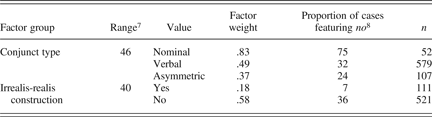
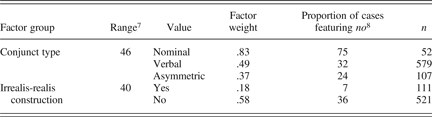
The conjunction no is the most common adversative conjunction in Russian, our sample including only 3% of the instances of no present in the corpus. Table 1 shows the factor groups that were selected by the regression analysis as having a significant influence on the selection of no.
Factors that significantly favor or disfavor the choice of no
Note: Factor groups not selected as significant: length of second conjunct, topicality of the second conjunct, register.
Unlike in the case of the less productive conjunctions, the choice of no was significantly affected by only two factor groups. This finding supports the proposal that the default/most productive expression is the one that is preferred in the least specified contexts (Schwenter & Torres Cacoullos, Reference Schwenter and Torres Cacoullos2008). This proposal is also supported by connectionist simulations reported by Hare, Elman, and Daugherty (Reference Hare, Elman and Daugherty1995), who show that expressions that are distributed more or less evenly through the space of possible contexts (thus being less associated with any specific context) are more likely to be extended to novel contexts (i.e., display high productivity) than forms that tend to occur in a restricted range of contexts. The prediction of Hare et al. (Reference Hare, Elman and Daugherty1995) is supported empirically by Boudelaa and Gaskell (Reference Boudelaa and Gaskell2002), who demonstrate that the high productivity of the suffixal plural in Arabic, which is unexpected based on its low type frequency, is predicted if evenness of distribution of the competing plurals across (phonological) contexts is taken into account.
Table 1 shows that no is the conjunction of choice for noun phrases and adjectives.Footnote 9 This result appears to contradict Payne's (Reference Payne and Shopen1985) statement that no cannot conjoin nominals. It should be noted that the nominals conjoined by no are postcopular complements and thus can be considered predicative. Nonetheless, they seem to behave differently than other predicates, which, unlike nominals, do not heavily favor no in the present sample. The preventive meaning is uncharacteristic for no, hence no is chosen only 7% of the time when the presence of the irrealis-realis construction indicates that the conjunction is used as a preventive.
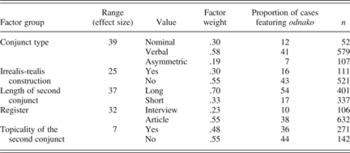
The conjunction odnako is less common than no, and therefore our sample contains about 50% of conjunct-initial instances of this conjunction found in the corpus. Table 2 shows the factor groups that were selected by the regression analysis as having a significant influence on the selection of odnako. As suggested by Lekant et al. (Reference Lekant, Gol'cova, Zhukov, Kasatkin, Klobukov, Malashenko, Tuzova, Fomenko and Xolodov1982), odnako appears to be favored by written discourse and is also associated with long conjuncts, which may be seen as another reflection of formality. In addition, odnako is favored by verbal conjuncts, verb phrases, and clauses. Finally, as suggested by Koolemans Beynen (Reference Koolemans Beynen1976), there is a tendency for odnako to introduce nontopical information.
Factors that significantly favor or disfavor the choice of odnako

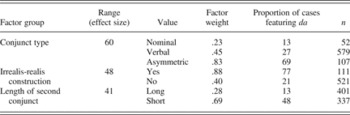
The results for da, the rarest (but, perhaps, the most interesting) of the three conjunctions, are shown in Table 3. Only factor groups that were selected as significant by the regression analyses are shown. Unlike no and odnako, da tends to introduce short second conjuncts, which could be considered support for da being colloquial (Krilova, Reference Krilova1980; Kruchinina, Reference Kruchinina1988; Shvedova et al., Reference Shvedova, Arutjunova, Bondarko, Ivanov, Lopatin, Uluxanov and Filin1980). Although the influence of register is not significant, the range of registers in the present study is small, because only highly formal (and edited) interviews and magazine articles are included in the corpus. Unfortunately, spoken corpora of Russian are not available, making studying differences between speech and writing difficult.
Factors that significantly favor or disfavor the choice of da

Note: Factor groups not selected as significant: topicality of the second conjunct, register.
Table 3 indicates that da is strongly favored by the irrealis-realis construction, which is a reflection of the preventive adversative meaning. Though we would expect 33% of instances of the irrealis-realis construction to contain da by chance, a full 77% of them do. This finding supports the claim that da is semantically distinct from the other adversative conjunctions, being much more strongly associated with the preventive meaning. In X da Y, Y is likely to prevent X from running to completion. The meaning of da discovered by multivariate analysis is in line with the proposal of Serebrjanaja (Reference Serebrjanaja1976) and contradicts Kruchinina's (Reference Kruchinina1988) hypothesis that da is more closely connected to the denial of expectation meaning than no. It also appears to contradict the statement of Lekant et al. (Reference Lekant, Gol'cova, Zhukov, Kasatkin, Klobukov, Malashenko, Tuzova, Fomenko and Xolodov1982) that da indicates a “softer contradiction” than the other adversative conjunctions. The preventive adversative appears to be the strongest possible contradiction in that the event expressed by the second conjunct prevents the event expressed by the first conjunct from running its course.
Finally, the presence of associations between the preventive meaning (operationalized by the presence of the irrealis-realis construction) and da and the denial of expectation meaning (operationalized by the presence of a realis verb form as the head of the first conjunct) and odnako supports Payne's (Reference Payne and Shopen1985) proposal that the two meanings are distinct, contra Foolen (Reference Foolen1991). Psychologically speaking, speakers of Russian seem to categorize preventive and denial of expectation uses into different categories, hence the distinction between prevention and denial of expectation must be learnable.Footnote 10 The fact that the semantic effect on conjunction choice is quantitative in nature may suggest that the boundary between the categories is blurry, possibly because the speaker is not always aware of the distinction while producing a sentence (Sankoff, Reference Sankoff and Newmeyer1988). On the other hand, it is also possible that the speaker is always aware of the distinction but the semantic influence on conjunction choice is sometimes overruled by other factors.
At first glance, the fact that da is strongly associated with the preventive meaning suggests that da must be productive unless Russian speakers find that they never need to talk about situations in which one event prevents another event from running to completion. The literature, on the other hand, is unanimous in claiming that da is becoming unproductive (Krilova, Reference Krilova1980; Kruchinina, Reference Kruchinina1988; Shvedova et al., Reference Shvedova, Arutjunova, Bondarko, Ivanov, Lopatin, Uluxanov and Filin1980). Closer inspection of the present data reveals that it is consistent with da being relatively unproductive.
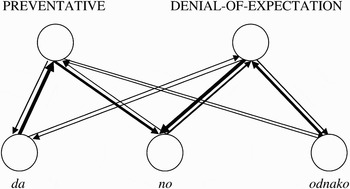
Even though da is strongly associated with the preventive meaning and thus is a good cue to the preventive meaning for the listener,Footnote 11 it is highly infrequent. Therefore, even if a speaker needs to express the preventive meaning, da is much less likely to be chosen for production than no. Given the proportions of da, no, and odnako in the corpus, we can estimate that a sample of preventive adversatives drawn from the corpus randomly would contain 24% da, 66% no, and 10% odnako. Thus, most of the time when a speaker intends to produce a preventive, no would be chosen despite da being a better cue to the preventive meaning for the listener. Another case of such an asymmetry is presented by Poplack and Tagliamonte (Reference Poplack, Tagliamonte, Baker and Syea1996:84) who found that one of the past tense markers in Nigerian Pidgin English (bin) is used as an anterior 90% of the time while having only a 5% chance of appearing in such a context. Zuraw (Reference Zuraw2000) presented a similar case of production-perception mismatch in morphophonology. The difference between perception and production is illustrated in Figure 1, where no is most likely to be selected for production with either of the intended meanings, resulting in neutralization in discourse (Sankoff, Reference Sankoff and Newmeyer1988), whereas in perception da is a cue to the preventive meaning unlike odnako and no, which are (weaker) cues to the denial-of-expectation meaning.
Conjunction choice in production (indicated by downward arrows) versus meaning assignment in perception (indicated by upward arrows). Line width indicates likelihood of following a particular arrow. Thus, given da, one is likely to arrive at the preventive meaning (the thickest arrow leading upward from da leads to the preventive) but given the preventive meaning, one is more likely to produce no than da as indicated by the thickness of the downward arrow from preventive to no relative to the arrow from preventive to da.

Recent psycholinguistic evidence (Hudson Kam & Newport, Reference Hudson Kam and Newport2005) indicates that children exposed to an artificial grammar in which one rule is obeyed 70% of the time and a competing rule is obeyed 30% of the time tend to overapply the more commonly used rule, using it 100% of the time with novel productions. Given this tendency of children to regularize unpredictable variation, no may gradually encroach on da as the preventive marker, accounting for statements that da is not fully productive in modern Russian (Krilova, Reference Krilova1980; Kruchinina, Reference Kruchinina1988; Shvedova et al., Reference Shvedova, Arutjunova, Bondarko, Ivanov, Lopatin, Uluxanov and Filin1980), although these observations are based on written data, which may lead to underestimating the productivity of da, which is suggested to be colloquial (e.g., Shvedova et al., Reference Shvedova, Arutjunova, Bondarko, Ivanov, Lopatin, Uluxanov and Filin1980). Ironically, the colloquial nature of da may hurt da's chances for survival compared with the chances of odnako. Hudson Kam and Newport (Reference Hudson Kam and Newport2005) show that adults exposed to the same artificial language featuring random variation, unlike the children they studied, tend to reproduce the frequencies of variants found in the input. The conjunction odnako, while being almost as rare as da, is more formal and characteristic of written language, thus being likely to be learned later in life than da is.Footnote 12 If unpredictable variation is more likely to be regularized by children than by adults, da may lose ground to no faster than odnako would.
In addition to being favored by the preventive meaning, da is favored when the conjuncts are not of the same type. The instances in which the two conjuncts are not of the same type cannot be the same instances as the ones in which da is used in the preventive sense because the preventive by definition requires both conjuncts to refer to events and thus be headed by a verb (Payne, Reference Payne and Shopen1985). Thus, the high rate of use of da when the conjoined units are of different types cannot be due to the association between da and the preventive meaning and must be caused by an independent factor. Conjunction choice in Russian thus appears not to be driven exclusively by semantic differences.
The finding that da is favored when the two conjuncts are not of the same type has implications for sentence production. If NP conj AP differs in its influence on conjunction choice from both NP conj NP and AP conj AP, the former favoring da and the latter two favoring no, then the grammatical categories of both conjuncts must be available to speakers when the conjunction is chosen. Thus, speakers must choose the conjunction at a point when they have already decided on the two conjuncts and the information about the type of the preceding conjunct must be available to the lexical selection mechanism at the same time as the information about the type of the following conjunct. This suggests that either the syntactic frame of the sentence is chosen before the selection of (variable) function words or that such words are inseparable from the sentence frame, as argued by Construction Grammar (Goldberg, Reference Goldberg1995, Reference Goldberg2006). Furthermore, if the asymmetric constructions are assumed to arise from ellipsis (e.g., the sentence in (10) Kot da ne tot. ‘A cat but not the right [one]’. deriving from Kot da ne tot kot. ‘A cat but not the right cat’.), conjunction choice cannot occur before ellipsis, because before ellipsis, asymmetric and symmetric constructions belong to the same syntactic category. In the case of (10), both “a cat” and “not the right cat” are noun phrases in the classification adopted for the multivariate analysis. Thus, if conjunction choice happened at the stage that both are noun phrases or clauses, sentences such as (10) would be expected to behave like other sentences consisting of two conjoined noun phrases, favoring no.
If the asymmetric constructions are assumed to arise from ellipsis, da can be taken to be a marker of ellipsis, serving to alert the listener that some part of the following clause needs to be filled in based on the preceding clause, signaling ellipsis in 31% of its occurrences.Footnote 13 However, it should again be borne in mind that da is much less frequent than no. Therefore, in a random sample of asymmetric constructions, da is expected to be chosen only 8.6% of the time with no accounting for 89.7% of tokens, whereas odnako almost never occurs in this context, being expected to account for only 1.7% of such instances. Thus, despite being associated with the asymmetric constructions and being potentially helpful to the listener as a marker of ellipsis, it may lose productivity as time goes on.
CONCLUSIONS
Adversative conjunction choice in Russian is influenced by semantic, syntactic, and stylistic factors. Syntactically, the conjunction no is favored when the conjuncts are postcopular complements (realized as noun, adjective, or prepositional phrases), odnako is favored when they are verb phrases or clauses, and da is favored when the conjuncts are of different syntactic types, such as a noun and an adjective. Semantically, the conjunction da is favored when the event described by the second conjunct prevents the event described by the first conjunct from running its course (Sannikov, Reference Sannikov1989; Serebrjanaja, Reference Serebrjanaja1976). Stylistically, odnako is favored and da is disfavored by formal, written discourse (Krilova, Reference Krilova1980; Kruchinina, Reference Kruchinina1988; Lekant et al., Reference Lekant, Gol'cova, Zhukov, Kasatkin, Klobukov, Malashenko, Tuzova, Fomenko and Xolodov1982; Shvedova et al., Reference Shvedova, Arutjunova, Bondarko, Ivanov, Lopatin, Uluxanov and Filin1980).
The present study illustrates that quantitative variationist methods can be used to uncover subtle semantic differences between constructions and to constrain semantic theory by providing evidence about the learnability of semantic distinctions. In addition, to draw inferences about differences in productivity between constructions in different contexts, it is important to interpret the results of multivariate analysis with reference to production and perception (something that has also been argued to be necessary for elucidation of relationships between meanings and forms by Poplack & Tagliamonte, Reference Poplack, Tagliamonte, Baker and Syea1996; and Schwenter & Torres Cacoullos, Reference Schwenter and Torres Cacoullos2008). In particular, the presence of an association between a construction and a frequently expressed meaning may not ensure a construction's survival if the meaning can also be expressed by a more frequent construction, albeit one that is not associated with the meaning as strongly. The most productive expression is shown to be the one that occurs in the least specified contexts, as proposed by Hare et al. (Reference Hare, Elman and Daugherty1995) and Schwenter and Torres Cacoullos (Reference Schwenter and Torres Cacoullos2008). Finally, corpus studies of syntactic variation show promise for constraining psycholinguistic models of the time course of sentence production by specifying which types of information influence a given choice. As previously suggested by Uryson (Reference Uryson2006:25, fn. 10), I argue that the choice of the conjunction is made late during sentence production when the types of the conjoined constituents are already known.