Introduction
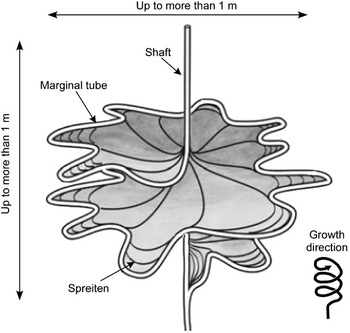
Zoophycos is a broad type of 3-dimensional structure constructed by marine infaunal animals. Palaeontologists and geologists have noted and described the structure in rocks for over 250 years (e.g. Häntzschel Reference Häntzschel1975) and it is now known from deposits ranging in age from Cambrian to Holocene (Alpert Reference Alpert1977, Ekdale & Berger Reference Ekdale and Berger1978). The basic form is a spreite (also termed “spreiten” or “lamina”) wound around a central axis (Fig. 1). However, the morphology of the trace fossil varies widely (e.g. Wetzel & Werner Reference Wetzel and Werner1981, Miller Reference Miller1991, Löwemark & Schäfer Reference Löwemark and Schäfer2003, Bromley & Hanken Reference Bromley and Hanken2003), as does its size, with both maximum diameter and maximum depth ranging from a few cm to > 1 m; some include small forms in a separate ichnogenus, Spirophyton (Simpson Reference Simpson1970; but see Ekdale Reference Ekdale1977). This variation and complexity has resulted in diverse reconstructions of Zoophycos producing behaviour(s) (Kotake Reference Kotake1989, Reference Kotake1992, Bromley Reference Bromley1991, Miller & D’Alberto Reference Miller and D’Alberto2001, Löwemark & Schäfer Reference Löwemark and Schäfer2003, Olivero & Gaillard Reference Olivero and Gaillard2007) and identification of multiple potential producers including “worms” (Seilacher Reference Seilacher1967), echiurans (Kotake Reference Kotake1992), and sipunculids (Ekdale Reference Ekdale1977, Olivero & Gaillard Reference Olivero and Gaillard2007). Given the range in morphology and age, it is likely that over time Zoophycos has been constructed by different animals with a range of behaviours that are sufficiently similar to result in the broad Zoophycos type of structure.
Major features of the trace fossil Zoophycos from Lowemark et al. (Reference Löwemark, Lin and Sarnthein2006). The dark lines within the spreiten are the lamellae; alternative terms for spreiten are “spreite” and “lamina”.

Palaeozoic Zoophycos occurs in marine margin, shallow water, and deep water deposits (Chamberlain Reference Chamberlain1971, Osgood & Szmuc Reference Osgood and Szmuc1972, Miller Reference Miller1991). Mesozoic Zoophycos are reported from both shelf and deeper facies (e.g. Locklair & Savrda Reference Locklair and Savrda1998, Olivero Reference Olivero2003); Tertiary and younger Zoophycos occur predominately in deeper water deposits (e.g. Blom Reference Blom1984, Manley & Lewis Reference Manley and Lewis1998, Bromley & Hanken Reference Bromley and Hanken2003, Pervesler & Uchman Reference Pervesler and Uchman2004).
Zoophycos is widespread and regionally abundant in Late Cenozoic bathyal and abyssal sediments of the world’s oceans (Ekdale Reference Ekdale1977, Löwemark & Schäfer Reference Löwemark and Schäfer2003), and occurs in bathyal and abyssal sediments of the Southern Ocean (e.g. Pudsey et al. Reference Pudsey, Barker and Hamilton1988). In spite of the fact that the continental shelves of Antarctica are isostatically depressed (500–1000 m) and probably have been since development of large ice sheets in the mid-Cenozoic (Siegert et al. Reference Siegert, Barrett, DeConto, Dunbar, Cofaigh, Passchier and Naish2008), Zoophycos has not been described from Antarctic shelf deposits; the single brief listing of Zoophycos does not illustrate or document occurrence of characteristic features of the trace fossil (Fielding et al. Reference Fielding, Naish, Woolfe and Lavelle2000).
In this paper we describe Zoophycos from Pliocene deposits in the ANDRILL 1B core drilled under the Ross Ice Shelf at a water depth of 917 m in summer 2006–07 (Falconer et al. Reference Falconer, Pyne, Levy and Olney2007). The Zoophycos occurs at ∼352–354 m below sea floor (mbsf) in a unit of interglacial marine sediments that is bounded above (346.94 mbsf) and below (364.18 mbsf) by glacial surfaces of erosion (Krissek et al. Reference Krissek, Brown, Carter, Cowan, Dunbar, McKay, Naish, Powell and Reed2007). This interval was deposited during a major climatic transition from open water conditions in the Early Pliocene when sea surface temperatures were higher than today to cooler conditions that supported a fluctuating subpolar ice sheet during the Late Pliocene (Naish et al. Reference Naish, Powell, Barrett and Levy2007). Estimates of water depth range from 200 to 1000 m. The environmental conditions of the Zoophycos-bearing unit can be interpreted at a higher resolution than would otherwise be possible by comparison with well-known Zoophycos-bearing sequences worldwide.
This occurrence of Zoophycos also has implications for the origin of the unique Antarctic benthic marine fauna. Whether the fauna developed from deep water species that migrated into shallower water (“emergence”) or by expansion into deeper water of shallow water forms that survived glacial advances in protected shallow-water havens (“submergence”) has been debated, and it is likely that multiple processes have been involved (e.g. Brandt et al. Reference Brandt, Gooday, Brandao, Brix, Broekeland, Cedhagen, Choudhury, Cornelius, Danis, De Mesel, Diaz, Gillan, Ebbe, Howe, Janussen, Kaiser, Linse, Malyutina, Pawlowski, Raupach and Vanreusel2007). Paucity of a Cenozoic rock record on the continent, as well as of body fossils of macrobenthic animals in cores of Cenozoic sediments around Antarctica hampers reconstructing the biogeographic history. In the absence of shelled fossils, this Zoophycos suggests that organisms moved from the deep sea to the Antarctic continental shelf during the extended warm period during the Early Pliocene.
Zoophycos in ANDRILL 1B: morphology and depositional setting
Morphology
Components comprising the trace fossil Zoophycos include a spreite or lamina coiled around a central axis, which commonly is an axial structure, lamellae within the lamina, and an open marginal tube (Fig. 1). Within this basic structure there is wide variation, and many specimens lack one or more of these components (e.g. Ekdale Reference Ekdale1992, Löwemark & Schäfer Reference Löwemark and Schäfer2003, Olivero & Gaillard Reference Olivero and Gaillard2007).
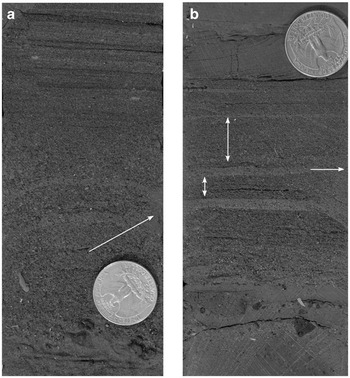
In the ANDRILL 1B core, Zoophycos is represented by eleven cross-sections of spreite. Four of these radiate off a portion of an axial structure intersected by the core at 352.62–352.64 mbsf, and two extend from a section of axial structure at 353.30–353.36 mbsf (Fig. 2). Others are isolated or in groups of two. The spreite are horizontal, gently inclined, or slightly convex. Most of the spreite are 2 to 4 mm thick. None have well defined lamellae. The spreite are composed of sediment that is lighter coloured than the matrix; where connected to an axial structure they are composed of the same material as the axial structure. In one case the spreite includes granules of volcanic rock that are similar to those occurring a few millimetres below, implying that the animal transported material upward. This has been reported elsewhere (Wetzel & Werner Reference Wetzel and Werner1981) although downward transport of surface material reported more commonly (Kotake Reference Kotake1989, Miller & D’Alberto Reference Miller and D’Alberto2001). The axial structures are oriented obliquely and have diffuse boundaries. They are composed of the same sediment as the spreite to which they are connected. The axial structures are a minimum of 0.5 mm in diameter (Fig. 2).
Zoophycos in ANDRILL 1B. a. Spreite extending outward from portion of axial structure; arrow point to axial structure. No lamellae are visible within the spreite. Top is 352.57 mbsf. b. Several spreite (vertical arrows) extending outward from axial structure at right (horizontal arrow). Note diffuse boundary of axial structure. Granules at base are volcanic rock fragments. Base of coin is at 353.29 mbsf.

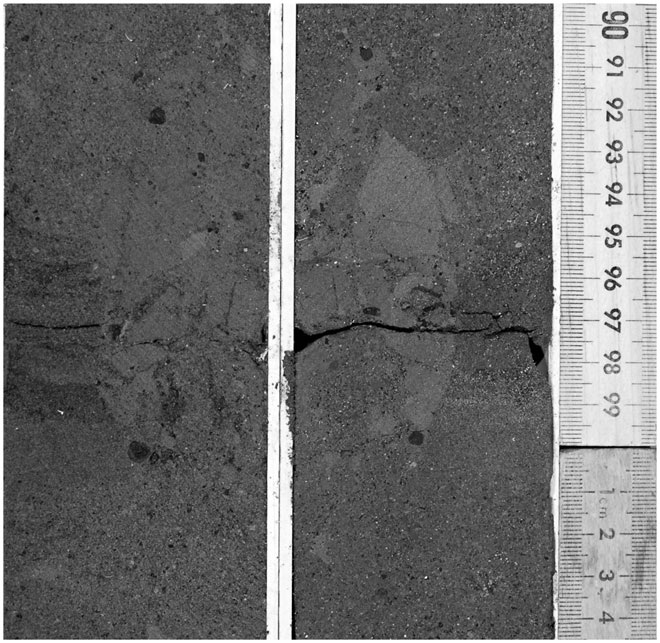
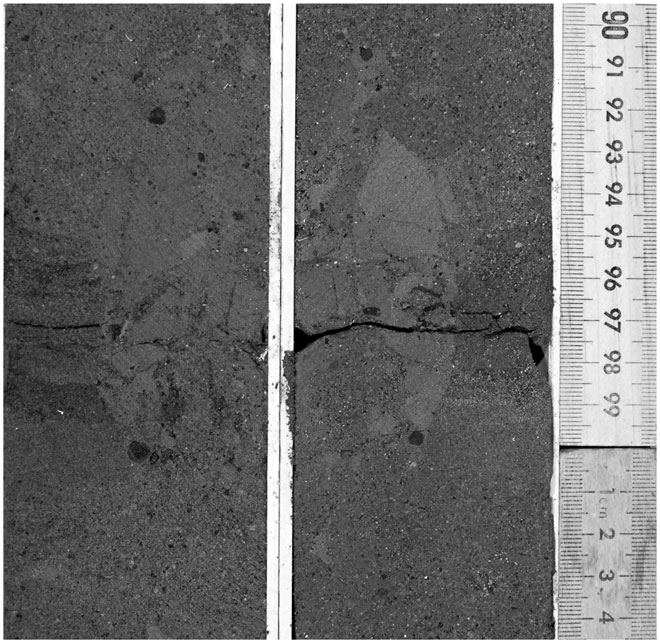
About 0.7 m above the uppermost spreite (351.93 mbsf) a cone-shaped structure 1.5 cm in diameter cuts through layers of sandstone (Fig. 3). It has diffuse boundaries and is filled with fine-grained sediment. Although not physically connected to the spreite and axial structure that occur below, this may be a section through the upper part of an axial structure as described by Löwemark & Schäfer (Reference Löwemark and Schäfer2003). If so, and if the spreite and axial structure that occur lower are all part of the same structure, the producing animal at times lived at least 1.45 m beneath the sediment-water interface.
Disturbed zone that may be upper part of axial structure (Fig. 1). The images are the two halves of the core from 351.89 to 352.01 mbsf; the working half is on the right, the archival half is on the left. This is ∼0.5 m above the highest spreiten and axial structure; although its relation to the axial structure(s) in the core is not known, its location is consistent with where an upper portion of an axial structure should occur (Löwemark & Schäfer Reference Löwemark and Schäfer2003).
Depositional setting
ANDRILL 1B recovered 1285 m of core from beneath the north-west corner of the Ross Ice Shelf. The uppermost 600 m of core records the Pliocene to Pleistocene history of a marine-based ice shelf that waxed and waned seemingly in response to orbital cycles (Naish et al. Reference Naish, Powell, Barrett and Levy2007). In the Early Pliocene when sea surface temperatures were 5° higher (Whitehead & Bohaty Reference Whitehead and Bohaty2003), the ice retreated from the Ross embayment onto land in West Antarctica and diatomite accumulated under open water conditions at the ANDRILL 1B site (Naish et al. Reference Naish, Powell, Barrett and Levy2007). The warm period ended at ∼3.3 Ma as temperatures dropped and the ice sheet advanced. The time interval between ∼3.5 Ma and 2.5 Ma was a period of high latitude cooling that heralded the expansion and change in style of both the West Antarctic Ice Sheet (WAIS) and East Antarctic Ice Sheet (EAIS) (Naish et al. Reference Naish, Powell, Barrett and Levy2007). The Zoophycos occurs in sediments deposited during the transition from ice-free open marine conditions to a fluctuating subpolar ice sheet suggesting that the Zoophycos-producing animal colonized the seafloor during this transition.
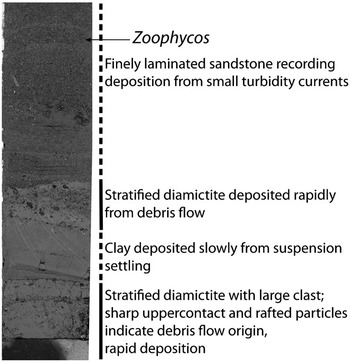
The 1.5 m thick interval in which Zoophycos has been found (351.93–353.38 mbsf) occurs in 17.24 m thick unit, bounded by glacial surfaces of erosion and comprised of silty claystone, sandstone, and clast-poor muddy diamictite thought to have been deposited under proximal to distal glacimarine conditions (Krissek et al. Reference Krissek, Brown, Carter, Cowan, Dunbar, McKay, Naish, Powell and Reed2007, Naish et al. Reference Naish, Powell, Barrett and Levy2007). Thin bedded stratified muddy diamictites below the Zoophycos-bearing interval are interpreted as debris flow deposits and the sandstones as deposited from turbidity currents; both processes are associated with a proglacial setting adjacent to the ice sheet (Fig. 4). Five metres above the Zoophycos-bearing interval is the base of a diamictite that records the advance of the ice sheet and termination of open water conditions (Krissek et al. Reference Krissek, Brown, Carter, Cowan, Dunbar, McKay, Naish, Powell and Reed2007, Naish et al. Reference Naish, Powell, Barrett and Levy2007).
Large variation in rates of deposition within a 24 cm thick interval (352.83–352.59 mbsf) within the Zoophycos-bearing unit. Arrow points to Zoophycos in Fig. 2a. Dashed line denotes sediments deposited slowly; solid line indicates those that were deposited rapidly.

The Zoophycos-bearing interval was deposited by sediment processes whose rates ranged from high to low (Fig. 4). Debris flow deposits accumulated rapidly whereas silty clays settled slowly from suspension. Laminated sandstones (Fig. 4) record small turbidity currents, presumably generated by processes related to the ice sheet grounding line with submarine meltwater.
Environmental distribution of Cenozoic Zoophycos
Zoophycos is both widely distributed and locally abundant in bathyal to abyssal Cenozoic deposits. Terrestrial occurrences document the enormous size of some Zoophycos (> 1 m high and in diameter; Ekdale & Lewis Reference Ekdale and Lewis1991) and allow reconstruction of the morphology and the behaviour recorded (Miller & D’Alberto Reference Miller and D’Alberto2001, Bromley & Hanken Reference Bromley and Hanken2003). Commonly Zoophycos occurs in fine-grained Cenozoic limestones that were originally deposited as calcareous oozes (Miller & D’Alberto Reference Miller and D’Alberto2001, Bromley & Hanken Reference Bromley and Hanken2003). In turbidite sequences Zoophycos is most abundant in the upper parts of individual turbidites and in intervening mudstones, suggesting that the producers preferred quiet water conditions (e.g. Manly & Lewis 1998). The occurrence of a small form of Zoophycos between turbidites where these are common, and of a larger form in the part of the same succession that lacks turbidites, has been interpreted as reflecting faster growth in less stressful environments not subjected to turbidity currents (e.g. Uchman & Demírcan Reference Uchman and Demírcan1999).
Zoophycos is also common in cores of Cenozoic oceanic sediments (e.g. Chamberlain Reference Chamberlain1975) occurring in 30 drill sites from the Caribbean, Atlantic, and Pacific oceans (Ekdale Reference Ekdale1977), as well as from the Kerguelen Plateau (Droser & Bottjer Reference Droser and Bottjer1991), South China Sea (Löwemark et al. Reference Löwemark, Lin and Sarnthein2006), Sulu Sea (Wetzel Reference Wetzel1984) and off the western coasts of Africa and Portugal (Wetzel & Werner Reference Wetzel and Werner1981, Löwemark & Schäfer Reference Löwemark and Schäfer2003). Zoophycos is restricted to water depths > 1000 m. Its recognition is enhanced by radiography; it was found in 37% of 382 archived cores of upper Cenozoic sediments from the world oceans (Löwemark & Schäfer Reference Löwemark and Schäfer2003). As noted from terrestrial occurrences (Ekdale Reference Ekdale1992), Zoophycos is a deep tier trace fossil produced up to a metre beneath the sediment-water interface. An age difference of 9 ka has been found between the sediment within the Zoophycos spreite and the surrounding sediment (Leuschner et al. Reference Leuschner, Sirocko, Grootes and Erlenkeuser2002). Complex structure within the axial shaft is interpreted to indicate that the Zoophycos structures are occupied for a long time, implying that the producer is long-lived.
Zoophycos occurs in sediments deposited slowly (e.g. <20 cm ka-1; Wetzel & Werner Reference Wetzel and Werner1981) and is reported from hemipelagites with rates of sedimentation ranging from <5 cm ka-1 to 20 cm ka-1 (Stow & Tabrez Reference Stow and Tabrez1998). Its peak abundance in the South China Sea is where rates of deposition are<5 cm ka-1; this is consistent with its documented association with omission surfaces (Ekdale & Lewis Reference Ekdale and Lewis1991). Although typically occurring in muds and oozes, Zoophycos also has been found in slumped sediments and deposits containing ice rafted debris (IRD), as well as commonly in turbidites (Löwemark & Schäfer Reference Löwemark and Schäfer2003).
The Zoophycos producers’ preference for sediments with moderate to relatively low total organic carbon (TOC) is well documented (< 1.5% TOC Wetzel & Werner Reference Wetzel and Werner1981; 0.3–0.7% TOC Löwemark et al. Reference Löwemark, Lin and Sarnthein2006), as is its apparent predilection for episodic rather than continual delivery of food resources. It some areas such as the South China Sea its abundance roughly tracks glacial-interglacial cycles; this is attributed to climate-driven, interrelated changes in monsoons, ocean currents, upwelling and productivity (Löwemark et al. Reference Löwemark, Lin and Sarnthein2006).
Conditions inimical to the Zoophycos producer(s) include high rates of sedimentation (> 20 cm ka-1), sandy substrates, substrates with large amounts of IRD or high TOC (> 2% TOC), and low levels of dissolved oxygen (Fu & Werner Reference Fu and Werner1994).
Zoophycos in the Southern Ocean
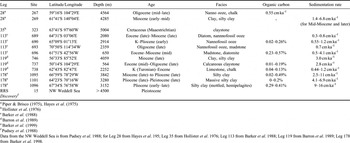
Zoophycos has been reported from cores taken at depths of > 3000 m off of the Antarctic Peninsula, where it occurs in the upper parts of turbidites and massive muds ranging in age from Early Pliocene to Late Pleistocene (ODP Leg 178, sites 1095, 1096, 1101; Table I). It has also been reported from hemipelagic deposits 200–300 ka in age recovered from a depth of > 4500 m the north-western Weddell Sea (Pudsey et al. Reference Pudsey, Barker and Hamilton1988), as well from Cretaceous to Miocene sediments in the Weddell Sea and between Prydz Bay and the Kerguelen Plateau (Table I). However, it is not ubiquitous in the cores from sites drilled on DSDP Legs 28 (Ross Sea) and 35 (Bellingshausen Sea), or ODP Leg 113 (Weddell Sea) and 119 (Prydz Bay).
Locations and water depth of Southern Ocean cores that contain Zoophycos and characteristics of the sedimentary units in which they occur; note the low TOC and low rates of sedimentation of Zoophycos-bearing sediments.

aPiper & Brisco (Reference Piper and Brisco1975), Hayes et al. (Reference Hayes and Frakes1975)
bHollister et al. (Reference Hollister and Craddock1976)
cBarker et al. (Reference Barker and Kennett1988)
dBarron et al. (Reference Barron and Larsen1989)
eBarker et al. (Reference Barker, Camerlenghi and Acton1999)
fPudsey et al. (Reference Pudsey, Barker and Hamilton1988)
Data from the NW Weddell Sea is from Pudsey et al. Reference Pudsey, Barker and Hamilton1988; for Leg 28 from Hayes et al. 195; Leg 35 from Hollister et al. Reference Hollister and Craddock1976; Leg 113 from Barker et al. Reference Barker and Kennett1988; Leg 119 from Barron et al. Reference Barron and Larsen1989; Leg 178 from Barker et al. 1998.
Zoophycos has not been documented to occur in Antarctic continental shelf deposits, in spite of the great depth (mean ∼500 m) and proximity to occurrences in the Southern Ocean. It has been mentioned as occurring in Oligocene deposits of the CRP 2/2a cores, but not illustrated or described morphologically (Fielding et al. Reference Fielding, Naish, Woolfe and Lavelle2000). The core description did not list the trace fossil; M. Miller perused core interval containing the reported Zoophycos and noted no well-defined structures similar to the Zoophycos in the ANDRILL 1B. Shelf deposits have been extensively investigated (e.g. Dunbar et al. Reference Dunbar, Leventer and Stockton1989, Anderson Reference Anderson1999, Domack et al. Reference Domack, Jacobsen, Shipp and Anderson1999) so if Zoophycos were common, it probably would have been described. Reasons for its presumed absence or rarity are not known but may include one or more of the following:
1) Rate of accumulation of siliceous ooze is too high. Silicious ooze is accumulating all around Antarctica except in the Weddell Sea (Anderson Reference Anderson1999); accumulation rate in the Ross Sea reaches 250 cm kyr-1 in coastal basins but is lower seaward (DeMaster et al. Reference DeMaster, Ragueneau and Nittrouer1996).
2) Total organic carbon is too high. In McMurdo Sound, average TOC at depths below 600 m are 1.5% and are as high as 3.5% (Dunbar et al. Reference Dunbar, Leventer and Stockton1989), which exceed TOC levels of sediment in which Zoophycos is abundant.
3) Current is too strong, substrate too coarse. Irregular topography coupled with bottom currents results in current-winnowed substrates on banks and slopes which are coarser than the Zoophycos producers’ preferred low-energy mud-dominated habitat (Taviani et al. Reference Taviani, Reid and Anderson1993).
4) Too much IRD. IRD is accumulating today, particularly near the coast. In addition, glacial advance during the LGM in the Ross Sea and elsewhere removed soft sediment, leaving poorly sorted glacial deposits that subsequently have been blanketed with a veneer of ooze (Domack et al. Reference Domack, Jacobsen, Shipp and Anderson1998, Reference Domack, O’Brien, Harris, Taylor, Quilty, De Santis and Raker1999, Shipp et al. Reference Shipp, Anderson and Domack1999).
5) Disruption by ice scour is too common. Iceberg scour disturbs the Antarctic shelf to depths > 500 m. It is estimated that every square metre of the Antarctic shelf is disturbed by ice once every 340 years (Gutt Reference Gutt2001), a level of disturbance that may be inimical to the Zoophycos producers.
ZOOPHYCOS constrains Pliocene conditions and Climate in ANDRILL 1B core
On a large scale, the Zoophycos-bearing unit in the ANDRILL 1B core represents an environmental window of opportunity between the relatively warm Early Pliocene whose productive open ocean conditions potentially led to TOC levels too high for the Zoophycos producers and the much cooler Late Pliocene during which persistent glaciation and accumulation of IRD would have been inimical to the animals. The 17 m thick heterolithic unit contains neither biosiliceous material signalling high productivity nor large quantities of IRD, although it is sandwiched between overlying biosiliceous diamictite and an underlying unit of intermixed diatomite and biosiliceous diamictite and mudstsone that caps a > 75 m thick unit of diatomite (Krissek et al. Reference Krissek, Brown, Carter, Cowan, Dunbar, McKay, Naish, Powell and Reed2007). These favourable conditions for the Zoophycos producers must have been extant for an extended period for them to colonize the ANDRILL 1B site. Early Pliocene ice free conditions probably allowed long-term migration of the Zoophycos producer toward the continent, but this and colonization of sediments were most likely slow processes; at present both Antarctic and deep sea faunas are characterized by slow rates of dispersal and thus of colonization (Lipps & Hickman Reference Lipps and Hickman1982).
The Zoophycos-bearing interval falls within a well-dated and complete stratigraphic window from 440–280 mbsf (-3.6–3.2 m yr) in ANDRILL 1B that is comprised of numerous advance/retreat cycles (Naish et al. Reference Naish, Powell, Barrett and Levy2007). Zoophycos producers were slow colonizers that preferred stable environments; its presence in the sequence implies that the grounding line position remained unchanged for an extended period within the cycle, further constraining the sedimentation rate.
On a smaller scale, the occurrence of Zoophycos provides information about the frequency of the debris flows recorded in this interval: they were sufficiently infrequent to allow colonization by and maintenance of the population of Zoophycos producers. The only quantitative estimate of time to colonize a new substrate type in the deep sea or Antarctic by Zoophycos producers of which we are aware is Wetzel’s (Reference Wetzel1984) estimate of < 100–200 years in the deep sea. Given the Zoophycos producers predilection for stable conditions combined with their low rate of colonization, we infer that the debris flows and rapid sedimentation events did not occur for some period (∼100–200 years) before colonization nor during production of the trace. The Zoophycos structure may have been excavated into debris flow deposits, but these events predated construction of the Zoophycos.
The proclivity of the Zoophycos producer for habitats characterized by episodic and limited food supply also illuminates conditions during deposition. Zoophycos-bearing strata in ANDRILL 1B are devoid of clear bioturbation fabrics and of discrete trace fossils formed by other deposit feeders that inhabit modern muddy sediments of the Antarctic shelf such spatangoid sea urchins, holothurians, and burrow-dwelling echiurans and whose subsurface tier activities have a high preservation potential (Smith et al. Reference Smith, Mincks and DeMaster2006). In modern shelf sediments off the Antarctic Peninsula, these animals have been shown to consume labile organic matter throughout the year, in spite of seasonal productivity in the water column, perhaps because summer phytodetritus forms a sediment food bank that deposits feeders draw on year round (Smith et al. Reference Smith, Mincks and DeMaster2006). However, in less productive settings, such as those with longer sea ice cover, or adjacent to ice shelves, food supply may be limited as well as highly seasonal. Under these conditions and similar conditions in the past, active “caching” of food resources might be the optimal survival strategy. There is growing consensus that the Zoophycos structure is used as a short-term cache for food (Miller & D’Alberto Reference Miller and D’Alberto2001, Löwemark & Schäfer Reference Löwemark and Schäfer2003) and it has been suggested that spreite of re-ingested sediment (e.g. used cache material) are characterized by absence of lamellae (Löwemark & Schäfer Reference Löwemark and Schäfer2003); lamellae are absent from all of the ANDRILL 1B spreite. The lack of biogenic structures produced by medium to deep tier animals other than the Zoophycos producers is consistent with the interpretation that the Zoophycos-bearing sediments were deposited in a habitat with such limited food resources delivered so sporadically that active caching was necessary; perhaps the common shelf “sediment food bank” (Smith et al. Reference Smith, Mincks and DeMaster2006) was insufficient to support non-caching deposit feeders, leaving the Zoophycos producer as the sole infaunal deposit feeder.
Origin of Antarctic fauna: relation to Zoophycos
There is widespread agreement that the Antarctic marine fauna is unique, particularly in its lack of shell-breaking predators, high diversity and abundance of large suspension feeders, high level of endemism, prevalence of gigantism and dwarfism and of individual longevity, and tendency toward slow growth, limited reproductive dispersion, and slow colonization (Lipps & Hickman Reference Lipps and Hickman1982, Aronson & Blake Reference Aronson and Blake2001, Gili et al. Reference Gili, Arntz, Palanques, Orejas, Clarke, Dayton, Isla, Teixidó, Rossi and Lopez-González2006).
The history and origin of the Antarctic fauna is not well understood nor is its relation to the fauna of the Southern Ocean, which only recently has been the focus of major study (e.g. Brandt et al. Reference Brandt, Gooday, Brandao, Brix, Broekeland, Cedhagen, Choudhury, Cornelius, Danis, De Mesel, Diaz, Gillan, Ebbe, Howe, Janussen, Kaiser, Linse, Malyutina, Pawlowski, Raupach and Vanreusel2007). Components of modern benthic Antarctic faunas have been shown to have Jurassic–Cretaceous affinities (e.g. isopods, molluscs, gorgonaceans, hexactinellids; Stilwell & Zinsmeister Reference Stilwell and Zinsmeister1992, Gili et al. Reference Gili, Arntz, Palanques, Orejas, Clarke, Dayton, Isla, Teixidó, Rossi and Lopez-González2006) and the legacies of early Tertiary molluscs, echinoids, and polychaetes (La Meseta Formation) are represented in modern faunas (Clarke Reference Clarke1990, Crame Reference Crame1997, Stilwell & Zinsmeister Reference Stilwell and Zinsmeister2000). Lack of post-Cretaceous deposits and paucity of body fossils in post-Eocene sediments on the shelf hampers reconstruction of the evolution of the benthic fauna that occurred as the climate cooled starting in the late Eocene and the fauna was isolated by the opening of the Drake Passage (Aronson & Blake Reference Aronson and Blake2001).
Suggested origins of the Antarctic marine fauna
In the absence of fossil data, several scenarios for the origin of the Antarctic benthic fauna have been proposed, including that the shelf faunas migrated to deep ocean basins (“submergence”), that deepwater faunas migrated upward to the continental shelves (“emergence”), and that the faunas have developed largely in place (Clarke et al. Reference Clarke, Aronson, Crame, Gili and Blake2004). Evidence for submergence comes from the distribution of genetically similar populations of Epistominella vitrea, a benthic foram that is abundant on Antarctic shelves and has an expanded depth range in the Southern Ocean (Brandt et al. Reference Brandt, Gooday, Brandao, Brix, Broekeland, Cedhagen, Choudhury, Cornelius, Danis, De Mesel, Diaz, Gillan, Ebbe, Howe, Janussen, Kaiser, Linse, Malyutina, Pawlowski, Raupach and Vanreusel2007), from present-day occurrence in deep water of molluscs found in early Cenozoic deposits on the Antarctic Peninsula, and from the eurybathic distributions of many species, interpreted to have developed by forced retreat to deep water during ice sheet advance (Brey et al. Reference Brey, Dahm, Gorny, Klages, Stiller and Arntz1996).
Development of the faunas in situ is supported by the high proportion of endemics in many groups, including pycnogonids (85% endemics, Clarke & Johnston Reference Clarke and Johnston2003), gastropods (Crame Reference Crame1997), and isopods (Brandt Reference Brandt2005). An example of emergence is provided by the large agglutinated foraminifera Astrammina triangularis which occurs at 25 m in western McMurdo Sound but at much greater depths elsewhere (Bowser et al. Reference Bowser, Bernhard, Habuäära and Gooday2002). It appears that all three processes have contributed to the origin of the Antarctic benthic fauna, an interpretation based almost exclusively on inferences from distributions of modern animals with little contribution from the limited body fossil record.
Contribution of Zoophycos to understanding modern Antarctic marine fauna
Occurrence of Zoophycos in Pliocene sediments from the ANDRILL 1B core coupled with its distribution in cores of deep sea sediments both younger and older in age demonstrates convincingly that some benthic animals migrated from deep water onto the Antarctic shelf during glacial minima.
The oldest post-Palaeozoic occurrence of Zoophycos in Antarctica is from the Jurassic to Cretaceous Fossil Butte Group of Alexander Island (Antarctic Peninsula) (Taylor Reference Taylor1967), composed primarily of bathyal siliciclastics (Doubleday et al. Reference Doubleday, MacDonald and Nell1993). Zoophycos also has been recorded from numerous deep sea cores from all sectors of the Southern Ocean (Table I) in deposits of Cretaceous and Eocene through Pleistocene age. We suspect that poor core recovery and lack of x-radiography has resulted in Zoophycos being under-reported; Zoophycos stands out in radiographs but may be difficult to see on core surfaces (Löwemark & Schäfer Reference Löwemark and Schäfer2003).
We are aware of no previously published descriptions of Zoophycos in cores of Cenozoic deposits from Ross Sea and McMurdo Sound. The single documented occurrence is that reported herein in Pliocene deposits, where the Zoophycos structure stands out in lithologic contrast with the surrounding material. More specimens may well be found in SHALDRILL, ANDRILL and other cores as more are x-rayed. Zoophycos occurs at the end of a multi-million year period of relative warmth (Naish et al. Reference Naish, Powell, Barrett and Levy2007) that provided time for the producer, probably a slow colonizer (Lipps & Hickman Reference Lipps and Hickman1982, Wetzel Reference Wetzel1984), to migrate onto the shelf; in fact there was time for repeated migrations around the continent. We infer that the distribution of Zoophycos producers was limited to localized areas shielded from high rates of sedimentation and organic enrichment, but that seasonal influx of organic matter provided material that could be stashed in temporary caches within the Zoophycos structure (Jumars et al. Reference Jumars, Mayer, Deming, Baross and Wheatcroft1990, Smith et al. Reference Smith, Mincks and DeMaster2006).
Significantly, Zoophycos occurs in Pliocene and Pleistocene deposits at depths > 3000 m off of the Antarctic Peninsula and in the Weddell Sea in sediments 200 ka to 300 ka (Pudsey et al. Reference Pudsey, Barker and Hamilton1988). These occurrences document the continued presence of the Zoophycos producer(s) in deep sea habitats during Pliocene migration into shallower water. The subsequent history is less clear, with several possibilities: 1) the Zoophycos producer(s) retreated to deeper water habitats, 2) the Zoophycos producer(s) remained on the shelf, but the record of activity has been eroded, or 3) the Zoophycos producer(s) remained in isolated refuges on the shelf (e.g. Gili et al. Reference Gili, Arntz, Palanques, Orejas, Clarke, Dayton, Isla, Teixidó, Rossi and Lopez-González2006).
Conclusions
The trace fossil Zoophycos occurs as sections of spreite and axial structures in a 1.5 m thick interval in ANDRILL 1B core recovered from underneath the Ross Ice Shelf. It is found in debris flow and vertically accreted sediments deposited during the transition from warm, open marine conditions in the Early Pliocene to a colder Late Pliocene characterized by subpolar ice sheets. Application of known preferences of the Zoophycos producers known from worldwide occurrences to the Zoophycos in ANDRILL 1B suggests that rates of sedimentation and levels of TOC were low, and that food was delivered episodically. In spite of evidence of sea floor disturbance (e.g. debris flows, turbidity currents), the presence of Zoophycos, whose producers are slow colonizers with strong preference for stable environments indicates extended periods with little change and minimal disturbance.
Previously Zoophycos was known from Mesozoic deposits in the Antarctic Peninsula and Cenozoic deep sea deposits around Antarctica, but had never been described from continental shelf deposits. The apparent absence of Zoophycos from shelf deposits except in ANDRILL 1B near the end of an extended period of Pliocene relative warmth suggests that the producers migrated onto the shelf during climate amelioration and retreated into deeper water during cooling and ice sheet advance. Given the poor Cenozoic body fossil record of Antarctica, this occurrence of Zoophycos provides rare positive fossil evidence that components of the Antarctic benthic fauna have “emerged” into shallow water during ameliorating climate.
Acknowledgements
The ANDRILL project is a multinational collaboration between the Antarctic programmes of Germany, Italy, New Zealand and the United States. Antarctica New Zealand is the project operator and developed the drilling system in collaboration with Alex Pyne at Victoria University of Wellington and Webster Drilling and Enterprises Ltd. Antarctica New Zealand support the drilling team at Scott Base; Raytheon Polar Services supported the science team at McMurdo Station and the Crary Science and Engineering Laboratory. The ANDRILL Science Management Office at the University of Nebraska-Lincoln provided science planning and operational support. Scientific studies are jointly supported by the US National Science Foundation, NZ Foundation for Research, Science and Technology and the Royal Society of New Zealand Marsden Fund, the Italian Antarctic Research Programme, the German Research Foundation (DFG) and the Alfred Wegener Institute for Polar and Marine Research. We thank Steve Petrushak for help accessing cores at Antarctic Research Facility, Florida State University. Marco Taviani and Chuck Savrda made valuable suggestions on an earlier version of the paper.