Introduction
One of the storms John DaltonFootnote 1 had to weather during his career was the charge of plagiarism lodged by William Higgins,Footnote 2 an Irish chemist employed by the Dublin Society. In 1814, Higgins initiated his claim to the atomic theory in Experiments and Observations on the Atomic Theory, and Electrical Phenomena (hereafter Atomic Theory), a work which resurrected his twenty-five-year-old views on chemical combination. For the next five years, William asserted in a rather exaggerated, aggressive and at times abusive manner that his book published in 1789, A Comparative View of the Phlogistic and Antiphlogistic Theories, anticipated Dalton's atomic theory.Footnote 3 The Higgins–Dalton priority dispute has been addressed in a myriad of publications over the years, the standard work on the subject being The Life and Work of William Higgins, Chemist (1763–1825), written by Wheeler and Partington in 1960.Footnote 4
In addition to focusing on William, The Life and Work of William Higgins contained biographical information on William's uncle Bryan Higgins, a well-known chemist of his day. Bryan's most popular book, Experiments and Observations Relating to Acetous Acid, Fixable Air, Dense Inflammable Air, &c., published in 1786 (hereafter Acetous Acid), described a theory of caloric consisting of central particles surrounded by atmospheres of heat, and a theory of chemical combination incorporating his caloric model, a one-to-one union of atoms, which Bryan used to explain why hydrogen and oxygen would only react when a spark was applied to the mixture.Footnote 5 William had apparently expanded upon Bryan's theory of binary chemical combination, to come up with his own theory of combination in multiple proportions. Wheeler died in 1962, and in the same year, the third volume of Partington's History of Chemistry was published, which summarized the findings of The Life and Work of William Higgins and included a section on Bryan Higgins as well.Footnote 6 Wheeler and Partington convincingly argued against William Higgins's claims of priority over Dalton. Although Bryan's theory of binary combination resembled Dalton's atom-to-atom combination according to his rule of greatest simplicity, and William had insights into the law of multiple proportions, neither Higgins envisioned the concept of relative atomic mass to come up with a useful ‘calculating system’ as described by Thackray,Footnote 7 a monumental achievement that has secured Dalton an unassailable position in the history of chemistry.
This essay revisits the Higgins–Dalton dispute, focusing not on William but on his uncle Bryan, and addresses two questions. First, why were Bryan's theories of caloric and chemical combination overlooked during the Higgins–Dalton dispute? In 1814, William mentioned Bryan's neglected theories in passing in Atomic Theory, referring to Acetous Acid as ‘a work which is shamefully passed over by modern writers on that subject’,Footnote 8 and even Humphry Davy noted that Bryan's works had been ignored in his Royal Medal address of 1826.Footnote 9 Based on new information, Bryan suffered a decline in his mental health in his later years. His condition led to his absence during the crucial period of the priority debate, and explains why his theories were overshadowed by nephew William's exaggerated claims.
Second, was Dalton aware of Bryan's theories, and if so, did they influence the development of his atomic theory? The question of Dalton's prior knowledge of Bryan's theories of caloric and chemical combination strikes at the underlying premise of Wheeler's and Partington's works. The Life and Work of William Higgins never wavered from Partington's initial assessment of the issue which he made in 1939: ‘Dalton's [atomic] theory is, therefore, not based on arbitrary rules but on the Newtonian atomic theory; it is an extension of that of Bryan Higgins and makes use of similar ideas, although there is no reason to think that Dalton was indebted to Higgins’.Footnote 10
I have recently argued elsewhere that Dalton learned of Bryan's theories when he met with his friend and fellow Quaker chemist William Allen in London on 10 July 1803 to discuss their Royal Institution lecture offers, the visit occurring just two months before Dalton came up with his first table of atomic weights, and at a time when Dalton was intensely interested in new researches regarding heat.Footnote 11 Allen attended Bryan's chemistry lectures, became a member of Bryan's Society for Philosophical Experiments and Conversations, and served on its publication committee. Notables, chemists and those with an interest in chemistry met Bryan in 1794 in London for weekly discussions at society meetings which focused on the nature of caloric, the subject of Dalton's new line of inquiry. This essay presents new evidence consisting of Dalton's reference to Bryan in Part II of A New System of Chemical Philosophy,Footnote 12 a comparison of Dalton's and Bryan's descriptions of their theories indicating similarity in concept and thought, and a fresh look at the correspondence between Dalton and Thomas Charles Hope. This new evidence further advances my recent argument that Dalton knew of Bryan's work at just about the time he came up with his first table of atomic weights, just after his meeting with William Allen.
Absent during the years of controversy: Bryan Higgins in decline
Bryan Higgins, who hailed from County Sligo, started a school of chemistry at 13 Greek Street in Soho, London, in 1774, with Benjamin Franklin and Joseph Priestley among the notables who attended some of the lectures.Footnote 13 Sometime before 1784, Bryan called for his nephew William to come to London from Ireland. After working for Bryan as a laboratory assistant for a few years, he then attended Magdalen Hall and Pembroke College at Oxford, and returned to London to again work for his uncle. In 1792, William left for Ireland, securing his position with the Dublin Society in 1795, where he waged his war on Dalton. In addition to operating his school of chemistry, Bryan also worked as a consulting and applied chemist, joining with Henry Cavendish and Adair Crawford in 1791 in reviewing the construction of a dam for Bristol Harbour and assessing its impact on the city's flow of sewage.Footnote 14 He received four patents, including one for the improvement of cement.
In 1794, Bryan formed his Society for Philosophical Experiments and Conversations, where notables, chemists and those with an interest in chemistry met for weekly discussions throughout the year, with the nature of caloric being the focus of the conversations. The Minutes of the Society for Philosophical Experiments and Conversations were published in 1795, Partington describing them as having focused ‘in tedious detail on the nature of “caloric”’.Footnote 15 In January 1795, the society disbanded, with many of the society members, such as Quakers William Allen and Thomas Young, eventually migrating over to the Royal Institution. In the summer of 1795, Bryan asked the Duke of Portland, Home Secretary under Pitt, to intervene on his behalf in an attempt to obtain the professorship of chemistry at the Royal Military Academy, Woolwich.Footnote 16 The position had been vacated with the death of Adair Crawford, Bryan's associate from the Bristol Bridge project. After this effort failed, Bryan Higgins secured a consulting project in Jamaica to improve the purification and production of sugar and rum, likely with the assistance of his former student, William Lewis, who had become secretary of the Society of Rectifying Distillers. Bryan stayed in Jamaica for five years, publishing several monographs detailing his work, but by March 1801 his health had declined, requiring a return to London.Footnote 17
Once in London, Bryan's career began to decline as well. The fourth part of his work on sugar and rum production was published in an unfinished state, indicating that the work on hydrometers that he promised to complete in London was delayed by six months.Footnote 18 He missed another chance to obtain the professorship of chemistry at the Royal Military Academy, Woolwich, when William Cruickshank became ill. Dr John MacCulloch instead secured the position with the endorsement of Humphry Davy.Footnote 19 And at the close of 1803, Bryan met Davy and offered to review the Royal Institution's laboratory without a fee, apparently in an effort to obtain a lectureship for the upcoming season. Instead of a lectureship, he was awarded an admission ticket to the upcoming lecture season at the Royal Institution.Footnote 20
Higgins spent his last few years at his estate in Staffordshire,Footnote 21 where it appears that he suffered from some type of mental disorder. Based on court records, he began to run afoul of the law in 1813,Footnote 22 when he threatened to spit at and shoot Thomas Pearson, a farmer and maltster, who previously had been or still was a tenant of Bryan's.Footnote 23 He assaulted one George Bedson in November 1814, for which he was indicted on 11 January 1816, and he was tried and convicted on 25 April 1816, despite his plea of not guilty.Footnote 24 Although the court ordered Higgins to enter a recognizance and surety of a hundred pounds,Footnote 25 he was unable to stay out of trouble, and on 18 July 1816 articles of the peace were sworn against him.Footnote 26 This time, the charges stated that on 13 June 1816 Higgins had once again threatened Thomas Pearson, brandishing his sword at him. In September 1816, records indicate, Higgins forfeited his surety due to the threat upon Pearson.Footnote 27 Higgins died two years later, at the beginning of November 1818.
Based on the court documents, it seems that Bryan's legal problems were only just beginning in 1813. During the next few years, when William Higgins prosecuted his claims against Dalton in earnest, Bryan's condition was deteriorating. Clearly Bryan's circumstances were such that he was not able to lend support for William, or, for that matter, to initiate any of his own claims of priority against Dalton regarding his theory of heat and chemical combination. Perhaps the passing of Bryan contributed to the end of William's claims of priority as well, for just three months after his uncle and first mentor died, William suddenly ended his dispute with Dalton on a somewhat melancholy note of frustration and isolation: ‘Of late I have had no philosophers to contend with, nor scientific questions to discuss … I shall now take leave of the subject for ever’.Footnote 28
Dalton's reference to Bryan Higgins in the New System
Dalton likely knew of Bryan's work sometime prior to 1810, because he mentioned Bryan's name and alluded to Acetous Acid in Part II of the New System, published in November 1810. The reference, which has been overlooked by historians of chemistry, is made by Dalton when discussing methane, which he called carburetted hydrogen:
The gas which I denominate carburetted hydrogen, was known in a state of mixture, to Dr. Priestley; he called all such mixtures by the name of heavy inflammable air. Lavoisier, Higgins, Austin, Cruickshanks [sic], Berthollet, Henry and others, have since cultivated this department of science.Footnote 29
Here, Dalton is alluding to Bryan's work on heavy inflammable air, which Bryan had described in Section XX of Acetous Acid, from pages 285 to 300.Footnote 30 In fact, the author Dalton listed next after Bryan – William Austin – specifically cited pages 288–289 of Acetous Acid in his paper ‘Experiments on the Analysis of the Heavy Inflammable Air’, published in the Philosophical Transactions in 1790. Austin states,
Dr. HIGGINS* has shewn, that 5,5 of inflammable air from foliated tartar inflamed with 7,5 of dephlogisticated air, form 5 measures of fixed air.
*HIGGINS on Acetous Acid, p. 288, 289.Footnote 31
If Dalton read Austin's paper with the same degree of care that he evidently read Austin's prior paper on light inflammable air (which contained the data he used to derive his first table of atomic weights), he would not have missed the references to Acetous Acid.Footnote 32
Is there any evidence to indicate that Dalton was aware of Bryan's theories before 1810? The allusion to Section XX of Acetous Acid is significant, because the section that immediately follows, ‘Primary notions of the matter of Fire’, as well as subsequent material,Footnote 33 details Bryan's theories of heat and chemical combination. As will be discussed, a closer examination of the similarities of Bryan's and Dalton's theories suggests that Dalton adopted and expanded upon Bryan's caloric model and concept of binary chemical combination as far back as 1803, when he came up with his first table of atomic weights.
Bryan's caloric model: Dalton's stepping stone to relative atomic mass and combination in multiple proportions?
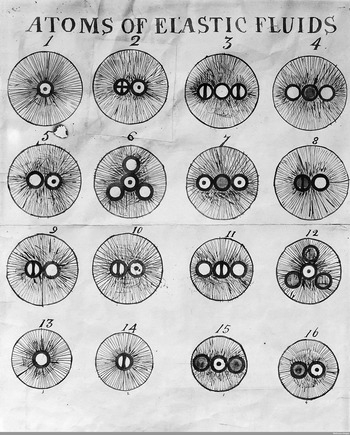
Even a cursory glance at Bryan's and Dalton's illustrations of a water molecule (Figures 1 and 2) clearly shows that both adopted similar models of caloric and chemical combination, displaying the union of central particles to form a molecule, all surrounded by atmospheres of caloric. Figure 2 shows that, unlike Bryan, Dalton addressed combination in multiple proportions. Bryan did not countenance such a possibility, his chemical atomic theory addressing only binary combination.
The chemical combination of hydrogen and oxygen according to Bryan Higgins, as illustrated in the Minutes of the Society for Philosophical Experiments and Conversations, London: T. Cadell and W. Davies, 1795. (a) Plate III. Atoms of hydrogen (left) and oxygen (right) surrounded by atmospheres of caloric. The density of the atmospheres decreases as a power of the distance from the central particles. The particles do not combine because the force exerted by the repellent atmospheres is greater than the force of attraction between the particles. (b) Plate IV. An atmosphere of caloric, the close but equal spacing of the concentric circles indicating an atmosphere of uniform density, denser than the caloric surrounding the atoms illustrated in Plate III. Reproduced courtesy of the Chemical Heritage Foundation. Roy G. Neville Collection. Othmer Library of Chemical History. Photographs by Jay Muhlin. (c) Higgins instructed the reader to hold the book up to the light with Plate III extended over Plate IV to view the effect of applying a spark to the particles. (d) Plate III extended over Plate IV shows the combination of the particles after a spark is applied. The spark adds caloric, eliminating and blending the local atmospheres of caloric, creating a single atmosphere of uniform density surrounding both particles. The attractive forces between the particles can now result in chemical combination. The caloric between the particles that is eliminated from their union propagates the reaction throughout the gaseous mixture. Reproduced courtesy of the Chemical Heritage Foundation. Roy G. Neville Collection. Othmer Library of Chemical History. Photograph (c) by Jay Muhlin; photo illustration (d) by Jay Muhlin.

Lecture sheet used by Dalton to illustrate the composition of elastic fluids. Atoms, both singly and in combination, are surrounded by atmospheres of heat of varying diameters. Water, composed of one atom of oxygen and one of hydrogen, is displayed in illustration 5. Coward and Harden date the illustration to the 1806–1809 period. Hubert Coward and Arthur Harden, ‘Part III: the lecture sheets illustrating the atomic theory’, in William Gee, Hubert Coward and Arthur Harden, ‘John Dalton's lectures and lecture illustrations’, Manchester Memoirs (1915) 59, pp. 1–66, 48–50. Wellcome Library, London, M0004649, ‘Composition and size of atoms’. Copyrighted work available under Creative Commons Attribution only licence CC BY 4.0, http://creativecommons.org/licenses/by/4.0.

According to Bryan and Dalton, atoms were central hard particles surrounded by a repelling atmosphere of caloric whose density varied inversely as a power of the distance from the central particle, the diameter of the atmosphere determining the size of the atom. Their model displayed a belief in the materiality of caloric that went well beyond the loose notions of particles surrounded by repulsive caloric held by many late eighteenth- and early nineteenth-century chemists. Before adopting this model, Dalton thought the repulsion between particles of an elastic fluid (a gas) might resemble some type of magnetic force, because his law of partial pressures, which preceded his atomic theory, was based on the premise that only like atoms repelled each other. However, if repulsion was due to caloric, the generally accepted view at the time, then all gaseous atoms surrounded by an atmosphere of caloric would repel each other. Dalton was able to resolve this problem by assuming that atoms of an element were identical, having the same size and weight. When elastic fluids were mixed, Dalton maintained that the distribution and arrangement of atoms of different sizes – as determined by the diameter of their caloric atmospheres in accordance with his caloric model – could account for the repulsion of like particles only.
Because Dalton and contemporary chemists believed that elemental gases such as hydrogen and oxygen consisted of single atoms, comparing the specific gravities of various gases was not a viable method for determining relative atomic mass. For example, Dalton represented the molecular formula for water or steam, a compound composed of hydrogen and oxygen, as OH. But the vapour density of steam was less than that of oxygen, which Dalton represented as O. He therefore concluded that the specific gravities of the elastic particles (a parameter determined by size as well as mass) differed in some manner from the specific gravity of the bulk gases. Dalton instead derived his relative atomic weights from chemical analysis coupled with the assignment of molecular formulas. The simplest formula for a compound consisting of two elements was a one-to-one union of atoms, a binary combination, for example OH for water. If two elements combined in multiple proportions, Dalton incorporated the minimum number of atoms into his formulas, his rule of greatest simplicity, by adding atoms one by one, to represent binary, ternary and higher-order compounds.
The molecular formulas determined with these rules, coupled with a determination of the composition of the compounds, enabled Dalton to calculate his relative atomic masses. Most contemporary chemists did not accept Dalton's concepts of physical atoms, minute particles with definite sizes and weights, and his rules for chemical combination came under attack as being arbitrary. Instead, these chemists sidestepped Dalton's metaphysics, and they dealt not with atoms, but with combining weights, combining volumes, and other observable parameters.Footnote 34
Regarding physical atomic theories, both Robert Fox and Partington have recognized the conceptual similarity of Bryan Higgins's and Dalton's caloric model – that atoms were central hard particles surrounded by a repelling atmosphere of caloric whose density varied inversely as a power of the distance from the central particle.Footnote 35 If Dalton had been aware of Bryan's caloric model, could it have influenced his development of thought regarding relative atomic weights? To explore this question, excerpts from the work of the two chemists are compared, an exercise which Fox and Partington did not conduct. The comparison reveals a likeness not only in Bryan's and Dalton's concepts of atomic size, a possible precursor to Dalton's idea of relative atomic mass, but in several instances in language as well.
Regarding chemical atomic theories, although there is a resemblance between Bryan's concept of binary chemical combination and Dalton's one-to-one union of atoms, the basis for his rule of greatest simplicity, how could Dalton's concept of combination in multiple proportions be significantly influenced by Bryan's chemical atomic theory, when Bryan did not address multiple proportions? As Alan Rocke has noted, Dalton's physical and chemical atomic theories were in fact closely related:
Dalton's physical ideas about atoms were so tightly imbricated with chemical ones that it may seem artificial to seek to distinguish them. No later chemist had as tight interconnections between physical and chemical theories as Dalton … In any case, the admitted weaknesses in Dalton's physical atomic theories should not diminish our respect for the revolutionary chemical-atomistic tradition he succeeded in starting.Footnote 36
In the context of Rocke's observations, the question of the influence of Bryan's chemical atomic theory can be reformulated: is there anything in Bryan's physical atomic theory, his caloric model, which might have supplied Dalton with the germ of his idea for combination in multiple proportions? Again, the question is addressed by comparing aspects of Bryan's caloric model to Dalton's explanation for his law of multiple proportions, an exercise which shows similarity in concept and language.
Bryan's caloric model and relative atomic mass
In The Life and Work of William Higgins, Partington said little on Dalton's development of thought regarding the concept of atomic mass. He concluded that Dalton's ideas on mixed gases likely ‘led him to suppose that the particles of different gases are different in size, and from this he hit on the idea that they are different in weight’.Footnote 37 If Partington is correct, then the germ of Dalton's idea of relative atomic mass as indicated in his writings is a Higgins-like concept of ‘bulk’, the caloric atmosphere surrounding an atom as a measure of its size.
For example, in a laboratory notebook entry from 1806, Dalton first described his concept of atomic diameter in terms of an earth-atmosphere analogy and an atom's strength of attraction for its caloric atmosphere:
According to this view of the subject, every atom has an atmosphere of heat around it, in the same manner as the earth or any other planet has its atmosphere of air surrounding it … The virtual diameters of atoms of matter will therefore vary in like circumstances according to their attraction for heat; those with a strong attraction will collect a large and denser atmosphere around them …Footnote 38
In New System, Dalton continued with this line of thought:
By the size or volume of an ultimate particle, I mean in this place, the space it occupies in the state of a pure elastic fluid; in this sense the bulk of the particle signifies the bulk of the supposed impenetrable nucleus, together with that of its surrounding repulsive atmosphere of heat.Footnote 39
In Acetous Acid, Bryan Higgins described the strength of the atom for its caloric and used the term ‘bulk’ as a measure of atomic size, in a manner resembling Dalton's descriptions cited in the excerpts above:
For the elasticity which subsists under immense pressure, argues a stronger attraction of the particles to their respective repellent atmospheres, than that which we last noticed; but that this stronger attraction compels denser and deeper atmospheres, may not only be argued a priori, but is experimentally demonstrable by the bulk, which in elastic fluids is the measure of the atmospheres, compared with the gravity, which is the measure of the gross particles.Footnote 40
Although Partington cited this passage,Footnote 41 he did not cite the following summary of Bryan's caloric theory made nine years later in Minutes of the Society for Philosophical Experiments and Conversations, a statement which not only employs an earth-atmosphere analogy similar to Dalton's, but also makes a significant and much clearer allusion to atomic mass by using the term ‘heavier’:
The obvious consequence of such natural powers and laws is this. The grosser and heavier central particles severally engage Caloric around them, combining with a certain portion, and drawing the remainder of their respective charges into the form of atmospheres decreasing in density as the distances from the central particles encrease [sic]. So the earth carries the like atmosphere of air, and electrified bodies maintain their electrical atmospheres.Footnote 42
A comparison of the excerpts reveals that both Dalton and Bryan used the term ‘bulk’ to signify the diameter of the caloric atmosphere surrounding a central particle, a measure of atomic size, and they both employed an earth-atmosphere analogy to describe their caloric models. Furthermore, Dalton described the strength of the atom for its surrounding caloric with the phrase ‘those with a strong attraction will collect a large and denser atmosphere around them’, which is similar to Bryan's ‘this stronger attraction compels denser and deeper atmospheres’.
Based on the excerpts cited above, Dalton's Higgins-like concept of atomic size dates back to his 1806 laboratory notebook entry. But is there any evidence to suggest that Dalton knew of Bryan's caloric theory when he came up with his first table of atomic weights in September 1803? Entries in Dalton's laboratory notebooks on 19 September 1803 do show calculations related to particle diameter,Footnote 43 but was Dalton specifically thinking about the diameter of the caloric atmosphere surrounding a central particle, or was he contemplating size that was in some manner related to magnetic-like forces of repulsion between particles? This is a key point, because Dalton stated in his Royal Institution lectures presented in 1810 that he did not adopt his caloric model until 1805.Footnote 44 Before this, he claimed, he had believed instead that the repulsive force might be magnetic.Footnote 45 Thus during the 1801–1803 period, Dalton referred to atomic size not as the diameter of the ‘atmosphere of heat’ surrounding a central particle, but as the diameter of its ‘sphere of influence’Footnote 46 or ‘aërial space’,Footnote 47 failing to specifically identify caloric atmospheres as the repulsive force between particles.
A fresh look at the correspondence between Dalton and Thomas Charles Hope, reproduced in Roscoe and Harden's New View,Footnote 48 does indicate that Dalton was indeed thinking of repulsive caloric atmospheres surrounding central particles at just about the time he came up with his first table of atomic weights in September 1803, contrary to his statement that he adopted this concept in 1805. On 4 November 1803, Hope wrote to Dalton stating that he had thought a good deal about the ideas that Dalton and he had discussed during their last meeting in Manchester, such as the phenomenon of the density of water as a function of temperature. Their meeting apparently occurred roughly in early October 1803, and the 4 November letter is filled with several questions Hope posed to Dalton about their meeting. Just prior to closing, Hope wrote,
In our last conversation you mentioned that you had ascertained that water does not expand as its temperature sinks from 40° to 32°. Would you be so obliging as state to me the data on which you form your opinion?
Would you also communicate to me the other very interesting positions respecting heat which you read to me?Footnote 49
What did Dalton read to Hope – a book, a published paper, a draft or correspondence? His own work or that of someone else, containing novel ideas? They would not be those of Lavoisier or Crawford, or other generally accepted views on caloric at the time, since Hope would certainly have been familiar with these, and there would be no reason for his follow-up request. Perhaps Dalton might have read Hope something related to Bryan's work, considering his recent meeting with Allen. By itself the statement provides no information regarding the identity of the unknown author. However, it is the response that Hope received from Dalton which suggests the possibility that Dalton may have already known about Bryan's caloric theory.
Based on the sequencing of letters in the New View, Dalton appears to have provided the information to Hope within a few days, because Hope's next letter refers to Dalton's reply of 8 November.Footnote 50 In what appears to be a response to some of Dalton's novel ideas on heat provided to him in their early October 1803 meeting, Hope states,
The reason you assign for the slow intermixture of the two gases affords what I conceive the strongest objection to the theory in general. You impute it to the operation of the atmospheres of caloric surrounding the particles of the different gases. This atmosphere I deem the essential cause of the elasticity and repulsion among the particles of the gas, and I cannot conceive that this atmosphere as it surrounds a particle of oxygen should repel the atmosphere that surrounds another particle of oxygen and should not repel the atmosphere that envelopes a particle of azote, hydrogen, or any other gas.Footnote 51
Thus, just about three months after Dalton met with Allen, he suddenly used Bryan Higgins's term ‘atmospheres of caloric’ instead of the usual ‘sphere of influence’ or ‘aërial space’, which Dalton had employed in his publications over the prior two years. His laboratory notebook calculations of atomic diameter, combined with the Hope correspondence, show that just about the time he came up with his first table of atomic weights, Dalton was thinking along the lines of a Higgins-like model, a central particle surrounded by an atmosphere of caloric, the diameter of the caloric atmosphere an indicator of the size of the atom.Footnote 52 According to Partington, Dalton made the leap from atomic size to relative atomic mass, but the concept eluded Bryan Higgins.
When viewed in the light of the Hope correspondence, are there additional entries in Dalton's laboratory notebooks for September 1803 which support the argument that Dalton was aware of Bryan's caloric model? On pages 245 and 246 of Dalton's notebook, just before his first table of atomic weights appears on page 248, Dalton comments on atmospheres of heat and specific gravities of gases in the following manner:
The ultimate atoms of bodies are those particles which in the gaseous state are surrounded by heat; or they are the centres or nuclei of the several small elastic globular particles [page 245]
Enquiry into the specific gravity of the ultimate particles or elements.
Though it is probable that the specific gravities (sic) of different elastic fluids has some relation to that of their ultimate particles, yet it is certain they are not the same thing; for the ult. part. of water or steam are certainly of greater specific gravity than those of oxygen, yet the last gas is heavier than steam [page 246].Footnote 53
Compare this to Bryan's observations in Acetous Acid, where he noted the following during a discussion of the affinity of matter for caloric:
I consider the specific gravity as a safe guide in our investigations of these affinities and of their order, in regard only to the elastic fluids which seem to consist of no more than one kind of gravitating matter engaged in the repellent atmosperes [sic]: And of fixable air, dense inflammable air, acid airs, the phlogistic alkaline air, and others, I would observe, that the atmosperes [sic] include molecules instead of solitary ultimate parts; for without this chemical union of heterogeneal parts, and the formation of molecules, an elastic fluid of the kind that I now speak of, could not differ, as it does, from either kind of matter of which it is composed.Footnote 54
Although both Dalton and Higgins reached the same conclusion regarding the differences between the specific gravities of a compound elastic fluid and its components, Dalton realized that the specific gravity of an ultimate particle would depend not only on its relative atomic mass, but on its size as determined by the diameter of its caloric atmosphere as well. Right after making his observation regarding specific gravities of ultimate particles, Dalton developed his first table of atomic weights, and then quickly turned to calculating atomic diameters. Bryan Higgins could advance his observations on specific gravities of elastic fluids no further, because although his caloric model accounted for atomic size, he never grasped the significance of his own statement regarding the utility of specific gravities of gases made up of only ‘one kind of gravitating matter’, which Partington described as a ‘vague statement’ that ‘approaches Dalton's idea of the atoms of elements having different weights’.Footnote 55
Bryan Higgins's caloric model and combination in multiple proportions
As noted, Bryan's chemical atomic theory was limited to binary combination, which was first published in detail in his 1776 book A Philosophical Essay Concerning Light, illustrating the spontaneous binary reaction of acid and alkali particles, a union occurring when the forces of attraction and repulsion between the particles just balanced.Footnote 56 However, in Acetous Acid, Bryan detailed a more robust concept of chemical combination, one incorporating his caloric theory, to explain non-spontaneous binary chemical combinations. He described the reaction of hydrogen and oxygen, which only occurs when a spark is applied. The caloric added by the spark blended the caloric atmospheres around the particles, allowing combination to take place, with caloric between the uniting particles displaced and emitted, propagating the reaction. Bryan illustrated the reaction in Minutes of the Society for Philosophical Experiments and Conversations published nine years later (Figure 1).
Dalton's first public explanation for the rationale behind his rules of chemical combination did not appear until 1811, in response to John Bostock's charge that Dalton did not provide evidence for his assumptions. To explain his rule of greatest simplicity, Dalton abandoned his first law of mixed gases, which was based on the repulsion of like atoms, and adopted his second law of mixed gases. This resembled Bryan's treatment of the hydrogen–oxygen reaction described in Acetous Acid, and illustrated in Minutes of the Philosophical Society. According to Dalton, the application of an electric spark to a uniformly diffused mixture of hydrogen and oxygen destroyed the equilibrium of the mixture, allowing the attraction between the dissimilar atoms to overcome the repulsion, the latter likely due to heat. This resulted in a one-to-one combination of hydrogen and oxygen atoms, because the dissimilar atoms were situated adjacent to one another in the uniform mixture; each hydrogen atom would combine with the nearest oxygen atom.Footnote 57
Having explained his rule of greatest simplicity using the hydrogen–oxygen reaction, a Higgins-like model of binary combination, in his 1811 response to Bostock, Dalton then applied the rule step-wise to form the basis for his theory of multiple proportions. According to Dalton, the number of like atoms B that could be accommodated around a central dissimilar atom A was limited by the repulsive forces between the like atoms B in accordance with his first law of mixed gases. Dalton described the B atoms spreading out around the A atom, ‘except so far as the repulsion of the atoms of B among themselves are more than a match for the attraction of an atom of A’. He continued,
as far as powers of attraction and repulsion are concerned, (and we know of no other in chemistry) binary compounds must first be formed in the ordinary course of things, then ternary, and so on, till the repulsion of the atoms of B (or A, whichever happens to be on the surface of the other), refuse to admit any more.Footnote 58
Although Bryan Higgins never developed a theory of multiple proportions, Dalton's rationale for his theory of multiple proportions nonetheless resembles Bryan Higgins's placement of caloric particles around a central particle, the repulsion between the caloric particles limiting the number of particles that can be accommodated at a given distance around the central atom. Bryan stated,
The general laws of attraction and combination, and all the known phenomena of Caloric, lead us to this inference; that attractive particles engage around them into a state of combination, as much Caloric as the mutual repulsions of its parts will permit to be thus approximated towards each other; and also engage further portions around the former, but with forces and densities decreasing, as the distances from the central particles increase.Footnote 59
Thus Bryan's caloric model incorporated the concept of repulsive caloric particles surrounding a central particle. This explained the make-up of the caloric atmosphere, the density of which decreased with distance from the central particle, and the diameter of the atmosphere as a measure of the size of the atom. Assuming Dalton was aware of Bryan's work, Bryan's caloric model may have been the impetus not only for atomic size and relative atomic mass, but also for Dalton's rationale for combination in multiple proportions, a physical atomic theory which Bryan never developed into a robust chemical atomic theory to explain the law of multiple proportions, as Dalton did.
Conclusion
Bryan Higgins's mental decline prevented him from lodging his own claims of priority against Dalton or defending his nephew William, inaction which contributed to his theories being overshadowed by William's exaggerated claims. As argued in this paper, four factors, when viewed together, constitute a strong circumstantial case indicating that Dalton was indeed aware of Bryan's theories when he came up with his first table of atomic weights, despite their general neglect in the scientific community at large.
First, there is the similarity of their concepts and the language used to describe them. Second, Dalton knew of Acetous Acid sometime before 1810, as evidenced by his allusion to it in New System. Third, the Dalton–Hope correspondence and Dalton's laboratory notebooks show that Dalton adopted a Higgins-like caloric model at just about the time he came up with his first table of atomic weights, referring to ‘atmospheres of caloric’ surrounding central particles and calculating atomic diameter based on the bulk of the caloric atmospheres. Fourth, Dalton used this Higgins-like caloric model not in 1805, as he had stated, but in 1803, just two months after his meeting with William Allen, a student of Bryan's, as well as a member of his society and its publication committee.
If Dalton was aware of Bryan's work, how did this knowledge influence his thinking as he developed the atomic theory? Dalton's physical atomic theory may have been influenced by Bryan's idea of atomic size, as measured by the diameter of the caloric atmosphere, as well as by Bryan's observations relating to the specific gravities of compound gases. The coupling of the two ideas perhaps led Dalton to the concept of relative atomic mass. Fox and Partington noted the conceptual similarity of their caloric models. In addition, a comparison of the wording used to describe their caloric models and their observations on specific gravities of particles shows a resemblance not only in concept, but in language as well.
Regarding Dalton's chemical atomic theory, his concept of atom-to-atom combination – the rule of greatest simplicity – resembles Bryan's theory of binary combination. When applied step-wise, it forms the basis for Dalton's theory of multiple proportions, the number of like atoms that can be accommodated by a dissimilar atom limited by the repulsive forces of the like atoms in accordance with his first law of mixed gases. Dalton's rationale for combination in multiple proportions resembled Bryan's caloric model, specifically the placement of caloric particles around a central particle, the repulsions between the caloric particles limiting the number of particles that could be accommodated at a given distance around the central atom. Bryan's approach would likely have resonated with Dalton, because replacing the repulsive caloric particles around atom A with repulsive B atoms constitutes an example which nicely illustrates the key feature of Dalton's first law of mixed gases.
However, the evidence for the influence of Bryan Higgins's caloric model and concept of binary chemical combination on Dalton's chemical atomic theory is more tentative than the argument for Bryan's influence on Dalton's physical atomic theory. There are fewer samples of wording addressing Dalton's thoughts on chemical combination to compare to Bryan's – hence the unknown origin of his atomic theory. Besides this, there is a possibility that other influences might have come into play as well, for example the early theories of chemical combination described by Thomas Thomson. As discussed by Seymour Mauskopf,Footnote 60 Thomson did employ a geometrical model, based on the arrangement and accommodation of various shapes of combining particles, to explain the affinity between particles and combination in differing proportions. But unlike Thomson, the geometrical model used by Dalton to explain combination in multiple proportions was based on repulsion of like atoms, not the affinity between them, with all of the atoms being spherical, and with no consideration for differing particle shapes.
If Dalton did adopt Bryan's caloric model, the issue of plagiarism arises – not for the atomic theory, but for Dalton's failure to provide acknowledgement for Bryan's caloric model. Dalton's own model was similar to Bryan's in concept and wording, with both chemists adopting the idea of central atoms surrounded by atmospheres of heat. The density of the atmosphere decreased with distance, and the diameter of the atmosphere was an indicator of atomic size. Regarding Dalton's chemical atomic theory, Bryan's concepts of binary combination and his placement of caloric particles around a central atom raise the issue of influence rather than plagiarism – Bryan simply did not use these ideas to address combination in multiple proportions. But whether Dalton was indebted to Bryan or not, he never referred to Bryan's anticipation of his caloric model, of which he was almost certainly aware throughout the years of the dispute with William.Footnote 61 Regardless, Dalton's priority for the atomic theory – his unique calculating system – is indisputable. When William and Bryan published the Comparative View and Minutes of the Philosophical Society in 1789 and 1795 respectively, each had knowledge of the other's works, yet the concept of relative atomic mass eluded both of the Higginses, and neither developed theories of any overarching practical utility, as Dalton did with his atomic theory.
It is worth recalling Partington's statement cited at the beginning of this essay: ‘Dalton's [atomic] theory is, therefore, not based on arbitrary rules but on the Newtonian atomic theory; it is an extension of that of Bryan Higgins and makes use of similar ideas, although there is no reason to think that Dalton was indebted to Higgins’. Clearly, the arguments I have presented call into question Partington's conclusion about the possibility of Bryan's influence, and evidence utilized over the years to argue the origin of the atomic theory is worthy of re-evaluation. As demonstrated in this essay, excerpts from Dalton's New System, his laboratory notebook entries, and the Hope–Dalton correspondence are subject to reinterpretation if Dalton had prior knowledge of Bryan's works.
In light of the new evidence presented, where does Bryan Higgins belong in the evolutionary chain of thought that led to the development of the atomic theory? Should he remain an appendage to a chain that runs from Newton to Dalton, to be treated outside the main narrative of Dalton's work (an acceptance of Partington's premise of 1939 regarding possible influence)? Or should Bryan be inserted as a link between Newton and Dalton, having contributed germs of ideas that Dalton extended, as noted by Partington, to formulate his monumental atomic theory? That should be the future nature of the debate surrounding the Higgins–Dalton dispute.