



Introduction
The staging method to describe the longitudinal development of mental disorders was introduced in 1993 (Fava & Kellner, Reference Fava and Kellner1993), with a considerable delay compared to other medical disciplines (Feinstein, Reference Feinstein1987). The model for unipolar depression included five stages: prodromal phase, acute major depressive episode, residual phase, dysthymia/recurrent major depression, and chronic major depressive episode (Fava & Kellner, Reference Fava and Kellner1993). This classification retained its basic structure in subsequent proposals (Cosci & Fava, Reference Cosci and Fava2013; Ferensztajn, Remlinger-Molenda, & Rybakowski, Reference Ferensztajn, Remlinger-Molenda and Rybakowski2014; Hetrick et al., Reference Hetrick, Parker, Hickie, Purcell, Yung and McGorry2008; McGorry, Hickie, Yung, Pantelis, & Jackson, Reference McGorry, Hickie, Yung, Pantelis and Jackson2006; Nelson, McGorry, & Fernandez, Reference Nelson, McGorry and Fernandez2021).
In 1997, Thase and Rush (Reference Thase and Rush1997) presented a five-level staging model yielding a categorical assignment of degree of resistance in unipolar depression in an effort to offer guidance for the sequential treatment of patients who do not respond to a first course of antidepressants. Patients were classified according to the number and classes of antidepressants that failed to produce a response. Also this method underwent modifications (Corey-Lisle, Birnbaum, Greenberg, Marynchenko, & Claxton, Reference Corey-Lisle, Birnbaum, Greenberg, Marynchenko and Claxton2022; Cosci & Fava, Reference Cosci and Fava2013; Fava, Reference Fava2003; Fekadu et al., Reference Fekadu, Wooderson, Donaldson, Markopoulou, Masterson, Poon and Cleare2009a; Souery et al., Reference Souery, Amsterdam, de Montigny, Lecrubier, Montgomery, Lipp and Mendlewicz1999).
Both staging models of longitudinal development and treatment-resistance were applied to empirical research, including randomized clinical trials (RCTs).
A systematic review of the concept of staging in mental disorders was published in 2013 (Cosci & Fava, Reference Cosci and Fava2013). The present paper provides an updated systematic review of studies concerned with staging models of longitudinal development or treatment-resistance in adult patients with unipolar depression and a critical discussion of their conceptual developments and clinical implications.
Methods
Eligibility criteria
English-language papers published in peer-review journals were included if reporting on staging models of unipolar depression, treatment-resistant depression (TRD) models, or their applications in adults. Unipolar depression was diagnosed according to the Research Diagnostic Criteria, the Diagnostic and Statistical Manual of mental disorders (DSM), or the International Classification of Diseases. Articles on models had to include a complete description of staging. Articles on applications had to refer to a sample of at least 10 subjects (Cosci & Fava, Reference Cosci and Fava2013). Special populations (e.g. veterans, pregnant women) and medically ill patients were excluded.
No restrictions to design were applied.
Information sources and search
MEDLINE, PsycINFO, EMBASE, and Web of Science were systematically searched from inception to December 2021. Search terms were ‘stage/staging’, combined using the Boolean ‘AND’ operator with ‘psychiatric disorder/mental disorder/depressive/mood disorder’. Online Supplementary Fig. S1 shows the search strategy used for PubMed. A manual search of reference lists from articles selected and reviews was also done.
Titles and abstracts were screened by two reviewers (F.C. and G.A.F.). Articles potentially relevant were retrieved in full. To ascertain the validity of eligible studies, the two reviewers rated each study based on homogeneity of samples regarding the diagnosis (unipolar depression) and age (⩾18 years). The MetaQAT (Rosella et al., Reference Rosella, Bowman, Pach, Morgan, Fitzpatrick and Goel2016) tool was used to assess relevancy, reliability, validity, and applicability. The two reviewers acted blindly and independently. Disagreements were solved by consensus.
For each excluded study, the elements of the electronic search not addressed were determined. For each included study, the following data were extracted: reference, setting, population, sample size, design, and model/main outcome.
When information was omitted, authors were contacted to retrieve missing data. In case of duplicate publications, only the report with the largest sample size was included.
The search strings and the list of relevant reviews used, the data coding, the assessment of quality criteria and risk of bias are available on request to the corresponding author.
The protocol was registered in PROSPERO (CRD42022298730 available from: https://www.crd.york.ac.uk/prospero/display_record.php?ID=CRD42022298730) and not published elsewhere. The development of the protocol was guided by the Preferred Reporting Items for Systematic Review and Meta-Analysis Protocols (PRISMA) guidelines (Page et al., Reference Page, McKenzie, Bossuyt, Boutron, Hoffmann, Mulrow and Moher2021).
Results
Selection of articles and study characteristics
The initial search strategies yielded 163 259 records from databases and 137 from citation searching. After adjusting for duplicates and reviewing the abstracts to exclude those which clearly did not meet the inclusion criteria, 359 full-text articles were assessed for eligibility. Of them, 190 were discarded (see flow diagram in online Supplementary Fig. S2) and 169 were retained, meeting the inclusion criteria. Among them, 18 studies described staging models of longitudinal development of unipolar depression or their applications (online Supplementary Table S1) while 151 described treatment-resistant unipolar depression staging models (online Supplementary Table S2a) or their applications (online Supplementary Table S2b). The studies will be here presented according to the aim of the classification.
Staging models of longitudinal development of unipolar depression: description and applications
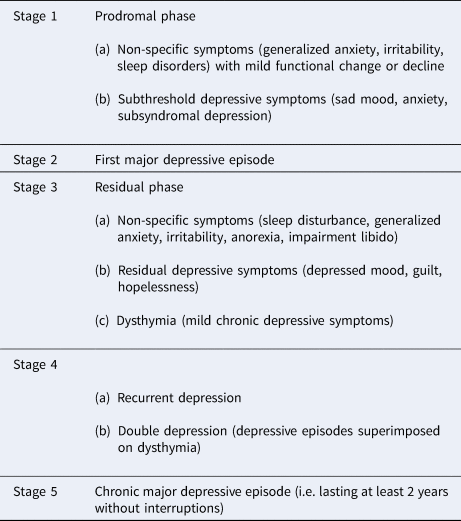
Fava and Kellner (Reference Fava and Kellner1993) model for unipolar depression was further elaborated in 2013, splitting stages 1 and 3 in subtypes (Cosci & Fava, Reference Cosci and Fava2013) (Table 1). McGorry and associates (Hetrick et al., Reference Hetrick, Parker, Hickie, Purcell, Yung and McGorry2008; McGorry et al., Reference McGorry, Hickie, Yung, Pantelis and Jackson2006) introduced stage 0 as a stage of high risk of illness without symptoms. More recent elaborations were more geared to recovery, persistence of symptoms, chronicity (Boschloo et al., Reference Boschloo, Schoevers, Beekman, Smit, van Hemert and Penninx2014; Wardenaar, Monden, Conradi, & de Jonge, Reference Wardenaar, Monden, Conradi and de Jonge2015); or to symptom decline, persistence of symptoms and residual manifestations, course trajectory of increasing symptomatology (Verhoeven, Wardenaar, Ruhé, Conradi, & de Jonge, Reference Verhoeven, Wardenaar, Ruhé, Conradi and de Jonge2018) (online Supplementary Table S1).
Four clinical investigations (Fava, Grandi, Zielezny, Canestrari, & Morphy, Reference Fava, Grandi, Zielezny, Canestrari and Morphy1994; Fava, Rafanelli, Cazzaro, Conti, & Grandi, Reference Fava, Rafanelli, Cazzaro, Conti and Grandi1998a; Fava, Rafanelli, Grandi, Canestrari, & Morphy, Reference Fava, Rafanelli, Grandi, Canestrari and Morphy1998b; Fava, Rafanelli, Grandi, Conti, & Belluardo, Reference Fava, Rafanelli, Grandi, Conti and Belluardo1998c) specifically referred to the staging model proposed by Fava and Kellner (Reference Fava and Kellner1993) to apply psychotherapy to the residual phase of depression (stage 3) after medication treatment in a sequential design. Three studies applied the staging model by McGorry et al. (Reference McGorry, Hickie, Yung, Pantelis and Jackson2006), or its elaborations. One showed increasing trends of dysregulation of inflammation, hypothalamic–pituitary–adrenal axis and vitamin D across healthy controls and at-risk stages (Verduijn et al., Reference Verduijn, Milaneschi, Schoevers, van Hemert, Beekman and Penninx2015a). Another study observed differences between clinical stages in resistance to treatment (Reneses et al., Reference Reneses, Aguera-Ortiz, Sevilla-Llewellyn-Jones, Carrillo, Argudo, Regatero and Palomo2020). A third study, which is the only one testing the clinimetric properties of a staging model of development of unipolar depression, found that the version by Hetrick et al. (Reference Hetrick, Parker, Hickie, Purcell, Yung and McGorry2008) had adequate construct validity but poor predictive validity (Verduijn et al., Reference Verduijn, Milaneschi, van Hemert, Schoevers, Hickie and Beekman2015b) (online Supplementary Table S1).
Staging model of treatment-resistant unipolar depression: description
Seven treatment-resistant staging methods were proposed for unipolar depression. The first was presented by Thase and Rush (Reference Thase and Rush1997), with staging moving from more common to less common treatments and the failure of an electroconvulsive therapy (ECT) trial representing the most weight to the degree of treatment resistance. The failed trials had to be of different classes of antidepressants. TRD stage I was considered with at least one trial failure.
The European staging method (ESM) (Souery et al., Reference Souery, Amsterdam, de Montigny, Lecrubier, Montgomery, Lipp and Mendlewicz1999) classified patients using three distinctive categories: non-responders (i.e. those who failed to respond to one treatment regimen of appropriate duration), with TRD (i.e. failure to two treatments of different classes of antidepressants), or with chronic-resistant depression (i.e. a depressive episode lasting at least 1 year despite multiple adequate interventions, including augmentation strategies). The TRD category was further divided into five stages depending on the duration and characteristics of the trials. The model and the European Group for the Study of Resistant Depression definition for TRD have been more recently optimized and adopted by the European Medicines Agency (https://www.google.com/url?q=http://www.ema.europa.eu&source=gmail-imap&ust=1651064990000000&usg=AOvVaw3vVHBc3BG4HpeFUASPPAyA).
The dimensions of TRD were also elaborated (Corey-Lisle et al., Reference Corey-Lisle, Birnbaum, Greenberg, Marynchenko and Claxton2022) based on the need to add mood stabilizer/atypical antipsychotic (dimension I), switch (dimension II), titrate (dimension III). Each dimension was rated on a 0–2 or 0–3 score and a total score ⩾5 identified TRD. No differentiations among drug classes were introduced.
The Massachusetts General Hospital staging model (MGH-S) (Fava, Reference Fava2003) was mainly based on the number of failed trials and the intensity or optimization of each trial, without assumptions on the hierarchy of antidepressant classes. It introduced an explicit point-based system yielding a composite score for treatment resistance. One point per each failed antidepressant trial contributed to the total score. Optimization of dose/duration, augmentation/combination of each trial increased the overall score of 0.5 point per trial. A special weight was given for failure of treatment with ECT, which received a score equivalent to three antidepressant failures.
Finally, the Maudsley staging Method (MSM) (Fekadu et al., Reference Fekadu, Wooderson, Donaldson, Markopoulou, Masterson, Poon and Cleare2009a) incorporated, in addition to the number of failed treatment trials, factors considered to be closely related to the depressive illness itself: duration, severity, treatment failure to antidepressants, use of augmentation, and use of ECT. At the end, the stage of treatment resistance was represented as a single score ranging from 3 and 15. The MSM was later modified adding several items which referred to functional impairment, comorbid anxiety, personality disorder, psychosocial stressors (Peeters et al., Reference Peeters, Ruhe, Wichers, Abidi, Kaub, van der Lande and Schene2016).
Cosci and Fava (Reference Cosci and Fava2013) made an attempt to integrate the various models introducing the use of psychotherapeutic strategies and basing their classification on the number of adequate (for duration) failed therapeutic trials, without antidepressant class distinction. Augmentation/combination strategies or ECT were also considered in the model as specifiers of the highest level of TRD (stage 4).
Conway, George, and Sackeim (Reference Conway, George and Sackeim2017) based their two-stage model on the number of failed trials with adequate antidepressant or psychotherapy in the current episode. The number of failed trial to have stage I TRD was 2.
Staging model of treatment-resistant unipolar depression: applications
The TRD staging methods constituted the entry criteria for clinical trials exploring alternative treatments, with particular reference to new medications (Salloum & Papakostas, Reference Salloum and Papakostas2019).
The Thase and Rush (Reference Thase and Rush1997) model was the most used and one-third of research consisted of RCT. Its application allowed to study stage-specific biomarkers; identify stage-specific pharmacological or non-pharmacological interventions; increase knowledge in imaging, neurocognitive domain, genetics, clinical features of TRD (online Supplementary Table S2b).
The ESM (Souery et al., Reference Souery, Amsterdam, de Montigny, Lecrubier, Montgomery, Lipp and Mendlewicz1999) has been used in four studies, only one being an RCT. Among the four studies, three were on treatment response, one was on capillary dysfunction in the cortex (online Supplementary Table S2b). In addition, the recently adopted definition for TRD by the European Medicines Agency is increasingly used in international trials (e.g. Bartova et al. Reference Bartova, Dold, Kautzky, Fabbri, Spies, Serretti and Kasper2019; Kasper, Reference Kasper2022) and a study (Kraus, Kadriu, Lanzenberger, Zarate, & Kasper, Reference Kraus, Kadriu, Lanzenberger, Zarate and Kasper2019) outlined a sequential treatment optimization paradigm for selecting first-, second-, and third-line treatments for acute and chronically ill patients with unipolar depression.
The Corey-Lisle et al. (Reference Corey-Lisle, Birnbaum, Greenberg, Marynchenko and Claxton2022) model was applied in five retrospective cohort studies: two were on costs of the illness; one on mental health service use; two used an adaptation of the model to study mortality and the influence of opioid use on TRD onset (online Supplementary Table S2b).
The Massachusetts General Hospital staging method (Fava, Reference Fava2003) is the second most utilized method, and it was extensively used in RCT. Reliability and validity have been explored in a number of investigations showing high predictive values (Gibson et al., Reference Gibson, Jing, Smith Carls, Kim, Bagalman, Burton and Goetzel2010) and accuracy (Johnston, Steele, Tolomeo, Christmas, & Matthews, Reference Johnston, Steele, Tolomeo, Christmas and Matthews2015). This is the only staging method having a derived standardized tool which allows us to classify TRD, the Massachusetts General Hospital Antidepressant Treatment Response Questionnaire (MGH-ATRQ) (Chandler, Iosifescu, Pollack, Targum, & Fava, Reference Chandler, Iosifescu, Pollack, Targum and Fava2010). The MGH-ATRQ showed good concordance with data collected by medical monitors (Chandler et al., Reference Chandler, Iosifescu, Pollack, Targum and Fava2010); excellent inter-/intra-rater reliability (Targum, Pendergrass, Toner, Asgharnejad, & Burch, Reference Targum, Pendergrass, Toner, Asgharnejad and Burch2014); high sensitivity (Freeman et al., Reference Freeman, Pooley, Flynn, Baer, Mischoulon, Mou and Fava2017; Targum et al., Reference Targum, Pendergrass, Toner, Asgharnejad and Burch2014); high specificity, predictive values, and kappa coefficients for treatment response and non-response outcomes (Targum et al., Reference Targum, Pendergrass, Toner, Asgharnejad and Burch2014) (online Supplementary Table S2b). The MGH-S was applied in research mainly to test treatment response in RCT. Some studies focused on clinical or genetic features, on neuroimaging, on biomarkers, on illness costs, or quality of life (online Supplementary Table S2b).
The Maudsley staging model (Fekadu et al., Reference Fekadu, Wooderson, Donaldson, Markopoulou, Masterson, Poon and Cleare2009a) has also been widely used (online Supplementary Table S2b). Some properties have been tested: odds of prediction for higher MSM score, likelihood of remission based on MSM score, prediction of course (Fekadu, Wooderson, Markopoulou, & Cleare, Reference Fekadu, Wooderson, Markopoulou and Cleare2009b; Fekadu et al., Reference Fekadu, Wooderson, Donaldson, Markopoulou, Masterson, Poon and Cleare2009a, Reference Fekadu, Rane, Wooderson, Markopoulou, Poon and Cleare2012; van Belkum et al., Reference van Belkum, Geugies, Lysen, Cleare, Peeters, Penninx and Ruhe2018, van Diermen et al., Reference van Diermen, Hebbrecht, Schrijvers, Sabbe, Fransen and Birkenhäger2018). Its derived Dutch Measure for quantification of Treatment Resistance in Depression (DM-TRD) tool (Peeters et al., Reference Peeters, Ruhe, Wichers, Abidi, Kaub, van der Lande and Schene2016) showed excellent inter-/intra-rater reliability (Peeters et al., Reference Peeters, Ruhe, Wichers, Abidi, Kaub, van der Lande and Schene2016) and high longer-term predictivity of symptom severity (van Dijk et al., Reference van Dijk, van den Boogaard, Deen, Spijker, Ruhé and Peeters2019). The MSM was applied in research to test treatment efficacy, even though seldom in RCT; to study specific clinical features of treatment-resistant unipolar depression, biomarkers, neurocognitive functions, or costs of the illness (online Supplementary Table S2b).
The Conway et al. (Reference Conway, George and Sackeim2017) model has been used only in a prospective comparative cohort study on premature workforce exit (online Supplementary Table S2b).
Seven studies used more than one treatment-resistance staging model, but their results are insufficient to draw conclusion on superiority of one model over another (online Supplementary Table S2b).
Staging models of tolerance to and side effects of antidepressant drugs
A staging model of manifestations of tolerance to and side effects of antidepressant medications has recently been introduced (Fava, Cosci, Guidi, & Rafanelli, Reference Fava, Cosci, Guidi and Rafanelli2020). Stages (from 0 to 4) were defined based on the occurrence (from 0 to >4) of the following events: paradoxical effects (i.e. increased depression with antidepressants); switching to hypomania or mania while on antidepressants; loss of clinical effect of antidepressants, despite adequate adherence; lack of response to a previously effective antidepressant treatment when it was started again after a drug-free period; new withdrawal or rebound syndromes after tapering, switching, and/or discontinuation of an antidepressant (Cosci & Chouinard, Reference Cosci and Chouinard2020); persistent post-withdrawal disorder after tapering, switching, and/or discontinuation of an antidepressant (Cosci & Chouinard, Reference Cosci and Chouinard2020). The model has not been applied to clinical studies, yet.
Discussion
The method of staging is part of clinimetrics, a domain concerned with the measurement of clinical issues that do not find room in customary clinical taxonomy (Fava, Tomba, & Sonino, Reference Fava, Tomba and Sonino2012a; Feinstein, Reference Feinstein1987). In addition to rate of progression of illness and its treatment response (staging), clinimetric methods include types, severity and sequence of symptoms; severity and characteristics of comorbidity; problems of functional capacity; reasons for medical decisions (e.g. treatment choices) and many other aspects of daily life, such as well-being and subclinical distress (Fava et al., Reference Fava, Rafanelli and Tomba2012a; Feinstein, Reference Feinstein1987).
Staging models of longitudinal development derived from the one outlined by Fava and Kellner (Reference Fava and Kellner1993). Such model is here presented in the updated version of Cosci and Fava (Reference Cosci and Fava2013) (Table 1). Its major application has been with the use of the sequential model for treating depression that consists of the consecutive application of two forms of treatment: psychotherapy after pharmacotherapy, pharmacotherapy after psychotherapy, sequential use of two psychotherapeutic or pharmacological strategies (Guidi & Fava, Reference Guidi and Fava2021). It is an intensive, two-stage approach, which derives from the awareness that one course of treatment (whether pharmacotherapy or psychotherapy) is unlikely to entail solution to the affective disturbances of patients, both in research and clinical practice settings. The application of psychotherapy to the residual stage of development of depressive illness after pharmacotherapy has been used in several RCTs and it has resulted in significant long-term benefits in terms of relapse rate (Guidi & Fava, Reference Guidi and Fava2021). Other applications, in addition to traditional pharmacotherapy, may be conceivable and need to be tested in controlled trials. A recent application of the sequential model in depression has been proposed to sustain the short-term effects of ketamine with cognitive behavioral therapy (Wilkinson et al., Reference Wilkinson, Rhee, Joormann, Webler, Ortiz Lopez, Kitay and Sanacora2021). There is room for using cognitive restructuring in the setting of repetitive transcranial magnetic stimulation (Neacsiu et al., Reference Neacsiu, Beynel, Powers, Szabo, Appelbaum, Lisanby and LaBar2022), particularly in the residual phase. Finally, medications that are found to be effective in the acute stage of depression may not necessarily be the most suitable for long-term treatment and its residual phase, where other types of drugs may be more suitable (Fava, Reference Fava2021).
The sequential model, however, does not consist of the mere application of psychotherapeutic strategies to the residual stage of depression; it requires a considerable degree of clinimetric integration (Fava, Rafanelli, & Tomba, Reference Fava, Rafanelli and Tomba2012b; Guidi & Fava, Reference Guidi and Fava2021). Components of this clinimetric approach include the role of repeated assessments that may modify an initial evaluation (e.g. pre-existing anxiety disturbances may emerge after pharmacotherapy of a major depressive episode); the shift from the disease model as a therapeutic target to the attainment of personal goals, upon identification of all modifiable biological and non-biological factors that are present in the specific stage; the organization of problematic areas (that is not limited to disorders, but also includes psychosocial problems and functional impairments) according to macro-analysis, where a relationship between co-occurring syndromes and problems is established (Fava et al., Reference Fava, Rafanelli and Tomba2012b).
Staging is uniquely geared to identifying individual trajectories (Fig. 1). There appears to be a relationship between residual and prodromal symptomatology according to the rollback phenomenon that was substantiated in mood disorders: as the illness remits, it progressively recapitulates, even though in a reverse order, many of the stages and symptoms that were seen during the time it developed (Detre & Jarecki, Reference Detre and Jarecki1971; Fava, Reference Fava1999). Since prodromal symptoms of relapse tend to mirror those of the initial episode, symptoms occurring in the prodromal phase deserve more clinical attention than others (Benasi, Fava, & Guidi, Reference Benasi, Fava and Guidi2021; Fava et al., Reference Fava, Grandi, Zielezny, Canestrari and Morphy1994). Indeed, in clinimetrics major and minor symptoms can be differentiated (Fava et al., Reference Fava, Tomba and Sonino2012a, Reference Fava, Rafanelli and Tomba2012b), unlike in the psychometric model endorsed by DSM, where all items are weighed the same. Individual trajectories may also apply to neurobiological correlates in the course of depression, particularly as to the persistence in the residual phase of biomarkers that were altered in the acute phase of the disorder (Fava, Reference Fava1999). Staging calls for a reassessment of basic pathophysiological models of pathogenesis of unipolar depression, that neglect intermediate phenomenological steps in the balance between health and disease. The pathophysiological model that is entailed by the existence of a prodromal phase (Benasi et al., Reference Benasi, Fava and Guidi2021; Fava, Reference Fava1999) is in line with the concept of allostatic load (the cost of chronic exposure to fluctuating or heightened physiologic responses resulting from repeated or chronic stress) in the balance between health and disease (Guidi, Lucente, Sonino, & Fava, Reference Guidi, Lucente, Sonino and Fava2021). When environmental challenges exceed the individual ability to cope, allostatic overload ensues. The determination of allostatic load initially relied on measurements of biomarkers, and then it was expanded to clinimetric criteria (Guidi et al., Reference Guidi, Lucente, Sonino and Fava2021). Allostatic load may cause a transition from one stage to another and trigger enhanced vulnerability to relapse. For instance, stressful life events have been associated with onset of depression in conjunction with prodromal symptomatology (Benasi et al., Reference Benasi, Fava and Guidi2021) and relapse during maintenance treatment with antidepressant drugs in the residual phase (Paykel & Tanner, Reference Paykel and Tanner1976).
Therapeutic implications of staging in the course of depressive disorders.
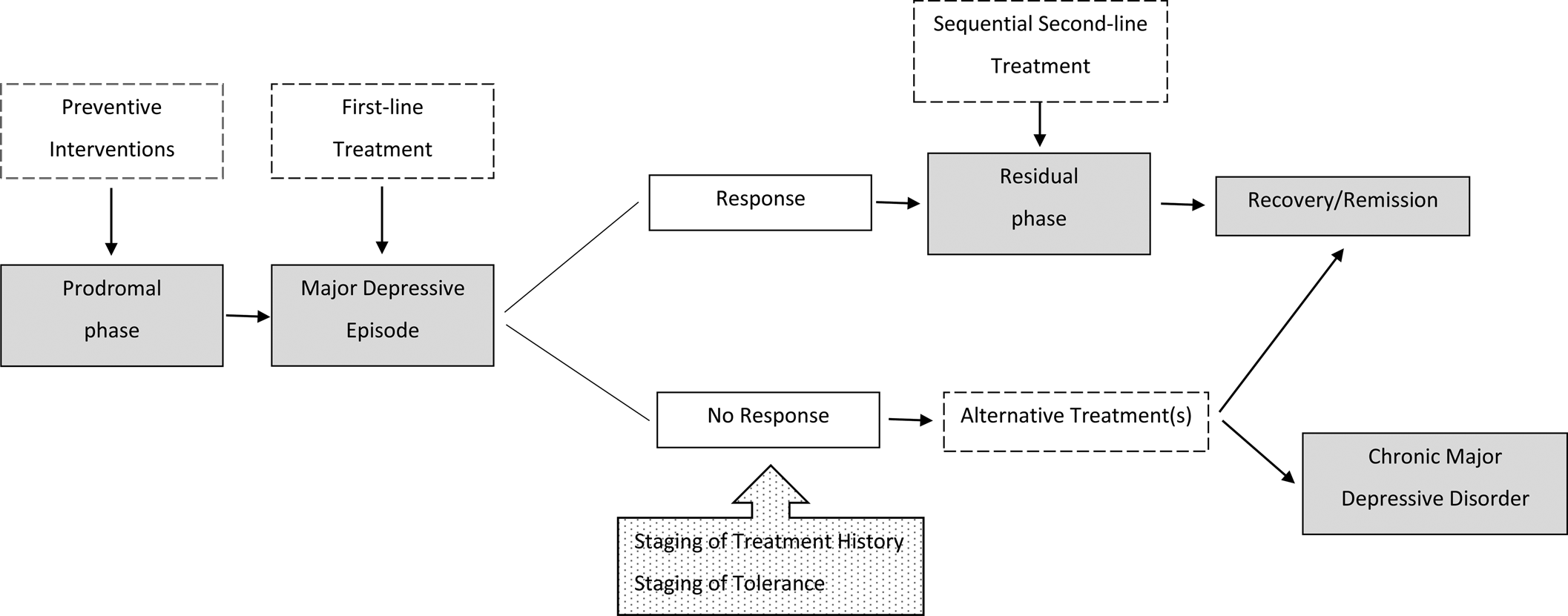
Table 1 does not include a stage 0, as suggested by other investigators to characterize an asymptomatic stage (Hetrick et al., Reference Hetrick, Parker, Hickie, Purcell, Yung and McGorry2008; McGorry et al., Reference McGorry, Hickie, Yung, Pantelis and Jackson2006; Nelson et al., Reference Nelson, McGorry and Fernandez2021). Such denomination reflects an idealistic position in view of the high prevalence of psychiatric symptoms in the general population and the fact that depressive illness often occurs in the setting of a pre-existing psychiatric disorder, such as anxiety disturbances (Fava et al., Reference Fava, Rafanelli and Tomba2012b). Robins and Guze (Reference Robins, Guze, Williams, Katz and Shield1972) developed the primary/secondary dichotomy in depression, which was based on chronology and course of follow-up. An episode of depression was defined as secondary when it was superimposed on a pre-existing psychiatric or medical disease, as it is done in clinical medicine (e.g. secondary hypertension) (Bech, Reference Bech2010; Robins & Guze, Reference Robins, Guze, Williams, Katz and Shield1972). The subtyping that is performed in stages 1 and 3 of Table 1 attempts to record such crucial clinical elements, differentiating between symptoms that are specific to depression, both in the prodromal and residual phases.
In addition to the primary/secondary dichotomy, euthymia (a trans-diagnostic construct characterized by lack of mood disturbances; presence of positive affect; balance of psychological well-being dimensions, flexibility, consistency, and resistance to stress) may also modulate stage 0 in either a direction of resilience or increased vulnerability (Guidi & Fava, Reference Guidi and Fava2022). The concept of euthymia means achieving flexibility of the response capacity of the individual in dealing with allostatic load and its biological underpinnings in the course of development (Guidi & Fava, Reference Guidi and Fava2022), such as neuroendocrine responses which also depend on nature of stressors leading to a vulnerable phenotype with disrupted stress reactivity (Agorastos & Chrousos, Reference Agorastos and Chrousos2022). Euthymia is associated with modifications in brain circuits that mobilize resources and govern anticipatory behavior. As a result, it may allow us to demarcate major prognostic and therapeutic differences in vulnerability to depressive disorder and stage transition among patients who otherwise seem to be deceptively similar since they share the same psychiatric diagnosis and treatment (Guidi & Fava, Reference Guidi and Fava2022). The brain is changing its circuitry and function epigenetically (McEwen, Nasca, & Gray, Reference McEwen, Nasca and Gray2016). A key result is structural remodeling of neural architecture, involving many cellular and molecular processes from the cell nucleus to the cell surface, leading to successful adaptation; whereas persistence of these changes when stress ends indicates failed resilience (McEwen et al., Reference McEwen, Nasca and Gray2016).
Staging has achieved prominence for defining entry criteria for clinical trials aimed to test the effectiveness of novel approaches to overcoming treatment resistance. Some methods (Corey-Lisle et al., Reference Corey-Lisle, Birnbaum, Greenberg, Marynchenko and Claxton2022; Cosci & Fava, Reference Cosci and Fava2013; Fava, Reference Fava2003; Souery et al., Reference Souery, Amsterdam, de Montigny, Lecrubier, Montgomery, Lipp and Mendlewicz1999; Thase & Rush, Reference Thase and Rush1997) had the focus on failure to respond to treatments, while other methods expanded the assessment to the clinical features of depression or on treatment characteristics (Fekadu et al., Reference Fekadu, Wooderson, Donaldson, Markopoulou, Masterson, Poon and Cleare2009a).
Entry criteria can be set at any point of a staging system, in relation to the purposes of the investigation (e.g. RCT, neurobiological studies). Including patients who only failed one therapeutic trial (Salloum & Papakostas, Reference Salloum and Papakostas2019) entails the disadvantage of confounding treatment resistance with likelihood of responsiveness. For instance, anxious depression is less likely to respond to antidepressants compared to non-anxious depression (Cosci & Fava, Reference Cosci and Fava2021). In a sample characterized by anxiety and depression of mild severity we can shift into the realm of resistance what is simply the result of a treatment that has limited efficacy and appropriateness. Setting the entry criteria to higher scores identifies a more severe end of the spectrum, but it may also recruit other clinical phenomena, such as those related to tolerance (e.g. loss of clinical response, paradoxical effects and switching, withdrawal and post-withdrawal phenomena, resistance upon re-challenge; refractoriness) that have recently been incorporated in a staging system (Fava et al., Reference Fava, Cosci, Guidi and Rafanelli2020).
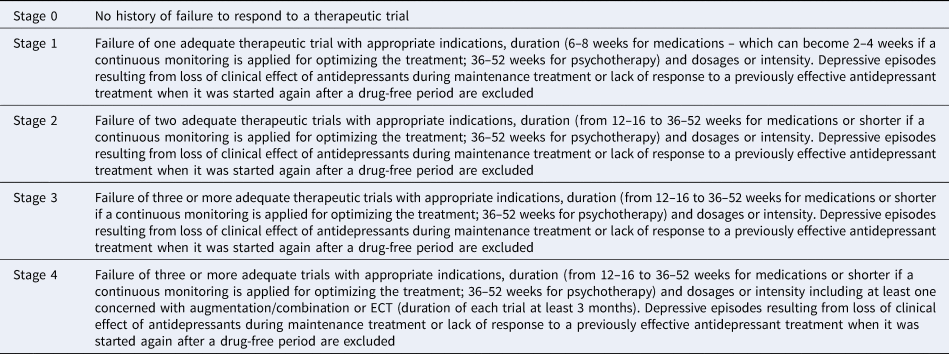
In setting staging hierarchies, the main focus has been on the characteristics of treatment (e.g. duration and dosages of antidepressants; differentiation between minimally effective and optimal treatment), with higher emphasis on augmentation therapies and ECT (Salloum & Papakostas, Reference Salloum and Papakostas2019). However, non-response includes a very wide range of additional potential explanations: the occurrence of side effects prevailing over benefits; incomplete adherence; previous exposure to that specific treatment; psychosocial events intervening during the trial; problems in the patient–doctor relationship; modifications in patient's lifestyle and illness behavior (Fava et al., Reference Fava, Cosci, Guidi and Rafanelli2020). In particular, manifestations of tolerance induced by previous treatments may affect the results (Fava et al., Reference Fava, Cosci, Guidi and Rafanelli2020). Such variables can be assessed by clinimetric methods (Fava et al., Reference Fava, Rafanelli and Tomba2012b). Table 2 provides such clinimetric integration. It outlines a staging system where two phenomena related to tolerance are excluded (i.e. loss of clinical effect of antidepressants during maintenance treatment despite adequate adherence; lack of response to a previously effective antidepressant treatment when it was started again after a drug-free period) because they may entail specific prognostic and therapeutic characteristics (Fava et al., Reference Fava, Cosci, Guidi and Rafanelli2020). Furthermore, psychotherapy is included among the therapeutic tools, in view of its effectiveness (Fava et al., Reference Fava, Cosci, Guidi and Rafanelli2020). Finally, the concept of medication appropriateness is taken into consideration (Hanlon & Schmader, Reference Hanlon and Schmader2022). This model is still to be tested in clinical trials but may serve both research and clinical purposes. In research it may allow us to identify more homogeneous populations in terms of treatment history that may diminish the likelihood of spurious results in comparisons. In clinical practice, it may serve as a blueprint to be integrated with other potentially counter-therapeutic elements (Fava et al., Reference Fava, Cosci, Guidi and Rafanelli2020). Clinical judgment may evaluate the potential role of all these factors in the individual case of treatment resistance.
Treatment-resistant unipolar depression staging model
The use of staging in a full clinimetric perspective allows the clinician to make full use of the clinical information that is available. It opens new exciting areas of research, that are likely to yield improved targets for neurobiological studies and treatment trials.
Supplementary material
The supplementary material for this article can be found at https://doi.org/10.1017/S0033291722001507.
Financial support
This research received no specific grant from any funding agency, commercial, or not-for-profit sectors.
Conflict of interest
None.



