Implications
Using ruminants for weed control in agroforestry (i.e. orchards or tree plantations) is more desirable and sustainable than tilling or using herbicides. However, livestock may not be suitable for grazing in commercial orchards or tree plantations because they may damage or kill the trees or the commercial products, such as olive trees. This study proposed the use of conditioned taste aversion (CTA) as an effective technique to control the ground cover without damaging olive trees.
Introduction
The Olive tree (Olea europaea L.), which is a native crop in the Mediterranean area, has a large importance in the world, being cultivated in >10.3×10⁶ ha (FAOstat, 2016). Spain produces over 1.1 Mt/year olive oil production, and is the world’s largest producer and exporter (Ministerio de Agricultura, Alimentación y Medio Ambiente, 2016). Olive groves are usually located on arid and erodible lands, sensitive to desertification and compromised by land management practices and global weather change. Kairis et al. (Reference Kairis, Karavitis, Kounalaki, Salvati and Kosmas2013) proved that no tillage–no herbicide culture practices reduced the risk of desertification in olive groves, by showing the lowest values of soil loss, water runoff and soil temperature. In addition, Hatfield et al. (Reference Hatfield, Goosey, Spezzano, Blodgett, Lenssen, Kott and Marlow2007) reported the advantages of using grazing sheep on cereal stubble fields to reduce weed biomass, farm labour, soil compaction and herbicides, without adverse effects on the profile of soil nutrients. Nevertheless, green olive leaves and small olive tree branches are very palatable for goats, and this makes grazing harmful for the crop (Manuelian et al., Reference Manuelian, Albanell, Rovai and Caja2010).
Conditioned taste aversion with LiCl is considered a useful tool for training livestock to avoid specific foods or plants. The efficiency of CTA depends on food novelty, product and dose used to create the aversion, availability of alternative feedstuff, animal species, breed and age (Ralphs et al., Reference Ralphs, Provenza, Pfister, Graham, Duff and Greathouse2001; Burritt et al., Reference Burritt, Doran and Stevenson2013; Manuelian et al., Reference Manuelian, Albanell, Rovai, Caja and Guitart2014). Although there are many short-term experiments on the use of LiCl for averting livestock, data reporting the practical use of CTA animals in long-term grazing crops is scarce (Burritt and Provenza, Reference Burritt and Provenza1990; Ralphs, Reference Ralphs1997; Burritt et al., Reference Burritt, Doran and Stevenson2013).
The objective of this study was to evaluate the long-term persistence of an effective CTA towards olive leaves under field conditions with two LiCl doses in goats.
Material and methods
The experiment was carried out at the Experimental Farm of the SGCE (Servei de Granges i Camps Experimentals) of the Universitat Autònoma de Barcelona (UAB) in Bellaterra (Barcelona, Spain). The experimental procedures and animal care conditions were approved by the Ethical Committee of Animal and Human Experimentation (CEEAH, reference 998) of the UAB.
Animals and management
A total of 15 Murciano-Granadina yearling dairy goats (27.0±0.8 kg BW) were used for assessing the long-term persistence of CTA to olive tree leaves. Goats were dry, non-pregnant and naïve to olive leaves. They grazed during the day (6 h/day) in natural and cultivated pastures and received tall fescue hay (Festuca arundinacea L.) ad libitum in the shelter. Water and a commercial block of vitamins and minerals (Multi-Block, Agraria Comarcal del Vallès, Les Franqueses, Barcelona, Spain) were permanently available in the shelter.
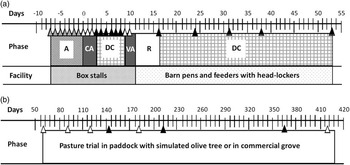
The study consisted of two experiments on the creation of CTA to olive leaves, reinforcement and evaluation of the persistency at the mid-term by double-choice tests (Experiment 1), and persistency evaluation in the long-term by grazing on simulated olive tree and in commercial olive grove conditions (Experiment 2), as shown in Figure 1.
Experimental design. (a) Box-stall and shelter periods with head locking stanchions; A, adaptation period; CA, creation of conditioned taste aversion; DC, double-choice feeding test; VA, validation of aversion; R, rest period;  , measurement days during A;
 , measurement days during CA with LiCl administration;
 , measurement days during DC without LiCl administration); and, (b) Pasture trial period (, grazing on simulated olive tree; , grazing on commercial olive grove).

Olive tree leaves of the cv. Arbequina, the most used olive tree cultivar in Catalonia (Spain), were obtained from the branches and leaves refusals of the Cooperativa Agricola de la Palma d’Ebre (La Palma d’Ebre, Tarragona, Spain) at the end of the olives harvesting season (January). The leaves were manually separated from the branches, air-dried for 1 week and stored in polypropylene fibre sacks at 4°C until use. Green Italian rye-grass (Lolium multiflorum Lam.) for the double choice feeding tests was mowed daily from the cultivated grazing fields of the SGCE of the UAB. Representative samples of the tall fescue hay, air-dried olive leaves and green Italian rye-grass, used throughout the experimental periods, were taken weekly, composited by treatment group and stored under refrigeration (4°C) until analysis.
Experiment 1
The conditioned taste aversion creation and reinforcement
The aversion was established on day 0 and reinforced on day 9 (when consuming >10 g olive leaves), following the procedure indicated by Manuelian et al. (Reference Manuelian, Albanell, Rovai, Caja and Guitart2014). Briefly, the basal diet was removed 2 h before offering 100 g of olive leaves (as-fed) to each goat. Goats were exposed to olive leaves during 1 h, and immediately after dosed with the corresponding treatment. Daily basal diet was offered to all goats 2 h after. The LiCl doses tested were 175 mg LiCl/kg BW (AV1; n=5) and 200 mg LiCl/kg BW (AV2; n=5). A group of goats was drenched with water as a control (C; n=5). A visual description of the CTA creation protocol using LiCl can be seen in Manuelian et al. (Reference Manuelian, Albanell, Salama and Caja2016).
Mid-term conditioned taste aversion persistence evaluation
The mid-term CTA persistence was evaluated by a double-choice feeding test which consisted of offering olive leaves (100 g as-fed) and Italian rye-grass (390 g as-fed), side-by-side, in individual box-stall pens during the 6 consecutive days after CTA creation (1 h/day), or in the group pens of the barn individualising the animals by means of head-locking stanchions on days 16, 24, 31, 38 and 53 (30 min/day), according to the schedule shown in Figure 1a. The basal diet was offered 2 h after the test, and the ort removed 2 h before the next test on the subsequent day.
Experiment 2
Long-term conditioned taste aversion persistence evaluation under simulated olive tree conditions
The CTA induced against olive tree leaves under box stalls and tested under barn conditions was validated on simulated olive tree conditions at the SGCE. With this aim, an olive tree branch (2.0 m long) was centrally located in an Italian rye-grass paddock of 99 m2 (11.0×9.0 m) made with a mobile electric fence (Lacme Secur, La Fleche, France). Rye-grass vegetative stages varied throughout the pasture trial according to season (February to December), but grass height was maintained constant at ~20 cm. A total of five test-sessions, in which each goat group was allowed to graze during 30 min, were carried out for over a year (days 59, 90, 121, 182 and 420) after CTA induction (Figure 1b). Each group grazed separately and without visual contact with the other groups to avoid possible social facilitation between non-averted and averted animals, as have been previously reported by Ralphs (Reference Ralphs1997).
Long-term conditioned taste aversion persistence evaluation under commercial olive grove conditions
To confirm the CTA goats behaviour under on-field conditions, C and AV2 groups were moved to a commercial olive grove with grass cover located near the city of Barcelona (Viladecans, Spain). A plot of 156 m2 (12.5×12.5 m) including spontaneous grass cover and 5 adult olive trees (4.0 m tall, 1.8 m of diameter of the crown, and branches started at 1.0 m above the soil) was selected from the grove and enclosed by an electric fence (Lacme Secur) operated by solar batteries. Three grazing test-sessions (days 143, 211 and 363) lasting 30 min each were performed and video recorded (Sony Corporation 2010, Handycam DCR-SR15E, Zoom optique 50x, Minato, Tokyo, Japan). Intake of olive leaves was evaluated as the time eating (TE) olive leaves. Moreover, the number of approaches (NA) and times during which goats used a bipedal stance to browse on leaves (NS) were recorded individually. Approaches were defined as number of times that a goat went close to an olive tree and touched it.
Feed composition
Dry matter was determined at 103°C for 24 h and ash content was measured gravimetrically by igniting the samples in a muffle furnace at 550°C for 4 h (Association of Official Analytical Chemists (AOAC), 2000). Crude protein (N×6.25) was determined by the Dumas method (AOAC, 2000) on a Leco analyzer (Leco Corporation, St. Joseph, MI, USA). Neutral detergent fibre, ADF and ADL were determined on an ash-free basis by the method of Van Soest (Reference Van Soest1982), using the Ankom200 Fiber Analyzer incubator (Ankom Technology, Macedon, NY, USA), adding amylase and sodium sulphite solutions. Tall fescue hay, olive leaves and fresh Italian rye-grass chemical composition results are shown in Table 1.
Chemical composition of tall fescue hay, olive tree leaves and Italian rye-grass (dry matter (DM) basis)

Statistical analyses
Intake of olive leaves, TE, NA and NS variables were non-normalisable and consequently were analysed using the Kruskall–Wallis procedure of Statistical Package for the Social Sciences (SPSS) v.19.0.0 (IBM, Chicago, IL, USA). Aversion persistency data were analysed across treatments by survival analysis using the Kaplan–Meier non-parametric and log-rank (Mantel–Cox) tests of equality of SPSS. Tall fescue hay basal diet intake was expressed by metabolic BW and analysed using a linear mixed model with repeated measures and the differences tested by least square means of R 3.0.2 (R Core Team, 2013). Values are shown as means±SE or as medians (for survival analyses), and significance was declared at P<0.05, unless otherwise indicated.
Results and discussion
Conditioned taste aversion learning
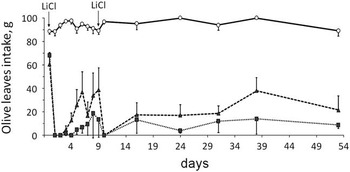
Despite the goats being naïve with regard to olive tree leaves, all of them were attracted to the leaves at day 0 of the experiment and voluntarily ate between 46 and 96 g (as-fed). The C goats consumed almost all the olive leaves offered from the first day to the end of the experiment (94±1 g, on average, Figure 2). On the contrary, on days 1 and 2 after LiCl dosing (box-stall period), none of the AV1 and AV2 goats approached the containers with the olive leaves or sniffed them, full rejecting the consumption of the leaves (P=0.001; Figure 2). The high initial intake of olive leaves (novel feed) disagrees with the neophobic feed behaviour described in small ruminants (Van Tien et al., Reference Van Tien, Lynch, Hinch and Nolan1999; Villalba and Provenza et al., Reference Villalba and Provenza2000; Manuelian et al. Reference Manuelian, Albanell, Rovai and Caja2010 and Reference Manuelian, Albanell, Rovai, Caja and Guitart2014). This can be explained by the limited amount of olive leaves offered (i.e. 100 g) which did not allow the goats to show the expected increase of intake in the following days.
Intake of olive leaves during the aversion conditioned experiment according to treatment (○, Control; , AV1 – 175 mg LiCl/kg BW;  , AV2 – 200 mg LiCl/kg BW). Values are means±SE.

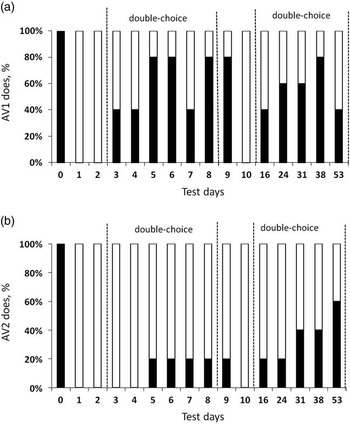
Figure 3 shows the percentage of goats eating or rejecting olive leaves for AV1 and AV2 treatments, being 100% the aversion rate during days 1 and 2. A similar aversion rate to olive leaves after the first LiCl dosing was obtained by Manuelian et al. (Reference Manuelian, Albanell, Rovai and Caja2010 and Reference Manuelian, Albanell, Rovai, Caja and Guitart2014) in sheep and goats, using 200 and 225 mg LiCl/kg BW. Lower aversion rate values (72% and 70%) were achieved by Barbosa et al. (Reference Barbosa, Pacífico da Silva and Soto-Blanco2008) and Gorniak et al. (Reference Gorniak, Pfister, Lanzonia and Raspantini2008) in goats when smaller LiCl doses were used (100 and 130 mg/kg BW), respectively.
Percentage of averted goats (a) AV1, 175 mg LiCl/kg BW (b) AV2, 200 mg LiCl/kg BW, consuming olive leaves during the aversion conditioned experiment and double choice test by dose ( , goats that did not eat olive leaves; , goats eating olive leaves).

No signs of gastrointestinal discomfort were observed in the days after treatment and the basal diet intake in the current study (i.e. fescue hay) was similar between goat groups (C, 55±2 g/kg BW0.75; AV1, 60±3 g/kg BW0.75; AV2, 59±2 g/kg BW0.75; P=0.35 to 0.99). In addition, treated goats did not show any other signs of malaise (e.g. head droop and/or inactivity), indicating that the side effects of LiCl were moderate. On the contrary, Manuelian et al. (Reference Manuelian, Albanell, Rovai, Caja and Guitart2014 and Reference Manuelian, Albanell, Rovai, Salama and Caja2015) reported 33% to 50% decrease of basal diet intake in goats and sheep dosed 200 mg LiCl/kg BW.
On day 3 and the following days, intake of olive leaves varied according to the LiCl dose administered (Figure 2). Thus, four AV1 goats (80%) progressively increased their intake of olive leaves (>10 g/day) from days 3 to 9 (Figure 3a), whereas only one AV2 goat (i.e. 20%) consumed olive leaves from days 5 to 9 (Figure 3b). These goats were reinforced with a second LiCl dose on day 9 and their full CTA was re-established on day 10 (Figure 3). Rate of animals needing to be reinforced agreed with the results of Manuelian et al. (Reference Manuelian, Albanell, Rovai, Caja and Guitart2014) in sheep: the lower the LiCl dose used, the more animals needed to be reinforced. Nevertheless, when compared with the same dose (200 mg LiCl/kg BW), fewer goats were re-dosed in our study than reported by Manuelian et al. (Reference Manuelian, Albanell, Rovai, Caja and Guitart2014) in sheep, supporting the claim of a higher LiCl sensitivity in goats than in sheep (Manuelian et al., Reference Manuelian, Albanell, Rovai and Caja2010 and Reference Manuelian, Albanell, Rovai, Salama and Caja2015).
Reestablishment rate of CTA in AV1 and AV2 goats in our study was greater than reported by Burritt and Provenza (Reference Burritt and Provenza1990) with 160 mg LiCl/kg BW. In addition, despite the use of the reinforcing dose, goats which consumed >30 g of olive leaves on day 9 were the earliest to resume the consumption of olive leaves thereafter (Figure 3). This indicates that the amount of feed eaten before inducing the CTA may be directly related with the strength and persistence of the aversion achieved, as previously stated by Massei and Cowan (Reference Massei and Cowan2002).
Persistency to the mid-term of effective aversion: double-choice feeding assay
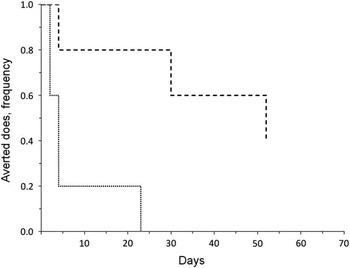
From days 16 to 53 (second double-choice period), intake of olive leaves increased earlier in AV1 than in AV2 goats (Figure 3). On average, ~56% AV1 and 36% AV2 goats persisted in consuming olive leaves in this period. Nevertheless, a partial CTA was still evident on day 53 in both AV1 and AV2 groups (Figure 2), the averted goats showing a lower intake of olive leaves (AV1, 22±12 g; AV2, 9±3 g; P=0.674) than C goats (C, 90±5 g; P=0.008). Moreover, the CTA persistence, evaluated by the lasting time obtained in the survival analysis (Figure 4), also showed the effect of LiCl dose. As observed, the AV2 goats lasted longer (median, 52 days; range, 5 to 99 days) than the AV1 goats (median, 4 days; range 2 to 6 days; P<0.001).
Frequency of averted goats by groups ( , AV1, 175 mg LiCl/kg BW;
 , AV2, 200 mg LiCl/kg BW).

The effect of LiCl on CTA persistence obtained in our goats dosed 175 and 200 mg LiCl/kg BW, was more marked than that previously reported by Manuelian et al. (Reference Manuelian, Albanell, Rovai, Caja and Guitart2014) in sheep dosed 200 and 225 mg LiCl/kg BW. Our results confirm and support the dose-dependent relationship theory between CTA and LiCl, the feed aversion rate being greater with the higher LiCl dose (du Toit et al., Reference du Toit, Provenza and Nastis1991; Egber et al., Reference Egber, Landau, Perevolotsky, Shlosberg and Belaich1999; Manuelian et al., Reference Manuelian, Albanell, Rovai, Caja and Guitart2014).
Persistency to the long-term of effective aversion: pasture trials
Simulated olive tree conditions
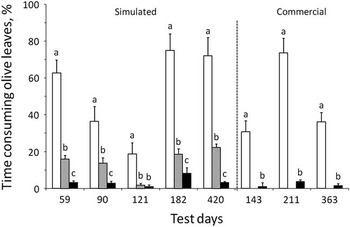
Figure 5 shows the results of goats grazing under olive tree simulated conditions (C, AV1 and AV2 goats) or under commercial olive grove conditions (C and AV2 goats).
Proportion of time consuming olive leaves and sprouts throughout simulated (59, 90, 121, 182 and 420 days and commercial (143, 211 and 363 days) olive field 30 min test for Control (), AV1 – 175 mg LiCl/kg BW ( ) and AV2 – 200 mg LiCl/kg BW ().a,b,cWithin a days values with different superscript letters differ (P<0.05).

The voluntary time consuming olive leaves of C goats under the simulated olive tree conditions decreased from days 59 to 121, and increased again on days 182 and 420 (Figure 5), indicating changes in the palatability of the olive leaves. The minimum value was observed at middle-April (day 121), when the olive tree branches used showed abundant flower buds, before the start of flowering under the SGCE latitude (N 41°30' 15.8'), and when the rye-grass offered on the plot was at the optimal grazing stage as indicated by its chemical composition (Table 1). At the same dates, the AV1 and AV2 goats showed lower consuming times of olive leaves than C goats (P<0.001), the AV1 values (Figure 5) being greater than AV2 (P=0.009 to 0.046), except for day 121 (P=0.743).
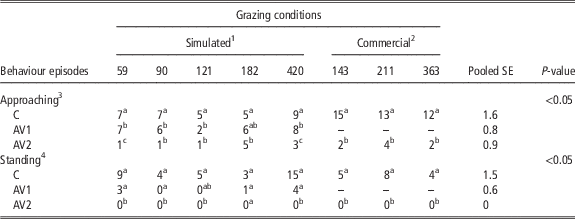
The behaviour of goat groups during grazing under the olive tree simulated conditions showed a similar pattern between test-days throughout the experimental period, but differed markedly between treatments (Table 2). Typically, the C goats approached the simulated olive tree, and used a bipedal stance to eat avidly the upper leaves, whereas the AV1 and AV2 goats refused to approach the simulated tree and choose to graze rye-grass. Moreover, C goat number of approaches and bipedal stance episodes were greater than those of AV2 goats, with the AV1 goats showing an intermediate behaviour (Table 2). At the last simulated test-session (day 420), after ~14 months of inducing CTA, both AV1 and AV2 goats still showed an effective CTA to the olive leaves. At this date, TE of olive leaves by the C goats (72% of the total test-time; 21.6±2.9 min) was the greatest (P=0.002) and resulted in a severe defoliation with many small branches being also damaged. Comparatively, TE of AV1 and AV2 goats were 22% (6.7±0.6 min) and 3% (58±22 s; P=0.009) of the total test-time, respectively (Figure 5) with no visual damage to the olive tree leaves or branches.
Goat behaviour towards the olive trees during the field tests in simulated and commercial olive grove according to treatments

C=control; AV1=averted with 175 mg LiCl/kg BW; AV2=averted with 200 mg LiCl/kg BW.
Values are means±SE.
a,b,cValues within a column for each behaviour episode with different superscript letters differ significantly at P<0.05.
1 Time after aversion induction (test days) at which the C, AV1 and AV2 goats grazed on a paddock with a simulated olive tree.
2 Time after aversion induction (test days) at which the C and AV2 goats grazed on a commercial olive grove commercial field.
3 Number of times in which goats approached the olive tree.
4 Number of times in which goats used a bipedal stance to reach the olive tree leaves.
Commercial olive grove conditions
Goats with the extreme treatments (C and AV2 group) were used under the commercial conditions due to animal transport limitations to the olive grove and the intermediate behaviour presented by the AV1 group. When the C and AV2 goats were moved to graze on the spontaneous grass cover under the commercial olive tree grove, their behaviour on days 143, 211 and 363 (Figure 5) was similar to that observed in the early- (days 59 to 121), mid- (day 182) and late- (day 420) simulated-tree experimental periods. The C goats rapidly approached the olive trees and used a bipedal stance, spending 19% to 75% of the total test-time as TE olive leaves (Table 2), which resulted in an evident damage to the trees. On the contrary, the AV2 goats only spent 1% to 8% of their grazing time as TE olive leaves of the lower branches (no bipedal stance episodes; Table 2) and resulted in negligible damage to the trees.
Time consuming the olive leaves of the C goats also reflected the changes of palatability above discussed according to the phenology of the olive trees. Latitude of the commercial olive grove (N 41° 19' 42'') was similar to that indicated for the SGCE. Our results proved the efficiency of LiCl to induce CTA and the transferability of the learning behaviour from the barn to the field conditions.
Although scarce information on long-term CTA persistency in small ruminants is currently available, our results agree with those of Burritt and Provenza (Reference Burritt and Provenza1990), where averted sheep to true mountain-mahogany (Cercocarpus montanus) took 30% fewer bites than the control sheep 9 months after the CTA induction. On the other hand, cows averted to larkspur (Delphinium barbeyi Huth) showed a complete aversion persistence (no consumption of larkspur) during 3 years without reinforcement (Ralphs, Reference Ralphs1997). This difference with our results could be because larkspur is a toxic plant and its sporadic consumption could reinforce the aversion by it-self. Moreover, the difference may also be due to the observation methodology; although we monitored all the goats during 30 consecutive minutes, Ralphs (Reference Ralphs1997) monitored individual cows three to five times daily lasting 5 min each.
An important point in learning behaviour in groups is social facilitation. In our study, we maintained completely separate and with no visual contact goats that have received different treatments. Ralphs (Reference Ralphs1997) have reported that after 3 years of complete aversion, cows started again to consume larkspur when grazing with cows that were not averted. Although we observed that AV1 and AV2 goats resumed olive leaf consumption, extinction of the aversion was not apparent in our study maybe due to short grazing trials (30 min).
Conclusions
Our results support the concept of food aversion intensity and persistence being dose dependent. Both LiCl doses used presented an effective aversion longer than 1 year and improved their persistency as the doses increased. Consequently, degree of aversion and persistency were stronger and longer with the 200 mg LiCl/kg BW. In addition, fewer goats needed to be re-enforced at the highest dose. As expected, our results confirm the possibility of using grazing goats to control the ground cover of olive groves without damaging the crop. However, further studies are still necessary to evaluate the effects of social facilitation within groups of averted animals as well as the persistence of their aversion when grazing during long periods under commercial olive grove conditions.
Acknowledgements
This work was partially granted by the Plan Nacioanl I+D+i (Research project AGL 2010-22178) funded by the Ministerio de Educación y Ciencia of Spain. The authors are grateful to Dr Jordi Bartolomé (Universitat Autònoma de Barcelona, Bellaterra, Spain) for supplying the olive tree leaves; and to Ramon Costa and the team of the Servei de Granges i Camps Experimentals of the UAB (Bellaterra, Spain) for their technical assistance and animals’ care. The authors thank the commercial olive grove in Villadecans for supporting the study and allowing the research group and goats to use their paddock during the experimental period.