

Venture capital is an important source of financial capital for early-stage, high-potential, high-growth, and high-technology companies. It has been widely recognized as a powerful engine for driving a nation’s innovation, job creation, and economic growth.Footnote 1 Developing a robust venture capital market is a key national strategy of many countries including Australia,Footnote 2 Singapore,Footnote 3 and China.Footnote 4 After three decades of development, China is now the second-largest country in terms of venture capital investment, ranking only behind the United States (US).Footnote 5 In 2015 alone, 597 new venture capital funds, collectively raising more than USD 30 billion worth of fresh capital eligible for investment, were set up in China,Footnote 6 and 257 companies invested into by venture capitalists (VC-backed companies) went public in China.Footnote 7
Initial public offerings (IPOs) have been a popular venture capital exit vehicle. Extensive academic literature has found a strong correlation between the size and liquidity of a nation’s stock market and the volume of its venture capital market.Footnote 8 In particular, Black and Gilson contend that the vibrancy of the venture capital market is dependent on the presence of an active stock market through which the venture capitalists can exit from a successful portfolio company via an IPO.Footnote 9 IPOs enable the venture capitalists to exit from the venture capital investments while leaving the entrepreneurs in control of the start-ups.Footnote 10 The option of an IPO-exit is necessary for the negotiation of an incentive-compatible implicit contract at the time of the venture capital investment.Footnote 11 Black and Gilson have also argued that the venture capital industry tends to be stronger and more vibrant in stock market-centred systems like the US, relative to countries like Germany and Japan which are bank-centred.Footnote 12
While previous research has explored the link between the two markets in countries such as the US and the United Kingdom (UK), China has not been the subject of theoretical or empirical investigation. Thus, this article seeks to fill the literature gap by exploring the correlation between the stock market and venture capital market in China. Based on empirical studies,Footnote 13 this article finds that there is a close connection between the stock market and venture capital market in China. This is consistent with the general theory that a link exists between stock markets and venture capital markets.
This article also extends the existing literature by finding that laws and policies indeed matter for venture capital availability in China, impacting the venture capital market both positively and negatively. On the one hand, strong and sustained law reforms and government policies aimed at improving the institutional structure and regulatory environment of the stock market have facilitated venture capital-backed exits, which have in turn enhanced new venture capital availability. On the other hand, numerous IPO closures by regulatory authorities have negatively impacted the venture capital market.
At this juncture, it is worth noting that the concept of ‘stock market’ in this article is defined to broadly include the Shanghai Stock Exchange (SSE) and the Shenzhen Stock Exchange (SZSE) Main Boards, the Small and Medium Enterprises (SME) Board of the SZSE, the ChiNext Board of the SZSE, the National Equities Exchange and Quotations System (NEEQ)Footnote 14 , and other regional equity markets that feature in the Chinese multi-tiered capital market system. Additionally, as this article only focuses on the domestic stock market and its implication for the venture capital market, the term ‘IPO-exits’ mainly refers to exits by VC-backed companies going public on the Chinese stock market. It does not include exits via overseas markets.Footnote 15
The remainder of this article consists of seven parts. Part I critically discusses the importance of exits in venture capital investments. Part II reviews the historical development of the stock market and venture capital market in China. Part III discusses the special features of venture capital exits in China and the legal, economic and cultural reasons for the preference for IPOs in China. Part IV explores the link between China’s stock market and its venture capital market based on both quantitative and qualitative data and argues that a strong stock market is conducive to a strong venture capital market. Thereafter, Part V analyzes the existing deficiencies in the stock market and how they could hinder the venture capital market. Part VI critically examines the major initiatives required to improve the regulatory environment of venture capital-backed exits and suggests future law reforms, particularly the newly expanded NEEQ and the recently introduced IPO reform. Finally, Part VII concludes by crystallizing the lessons to be learnt from China’s experience.
1. The Importance Of Exits Via An Ipo In A Venture Capital Market
A typical venture capital cycle in China is similar to its international counterparts.Footnote 16 The cycle consists of three stages: raising a venture capital fund (fund-raising), investing in and adding value to a portfolio company through the venture capital fund (investment), and realizing profits and returning them to the venture capital investors (exit).Footnote 17 A venture capital project also involves three major parties: (1) investors who provide capital to the venture capital fund; (2) venture capitalists who manage the venture capital fund and who identify and give credibility to their portfolio companies by providing management assistance, intensive performance monitoring, and reputational capital; and (3) entrepreneurs within the portfolio companies.Footnote 18
According to Cumming et al., there are five principal venture capital exit vehicles: (1) an IPO, in which a significant portion of the portfolio company is sold in the public market; (2) an acquisition exit, in which the entire firm is sold to a third party (through a sale of shares, merger, or sale of the firm’s assets);Footnote 19 (3) a secondary sale, in which only the venture capitalists’ shares are sold to a third party (typically a strategic acquirer); (4) a buyback, in which the venture capitalists’ shares are purchased by the entrepreneurial firm itself; and (5) a write-off, in which the venture capital walks away from the investment.Footnote 20 Venture capitalists and entrepreneurs are free to choose the appropriate exit strategy based on their business needs, the firm’s financial condition and market conditions. There are advantages and disadvantages for each form of exit.Footnote 21
Venture capital investments are primarily equity investments.Footnote 22 To make a profit, venture capitalists must turn their illiquid stakes in the startup company into realized returns. As many startup firms are young and lack the cash flow and profits to pay their investors interest or dividends, most venture capitalists’ returns come through capital gains.Footnote 23 Therefore, the means by which venture capitalists can exit (i.e., cash out) their investments is vital to the profitability of venture capital investments.Footnote 24
There have been many empirical and theoretical attempts to explore the importance of exits, especially exits via an IPO, to the development of venture capital markets.Footnote 25 Gilson notes that there are two major legal relationships/contracts within a venture capital cycle: (1) between investors (capital providers) and venture capitalists at the fund-raising stage; and (2) between venture capital funds and portfolio companies at the investment stage.Footnote 26 In the venture capitalist-investor relationship, apart from the express contract in the form of the limited partnership agreement, there is also an implicit contract in which the investors are expected to reinvest in future venture capital funds that are sponsored by successful venture capitalists.Footnote 27 As venture capital funds have a limited life span, successful exits are critical to the venture capitalists in ensuring attractive returns to the investors, and in turn securing subsequent capital from the investors for future venture capital funds.Footnote 28 A successful exit is also a central indicator of the venture capitalist’s success.
In the venture capital fund-portfolio company relationship, the venture capital fund often insists on retaining control of the portfolio company to protect itself from the high risk that entrepreneurs may mismanage the company or pursue private benefits.Footnote 29 Such an arrangement of control is typically reflected in an explicit contract between the venture capital fund and the portfolio company. For instance, contracts often provide that the fund invests in the portfolio company through convertible preferred stock and enjoys significant control over the company via disproportionate board representation and approval rights for important operating decisions.Footnote 30
On the other hand, entrepreneurs have the opportunity to regain control from the venture capital fund by exercising their call options on control upon an IPO. The contract denominated in control serves as an important performance incentive to the entrepreneurs.Footnote 31 In order to regain control of the firm, the entrepreneurs need to prove their management skills and provide evidence that they can be trusted with the capital provided by the venture capital fund.Footnote 32
The viability of this implicit contract in turn depends on the viability of an IPO-exit strategy.Footnote 33 Other exit strategies such as a trade sale of the whole portfolio company to another buyer or a secondary sale of a portion of the shares to a third party will not help the entrepreneur regain control of the firm, and thus do not incentivize the entrepreneurs in the same way.
Further, IPO-exits, more than other exit vehicles, incentivize entrepreneurs to ensure the firm succeeds. First, IPOs are the most profitable for a portfolio company.Footnote 34 Empirical studies also show that innovative and profitable ventures are more likely to go public.Footnote 35 Thus, entrepreneurs and their investors have good reasons to work towards IPOs. Second, unlike acquisitions or secondary sales which are usually constrained by buyer availability, IPOs are typically always possible provided that the firm is sufficiently successful and profitable. Finally, such success requirements further encourage entrepreneurs to properly manage and grow the company. In contrast, secondary sales and write-offs do not necessarily require a firm to be successful or profitable. In short, the profitability of IPOs, and the fact that going public is contingent on the firm’s success, foster strong motivations for entrepreneurs and investors.
As an IPO-exit is naturally contingent upon the presence and vitality of a stock market, the importance of IPOs in both the investor-venture capitalist and venture capital fund-portfolio company relationships indicates a link between the venture capital market and the stock market.Footnote 36 Indeed, the connection between the two markets has also been observed empirically in EuropeFootnote 37 and more generally around the world.Footnote 38 The following parts of this article will explore the correlation between VC-backed IPOs and the stock market in the context of China.
II. The Development Of The Stock Market And The Venture Capital Market In China
The US has over 70 years of experience in venture capital since the 1940s.Footnote 39 In contrast, China has a much shorter history of venture capital. Before the reform of China’s economic system and the opening of its market to the outside world (gaige kaifang) in 1978, China was a planned economy. There were no private enterprises, startups or venture capital funds.
The concept of venture capital was first officially introduced in China in 1985 through the central government’s ‘Decision to Reform the Science and Technology System’,Footnote 40 following which the first venture capital firm was set up.Footnote 41 Thereafter, local governments and government agencies established funds to provide financing to technology companies. However, due to unfamiliarity with the concept of venture capital and the lack of a nation-wide capital market, venture capital developed very slowly in the 1980s.
The year 1990 saw the establishment of China’s capital market. Two stock exchanges – SSE and SZSE – were established, offering new exit channels for VC-backed companies. Since then, China’s stock market has rapidly grown in size and liquidity. As of May 2015, the two main stock exchanges, i.e. the SSE and SZSE, were worth over USD 10 trillion collectively, with the SSE being the second largest stock exchange in Asia and the sixth in the world by market capitalization.Footnote 42
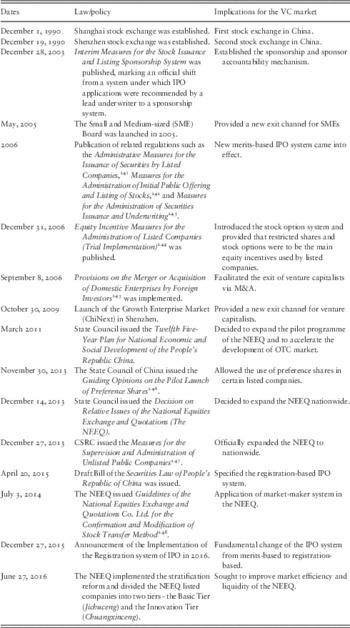
Another turning point in the 1990s was the presentation of the so-called ‘No.1 proposal’ at the first meeting of the 9th Chinese People’s Political Consultative Conference, which urged the development of venture capital in China.Footnote 43 After that, continuous law reforms were made to gradually develop an underlying legal and regulatory infrastructure to facilitate VC-backed IPO-exits. (See Appendix 2 for a detailed list of key legal developments in China’s stock market and their implications for the venture capital market).
In 2002, the planned launch of a National Association of Securities Dealers Automated Quotations (NASDAQ)-style secondary board was delayed. This undermined investor confidence in the venture capital market. Nearly a hundred domestic venture capital firms that were based in Shenzhen closed that year.Footnote 44 The decline of venture capital investments in the early 2000s was also exacerbated by the burst of the ‘dot-com bubble’ in 2001 and the global economic slowdown in 2002.
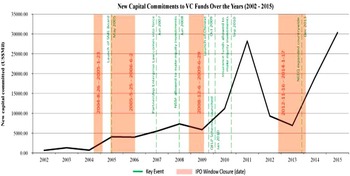
Figure 1 provides a timeline for the development of the venture capital market in China. It illustrates how the development of the venture capital market is largely influenced by the development of the domestic stock market. On the one hand, continuous improvements to China’s stock market since 2008 have contributed significantly to the growth of venture capital fund-raising. For example, after the long-awaited secondary board – the ChiNext board – was finally established in October 2009, both the number of newly-established venture capital funds and the amount of funds raised doubled in 2011. On the other hand, as will be discussed in Part IV, numerous IPO closures (highlighted in red in Figure 1) have led to freeze-ups in China’s venture stock market.Footnote 45
New Venture Capital Commitments over the Years and Major Changes to the Stock Market (2002-2015)Footnote 46

III. Special Characteristics Of Venture Capital Exits In China
A. The IPO as a Preferred Exit Option for Venture Capital-Backed Companies
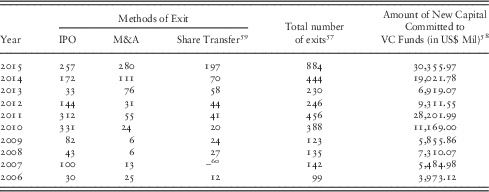
According to Zero2IPO Research Centre, a leading service provider and investment institution in China’s private equity industry, exits by private equity and VC-backed firms in China totalled 2,906 from 2008 to 2015 (inclusive).Footnote 47 This included 1,374 exits via an IPO (47.28%), 589 exits via a merger and acquisition (M&A) (20.27%), and 481 exits via a share transfer (16.55%). The remaining 462 exits were executed via other means including share buybacks,Footnote 48 write-offs, and other methods.Footnote 49 From 2006 to 2015, VC-backed IPO-exits totalled 1,504 – almost three times the number of VC-backed M&A-exits in the same period (589).
These figures indicate that IPOs have been the most popular exit method for venture capital in China. Share buybacks, for instance, are usually only opted for either when exits cannot be done via an IPO or M&A, or when the portfolio company no longer wishes to be controlled by the venture capitalist.Footnote 50 This is unsurprising given that share transfers and share buybacks usually mean relatively lower rates of return on the investments. Moreover, there are relatively more legal restrictions on share buybacks under Chinese law.Footnote 51 Finally, write-offs are naturally reserved as a method of last resort for venture capital funds.
China Venture Capital Exits via IPO54 and M&A

Number of exits via IPO, M&A, and share transfer for VC-backed companies, as well as the corresponding amount of new capital committed to VC funds (2006–2015)
Source: Zero2IPO55 & ChinaVenture56
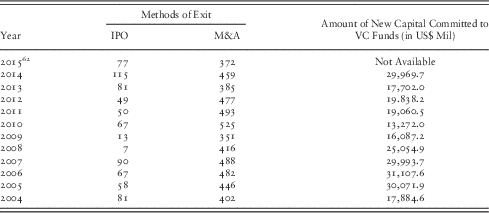
That IPOs are the preferred exit option reinforces the link between China’s venture capital market and stock market. As argued above, the primary mechanism through which a stock market encourages venture capital investments is the provision of exit options. A useful contrast can be made with the US, where a greater proportion of venture capital exits occur via an M&A than an IPO. In 2015, the US venture capital industry saw 77 exits via an IPO and 372 exits via an M&A (see Table 2 below).Footnote 52 From 2006 to 2015, only 616 VC-backed IPOs took place – roughly one-seventh of the 4,448 VC-backed M&A-exits in the same period.Footnote 53
US Venture Capital Exits via IPO and M&A

Number of exits via IPO and M&A for VC-backed companies, as well as the corresponding amount of new capital committed to VC funds (2004–2015)
Source: National Venture Capital Association61
Consequently, it is suggested that Chinese stock markets play an even larger role in encouraging venture capital availability than their US counterparts.Footnote Footnote Footnote Footnote Footnote Footnote Footnote Footnote Footnote
B. Reasons for the Preference for IPOs in China
Five legal, economic, and cultural reasons can be proffered to explain the investor preference for an IPO over an M&A as an exit option in China, particularly during 2011 and 2012.
First, IPO-exits in China tend to give high returns. As of 31 December 2015, the average price-earnings ratio (P/E ratio) of A-shares on the SSE and SZSE were 17.61 and 53.34 respectively – far higher than the average of 9.88 for shares listed on the Hong Kong Exchange (HKEx) Main Board.Footnote 63 The P/E ratio for the SME Board and ChiNext were even higher, at 68.06Footnote 64 and 109.01Footnote 65 respectively. In fact, the SME Board’s highest P/E ratio in 2015 was 85.65,Footnote 66 while ChiNext’s was a staggering 146.57.Footnote 67 Also, a study of Chinese IPO initial returns found that the average IPO initial return was 66%, with 14-22% being attributed to under-pricing, and 44-53% due to overvaluation.Footnote 68 It was also found that initial returns and overvaluations have no relevance to post-IPO stock performance in the long-term.Footnote 69 Thus, the high returns from selling shares after listing make IPOs an attractive option.
Second, M&As are less feasible as an alternative exit option in China because regulatory approvals are required for M&A transactions. ListedFootnote 70 and non-listedFootnote 71 public companies must seek approvals from relevant authorities when the acquisition and/or relevant equity changes pertain to issues such as national industrial policies, industry access, transfer of state-owned shares, and foreign investments. Therefore, M&A transactions and corporate reorganizations are uncertain and risky. A prolonged approval timeline also compromises M&A efficiency, resulting in negative implications including employee brain drain and variations in acquisition pricing. Also, local governments have been known to use their administrative powers to obstruct M&A transactions, especially those involving state-owned enterprises.Footnote 72 In addition, there are tight regulations over foreign M&A transactions. Under the Provisions on Foreign Investors’ Merger and Acquisition of Domestic Enterprises,Footnote 73 any M&A transaction by foreign-invested enterprises requires approval from the Ministry of Commerce (MOFCOM) or a provincial department in charge of commerce.Footnote 74 Faced with these institutional obstacles, it is unsurprising that the scale of the M&A and corporate reorganization businesses in the investment banking arms of Chinese securities companies is very small. In 2011, M&A and corporate reorganization work took up only 5% of the investment banking businesses of securities companies. In 2012, this only increased to 5.7%.Footnote 75
Third, the Chinese government has exerted stringent control over debt financing. Banks in China have very conservative lending practices, making it difficult to finance both venture capital and M&A deals with debt. According to Article 20(3) of the General Rules for Loans issued by the People’s Bank of China in 1996, a borrower is not permitted to use bank loans to fund equity investments. This is an enormous obstacle for venture capital firms seeking debt financing in M&A transactions. To remedy this, the China Banking Regulatory Commission (CBRC) issued a Notice on the Risk Management of M&A Loans of Commercial Banks in December 2008 (‘2008 Guidelines’),Footnote 76 allowing commercial banks to provide acquisition financing to certain companies. The 2008 Guideline was later replaced by a new guideline, issued in February 2015 (‘2015 Guideline’),Footnote 77 which expanded the potential sources of funding by allowing policy banks and branches of foreign banks to provide acquisition financing.Footnote 78 However, under the 2015 Guideline, the CBRC is still cautious of acquisition financing. For instance, the term of any loan is limited to 7 years,Footnote 79 and the total value of a loan must not exceed 60% of the total acquisition price.Footnote 80
Fourth, the preference for IPOs may be explained by cultural factors. Chinese entrepreneurs can frequently be very attached to their companies and are unwilling to completely let go of their companies via an M&A.Footnote 81 This is particularly prevalent in VC-backed startups with relatively concentrated shareholding structures (in contrast to the diversified shareholding of large public companies). It is thus more difficult for outsiders to acquire the whole startup by a tender offer. Moreover, in acquisition situations, a strategic buyer would usually make the target company a wholly-owned subsidiary or a separate division of the strategic buyer in order to produce synergistic gains,Footnote 82 such as by integrating the target company’s products and technologies.Footnote 83 In doing so, the strategic acquirer faces difficulties in reconciling the target company’s corporate culture with that of the parent company. The acquirer may also find it difficult to exert influence on the existing employees of the target company. Considering these difficulties, it has been opined that the number of strategic buyers who wish to acquire VC-backed companies in China is limited.Footnote 84
Fifth, the institutional infrastructure for M&As in China is underdeveloped. In an M&A-exit, a potential buyer will face difficulties getting direct access to the information of non-listed target startup companies. M&A transactions thus require a high level of professional assistance. However, statistics show that in China, there is a shortage of sophisticated financial intermediaries who have the relevant expertise, due to the short history of China’s capital market.Footnote 85 Given the limited domestic talent pool, banks have struggled to find enough talent to sustain their operations.Footnote 86 Therefore, historically, few M&A transactions have been entered into and these deals often do not succeed.Footnote 87
Nonetheless, there appears to be a trend towards M&A-exits in recent years, especially in the venture capital industry. The quantity of VC-backed M&A transactions has increased significantly from 76 in 2013 to 111 in 2014 (See Table 2 above). The total value of M&A-exits in China doubled from USD 34,660 million in 2013 to USD 68,829 million in 2014.Footnote 88 M&A-exits doubled again to 280 in 2015, making the year 2015 the first year since 2006 where M&A-exits exceeded VC-backed IPOs (257) (excluding the year 2013, when the IPO window was suspended for the year).
Arguably, the suspension of the IPO market in 2013 contributed to the increased popularity of M&As as it introduced greater uncertainty and risk into the IPO process. The riskiness of IPO-exits has been further exacerbated by the volatility of stock markets in recent years.Footnote 89 Additionally, the growing experience and improving attitudes of investors have contributed to a smoother M&A-exit channel for venture capital investments. Deloitte has found that Chinese investors are increasingly more optimistic about market dynamics with respect to M&A and are developing an appetite for larger M&A transactions.Footnote 90 With these heightened expectations, Chinese investors have become more willing to involve professional advisors in their transactions. Notably, this includes engaging professionals to resolve issues pertaining to post-merger integration – an aspect widely accepted in China as crucial to a successful M&A transaction.Footnote 91
Furthermore, on 7 March 2014, the State Council promulgated a new OpinionFootnote 92 which aimed to reduce the scope of projects that are subject to examination and approval, and cancel the pre-examination procedure for takeover reports of listed companies. Pursuant to the Opinion, the China Securities Regulatory Commission (CSRC) issued a new regulation to cancel the examination and approval procedure for major purchases, sales, and replacement of assets by companies that do not constitute back-door listings, and the prior examination and approval procedure for tender offers.Footnote 93 In addition, a mandatory 75% loan-to-deposit ratio has been abolished under the 2015 amendments to the Law of the People’s Republic of China on Commercial Banks,Footnote 94 and this may encourage Chinese banks to lend more. This author believes that with the improvements of the regulatory environment in the M&A market, M&A will gradually evolve into an important exit option for VC-backed companies.
IV. The Correlation Between The Stock Market And The Venture Capital Market In China
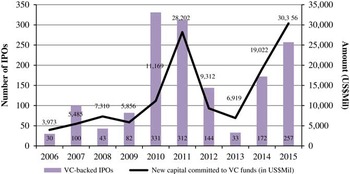
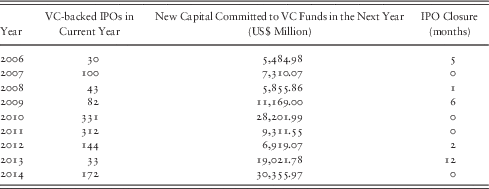
The amount of venture capital raised in China is directly influenced by the health of the Chinese stock market. To show this, Figure 2 plots the number of VC-backed IPOs against new capital commitments to venture capital funds in China in the same year. It will also be shown later in Table 3 that a significant positive correlation seems to exist between the number of IPOs and the amount of venture capital raised the following year.
VC-backed IPOs and New Capital Commitments to Venture Capital Funds in China 2006–2015Footnote 95

VC-backed IPOs, New Capital Committed to Venture Capital Funds in China, and IPO Window Closure (months) 2006–2014Footnote 103

Immediately noticeable from Figure 2 above is the sheer volume of exits via IPOs by VC-backed Chinese firms from 2006 to 2015. In 2015 alone, 257 VC-backed companies went public in China. Further, there seems to be a positive correlation between the number of IPOs and the funds raised. Except in 2008 and 2010, the investors’ willingness to invest in venture capital funds moved in tandem with the number of VC-backed IPOs.
As Figure 2 demonstrates, from 2006 to 2015, China’s venture capital market has experienced steady growth in the total amount of funds raised, albeit with dips in 2008, 2012, and 2013.
The peaks shown in 2010 and 2011 can largely be attributed to the establishment of ChiNext in 2009 and the expansion of qualified limited partners in 2010, which increased the ease of exit through IPOs. Other figures also reveal that in the first quarter of 2010, the average rate of return (ARR) of the SME Board and the ChiNext was more than 10%. In the second quarter of 2010, the ARR of IPOs on the ChiNext was 23.31%.Footnote 96 Such developments significantly encouraged the growth of venture capital fund-raising and investments.
However, the closures of the IPO process during the periods of December 2008 to June 2009 (approximately 7 months) and November 2012 to January 2014 (approximately 14 months) were followed by substantial decreases in venture capital fund-raising activities, as venture capitalists became concerned about the viability of an IPO as an exit option. In 2011, the fact that many US-listed Chinese firms suffered from fraud allegations negatively affected both the overseas listing of Chinese companies in generalFootnote 97 as well as venture capital fund-raising in the year 2012. When the CSRC resumed its approval of IPOs in early 2014, venture capital financing experienced growth again and continued to grow throughout 2015. In the third quarter of 2015, 192 Chinese enterprises were listed on the three domestic stock exchange platforms, a 37% increase from the same period in the previous year.Footnote 98 Funds raised from these 192 listings amounted to USD 23.173 billion, a 72% increase from the previous year.Footnote 99 Finally, a larger growth in the number of listings and the amount of funds raised was observed in the first half of 2015, which could be partly attributed to the bull market in the A-share market. After the CSRC suspended new listings in July 2015, there were only 5 listings on the domestic stock market in the third quarter of 2015, a sharp decrease from previous quarters.Footnote 100 The stock market’s slowdown in the latter half of 2015 was accompanied by a fall in venture capital investments from the third to the fourth quarter in 2015.Footnote 101
There is some statistical evidence reinforcing the correlation between the number of venture-backed IPOs and the amount of new capital commitments to venture capital funds. An ordinary least squares linear regression based on the 2006-2014 data (see Table 3 below) of newly-raised venture capital in each year (X) on the number of VC-backed IPOs the year before (X-1) yields a relationship significant at the 10% level, with a p-value of 0.0533, when controlled for the number of months that the IPO window was suspended in year X.Footnote 102
Despite the trends illustrated by the data above, it must be noted that an IPO is just one type of exit strategy for VC-backed companies. As will be discussed below, venture capitalists in countries such as the US and China also frequently exit via the sale of the portfolio company to a strategic buyer.
Moreover, it should be noted that a well-developed stock market is not, in itself, determinative of a successful venture capital market. As Gilson’s three-factor simultaneity theory posits, what remains crucial is the simultaneous presence of (1) capital funding; (2) suitable contractual vehicles; and (3) entrepreneurs.Footnote 104 In the context of China, this issue has been comprehensively examined by this author in another article,Footnote 105 which argued that the Chinese government has played a major and positive role in developing these three factors.Footnote 106 Other determinants of a venture capital market briefly discussed in that article include tax considerations and bankruptcy law.Footnote 107 In addition, in the context of China, it is clear that the continuous law reforms by the State Council, the CSRC, and the stock exchanges have been a key factor in the creation and growth of China’s stock market.Footnote 108
Accordingly, this article does not revisit those areas, but instead it empirically explores the connection between the venture capital market and the stock market in the context of China, and examines the role of law in developing the two markets.
V. The Existing Problems Of And Impediments To Vc-Backed Ipos
Given the importance of an IPO for VC-backed companies, it is imperative to examine the IPO environmentFootnote 109 in China, identify the major regulatory obstacles faced by VC-backed companies in the IPO process, and propose solutions.
A. Main Board
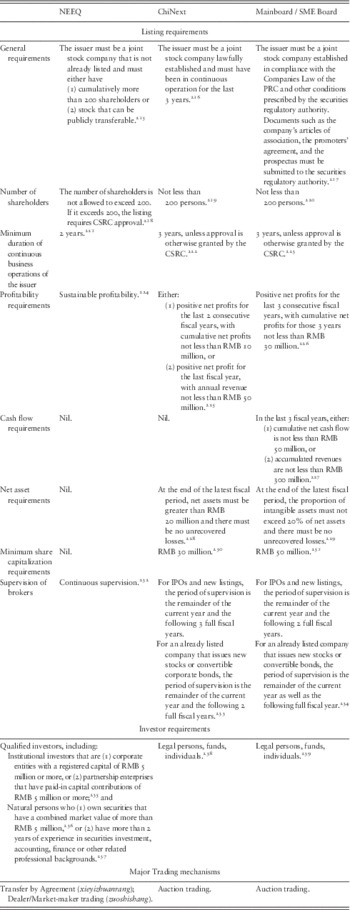
The primary concern for venture capitalists in China is the merits-based regulatory regime that imposes stringent financial requirements for would-be issuers.Footnote 110 Under this regime, share offerings are subject to tight administrative controls.Footnote 111 The Securities Law of the People’s Republic of China specifies certain substantive requirements (shizhi yaojian) for the public issuance of stocks: a company must have ‘sustainable profitability’ (chixuyingli nengli) and be ‘financially sound’. It also needs to ‘meet other requirements as prescribed by the securities regulatory authority under the State Council and as approved by the State Council.’Footnote 112 In accordance with this statutory requirement, the Main Board has stipulated various requirements for an issuer, such as the minimum duration of continuous business operations, profitability levels, cash flow, and net asset ratios.Footnote 113 A prospective Main Board issuer must have, within the past three accounting years, either generated a cumulative cash flow exceeding RMB 50 million or earned a cumulative business revenue exceeding RMB 300 million, and reported aggregate profits exceeding RMB 30 million. These requirements are extremely high for young entrepreneurial firms and thus represent formidable obstacles to their listing on the Main Board.Footnote 114
Moreover, the CSRC controls the listing process and this increases inefficiency and time costs for IPOs. The whole listing process on China’s Main Board usually takes an average of 1 to 3 years.Footnote 115 This is considerably longer than the same process on the New York Stock Exchange (NYSE), which clocks an average of 12 to 16 weeks,Footnote 116 or the NASDAQ which only requires an average of 5 to 6 weeks.Footnote 117
Indeed, the listing process could be even longer if the CSRC suspends the IPO window altogether. From January 1994 to December 2015, the IPO window was suspended 9 times for a total of 52 months.Footnote 118 This amounted to almost 20% of the 264 calendar months in that period. Consequently, many pre-IPO firms missed strategic IPO timings, a problem particularly acute considering how high-technology companies are often dependent on high growth and agility. Therefore, a number of firms in the Technology, Media & Telecommunications (TMT) industry have chosen to list their shares on overseas stock markets instead. As of 31 December 2014, 168 Chinese enterprises with a combined market capitalization of RMB 3.99 trillion have chosen to list themselves in the US, including top IT giants Alibaba, Tencent, JD.com, Baidu, Sohu, and NetEase.Footnote 119
Further, for a long period of time, stock pricing (especially in relation to the P/E ratio) in China was strictly controlled by the CSRC.Footnote 120 Although there have been improvements over the years, the CSRC still indirectly controls the pricing of stocks. For instance, additional disclosure and approval requirements are required where the P/E ratio of the newly issued shares is 25% higher than the industry average.Footnote 121 The assumption that industry averages exist and are instructive seems somewhat unrealistic for high-technology startups that typically market themselves as being in a class of their own with unique and innovative products. Further, the CSRC may require the issuer and the underwriter to re-conduct a pricing enquiry or to re-submit an IPO application to the CSRC under certain circumstances,Footnote 122 especially when they deem the price to be too high. Given these artificial controls on IPO pricing, the price of a stock may not objectively reflect the company’s value. In turn, such price distortions have undermined the market’s ability to efficiently allocate capital.
In addition, unlike the US where a typical lock-up period usually lasts for 90 to 180 days,Footnote 123 the IPO lock-up period under the SSE listing rules is 12 to 36 months.Footnote 124 According to Rule 4.1.5 of the SSE listing rules, venture capitalists or the venture capital fund holding controlling stakes in the company are forbidden from selling their shares within 36 months after listing. While an IPO lock-up period is arguably necessary to prevent stock prices from being depressed, the lock-up period under SSE listing rules is nonetheless too long and has created enormous obstacles impeding venture capitalists from disposing of their investments after the company goes public.
B. SME Board
In light of the difficulties SMEs face in getting listed on the Main Boards, the SME Board was launched on 17 May 2004 to provide a new financing channel for the SMEs.Footnote 125 However, in the ten years of the SME Board’s operation, it has not proven to be a suitable exit channel for venture capitalists.Footnote 126 This could be because of its stringent listing requirements which are almost the same as those of the Main Boards. For example, the issuer must have reported profits in the last three consecutive years; its net profits for the last three years cannot be less than RMB 30 million; the issuer must either have an overall cash flow exceeding RMB 50 million in aggregate or annual revenue exceeding RMB 300 million in the past three accounting years.Footnote 127 These stringent requirements would price out most VC-backed firms, given the nature of small portfolio startup companies as earlier described.
C. ChiNext
In a bid to build a multi-layered capital market by setting up a new secondary board in China, the ‘ChiNext’ (a portmanteau of the phrase ‘China Next’, also known as the Growth Enterprise Board or chuangyeban), was officially launched on 30 October 2009 on the SZSE. ChiNext specifically aims to attract firms in the high-growth and high-tech sectors and meet pent-up demands from SMEs facing difficulties in securing financing. ChiNext provides more relaxed listing requirements compared to the Main Boards and the SME Board. For example, a company is only required to have a share capital of not less than RMB 30 million post-IPO, in contrast to the RMB 50 million requirement for the Main Boards and the SME Board. ChiNext’s profit requirements are also lower than the Main Boards and the SME Board.Footnote 128
The launch of ChiNext has indeed facilitated VC-backed exits. In the five-year span after ChiNext’s launch, 519 exits were made via ChiNext, with a market return of RMB 743.4 billion.Footnote 129 As of 23 October 2014, 519 companies that were backed by venture capital/private equity were listed on ChiNext.Footnote 130
Nevertheless, compared to NASDAQ, which is an important exit venue for high-tech firms in the US, the financial requirements of ChiNext are stricter and less flexible. The NASDAQ adopts 11 sets of standards for three different market tiers (i.e. NASDAQ Capital Market for firms with small market capitalization, NASDAQ Global Market for those with medium market capitalization and NASDAQ Global Select Market for those with large market capitalization). In contrast, ChiNext adopts only two standards for profitability.Footnote 131 The first is that the issuer must have been profitable for the last two consecutive years and the net profits in this period must increase continuously and exceed RMB 10 million. Alternatively, the second standard provides that the issuer must have been profitable in the immediately preceding year and the net profits in that period must exceed RMB 5 million. In addition to these requirements, the firm’s revenue for the most recent year must have been over RMB 50 million and with a growth rate of at least 30% in the last two years.Footnote 132
While a high financial standard is necessary for relatively young exchanges to reduce speculation and enhance investor protection, it is argued that the stringent listing requirements of ChiNext make it difficult for startups that have yet to be profitable. This defeats the very purpose of setting up ChiNext – to facilitate equity financing for startup firms and to help upgrade China’s economic model. As the listing requirements for ChiNext are similar to those for the SME Board, the roles of the two boards are hardly distinguishable. As a result, more traditional companies, rather than high-tech companies that were initially targeted, are listed on ChiNext. As of 31 December 2015, manufacturing companies accounted for 52.78% of all Shanghai registered companies listed on ChiNext whereas companies engaging in information, technology and software only constituted 38.89%, and companies involved in technology, research, and service a mere 2.78%.Footnote 133
D. The Lack of a Dual-Class Share Structure
Dual-class share structures are typically characterized by one class of shares with only one vote per share (i.e., usually offered to public investors) and another class of shares with multiple votes per share (i.e., usually issued to founders).Footnote 134 Dual-class share structures are commonly used in VC-backed firms as they enable entrepreneurs to maintain control of the firm even after listing.
Nevertheless, unlike in the US where dual-class share structures are permissible, companies incorporated in China are generally not allowed to offer shares with multiple voting rights. The Chinese stock market has long been constrained by the ‘one share one vote’ system.Footnote 135 Arguably, this has led a sizeable number of Chinese enterprises to list on overseas stock exchanges instead. In 2014, 11 out of 15 Chinese companies, including the two largest Chinese e-commerce companies Alibaba and JD.com, were listed on the NYSE and the NASDAQ, both of which adopted the dual-class structure.Footnote 136
With the overseas listing of these high-growth and high-potential companies, China’s stock markets have lost these IT giants as valuable potential applicants. This reduces the attractiveness of China’s domestic stock exchanges, as many domestic investors would miss out on the considerable investment returns that could be brought about by the rapid growth of these companies.
Meanwhile, with improving IT infrastructure, there are a considerable number of high-tech companies in China. For instance, the ‘Chinese Silicon Valley’ – Zhongguancun – birthed 49 startups daily in 2014.Footnote 137 With the expansion and urgent financing needs of these high-growth startups, there is demand from the founders of these firms for a dual-class share structure that would allow them to raise capital while still preserving controlling interests. Arguably, adopting a dual-class share structure in China would give domestic entrepreneurial firms greater flexibility in terms of capital structure and provide domestic investors with a wider range of investment opportunities.Footnote 138
VI. Major Steps Toward A Better Exit Environment And The Way Forward
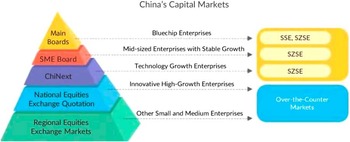
Given the increasing demands from a large number of SMEs, startups, and entrepreneurs, the CSRC has taken substantive steps to improve the stock market’s regulatory environment, particularly in creating a multi-layered capital market (duocengci ziben shichang) (see Figure 3). This part critically examines the major steps taken and their implications for the Chinese venture capital market. It also provides suggestions for future law reform.
China’s Multi-layered Capital Markets

A. The Launch and Expansion of the NEEQ
1. The special features of the NEEQ
The National Equities Exchange and Quotation (NEEQ) system, more commonly known as the New Third Board (xinsanban), is a national over-the-counter (OTC) market.Footnote 139 The NEEQ differs from the other Chinese stock exchanges in terms of targeted companies, trading rules, and eligible investors (see Appendix 1). In particular, the NEEQ is targeted at ‘innovation-oriented, entrepreneurial, and growing medium, small and micro-sized businesses (zhongxiaowei qiye)’,Footnote 140 instead of more mature companies.Footnote 141 Further, NEEQ has a much higher investor requirement – companies quoted on the NEEQ are unable to offer securities to the public, but only to specific qualified investors.Footnote 142
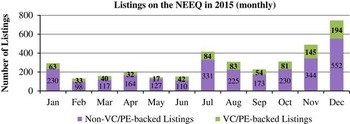
The NEEQ’s origins can be traced back to 2001 when the ‘Proxy Equities Exchange and Quotation system’ (PEEQ, guquan daiban zhuanrang xitong) was set up to provide a platform for companies delisted from the main board as well as for former Securities Trading Automated Quotation (STAQ) and National Exchange and Trading System (NET) companies to transfer their equities. The PEEQ was called the ‘third’ board because it was the third stock exchange when it was developed in 2001, after the Main Boards (the SSE and the SZSE) and the SME Board.Footnote 143 It was named the ‘New Third Board’ in 2006 as part of a trial OTC programme involving only a few high-tech enterprises in Beijing’s Zhongguancun Science Park. In 2012, the pilot programme was expanded to include high-tech zones in Shanghai, Zhangjiang, Wuhan Donghu, and Tianjin Binhai. In 2013, the pilot program was again expanded to cover all qualified companies nationwide and the NEEQ was officially launched.Footnote 144 A year later, the market-maker mechanismFootnote 145 was introduced by the Regulations of the National Equities Exchange and Quotations on the Administration of Market Makers’ Market-Making Business on 5 June 2014. Arguably, the launch of the NEEQ moved China’s stock market a step closer to the market-oriented model. It has greatly facilitated financing for VC-backed companies (see Figure 4).
The Popularity of the NEEQ in 2015Footnote 146

First, unlike the Main Boards, the SME Board, and ChiNext, all of which employ the merits-based regulatory system (also known as the approval-based system; see Part III above), the NEEQ uses the filing system, under which board listings are not subject to CSRC approvals. Instead, the NEEQ itself approves listings based on application materials submitted by the sponsors of the applicant companies.
Second, the relatively low listing requirements and shorter listing timeline have greatly expedited financing for small, high-growth internet enterprises, especially companies that were hitherto unable to meet the listing standards of the Main Boards, the SME Board, or ChiNext.
As shown in Appendix 1, amongst all the Chinese stock markets, the NEEQ has the least stringent listing requirements. Listing on the NEEQ requires a company to have a valid existence for only two years, whereas the other three boards require three years.Footnote 147 Meanwhile, unlike the other boards that have minimum pre-IPO profit requirements, the NEEQ only requires a company to have ‘sustainable profitability’ and does not prescribe detailed requirements.Footnote 148 Further, while the other boards have a minimum requirement of 200 shareholders, companies listed on the NEEQ may have less than 200. There are also no listing requirements pertaining to cash flow, net assets, or total share capital.Footnote 149 Finally, unlike listings on the Main Boards which usually take one year,Footnote 150 listings on the NEEQ only require an average of 6 months.Footnote 151
Third, companies listed on the NEEQ can seek financing through various means, including private placement of ordinary shares, private issuance of preference shares,Footnote 152 issuance of convertible debts, and privately-raised company bonds. These investment tools meet the particular needs of the various high-growth enterprises that constantly need urgent funding and also prevent the problem of share dilution after an IPO.
Fourth, unlike the Main Board, the SME Board, and ChiNext, which mainly use the order-driven mechanism (jingjia jiaoyi), in which trades occur between buyers and sellers by bidding, the NEEQ runs on the market-maker mechanism introduced in 2014. Companies listed on the NEEQ would appoint securities firms to act as market-makers to ‘quote’ buy or sell share prices,Footnote 153 and so transactions are not concluded directly between buyers and sellers.Footnote 154 The market-maker has to meet certain trading requirements and bear various obligations in order to ‘make the market’. These include responding to quote requests within a set time limit and providing continuous stock quotes within certain trading hours. Because of these features, the market-maker has been empirically proven as an important intermediary that increases liquidity, price efficiency, and price stability in stock markets.Footnote 155
With a series of positive laws and policies being promulgated to facilitate the development of the NEEQ, this Board has emerged as an attractive and important financing channel for SMEs. It has also become a major exit channel for VC-backed companies.
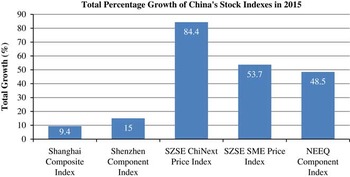
Funds raised on the NEEQ reached RMB 850 billion as of May 2015, an increase of 621% from RMB 137 billion for the whole of 2013.Footnote 156 In 2014 alone, trading volume on the NEEQ grew to 1.21 billion shares with a turnover value of RMB 6.67 billion.Footnote 157 As of 31 December 2015, 5129 companies have been listed on the NEEQ, with trade volume reaching a new high at 102.363 billion shares. Also, total market capitalization reached 2458.4 billion, setting new milestones both in terms of trading volume and turnover value (see Figures 5 and 6).Footnote 158
Comparative Growth in China’s Multi-Layered Capital MarketsFootnote 159

The Development of the NEEQ on a Logarithmic Scale 2012-2015Footnote 160

2. Existing problems and possible solutions
Nevertheless, as a new market, the NEEQ is not without problems. One pervasive issue is the low liquidity of the market – 2816 out of 5074 listed companies on the NEEQ have not seen any share transactions via the Board as of December 29, 2015.Footnote 161 The NEEQ’s average daily turnover was only RMB 1457.461 million as of 31 December 2015,Footnote 162 much less than that of the SZSE.Footnote 163
Arguably, the high investor threshold of the NEEQ has partially contributed to the low liquidity of the market. For institutional investors, only institutions with legal personality and a registered capital of more than RMB 5 million, or partnership enterprises with paid-up capital of more than RMB 5 million can trade on the market.Footnote 164 For individual investors, the admission standard requires RMB 5 million in the securities account.Footnote 165 While a high investor threshold is ostensibly necessary given that the majority of companies listed on the NEEQ are high-risk companies,Footnote 166 such strict requirements are not found in the NASDAQ, which similarly hosts a number of high-risk VC-backed firms. Nevertheless, lowering the threshold may not be an effective solution. As the NEEQ was designed to facilitate financing for high-tech, high-growth SMEs and micro-sized startup firms, having a large portion of retail individual investors with little knowledge of how to properly invest in high-risk companies is likely to increase market volatility and speculation. Therefore, a better solution would be to encourage institutional investors, such as mutual funds, to participate more actively in the market.
The new stratification reform (fenceng gaige)Footnote 167 which was implemented in June 2016 is likely to improve market efficiency and the liquidity of the NEEQ. The reform divides the NEEQ listed companies into two tiers - the Basic Tier (Jichuceng) and the Innovation Tier (Chuangxinceng). It also offers three different sets of listing and trading requirements to meet the varying needs of different companies.Footnote 168 Companies in the Innovation Tier have priority in using pilot schemes, such as new trading methods and financing methods. However, they are also subject to stricter supervision and disclosure requirements.Footnote 169 The two-tier system will likely help investors identify potential companies based on the different listing requirements of different tiers, and reduce investors’ reliance on market-makers for making investment decisions. It will also increase competition among the listed companies on the NEEQ and incentivize them to grow so as to trade on the higher Innovation Tier, permitting them access to more sophisticated investors.
Second, as the CSRC administers and controls the licensing of market-makers, there are only 83 qualified market-makers as of July 2015.Footnote 170 The market has come to be ‘monopolized’ by a few market-makers which in turn control the pricing of shares in NEEQ-listed companies.Footnote 171 Meanwhile, as the market-maker is a new trading mechanism in China, there is still a lack of sophistication and experience with this new mechanism among qualified market-makers.Footnote 172
It is suggested that the CSRC should strengthen its supervision of market-makers so as to prevent market manipulation, insider trading, and other economic crimes. One possible solution is to require market-makers to disclose trading information in a timely manner. Moreover, more qualified market-makers should be permitted to trade in the NEEQ. Arguably, the emerging unified national credit reporting system run by the People’s Bank of China should be integrated with the stock exchanges so as to encompass more enterprises and individuals within the market. Further, overseas markets such as the NASDAQ and London Stock Exchange operate mixed trading mechanisms which utilize both the market-maker and order-driven models. It is suggested that the NEEQ may also consider introducing the order-driven mechanism to broaden the choice of trading mechanisms and prevent a monopoly by the existing market-makers from taking hold.
Third, although the NEEQ is targeted at high-growth, high-technology companies, the lower listing requirements of the NEEQ have attracted a wide range of companies from various industries with great differences in asset volume, profitability, and scale,Footnote 173 including many low-quality companies which were unable to list on the Main Boards.Footnote 174 Overvaluation among these companies is also a problem faced by investors on the NEEQ.Footnote 175
In order to protect investors’ interests, to ensure the quality of the listed companies, and to match international best practices from exchanges such as the New York Stock Exchange and London Stock Exchange, a delisting mechanism should be introduced to force a poorly performing company to delist itself from the NEEQ if it fails to meet the listing requirements and corporate governance standards. The newly implemented stratification reform would also help to optimize the NEEQ and inform investors of the potential of the different listed companies.
In addition, unlike the Main Boards which impose a price limit of ±5% daily on poorly performing firms assigned the special treatment (ST) status,Footnote 176 stocks listed on the NEEQ do not have daily price limits. As a result, some stocks may swing 300% to 400% in a day.Footnote 177 While regulatory price limits arguably work against free market efficiencies, introducing daily price limits may relieve the concerns that investors, especially long-term institutional investors, have about the volatility of the NEEQ.
B. Streamlining the IPO Process
1. The IPO reforms
China’s IPO regime has long been subject to tight administrative controls which are commonly blamed for distorting the capital market and encouraging official corruption.Footnote 178 Because of China’s unique political and institutional infrastructure, its two stock exchanges (SSE and SZSE) are not state-independent and lack significant autonomous regulatory authorities.Footnote 179
Under the current merits-based regulatory system, many aspects of securities offering are heavily regulated, thereby significantly hampering the efficiency of the capital market and the operation of market forces. As mentioned above, due to difficulties with listing on China’s stock market, many Chinese companies, especially high-growth and internet companies, have chosen to turn to overseas capital markets.
To address these issues, China’s IPO system has undergone a series of reforms since the 1990s.Footnote 180 The first system implemented in China was a strictly planned ‘Quota Management’ system (e du guanli)Footnote 181 from 1993 to 1995, under which the issuer must first obtain share issue quotas from local governments or central ministries.Footnote 182 The CSRC would review the approved stock issuance application and decide the volume, issuing price, and other details of the shares to be issued.Footnote 183
From 1996 to 2000,Footnote 184 the IPO system transitioned into the ‘IPO Number Management’ (zhibiao guanli) system. The CSRC would set a quota for the number of IPOs for relevant local authorities to adhere to.Footnote 185 These local bodies would then recommend pre-selected enterprises for listing, subject to review and approval by the CSRC and State Council Securities Committee (SCSC).Footnote 186
In 2001, the ‘Channel System’ (tongdaozhi) was established.Footnote 187 Each securities firm could only recommend a certain number of companies to apply for IPOs, with the quota to be obtained from the CSRC.183 Only when a recommended issuer was approved could the next recommendation be made. Therefore, the number of IPOs was still controlled. However, compared to the previous systems in which the issuers were administratively selected, underwriters were granted the right to recommend issuers and accordingly would bear the risks of an IPO’s success or failure to some extent.
From 2004 till now, the Sponsorship System has been used (baojianzhi),Footnote 188 under which certified sponsors may recommend companies for stock issuance and listing. Sponsors are required to instruct, assist, and guide companies on information disclosure, and to guarantee that all financial information provided in the IPO prospectus is true.Footnote 189 The Sponsorship System reinforces the responsibility and accountability of the sponsors,Footnote 190 though the rights of approval for IPO applications are still vested with the CSRC.
2015 saw a significant move in orienting China’s stock market towards market demands. On 20 April 2015, the draft bill of the Securities Law of the People’s Republic of China was published, which specified the new registration system for stock issuing and listing. On 27 December 2015, the Standing Committee of the National People’s Congress approved a proposal to revamp the IPO system (‘the Proposal’), authorizing the State Council to implement changes to the system in March 2016.Footnote 191
The major feature and key objective of the new registration system is the shift away from an administrative regime towards a market-driven one in allocating resources. Presently, IPO applications are subject to the CSRC’s approval. Under the new system, however, financial intermediaries, instead of the CSRC, will be primarily responsible for the substantive verification of such applications.Footnote 192
Under the registration system, the main role of the stock exchanges is to assess the ‘completeness, consistency, and intelligibility’ (qibeixing, yizhixing, kelijiexing) of application materials submitted by issuers. The completeness requirement mainly refers to whether the contents, scope, and degree of the materials have satisfied disclosure rules and provided necessary and sufficient information for investors to make informed decisions.Footnote 193 The consistency requirement concerns the reasonableness of the operating conditions of the enterprise as disclosed, the logicality of financial statements articulated, and the level of corroboration by financial and non-financial data.Footnote 194 Finally, the intelligibility requirement requires that the language and expression of submitted materials be succinct and understandable.Footnote 195 Upon completing the review of the application materials, if the stock exchange deems the application acceptable, it will issue a favourable opinion and submit this, with the application materials, to the CSRC for registration.Footnote 196 The CSRC will then validate the registration within a prescribed timeframe unless a dissenting opinion is issued by the stock exchange.Footnote 197
However, the proposed IPO registration system has not been implemented and was not even mentioned in the government work report of 2016.Footnote 198 It is unclear when the new system will be implemented. Crucially, it is still an open question whether the new registration system can fundamentally rid itself of administrative interference in the capital market, given that the degree of administrative intervention in China’s capital market has always been prominent.
2. Suggestions for VC-backed-IPOs
First, it is submitted that the proposed IPO reform should be carried out to improve the regulatory environment of VC-backed IPOs. The shift from an administrative merits-based regulatory system to a registration-based one would greatly simplify the IPO process and substantially reduce transaction costs for VC-backed IPOs. Under the new system, entrepreneurial firms would not need to wait for months or years before they can raise capital. Neither would they need to worry about suspensions of the IPO process during periods when the market is weak. Thus, the shift would fundamentally eliminate the negative impacts caused by IPO suspensions. Reducing the CSRC’s control over the IPO process would also solve the existing corruption and price distortion problems.
The shift would also likely impact Chinese venture capital firms’ choice of portfolio companies and investment timings. Under the current system, the regulator rather than the market decides the price of an issuer’s shares. Investors are likely to presume that a successfully listed company is financially strong and has high potential, having survived the tedious and burdensome approval process by the CSRC. This has partially contributed to the extremely high P/E ratios of companies on China’s stock market.Footnote 199 Therefore, in the past few years, a number of venture capital firms which traditionally invested in early-stage startups changed their investment strategy to invest in pre-IPO, later-stage projects so as to get fast and high returns.Footnote 200 After the impending IPO system reform, the market will presumably play a more decisive role in capital allocation and price setting. The preference of venture capital funds for investing in pre-IPO projects is likely to diminish. Venture capital funds may shift back to investing in early-stage portfolio companies, as they traditionally did, thus providing more funding for nascent companies that are in greater need of financing to fuel their growth.
Second, existing listing rules and requirements must be revisited and revised. As discussed above, profitability is a major listing requirement of the Main Boards, the SME Board, and ChiNext. However, many entrepreneurial firms are young firms which lack the necessary cash flow and profits. Also, it is not an international practice for secondary boards targeted at high-growth companies to have requirements pertaining to profitability or track record.
Since ChiNext was initially launched to encourage innovation and entrepreneurship by facilitating capital financing for high-tech and high-growth entrepreneurial firms, ChiNext should remove or reduce the profitability requirement and focus on the ‘growth’ and ‘innovation’ ability of the issuers instead. For example, ChiNext may consider following the approach adopted by the Hong Kong Growth Enterprise Board (GEM) which requires a listing applicant to:
[h]ave a trading record of at least 2 full financial years with substantially the same management throughout the 2 years, and a continuity of ownership and control throughout the full financial year immediately preceding the issue of the listing document.Footnote 201
Moreover, the issuer is required to disclose in detail its past business track record and future business plans and innovation models, and make them the key components of the listing documents. The issuer is also required to publish quarterly accounts and make half-yearly comparisons of its business progress and innovation models with the business plan and models of the first 2 financial years.
Third, the role played by investment intermediaries in an IPO-exit has been empirically documented.Footnote 202 The more reputable the investment banker, the less extreme the short-term underpricing of the issue.Footnote 203 Similarly, ‘the better the reputation of the firm’s accountants, the less extreme the underpricing.’ Footnote 204 In China, it has been found that for non-state-owned enterprise issuers, the underwriter’s reputation is positively correlated with the issuer’s post-IPO performance, indicating that prestigious underwriters can incrementally improve the issuer’s post-IPO performance.Footnote 205 Under the new registration-based IPO system, the level of accountability of the underwriters, lawyers, and accounting firms will be increased and their roles enhanced, as the CSRC will not scrutinize the substantive aspects of the listing documents. Therefore, increasing the sophistication of financial intermediaries is crucial to the implementation of the IPO reform. Arguably, this can be achieved by: (1) imposing criminal liability for any fraud or improper information disclosure during a listing; (2) appointing internal control experts to improve the internal control within the underwriters; and (3) introducing a comprehensive credit rating system for the underwriters.
Fourth, an effective implementation of the new IPO system also depends on building greater investor sophistication in the Chinese stock market. One major feature of the Chinese stock market is the large proportion of retail investors.Footnote 206 A survey conducted by the SZSE showed that in 2015, the average trading assets of the securities accounts of 84.4% investors were below RMB 50,000.Footnote 207 As of September 2014, individual investors accounted for 64.4% of the total share capital of ChiNext, in contrast to 35.6% held by institutional investors.Footnote 208 The IPO initial return study found a positive correlation between heightened investor sentiments and the phenomenon of overvaluation.Footnote 209 Many of these retail investors are more likely to speculate and be influenced by investor sentiments. Arguably, without greater participation from institutional investors and sophisticated investors, the Chinese stock market will continue to be very susceptible to shocks caused by retail investors who are less risk tolerant and who are more inclined to invest based on fear or greed.Footnote 210
Under the current system, as the supply of IPOs is artificially constrained by the CSRC, retail investors with little knowledge of how to properly invest will always be seeking the ‘next best thing’ that is listed on the stock exchanges, driving up the share prices of newly listed companies. However, the proposed IPO registration system will be more objective and market-driven in terms of approval and pricing. Accordingly, investors will increasingly need to make investment judgments themselves. Therefore, improving the sophistication of investors on the stock exchange is of crucial importance. This can be achieved by continuous investor education and relaxing restrictions on institutional investors making equity investments.Footnote 211
Fifth, many auxiliary legal reforms and institutional improvements are needed to facilitate the implementation of the registration system. As alluded to above, these include building and attracting more sophisticated investors, promulgating a well-designed delisting mechanism, and establishing a competent regulatory body with effective public enforcement. Additionally, given the large number of reported cases of corruption by CSRC officials in relation to IPOs,Footnote 212 party and regulatory discipline should be enhanced.Footnote 213
VII. Conclusion
China provides an important and instructive case study to test the theory that stock markets and venture capital markets are closely linked. China’s experience offers interesting evidence of how legislative efforts in building a stock market can facilitate the mutual development of the venture capital market.Footnote 214
Preliminary empirical results presented above confirm the correlation between the stock market and venture capital market in China. This article also significantly extends the existing literature by finding that the regulatory environment driven by an efficient stock market has a significant impact on the venture capital market in China, particularly when it comes to venture capital availability. For example, favourable investment policies have typically been accompanied by observable increases in venture capital availability, while IPO window closures heralded the exact opposite outcome.
The article also shows that despite China’s progress towards cultivating a favourable regulatory environment for VC-backed exits, there remain various institutional impediments within the stock market that hinder the development of the venture capital industry. Most importantly, it is difficult to foresee when and how the proposed IPO registration system will be implemented and, in light of the party-state system in China, whether this new system will successfully orient the stock market towards market forces rather than administrative control. It is likely that the unclear and grey areas of the IPO regulatory regime would be capitalized on by the CSRC to retain control (albeit in an indirect manner) on the issuance and pricing of shares in the IPO market. Ultimately, much has to be done before China’s stock market can fully fulfil its role in allocating capital in the venture capital market and to strike a proper balance between government control and market autonomy. Given the IPO strategy’s significant popularity as an exit channel, it is suggested that governments prioritize reform efforts towards creating a strong and sustained policy to improve the institutional structure and regulatory environment of the stock market, in order to facilitate VC-backed IPO-exits and grow the venture capital industry.
On top of a robust stock market, an effective venture capital market also requires a wide range of complex institutions, including comprehensive contractual designs in addressing agency problems that arise in venture-capital contracting, a robust M&A market, sophisticated financial intermediaries, strong investor protection, and effective dispute resolution by courts. Further research must be done to analyze how a vibrant M&A market that facilitates VC-backed M&A-exits may be developed.
A Comparison of the Listing Requirements under China’s various Stock Markets

Legal Developments in China’s Stock Markets and their Implications for the Venture Capital Market 1990-2015Footnote 240