INTRODUCTION
The Sotalia genus has two species, one fluvial, the tucuxi Sotalia fluviatilis (Gervais & Deville, 1853), and another marine, the estuarine dolphin Sotalia guianensis (van Bénéden, 1864) (Monteiro-Filho et al., Reference Monteiro-Filho, Reis and Monteiro2002; Cunha et al., Reference Cunha, da Silva, Lailson-Brito Jr, Santos, Flores, Martin, Azevedo, Fragoso, Zanelatto and Solé-Cava2005; Caballero et al., Reference Caballero, Trujillo, Vianna, Barrios-Garrido, Montiel, Beltrán-Pedreros, Marmontel, Santos, Rossi-Santos, Santos and Baker2007).
The tucuxi is an endemic species found in the Amazon and Orinoco rivers which cut through seven South American countries: Bolivia, Brazil, Colombia, Ecuador, Guiana, Peru and Venezuela (Vidal et al., Reference Vidal, Barlow, Hurtago, Torre, Cedón and Ojeda1997). Gatherings of individuals can frequently be seen at river mouths and canals (da Silva & Best, Reference da Silva and Best1996; Vidal et al., Reference Vidal, Barlow, Hurtago, Torre, Cedón and Ojeda1997), though little is known of their relationship with the medium (Monteiro-Filho et al., Reference Monteiro-Filho, Filla, Domit, de Oliveira, Reis, Peracchi, Pedro and Lima2006).
The estuarine dolphin is found on the neotropical Atlantic coast from Honduras in Central America (da Silva & Best, Reference da Silva and Best1996) to the Santa Catarina State in the south of Brazil (Simões-Lopes, Reference Simões-Lopes1988), being frequently found in estuarine regions and protected areas (Carvalho, Reference Carvalho1963). The species is essentially gregarious and some individuals can be observed alone for short periods of time and later joining some nearby group (Monteiro-Filho, Reference Monteiro-Filho2000).
Studies about the estuarine dolphin group structure have been reported on the Nicaraguan Coast, in Cayos Miskito, by Edwards & Schnell (Reference Edwards and Schnell2001) and on some points of the Brazilian coast, mainly in the south-eastern region, in the States of São Paulo (Geise et al., Reference Geise, Gomes and Cerqueira1999; Monteiro-Filho, Reference Monteiro-Filho2000), Rio de Janeiro (Lodi & Hetzel, Reference Lodi and Hetzel1998; Lodi, Reference Lodi2003), and in the north-eastern region in Ceará State (Oliveira et al., Reference Oliveira, Ávila, Alves Júnior, Furtado-Neto and Monteiro-Neto1995).
Edwards & Schnell (Reference Edwards and Schnell2001) followed a S. guianensis population for three years in Nicaragua and observed groups from one to 15 individuals. They noticed that the quantity of individuals per group varied according to the activity of the group. The groups varied significantly during the years 1996–1998 but not much during months of the same year.
The largest groups of estuarine dolphins registered to this date were observed in Baía da Ilha Grande, in Rio de Janeiro State, south-east of Brazil. The variation of these groups was between three to approximately 450 individuals and in 90% of their observations the groups were formed by adults, juveniles and/or calves (Lodi & Hetzel, Reference Lodi and Hetzel1998). In another study in Baía de Paraty, also in Rio de Janeiro State, the average size of the groups was smaller (32 to 48 individuals per group) which can still be considered as being large for that species (Lodi, Reference Lodi2003).
In the Cananéia Estuarine Complex region, São Paulo State, the estuarine dolphins were present in small groups and most frequently found in pairs (30%). Calves were also observed during the whole year and were always accompanied by one or more adults (Geise et al., Reference Geise, Gomes and Cerqueira1999). In another study in the same area carried out over about 16 years, small groups of one to three individuals were the most frequently seen, although larger groups were also observed (Monteiro-Filho, Reference Monteiro-Filho2000).
As there is very little information about the structure of the estuarine dolphin groups in the south of Brazil, this study was carried out to obtain that information since these data are essential to serve as a foundation for all future population, behavioural and conservation studies of the species.
MATERIALS AND METHODS
Study area
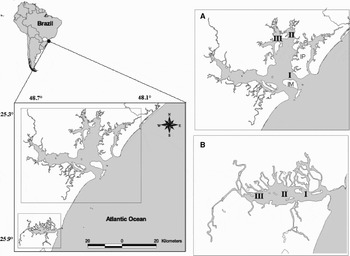
Paraná State coast (Figure 1) is small in extension (approximately 98 km; IPARDES, 1989) and has two bays, Baía de Paranaguá in the north (25°20′S–25°50′S/48°20′W–48°80′W) and Baía de Guaratuba in the south (25°80′S–25°90′S/48°34′W–48°80′W) with an average temperature in the hottest months of 22°C and in the coldest months of 18°C (Veloso et al., Reference Veloso, Rangel Filho and Lima1991). Low index of surface salinity is predominant in the summer due to a larger flow of fluvial waters because of a higher rain incidence (Knoppers et al., Reference Knoppers, Brandini and Thamm1987).
Map of study areas and nearby regions in relation to the Paraná State and Brazil: (A) corresponds to Baía de Paranaguá—Sector I corresponds to the area between Ilha do Mel (IM) and Ilha das Peças (IP); Sector II corresponds to Baía de Guaraqueçaba; and Sector III corresponds to the cove Enseada do Benito; (B) corresponds to Baía de Guaratuba (with non-named Sectors I, II and III).

The estuarine system in Baía de Paranaguá is situated in the north and is made up of several sectors, each having a special denomination (Bigarella, Reference Bigarella1978). It is connected to the open sea through three canals, the main one being the canal that surrounds the island Ilha do Mel, with an aperture equal to 152 km2 (Lana et al., Reference Lana, Marone, Lopes, Machado, Seeliger and Kjerfve2000). It has two main axes—the first one leading east/west of approximately 50 km long and 7 km wide and the second one leading north/south of approximately 30 km long and 13 km wide (Netto, Reference Netto1993). According to Brandini et al. (Reference Brandini, Thamm and Ventura1988) the environmental heterogeneity can be very strong in the internal areas of the Baía de Paranaguá which is linked to alterations in the fresh water that transports great quantities of dissolved particles into the system causing an accumulation of nutrients.
Baía de Guaratuba is linked to the ocean by an aperture of approximately 500 m with a length of 15 km running east/west and a maximum north/south width of 5 km. It is also an estuarine system with a basically muddy bottom (Vendel & Chaves, Reference Vendel and Chaves1998). Its margin is river fed and is a mangrove having wells of at least 7 m deep (Chaves, Reference Chaves1995).
Groups
In this study, two association categories of the estuarine dolphins are distinguished according to Monteiro-Filho (Reference Monteiro-Filho2000): families and schools. The family is characterized by the relationship and cohesion amongst individuals, and may be formed by a pregnant female plus another adult, a female and its calf, or two adults and a calf where we can assume that one of the adults is the mother and the other a helper with the provision of caring for the calf. The school is formed by an association between families that unite for a specific reason, which is commonly related to the capture of fish and change of location.
To distinguish between adults and calves, three main criteria were simultaneously used: the proportional size of the body since it is visibly smaller in calves; its colouring, since calves possess a pink abdomen and flanks with a greyish area on its back, pink-greyish marks on its flippers, whereas adults have completely grey flippers and back (Randi et al., Reference Randi, Rassolin, Monteiro-Filho, Rosas, Monteiro-Filho and Monteiro2008); and the behaviour, since the calf is always close to an adult—probably its mother (Monteiro-Filho et al., Reference Monteiro-Filho, Neto, Domit, Monteiro-Filho and Monteiro2008).
Procedures
Considering the heterogeneity of the bays where this study was carried out, these were divided into sectors and their surveys were executed independently. Each bay has three internal sectors which were established according to physical characteristics related to the water flow and its proximity to the ocean.
In Baía de Paranaguá (Figure 1A), Sector I corresponds to the west side of the island Ilha das Peças and the canal between it and the island Ilha do Mel in direct contact with the Atlantic Ocean; Sector II corresponds to the bay known as Baía de Guaraqueçaba with a flow of sweet water from rivers in the region; and Sector III corresponds to the cove Enseada do Benito into which the biggest rivers of the region discharge. In the first sector the surveys could only be taken up until 2 p.m. due to the navigation restrictions. In Baía de Guaratuba (Figure 1B), Sector I also includes the region closest to the mouth of the bay opening; Sector II is the central area, and Sector III corresponds to the most internal region with the least seawater influence.
Line transects previously established were traversed and all animals were registered, including those that were found between two transects. Transects in each area were traversed using the same boats (4 m long aluminium boats with a 25 hp stern engine) conducted by the same pilots. Speed was low (10 km/h) and quite constant with the observer kept at the centre of the boat. The time spent in each transect was also registered to measure the sampling effort. Special care was taken to follow instructions as per Leatherwood (Reference Leatherwood1979), Gaskin (Reference Gaskin1982) and Bonin et al. (Reference Bonin, Filla, Monteiro-Filho, Monteiro-Filho and Monteiro2008).
This work was done during two seasons: rainy season from October to March (when the pluviometry index is an average 200 mm/month) and the dry season from April to September (when the pluviometry index falls to 95 mm/month; SIMEPAR, 2007). The days were divided into two periods: morning (between 6 a.m. and 11.59 a.m.) and afternoon (noon to 6.30 p.m.).
All the data were taken for both the number of groups and the headcount in each group, and whenever possible, the individuals were differentiated as adults or non-adults. The data were treated separately and comparatively between the two bays and between sectors of each bay. The significance of the differences between the numbers of individuals per group and number of groups in different sectors in the two bays was checked using the Chi-square test, assuming the null hypothesis of equal distribution among sectors and seasons.
RESULTS
Overall there were 23 sampling periods, 11 of which were taken from March 1999 to February 2000 in three sectors of Baía de Paranaguá and the other 12 were taken in July 2002 and June 2003 in Baía de Guaratuba. Overall, the surveys took 68 days and 400 hours of sampling effort.
In the first bay, an average of 5.98 individuals (2.06 groups) were registered per hour of survey, whereas in the second bay, the average fell to 0.33 individual (0.15 groups) per hour.
Group sizes
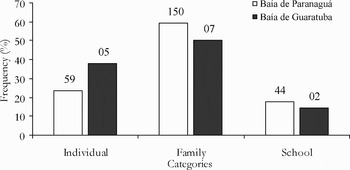
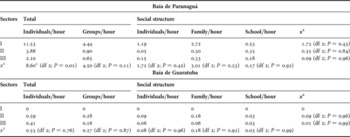
Taking together the three Baía de Paranaguá sectors, 735 Sotalia guianensis were sighted and distributed into 253 groups with an average size of 2.90 individuals per group. The number of individuals per group varied from one to 37 with the majority being of a family formation (59.29%), meaning groups of two or three individuals. Schools represented 17.39% of that total amount and only five (1.98%) had 10 or more individuals (10, 12, 20, 25 and 37 individuals), 23.32% of the individuals of this bay were seen in isolation (Figure 2). When the sectors in Baía de Paranaguá were analysed separately (Table 1), we verified the same pattern, meaning that the three sectors were predominantly of family formation.
Frequency of social organization categories of estuarine dolphins between 1999 and 2000 in Baía de Paranaguá, and 2002 and 2003 in Baía de Guaratuba, Paraná State, south of Brazil. The values above the columns indicate their respective absolute numbers.

Total number of estuarine dolphins and groups observed between 1999 and 2000 and respective types of groups in each sector of Baía de Paranaguá, and between 2002 and 2003 in Baía de Guaratuba, Paraná State, south of Brazil.

In the whole of Baía de Guaratuba only 32 individuals were sighted distributed into 14 groups that varied from one to six individuals with an average size of 2.13 individuals per group. Family formations were the most registered (50%) and on two occasions schools were registered (14.30%) where one of them had four dolphins and one of them had six (Figure 2). Five dolphins were seen alone (35.70%). When the sectors in Baía de Guaratuba were analysed separately (Table 1) we verified that no individual estuarine dolphin was sighted in Sector I. In other sectors the family formation was prevalent.
Seasonal differences
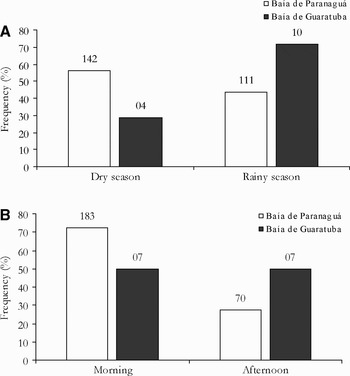
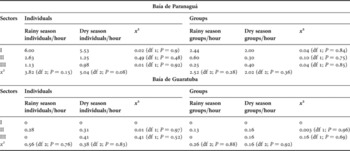
In Baía de Paranaguá, 6.80 individuals (2.32 groups) were registered per hour of survey during the rainy season. During the dry season the sightings of individuals was lower (5.19 individuals/hour) as well as the group numbers (1.81 group/hour) (Figure 3A).
Frequency of groups of estuarine dolphins, Sotalia guianensis, in dry and rainy seasons (A) and in periods of the day—morning and afternoon; (B) in Paranaguá and Guaratuba Bays, Paraná State, south of Brazil. The values above the columns indicate their respective absolute numbers.

In Baía de Guaratuba, 0.56 individuals (0.25 groups) were registered per hour of survey during the rainy season. During the dry season, the number of individuals (1.44 individuals/hour) and group numbers (0.63 groups/hour) was higher (Figure 3A).
Considering the stratification in Baía de Paranaguá in Sectors I and III, a higher number of groups and individuals were observed during the rainy season. In Sector II, a higher number of groups were observed in the dry season though a higher number of individuals were found in the rainy season (Table 2). In Sectors II and III of Baía de Guaratuba, the registration of individuals and groups was higher during the dry season (Table 2).
Number of individuals and groups of estuarine dolphins observed in rainy and dry seasons in each of the three sectors of Baía de Paranaguá, and in each of the three sectors of Baía de Guaratuba, Paraná State, south of Brazil.

Time differences
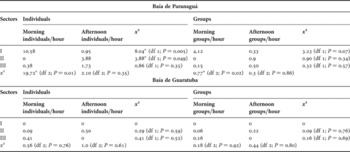
In Baía de Paranaguá, an average of 8.60 individuals (2.45 groups) was registered per hour of survey during the morning period. During the afternoon the registration of individuals (3.87 individuals/hour) and group numbers (1.04 groups/hour) was a lower (Figure 3B).
An overall 16 estuarine dolphins were observed in Baía de Guaratuba both in the morning and evening (1 individual/hour), and on both occasions they were spread over 7 groups (0.44 groups/hour; Figure 3B).
Considering the stratification we noted that all 155 individuals in Sector II of Baía de Paranaguá (distributed over 36 groups) were sighted during the afternoon. In Sector III there was a higher incidence in both the number of individuals and groups also at that time of the day, whereas in Sector I most of the data were collected during the morning (Table 3).
Number of individuals and groups of estuarine dolphins observed in each period of the day in each of the three sectors of Baía de Paranaguá and in each one of the three sectors of Baía de Guaratuba, Paraná State, south of Brazil.

In Sector II of Baía de Guaratuba most observations were taken in the afternoon whereas, in Sector III, all animals were seen in the morning (Table 3).
Proportion of adults/calves
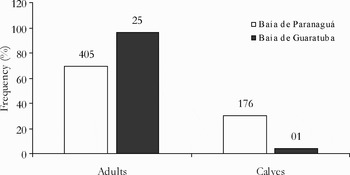
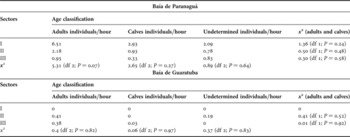
The proportion of adults/calves in the areas that were studied varied quite a lot, especially between sectors of each area. Taking the three sectors of Baía de Paranaguá altogether, the individuals that were easily identified as calves represented 24% (176 individuals), adults 55% (405 individuals) and 21% (154 individuals) were undetermined (Table 4). For statistical analysis we only considered the clearly identified individuals of either adults or calves. In Baía de Guaratuba, in Sector III, 32 individuals were sighted, 25 of those (78%) were adults, only one was a calf (3%) and 6 (19%) were undetermined (Figure 4). In relation to the animals seen in Sector II, 13 were adults (68.4%) and 6 (31.6%) were undetermined (Table 4).
Frequency of age-groups of estuarine dolphins, Sotalia guianensis, registered in Paranaguá and Guaratuba Bays, Paraná State, south of Brazil. The values above the columns indicate their respective absolute numbers.

Age classification of estuarine dolphins observed in each one of the three sectors of Baía de Paranaguá and in each one of the three sectors of Baía de Guaratuba, Paraná State, south of Brazil.

Calves incidence
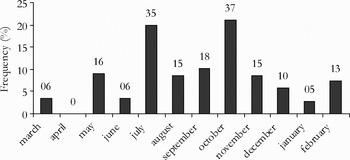
In Baía de Paranaguá, calves were registered in all sampling months. The highest number occurred in October 1999: 37 in all, 30 of which were registered in Sector I which corresponds to the island Ilha das Peças. In January 2000, a lower number occurred (five calves; Figure 5). In Baía de Guaratuba one only calf of estuarine dolphin was registered in September 2002 in Sector III, the most internal region of the bay.
Frequency of calves of estuarine dolphins, Sotalia guianensis, in each sampling month (March 1999 to February 2000) in Baía de Paranaguá, Paraná State, south of Brazil. The values above the columns indicate their respective absolute numbers.

DISCUSSION
The social aspects between mammals are unique and, in general, they lead to groups based upon relations or cooperation (Vonhof et al., Reference Vonhof, Whitehead and Fenton2004). The cetaceans, for example, are essentially gregarious animals whose group organization and behavioural pattern is probably a cost–benefit relationship between the several activities done throughout their life cycle (Matthews, Reference Matthews1988). Group life evolution may be related to the exploration of the feeding resources (Monteiro-Filho, Reference Monteiro-Filho1992, Reference Monteiro-Filho1995), to defence (Rose & Payne, Reference Rose and Payne1991; Gaskin, Reference Gaskin1982) and to looking after their calves (Mann et al., Reference Mann, Connor, Barre and Heithaus2000; Rautenberg & Monteiro-Filho, Reference Rautenberg, Monteiro-Filho, Monteiro-Filho and Monteiro2008).
Size and/or composition of groups of tucuxi (Sotalia fluviatilis) were reported by Magnusson et al. (Reference Magnusson, Best and da Silva1980) who found small groups, 55% of them, formed by two or more individuals and 45% of single dolphins. Vidal et al. (Reference Vidal, Barlow, Hurtago, Torre, Cedón and Ojeda1997) sampled a large extension of the Rio Amazonas taking samples in three different countries: Colombia, Peru and Brazil, where they found tucuxis groups having an average of 3.9 individuals. The work of Bodmer et al. (Reference Bodmer, Fang and Puertas2007) in the Rio Samiria (Peru) estimated that the age composition of the groups was, on average, 60% adults, 30% juveniles and 10% calves.
Sotalia guianensis groups in this study varied between two to 37 individuals. The groups with two or three individuals (family formation) were the most frequent in both bays. In the Baía de Paranaguá about a quarter and in the Baía de Guaratuba about a third, were single dolphins, but these animals were isolated for only short periods of time after which they joined some nearby group (Monteiro-Filho, Reference Monteiro-Filho2000), which is similar to what happens with the pink river dolphins in the Amazonian basin (Aliaga-Rossel, Reference Aliaga-Rossel2002). Single estuarine dolphins were also rarely seen in the Baía Norte of the Santa Catarina State (Daura-Jorge et al., Reference Daura-Jorge, Wedekin, Piacentini and Simões-Lopes2005), the Cananéia region in São Paulo State (Santos & Rosso, Reference Santos and Rosso2008) and in the Sepetiba Bay of Rio de Janeiro State (Flach et al., Reference Flach, Flach and Chiarello2008).
Studies of estuarine dolphins have shown that the size of groups in open areas is larger than those found in bays and estuaries. In confined areas the average size of the groups is small (Geise, Reference Geise1991; Geise et al., Reference Geise, Gomes and Cerqueira1999; Monteiro Filho, Reference Monteiro-Filho2000), but can be much larger in open areas (Lodi & Hetzel, Reference Lodi and Hetzel1998). Exceptions to this rule were found in the Baía de Paraty (Rio de Janeiro State) where groups of up to 450 individuals were registered (Lodi & Hetzel, Reference Lodi and Hetzel1998) and in Baía de Sepetiba (also Rio de Janeiro State) where there were groups of up to 250 individuals (Flach et al., Reference Flach, Flach and Chiarello2008). Different to other estuaries, fish species form large shoals in these two bays (Araujo & Azevedo cited in Flach et al., Reference Flach, Flach and Chiarello2008) which probably explain the formation of large Sotalia groups as a feeding strategy. In the Norte Bay (Santa Catarina State), feeding strategy groups were larger than those when they were on the move (Daura-Jorge et al., Reference Daura-Jorge, Wedekin, Piacentini and Simões-Lopes2005).
In our study in the Baía de Paranaguá, the quantities of groups and individuals observed throughout the survey months were uneven. The sightings were higher in the rainy season months (October to March). The exception occurred in Sector III where although having a higher number of individuals in the rainy season, also there was a higher number of groups in the dry season. Therefore, the quantity peaks of groups and individuals may not coincide since more groups do not necessarily imply a higher number of individuals because a single group could contain more individuals than several smaller groups. This is probably associated to the type of food existent in that area as well as the fishing strategies utilized (see Monteiro-Filho, Reference Monteiro-Filho1995). The heterogenic distribution of estuarine dolphins in the three sectors of this bay cannot be considered as being casual. The movements seem to be intimately related to those of their potential prey (Leatherwood et al., Reference Leatherwood, Reeves and Show1982; Monteiro-Filho, Reference Monteiro-Filho1992, Reference Monteiro-Filho1995), similar to what happens in the Amazonian basin with the pink river dolphin (Inia geoffrensis) and tucuxi (Bodmer et al., Reference Bodmer, Fang and Puertas2007).
In the case of estuarine animals, distribution can also be indirectly related to salinity variation. In Baía de Paranaguá, estuarine dolphins can be seen during most of the year in the most external sector (Sector I) where salinity is practically constant whereas this uniform distribution is not observed in the other sectors that receive a greater incidence of fresh waters from rivers of the region. In the Cananéia Estuary (São Paulo State) (Santos & Rosso, Reference Santos and Rosso2008) and in Baía de Sepetiba (Rio de Janeiro State) (Flach et al., Reference Flach, Flach and Chiarello2008), most of the estuarine dolphins gatherings were registered in the sector closest to the access to the sea. Salinity is a factor that many times determines the presence of shoals of marine fish. These fish probably migrate to waters that are closer to the adjacent ocean in the months of a higher pluviometry index (Fernandes-Pinto, Reference Fernandes-Pinto1997), resulting in the dislocation of estuarine dolphins following their prey (Oliveira et al., Reference Oliveira, Rosas, Pinheiro, Santos, Monteiro-Filho and Monteiro2008).
During the two periods of the day (morning and afternoon) it was possible to observe different realities in the two studied bays. In Baía de Guaratuba, where the number of individuals is small, a homogeneous distribution was observed between the number of individuals and groups in each period, however, in Sector II the sightings were more frequent in the afternoon and in Sector III the opposite happened. Due to the low number of individuals and sampled groups, it is possible that the same animals were seen at different points of the bay at different times. In the past, the presence of estuarine dolphins in Sector I was common (Monteiro-Filho et al., Reference Monteiro-Filho, Bonin and Rautenberg1999), but during the periods of this study, no estuarine dolphins were seen. This probably occurs because Sector I of the bay suffers great entropic pressure as well as intense boat traffic. This is similar to what was registered by Edwards & Schnell (Reference Edwards and Schnell2001) in some areas of the Cayos Miskito Reserve in Nicaragua.
In Baía de Paranaguá, a heterogenic distribution throughout the day was observed, with a higher number of sightings in the morning. Most of these results are from Sector I, which is strongly influenced by oceanic waters and was only sampled between 08.00 a.m. and 2.00 p.m. Therefore, it is impossible to state that the estuarine dolphins remained in that area for most of the afternoon. However, that higher frequency of observations in the morning resembles the results described in Cananéia (São Paulo State) (Geise et al., Reference Geise, Gomes and Cerqueira1999), in Baía de Guanabara (Geise, Reference Geise1991), in Baía de Paraty (Rio de Janeiro State) (Lodi, Reference Lodi2003), and Iracema beach (Ceará State) (Oliveira et al., Reference Oliveira, Ávila, Alves Júnior, Furtado-Neto and Monteiro-Neto1995). This variation was probably influenced by tide fluctuations that change the salinity and the presence of fish shoals.
Another factor that interferes in the size and cohesion of groups is the presence of calves (Mann et al., Reference Mann, Connor, Barre and Heithaus2000; Rautenberg & Monteiro-Filho, Reference Rautenberg, Monteiro-Filho, Monteiro-Filho and Monteiro2008). Despite the difficulty in determining the age of dolphins (Thompson et al., Reference Thompson, Lusseau, Corkrey and Hammond2004) the proportion between age-groups of adults/calves in cetaceans has been frequently documented, especially in studies of bottlenose dolphins. In the coastal area of Texas (USA) calves represented 9.30% of the population (Barham et al., Reference Barham, Sweenecy, Leatherwood, Beegs and Barham1980); on the Virginian coast (USA) the calves represented 10.15% of the population (Barco et al., Reference Barco, Swingle, Mclellan, Harris and Pabst1999). In two years of studies in Florida (USA) the calves represented 2% to 6% of the total individuals. In some studies, the proportion of infants of Atlantic spotted dolphins (Stenella frontalis) was 5% in the first year and 11% in the second (Griffin & Griffin, Reference Griffin and Griffin2004).
In this study the proportion of adults/calves varied between the two bays and represented 24% of the total individuals in Baía de Paranaguá and 3% in Baía de Guaratuba. For Baía de Paraty (Rio de Janeiro State), Lodi (Reference Lodi2003) observed that the calves of estuarine dolphins represented 19% of the registers. In both studies the proportions found can be considered high which strengthens the proposal of family unity (Monteiro-Filho, Reference Monteiro-Filho2000). In other words, most of the groups found in the southern bays of Brazil are small and generally have calves. Therefore, these areas deserve attention as they have been largely utilized by estuarine dolphins for reproduction and calf care because sheltered and shallow bays with available food can be considered favourable macro-habitats for groups containing calves (Monteiro-Filho, Reference Monteiro-Filho2000; Lodi, Reference Lodi2003).
The presence of calves during the whole year in Baía de Paranaguá is similar to the results obtained in Baía de Paraty (Lodi, Reference Lodi2003), in Baía de Guanabara (Geise, Reference Geise1991) (both in Rio de Janeiro State), and in Baía de Trapandé (São Paulo State) (Geise et al., Reference Geise, Gomes and Cerqueira1999), confirming the studies about S. guianensis reproduction carried out in the Cananéia (São Paulo State) region and Baía de Paranaguá, where the females apparently do not possess a pre-defined ovulation period and the males do not present a seasonal variation of testicular activity which seems consistent with the observation of births throughout the year indicating the continuous reproductive condition of this species (Rosas & Monteiro-Filho, Reference Rosas and Monteiro-Filho2002).
Both of the surveyed bays in this study can be considered well preserved; however urban growth and the increase in boat traffic in those areas are alarming factors because, if they remain constant, they could cause behavioural alterations and temporary or even permanent abandonment of the area, as registered for the estuarine dolphin in other areas (Edwards & Schnell, Reference Edwards and Schnell2001). This concern is higher for the Baía de Guaratuba where a much lower number of estuarine dolphins were registered with only one calf. That reduction in numbers occurred in a very short time since it was only a few years ago that they were frequently seen in the region (Monteiro-Filho et al., Reference Monteiro-Filho, Bonin and Rautenberg1999). They are considered a ‘threatened species’ in Paraná State (Margarido & Braga, Reference Margarido, Braga, Mikich and Bérnils2004).
This work can be considered as a first step towards a better understanding of the size and composition of estuarine dolphin groups in both bays on the coast of the Paraná State, however, we strongly recommend the continuation of these studies so as to aid in the future development of effective strategies for species conservation.
ACKNOWLEDGEMENTS
We thank the skippers Mr Augusto D. Portela and Mr Waldir Vitorino and the biologists Carolina A. Bonin and Anne K. Japp for essential help in the field. We thank Instituto de Pesquisas Cananéia (IPeC) and Pós-Graduação em Zoologia (UFPR) for logistic support. We also thank Emanoela do Nascimento and Roberto Fusco Costa for making the maps of the area; and the Conselho Nacional de Desenvolvimento Cientifico e Tecnológico (CNPq) and the Coordenação de Pessoal de Nível Superior (CAPES) for financial support. We thank the referees for all their valuable suggestions.