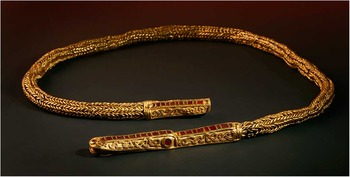
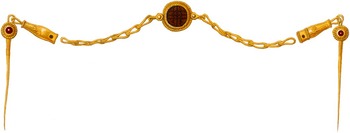
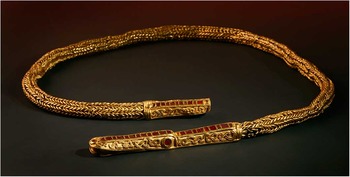
In the summer of 1922 a gold chain was found by a labourer while digging out tree stumps in the rural area south of Isenbüttel, in the Gifhorn district of Lower Saxony, Germany. At first its significance was not recognised and the finder gave the chain to his child. Several weeks later, a physician noted the object and arranged a meeting with a local museum director, but the object was then sold to a private collector. Happily, it ended up in the collection of the Lower Saxony State Museum in Hanover some forty years later. The object – a loop-in-loop chain made of gold with animal-head terminals with garnet inlays (fig 1) – is an exceptional discovery for which no parallels are yet known. Excavations at the findspot in the spring of 1928 revealed no further evidence, leading to the assumption that the Isenbüttel necklace was a single find.Footnote 1 Recently, the object was re-examined at the Römisch-Germanisches Zentralmuseum (RGZM) in Mainz, Germany, as part of the interdisciplinary International Framework (Weltweites Zellwerk) project, which looked at a large number of garnet-decorated objects from sites in Europe, dating mainly to the seventh century.Footnote 2
The gold and garnet chain from Isenbüttel: present condition. Photograph: U Bohnhorst; © Landesmuseum Hannover
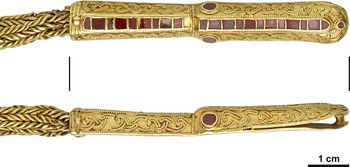
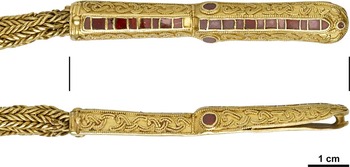
The 420mm-long chain is made of gold wire in a double, or probably threefold, loop-in-loop technique.Footnote 3 The preserved length, including the chain and the two terminals, is c 490mm. The intact terminal represents an animal head with a long neck and open mouth, while only the neck survives from the damaged counterpart. Both heads were constructed identically and are decorated with garnet inlays and filigree designs in Salin’s Animal Style II.Footnote 4 The lack of diagnostic features makes it difficult to identify whether the animal is a snake or a mythical creature. A strong gold rod is soldered into the open mouth; two small rings (now missing)Footnote 5 that were attached to it probably functioned as a fastener. The terminals are strikingly decorated with red garnet inlays in a cloisonné row on top of the head and neck and in round form to serve as eyes and on top of the nose (fig 2). Gold waffle foil is visible underneath the garnets, which were fitted into the cells as precisely as possible; closer examination shows that the edges are not cut and polished but are simply chipped. The garnet slabs appear brittle and have surface scratches; this is typical for garnet cloisonné of the seventh century and probably led to earlier misinterpretations of the material as glass.Footnote 6
Top and side view of the Isenbüttel chain’s well-preserved animal-head terminal. Photographs: S Steidl, Römisch-Germanisches Zentralmuseum, Mainz
In 2015, µ-XRF analyses at the Römisch-Germanisches ZentralmuseumFootnote 7 confirmed that the garnets are of a type known as Bohemian pyrope, which is often characterised by its very small size and dark colour, as can be seen on this object.Footnote 8 Indian almandine is more typically used for garnet cloisonné in Europe until the end of the sixth century,Footnote 9 being replaced by coloured glass or by Bohemian pyrope at the turn of the seventh century,Footnote 10 when the cloisonné style vanished from the Continent and was replaced by filigree designs and single set stones. This shift in raw material sources from India and Sri Lanka to Bohemia in the seventh century has now been confirmed in a multitude of studies,Footnote 11 and it supports a seventh-century dating for the Isenbüttel chain. One often cited explanation for this phenomenon is that trade routes were disrupted by the Sassanian conquest of the Arabian peninsula in the later sixth century,Footnote 12 or by Islamic expansion in the early seventh century.Footnote 13 The truth is probably more complex and connected to growing regionalisation of the economy in the western Mediterranean followed by a general decline in Mediterranean trade.Footnote 14 Remarkably, the cloisonné style continued to be employed in seventh-century Vendel-period Sweden and in Anglo-Saxon England, but the very limited number of chemical analyses carried out on garnet jewellery from these areas means that the raw material sources for these garnets remain largely unknown.Footnote 15
Comparative Material And The Development Of The Pin Suite
Before looking at the parallels for the find from Isenbüttel, it is necessary to take a closer look at the development of loop-in-loop chains, with a focus on double or threefold chains with animal-head terminals. In their simplest form (single loop-in-loop or figure-of-eight loop) these chains already appear in prehistoric contexts: one of the earliest examples comes from Asia Minor (Troy III; c 2250–c 2200 bc).Footnote 16 These chains first reached central Europe during the Hallstatt period (eighth to sixth centuries bc), probably in the form of Etruscan imports.Footnote 17 More massive (double or threefold) loop-in-loop chains with animal-head terminals seem to have become popular for the first time in classical Greece. They spread with the expansion of Greek colonies in the Mediterranean and the Black Sea region, as illustrated by examples from Chersonesos (Crimea), Santa Eufemia (Calabria) and Capua (Campania).Footnote 18 They were usually worn in the form of a pectoral-necklace together with an amulet or pendant. But there are also examples used to link pairs of brooches. One example, now in the British Museum, consists of a 540mm-long silver loop-in-loop chain with snake-head terminals from Elis (Peloponnese), dating to c 420–400bc. Footnote 19 Two unusually massive examples of loop-in-loop gold necklaces in ‘torc-style’ formed part of the Winchester Hoard (Owslebury, Hampshire) and are associated with two pairs of gold brooches, one pair being linked with a smaller loop-in-loop chain. They were most probably made in a Roman workshop during the first century bc.Footnote 20 Loop-in-loop chains stayed in vogue throughout antiquity, and animal heads – especially the heads of lions – were a popular terminal design.
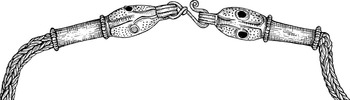
For late antiquity and the Migration Period, Joan Pinar et al showed that the associated workshops for a special group of these chains were located in the western Mediterranean, for example, in Rome, Ravenna or Carthage.Footnote 21 North of the Alps double or threefold loop-in-loop chains with animal-head terminals are more numerous in late Roman contexts. Examples dating from the fourth and fifth centuries have been found in hoards from Thetford (Norfolk)Footnote 22 and Hoxne (Suffolk)Footnote 23 (fig 3). Besides lion-head terminals, dolphin- and snake-heads have become well-established by this time, often with glass inlays as eyes. Roman loop-in-loop chains were usually worn as necklaces with hook and eye closure.
Late Roman gold necklace with snake- or dolphin-head terminals from Thetford, Norfolk. Drawing: © Trustees of the British Museum

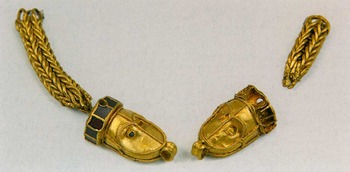
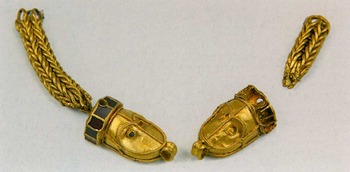
A golden loop-in-loop chain with animal-head terminals and garnet inlays was found in association with a Migration Period treasure from Cluj-Someşeni, Romania, next to the famous Apahida findspot (fig 4).Footnote 24 This assemblage dates to the fifth century and probably originates from a Byzantine workshop.Footnote 25 Technological features, as well as the garnet cloisonné in the form of a row, are reminiscent of the find from Isenbüttel, but its function was different as it originally held a large pendant. An analogy can be seen in a similar necklace from Olbia.Footnote 26 It can be assumed that loop-in-loop chains appearing in ‘barbarian’ graves, since at least late antiquity, were not only inspired by Roman models, but most probably originated from within the Roman Empire.Footnote 27
Fragmentary preserved loop-in-loop chain with animal-head terminals and garnet inlays from the Cluj-Someşeni Migration Period treasure. Photograph: after Harhoiu Reference Harhoiu2001, 162; reproduced courtesy of G Dumitriu, National Museum of Romanian History, Bucharest
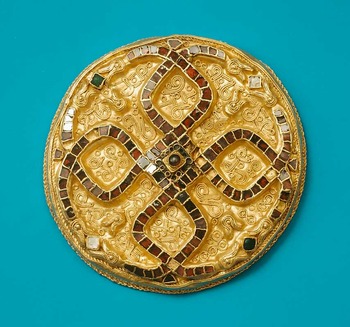
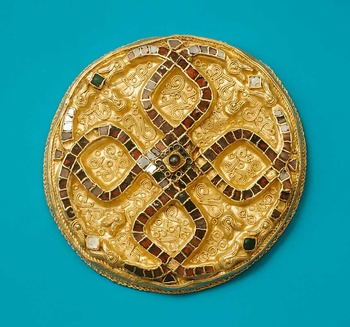
In the early medieval period, double or threefold loop-in-loop chains are mainly documented from the Byzantine Empire, predominantly in the form of gold necklaces with pectoral crosses or encolpia.Footnote 28 In central Europe they have mostly been found in richly furnished female burials, such as the one dating to the last quarter of the sixth century from below Cologne Cathedral, which apparently functioned as a chain linking a pair of brooches.Footnote 29 A fragment of a loop-in-loop gold chain with a pendant in the form of a hand was found in a rich female burial from Wittislingen (in the Dillingen district of Germany), dating to the middle of the seventh century.Footnote 30 The hand pendant was probably already an antique by that time, as the best comparisons are from the Roman period. A gold filigree disc brooch with garnet cloisonné was found in the same grave. The cloisonné cells are arranged in rows forming the snake-like bodies of eight animals, with heads turned to face one another (fig 5). Stylistically and technologically this disc brooch is an important clue to the dating of the find from Isenbüttel.
Gold filigree disc brooch from Wittislingen with garnet cloisonné decoration arranged in rows. Photograph: M Eberlein; © Archäologische Staatssammlung, Munich
In general, then, we can conclude that loop-in-loop gold chains only occur in very rich burials in the early medieval period, but that animal-head terminals seem no longer to have been popular, at least in Continental Europe.Footnote 31 The exception is the one group of chains with animal-head terminals that has not yet been considered: namely the Anglo-Saxon linked pin suite. This type of jewellery often appears in sets comprising simple copper-alloy pins linked by a single loop-in-loop chain, but more elaborate pieces are also found, made of precious-metal and garnet-decorated pins. Some of the latter have chains merging into animal-head terminals.
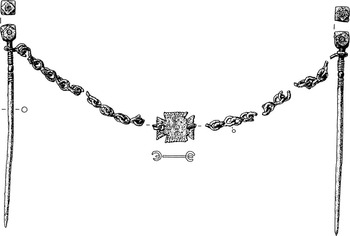
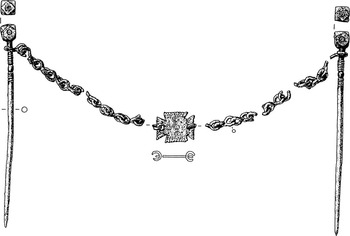
Linked pins probably originated in late antiquity, as demonstrated by finds from Olympia. In a stone slab grave within the area of the temple of Zeus, a pair of copper-alloy pins with polyhedral heads was linked with a simple chain. Comparative finds date this pin-type mainly to the third and fourth centuries ad.Footnote 32 But the same type, this time with a copper-alloy cross in the middle of the chain (fig 6), was found in another grave (no. 21) at that site, which was part of a Christian cemetery dating from the fifth century.Footnote 33 In the second quarter of the fifth century these linked pins with polyhedral heads are distributed mainly in the East Germanic area and seem to replace the traditional dress styles with brooches.Footnote 34 While these pins are usually made of copper-alloy, more elaborate finds are also known, such as a set of gold pins from Hippo Regius (modern Annaba, in Algeria) with loops for a chain.Footnote 35 Another golden set comes from Beiral, in Portugal, with a sumptuous linking chain made of gold and decorated with pin-shaped pendants. This object group probably had its origin in the western Mediterranean, just like the loop-in-loop chains with animal-head terminals already described.Footnote 36
Pins with polyhedral head and linking chain from Olympia, grave 21. Drawing: after Völling Reference Völling2001, 319, fig 4
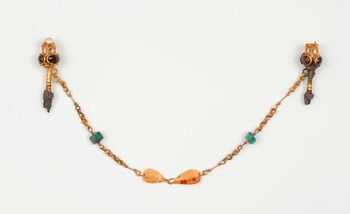
The Piazza della Consolazione treasure from Rome also dates to the first half of the fifth century. It consists of different pieces of jewellery, among them at least four gold necklaces with gemstones.Footnote 37 One is a double or threefold loop-in-loop chain with pearls, sapphires and emeralds;Footnote 38 another is a figure-of-eight loop chain with lion-head terminals.Footnote 39 An associated set of linked pins is made of gold and copper-alloy with inlaid pearls and garnet cabochons. The linking chain is decorated with emerald beads and has a hook latch for closure in the middle (fig 7).Footnote 40 Among the other items of jewellery from this assemblage are types that are depicted in the portraits of the Empress Theodora and her attendants in the Ravenna mosaics.Footnote 41 Not only does this illustrate that the massive loop-in-loop chains have a strong connection to the fashion of the Byzantine Empire, but also that the linked pin suite as a type of jewellery continues a tradition going back to antiquity. A variation is the set of linked pins with garnet cloisonné-heads from the treasure of Domagnano (San Marino) dating to the late fifth or early sixth century, which probably formed part of a head-dress.Footnote 42
Pin suite made of gold with garnet cabochons, pearls and emeralds from the Piazza della Consolazione treasure. The tips of the pins were made of a copper-alloy and are now corroded. Photograph: © Dumbarton Oaks, Byzantine Collection, Washington, DC

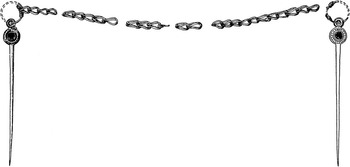
While it appears that the fashion of wearing linked pin suites was abandoned on the Continent during the early medieval period, it had become a popular part of female dress jewellery in Anglo-Saxon England by the seventh century. Here the comparatively short pins were probably used to fix a veil or a light shawl in the collar area.Footnote 43 Often just single pins with looped heads and fragmentary chains survive;Footnote 44 it can be assumed that these represent a former set of linked pins already broken before burial.Footnote 45 Complete sets are mostly connected with loop-in-loop chains and can be made of copper-alloy, but also of silver or gold.Footnote 46 More elaborate sets are made of precious metal with garnet decoration on the pin head, as in the finds from Cow LoweFootnote 47 and Wigber LowFootnote 48 (both Derbyshire), from graves 39 and 55 at Chamberlains Barn (Leighton Buzzard, Bedfordshire) (fig 8),Footnote 49 from grave 138 at Butler’s Field (Lechlade, Gloucestershire)Footnote 50 and on a new find from the Trumpington bed burial (Cambridgeshire).Footnote 51 A site in Appleby (North Lincolnshire) produced two silver-gilded stray finds, obviously belonging together, forming a set of disc-headed pins with attachment loops and red glass cabochons.Footnote 52 A special form of triple-linked pin suite made of gold with garnet inlays is known from Little Hampton (Worcestershire).Footnote 53 If pin suites are found in situ on the body, they are normally in the area between neck and chest, like the set from grave 39 at Chamberlains Barn, where a pin suite made of silver with garnet inlays was found in the upper chest area, underneath the chin: the pins pierced two layers of a fine textile and were covered by a third, rougher, piece of cloth.Footnote 54
Silver pin suite from grave 39, Chamberlains Barn, Leighton Buzzard, Bedfordshire, with flat garnets set on each side of the pin heads. Drawing: after Hyslop Reference Hyslop1963, 182, fig 13

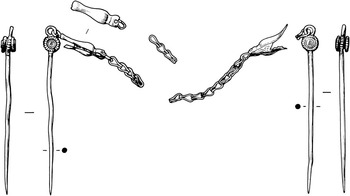
A gold set from Roundway Down, a barrow burial in Wiltshire,Footnote 55 not only has garnet inlays on the pin heads, but is also linked with a single figure-of-eight loop-in-loop chain with animal-head terminals (fig 9). The animal heads, probably depicting boars, are of cylindrical form, connected with the chain via loops. In the middle of the chain a round glass pendant with a cross-motif is set in a gold collar. The glass possibly originates from Ireland.Footnote 56 This kind of chain and the central cross pendant stand in a Mediterranean late antique tradition and are reminiscent of the above-mentioned contexts from Olympia. The rich female burial from Roundway Down was inserted into a Bronze Age barrow and was probably also a bed burial on the evidence of the associated finds of wood and iron.Footnote 57 Besides the linked pins, a necklace with biconical gold beads and garnet- and glass-cabochon pendants was found, dating the burial to the second half of the seventh century.
Gold pin suite with garnet-decorated pin heads and linking chain with animal-head terminals from a barrow burial at Roundway Down. Drawing: after Akerman Reference Akerman1885, pl 1.1

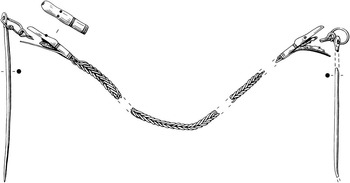
In the Anglo-Saxon cemetery at Butler’s Field in Lechlade (Gloucestershire) a silver parallel to the Roundway Down pin suite was found in grave 14, the richly furnished burial of a female teenager interred at the end of the seventh century.Footnote 58 The silver pin suite, which lay in the chest area, also has garnet-decorated pin heads and a figure-of-eight loop chain with animal-head terminals (fig 10). While pins and chain are closely paralleled at Roundway Down, the animal-head terminals are designed less vividly and seem to be constructed simply of two bent silver sheets. They are also linked via loops. A small cylindrical container was associated with the burial; often associated with linked pins,Footnote 59 in many cases such containers include fragments of textile and thread and are thus described as sewing boxes in some reports, but they are frequently decorated with a cross-motif and are more likely to be reliquary containers (see ‘Interpretation’, below).Footnote 60
Silver pin suite with animal-head terminals from the Butler’s Field cemetery, Lechlade, Glos. The pin heads are also decorated with garnet inlays. Drawing: after Boyle et al Reference Boyle, Jennings, Miles and Palmer1998, fig 5.39; © Oxford Archaeology

A broken silver pin suite (fig 11) was found within one of these containers in grave 18 of the Harford Farm cemetery (Caistor St Edmund, Norfolk) along with fragments of textile and two dress hooks.Footnote 61 Why the broken pin suite was put into the container is unclear,Footnote 62 but it is conceivable that it was an heirloom or a relic associated with a revered individual. This richly furnished grave also contained a gold filigree pendant with cruciform garnet inlays, placed within a wooden box.Footnote 63 This is typical for the second half of the seventh century, where most of the grave goods were placed within boxes or bags rather than being placed on the body in the position in which they would have been worn.Footnote 64 The burial is also associated with two coins dated to the end of the seventh century.Footnote 65 This pin suite is probably the best parallel to the Isenbüttel find. The simple silver pins with looped heads were connected via wire rings to loops that extended from the open mouths of the animal heads of the chain. The animal heads were made of two pieces of bent silver sheet, like those from Butler’s Field, but of a more vivid design: the upper part forms the top of the head, with eyes, nose and upper jaw, while the lower part forms the lower jaw and neck. The animal heads from the Isenbüttel chain were constructed in a comparable way. The animals on the Harford Farm chain have small inlaid eyes of blue glass; a semicircular notch on the tip of the nose might be stylistic or it might relate to the attachment of the loops. The remaining animal head on the chain from Isenbüttel has a small round garnet inlaid in the same position. Directly underneath is the strong gold rod to which the two above-mentioned small rings were attached. Based on the comparisons mentioned so far, it can be assumed that these rings were the linking parts between the chain and two pins or (in a Continental context) two brooches. The fragmentary silver loop-in-loop chain from Harford Farm seems to have been made in a technologically comparable way to the chain from Isenbüttel. It is only the size that differentiates the Isenbüttel example and Anglo-Saxon linking chains: while the latter are quite delicate and, at about 200mm, rather short,Footnote 66 the Isenbüttel chain is distinguished by its total length of c 500mm.
This silver pin suite from the Harford Farm cemetery, Norfolk, is probably the best parallel to the find from Isenbüttel. It was already broken when it was buried inside a relic box in a rich grave between c ad 690 and 710. Drawing: after Penn Reference Penn2000, fig 88

Derivation Of The Motif And Socio-Historical Context
In Anglo-Saxon England linked pin suites are usually found in burials that do not contain brooches, thus apparently representing a fashion in which the garment was closed in another way. It is possible to imagine a combination of tunic-style dress and veil, as was fashionable among the aristocratic women of the Byzantine Empire. These influences might have come to England via the Frankish Empire, where women adopted Byzantine imperial dress styles from the early sixth century.Footnote 67 In the late sixth and early seventh centuries, southern England was influenced by Merovingian Francia through trade and personal mobility, religion, law and marriage.Footnote 68 Even so, linked pin suites seem to be an English idiosyncrasy, dating from the middle of the seventh century to the end of the practice of furnished burial.Footnote 69 The find from Isenbüttel seems to represent the one Continental exception.
Seventh-century linked pin suites have both Germanic and classical features. During the Anglo-Saxon Conversion period they belong to a series of objects with a strong reference to antiquity, which may represent a new kind of romanitas or, under the influence of the Church and the Merovingian Empire, the assimilation of a Romano-Byzantine fashion.Footnote 70 Although the double-headed snake-motif has its origin in antiquity, it becomes especially popular north of the Alps in the sixth and seventh centuries, periods that are otherwise comparatively poor in figurative art.Footnote 71 From the seventh century onwards even a connection to the ‘weapon dancer’ motif is possible.Footnote 72
This combination of classical and Germanic motifs can be seen on several other objects from the North Sea area at that time; for example, in the two silver arm-rings with animal-head terminals excavated in Cathedral Square, Utrecht.Footnote 73 One of the arm-rings has cylindrical animal heads ending in a boar-like snout, similar to the pin suite from Roundway Down (see above). Zigzag notches between the eyes and snout are reminiscent of the cloisonné row on the Isenbüttel animal heads.Footnote 74 The other Utrecht arm-ring is gilded and has terminals in the form of oval snake-heads. A small garnet was preserved in one of the eye sockets. The heads correspond to those from the late antique hoards from Thetford and Hoxne. Both arm-rings date to the late seventh century and illustrate how antique forms and features were quoted and interpreted at this time. Gold arm-rings with animal-head terminals and garnet inlays are also known from Migration Period burials from Untersiebenbrunn (Austria) where they represent a synthesis of Germanic arm-rings with truncated terminals (Kolbenarmringe) and late antique influences.Footnote 75
Interpretation
If the chain from Isenbüttel had been found in a burial context, the grave would surely have belonged to a member of the social elite in Eastphalia.Footnote 76 As a single find, the circumstances of its deposition will probably never be clarified. In general, there are rather few objects in the Continental Saxon area that are decorated with Animal Style II motifs,Footnote 77 especially by contrast with the Anglo-Saxon, Scandinavian or Frisian regions. There is also little evidence for high-status burials in the Saxon area,Footnote 78 such evidence as there is being found within the Frankish Empire contact zones.Footnote 79
During the sixth and seventh centuries, burial rites show great diversity in the Eastphalia area, even from one cemetery to another, with differently orientated inhumations and cremation burials being practised in some cases even in the seventh century. Christoph Grünewald interprets this as evidence for the lack of regulation of burial rite and a sign of changing authority in the region,Footnote 80 while Gabriele Wand sees the mobility of the population and their openness to the influence of neighbouring peoples as the determining factor.Footnote 81
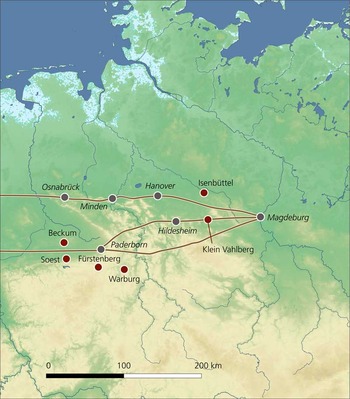
Furnished burials are known from almost all the region’s cemeteries, and these show strong Frankish (and later northern) influences in the choice of grave goods, but richly furnished burials are rare. This lack of richly furnished burials cannot be attributed to the lack of an elite, as the large number of hoards and stray finds from the Continental Saxon area, including the gold chain from Isenbüttel, are evidence for the continuing presence of wealthy individuals.Footnote 82 Some elite burials appear around the turn of the seventh century, often with western-influenced grave goods, such as the warrior burials from Beckum, Fürstenberg and Warburg-Ossendorf, or the rich female burial from Soest. Another example of early medieval elite burial in Eastphalia is Klein-Vahlberg, located just 35km south east of Isenbüttel, in the Wolfenbüttel district. Here, a partly robbed but richly furnished female grave, dating from the beginning of the seventh century, was found in a barrow.Footnote 83 With the advance of the century the short phase of elite burials ends in this region, while furnished burial as a whole ends here by the late seventh century.Footnote 84
It is notable that all these places were located within the catchment area of the Hellweg, a major early medieval road network connecting important trading places between the Rhine and the Elbe rivers (fig 12). It can be assumed that local elites settled in this vicinity to benefit from this trading network.Footnote 85 Although it cannot be said for sure if it was the people who travelled or the objects, the western (and later northern) character of the grave goods is probably a result of the nearby Hellweg trading network and a sign of the same mobility of the people living in the area that is reflected in the diversity of burial customs.Footnote 86
Places mentioned in the text (red) and other places along the Hellweg

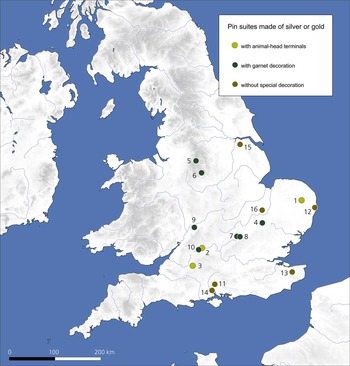
Even though its function as a simple necklace cannot be excluded for the Isenbüttel chain, the best parallels are found in Anglo-Saxon linked pin suites. Linked pins decorated with garnets or with a linking chain with animal-head terminals are only found in England in exceptionally rich female burials dating to the seventh century. Helen Geake’s sample of thirteen graves with linked pins (including copper-alloy examples) showed a concentration in the Upper Thames region and East Anglia.Footnote 87 No clear pattern is apparent for the distribution of pin suites with garnet decoration due to the small number of objects. The same is true of animal-headed terminal pin suites. But looking at all precious-metal pin suites, including both garnet-decorated types and examples with animal-head terminals, a general pattern emerges showing a concentration in the southern half of England (fig 13). The sample of fourteen graves from eleven sites with linked pins (including copper-alloy examples) from the recent study of some 600 Anglo-Saxon graves carried out by a team around John Hines and Alex Bayliss revealed a corresponding pattern,Footnote 88 which is also reminiscent of the distribution of some other types of imported materials known from Anglo-Saxon cemeteries in the later sixth and seventh centuries, especially amber, crystal and amethyst beads, ivory rings and gold coinage.Footnote 89
Distribution map of Anglo-Saxon pin suites made of gold or silver. 1: Harford Farm; 2: grave 14, Butler’s Field; 3: Roundway Down; 4: Trumpington; 5: Cow Lowe; 6: Wigber Low; 7: grave 39, Chamberlains Barn; 8: grave 55, Chamberlains Barn; 9: Little Hampton; 10: grave 138, Butler’s Field; 11: Winnall; 12: Bloodmoor Hill; 13: Chartham Downs; 14: Southampton; 15: Appleby; 16: Westfield Farm

The women that were buried with elaborate pin suites obviously belonged to a social elite. This can be assumed on the one hand from the burial in richly furnished graves in a time that is otherwise poor in grave goods, and on the other from the types of burial: these include barrow burials (Roundway Down, Chartham Down) and bed burials (Trumpington, Roundway Down), or burials that show close parallels to these types. The numerous occurrences of objects with cross-motifs in these burials can surely be interpreted as Christian imagery during the Anglo-Saxon Conversion period. In the Trumpington bed burial, for example, a golden garnet cloisonné pectoral cross was found next to the pin suite.Footnote 90 This change in spiritual, as well as material, life styles came, most probably, from the Continent, more specifically from Frankish Gaul, where the daughters of Anglo-Saxon aristocratic families were sent to monasteries, as is mentioned in historical sources.Footnote 91 The rich female burials that appear in Anglo-Saxon England from the 630s onwards also have to be considered in the context of a significant change in the role of females in the Church. This change ultimately led to the rise of a number of abbesses during the last four decades of the seventh century, including St Hilda of Whitby and St Æthelthryth of Ely.Footnote 92
In summary it can be said of women wearing linked pin suites that they belonged to the aristocracy, were buried in a Christian context and were probably wearing a special kind of ‘veil-fashion’. Besides being simply a fashionable accessory following Romano-Byzantine ideals, pin suites could also represent an early form of monastic habit. Since antiquity, the veil has been a symbol of married and aristocratic women and later also of Christian nuns (as brides of Christ).Footnote 93 St Aldhelm, in condemning the luxurious costumes of aristocratic members of the monastic community, mentions long and colourful veils reaching down to the feet of women.Footnote 94 A very small, recently excavated cemetery at Westfield Farm, Ely (Cambridgeshire), dating to the late seventh century, could have been associated with the first monastery in Ely, founded by Æthelthryth in 673. It is interesting that the central, richly furnished grave is that of a girl and contained a silver pin suite besides other jewellery.Footnote 95
If pin suites represented bridal gifts, we would expect much higher numbers to have been found. A potential religious connotation is indicated by the finds from grave 1 at Westfield Farm and grave 18 at Harford Farm.Footnote 96 While the former can be linked to an early monastery, the latter burial contained a pin suite that was found in a so-called relic box together with textile fragments. Bearing in mind that these small containers are a phenomenon of the Conversion period, the pieces of cloth included in the container could represent relics (possibly not first- or second-class relics, connected directly with Christ or a saint as something they had worn or touched, but more possibly third-class relics that had touched a first-class relic). Relic boxes have parallels in Continental Europe where such containers have also been popular, often in the form of so-called bullae, spherical amulet capsules. Besides pieces of cloth, they sometimes include herbs and aromatics. One of the largest examples comes from a female burial from Cologne Cathedral, which also included a long loop-in-loop chain connecting two brooches.Footnote 97
Whether the chain from Isenbüttel falls into the same category as the Anglo-Saxon pin suites is difficult to decide because of the lack of a context for the find. Chronologically, it probably stands at the beginning of the evolution from the long and massive sixth-century Cologne Cathedral-style loop-in-loop chain functioning as a ‘brooch chain’ to the delicate and smaller pin suites of the second half of the seventh century. Stylistic parallels for the garnet cloisonné, as seen on the brooch from Wittislingen, point to a possible date around the middle or the beginning of the second half of the seventh century for the chain from Isenbüttel, which probably represents the only Continental addition to the small corpus of early medieval pin suites with animal-head terminals. It stands out as a unique find in the Eastphalian area, where the general absence of rich grave finds makes the local elite an elusive one from an archaeological point of view. At this point it is impossible to say why the leading wealthy families did not invest in furnished burials in this region, but the strong links between Anglo-Saxon pin suites and the Isenbüttel find – all of them examples of high-quality goldsmith’s work – are an evocative, if enigmatic, testament to close contacts between the Anglo-Saxon and the Eastphalian elites of the seventh century.
Acknowledgements
I am grateful to the Lower Saxony State Museum (the Niedersächsisches Landesmuseum) in Hanover (in particular Babette Ludowici of the Department of Archaeology) for allowing the chain from Isenbüttel to be studied in the labs of the Römisch-Germanisches Zentralmuseum (RGZM). The study has been made possible by generous funding from the German Federal Ministry of Education and Research (BMBF). All analyses have been carried out in the labs of the RGZM. The maps were created by Michael Ober. I am thankful to Sonngard Hartmann and Michael Rychlicki for XRF analyses and Christiane Stempel for technological analyses. I would also like to thank Dieter Quast for our interesting discussions and for encouraging me to write this article, as well as Martin Schönfelder and Holger Baitinger for supplying literature on prehistoric finds and the finds from Olympia (all RGZM). Thanks are also due to Jörn Schuster (AsF) for draft proofreading and to the three anonymous referees of the Antiquaries Journal and the journal’s editors, Kate Owen and Christopher Catling, for their constructive comments on the paper.