BACKGROUND
Religion and spirituality are important for many people who are coping with cancer or other life-threatening diseases. However, healthcare providers and medical institutions often do not do a good job of attending to this dimension of a patient's care (Handzo, Reference Handzo2011). More than 70% of cancer patients (Balboni et al., Reference Balboni, Vanderwerker and Block2007) and patients with end-stage heart failure and their caregivers (Ross & Austin, Reference Ross and Austin2015) have expressed that their spiritual needs were minimally attended to or not supported at all by the medical system (Balboni et al., Reference Balboni, Vanderwerker and Block2007). More importantly, attention to religious/spiritual issues has been found to have a significant influence on important indicators of quality care. Several studies have documented the positive relationship between meeting a patient's spiritual needs and patient satisfaction (Williams et al., Reference Williams, Meltzer and Arora2011; Astrow et al., Reference Astrow, Wexler and Texeira2007). Other findings suggest that attention to spiritual needs improves quality of life (Astrow et al., Reference Astrow, Wexler and Texeira2007) and reduces the use of aggressive care at the end of life (Balboni et al., Reference Balboni, Paulk and Balboni2010).
The words that patients use to communicate their end-of-life needs reveal how important it is to assess the dynamics of patient–clinician communication (Lunder et al., Reference Lunder, Furlan and Simonic2011; Arnold Reference Arnold2011). At the same time, clinicians caring for patients with a life-threatening illness must recognize that these individuals are experiencing spiritual distress and that they need spiritual care, even though they are among the least likely to ask for it (Fitchett & Risk, Reference Fitchett and Risk2009). Many individuals recognize their life-threatening illness as an opportunity for spiritual growth, and they will be looking for the spiritual resources necessary to help them adjust to adverse circumstances (Lunder et al., Reference Lunder, Furlan and Simonic2011; Nadarajah et al., Reference Nadarajah, Berger and Thomas2013).
The presence of spiritual pain can be an important component of a patient's distress during a life-threatening illness accompanied by chronic or acute pain and other physical and psychological symptoms (Delgado-Guay et al., Reference Delgado-Guay, Hui and Parsons2011). The patient's pain is also a significant source of suffering for caregivers (Delgado-Guay et al., Reference Delgado-Guay, Parsons and Hui2013).
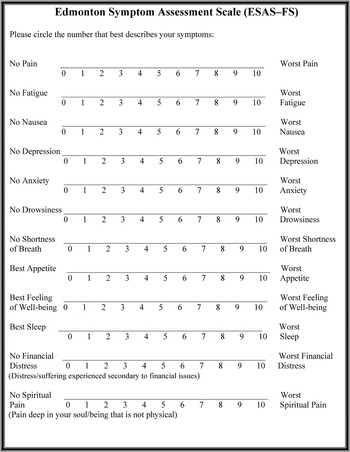
The literature about regular assessments of spiritual distress/spiritual pain in a supportive/palliative care outpatient setting is limited, if not totally unavailable. The purposes of our study were to: (1) determine the frequency and intensity of spiritual pain among patients with advanced cancer in a supportive/palliative care outpatient center (SCPC), and (2) determine the association between spiritual pain and other physical (pain, fatigue, nausea, drowsiness, dyspnea, sleep, appetite) and emotional (anxiety, depression, well-being) symptoms, and financial distress among patients with advanced cancer using a modified Edmonton Symptom Assessment Scale (ESAS–FS). We defined “spiritual pain” as it has been described in the literature: a pain deep in your soul/being that is not physical (Delgado-Guay et al., Reference Delgado-Guay, Hui and Parsons2011; Reference Delgado-Guay, Parsons and Hui2013; Mako et al., Reference Mako, Galek and Poppito2006) (Figure 1).
The Edmonton Symptom Assessment Scale–FS (ESAS–FS).

METHOD
The institutional review board at The University of Texas MD Anderson Cancer Center approved our study and waived the requirement for informed consent. During the study period (October of 2012 through January of 2013), we reviewed 292 consecutive consults of advanced cancer patients (ACPs) and their first follow-up evaluation at our SCPC. At our institution, SCPC patients are managed by an interdisciplinary palliative care team comprising palliative care specialists, fellows, midlevel practitioners, palliative care nurses, social workers, chaplains, psychologists, and pharmacists (Yennurajalingam et al., Reference Yennurajalingam, Urbauer and Casper2011). The palliative care team conducts a comprehensive evaluation at the beginning of the consult and during the follow-up period. Patient symptoms are evaluated with the Edmonton Symptom Assessment Scale (ESAS).
The ESAS (Bruera et al., Reference Bruera, Kuehn and Miller1991; Watanabe et al., Reference Watanabe, Nekolaichuk and Beaumont2012; Rees et al., Reference Rees, Hardy and Ling1998; Porzio et al., Reference Porzio, Ricevuto and Aielli2005; Stromgren et al., Reference Stromgren, Groenvold and Peterson2004) assesses 10 common symptoms (pain, fatigue, nausea, depression, anxiety, drowsiness, shortness of breath, loss of appetite, sleep problems, and lack of a feeling of well-being) experienced by patients with cancer or a chronic illness over the previous 24 hours. In this scale, the patient rates symptom intensity on a 0-to-10 numerical scale, with 0 representing “no symptom” and 10 the “worst possible symptom.” The ESAS was developed in 1991 to evaluate the intensity of the most frequent physical and psychological symptoms in cancer patients receiving palliative care and was rapidly adopted by cancer and supportive and palliative care programs (Bruera et al., Reference Bruera, Kuehn and Miller1991; Stromgren et al., Reference Stromgren, Groenvold and Peterson2004). The scale is also widely employed in supportive and palliative care research. Its ease of use and visual representation make it an effective and practical bedside tool (Bruera et al., Reference Bruera, Kuehn and Miller1991; Stromgren et al., Reference Stromgren, Groenvold and Peterson2004; Philip et al., Reference Philip, Smith and Craft1998). It allows the healthcare provider to track symptoms over time with regard to intensity, duration, and responsiveness to therapy. In October of 2012, our group modified the ESAS by adding two important items to cover financial distress and spiritual pain, yielding the ESAS–FS. The concept and correlates of financial distress are discussed in another manuscript.
We reviewed charts for information about demographics—including age, gender, ethnicity, primary cancer, stage of cancer (localized, advanced, or metastatic)—and treatment. Symptom profiles obtained from the day of the initial consultation and the first follow-up at our supportive care center were collected using the ESAS–FS.
All patients were asked to self-rate their intensity of spiritual pain on a 0-to-10 scale (0 = none to 10 = worst possible) according to the definition of spiritual pain given by Mako et al. (Reference Mako, Galek and Poppito2006) as “a pain deep in your soul (being) that is not physical.”
We determined the frequency, intensity, and correlates of self-reported spiritual pain (≥1/10) among these advanced cancer patients. We then defined the presence of spiritual pain as mild in intensity if the ESAS–SP score was ≥1/10 and as moderate to severe in intensity if it was ≥4/10.
Statistical Analysis
Descriptive statistics were generated for demographic variables and both baseline and follow-up clinical measures. The statistics for continuous variables included sample size, mean with a 95% confidence interval, median with an interquartile range, minimum values, and maximum values. The statistics for discrete variables included frequency and proportion of the total.
Spiritual pain was defined as any ESAS–Spiritual Pain (ESAS–SP) score greater than 0. The dual primary hypotheses of “decrease in frequency of SP” and “decrease in intensity of SP” were tested using a type I error rate of 0.025 (2.5%) each. All other tests were held to a standard of α ≤ 0.001 based on the Bonferroni method in order to account for the large number of secondary statistical tests. Spiritual pain at baseline and follow-up were compared with a two-sided McNemar test. The change in intensity of the ESAS variables from baseline to follow-up was tested using sign tests (the nonparametric equivalent of paired t tests). Spearman correlations of continuous ESAS spiritual pain with other measures were calculated at baseline and at follow-up. Baseline ESAS variables were tested for any association with change in intensity of spiritual pain using Spearman correlations, in which a change in SP is defined as the difference between baseline and follow-up SP scores. Baseline ESAS variables were tested for differences between the spiritual pain and non-spiritual pain groups using the Wilcoxon rank-sum test. Baseline ESAS variables were tested for an association with baseline SP using multivariable logistic regression, in which SP is defined as any ESAS spiritual pain score greater than zero.
RESULTS
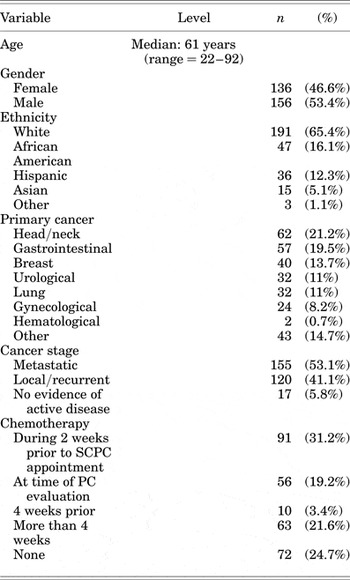
Table 1 summarizes patients' clinical characteristics. The median age was 61 years (range = 22–92). Some 53% were male, 189 (65%) were white, 45 (15%) African American, and 34 (12%) Hispanic; 282 of 292 patients (97%) had non-missing baseline ESAS–SP scores; 165/292 patients (57%) had non-missing follow-up ESAS–SP scores; 162/292 (55%) had both non-missing baseline and follow-up ESAS–SP scores.
Characteristics of advanced cancer patients evaluated in our outpatient supportive/palliative care clinic (SCPC) (N = 292)

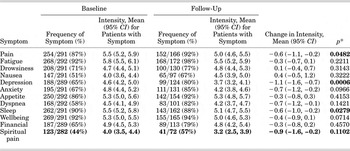
Table 2 presents the frequency and intensity of multiple physical and emotional symptoms in the study population. Some 123 of the 282 patients (44%) with advanced cancer had at least mild spiritual pain (≥1/10) (mean [95% confidence interval (CI) = 4(3.5–4.4)] and 60 of 282 (21%) had moderate to severe spiritual pain (≥4/10).
Change in frequency and intensity of symptoms from baseline to follow-up for those patients who have the symptom (ESAS score ≥1) at baseline

ESAS–FS = Edmonton Symptom Assessment Scale–Financial Distress/Spiritual Pain; 95% CI = 95% confidence interval.
*Sign test for change in intensity different from zero is based on patients with non-missing data at both baseline and follow-up and for whom the symptom was present at baseline.
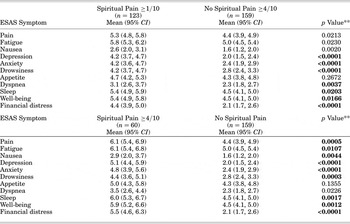
As shown in Table 3, compared to ACPs without SP, spiritual pain in ACPs was associated with worse multiple physical and emotional symptoms: pain [mean 95% CI = 5.3(4.8, 5.8) vs. 4.5(4.0, 5.0), p = 0.02]; depression [4.2(3.7, 4.7) vs. 2.1(1.7, 2.6), p < 0.0001]; anxiety [4.2(3.6, 4.7) vs. 2.5(2.0, 3.0), p < 0.0001]; drowsiness [4.2(3.7, 4.7) vs. 2.8(2.3, 3.2), p < 0.0001]; dyspnea [3.1(2.6, 3.7) vs. 2.3(1.8, 2.7), p = 0.0037]; well-being [5.4(4.9, 5.8) vs. 4.5(4.1, 4.9), p = 0.0136]; and financial distress [4.4(3.9, 5.0) vs. 2.2(1.8, 2.7), p < 0.0001] . The intensity of distressing symptoms was even more severe when patients with advanced cancer had moderate to severe spiritual pain.
Multiple distressing symptoms among advanced cancer patients with mild (≥1/10) to moderate/severe (≥4/10) spiritual pain: Use of the ESAS–FS* in a supportive/palliative care outpatient clinic setting

*ESAS–FS = Edmonton Symptom Assessment Scale–Financial Distress and Spiritual Pain.
**Wilcoxon rank-sum test
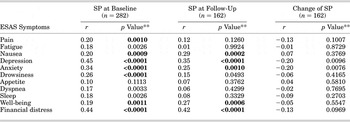
Spiritual pain correlated (Spearman's) with depression (r = 0.45, p < 0.0001), anxiety (r = 0.34, p < 0.0001), drowsiness (r = 0.26, p < 0.0001), and financial distress (r = 0.44, p < 0.0001) (Table 4).
Correlations between ESAS–FS* symptom distress and spiritual pain (SP) at baseline, at follow-up, and the impact of baseline symptom distress on change in spiritual pain

*ESAS–FS = Edmonton Symptom Assessment Scale–Financial Distress and Spiritual Pain.
**Spearman correlation test.
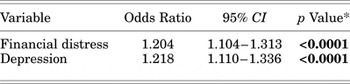
Multivariate analysis demonstrated an association with financial distress [OR (95% Wald CI) = 1.204(1.104–1.313), p < 0.0001] and depression [1.218(1.110–1.336), p < 0.0001] (Table 5).
Logistic regression multivariable model showing association of significant baseline symptoms with baseline spiritual pain

*Chi-square test.
The odds that patients with spiritual pain at baseline would also report SP at follow-up were 182% higher (OR = 2.82) than patients who were SP-negative at baseline (p = 0.0029). Spiritual pain at follow-up correlated with depression (r = 0.35, p < 0.0001), anxiety (r = 0.25, p = 0.001), well-being (r = 0.27, p = 0.0006), nausea (r = 0.29, p = 0.0002), and financial distress (r = 0.42, p < 0.0001).
DISCUSSION
Our study highlights the high prevalence of spiritual pain among advanced cancer patients referred to a supportive/palliative care clinic. Screening for spiritual distress, identifying spiritual needs, and facilitating appropriate spiritual care at several timepoints throughout the continuum of care is essential. Using the ESAS–FS allows clinicians to begin exploring patients' spiritual issues and spiritual needs. Some 97% of patients in our study were able to complete the self-reported item. This suggests that the self-reported item, as described by Delgado-Guay and colleagues (Reference Delgado-Guay, Hui and Parsons2011), is easy to understand and well accepted by patients with advanced cancer. More research is needed in patients with different illnesses and cultural backgrounds. This finding opens a door of communication that allows us to better connect with patients and caregivers. At the same time, it helps us explore how spiritual distress correlates with other physical and emotional symptoms. The process of providing good spiritual care is built around the premise that spiritual care, like all other domains of care, should focus on quickly identifying and attending to distress in this domain. The use of the ESAS–FS can be helpful for this purpose. The interdisciplinary palliative care model of spiritual care proposes inclusion of the spiritual domain in the overall screening and history-taking process, as well as conducting a full spiritual assessment by the professional chaplain as needed. As a first step, the ESAS–FS might provide the venue for identifying spiritual issues and opening the door for complete spiritual care. It is also important to emphasize that the provision of spiritual care is shared by all members of the team in the same way that documentation of spiritual need is shared (Alcorn et al., Reference Alcorn, Balboni and Prigerson2010; Delgado-Guay, Reference Delgado-Guay2014).
Spiritual pain was explained to patients as “a pain deep in your soul (being) that is not physical,” as suggested by Mako et al. (Reference Mako, Galek and Poppito2006). They found a much higher incidence of spiritual pain (96%) in a sample of 57 advanced cancer patients interviewed by a chaplain when admitted to a hospital. The mean observed intensity of spiritual pain (4.7) in their study was slightly higher than ours. This difference could be partially attributed to differences in spiritual pain assessment (chaplain vs. self-assessment) as well as in the setting of the two studies (inpatient vs. outpatient). Further research is required to better define the frequency of spiritual pain in different patient populations and varied settings.
The prevalence of spiritual pain among our study population was similar to that of other studies in similar settings (Delgado-Guay et al., Reference Delgado-Guay, Hui and Parsons2011), where patients with spiritual pain showed significantly lower self-perceived religiosity and spiritual quality of life. Alcorn et al. (Reference Alcorn, Balboni and Prigerson2010) reported that 85% of advanced cancer patients receiving palliative radiation therapy identified one or more spiritual issues. The most common spiritual issues reported were “seeking a closer connection with God or one's faith” (54%); “seeking forgiveness (of oneself or others)” (47%); and “feeling abandoned by God” (28%). Interestingly, among the 22% of patients who said that religion/spirituality was “not important” to their cancer experience, two thirds had at least one spiritual issue, and 40% reported four or more spiritual issues. This raises the importance of screening for spiritual issues even if patients do not consider themselves as religious or spiritual individuals. A needs assessment can identify the specific services and assistance the patient most desires and is a first step in designing needs-tailored interventions (Lunder et al., Reference Lunder, Furlan and Simonic2011).
Our findings showed a significantly higher severity in 10 of the ESAS–FS symptoms in the SP group, suggesting that spiritual pain might increase the expression of physical and psychosocial symptoms. More research is needed to better characterize the association among spiritual pain, other physical and psychosocial symptoms, and even for financial distress. It is extremely important to provide a comprehensive culture- and spirituality-sensitive interdisciplinary team approach to these patients with multiple physical, emotional, and spiritual distress.
The presence of spiritual pain in the follow-up visit raises an important issue in clinical practice as we treat patients with advanced and terminal illnesses. The prevalence of spiritual pain at follow-up remains high and indicates a need to continue spiritual care throughout the continuum of care and that continuing the involvement of the chaplain is warranted.
Our study has several limitations. Its retrospective design makes it impossible to establish causality between the presence of spiritual pain and other physical and emotional symptoms (anxiety and depression) or even financial distress. There is a growing literature on the spiritual dimension of depression (Koenig, Reference Koenig2005; Peteet, Reference Peteet2012) and on the value of spirituality and religiosity in the management of depression (Koenig et al., Reference Koenig, King and Carson2012; Miller et al., Reference Miller, Wickramaratne and Gameroff2012; Moritz et al., Reference Moritz, Kelly and Xu2011). There may be an association between spiritual pain and depression, though it is still difficult to identify the causality of each entity and how each influences the other. Further research needs to continue to address this important issue. We were unable to determine the source of spiritual pain among these patients and describe interventions related to these findings.
Our study also highlights the importance of using the ESAS–FS as a first-line tool to open the door to a complete spiritual screening/assessment. Although the ESAS has been validated in other studies, the spiritual pain and financial distress components have not been validated as of yet. Further research will contribute to validation of this tool for the element of spiritual distress. Although our study provides some insight into the important construct of spiritual pain, it is important to mention that spiritual pain has not been totally defined well because of the paucity of literature on the subject. This may have influenced how our patients interpreted it.
In the supportive and palliative care setting, we need to be aware of the very strong spiritual and religious needs of patients with a life-threatening illness and their caregivers. We can act as channels of communication between the clinical setting and religious/spiritual leaders or traditional healers to facilitate healing environments in patients and caregivers who are experiencing spiritual distress.
DISCLOSURES
The authors state that they have no conflicts of interest to declare.
ACKNOWLEDGMENTS
We thank the Department of Scientific Publications at The University of Texas MD Anderson Cancer Center for editorial assistance. Dr. Bruera is supported in part by National Institutes of Health grants RO1NR010162-01A1, RO1CA122292-01, and RO1CA124481-01.