Introduction
Cases of severe domestic squalor in various countries have achieved notoriety through television and newspaper reports. The pictures provoke questions. “How can anyone live like that?” “How can a caring community allow such a situation to develop?” Cooney and Hamid (Reference Cooney and Hamid1995) exemplified these cases when they referred to a person living in a dilapidated, filthy house that was cluttered with rubbish and infested with vermin. Excrement and decomposing food were strewn around the floors and the stench was unbearable to visitors.
There is good reason to express concerns about the health, safety and quality of existence of those living in squalor and of those who live nearby. It is understandable that a community's awareness that a person is dwelling in disgusting and unsafe conditions in their midst should lead to demands for something to be done. Attitudes towards such people range from sympathy to condemnation, from worries about the person's welfare to outrage about unsightliness and odors and effects on property values, and from desires to protect a vulnerable individual to concerns mainly focused on risks to the community.
Relatively little has been written concerning how best to intervene in cases of severe domestic uncleanliness. Reports of individuals who neglect aspects of self-care but do not live in squalor, and of those whose problem is seen as one of hoarding rather than uncleanliness, raise issues quite different from those applying when the filth in a person's home (commonly with a lack of personal hygiene) is the main precipitant for action. They will not be discussed here. Outcomes of interventions in cases of squalor have been presented in single case-reports, and the difficulties posed to a variety of agencies have been described and discussed in their journals and newsletters. There has been a paucity of studies examining the outcomes of alternative strategies, and how management approaches need to be varied in relation to what factors are deemed to be causative or contributory. Many reports have commented that effective management is usually time-consuming and complex, often requiring liaison and cooperation among several agencies. Intervention (especially if an extensive clean-up is needed) is expensive, which is one reason why agencies may try to pass the responsibility elsewhere. Reports suggest that organizations worldwide are generally uncoordinated and consequently inefficient when trying to intervene and help in such cases (Snowdon et al., Reference Snowdon, Shah and Halliday2007).
Recommendations for action
London, Ontario
The first substantial effort to identify and recommend appropriate responses to these perceived inefficiencies was made in Canada. A task force was established in London, Ontario, in 1999 in response to the challenges posed by “senile squalor” to service providers, landlords and residents of the area. The Medical Officer of Health ensured provision of funding to engage a project manager, and a city councilor was appointed as chair. Half of the 19 members were health professionals, including public health nurses, a public health inspector and the Director of Environmental Health. Others represented the Office of the Public Guardian and Trustee, Housing, Mission Services, the police and legal services. After completing an initial review of the issues, a half-day community forum (48 individuals) provided further comments and suggestions. A report (Pelletier and Pollett, Reference Pelletier and Pollett2000) summarized the findings and provided recommendations from the Task Force. Attention was drawn to the gaps between agencies and services through which at-risk individuals tended to fall, and to deficits in enabling legislation. Confidentiality and protection of personal privacy were found to impair the ability of agencies to coordinate case management services effectively.
The Task Force noted difficulties in arranging assessment (including capacity assessment) of at-risk individuals. Early recognition of those at risk was considered to be the key to timely intervention and resolution of risk factors. Development of a gatekeeper program was recommended, using a model created in the U.S.A. in 1978 (Pelletier and Pollett, Reference Pelletier and Pollett2000) to identify isolated and at-risk older adults. Gatekeepers serve as non-traditional referral sources, and include mail carriers, meter readers, bank tellers, firefighters, police, neighbors, phone installers and property managers.
The report cited Macmillan and Shaw (Reference Macmillan and Shaw1966) in England who stated: “There is usually no organization to which cases can be referred and from which efficient action can be obtained.” The Task Force recommended development of a consortium of service providers and other stakeholders to coordinate services for at-risk individuals. The consortium would establish a mechanism for effective and timely assessment, case management, and service delivery, to ensure a coordinated and shared service response.
The Task Force made recommendations for the education of service providers and the public, for research and evaluation, and for identification of issues associated with legislation and policy.
Fairfax County, Virginia
Although focused on hoarding rather than uncleanliness, it is appropriate to mention here a Task Force initiated by a Fire and Rescue Department in the U.S.A., following fatal fires in 1998 and 1999. The Task Force aimed to combine the resources of county agencies to provide a coordinated response to residential hoarding when it threatened life, safety and property. Recommendations were provided for dealing with squalor associated with hoarding, whereas most literature on how to intervene in cases of hoarding gives attention mainly to behavioral approaches to getting rid of clutter. In a recent report, the Fairfax County Hoarding Task Force (2008) stated that the Health Department was serving as the lead agency, and has authority to enforce a County Code to control rodent and insect infestations, as well as ensuring disposal of improperly retained garbage. The report refers to other jurisdictions that have convened comparable Hoarding Task Forces.
New South Wales (NSW), Australia
Soon after the Ontario report became available, service providers in Sydney applied to the NSW Government's Department of Ageing, Disability and Home Care (DADHC) for funding to facilitate a review of services provided to people living in severe domestic squalor. Discussions and publications had revealed that most jurisdictions and government departments around the world have no documented policies or plans concerning management of such cases. Consequently, many of those who encounter problems in relation to people who live in squalor have found no guidance available to suggest who (which service or person) should take initial steps in referral, nor to whom it is best to refer. Discussions in Canberra in 2002 (facilitated by GH) led to a proposal that a ‘Squalor Panel’ should be established to coordinate services in the Australian Capital Territory for those living in squalor.
In NSW, the requested funding was provided by DADHC, and a Reference Group was formed to oversee the project. An experienced consultant was recruited to take responsibility for obtaining opinions from informed sources, and for developing (with input from the Reference Group) guidelines on how best to arrange and coordinate interventions in cases of severe domestic squalor. An old age psychiatrist (JS) chaired the Reference Group, though it was recognized that many of those living in squalor are under the age of 65 years (Halliday et al., Reference Halliday, Banerjee, Philpot and Macdonald2000). The Reference Group included service providers working with younger and middle-aged as well as older clients, some being from rural areas. Appointees represented services involved in aged care, mental health, drug and alcohol counseling, housing, municipal government (which has environmental health responsibilities), animal welfare, fire brigades, community services, protective bodies such as the Public Guardian's Office, police and cleaning agencies.
The Reference Group met seven times over a nine-month period. Results of a survey of agencies and individuals were discussed, and sample cases were presented. Occupational health and safety issues were considered, and ideas and opinions were expressed on how to achieve desired outcomes, depending on the interplay of factors and circumstances in individual cases. Recognizing the importance of legislation and ethical issues in relation to intervention in cases of squalor (Wolfson et al., Reference Wolfson, Cohen, Lindesay and Murphy1990; Shah, Reference Shah1995; Strang et al., Reference Strang, Molloy and Harrison1998), a lawyer was asked to write a critique of how NSW law could be used to benefit those at risk because of severe domestic squalor. The relevance of medical and psychiatric diagnosis was considered, noting that changes in behavior and cleanliness can be associated with brain damage, dementia, schizophrenia, personality problems, physical disabilities and other conditions.
The Reference Group focused on environmental uncleanliness and accumulation of rubbish, rather than on neglect of personal hygiene and other aspects of self-neglect. It was agreed that, in some cases, uncleanliness results from compulsive hoarding and that a cognitive or behavioral approach may be useful. Manuals describing psychological treatments for compulsive hoarding have become available since the NSW report was completed (Neziroglu et al., Reference Neziroglu, Bubrick and Yaryura-Tobias2004; Steketee and Frost, Reference Steketee and Frost2007; Tolin et al., Reference Tolin, Frost and Steketee2007).
Having regard to the cases encountered by agencies represented on the Reference Group, a psychological approach alone was considered too limited to be successful in dealing with most of their cases of squalor. Where indicated, medical treatment of psychiatric, cognitive or physical disorders may lead to improved ability and motivation to maintain standards of cleanliness and organization. For example, the behavior of a person with schizophrenia may change radically if antipsychotic medication is taken regularly. An early step in determining how best to intervene in cases should be to assess whether clients might benefit from medical, psychiatric or psychological help. However, part of the Reference Group's responsibility was to recommend what to do if a person living in severe squalor rejects assessment, contact or assistance. Medical assessment, examining particularly for reversible causes of confusion, apathy, asocial behavior and physical weakness or illness, may be crucial in dealing with domestic neglect, yet the person may have shunned contact with doctors for years.
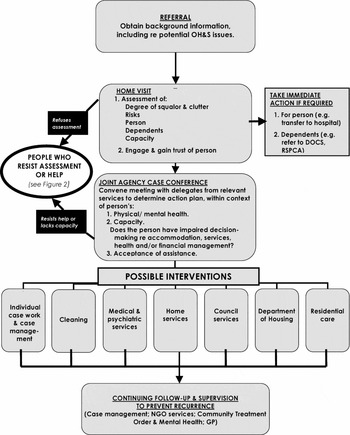
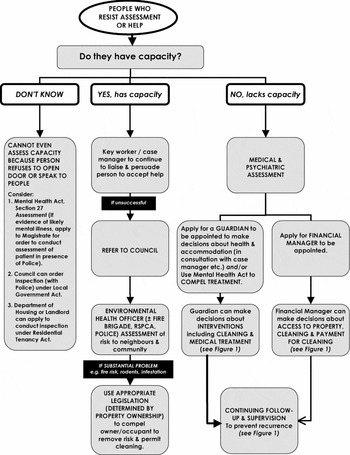
The Reference Group drafted guidelines, with diagramatic algorithms showing how strategies would be dependent on circumstances. The benefits of a coordinated approach, and agreement on who should take responsibility as the key worker or case manager, were emphasized. In some cases, however, the hoarding and filth may be so extensive that the expenses, in terms of clearing, cleaning and staff time, are beyond the budget of whichever agency is otherwise in the best situation to help.
The Reference Group submitted its final report to DADHC in September 2004. It recommended:
(1) That service agreements between all organizations within designated catchment areas be developed, thus enhancing interagency collaboration.
(2) That administrators in each designated catchment area (e.g. DADHC region) appoint an experienced community worker to act as a coordinator, with the aim of developing a central data collection, information, referral and support service. This service would develop and facilitate a coordinated response once a situation of squalor or hoarding was identified. The position should be ongoing.
(3) That additional recurrent funding be provided for case management and brokerage services to people at risk, including people living in severe domestic squalor in each DADHC region.
(4) That appropriate lines of communication be developed between all relevant organizations within designated catchment areas in order to manage confidentiality issues and share information that is necessary to assist in the management of squalor.
(5) That enquiries be initiated concerning the extent of domestic squalor and hoarding behaviors in rural communities, in order to determine intervention strategies that may be specific to local needs.
(6) That it be suggested that relevant organizations consider how best to arrange education for service providers in relation to assessment and appropriate interventions in cases of severe domestic squalor. Such education should include a focus on how to successfully engage people who live in squalor, how to gain access to premises, and the establishment of risk assessment and management strategies.
(7) That the guidelines be distributed to government and non-government organizations that may have involvement or responsibility in cases of severe domestic squalor.
(8) That the Reference Group be reconstituted as an Advisory Committee in order to oversee and review use of the guidelines and to focus on the development of support networks of people and organizations involved in cases of severe domestic squalor.
The report is available by email from the authors of this paper
Guidelines for intervention
Following submission of the above-mentioned report, DADHC officials in NSW met with representatives of other government departments to discuss the guidelines. Together they constituted a Partnership Against Homelessness which, in due course and after minor modifications, approved the issue of the project's guidelines. Since early 2008 they have been available on the DADHC website (www.dadhc.nsw.gov.au/dadhc/Publications+and+policies/ “Guidelines for field staff to assist people living in severe domestic squalor”). Alternatively they can be obtained by contacting the authors of this paper. The original algorithms are shown in Figures 1 and 2.
Recommended guidelines for intervention. Assessment & management of people living in squalor.

People living in squalor resisting assessment or help. Guidelines applicable in NSW (and under NSW law) will need adaptation if used in other jurisdictions.

It is hoped that those working in agencies elsewhere in the world that have involvement in cases of severe domestic squalor will download the guidelines, and that they will provide feedback on their utility either directly to the authors of this paper or through the Letters section of International Psychogeriatrics. Suggestions for adaptation for use in different jurisdictions could be useful. Policies on how to deal with squalor have been developed also in the Australian Capital Territory. The authors would be glad to be referred to comparable guidelines issued by other jurisdictions.
It is understood that the guidelines have proved useful to various services in NSW and elsewhere. The authors developed a squalor rating scale, which was made available with the guidelines. A final version of the Environmental Cleanliness and Clutter Scale (ECCS) has recently been validated (Halliday and Snowdon, Reference Halliday and Snowdon2009).
Further action
Although domestic squalor is commonly cited among the most difficult problems for community services to deal with, it is relatively under-researched. Various series of cases of squalor have been reported, mainly from aged care and psychiatric services (Snowdon et al., Reference Snowdon, Shah and Halliday2007), but referral bias may have distorted conclusions from these studies. Epidemiological research focusing on people who live in squalor (whether or not they hoard or neglect personal care) can be expected to provide guidance about the relative importance of putative causative factors in individual cases. Such studies will also help show what, where and when interventions can be effective.
The majority of the workload of Adult Protective Services (APS) in the U.S.A. is related to self-neglecting older adults who, because of inability, incapacity or choice, live in circumstances that most in that society would deem undesirable or unsafe (Lachs et al., Reference Lachs, Williams, O'Brien and Pillemer2002). However, comparatively scant attention has been given by those writing about self-neglect to factors and interventions of relevance in relation to squalor. In one report of cases of self-neglect among older persons, the authors commented that only in extreme instances do they live in squalor (Dyer et al., Reference Dyer, Goodwin, Pickens-Pace, Burnett and Kelly2007). Elsewhere, while discussing development of a scale to measure self-neglect severity, it was stated that APS staff cited inability to maintain the environment as the most common key element of self-neglect, the other domains being personal hygiene and impaired functioning (Kelly et al., Reference Kelly, Dyer, Pavlik, Doody and Jogerst2008). Squalor constituting a public health problem has been stated to be only an occasional accompaniment to hoarding (Steketee and Frost, Reference Steketee and Frost2006).
Whether squalor is common or not in cases of self-neglect and hoarding, recent evidence has shown, in one metropolitan district, that one person out of every 1000 aged over 65 years lives in moderate or severe domestic squalor (Snowdon and Halliday, Reference Snowdon and Halliday2007), one third of them with associated accumulation of clutter. The prevalence among younger people in the same district has yet to be measured. Informants elsewhere in the world have described comparable cases, but data are not available to show whether the incidence of squalor, and attitudes concerning soiling and accumulation of rubbish, vary between cultural settings. Guidelines for intervention will differ, depending on variations in the factors found or considered to influence tendencies to live in squalor.
Recent findings have suggested that compulsive hoarding is a condition distinguishable from obsessive-compulsive disorder (Saxena, Reference Saxena2007; Pertusa et al., Reference Pertusa, Fullana, Singh, Alonso, Menchon and Mataix-Cols2008). Strategies to overcome compulsive hoarding have been demonstrably effective (Steketee and Frost, Reference Steketee and Frost2006), and could well be helpful in some cases where hoarding is regarded as a major contributory factor. However, evidence has not yet been provided about whether the success of psychological treatments is negatively associated with the degree of squalor in such cases. Nor is there good evidence of efficacy in treatment of animal hoarding (Patronek and Nathanson, Reference Patronek and Nathanson2009), though a coordinated interdisciplinary approach has been recommended by the Hoarding of Animal Research Consortium (see www.tufts.edu/vet/cfa/hoarding). Tolin et al. (Reference Tolin, Frost and Steketee2007) noted a lack of comparative data regarding brain abnormalities in hoarders who live in squalor and those who do not. Testing for frontal lobe abnormalities (including neuroimaging) in a range of cases of severe squalor may assist in understanding how best to intervene (Snowdon et al., Reference Snowdon, Shah and Halliday2007). Dyer et al. (Reference Dyer, Goodwin, Pickens-Pace, Burnett and Kelly2007) suggested that executive dysfunction may be at the root of many cases of elder self-neglect, and that specific regions of the frontal lobe are associated with behaviors that impair activities of living.
In NSW there has been positive action in response to the Reference Group's recommendations, listed above. A Living Conditions Pilot Program was developed in 2005 by a non-government community care service in Northern Sydney. In 2008, $375,000 was made available through DADHC for a pilot project to be run by Catholic Healthcare. The project (launched in late 2008) accepts referrals from one half of Sydney, with the aim of ensuring interagency collaboration and appropriate case management, with development of support networks for people and agencies who deal with severe domestic squalor. The project advertises a “squalor hotline” so that concerned individuals in NSW can ring (even if living outside the designated service area) for advice on what can be done, and on who might be available to help in their locality. Education of service providers is being conducted at seminars and the guidelines are being promoted. Brokerage funds are available when needed to facilitate cleaning and interventions. An Advisory Group was appointed to oversee the pilot project and its evaluation. If the project works well for the half of Sydney it is serving, it is hoped that administrators will feel bound to fund similar arrangements elsewhere in NSW. The challenge will be for jurisdictions elsewhere in the world to provide advice and evidence on how best to intervene in cases of unacceptable squalor.
The major relevant challenge for diverse communities around the world is to preserve the rights of individuals to live unrestricted lives, while ensuring that people at risk (and society) are protected from the harmful consequences of severe domestic squalor.
Conflict of interest
None.
Description of authors' roles
JS and GH co-wrote the paper. GH drew the two figures.
Acknowledgments
Members of the Reference Group (listed in the cited report and guidelines) provided the ideas and opinions presented in the report to DADHC, and together developed the guidelines referred to in this article. Wendy Weir was the project officer and the project was auspiced by Central Sydney Area Health Service. The project officer's position and the writing by a lawyer of a chapter in the report were funded by a grant from the NSW Department of Ageing, Disability and Home Care.