Introduction
Chilo partellus (Swinhoe) (Lepidoptera: Crambidae) is one of the most important insect pests attacking maize and sorghum in eastern and southern Africa including Ethiopia (Overholt, 1994; Getu et al., Reference Getu, Overholt and Kairu2001). Depending on cultivar, age of the crop at time of infestation and density of the borer population, 10–100% yield loss has been reported in Ethiopia and elsewhere in the region due to C. partellus (Sithole, Reference Sithole1990; Getu & Abate, Reference Getu and Abate1999; Kfir, Reference Kfir2001). Even though C. partellus is known to be most damaging to maize and sorghum, it also attacks other crops such as pearl millet, finger millet, rice, wheat, sugar cane, foxtail and various wild grass species (Khan et al., Reference Khan, Chilishwa, Ampong-Nyarko, Smart, Polaszek, Wandera and Mulaa1997; Seshu Reddy, Reference Seshu Reddy and Polaszek1998). Studies on the biology and ecology of C. partellus have demonstrated local variation in the life cycle, depending mainly on climatic conditions (Harris, Reference Harris1990).
Chilo partellus is an exotic pest, introduced to Africa likely from India in the early 20th century (Tams, Reference Tams1932). Since arriving in Africa, it has spread to nearly all countries in eastern and southern Africa, and there is evidence that it is continuing to spread to western Africa (Nye, Reference Nye1960; Van Hamburg, Reference Van Hamburg1979; Kfir, Reference Kfir and Polaszek1998). Even though Chilo partellus has been known to coexist with another economically important indigenous stemborers, several reports have documented its comparatively rapid spread within many countries (Polaszek, Reference Polaszek1998). Besides its rapid expansion, C. partellus has proven to be a very efficient colonizer and devastating pest wherever it occurs (Kfir, Reference Kfir1997; Getu et al., Reference Getu, Overholt and Kairu2001). Damage due to the pest includes leaf feeding, extensive tunnels in stems and maize cobs, disruption in nutrients flow and subsequent death of growing point producing ‘deadhearts’ (Polaszek, Reference Polaszek1998).
Generally, C. partellus has been known in low to mid altitudes (<1500 m) and warmer areas (Warui & Kuria, Reference Warui and Kuria1983; Overholt et al., Reference Overholt, Ngi-Song, Omwega, Kimani-Njogu, Mbapila, Sallam and Ofomata1997). However, a growing number of studies indicate that the pest is expanding its geographic distribution to higher elevation (Kfir, Reference Kfir1997; Getu et al., Reference Getu, Overholt and Kairu2001). More recently, Tamiru et al. (Reference Tamiru, Getu and Jembere2007) reported the pest at altitude of 2088 m above sea level in Ethiopia. In Kenya, Ong'amo et al. (Reference Ong'amo, Le Rü, Dupas, Moyal, Calatayud and Silvain2006) reported C. partellus presence in relatively high altitude zones (moist high and moist mid-altitude zones) where the pest used not to occur. The pest has been reported to be highly invasive and partially displacing other indigenous stemborer species, such as Busseola fusca and Chilo orichalcociliellus, in several areas (Kfir, Reference Kfir1997; Ofomata et al., Reference Ofomata, Overholt, Lux, Van Huis and Egwuatu2000; Mbapila et al., Reference Mbapila, Overholt and Kayumbo2002). Evidence from laboratory studies conducted to examine the displacement of the indigenous stemborer Chilo orichalcociliellus has revealed that C. partellus had a higher fecundity than C. orichalociliellus at 25°C and 28°C (Ofamata et al., 2000).
The reasons for the rapid spread and establishment of the pest and its destructive nature are not well understood. Knowledge on the biology of the pest and its environmental requirements, such as temperature and relative humidity (RH) are crucial in order to better understand such phenomenona. A recent study, which took into consideration mean monthly temperature and rainfall data of the study area over the last several years, indicated climatic change (temperature rise) as one of the possible factors contributing to the spread of C. partellus to mid-high elevations (Tamiru et al., Reference Tamiru, Getu and Jembere2007). Studies have shown the importance of climatic conditions, especially temperature and relative humidity in influencing the biology and development of a given insect (Odum, Reference Odum1983; Ouedraogo et al., Reference Ouedraogo, Sou, Sanon, Monge, Huignard, Tran and Credland1996). Fecundity, fertility, developmental period and longevity are the best measures of biotic potential of an insect (Southwood, Reference Southwood1978). Hence, this study was carried out to investigate the influence of different temperature and relative humidity regimes on the biology of C. partellus.
Materials and methods
Source of test insect and maintenance
C. partellus larvae and pupae were collected from experimental fields of Melkassa Agricultural Research Center (MARC) (8°24′N; 39°21′E). MARC has a mean annual rainfall of 743 mm and average maximum and minimum temperatures of 28.0°C and 14.4°C, respectively. The larvae of C. partellus were collected by dissecting infested maize plants and taken to the insectary for rearing. Early (1st and 2nd) instars of C. partellus larvae were reared on a natural diet of young maize shoots, whereas the older instars (3rd–6th) were reared on matured maize stem. The natural diet was changed every three days until pupation. Soon after emergence, both sexes (male and female) of adult C. partellus were placed inside a clean (30 cm×30 cm×30 cm) perspex sleeve cage. Cotton balls soaked with a sugar-water solution (20%) and young maize shoots were placed in the cage to serve as a food source for the emerging moths and oviposition substrate, respectively. Eggs laid were collected daily and used for the study.
Developmental time, adult longevity, potential and realized fecundity of C. partellus were studied at three temperature (22, 26, 30°C) and RH levels (40, 60, 80%) representative of the study area previously considered in related ecological study (Tamiru et al., Reference Tamiru, Getu and Jembere2007). The experiments were undertaken inside temperature-controlled incubators where in/out hygro-thermometers were placed inside to monitor the relative humidity. The required relative humidity was maintained using different salts (Getu et al., Reference Getu, Overholt and Kairu2003). All studies were conducted at 12L:12D photoperiod. The experiment was designed in a completely randomized design (CRD) with a factorial arrangement to test each temperature and relative humidity combinations (Gomez & Gomez, Reference Gomez and Gomez1984). All experiments were replicated 30 times, where each replicate consisted of one insect.
Developmental time of C. partellus
Egg batches laid by C. partellus the previous night were collected every morning and kept at each temperature and relative humidity regime. After hatching, larvae were placed individually in 9-cm diameter Petri dishes and reared on a natural diet of young maize shoot (1st and 2nd instars) or matured maize stems (3rd–6th instars). Daily observations were carried out, and egg period (days to hatching), larval period, pupal period and adult emergence were recorded.
Adult longevity of C. partellus
Thirty pairs of newly emerged male and female adults of C. partellus were kept separately in rearing cages which were placed in incubators set at different temperature and relative humidity regimes. The incubators were set at 22, 26 and 30°C temperature and 40, 60 and 80% RH. The relative humidity regimes were maintained using different salts (Getu et al., Reference Getu, Overholt and Kairu2003). Adult C. partellus were provided with cotton balls soaked with a sugar-water solution (20%) to serve as food. Adult mortality was recording twice per day (at 09:00 and 16:00) until all adults were dead.
Potential fecundity of C. partellus
From batches of insects under each treatment regime, 30 24-h-old adult females of C. partellus were randomly selected and dissected. The egg load of each female was determined by counting the number of eggs in the ovaries using a binocular microscope.
Realized fecundity of C. partellus
The test insects were reared at the respective study temperature and relative humidity regimes until pupation. Soon after emergence, 30 male and female adults of C. partellus were transferred into small insect cages (30 cm×30 cm×30 cm) in pairs and placed at each treatment regime. Insects were allowed to mate and kept together until they died. The actual number of eggs laid by each female during its life time was summed to obtain a measure of realized fecundity under each temperature and relative humidity regime.
Data analysis
Data were analyzed with analysis of variance (ANOVA) using General Linear Model (GLM) in SAS software (SAS Institute, 2002–2008). All data were checked for normality before they were subjected to analysis. Data which lacked normality were transformed using log and square root transformations. Significant means were separated using Tukey's Studentized Range Test (HSD).
Results
Developmental time of C. partellus
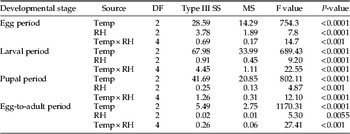
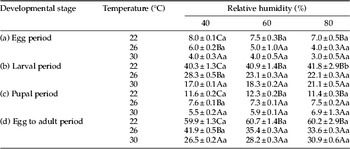
The analysis of variance (ANOVA) for developmental time indicated that all developmental stages of C. partellus (egg, larva, pupa and egg-adult periods) were significantly affected by temperature (P<0.05, df=2), RH (P<0.05, df=2) and their interaction (P<0.05, df=4) (table 1). The combined effect of temperature and relative humidity with respect to all developmental stages is shown in table 2.
Analysis of variance for developmental time of C. partellus.

Combined effects of temperature and relative humidity on mean (±SE) (a) egg, (b) larval, (c) pupal, (d) egg to adult period (days) of C. partellus.

Means followed by the same letter(s) within a column (upper case letter) and within a row (lower case letter) are not significantly different at 5%, Tukey's Studentized Range Test (HSD).
Egg period
The egg period was significantly longer at 40% RH and 22°C temperature. For 60% and 80% RH, the egg period was not significantly different at the temperatures of 22°C and 26°C. At 30°C, the egg period was shortest, but it was not significantly different across the tested relative humidity regimes.
Larval period
The combined effect of temperature and relative humidity on larval period of C. partellus indicated that the larval period was significantly shorter at 40% RH and 30°C temperature. At 60% and 80% RH, the larval period was not significantly different for the 26°C and 30°C temperatures regimes. The larval period was significantly longer at 22°C and 40% RH.
Pupal period
At 40% RH, the pupal period was significantly short at 30°C. The pupal period was not significantly different at 26°C and 30°C for 60% and 80% RH. At 22°C, the pupal period was significantly longer than at 26°C and 30°C for all tested relative humidity.
Egg-adult period
The development period was significantly longer at 22°C compared to 26°C and 30°C under the three relative humidities. The developmental time from egg to adult decreased from 60.7±1.4 (22°C, 60% RH) to 26.5±0.2 days (30°C, 40% RH) (table 2). At 60% and 80% RH, the egg-adult period was not significantly different for 26°C and 30°C temperature regimes.
Longevity of C. partellus moths
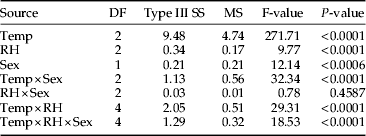
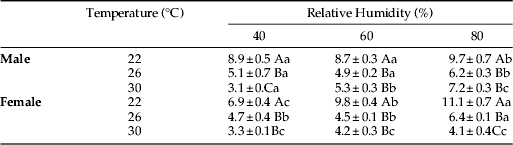
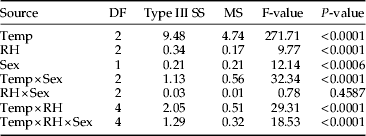
Analysis of variance for the longevity of C. partellus is shown in table 3. Temperature (P<0.05, df=2), RH (P<0.05, df=2), sex (P<0.05, df=1) and their interactions (P<0.05, df=2) significantly affected the longevity of adult of C. partellus except for the interaction of relative humidity and sex (P<0.46, df=2). The combined effect of temperature and relative humidity with sex is shown separately in table 4. Both male and female C. partellus lived longer at 22°C compared to 26°C and 30°C. At each temperature, there was no significant difference between the longevity of male and female moths. Both the male and female moths of C. partellus lived significantly longer at 80% RH.
Analysis of variance for adult longevity of C. partellus at different temperatures and relative humidities.
Combined effect of temperature, relative humidity and sex on mean (±SE) adult longevity of C. partellus.
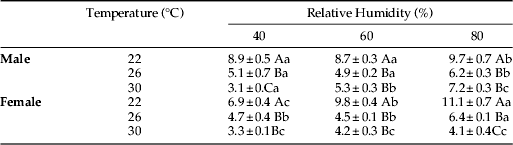
Means followed by the same letter(s) within a column (upper case letter) and within a row (lower case letter) are not significantly different at 5%, Tukey's Studentized Range Test (HSD).
Potential and realized fecundity of C. partellus
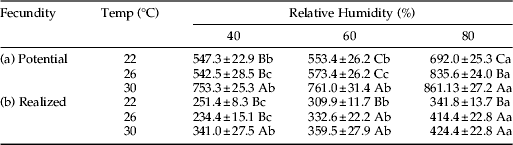
The potential fecundity and realized fecundity of C. partellus were significantly affected by temperature (P<0.05, df=2), RH (P<0.05, df=2) and their interaction (P<0.05, df=4) (table 5). Effect of relative humidity on potential and realized fecundity of C. partellus at different temperatures is shown in table 6. The highest potential and realized fecundity was observed at 30°C for different relative humidity levels. The number of eggs laid and egg load was highest at 80% RH across the different temperature regimes.
Analysis of variance for fecundity of C. partellus at different temperature and relative humidity.

Effect of relative humidity on mean (±SE) (a) potential fecundity (number of eggs in ovaries) and (b) realized fecundity (actual number of eggs laid) of C. partellus at different temperatures.
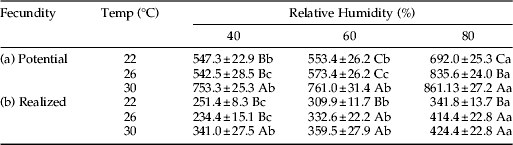
Means followed by the same letter(s) within a column (upper case letter) and within a row (lower case letter) are not significantly different at 5%, Tukey's Studentized Range Test (HSD). Realized fecundity is the actual number of eggs laid by each female during her life time, while potential fecundity is the egg load of a female determined by counting the number of eggs in the ovaries before actual egg laying starts.
Discussion
Developmental time
The current study affirmed temperature, relative humidity and their interaction significantly affect the developmental time of C. partellus, temperature being the most important factor. The effect of temperature on development and life history parameters of insects has been studied widely (Mbapila, Reference Mbapila1997; Ivanovic & Nenadovic, Reference Ivanovic and Nenadovic1999). A few but growing number of studies have also considered the combined effects of temperature and relative humidity (Yadav & Chaudhary, Reference Yadav and Chaudhary1986; Rahim et al. Reference Rahim, Hashmi and Khan1991; Getu, Reference Getu2007). The significant interaction between relative humidity and temperature in the current laboratory investigation revealed developmental time of C. partellus is governed by both factors, though temperature may play a more significant role. Although there was no previous information on the interactive effect of temperature and relative humidity on C. partellus development, the current findings are in agreement with related studies which underscored the significance of these environmental factors on development of other insects (Wilson et al., Reference Wilson, Stinner and Rabb1982; Guglielomone, Reference Guglielomone1992; Ouedraogo et al., Reference Ouedraogo, Sou, Sanon, Monge, Huignard, Tran and Credland1996; Getu et al., Reference Getu, Overholt and Kairu2003).
In the current study, significant differences were observed in life history processes of C. partellus under different relative humidity levels and temperature regimes, suggesting the influence of these factors in determining suitability of the environment for the development of the pest, which, in turn, affect the spread and establishment of the pest. Previously, elevation was thought to be an important factor in determining the distribution of C. partellus (Nye, Reference Nye1960; Seshu Reddy, Reference Seshu Reddy1983). However, Sithole (Reference Sithole1987) indicated that temperature, rainfall and humidity influence the distribution of the stemborer, temperature being the most important factor. Both generalizations may support each other as elevation affects physical environment such as temperature and relative humidity, which provide selective pressure influencing development and spread of a given insect.
Egg hatching took 3–8 days, depending on temperature and relative humidity. The egg period was inversely related to temperature and relative humidity. Egg period was longer (eight days) at 22°C and 40% RH, while it was shortest at 30°C and 80% RH. Similarly, larval period was significantly longer at lower temperature (22°C) when compared to 26°C and 30°C temperatures regimes for all levels of relative humidity. The fastest larval development was observed at higher temperatures. A reduction in larval period with an increase in temperature due to increased metabolic activity and feeding has also been demonstrated in other insects (Johnston & Bennett, Reference Johnston and Bennett1996; Srivastava & Omkar, Reference Srivastava and Omkar2003; Omkar & Pervez, Reference Omkar and Pervez2004).
The pupal period was shorter at higher temperatures and longer at lower temperatures. Despite the longer time taken, healthy and viable adults were obtained from pupae kept at 22°C for all tested relative humidity levels. Development of egg to adult stage was inversely related to temperature. Even though successful development from egg to adult was possible at all tested temperature regimes and relative humidity levels, significant variation in the number of days was observed among the temperature regimes. Higher temperatures had significantly shorter egg to adult developmental periods.
There was variation in developmental time of C. partellus due to relative humidity at different temperature levels. Egg hatching varied due to relative humidity at 22°C and 26°C. For the different temperature regimes, egg hatching was faster at higher relative humidity. This concurs with previous reports which indicated the importance of high relative humidity in favoring normal embryonic development and hatching (Godfrey & Holtzer Reference Godfrey and Holtzer1991; Ofomata et al., Reference Ofomata, Overholt, Lux, Van Huis and Egwuatu2000). The effect of 80% RH on C. partellus developmental time is different from 40% and 60% RH at the different temperature regimes except for larval and pupal period at 26°C. These results imply that high relative humidity modifies, to some extent, the effect of temperature and contributes to the variation in the egg period of C. partellus.
Temperature caused marked variation in developmental time of C. partellus across different humidity levels. Temperature was inversely related to the developmental periods regardless of relative humidity levels. Mean duration of the C. partellus life cycle was reduced from 59.9 days at 22°C to 26.5 days at 30°C at 40% RH. A similar reduction in length of the life cycle was observed with an increase in temperature at 60% and 80% RH. The significant variation in developmental time at different temperature regimes underscored a crucial role temperature plays in the development of C. partellus. Several studies with other insects have revealed similar results, where exposure to higher temperature reduces developmental time and consequently increase developmental rates (Yadav & Chaudhary, Reference Yadav and Chaudhary1986; Muegge & Lambdin, Reference Muegge and Lambdin1989; Rahim et al.; Reference Rahim, Hashmi and Khan1991, Ponsonby & Copland, Reference Ponsonby and Copland1996; Levesque et al., Reference Levesque, Fortin and Mauffette2002; Mbapila et al., Reference Mbapila, Overholt and Kayumbo2002).
Longevity
Temperature and relative humidity and their interaction significantly influenced male and female longevity of C. partellus. At each temperature, there was no significant difference between the longevity of male and female moths. Adult C. partellus lived longer at lower temperatures whereas the longevity was reduced at higher temperatures. Average life span of adult C. partellus was 6.9–11.1 days at 22°C while it was only 2.3–7.2 days at 30°C. This result agrees with Mbapila et al. (Reference Mbapila, Overholt and Kayumbo2002) who reported that duration of the adult life stage or longevity of C. partellus is inversely related to temperature. The current experiment showed that the longevity of adult C. partellus depends on temperature, relative humidity and their interaction. Different workers have also demonstrated the effect of temperature and relative humidity on adult longevity of other insects (Potting, Reference Potting1996; Mbapila, Reference Mbapila1997; Getu, Reference Getu2007). In this study, adult longevity was not significantly affected by the interaction of relative humidity and sex. Based on the results of the current study, the longer longevity of C. partellus at lower temperatures may give an advantage of a prolonged egg-laying period at higher altitude where temperature is low. On the other hand, our study also indicated that generation times were shorter and fecundity higher at higher temperature, which is likely to have a greater effect on overall population growth rates than the reduction in longevity of individual insects.
Fecundity
The current study indicated that temperature, relative humidity and their interaction significantly affected the potential and realized fecundity of C. partellus. Other studies have also indicated that temperature, relative humidity and their interaction govern insect fitness by affecting fecundity (Yadav & Chaudhary, Reference Yadav and Chaudhary1986). In the present experiment, the average potential fecundity observed was 542–861 eggs, whereas the average realized/actual fecundity was 204–476 eggs. Higher potential and realized fecundity were observed at higher RH (60%, 80%) for different levels of temperature. The highest egg load and realized fecundity was obtained at 30°C across the different relative humidity levels. High population growth of C. partellus and higher infestation due to the pest were previously reported at similar temperature and relative humidity regimes (Mbapila et al., Reference Mbapila, Overholt and Kayumbo2002; Zulfiqar et al., Reference Zulfiqar, Sabri, Raza, Amir Hamza, Hayat and Khan2010). This is due to population dependence of pest attack, where high population build-up results in higher infestation, which in turn depends on fecundity (Southwood, Reference Southwood1978; Odum, Reference Odum1983; Muegge & Lambdin, Reference Muegge and Lambdin1989). This could be one of the reasons why the pest is predominant at lower elevations where the temperature is warmer.
In summary, the study results showed the influence of temperature, relative humidity and their interaction on development and fecundity of C. partellus, temperature being the most important factor. This fact suggests that these factors play an important role in determining survival and establishment of adult C. partellus in new ecological niches. According to the outcome from the present study, the optimal conditions for development of C. partellus were 26–30°C and 60–80% RH; nevertheless, the pest was able to successfully reproduce at all temperature and relative humidity regimes tested. These results provide important information for better understanding of C. partellus biology and suitability of different environmental conditions, which will have practical value in designing appropriate management strategies and improving efficacy of biological control programmes. The information generated here would also serve as useful data input in modeling, as environmental conditions, such as temperature and humidity, serve as important criteria in predicting possible distribution and establishment of a given pest. We also recommend further developmental and ecological studies to be carried out with wider temperature and relative humidity regimes to determine the adaptation of the pest at extreme environmental conditions.
Acknowledgements
The authors are thankful to Melkassa Research Center of Ethiopian Institute of Agricultural Research for the provision of necessary laboratory facilities for the research. The technical assistance of Mrs Genet Habte and Mrs Meseret Getachew in rearing insects was highly appreciated. The study was financially supported by a collaborative research project for stemborer biological control between the Ethiopian Institute of Agricultural Research (EIAR) and the International Center for Insect Physiology and Ecology (ICIPE).