Introduction
Nocturnal insects exhibit various reactions to artificial light, including phototaxis, light adaptation, circadian rhythm disturbance, and photoperiodicity (Shimoda and Honda, Reference Shimoda and Honda2013). Diverse techniques have been used to manage pests in the field by taking advantage of these responses. For example, electric light traps take advantage of the positive phototaxis behaviour of insects (van Grunsven et al., Reference van Grunsven, Lham, van Geffen and Veenendaal2014; Kim et al., Reference Kim, Huang and Lei2019), and the activities of some nocturnal pests can be suppressed with monochromatic yellow light (Prokopy and Owens, Reference Prokopy and Owens1983).
Ectropis grisescens is a major lepidopterous pest of tea gardens in China (Li et al., Reference Li, Cai, Luo, Bian, Xin, Liu, Chu and Chen2019). It is a nocturnal geometrid moth that exhibits a strong positive phototactic response to artificial light sources (Bian et al., Reference Bian, Cai, Luo, Li and Chen2018). Light traps are thus commonly used to monitor and control this species. E. grisescens is also sensitive to yellow (590–595 nm) and green (520–525 nm) light stimulation, which can significantly inhibit the oviposition of female moths (Qiao et al., Reference Qiao, Zhang, Gong, Geng, Hong, Yin and Wu2022).
Our long-term trapping efforts revealed that most trapped moths are males. In addition, geometrid moths often concentrated around light traps, suggesting that they had entered the light adaptation state, and this might have promoted the growth of the E. grisescens population. A high abundance of males in light traps has been reported in other lepidopterous pests, such as Yponomeuta cagnagella and Ligdia adustata (Altermatt et al., Reference Altermatt, Baumeyer and Ebert2009). Light adaptation around the light source following a positive phototactic response has also been observed in Noctuidae species (Chen, Reference Chen1979; Kim et al., Reference Kim, Song, Li, Huang and Lei2018), such as Mythimna separata, which is a cosmopolitan agricultural pest. The phototactic behaviour of M. separata is affected by the dark adaptation time and light exposure time (Kim et al., Reference Kim, Song, Li, Huang and Lei2018). Indoor bioassays have revealed that many individuals of E. grisescens remain in the release zone and display no reaction to some types of mono-chromatic light (Bian et al., Reference Bian, Cai, Luo, Li and Chen2018); this suggests that light adaptation occurs in these moths, in contrast to previous observations of Noctuidae moths.
The spectral sensitivities of photoreceptors are determined by the absorption spectrum of the expressed visual pigments in insects (van der Kooi et al., Reference van der Kooi, Stavenga, Arikawa, Belusic and Kelber2021). Moths show a response to monochromatic light if their visual pigments are sensitive to the wavelength of incoming light. However, little information is available on the spectral sensitivity of geometrid compound eyes, apart from Arichanna gaschkevitchii, which shows photoreceptor spectral sensitivity peaks of 380, 500, and 540 nm (van der Kooi et al., Reference van der Kooi, Stavenga, Arikawa, Belusic and Kelber2021). Light stimulation might induce changes in internal metabolic processes without inducing obvious behavioural responses in insects; consequently, the effects of light stimulation on the metabolism of insects can be difficult to detect through behavioural experiments. For example, the expression of opsin genes from the compound eyes of Helicoverpa armigera could be regulated by light exposure (Yan et al., Reference Yan, Zhu, Zhu, Zhang, Li, Liu and Zhang2014), and the expression levels of opsin genes can affect the phototactic behaviour of Spodoptera exigua (Liu et al., Reference Liu, Yan, Shen, Li, Zhang, Liu, Zhang and Liu2018).
In this study, we characterized the internal and external effects of visible light on E. grisescens moths. We first identified the opsin genes of E. grisescens moths, and these data enhance our poor understanding of the visual physiology of geometrid moths. We then analysed the effects of visible light of several wavelengths on the expression of opsin genes. The spectral sensitivity of male compound eyes was determined using visual electrophysiology. Finally, we conducted behavioural bioassays to analyse the effects of visible light on the ability of male E. grisescens to adapt to light.
Materials and methods
Insects
We reared E. grisescens larvae on fresh tea shoots (Longjing 43 cultivar) at 25 ± 2°C, 60–70% relative humidity, with a 14-h/10-h light/dark photoperiod (14 L:10 D). After the pupae emerged, moths were fed 10% honey water, and moths that were unmated at 2 days old were used in the experiments.
Opsin gene cloning and phylogenetic analysis
We identified opsin genes from various databases, including the Nr (e value <10−5), Nt (e value <10−5), Pfam (e value <0.01), KOG/COG (e value <10−3), Swiss-Prot (e value <10−5), KEGG (e value <10−10), and GO (e value <10−6) databases, using the BLASTX online tool; we also annotated their functions via transcriptome analyses of E. grisescens head samples (Sequence Read Archive: SUB11197059; Bio Project accession number: PRJNA816711). After extracting total RNA from E. grisescens head samples, we transcribed it to generate cDNA using PrimeScript™ RT Master Mix (TaKaRa, China). We then used the cDNA as the PCR template to confirm the opsin gene sequences. The full-length opsin genes were amplified by PCR using 2 × Phanta Max Master Mix (Vazyme, China) and gene-specific primers (Table S1). The thermal cycling conditions were as follows: pre-denaturation at 95°C for 3 min, 95°C for 15 s, 60°C for 15 s, 30 cycles of 72°C for 60 s, and 72°C for 5 min. The amplified products (3 μl) were determined by 1% agarose gel electrophoresis and then subcloned into the pGEM-T Easy vector for opsin gene sequencing.
We conducted nested PCR (SMARTer RACE 5′/3′ Kit, Clontech, USA) using two downstream primers of 5′RACE (Table S1) and the gene segment of the long-wave sensitive opsin gene (Eg-LW opsin) because the full-length sequence of the Eg-LW opsin gene was not obtained. The thermal cycling conditions of the first PCR reaction were as follows: five cycles of 94°C for 30 s and 72°C for 3 min; five cycles of 94°C for 30 s, 70°C for 30 s, and 72°C for 3 min; and 20 cycles of 94°C for 30 s, 68°C for 30 s, and 72°C for 3 min. The thermal cycling conditions of the second PCR reaction were as follows: 20 cycles of 94°C for 30 s, 70°C for 30 s, and 72°C for 3 min. Finally, we subcloned and sequenced the PCR products to obtain the full-length sequence of the Eg-LW opsin gene.
We aligned the amino acid sequences of three opsin proteins in E. grisescens with opsin sequences from other insect species to construct the phylogenetic tree. We identified opsin sequences of other insects using the BLASTX online tool, and the dataset contained opsins from six other insect species (Biston betularia, S. exigua, Agrotis ipsilon, H. armigera, M. separata, and Mamestra brassicae) (Table S2). We used Mafft (version 7.311) to align amino acid sequences; we then used these alignments to generate the BLOSUM62 protein weight matrix. We constructed a phylogenetic tree using the maximum likelihood method and the Poisson correction distance with 500 bootstrap replicates in MEGA 6.0; we used the nearest-neighbour interchange method with the branch swap filter set to very strong (Tamura et al., Reference Tamura, Stecher, Peterson, Filipski and Kumar2013).
Validation of the diurnal rhythm of opsin gene expression
We extracted total RNA from the heads of E. grisescens moths. qRT-PCR primers (Table S3) for a UV-sensitive opsin gene (Eg-UV opsin), blue-sensitive opsin gene (Eg-BL opsin), and Eg-LW opsin were designed using the software Beacon Designer 8.14. The thermal cycling conditions of the PCR reaction were as follows: 3 min at 95°C, followed by 40 cycles of 95°C for 5 s, 58°C for 20 s, and 72°C for 20 s. The qRT-PCR reaction system contained the following components: 10 μl of ChamQ Universal SYBR qPCR Master Mix (Vazyme, China), 0.4 μl of forward primer, 0.4 μl of reverse primer, 1 μl of cDNA (50 ng μl−1), and 8.2 μl of ddH2O to achieve a total volume of 20 μl. We used the GTPBP gene as an internal control to normalize relative expression levels (Li et al., Reference Li, Luo, Cai, Bian, Xin, Liu, Chu and Chen2017). Samples collected at the beginning of a diurnal rhythm were control samples, and we analysed gene expression levels using the 2−ΔΔCt method (Pfaffl, Reference Pfaffl2001). We conducted four biological replicates of each experiment, and each replicate comprised four heads.
Exposure to different light conditions: The pupae of E. grisescens were separated by sex and kept in different cages under different light environments. We designated zeitgeber time 0 (ZT0) as the beginning of a diurnal rhythm, and ZT24 as the end of the rhythm. The surrounding light environment included (1) 14 L:10 D (LD), (2) constant darkness (DD), (3) constant white light (LL), (4) constant blue light (BL), (5) constant green light (GL), and (6) constant red light (RL). We collected moths (2 days old) at 3-h intervals from ZT2 to ZT23 for qRT-PCR. The wavelengths of the monochromatic blue, green, and red LED lights were 457, 544, and 627 nm, respectively (10–15 nm effective bandwidth, approximately 600 Lux, Chitic Vana Optoelectronic Tech Co., Ltd., Hangzhou, China).
Electroretinography (ERG) recordings
After emergence, female E. grisescens moths usually inhabit their host plants, and the males are more active and locate females at night through sex pheromones (Luo et al., Reference Luo, Li, Cai, Bian and Chen2017). Because most moths trapped by artificial lamps were males, we used male moths for ERG recordings to determine the spectral sensitivities of their compound eyes. The monochromatic stimulus of different wavelengths was derived from a 150-W xenon arc lamp through diverse narrow-band interference filters (330–690 nm, bandwidth 10 nm, Andover Corp., Salem, NH, USA). The monochromatic light, which illuminated the compound eye of the moth, was directed via an optical fibre when a shutter was opened (Bian et al., Reference Bian, Cai, Luo, Li and Chen2020).
Following the method of Telles et al. (Reference Telles, Lind, Henze, Rodriguez-Girones, Goyret and Kelber2014), we fixed moths with a black clamp device connected to a lockable ball-and-socket joint with the head, mouthparts, and antennae firmly glued with utility wax (Kerr, SpofaDental a.s.,Czech Republic). In a dark Faraday cage, we inserted an electrolytically sharpened tungsten electrode into the frontal margin of one eye using a micromanipulator (M3301R-M10-5052, WPI, USA), and used the other tungsten electrode, which was placed into the base of a neighbouring antenna, as the reference. Before ERG recordings, the moths were first dark-adapted for 30 min and then stimulated with light flashes of 100-ms duration at 5 s intervals. The maximum light intensity of light stimuli was approximately 1012⋅photons⋅cm−2 s−1, and it was adjusted over a 4-log unit intensity range at each wavelength with neutral-density filters (Andover Corp, Salem, NH, USA). We performed six biological replicates were performed for the spectral sensitivity measurements during the peak period of male flight activity from 20:00 to 24:00. Spectral sensitivity was calculated by taking the reciprocal of all K values in the Naka–Rushton function: V/V max = In /(In + Kn), where V is the response amplitude, V max is the maximum response amplitude, I is the intensity of the light stimulus, K is the light intensity eliciting 1/2 of V max, and n is the exponential slope (McCulloch et al., Reference McCulloch, Osorio and Briscoe2016).
Light adaptation under different light stimuli
Long-term breeding efforts and observations have shown that E. grisescens moths are active at night or in dark environments. In such environments, female moths expose their gonads to release sex pheromones, and males crawl or flap their wings on host plants or the cage wall. Following sudden exposure to artificial light, light adaptation begins in active moths, and they immediately become still (within approximately 30s). The length of the light adaptation process depends on the wavelength and intensity of artificial light.
In behavioural tests, we suddenly exposed a single active male moth to a monochromatic LED light after it had been dark-adapted for 30 min in a net cage. The adaptation time (t) was defined as the time between when the moth was first exposed to light and when it stopped moving and spread its wings to rest. The light was turned off for 30 min, and the moth became active again. We then stimulated the moth using the same monochromatic light at a different intensity, and the adaptation time (t) was recorded. For each moth, the light intensity (I) ranged from 101 to 103 Lux, and moths were exposed to over five light intensities at each wavelength using neutral-density filters (Zhongjiao Jinyuan Technology Co., Ltd., Beijing, China). The ERG results showed that moths had been exposed to the following types of monochromatic LED light: violet (390 nm), blue (457 nm), green (544 nm), yellow (593 nm), and red (627 nm); the effective bandwidth was 10–15 nm. We conducted nine biological replications in the behavioural experiment. Moths that did not become active during the pre-dark-adaptation (30 min) or took more than 1 min to adapt to the light were excluded from subsequent analyses.
Data analysis
All data were analysed using IBM SPSS (19.0, Chicago, IL).
Effect of invisible light on opsin expression Differences in opsin gene expression levels under different exposure times were analysed using one-way analysis of variance (P < 0.05). Differences in opsin gene expression levels between males and females were analysed using independent sample t-tests (P < 0.05).
Effect of invisible light on light adaptation following the method of Wakakuwa et al. (Reference Wakakuwa, Stewart, Matsumoto, Matsunaga and Arikawa2014), we assumed that light adaptation can be induced by all types of monochromatic light within the spectrum of expressed visual pigments in E. grisescens when the intensity of light is sufficient. The dependent variable (t) and the independent variable (I) were fitted with a logistic model (a sigmoidal curve),

where t is the adaptation time, and I is the light intensity. A, B, and k are parameters of the model. The parameter A is the theoretical maximum of the dependent variable t. I 1/2 is the half-maximal flash strength, which is the intensity required to reduce the adaptation time by half (i.e., t = 0.5A). Thus,

and the maximum adaptation time did not exceed 30s in all behavioural tests. We also fitted the sigmoidal curve with the maximum at A = 30 to each set of data to calculate I 1/2 (A = 30) for each monochromatic light.
Results
Phylogenetic analysis of three opsin genes
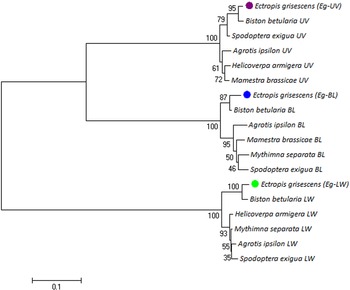
We cloned and identified three types of cDNA encoding visual pigment opsins, including 1119 bp of UV wavelength-sensitive, 1149 bp of blue wavelength-sensitive, and 1152 bp of long wavelength-sensitive opsin genes, which we referred to as Eg-UV, Eg-BL, and Eg-LW (GenBank accession numbers were ON055244, ON055245, and ON055246), respectively. Phylogenetic analysis revealed that the three types of opsin genes clustered in the UV, blue, and long wavelength-absorbing opsin clades of several insects (fig. 1). The lengths of these three types of opsins were 372 (Eg-UV), 383 (Eg-BL), and 382 (Eg-LW) amino acids. The predicted molecular masses of the three encoded opsins were 92.8 kDa (Eg-UV), 95.33 kDa (Eg-BL), and 96.7 kDa (Eg-LW), and the calculated isoelectric points were 5.01 (Eg-UV), 5.01 (Eg-BL), and 5.02 (Eg-LW).
Phylogenetic relationships of the three types of opsins from six species. E. grisescens moths have three types of opsins, ultraviolet (UV), blue (B), and long wavelength (LW)-sensitive opsins, which are coloured in violet (Eg-UV), blue (Eg-BL), and green (Eg-LW), respectively.

Effects of light exposure on the diurnal rhythm of opsin gene expression
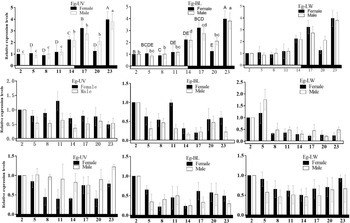
Under the LD environment, significant differences in the expression of the three opsin genes were observed (fig. 2A, P < 0.01). The relative expression levels of Eg-UV (female, F 7,16 = 25.14; male, F 7,16 = 18.70) and Eg-BL (female, F 7,16 = 9.91; male, F 7,16 = 10.99) increased as the moths began to be exposed to dark conditions and peaked 9 hours later. Fluctuations in Eg-LW expression were relatively small, but the effect of time was significant (female, F 7,16 = 4.35; male, F 7,16 = 9.76). The expression level of Eg-BL in male moths was significantly higher than that in female moths at ZT11 (t = −3.08, P < 0.01) and ZT20 (t = −11.16, P < 0.01, fig. 2A-ii).
Changes in the relative expression (mean ± SE) of Eg-UV (i), Eg-BL (ii), and Eg-LW (iii) over time under three different light environments. The light environments included A, LD (14 L:10 D; white light for the first 14 hours, and black for the last 10 hours on the x-axis), B, LL (constant white light; the x-axis is white), and C, DD (constant darkness; the x-axis is black). Asterisks indicate significant differences in relative expression levels between male and female moths (independent sample t-tests, P < 0.05).

When moths were exposed to LL conditions, the relative expression levels of Eg-UV (female, F 7,16 = 4.93; male, F 7,16 = 4.29), Eg-BL (female, F 7,16 = 10.08; male, F 7,16 = 18.41), and Eg-LW (female, F 7,16 = 11.86; male, F7,16 = 19.63) significantly changed over time (fig. 2B, P < 0.01). The expression levels of Eg-UV were significantly higher in females than in males at ZT8 (t = 3.70, P < 0.01) and ZT11 (t = 2.87, P < 0.01, fig. 2B-i). By contrast, the expression levels of Eg-BL were higher in females than in males at ZT11 (t = 8.47, P < 0.01, fig. 2B-ii).
The relative expression levels of Eg-UV (F 7,16 = 6.38) and Eg-LW (F 7,16 = 4.02) in female heads significantly changed over time under DD conditions (fig. 2C). The relative expression levels of Eg-BL in the heads of both males and females significantly changed over time (female, F 7,16 = 8.61; male, F 7,16 = 5.78, fig. 2C-ii). The expression levels of Eg-UV were significantly higher in males than in females at ZT8 (t = −4.07, P < 0.01) under DD conditions (fig. 2C-i).
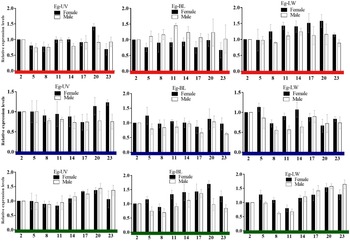
No significant changes were observed in the expression levels of Eg-UV in male and female moths over time under monochromatic blue light. Significant changes in the expression levels of Eg-BL (F 7,16 = 3.52; P < 0.05) were observed in males; significant changes were observed in the expression of Eg-LW (female, F 7,16 = 7.62; male, F 7,16 = 4.27; P < 0.05) in both males and females (fig. 3A). Sex differences in expression levels were observed in Eg-BL at ZT5 (t = −2.57, P < 0.05, fig. 3A-ii) and in Eg-LW at ZT11 (t = 5.28, P < 0.05) and ZT14 (t = 3.65, P < 0.05, fig. 3A-iii).
Changes in the relative expression (mean ± SE) of Eg-UV (i), Eg-BL (ii), and Eg-LW (iii) over time under three monochromatic light environments. The monochromatic light environments included (A) BL (constant blue light of 457 nm; x-axis in blue), (B) GL (constant green light of 544 nm; x-axis in green), and (C) RL (constant red light of 627 nm; x-axis in red). Asterisks indicate significant differences in relative expression levels between male and female moths (independent sample t-tests, P < 0.05).

When the monochromatic light was green, the relative expression levels of Eg-UV (female, F 7,16 = 4.10; male, F 7,16 = 5.11; P < 0.05), Eg-BL (female, F 7,16 = 6.27; male, F 7,16 = 6.68; P < 0.05), and Eg-LW (female, F 7,16 = 7.90; male, F 7,16 = 39.72; P < 0.05) changed significantly over time (fig. 3B). The expression levels of Eg-BL were significantly higher in females than in males at ZT5 (t = 3.92, P < 0.01) and ZT20 (t = 5.22, P < 0.01, fig. 3B-ii), and the expression levels of Eg-LW were significantly higher in females than in males at ZT5 (t = 3.0, P < 0.01) and ZT8 (t = 9.10, P < 0.01) under GL conditions (fig. 3B-iii).
Under RL conditions, the relative expression levels of Eg-UV (F 7,16 = 8.83; P < 0.05) and Eg-LW in females (F 7,16 = 3.67; P < 0.05) changed significantly over time (fig. 3C). The ex-pression levels of Eg-UV were significantly higher in females than in males at ZT20 (t = 3.73, P < 0.01, fig. 3C-i), and the expression levels of Eg-BL were significantly lower in females than in males at ZT5 (t = −2.81, P < 0.01) and ZT11 (t = −6.06, P < 0.01, fig. 3C-ii).
Spectral sensitivity of the compound eyes
After dark adaptation, the spectral sensitivities of the compound eyes of male E. grisescens moths were determined via ERG. E. grisescens moths had three types of visual opsins, but ERG recordings yielded six narrow spectral sensitive peaks at 370, 390, 480, 530, 550, and 580 nm (fig. 4). Each ommatidium of E. grisescens moths has fifteen retinular cells, and fourteen cells comprise the closed rhabdome (Xu et al., Reference Xu, Li, Jiang, Meng, Tan, Wang and Bian2022). Unicellular recordings were difficult to perform on each retinular cell because of the clear zone. In addition, these narrow-band peaks in the sensitive spectrum were difficult to match with the existing templates of Stavenga et al. (Reference Stavenga, Smits and Hoenders1993) or Govardovskii et al. (Reference Govardovskii, Fyhrquist, Reuter, Kuzmin and Donner2000).
Spectral sensitivity curves of the compound eye of male E. grisescens moths derived from ERG recordings.

Effects of light exposure on the light adaptation behaviour
Male E. grisescens moths were highly sensitive to light stimulation. The activity of males ceased (i.e., they entered the light adaptation state) immediately following exposure to violet (390 nm), blue (457 nm), green (544 nm), and yellow (593 nm) light. However, males remained active following red-light (627 nm) exposure, indicating that red light (627 nm) had no effect on the movements of males.
Under an effective light stimulus, the adaptation time (t) decreased with the light intensity, but the theoretical maximum adaptation time (A) increased as the wavelength of light increased (Table 1). For example, when active males were stimulated with violet light, moths ceased activity within 7.97 s. However, when active males were stimulated with yellow, moths ceased activity within 18.57 s. We used the value I 1/2 to evaluate the sensitivity of the males to light stimulation of different wavelengths. Regardless of whether or not A was assumed to be equal to 30, E. grisescens males were most sensitive to violet light, followed by green light, blue light, and yellow light, according to the effects of these wavelengths on light adaptation behaviour (Table 1). In other words, a lower intensity of violet light was more effective in rapidly inducing light adaptation in moths compared with other monochromatic lights.
The values of each parameter in the logistic model and the half-maximal flash strength (I 1/2) of different monochromatic lights

The dependent variable t is the light adaptation time; the independent variable I is the light intensity. A, B, and k are parameters of the model. I 1/2 is the half-maximal strength of each monochromatic light; that is, the intensity required to reduce the adaptation time by half (i.e., t = 0.5A). R2 was used to evaluate the degree of fit of the model.
Discussion
Besides the trapped individuals, some E. grisescens moths often gather around light sources at night. This phenomenon has been observed in several Noctuidae species, including H. armigera, Heliothis assulta, and M. separata, and it has been studied since the 1970s (Gao, Reference Gao1976). The moths fly towards artificial light sources because dim light encourages them to complete their mating faster. The light intensity increases as moths approach the light source. Noctuid moths can be further stimulated to fly towards light sources if the surrounding light intensity is within the visual threshold range of their compound eyes. When the intensity of the surrounding light exceeds the visual threshold range of their compound eyes, the noctuid moths land before they make contact with the light source or even show negative phototaxis (Gao, Reference Gao1976; Chen, Reference Chen1979; Yan et al., Reference Yan, Qin, Zhao, Wang, Zhu and Liu2017). After the E. grisescens moths landed, they quickly entered the light adaptation state, and the adaptation time decreased as the light intensity increased; thus, high light intensities might reduce the number of E. grisescens moths trapped in artificial light traps because only flying moths showed positive phototaxis towards artificial light sources. However, unlike E. grisescens moths, noctuid moths take flight again after adjusting to the surrounding light (Yan et al., Reference Yan, Qin, Zhao, Wang, Zhu and Liu2017).
Increasing the light intensity of the lamp might be expected to expand the effective irradiation range of the light trap and thus expand the control area of the light trap against crop pests showing positive phototaxis. However, increases in light intensity did not attract more E. grisescens moths to light traps. The effect of light intensity on phototaxis behaviour varies among species. The phototactic response rate of some insects increases with increases in light intensity, such as in Exolontha castanea (Shang et al., Reference Shang, Pan, Liu, Wei, Huang, Goebeland and Nikpay2022) and Mayetiola destructor (Schmid et al., Reference Schmid, Snyder, Cohnstaedt and McCornack2017). The phototactic responses of some pests differ under different light intensities. For example, the phototactic response rate of Serica orientalis is high under low light intensity, and it decreases as light intensity increases and increases slightly under strong light intensity (Lu et al., Reference Lu, Hai, Fan, Zhou and Liu2016). There is thus a need to determine the range of light intensities that can induce the positive phototaxis behaviour of target pests; this information could be used to define the upper limit of light intensity for different light sources.
The compound eyes of male and female E. grisescens moths only differ in size; the internal structure and the type of visual pigments in their eyes are the same (Xu et al., Reference Xu, Li, Jiang, Meng, Tan, Wang and Bian2022). Therefore, the greater abundance of males in light traps might be related to the mating habits of E. grisescens moths, given that males fly and locate females through sex pheromones (Luo et al., Reference Luo, Li, Cai, Bian and Chen2017). Females climb onto hosts after emergence and rarely fly long distances; flight has been lost in the females of some Geometridae species (Kadlec et al., Reference Kadlec, Pikner and Piknerova2016).
The spectral sensitivity curve of the compound eyes of E. grisescens males differs from that in most other insects (van der Kooi et al., Reference van der Kooi, Stavenga, Arikawa, Belusic and Kelber2021). Although there are only three types of opsin genes (ultraviolet, blue, and longwave), we detected six photosensor classes in the compound eyes. The small white butterfly Pieris rapae crucivora has four types of visual pigments (ultraviolet, violet, blue and green); however, the spectral sensitivities from ERG recordings yielded eight photosensor classes because of filtering and screening pigments, as well as heterogeneity in ommatidia (Stavenga and Arikawa, Reference Stavenga and Arikawa2011). Few studies have examined the vision of Geometridae moths; the multi-peak and narrow-band spectral sensitivity curve might be related to the complex structure of their compound eyes and their internal pigments. We confirmed that the compound eye of E. grisescens moths has a more complex superposition structure with a 14 + 1 pattern (i.e., 14 photoreceptor cells forming the closed rhabdom, which are connected to the 15th basal photoreceptor cell), as well as a variety of screening pigments (Xu et al., Reference Xu, Li, Jiang, Meng, Tan, Wang and Bian2022).
In behavioural experiments, red light did not affect the activity of E. grisescens males; red light also does not affect the mating flights of males in the presence of sex pheromones (Luo et al., Reference Luo, Li, Cai, Bian and Chen2017). We originally suspected that red light might not be recognized by moths, but the ERG recordings showed that red light was within the spectral sensitivity range of the Eg-LW opsins of E. grisescens males, suggesting that red light might have other non-behavioural effects on E. grisescens. For example, red light can inhibit mating in the winter moth (Operophtera brumata) and decrease the number of males attracted to synthetic pheromones (van Geffen et al., Reference van Geffen, van Eck, de Boer, van Grunsven, Salis, Berendse and Veenendaal2015). Conversely, dim red light can up-regulate the expression levels of odorant-binding protein genes in the antennae of the yellow peach moth, Conogethes punctiferalis, and promote mating between the sexes (Chen et al., Reference Chen, Yang, You, Luo, Hu, Xu and Xiao2021). Red light affects the expression levels of opsin genes in E. grisescens moths; whether red light affects the expression of other genes or physiological processes requires further study.
Supplementary material
The supplementary material for this article can be found at https://doi.org/10.1017/S0007485323000202.
Data
Data are contained within the article.
Acknowledgements
We thank Liwen Bianji (Edanz) (www.liwenbianji.cn) for editing the language of a draft of this article.
Authors’ contributions
Conceptualization, Y. Shan., MF. Xu. and L. Bian; methodology, Y. Shan and MF. Xu; formal analysis, GC. Wang; investigation, L. Bian, GC. Wang, and C. Tan; resources, L. Bian; data curation, C. Tan; writing/original draft preparation, Y. Shan and MF. Xu; writing/review and editing, Y. Shan, MF. Xu. and L. Bian; visualization, C. Tan; supervision, L. Bian, GC. Wang and C. Tan; project administration, ZM. Chen, L. Bian and GC. Wang; funding acquisition, L. Bian. All authors have read and agreed to the published version of the article.
Financial support
This research was funded by the Youth Innovation Program of Chinese Academy of Agricultural Sciences (No. Y2022QC25, China); the National Key R & D Program of China (2019YFD1002100); and the Young Elite Scientists Sponsorship Program by CAST (2018QNRC001).
Competing interest
The authors declare no conflict of interest.