Introduction
The Ophiuroidea (brittle stars and basket stars) is the most speciose class of echinoderms, with at least 2100 described species (Stöhr et al., Reference Stöhr, O'Hara and Thuy2012). The ophiuroid family Ophiohelidae Perrier, 1893, only represented by 19 species, has been recently resurrected by Parameswaran et al. (Reference Parameswaran, Jaleel, Gopal, Sanjeevan and Vijayan2015). These authors followed Thuy & Meyer (Reference Thuy and Meyer2013) who conclusively separated the genera Ophiomyces Lyman, Reference Lyman1869, Ophiohelus, Lyman, 1880, Ophiotholia Lyman, 1880 and Ophiothauma H. L. Clark, 1938, from the family Ophiacanthidae Ljungman, 1867 and placed them back into the family Ophiomycetidae Verrill, 1899, considered by Parameswaran et al. (Reference Parameswaran, Jaleel, Gopal, Sanjeevan and Vijayan2015) as a junior synonym of Ophiohelidae. More recently, O'Hara et al. (Reference O'Hara, Hugall, Thuy, Stöhr and Martynov2017) placed Ophiacanthidae and Ophiohelidae in different orders: Ophiacanthida O'Hara, Hugall, Thuy, Stöhr & Martynov, Reference O'Hara, Hugall, Thuy, Stöhr and Martynov2017 and Ophioscolecida O'Hara, Hugall, Thuy, Stöhr & Martynov, Reference O'Hara, Hugall, Thuy, Stöhr and Martynov2017, respectively.
The species belonging to Ophiohelidae are typically deep-water dwellers, not found shallower than 250 m depth except for isolated records from seamounts and the exceptional shallow occurrences of Ophiomyces delata Koehler, 1904, at 56 m depth off the Andaman Islands, in the northern Indian Ocean (Parameswaran et al., 2015), and Ophiomyces papillospinus Litvinova, Reference Litvinova, Kuznetsov and Zezina2001, at 75 m depth off Shirihama, Japan, in the Pacific Ocean (Okanishi et al., Reference Okanishi, Sentoku, Fujimoto, Jimi, Nakayama, Yamana, Yamauchi, Tanaka, Kato, Kashio, Uyeno, Yamamoto, Miyaza and Asakura2016). Nine species are presently known in the genus Ophiomyces (Parameswaran et al., 2015), with none of them recorded so far from the Mediterranean (Koukouras et al., Reference Koukouras, Sinis, Bobori, Kazantzidis and Kitsos2007; Mecho et al., Reference Mecho, Billett, Ramírez-Llodra, Aguzzi, Tyler and Company2014; Öztoprak et al., Reference Öztoprak, Doğan and Dağli2014).
Ophiomyces grandis Lyman, Reference Lyman1879 was described from a sample collected at 1860 m depth off Tristan da Cunha. Although it has also been recorded off Tasmania at 1630 m depth, in south-eastern Australia, this species is considered predominantly distributed in the Atlantic Ocean, where it has been recorded, apart from the type locality, from the Rockall Trough to Gibraltar at depths ranging from 230 to 800 m (Paterson, Reference Paterson1985).
Due to the presence of this species in the Pacific Ocean overlapping with the distribution range of O. delata and the morphological resemblance of both species, Parameswaran et al. (Reference Parameswaran, Jaleel, Gopal, Sanjeevan and Vijayan2015) proposed the possibility that they could be synonymous or that together they represent a multi-species complex. Such taxonomic uncertainties have promoted the application of molecular genetics approaches such as DNA barcoding (Hebert et al., Reference Hebert, Cywinska, Ball and de Waard2003), a method that has successfully been used for species discrimination or the discovery of cryptic species complexes (e.g. Baric & Sturmbauer, Reference Baric and Sturmbauer1999; Boissin et al., Reference Boissin, Feral and Chenuil2008).
The aim of the present work is to describe in detail the specimens of O. grandis collected in the Mallorca Channel seamounts, western Mediterranean. We also provide for the first time its COI barcode and compare it genetically to O. delata.
Materials and methods
Study area and sampling
The Balearic Islands (western Mediterranean) are located in the Balearic Promontory, a structural elevation 348 km in length, 105 km wide and from 1000 to 2000 m high with respect to the surrounding basins. In the Mallorca Channel that separates the two subunits of this promontory (Mallorca-Menorca and Eivissa-Formentera), three seamounts are located (Figure 1): Ses Olives, with its summit at around 290 m depth, and the Ausias March and Emile Baudot with summits around 90 m depth. While Ses Olives and Ausias March are of continental origin, the Emile Baudot is of volcanic origin (Acosta et al., Reference Acosta, Ancochea, Canals, Huertas and Uchupi2004).
Map of the study area showing the Mallorca Channel seamounts.

In the Mediterranean, the scientific knowledge about seamounts is marked by large gaps, mainly on the eastern basin, but also by an asymmetry between the amount of geological studies and the biological ones (Würtz et al., Reference Würtz, Rovere, Bo, Würtz and Rovere2015). Currently, Ses Olives, Ausias March and Emile Baudot seamounts are being studied within the LIFE IP INTEMARES project. The objective is to improve the scientific knowledge on habitats and species, and human activities, to include these seamounts in the European network of marine Natura 2000 sites.
The first INTEMARES survey in the seamounts of the Mallorca Channel was conducted during July 2018 on board the RV ‘Ángeles Alvariño’. A total of 18 samples were taken in daytime (Figure 1) with a Jennings type beam trawl of 2 and 0.5 m horizontal and vertical openings, respectively, and a 5 mm mesh size cod-end. The efficiency of beam trawl for sampling epibenthos has been estimated by Reiss et al. (Reference Reiss, Kröncke and Ehrich2006). A SCANMAR system was used to control the arrival and departure of this gear to the bottom. Beam trawl samples were of 5 min duration at around 2 knots. Samples were washed on a 1 mm mesh sieve, sorted and identified to species or to the lowest possible taxonomic category. Specimens of unidentified species were preserved for further identification in the laboratory by taxonomic specialists. Specimens of Ophiomyces sp. were preserved in absolute ethanol. Abundance and biomass of species were standardized to 500 m2.
Individuals were analysed under a stereomicroscope Leica M165C equipped with a camera Leica MC170. Identification was done according to Lyman (Reference Lyman1869, Reference Lyman1879), Mortensen (Reference Mortensen1927), Ziesenhenne (Reference Ziesenhenne1940), Paterson (Reference Paterson1985), Litvinova (Reference Litvinova, Kuznetsov and Zezina2001) and Parameswaran et al. (Reference Parameswaran, Jaleel, Gopal, Sanjeevan and Vijayan2015). The terminology applied for the morphological description follows Stöhr et al. (Reference Stöhr, O'Hara and Thuy2012) and Hendler (Reference Hendler2018). The O. grandis individuals were deposited in the Marine Fauna Collection (http://www.ma.ieo.es/cfm/) based at the Centro Oceanográfico de Málaga (Instituto Español de Oceanografía) with the identification reference numbers CFM7020–CFM7029.
Molecular analyses
Total DNA was extracted from a small piece of arm (~2 cm) of one individual of O. grandis using the DNeasy Blood and Tissue Extraction kit (QIAGEN). Polymerase chain reaction (PCR) was used to amplify the mitochondrial DNA barcoding fragment (cytochrome oxidase I, COI) with universal primers for Echinodermata EchinoF1/EchinoR1 (Ward et al., Reference Ward, Holmes and O'Hara2008). PCR was performed in 25 µl volume (17.2 µl ddH2O, 2.5 µl Mangobuffer (Bioline), 1 µl DNTPs, 1.75 MgCl2, 0.5 µl BSA, 0.5 µl each primer (each 10 pmol), 0.05 µl TAQ (Bioline) and 1 µl DNA). The PCR thermal profile was: initial stage of 96 °C for 5 min; then 35 cycles at 94 °C for 60 s, 50 °C for 60 s and 72 °C for 60 s, followed by a final extension at 72 °C for 10 min. PCR products were purified using the QIAquickR PCR Purification Kit (QIAGEN). Both heavy and light strands were sequenced on an ABI 3130 sequencer using the ABI Prism Terminator BigDye® Terminator Cycle Sequencing Reaction Kit (Applied Biosystems).
Sequences were imported into BioEdit 7.0.5.2. (Hall, Reference Hall1999) and checked for quality and accuracy with nucleotide base assignment. Multiple sequence alignments (MSA) were obtained with ClustalW (Thompson et al., Reference Thompson, Higgins and Gibson1994). The DNA sequences obtained were deposited in the GenBank database (http://www.ncbi.nlm.nih.gov/genbank/) under accession number MK934137. In order to compare our O. grandis specimen with other species belonging to genus Ophiomyces and to another species with a different genus but within the Ophiohelidae family, we downloaded the COI sequences of the following species from GenBank (https://www.ncbi.nlm.nih.gov/genbank/) and Barcode of Life Data (BOLD; http://www. boldsystems.org; Ratnasingham & Hebert, Reference Ratnasingham and Hebert2007): O. delata (GenBank IDs: KU895350 and HM900450) and Ophiotholia spathifer (Lyman, Reference Lyman1879) (GenBank ID: KU895353). In addition, a COI sequence of Ophiophrura liodisca H.L. Clark, 1911 (GenBank ID: KU895351), which belongs to the Ophioscolecidae family, a sister family of Ophiohelidae, was included as outgroup. Percentage of genetic distance (p-distance) and number of base differences between pairs of DNA sequences were estimated with MEGA v.6 (Tamura et al., Reference Tamura, Stecher, Peterson, Filipski and Kumar2013). Overall similarities were also assessed with neighbour-joining, using Kimura 2-parameter model (K2P; Kimura, Reference Kimura1980). The tree was produced using MEGA v.6 performing 1000 bootstrap replicates.
Results
Material
Ophiomyces grandis appeared in the three seamounts surveyed in the Mallorca Channel. A total of 204 specimens of this species were collected from seven beam trawl samples. For the purpose of a detailed description, the 10 individuals in a better state of preservation were selected: three from the Ses Olives seamount (RV ‘Ángeles Alvariño’, survey INTEMARES-A22B_0718; Stn. 20, beam trawl; 38°56.10′N 01°57.97′E, 275 m depth), three from the Ausias March seamount (same survey; Stn. 37, beam trawl; 38°45.89′N 01°47.36′E, 124 m depth) and four from the Emile Baudot seamount (same survey; Stn. 60, beam trawl; 38°43.22′N 02°29.49′E, 138 m depth).
SYSTEMATICS
Class OPHIUROIDEA Gray, 1840 Order OPHIOSCOLECIDA O'Hara, Hugall, Thuy, Stöhr & Martynov, Reference O'Hara, Hugall, Thuy, Stöhr and Martynov2017 Family OPHIOHELIDAE Perrier, 1893 Genus Ophiomyces Lyman, Reference Lyman1869 Ophiomyces grandis Lyman, Reference Lyman1879
Ophiomyces grandis Lyman, Reference Lyman1879: 46, Figures 383–385.
Ophiomyces peresi Reys, Reference Reys1961: 154, Figures 3–5, photographs a, b.
Diagnosis
Disc sack-like, lacking radial shields, completely covered with scales and with fine spines present. Sack usually raised up. Arms often bent upwards in both alive and preserved individuals. Oral plates completely covered by two rows of flattened oral papillae; six papillae present on the edge row on each oral plate, whereas four papillae are present on the ventral surface row on each oral plate. Fourth tentacle pore with three flattened spatulate tentacle scales on each side of the ventral arm plate. Sixth to 13th–14th tentacle pores with two spatulate tentacle scales on the lateral arm plate and one flat rounded scale on the ventral arm plate. Near the tip of the arm, tentacle pores with only one leaf-like scale, present on the lateral arm plate. Lateral arm plates meeting dorsally and ventrally except in the first two segments where they are separated dorsally by the dorsal arm plates. Eleven arm spines proximally, 9–10 distally, which completely cover the dorsal surface of the arms except for the two first segments.
These characters distinguish our specimens from the rest of valid species in the Ophiomyces genus. The arm spines completely covering the dorsal surface of the arms distinguish them from Ophiomyces altissimus Litvinova, Reference Litvinova, Kuznetsov and Zezina2001, Ophiomyces nadiae Litvinova, Reference Litvinova, Kuznetsov and Zezina2001, O. papillospinus and Ophiomyces danielae Litvinova, Reference Litvinova, Kuznetsov and Zezina2001. The number of tentacle scales attached to the ventral arm plates, up to three pairs in our individuals, distinguishes them from Ophiomyces multispinus Ziesenhenne, Reference Ziesenhenne1940, up to four pairs, and Ophiomyces frutectosus Lyman, Reference Lyman1869, up to two pairs. The lateral arm plates meeting dorsally beyond the second segment in our specimens also distinguishes them from O. multispinus, for which lateral arm plates meet dorsally beyond the third segment. The number of tentacle scales attached to the ventral arm plates and the shape of distal tentacle scales attached to the lateral arm plate (leaf-like in our specimens) distinguishes our specimens from O. delata, which proximally has up to two tentacle scales attached to the ventral arm plates, whereas distally, tentacle scales attached to the lateral arm plate are conical and spine-like. The number and relative size of the arm spines in our specimens, up to 11 very unequal in size, distinguish them from Ophiomyces mirabilis Lyman, Reference Lyman1869, with up to six arm spines nearly equal in size.
Description
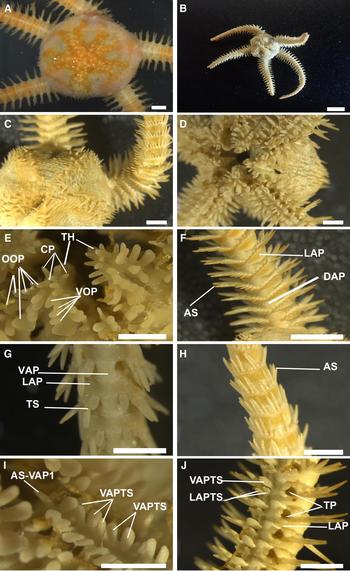
Disc sack-like, globose, completely covered by fine scales, with pointed spines in the inter-radial areas, smaller but more broadly distributed on the ventral side (Figure 2A–D). Radial shields absent. Disc diameter 4.9–6.5 mm, disc height 3.4–5.2 mm, length of the arms 3–3.2 times disc diameter. Jaw width similar to jaw length. Teeth large, flat and broad, resembling a leaf, distally ending in a point (Figure 2E). Below teeth, there are three spine-like crest papillae, the one in the centre follows the alignment of teeth and is flanked by the other two which are in line with the outer row of oral papillae covering the edge of each oral plate. Another row of oral papillae covers the ventral surface of each oral plate. First (most proximal) oral papilla on the outer row of papillae with similar shape to crest papillae, then second, third, fourth, fifth and sixth become progressively larger and flatter, the sixth much wider than the fifth, almost triangular and located between the edge and ventral surface rows of oral papillae; ventral surface row of papillae with four oral papillae, similar in size and shape to fourth papillae in the edge row, blunt and slightly flattened; outer row of oral papillae oriented upwards and perpendicular to oral plate edge, while oral papillae on the ventral surface of the oral plate usually oriented upwards and backwards to the disc edge (Figure 2E). After removing mouth papillae, a small diamond shaped oral shield can be seen; adoral shields small and triangular, not touching. Arms often rising up to the dorsal side, sometimes covering the sack-like disc in some of the preserved individuals. Proximally, dorsal arm plates about 2.5 times wider than long, shortly separated from one another (Figure 2F); distally almost as wide as long, more rounded and widely separated. Lateral arm plates meeting dorsally and ventrally except in the first two segments where they are separated dorsally by the dorsal arm plates (Figure 2F, G). Arm spines present on lateral arm plates, which completely cover the dorsal surface of the arms except for the two first segments; from the third segment, the gap of spines where the lateral arm plates meet is very narrow and similar to gaps between any two contiguous spines; 11 arm spines proximally, dorsalmost first to sixth smaller than the rest and gradually increasing in size but seventh almost twice as long as sixth, eighth the longest, 8–11 the largest ones and a little flattened; distal arm segments usually with 9–10 arm spines, gradually decreasing the difference between the length of inner and outer ones, all arm spines very similar in length from the 15–16 segment onwards (Figure 2H). First to third ventral arm plates almost contiguous, third to fourth clearly separated and becoming gradually more separated distally, 10th and 11th already separated by around half of the ventral arm plate length; ventral arm plates with very concave sides, distally axe shaped, distal width slightly larger than length of the plate. Third tentacle pores with two large flattened spatulate tentacle scales laterally projecting over the tentacle pore from each side of the ventral arm plate, a fifth scale is on the apex of the ventral plate, projecting to the mouth opening; fourth tentacle pores with three large flattened spatulate tentacle scales projecting laterally over the tentacle pores from each side of the ventral arm plate (Figure 2I); fifth tentacle pores with two tentacle scales projecting laterally over the tentacle pores from each side of the ventral arm plate and two smaller spatulate tentacle scales, distally oriented, on the lateral arm plate; sixth to 13th–14th tentacle pores with one tentacle scale projecting laterally over the tentacle pores from each side of the ventral arm plate and two tentacle scales on the lateral arm plate (Figure 2J); beyond, ventral arm plates do not bear any tentacle scale while two tentacle scales are present on the lateral arm plate, one of which is lost closer to the arm tips where only one leaf-like tentacle scale on the lateral arm plate is left (Figure 2F). Colour of individuals alive generally white but lateral arm plates and upper part of the disc orange, particularly the inter-radial areas; colour of specimens preserved in ethanol is white-yellowish (Figure 2A, B).
Photographs of the Ophiomyces grandis specimen CFM7020 collected from the Mallorca Channel seamounts showing: the individual alive (A), the individual preserved in ethanol (B), dorsal view of the disc (C), ventral view of the disc (D), jaws (E), dorsal view of the proximal portion of the arm (F), ventral view of the distal portion of the arm (G), dorsal view of the distal portion of the arm (H), ventral view of the proximal portion of the arm (I) and the ventral view of the middle portion of the arm (J). Scale bar represents 1 mm in all photographs except in 2B (30 mm). AS, arm spines; CP, crest papillae; DAP, dorsal arm plates; LAP, lateral arm plate; LAPTS, lateral arm plate tentacle scale; OOP, outer row of oral papillae; TH, teeth; TP, tentacle pore; TS, tentacle scale; VAP, ventral arm plate; AS-VAP1, apical scale on first ventral arm plate; VOP, row of oral papillae on the ventral surface of the oral plate; VAPTS, ventral arm plate tentacle scale.

Remarks
The examined specimens from the Mallorca Channel seamounts are similar to the description of the O. grandis holotype from Tristan da Cunha by Lyman (Reference Lyman1879), and its redescription by Paterson (Reference Paterson1985). It differs from Paterson's (Reference Paterson1985) redescription in the proportions of the ventral arm plates, longer than wide in that case and slightly wider than long in our samples. However, Lyman (Reference Lyman1879) for the holotype described it as ‘about as broad as long’ on the fourth ventral arm plate. Our specimens differ also from Paterson (Reference Paterson1985) in the number of arm spines, nine in the holotype, whereas we counted 11 proximally and 9–10 distally. Lyman (Reference Lyman1879) reported 11 arm spines. Our specimens match well with the description of the Tasmanian record by O'Hara (Reference O'Hara1990) except for the number of papillae on the ventral side row of the oral plates, two in O'Hara's description vs four in our specimens.
Genetics
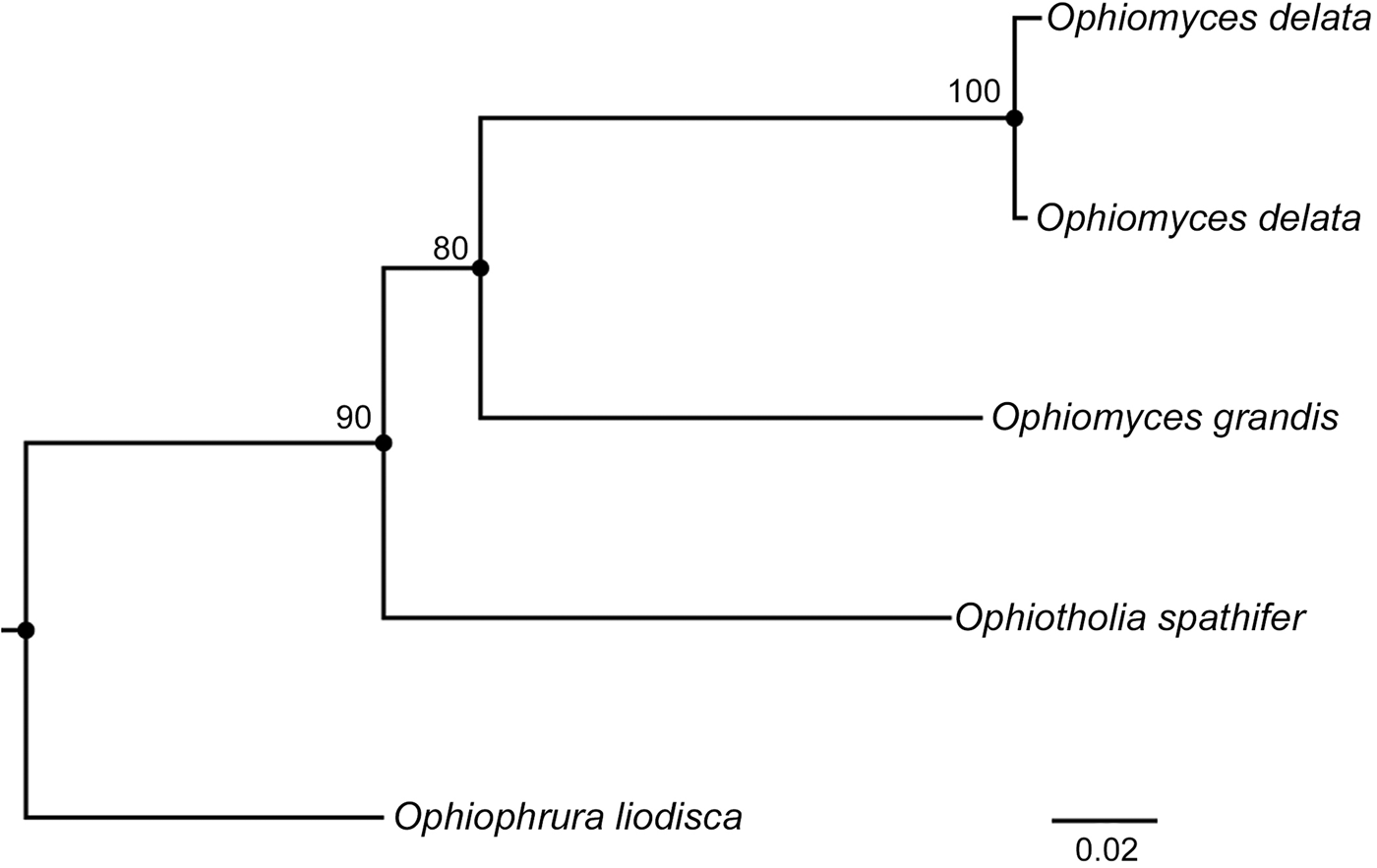
A fragment of 530 base pairs (bp) of the COI mitochondrial gene was sequenced for the specimen studied. The nucleotide frequencies were T = 29.06, C = 27.17, A = 24.72 and G = 19.06. High values of genetic distance as well as a high number of base pairs differences were detected between O. grandis and O. delata specimens (p-distance = 17.3/17.7% and bp differences = 92/94). Larger values were detected when comparing O. grandis and O. spathifer (p-distance = 18.8% and bp differences = 100). The neighbour-joining tree showed two clades, with an 80% bootstrap support, within the Ophiomyces genus, corresponding to O. delata and O. grandis (Figure 3). These results supported the morphological identification of O. grandis.
Neighbour-joining tree based on the cytochrome c oxidase subunit I (COI) fragment including the Ophiomyces grandis specimen CFM7020 collected from the Mallorca Channel seamounts. Bootstrap values are shown as percentages and are indicated near the nodes.

Ecology
The species was collected on the three seamounts sampled. The bathymetric distribution of its occurrences ranged from 124 to 312 m. None of the five beam trawl samples collected deeper (i.e. from 446 to 759 m depth) caught any specimen of O. grandis. When present, the abundance of O. grandis ranged between 3 and 66 specimens per 500 m−2. The highest abundances, 23, 53 and 66 specimens per 500 m−2, were recorded at 275, 242 and 312 m depth at Ses Olives, Ausias March and Emile Baudot seamounts, respectively.
The associated fauna accompanying O. grandis varied depending on the depth and seamount. In Ses Olives seamount, the most abundant accompanying species in the sampling stations at 275 and 290 m depth were Porifera (Thenea muricata (Bowerbank, 1858) and some species pending to determine) and the decapod crustaceans Ebalia nux A. Milne-Edwards, 1883, and Plesionika edwardsii (Brandt, 1851), the echinoderms Dictenophiura carnea (Lütken, 1858), Ophiocten abyssicolum (Forbes, 1843) and Pseudostichopus occultatus von Marenzeller, 1893, and the Polychaeta Hyalinoecia tubicola (O.F. Müller, 1776).
On the Ausias March seamount, 67 individuals of O. grandis were collected at 242 m depth, representing more than half of the total number of individuals of all species collected in that sample. The most abundant accompanying benthic species at this station were the decapod crustaceans Munida speciosa von Martens, 1878 and Plesionika antigai Zariquiey Álvarez, 1955, and the Polychaeta H. tubicola. In contrast, on this seamount, but at 124 m depth, where only four specimens of O. grandis were collected, they were mainly accompanied by the decapod crustaceans Aegaeon lacazei (Gourret, 1887), Ergasticus clouei A. Milne-Edwards, 1882 and Pagurus prideaux Leach, 1815, the Polychaeta Spirobranchus triqueter (Linnaeus, 1758) and the echinoderm O. abyssicolum.
On the Emile Baudot seamount, the most abundant accompanying species of O. grandis in the samples collected at 138 and 146 m depth were the decapod crustaceans Inachus dorsettensis (Pennant, 1777), E. clouei and E. nux, the brachiopod Gryphus vitreus (Born, 1778), and the echinoderm Cidaris cidaris (Linnaeus, 1758). In this seamount, at 312 m depth, the deepest sample station where O. grandis was collected, it was the most abundant species with 89 specimens caught (21% of the total number of individuals of all species). At this station O. grandis was accompanied mainly by the echinoderms P. occultatus, D. carnea and Amphiura filiformis (O.F. Müller, 1776), and the decapod crustaceans E. clouei and P. antigai.
Discussion
According to Galil & Zibrowius (Reference Galil and Zibrowius1998), the first scientists who studied the biological communities of seamounts in the Mediterranean, these geomorphological structures can be considered as islands, biogeographically separated from the continental coasts by great depths. These authors suggested that seamounts may serve as isolated refuges for relict populations of species that have disappeared from a previously larger distribution range. This may be the case of Ophiomyces grandis in the Mediterranean. However, it may also be that seamount communities are more connected through dispersal than previously thought, as suggested by Clark et al. (Reference Clark, Rowden, Schlacher, Williams, Consalvey, Stocks, Rogers, O'Hara, White, Shank and Hall-Spencer2010) (and references therein), and that O. grandis has evolved to live in these geomorphological isolated features. Its reported distribution is almost exclusively from isolated islands or seamounts mainly in the Atlantic Ocean such as Tristan da Cunha, Rockall Trough or the Galicia Bank (Lyman, Reference Lyman1879; Paterson, Reference Paterson1985; Litvinova, Reference Litvinova, Kuznetsov and Zezina2001; Serrano et al., Reference Serrano, Cartes, Papiol, Punzón, García-Alegre, Arronte, Ríos, Lourido, Frutos and Blanco2017), although it has also been reported from the Bass Strait in south-east Australia (O'Hara, Reference O'Hara1990).
The high abundances of O. grandis detected in the present work are evidence that the population is well established in the Mallorca Channel seamounts and that the Mediterranean should be considered within species' distribution range. It also suggests that O. grandis is probably present in other Mediterranean seamounts, although it seems to be absent from Mediterranean continental deep-sea areas (Koukouras et al., Reference Koukouras, Sinis, Bobori, Kazantzidis and Kitsos2007; Mecho et al., Reference Mecho, Billett, Ramírez-Llodra, Aguzzi, Tyler and Company2014; Öztoprak et al., Reference Öztoprak, Doğan and Dağli2014; Moya-Urbano et al., Reference Moya-Urbano, Moya, Mateo-Ramírez, Gallardo-Núñez, Ordines, Farias, Manjón-Cabeza, Urra, Rueda and Ruiz2016). The abundance of seamount-like features in the Mediterranean is considered large and was estimated to be composed of about a hundred of these structures that occupy a large area of about 89,000 km2 (Morato et al., Reference Morato, Kvile, Taranto, Tempera, Narayanaswamy, Hebbeln, Menezes, Wienberg, Santos and Pitcher2013). Despite their importance, Mediterranean seamounts are poorly known, with in situ information only available for less than 10% of them and mainly consisting of geological investigations, with almost no biological and ecological studies until the end of the 20th century, except for the Erastothenes seamount in the Levant basin (Galil & Zibrowius, Reference Galil and Zibrowius1998; Danovaro et al., Reference Danovaro, Company, Corinaldesi, D'Onghia, Galil, Gambi, Gooday, Lampadariou, Marco Luna, Morigi, Olu, Polymenakou, Ramirez-Llodra, Sabbatini, Sardà, Sibuet and Tselepides2010).
This situation has changed during the last decade when research surveys have been conducted in scattered seamounts mainly located in the Alboran Sea, around the Balearic Islands and the Tyrrhenian Sea (Danovaro et al., Reference Danovaro, Company, Corinaldesi, D'Onghia, Galil, Gambi, Gooday, Lampadariou, Marco Luna, Morigi, Olu, Polymenakou, Ramirez-Llodra, Sabbatini, Sardà, Sibuet and Tselepides2010; Bo et al., Reference Bo, Bertolino, Borghini, Castellano, Covazzi Harriague, Gioia Di Camillo, Gasparini, Misic, Povero, Pusceddu, Schroeder and Bavestrello2011; Sabatini et al., Reference Sabatini, Follesa, Locci, Matta, Palmas, Pendugiu, Pesci and Cau2011; Aguilar et al., Reference Aguilar, Pastor, Garcia, Marin and Ubero2013; De la Torriente et al., Reference De la Torriente, Serrano, Fernández-Salas, García and Aguilar2018). These surveys mainly used Remote Operated Video (ROV) and grabs in order to sample the benthic and demersal communities, although bottom trawl was also used in the Baronie seamount, in the Tyrrhenian Sea, central Mediterranean (Sabatini et al., Reference Sabatini, Follesa, Locci, Matta, Palmas, Pendugiu, Pesci and Cau2011). These studies have considerably increased the benthic biodiversity knowledge of Mediterranean seamounts, particularly for the Seco de los Olivos, Seco de Palos and Mallorca Channel seamounts in the western Mediterranean and for the Vercelli seamount in the Tyrrhenian Sea (Anon, 2011; Bo et al., Reference Bo, Bertolino, Borghini, Castellano, Covazzi Harriague, Gioia Di Camillo, Gasparini, Misic, Povero, Pusceddu, Schroeder and Bavestrello2011; Aguilar et al., Reference Aguilar, Pastor, Garcia, Marin and Ubero2013; Maldonado et al., Reference Maldonado, Aguilar, Blanco, García, Serrano and Punzón2015). Despite the abundance of O. grandis reported in the present work, none of the faunistic lists resulting in the mentioned works reported the presence of O. grandis, neither in Ses Olives, Ausias March nor Emile Baudot seamounts, where more than 20 hours of video were recorded (OCEANA, 2011). Perhaps a hiding behaviour could explain the absence of this species from ROV images, or maybe it was one of the Ophiuroidea species reported as no identified ophiuroids (OCEANA, 2011). To our knowledge, beam trawl has only been used once before to sample seamounts in the Mediterranean, in the Erastothenes seamount, where a single one hour beam trawl sample was performed (Galil & Zibrowius, Reference Galil and Zibrowius1998). Only one echinoderm species, Odontaster mediterraneus (von Marenzeller, 1893), was reported from that sample. Contrastingly, in our beam trawl samples, the echinoderms were the most abundant (a total of 983 individuals were collected) and diverse (35 species) group of mobile benthic fauna after crustaceans (1878 individuals belonging to 49 species), evidence that the Mallorca Channel seamounts represent a suitable environment for echinoderms, and particularly for O. grandis, which was among the dominant species in several of the samples where it appeared. It is also remarkable that the shallowest depth of occurrence of O. grandis in the Mallorca Channel seamounts, 124 m, may be the shallowest record ever reported for this species, and also, one of the shallowest records for the Ophiomyces genus, except for the exceptionally shallow records of O. delata and O. papillospinus, from the Andaman Islands and Japan, respectively (Parameswaran et al., 2015; Okanishi et al., Reference Okanishi, Sentoku, Fujimoto, Jimi, Nakayama, Yamana, Yamauchi, Tanaka, Kato, Kashio, Uyeno, Yamamoto, Miyaza and Asakura2016).
The overlapping distribution of O. grandis and O. delata in the Pacific Ocean and the large coincidences in their morphological traits led Parameswaran et al. (Reference Parameswaran, Jaleel, Gopal, Sanjeevan and Vijayan2015) to suggest that these two species were synonyms or that they represented a species complex. However, the genetic differences observed in the present study between O. grandis and O. delata confirm the validity of both species.
The assessment of benthic species richness on seamounts can be strongly influenced by the sampling methodology applied (Pitcher et al., Reference Pitcher, Morato, Hart, Clark, Haggan and Santos2007), with extractive sampling yielding broader estimation of biodiversity, as well as the possibility of obtaining individuals for genetic analyses (Williams et al., Reference Williams, Althaus and Schlacher2015). Our results emphasize the importance of beam trawl sampling in seamounts biodiversity research. This is not always possible due to the often rough geomorphology of seamounts. However, when possible, in sedimentary bottoms, this type of sampling can be a useful tool, which in combination with ROV and other image acquisition methodologies can provide a more realistic picture of the biodiversity of seamounts' benthic communities.
Acknowledgements
This research has been developed within the project LIFE IP INTEMARES. We are very grateful to Dr Ben Thuy and two anonymous reviewers whose comments and suggestions have greatly contributed to improve this manuscript. We also thank all participants in the survey INTEMARES MALLORCA0818 and the Captain and crew of the RV ‘Ángeles Alvariño’.
Financial support
This study was funded by the project LIFE IP INTEMARES. Sergio Ramírez-Amaro is supported by a postdoctoral contract co-funded by the Regional Government of the Balearic Islands and the European Social Fund.