


1 Introduction
Metathesis usually refers to the transposition of two segments, although the term has also been used more generally to refer to any reordering of linear segments (Hume Reference Hume2001, Blevins & Garrett Reference Blevins, Garrett, Hayes, Kirchner and Steriade2004, Chandlee Reference Chandlee2014, Canfield Reference Canfield2015). Unlike phonological processes such as epenthesis or deletion, metathesis has often been described as a ‘sporadic’ and ‘non-regular’ pattern, because of its rarity (Montreuil Reference Montreuil1981, Powell Reference Powell, Acson and Leed1985). However, other work has claimed that metathesis shares its computational properties with other commonly discussed phonological processes (Chandlee Reference Chandlee2014), and can be readily analysed within the Optimality Theory framework (e.g. Buckley Reference Buckley, van Oostendorp, Ewen, Hume and Rice2011, Canfield Reference Canfield2015; see Chandlee Reference Chandlee2014 for a computational analysis of metathesis).
Examples of synchronic metathesis come from languages such as Rotuman, Leti, Palestinian Arabic, Fur and Hebrew (Canfield Reference Canfield2015). Almost all of the attested synchronic metathesis cases involve adjacent segments. Synchronic long-distance metathesis, involving non-adjacent segments, is rare at best, and limited to a few cases involving affixation. Both CC and CV(VC) metathesis involving various segments are attested, while VV metathesis has been claimed not to exist (McCarthy Reference McCarthy2000, Mielke & Hume Reference Mielke and Hume2001, Canfield Reference Canfield2015; cf. historical V1CV2 > V2CV1 metathesis in Hawu (Blust Reference Blust2012)). In languages such as Rotuman and Kwara'ae, the segments involved in CV reordering encompass the entire consonant and vowel inventories. However, in most observed synchronic cases of CC reordering, the segments involved are restricted to some natural class of consonants.Footnote 1
In this paper, I propose a Harmonic Serialism (HS) analysis in which transposition is not an operation that is made available by Gen; attested synchronic metathesis must be analysed in HS as a combination of operations, rather than as a single reordering operation. This analysis utilises the notion of copy and deletion operations for metathesis that have been suggested in the literature, but formalises them as splitting and fusion. I will show that almost all of the metathesis patterns can be described as a combination of split and fuse operations; some patterns require first splitting and then fusion, while others require the opposite order. Although generally not assumed in the HS framework (McCarthy Reference McCarthy, Blaho, Bye and Krämer2007b), it is demonstrated in this paper that this combination of operations relies crucially on incorporating indices into the representation. The analyses presented, together with comparisons to both parallel and serial analyses with reordering, show that an HS analysis without reordering captures certain generalisations rather elegantly (see §3.4 and §6); these generalisations are otherwise difficult to incorporate if segment reordering is an atomic operation.
Previous parallel OT analyses of metathesis treat the relevant phonological operation as segment reordering, an operation which violates the faithfulness constraint Linearity. However, it has been argued that Linearity poses both conceptual and empirical problems (Carpenter Reference Carpenter, Carpenter, Coetzee and de Lacy2002, Heinz Reference Heinz2005a, Canfield Reference Canfield2015); notably, the analysis of metathesis in parallel OT in terms of Linearity alone overgenerates. In each case, a family of faithfulness constraints is necessary to generate the correct patterns (see §2–§4). In contrast, a derivational version of Optimality Theory, Harmonic Serialism (McCarthy & Pater Reference McCarthy and Pater2016), has been argued to correctly rule out unattested patterns such as those involving long-distance metathesis (McCarthy Reference McCarthy2007a).
Unlike parallel OT, which assumes a direct mapping from the input to the output, HS assumes a series of intermediate stages in the process of deriving surface forms. One of the major differences between parallel OT and HS lies in Gen. Candidates generated by Gen in HS can be only minimally different from the input at each stage. In other words, only one operation can be applied to the input to generate each candidate. At each intermediate stage, harmony must improve (McCarthy Reference McCarthy2010). McCarthy (Reference McCarthy2007a) shows that this gradualness blocks long-distance metathesis, which has been argued to be unattested synchronically, solving the empirical problem with Linearity found in parallel OT.
However, whether or not segment reordering is a primitive operation in Gen is an open question. Compared to operations such as deletion and epenthesis, which are cross-linguistically widely attested, metathesis is observed less frequently (Mielke & Hume Reference Mielke and Hume2001). In addition, there is an asymmetry between the segments involved in CV and CC metathesis. While many CV metathesis operations involve a language's entire segment inventory, CC metathesis is typically limited to specific consonants. This asymmetry cannot be explained by the Linearity constraint, since it does not impose restrictions on segments that can be reordered.
Accounting for metathesis via the application of sequential operations has previously been proposed in the literature. Postal (Reference Postal1969) and Michelson (Reference Michelson1988) analyse [CVɁ] sequences in Mohawk as underlyingly /CɁV/, and characterise the alternation between the two as involving copy and deletion. Blevins & Garrett (Reference Blevins and Garrett1998: 527) offer a diachronic analysis of prosodically conditioned consonant–vowel metathesis patterns as ‘vowel-to-vowel coarticulation in VCV sequences’ followed by ‘unstressed vowel reduction and loss of the peripheral vowel’, which can be seen as evidence for the sequential operations involved in synchronic analysis.
Further support for the sequential operation view comes from optional output forms found in Kwara'ae, a language with synchronic CV metathesis. The language has two possible outputs for /CVCVx/, viz. [CVVxC] and [CVVxCVx], with a final voiceless vowel in certain contexts (Blevins & Garrett Reference Blevins and Garrett1998, Heinz Reference Heinz2004). These optional outputs can be viewed as evidence for the intermediate winner retaining a copied vowel CVVxCVx, with the original vowel not being completely deleted (see §3).
Finally, in order to show that metathesis is phonologically no more complex than phonological operations such as deletion and epenthesis, Chandlee (Reference Chandlee2014) provides a survey of metathesis cases that can be analysed as involving copy followed by deletion. Her analysis successfully derives the correct metathesis patterns in a finite-state transducer, and demonstrates that differences in computational complexity coincide with the difference between diachronic and synchronic metathesis. Her cross-linguistic survey of metathesis supports the decomposability of metathesis into a series of operations. The HS analysis to be presented here provides a more complete analysis of CV metathesis in Rotuman and Kwara'ae, successfully accounting for a wider range of cases, including deletion, umlaut and multiple metathesis.
My analysis provides a formal analysis of such processes in HS, presented as a combination of splitting and fusion. To the best of my knowledge, this has not previously been attempted in the literature. I will argue that all metathesis patterns arise from a combination of splitting and fusion, although the order of the application of these operations may differ between languages. I will also show that, in order to analyse split and fuse operations (or vice versa) in the HS framework, coindexation needs to be allowed as a part of the representation.
In §2, I propose a unified Harmonic Serialism analysis of phase alternations in Rotuman involving split and fuse. I contrast this analysis with a previous parallel OT analysis in which three separate phonological phenomena, metathesis, deletion and umlaut, are claimed to be involved in the phase alternations. In §3, I account for locality restrictions on Kwara'ae metathesis by restricting the splitting domain to a foot, which in turn accounts for the observed direction of the operation. In §4, an assessment of transposition vs. non-transposition analyses in HS provides further support for the transposition-free approach. An investigation of various consonant–consonant metathesis patterns, with sequential fusion and splitting operations, is provided in §5, and a discussion and conclusion follow in §6.
2 Split and fuse: Rotuman
In this section I provide a unified analysis of three types of alternations in Rotuman, an Austronesian language which is spoken primarily in the Fijian island group that includes Rotuma, and which shows metathesis, deletion and umlaut. I demonstrate how split and fuse operations can be carried out in Harmonic Serialism, thereby accounting for all of the patterns observed.Footnote 2
2.1 Rotuman phase alternations
The alternation between ‘complete’ and ‘incomplete’ phases (Churchward Reference Churchward1940, Besnier Reference Besnier1987, Blevins Reference Blevins1994, Hale & Kissock Reference Hale and Kissock1998, McCarthy Reference McCarthy2000) involves metathesis (1a), as well as deletion (1b) and umlaut (1c). I will analyse all three patterns as split and fuse, which in the cases of (b) and (c) are then followed by further fusion if the sonority of the final vowel is not greater than the sonority of the penultimate vowel.
(1)


While differences between these two types of phases are considered to be morphological or syntactic by Churchward (Reference Churchward1940) and McCarthy (Reference McCarthy1995), among others, McCarthy's (Reference McCarthy2000) analysis of phase alternation in Rotuman assumes that the alternations are phonological phenomena (also see Hale & Kissock Reference Hale and Kissock1998). Complete phase forms are generally found preceding monosyllabic suffixes or clitics, while incomplete phase forms are used before polysyllabic suffixes or clitics. Although it is intriguing to contemplate the incorporation of these differences in suffix length in the analysis, for the sake of simplicity I examine the words in the two phases in isolation. I also follow Hale & Kissock (Reference Hale and Kissock1998) and McCarthy (Reference McCarthy2000) in assuming that both phases are derived from an underlying representation that is identical in relevant respects to the surface form in the complete phase.
Since Rotuman stress is trochaic, and the incomplete phase always ends in a stressed syllable, stressed syllables in incomplete phase words are always heavy, so as to satisfy the Stress-to-Weight principle (SWP; Prince 1990). I assume that coda consonants are moraic (see McCarthy Reference McCarthy2000 for arguments for assigning a mora to codas), making CVC syllables heavy.
If the last two vowels in a word have rising sonority, the last CV in the word undergoes metathesis. When the two vowels do not rise in sonority, either the last vowel does not surface in the output (apparent deletion), or the two vowels coalesce (umlaut), depending on the vowels involved. The umlaut cases are observed only with sequences of back + front vowels.
2.2 Proposal
I propose that all of the alternation patterns result from split and fuse operations driven by the constraints in (2a) and (b), SWP and Final Stress (Inkelas Reference Inkelas, Kager, van der Hulst and Zonneveld1999). Having these markedness constraints dominate Integrity and Uniformity in (c) and (d) allows an intermediate stage with two identical vowels straddling the stressed vowel, although this form does not surface as the final output.
(2)

The derivations presented here assume that stress is first assigned by high-ranked prosodic constraints (not shown in this section). With the constraint SWP undominated, the first step of the derivation (after stress assignment) outputs the intermediate winner /ˈpu1re2/ → [ˈpu1e2re2] through vowel splitting, as shown in (3). This is an operation which some have previously seen as copying. However, to make it clear that the constraint violated by the operation is Integrity, not Dep, I will use the term splitting. I assume Max is also undominated in this language, prohibiting deletion of a segment (apparent ‘deletion’ cases in the incomplete phase will be discussed below). Vowel splitting violates Integrity (McCarthy & Prince Reference McCarthy and Prince1995), which prohibits an input segment from having multiple corresponding segments in the output. I assume that, although Integrity bans coindexed output segments that have a single corresponding segment in the input, the second appearance of the segment does not violate general Dep, since the segment has an input correspondent (Staroverov Reference Staroverov2014). Although (3b) violates FinalStress, because the stressed syllable /ˈpue/ is not the final syllable of the word, it still emerges as the winner at this stage, since the stressed syllable is heavy and the SWP requirement is met without deletion of the final V.Footnote 3
(3)
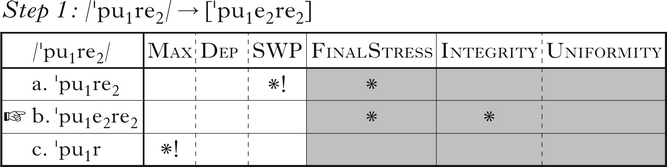
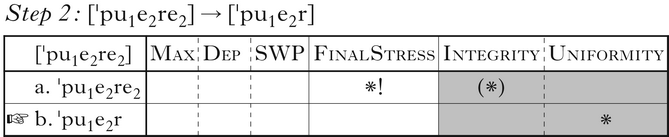
In the next step, in (4), [ˈpu1e2re2] → [ˈpu1e2r], the faithful candidate [ˈpu1e2re2] loses, due to its violation of FinalStress. The fusion of the coindexed vowels does not violate Max, since each input segment coindexed with ‘2’ does have a corresponding segment in the output (for correspondence involving a copied segment, see Stanton & Zukoff Reference Stanton and Zukoff2016). I assume here that the winning candidate created by fusion violates Uniformity, since the two coindexed segments in the input have one corresponding segment in the output (McCarthy & Prince Reference McCarthy and Prince1995).
(4)
McCarthy (Reference McCarthy2016: 62–63) questions the need for indexation in Harmonic Serialism. It is generally assumed that the operation at each stage can only ‘see’ the input at the current stage of the derivation. Utilising indices throughout the HS derivation diverges from common practice in standard HS (see McCarthy Reference McCarthy2016). However, maintaining faithfulness to the UR throughout the derivation in HS has been proposed previously (e.g. Hauser et al. Reference Hauser, Hughto and Somerday2015). Along with the perspective that additional faithfulness might still be required in HS, I postulate that split (copied) vowels have a special status, and are marked as copies of each other. This assumption is at the crux of the analysis here.
Apparent deletion cases such as /ˈra1ko2/ → [ˈra1,2k] can also be analysed as split and fuse, followed by further vowel fusion. The proposed derivational path is shown in (5), which employs an adapted version of the HS tableaux presented in Pruitt (Reference Pruitt2012). The second column shows the derivation from the UR to the final output, with the arrow in each row representing the winner at each step. Only constraints crucial to the derivation are given in (5). LightDiph bans a VV sequence of non-rising sonority in a closed syllable (McCarthy Reference McCarthy2000). Although fusing two vowels together violates Uniformity, the constraint ranking derives [ˈra1,2k] with a fused vowel as the most harmonic output.
(5)

Support for the fusion analysis comes from umlaut cases such as /ˈho1ti2/ → [ˈhø1,2t]. The steps shown in (6) proceed through the same stages as the derivation of /ˈra1ko2/ to [ˈra1,2k] in (5). The only difference is the change in vowel quality observed in the final output.
(6)

The three phase-alternation patterns have been analysed in the literature as involving three different processes (metathesis, deletion and umlaut), although some analyses involve copy and deletion (Chandlee Reference Chandlee2014). What is novel in the current analysis is the unification of metathesis, deletion and umlaut as all undergoing the same split and fuse operations.
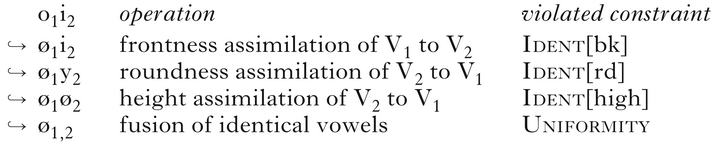
While there is a strong appeal to such unification, the final vowel fusion in (6) (/o1i2/ → [ø1,2]) requires further investigation. While Fallon (Reference Fallon1998) suggests that fusion is a primitive operation, others consider it to be the result of assimilation followed by deletion (e.g. Aoki Reference Aoki1974). As we have seen, high-ranked Max eliminates the possibility of analysing fusion as assimilation and deletion. However, analysing fusion as an operation is problematic in HS, since fusing two segments into one violates more than one Ident constraint. As McCarthy (Reference McCarthy, Blaho, Bye and Krämer2007b) notes, if we assume that Gen can only perform one unfaithful mapping at a time, a fused vowel cannot appear as a candidate in a HS derivation. Although detailed analysis of vowel fusion in HS requires further investigation, it is possible to view fusion in Rotuman /o1i2/ → [ø1,2] as a gradual series of assimilation operations, followed by fusion of identical vowels, as in (7). In this approach, only one faithfulness violation is introduced at each step. Since vowel fusion in split and fuse affects a coindexed identical vowel, limiting it to identical vowels ties together the two types of vowel fusion explored in this section (one being part of metathesis and the other part of vowel coalescence). How fusion should be analysed in the HS framework has not been examined rigorously in the literature (McCarthy Reference McCarthy2016: n. 8). It has therefore been tacitly assumed that fusion is an operation that violates Uniformity, an assumption that I adopt for the most part in this paper. However, a series of assimilations followed by fusion of an identical segment is another way to incorporate the fusion of two segments in HS.
(7)
Another potential concern regarding the present analysis is the use of coindexation in the HS framework. It might be argued that coindexation requires keeping each step in memory. However, the current analysis requires output coindexation, rather than input–output indexation. As noted in McCarthy (Reference McCarthy2016: 62), faithfulness constraints can look back to the input of the most recent application of Gen; in order to create candidates, the most recent input still has to be referred to. Therefore, coindexation simply indicates that the segments involved had the same input at the previous stage. The correspondence between coindexed elements is important at the splitting stage (see Rose & Walker Reference Rose and Walker2004, Stanton & Zukoff Reference Stanton and Zukoff2018). These coindexed elements are then evaluated at the next step, but there is no need for the system to remember the input/output correspondences at each step. (8) shows the schematic representation of coindexation. This is almost identical to the representation in Stanton & Zukoff (Reference Stanton and Zukoff2018), even though their analysis is carried out in parallel OT. At step n, one input vowel, Vx, is split into the two coindexed output vowels. Since the two output vowels maintain their correspondence with the input, there is no Dep violation. Similarly, at step n+1, both of the input vowels correspond to the output vowel, and thus, since the Vx in the output has a correspondent segment in the input, general Max is not violated.Footnote 4
(8)

2.3 Parallel OT analyses
In contrast to the analysis outlined above, McCarthy's (Reference McCarthy2000) parallel OT analysis of Rotuman phase alternation depends on the ranking LightDiph, FinalStress ⪢ Max ⪢ Linearity to account for both metathesis and deletion cases. A summary tableau, adapted from McCarthy (Reference McCarthy2000: 175), is shown in (9).
(9)

However, as pointed out in Carpenter (Reference Carpenter, Carpenter, Coetzee and de Lacy2002), this constraint ranking does not rule out a problematic candidate such as [ˈro2a1k], with long-distance metathesis, as shown in (10). The intended winner, [ˈra1k], loses to candidate (e). Despite the two violations of Linearity, [ˈro2a1k] does not violate the markedness constraints or Max.
(10)

Consideration of candidates such as (e) leads Carpenter (Reference Carpenter, Carpenter, Coetzee and de Lacy2002) to conclude that Linearity alone cannot block reordering of segments that span a certain distance. She proposes a family of Adjacency (domain) constraints, i.e. faithfulness constraints that require ‘segments or features to maintain, in the output, the immediate proximity found in the input’ (2002: 5). This specified domain treats various metathesis types differently. For instance, Carpenter utilises I-Adjacency(σ), a constraint which requires that segments within an input syllable remain adjacent to each other in the output, to account for the Rotuman metathesis patterns, successfully eliminating any non-adjacent metathesis candidate that does not surface in this language. The non-adjacent metathesis form in (10e) thus incurs two violation marks in (11e), since the adjacency between /r/ and /a/ and between /k/ and /o/ in the input is not maintained in the output (Carpenter assumes that the alternate form [ˈra1k] in the incomplete phase is derived from the complete form [ˈra1.ko2]).Footnote 5
(11)

The parallel OT analysis works by adopting a family of faithfulness constraints, without which it would be difficult to block unattested patterns. In the HS split and fuse analysis proposed here, however, splitting is only harmonically improved after stress assignment, in order to satisfy SWP. Splitting a vowel such that the two identical vowels straddle the stressed vowel (ˈV1V2 → V2ˈV1V2), as in /ˈra1ko2/ → [ro2ˈa1ko2] → [ro2ˈa1k] does not improve the weight of the stressed syllable, since [o2ˈa1] is not a well-formed heavy syllable. This type of vowel-over-vowel splitting is correctly blocked by the proposed ranking for Rotuman, but it may be universally prohibited, since it is cross-linguistically unattested.
The analysis of the Rotuman phase alternations provided in this section has shown that transposition is not needed as an operation in HS, and seemingly different alternation patterns all result from sequential split and fuse operations, as long as we allow coindexation. Unlike McCarthy's (Reference McCarthy2000) parallel OT analysis, in which Max has to be dominated by LightDiph, the ranking is crucially reversed in the HS analysis proposed here. Furthermore, a long-distance metathesis candidate such as *[ro2a1k], which necessitates the proliferation of a family of adjacency constraints in parallel OT, does not surface in the split and fuse HS analysis, because of the gradualness of Gen.
3 Locality restriction on metathesis: Kwara'ae multiple loci
McCarthy (Reference McCarthy2007a, Reference McCarthy, Blaho, Bye and Krämerb) illustrates how the gradualness of Gen in serial OT blocks unattested patterns such as double metathesis (/apekto/ → [paketo]) and long-distance metathesis (e.g. /art/ → [tar]). However, metathesis patterns with multiple loci of apparent transposition do exist in Kwara'ae, an Austronesian language spoken in the Solomon Islands. This section shows that HS split and fuse can account for such patterns, but that the splitting domain needs to be restricted to account for the locality of the apparent transposition.
3.1 Kwara'ae metathesis
Kwara'ae exhibits multiple metathesis in which sets of adjacent segments are transposed (e.g. /ketalaku/ → [ˈkeat.ˌlauk] ‘my height’; Heinz Reference Heinz2004, Reference Heinz2005a, b). The Kwara'ae pattern is unique, in that attested metathesised words contain up to three metathesis loci (e.g. /raɁeraɁenaɁa/ → [ˈraeɁ.ˌraeɁ.ˌnaaɁ] ‘incline, slope’). A parallel OT analysis of Kwara'ae metathesis is offered by Heinz (Reference Heinz2005a), with a family of Contiguity constraints. As I will show in this section, the attested patterns can be correctly derived by assuming split and fuse operations in HS.
Kwara'ae uses two different speech registers, ‘citation’ and ‘normal’. Forms in the two registers exhibit different phonotactics and stress patterns. In the normal register, vowel hiatus is prohibited, while a tautosyllabic vowel sequence is common. Onsets are required for non-word-initial syllables. The initial syllable of a word in the normal register always has primary stress, while the syllable containing the penultimate mora has secondary stress. The stress pattern observed is generally trochaic, but heavy–light disyllabic words are not found. The phonotactic differences between the two registers can be observed in the examples in (12), from Heinz (Reference Heinz2004).
(12)

I will follow Heinz (Reference Heinz2004) in assuming that citation and normal forms are derived from the same UR, and that this UR is generally identical to a stressless version of the citation form. Normal forms displaying metathesis are shown in (13).Footnote 6
(13)

3.2 Proposal
I demonstrate that, like the alternations in Rotuman, Kwara'ae metathesis involves split and fuse. The analysis of Kwara'ae metathesis as involving similar multiple operations is not new (see e.g. Blevins & Garrett Reference Blevins and Garrett1998, Chandlee Reference Chandlee2014). However, the complex multiple metathesis patterns have not been analysed in the Harmonic Serialism framework. I propose that the Kwara'ae metathesis patterns also result from split and fuse, but unlike in Rotuman, the patterns are driven by SWP and FootForm constraints.Footnote 7 The analysis is motivated by the following factors: (i) syllables that undergo apparent metathesis in the normal form are almost always heavy, (ii) feet are trochaic (Norquest Reference Norquest2001) and (iii) heavy–light disyllabic words do not occur.
Trochaic stress assignment takes place before splitting, since without stress assignment, there is no motivation for splitting. Subsequently, the unstressed vowel is split into two halves, with one appearing in the stressed syllable. The two split halves fuse back in the stressed syllable at the next step, as illustrated in (14).
(14)

The derivation of the Kwara'ae pattern becomes possible with the definition of the prosodic constraint *HL in (15a) and an Integrity constraint in (15b), *VαVα, which militates against the creation of two identical adjacent segments by splitting.
(15)

The derivational steps are given in (16).Footnote 8
(16)

The motivation for *VαVα comes from the following observations. All content words in in Kwara'ae are minimally CVV. The underlying CV sequence surfaces as a lengthened vowel CVxVx. However, a stressed vowel is not lengthened to make the syllable heavy when there is another vowel in the adjacent syllable that can split (/ˈsa1lo2/ → [ˈsa1o2lo2], not *[ˈsa1a1lo2]). I assume that *VαVα is responsible for this, and that violating it is only permitted if there are no other vowels to be split so as to satisfy word-minimality (similar patterns are observed in Rotuman). In other words, as a repair to satisfy SWP, splitting a vowel across a consonant is preferred to lengthening the vowel (i.e. splitting to create VαVα).
3.3 Kwara'ae multiple metathesis
The split and fuse analysis provided above also applies to more complex Kwara'ae cases. The unique aspect of the apparent metathesis patterns in Kwara'ae is that longer words can contain up to three loci of apparent CV transpositions, as shown in (17) (from Heinz Reference Heinz2004).
(17)

As stated above, I assume that stress assignment precedes split and fuse because of the higher ranking of the prosodic constraints in (18), which assign foot structure. This ranking will parse a bimoraic trochaic foot at the right edge, and then assign a main stress at the left edge. I propose that the apparent metathesis occurs in each foot, both to satisfy SWP and to avoid HL feet.
(18)

The derivations in (19) show pre-metathesis footed intermediate winners derived by the prosodic constraints. In the case of (c) /ketalaku/ → [(ˈketa)(ˌlaku)] and (d) /daroɁanida/ → [(ˈdaro)Ɂa(ˌnida)], each footed (ˈCVCV) undergoes split and fuse, one by one. The correct surface form is derived, regardless of which foot undergoes the process first.Footnote 9
(19)

Restricting the splitting domain to be foot-internal is crucial for deriving patterns such as (b) and (e). Since there are two stressed syllables, [ˈli] and [ˌma], without a splitting domain restriction, the second vowel could be split leftward to make the first stressed syllable heavy, as in *[ˈli1a2.ˌma2.ku3]. This is correctly blocked if we assume that a constraint prohibiting splitting across foot boundaries is active. Although such constraints may be unusual, there are numerous cases in which prosodic domains restrict the application of phonological processes. For instance, Jurgec (Reference Jurgec2011) notes that assimilation is in some cases restricted to particular prosodic domains. It is therefore reasonable to assume that an active constraint such as (20) restricts the splitting domain on the basis of a relevant prosodic boundary.Footnote 10
(20)

Along with *HL, this constraint ensures that the surface form is correctly derived, as shown in (21). SWP presumably motivates splitting of the unstressed vowel, with one of the split vowels becoming part of the stressed syllable, but splitting of the second syllable /a/ is blocked by the foot boundary. Similarly, vowel splitting that would create two identical adjacent vowels (i.e. lengthening) is also blocked by *VαVα.
(21)

Kwara'ae's multiple metathesis patterns are thus correctly derived in HS with split and fuse and the restriction of the splitting domain to the foot. Assuming a prosodic domain effect on splitting distance also ensures that long-distance metathesis (via long-distance splitting) does not arise. Consider the case of /li1ma2ku3/ → [(ˈli1)(ˌma2ku3)] → [(ˈli1) (ˌma2u3ku3)]; the split vowel /u3/ cannot be split again into the first stressed syllable *[(ˈli1u3)(ˌma2u3ku3)], since this would involve crossing a foot boundary.
3.4 Kwara'ae locality restrictions in parallel OT
Restrictions on the direction of a transposition and on the linear distance of the segments involved in metathesis have generally been handled using a family of constraints that imposes restrictions on which segments can be transposed. As discussed in §2.3, unattested long-distance metathesis candidates in Rotuman need to be blocked by a family of adjacency constraints in Carpenter (Reference Carpenter, Carpenter, Coetzee and de Lacy2002). Similarly, some patterns in Kwara'ae, such as the one in (21), are problematic, and require the postulation of additional constraints in parallel OT. This section summarises such cases. By comparing the HS analysis with the version of parallel OT presented here, I argue that the non-metathesis analysis is to be preferred, because it does not require an additional family of constraints to restrict the domain of transpositions, and the directionality is captured through active constraints in the language.
In Heinz's (Reference Heinz2004, Reference Heinz2005a, Reference Heinzb) parallel OT analysis of Kwara'ae metathesis, in which SWP outranks Linearity, a derivation such as /li1ma2u3mu4lu5/ → [ˈli1.ma2u3.ˌmu4u5l] is problematic, since this ranking would select [ˈli1a2.mu3.ˌmu4u5l] as the optimal candidate, with both of the two stressed syllables [ˈli] and [ˌmu] made heavy by two transpositions, as in (22) (Heinz Reference Heinz2005a: 202).
(22)

This problematic candidate motivates a family of Contiguity constraints. Observing that the VV sequence in Kwara'ae is never disturbed, while CV sequences are, Heinz (Reference Heinz2005a) argues that V-V MaxContig, which reinforces preservation of the contiguity between adjacent vowels, is ranked above SWP and the general Contiguity constraint, preventing the problematic candidate from surfacing. Candidate (23a) violates V-V MaxContig, because the /a-u/ contiguous string in the input is deleted in the output. The correct output form in (23b) is derived, although contiguous input strings are deleted and new ones created, thus violating general MaxContig and DepContig (Heinz Reference Heinz2005a: 205).
(23)

In comparison, the non-metathesis HS analysis does not require a family of additional constraints, since prosodic constraints that restrict the splitting domain take care of the undesirable candidates. The derivational path is given in (24): both *Vα)FtVα and *VαVα crucially dominate SWP.
(24)

Moreover, the foot-based split and fuse approach makes different predictions from the parallel OT analysis. One of the important generalisations in Kwara'ae multiple metathesis is that a vowel is always transposed leftwards (Blevins & Garrett Reference Blevins and Garrett1998, Heinz Reference Heinz2004). This fact is thought to be related to the cross-linguistic relationship between stress and CV/VC metathesis patterns (Heinz Reference Heinz2004). Heinz argues that in trochaic languages such as Kwara'ae vowels move to the left, whereas in iambic languages they move in the opposite direction. In fact, Blevins & Garrett's (Reference Blevins and Garrett1998: 538) analysis of diachronic change in Paman shows the pattern *V1CV2 > *V1CV1V2 > *V1CV1V2 > *CV1V2, in which the V1 is copied rightwards into the stressed syllable.
The parallel OT transposition analysis with Linearity alone cannot explain this directionality straightforwardly, since there is no restriction on which segments can be transposed. To account for this generalisation, Heinz (Reference Heinz2005a) speculates that these two kinds of languages differ in terms of the types of contiguous sequence that are allowed in the output: Kwara'ae and similar languages prohibit the creation of new CV transpositions. However, the underlying CV transitions do not need to display the same contiguity in the output. Although a family of contiguity constraints in Heinz (Reference Heinz2005a) derives correct metathesis patterns, it does not capture the generalisation about the locus of metathesis following from foot structure. For instance, in the case of the trimoraic word /fikuda/ ‘to gather them together’, a form such as [ˈhikˌdua] is not a possible surface form, even though it satisfies SWP and matches the possible prosodic pattern of the language (the correct form is [ˈhiˌkuad], which Heinz Reference Heinz2005a derives with contiguity constraints). The locus of the metathesis is most clearly determined by prosodic boundaries: it is the second CV of a disyllabic foot. This generalisation cannot be straightforwardly captured in a non-foot-based parallel OT analysis.
On the other hand, the analysis presented here correctly predicts that the vowel ‘movement’ (split and fuse) into the stressed syllable is leftward. This is because the default stress pattern is trochaic, and the SWP-motivated splitting of a vowel is restricted to the foot. This further correctly predicts that the opposite pattern would result in an iambic language (cf. Heinz Reference Heinz2005b).
The variation that exists in Kwara'ae normal forms provides another reason to prefer the HS analysis, without the transposition operation. In the normal form, a word such as [ˈmauɁ] ‘fear’ can also be realised as [ˈmauɁu̥], with a devoiced vowel.Footnote 11 In a parallel OT analysis of Kwara'ae, vowel splitting, violating Integrity, is independently required to deal with the optional forms (/maɁu/ → [ˈmauɁ] or [ˈmauɁu̥]). Although the optional form is believed to be related to the metathesised forms (Heinz Reference Heinz2004 calls it ‘partial metathesis’), Heinz derives the optionality using output–output correspondence between normal (metathesised) and optional forms in parallel OT. On the other hand, in the HS split and fuse analysis, the output can be derived by the same mechanism with partially ranked constraints (or in Stochastic OT; Boersma & Hayes Reference Boersma and Hayes2001).
The variation between [ˈmauɁ] and [ˈmauɁu̥] can be accounted for by incorporating Max-μ (Stanton & Zukoff Reference Stanton and Zukoff2018), which militates against the deletion of input moras, assuming that Max-μ and *HL are unranked. In the optional case, Max-μ is ranked above *HL, while in other cases the ranking is reversed. The final vowel is devoiced if not fused, in order to enhance the foot structure.
In this section, I have shown that a split and fuse analysis can be readily applied to Kwara'ae metathesis patterns. The analysis here accounts for multiple metathesis patterns involving various FootForm constraints that seem to be well supported in the language. Unlike the parallel OT analysis of Kwara'ae metathesis, the HS analysis with a restriction on the splitting domain can block problematic candidates without the need for a family of new constraints.
If the gradualness of Gen is responsible for blocking long-distance patterns, are there any advantages to analysing metathesis as split and fuse instead of transposition? Or is a HS transposition analysis correspondingly capable of deriving the correct patterns? The next section shows how Linearity is problematic even in a Harmonic Serialism framework.
4 Further support for non-transposition: reordering in HS
The data and arguments presented so far have demonstrated that in the HS analysis metathesis can be analysed without transposition. A comparison of the split and fuse analysis and the parallel OT transposition analysis of CV metathesis provided support for the HS analysis. McCarthy's (Reference McCarthy2007a, Reference McCarthy, Blaho, Bye and Krämerb) comparison of HS and parallel OT analyses of metathesis shows that the gradualness of Gen in HS is necessary in order to block unattested patterns. This section will establish that transposition as an atomic operation in HS still poses problems, and that some undesirable metathesis patterns cannot be sufficiently blocked without a non-transposition analysis.
The analyses provided above for Rotuman and Kwara'ae can account for simple cases of metathesis even if we retain transposition as an atomic operation in HS. The correct patterns will be derived as long as the constraints are appropriately ranked (Rotuman) and we apply domain-restricting constraints on transposition with reference to foot boundaries (Kwara'ae). However, there are patterns in both languages that are problematic for a transposition analysis.
In both Rotuman and Kwara'ae, some words are onsetless. As shown in (25), from Heinz (Reference Heinz2004), onsetless /V1CV2/ in Kwara'ae becomes [V1V2C] in the normal form. A similar alternation is observed in Rotuman.
(25)

This creates a problem for a transposition analysis in HS, since only one transposition of adjacent segments at a time is permitted. That is, the application of a transposition operation can give rise to /i1h2u3/ becoming either [i1u3h2] or *[h2i1u3], since both incur one violation under Linearity. Even with the foot-boundary restriction on the transposition domain, there is no restriction on which segments can be transposed, allowing both (26b) and (c) to be potential surface forms. The lack of an onset in the first syllable creates the possibility of transposing VC to create an onset. Then, the unintended winner [(ˈh2i1u3)] in (26c) could surface, satisfying all of the relevant markedness constraints. An Anchor-L constraint would be required to make the actual surface form the winner in an analysis with transposition.
(26)

On the other hand, if we do not assume transposition to be an atomic operation, the pattern has to be derived through sequential split and fuse operations (/ˈi1hu2/ → [ˈi1u2hu2] → [ˈi1u2h]). In the split and fuse analysis, [ˈh2i1u3] will not surface, since this would involve consonant splitting. With consonant splitting of /ˈi1h2u3/ → [ˈh2i1h2u3], assuming SWP, the winner at the next stage will necessarily be [ˈh2i1u3h2u3], which will lead to the deletion of the final vowel, giving [ˈh2i1u3h2]. Thus the unintended winner will not be able to surface.Footnote 12
The problem with Linearity in HS seems to be that there is no restriction on which segments can be transposed, requiring additional constraints to block unattested patterns. Replacing such operations with primitive operation sequences such as split and fuse (violating Integrity and Uniformity respectively) correctly predicts the surface patterns without introducing otherwise unnecessary constraints.
5 Fusion and splitting: some cases of CC metathesis
We have seen that apparent CV metathesis in Rotuman and Kwara'ae can be successfully analysed as resulting from split and fuse operations. The non-transposition analyses can be extended to other CV metathesis cases, in, for example, Leti (van Engelenhoven Reference Engelenhoven1995, Hume Reference Hume1998), Palestinian Arabic (Hume & Seyfarth Reference Hume and Seyfarth2019) and Mohawk (Postal Reference Postal1969), although these are not discussed here. One might ask, then, whether this analysis can also be extended to other types of metathesis. In this section I will show that not all metathesis patterns are split and fuse, but instead that some patterns result from the application of the identical operations in the reverse order: fuse and then split.
5.1 Balangao CC metathesis
Balangao, an Austronesian language spoken in the Philippines, exhibits synchronic CC metathesis. In Balangao, complex onsets are prohibited. Complex codas are allowed only when an affix is attached. Thus CC sequences generally appear word-medially. Upon affixation, a vowel in an open or unstressed syllable is often deleted (e.g. /Ɂi-hɨˈgɨp/ → [Ɂihˈgɨp]).Footnote 13 When this vowel deletion creates a glottal–plosive sequence, it surfaces as plosive–glottal, as shown in (27) (based on Shetler Reference Shetler1976, Hume Reference Hume2004 and Canfield Reference Canfield2015).
(27)

While it might be wondered whether it is possible to account for these patterns using split and fuse, this does not seem to be helpful for most cases of CC metathesis, because the intermediate stage with a split segment does not usually improve harmony when C1C2 becomes C2C1C2 or C1C2C1. Instead, I propose that Balangao's apparent CC metathesis results from fusion followed by splitting (fuse and split).
The consonant–consonant fusion operation proposed here is a phonological process in which adjacent segments and their features are analysed as being associated to a single segment. The concept is similar to Bradfield's (Reference Bradfield2014) ‘concurrency’, and defines a fused segment as a non-linear complex segment, e.g. /h1g2/ → [g͡h1,2] or [h͡g1,2]. Crucially, the complex segment created in this step is unordered. However, it has also been suggested that a complex segment with a plosive maintains the ordering (Steriade Reference Steriade, Huffman and Krakow1993). Under this view, the ordering in [g͡h] will determine whether the complex segment is a preaspirated or postaspirated plosive. Even on the assumption that the surface complex segment is ordered, it is possible to create a derivational path that does not involve transposition (e.g. /h1g2/ → [ʰ1g2] → [h͡g1,2] → [gʰ1,2]).
Following Canfield (Reference Canfield2015), I assume that the glottal–plosive sequence violates a constraint such as *GlottalPlosive. In HS, avoidance of such a sequence can be achieved by a series of operations that affect intermediate stages while improving harmony, but the direct effect of these operations is not necessarily obvious in the surface form.
What is crucial in the ‘metathesised’ surface form is that all of the input segments are present in the output. This can be achieved by fusing two adjacent segments to create a complex segment at Step 1 (28a) and then ‘unpacking’ them at the next step. Because of *CompSeg (Padgett Reference Padgett1995), which penalises a complex segment, the candidates will not converge at the fused stage.Footnote 14 At Step 2, the ‘unpacked’ candidate [Ɂig2h1ɨp] wins (and the derivation converges at the following step).
(28)

Various assumptions are central to my analysis. As discussed in the split and fuse analyses, indexation must be allowed. If the use of indexation throughout the derivation is justified for the CV metathesis cases, then its utilisation for CC metathesis is not unexpected. Fusion violates Uniformity, and an Integrity violation is then incurred by splitting: the opposite of the ordering seen in split and fuse. It might be argued that fusion would lead to the loss of some feature. However, the complex segments that are considered here do not involve such examples. Therefore, I assume all features are preserved in the process of creating a complex segment in which the segments are phonologically unordered. For instance, in the derivation in (28), the post-vowel-deletion intermediate input, /Ɂih1g2ɨp/, maps to [Ɂig͡h1,2ɨp] to create a complex segment [g͡h1,2].
5.2 Comparison to a parallel OT analysis
How does the non-metathesis analysis in HS differ from a parallel OT analysis? Canfield (Reference Canfield2015) provides a parallel OT analysis of Balangao CC metathesis. She models the variable vowel deletion with a markedness constraint DeleteVowelWhenAffixed (DVWA), and contextualises Linearity constraints based on the observation that the metathesis of glottal and plosive segments occurs only when they originate in the same morpheme. Since the general Linearity constraint does not differentiate between morpheme-internal and morpheme-external reordering, Canfield (Reference Canfield2015: 223–224) formulates the separate morpheme-related Linearity constraints in (29b), utilising McCarthy & Prince's (Reference McCarthy and Prince1995) definition of correspondence in (29a).
(29)

The constraints in (29b) allow Canfield (Reference Canfield2015) to derive outputs with and without metathesis. While metathesis applies in (30a), it is blocked in (b) by Linearity-outside-Morpheme (adapted from Canfield Reference Canfield2015: 89).
(30)

The analysis of Balangao proposed below incorporates fusion and splitting, and does not require a family of Linearity constraints. The blocking case of /Ɂumalih-to/ → [Ɂu.ma.lih.to] can be achieved simply by ranking CrispEdge (Itô & Mester Reference Itô, Mester, Merchant, Padgett and Walker1994) in (31) above *GlottalPlosive, as in (32).
(31)
(32)


The fact that transposition only occurs with segments originating in the same morpheme is problematic for a parallel OT analysis, necessitating the generation of various Linearity constraints. As we have seen in CV/VC metathesis cases, this again shows that in a parallel OT analysis, Linearity alone cannot capture the metathesis patterns. Each language discussed in this paper requires a different set of faithfulness constraints to account for its metathesis pattern, and to restrict the contiguity/adjacency of the segments. However, in the HS non-transposition analysis, the differences between morpheme-internal and morpheme-external metathesis patterns are accounted for by a constraint that has been independently proposed for other phonological processes in different languages.
5.3 Why fusion and splitting?
One of the reasons for wanting to choose the fuse and split analysis over other operations stems from an observation about the segment types involved in CC metathesis. Hume (Reference Hume2004: 219) cites Blevins & Garrett's (Reference Blevins and Garrett1998) observation that ‘glottals, liquids, and glides are commonly involved in metathesis’. Incorporating Blevins & Garrett's insight, Hume speculates that those segments generally have acoustically longer cues, which can ‘extend over a domain which may encompass adjacent sounds [and] can result in the overlap of important phonetic cues, potentially creating ambiguity concerning the onset and offset of the sounds involved’. According to Hume's Ambiguity/Attestation model, these ambiguous cues are subject to reinterpretation, and surface in the order which is more common in these languages. As noted in Blevins & Garrett (Reference Blevins and Garrett1998), if CC metathesis is observed particularly for segments that create ambiguity, it is not unreasonable to speculate that these overlappable segments are analysed as an unordered complex segment at some point in the derivation. While such complex segments are marked, and never surface in the output, they can still exert their effect at intermediate steps.
Analysing CC metathesis patterns such as the one in Balangao as fuse and split also allows us to postulate that all metathesis involves the general operations of fusion and splitting, although the order of application can differ, depending on the language.
A final advantage of the fusion and splitting analysis is that we see consonant fusion and splitting as independent operations. Consonant fusion has been observed in languages such as Zoque /jt/ → [tʲ] (Sagey Reference Sagey1986) and Korean /h+k/ → [kʰ] (Kim Reference Kim1977). Although rarer, consonant splitting cases have been reported, as preaspiration (e.g. Icelandic /vakʰna/ → [vahkna]; Heimisdóttir Reference Heimisdóttir2014), and as breaking (e.g. Slovak /ʒeːn/ → [ʒien] ‘women (gen)’; Rubach Reference Rubach1993).
The fuse and split analysis can be extended to various other metathesis cases, such as Highland East Cushitic (Hughto & Davis Reference Hughto and Davis2014), Bayso (Garrett & Blevins Reference Garrett, Blevins, Hanson and Inkelas2009) and possibly Faroese and Lithuanian (Hume & Seo Reference Hume and Seo2004, Kenstowicz Reference Kenstowicz1972). In both Faroese and Lithuanian, a stem-final velar stop and a coronal fricative are transposed when a certain consonant is suffixed (e.g. /sk-k/ → [ksk]), as shown in (33) (examples from Hume & Seo Reference Hume and Seo2004).
(33)

The parallel OT analysis of these patterns is explored in depth by Hume & Seo, who utilise the contextual constraint Avoid X/Y and the Sonority Principle to account for the patterns. For instance, the constraint motivating the apparent metathesis is *stop/C_C(obs), which penalises sequences such as /sk-t/ (Hume & Seo Reference Hume and Seo2004: 43).
The fuse and split analysis of these cases is straightforward. To avoid a plosive–plosive sequence in /s1k2-k/, the fricative–plosive /s͡k1,2/ is analysed as a complex segment, arguably making the sequence better than a simple plosive–plosive sequence. The intermediate candidate derived through this operation does not violate the contextual constraint *stop/C_C(obs). Unpacking the ‘fused’ segment will avoid violating *CompSeg, as shown in (34). The fuse and split analysis of metathesis suggests that segments that have been argued to form single complex segments are potential candidates for fusion.
(34)

‘Complex segment’, as discussed in this paper, is loosely defined, to allow for the inclusion of various segment types that have been argued to form clusters or be analysed as single segments. This includes (i) the complex segments predicted to be possible by van de Weijer (Reference Weijer1996), (ii) sC clusters that have been argued to be complex segments (Yamane Reference Yamane, van de Weijer and Nishihara2001) and (iii) various secondary articulations, including palatalisation and aspiration. Further investigation is required to determine which of these can be considered as fusible segments. However, it is clear from various arguments in the literature that certain adjacent segments are more closely tied together, and in some cases have been analysed as single segments (e.g. sC sequences in loanword adaptation; Fleischhacker Reference Fleischhacker2001, Zuraw Reference Zuraw2007, Broselow Reference Broselow, Hsiao and Wee2015). The segment types involved in most of the attested synchronic CC metathesis (see Appendix A) seem to match the range of fusible segment described above, which leads me to predict that most CC metathesis can be analysed as fuse and split.
However, there are cases in which a fuse and split analysis seems difficult to maintain. In modern Hebrew, /t/ in the prefix /hit-/ and a stem-initial sibilant fricative become transposed, as in (35) (from Bat-El Reference Bat-El1988: 480 and Bolozky Reference Bolozky1980). This sibilant fricative + /t/ sequence is permitted within a morpheme and with other prefixes, as in /hi-ʦis/ → [hiʦis] ‘it fermented’ and /t-saper/ → [ʦaper] ‘you (masc.sg) will tell’ (Yanagawa Reference Yanagawa, Solé, Recasens and Romero2003).
(35)

Examples such as /hit-ʦalem/ → [hiʦtalem] present problems for the fuse and split analysis. The root-initial affricate /ʦ/ metathesises with the prefix /t/. Even if we assume that the intermediate candidate winner is derived from fusion (/hit-ʦalem/ → [hiʦalem]), creating a single affricate, it seems unlikely that an affricate can be split to create both an affricate and a plosive.
As shown above, CC metathesis cases are analysable as processes involving fusion and splitting. Although the fuse and split analysis for CC metathesis requires refinement and further supporting evidence, it gives us an opportunity to understand the phenomenon as resulting from a series of fusion and splitting operations, in the opposite order from those involved in CV metathesis. Problematic cases such as Hebrew seem to involve a sibilant. The current fuse and split analysis isolates a specific type of metathesis, suggesting that metathesis involving sibilants might need to be analysed as undergoing other types of sequential operations.Footnote 15 By eliminating transposition as an operation, CC metathesis in HS does not require specific faithfulness constraints (e.g. a family of Linearity constraints).
6 Discussion and conclusion
The analysis of metathesis in the OT framework has traditionally relied on the Linearity constraint, which has been argued to pose conceptual as well as empirical problems in deriving correct surface patterns in parallel OT (e.g. Carpenter Reference Carpenter, Carpenter, Coetzee and de Lacy2002, Heinz Reference Heinz2005a, Canfield Reference Canfield2015). Additionally, as I have shown, gradual Gen cannot always block undesirable patterns from surfacing in HS if we take transposition to be an atomic operation. I have demonstrated, through an analysis of synchronic CV metathesis in Rotuman, that under Harmonic Serialism we do not require transposition as a phonological operation to derive the correct restrictive patterns. Assuming that metathesis is composed of sequences of primitive operations such as fuse and split, HS offers a simpler analysis, and does not have to resort to three constraint families (Linearity, Contiguity and Adjacency), which would otherwise be necessary in parallel OT analyses. A non-transposition analysis correctly blocks the undesirable patterns that arise in a serial OT analysis. Removing transposition as a possible operation also has the advantage of keeping the inventory of operations in Gen simple, and is in line with the view that Gen can only make minimal changes, such as feature deletion (McCarthy Reference McCarthy2016).Footnote 16
The proposal made in this paper suggests that most (if not all) metathesis patterns result from the serial applications of general operations that violate Integrity (splitting) and Uniformity (fusion). Crucially, the order of the applications can differ, depending on the language. The Rotuman and Kwara'ae CV metathesis patterns result from splitting a vowel over the consonant, with subsequent fusion, as in (36a), while CC metathesis in Balangao is brought about by consonant–consonant fusion and then splitting, as in (b).
(36)

An important assumption in the proposed analyses is that coindexation must be incorporated into the representation. The success of the fuse and split analysis relies pivotally on the indices being part of the representation at the n―1 or n+1 stage, something that is not generally allowed in Harmonic Serialism, since it is assumed that ‘faithfulness constraints look back only as far as the input to the most recent application of Gen’ (McCarthy Reference McCarthy2016: 62). However, the need for access to the input of previous derivation stages in HS has been suggested (e.g. Hauser et al. Reference Hauser, Hughto and Somerday2015), and I argue that the benefit of eliminating transposition outweighs the sacrifice engendered by abandoning the commonly held assumptions about faithfulness in HS.
In order to calculate the typological predictions of the metathesis analysis presented in this paper, OT-Help 2.0 (Staubs et al. Reference Staubs, Becker, Potts, Pratt, McCarthy and Pater2010) was used. Most of the constraints and operations created for OT-Help reflect those discussed in the proposed analysis in this paper. All of the Rotuman, Kwara'ae and Balangao metatheses were tested. For Rotuman, eight possible languages were found. One of them produced all of the alternations that are separately analysed as metathesis, deletion and umlaut in parallel OT. In the case of Kwara'ae, the program generated 232 possible languages. One of the languages had the desired outputs, /CV1CV2/ → [(ˈCV1V2C)] and /CV1CV2CV3/ → [(ˈCV1)(ˌCV2V3C)], successfully deriving a problematic metathesis pattern. In the case of Balangao, post-vowel-deletion intermediate winners were fed as input to the serial derivation. The program outputted five possible languages, and successfully derived morpheme-external metathesis and morpheme-internal non-metathesis. The ranking generated by OT-Help is provided in Appendix B.
As well as the analyses of metathesis in independent languages provided in this paper in favour of the HS, there is a further support for a non-transposition approach. In an analysis with Linearity (either in parallel OT or in HS), there has to be a separate constraint to prohibit VV metathesis from surfacing, since VV metathesis has been claimed to be cross-linguistically unattested. On the other hand, in the split and fuse HS approach, there is an inherent difference between CV/VC metathesis and VV metathesis: it is highly unlikely that V2V1V2 (a necessary step for VV metathesis) is more harmonic than V1V2.
Another important reason for preferring the non-transposition analysis in HS is that there is a major distinction between CV and CC metathesis. While in many cases of CV metathesis, for example Rotuman and Kwara'ae, any segments can undergo CV ~ VC alternation, all of the attested CC metathesis cases have restrictions on the segment types involved. In the transposition analysis, this difference is not accounted for, but this is straightforwardly achieved in the non-transposition HS analysis. CV–VC metathesis cases such as Rotuman and Kwara'ae are prosodically motivated, and thus affect all segment types. CC metathesis arises simply from the markedness of segments involved in each language. This paper predicts that most of these segments involved in CC metathesis are fusible. That is, only adjacent consonants that are argued to consist of a single segment, or at a minimum are closely associated with each other, can undergo metathesis.
As I have shown in this paper, the split and fuse (or fuse and split) analysis can remove transposition operations entirely from Gen. However, the fuse and split analysis is not without problems. One issue is the lack of direct evidence for an intermediate stage which exhibits fusion but not splitting. For instance, if we had observed an optional output [Ɂig͡h1,2ɨp] for the /Ɂih1g2ɨp/ → [Ɂig2h1ɨp] mapping in Balangao, this would be strong evidence in support of the fuse and split approach. Another potential issue is the rarity of consonant splitting across languages. However, Staroverov (Reference Staroverov2014) proposes that consonant epenthesis is in fact splitting. If this is the case, consonant splitting is more frequently observed. The rarity of consonant-splitting operations might be connected to the rarity of CC metathesis in comparison with other operations involving consonants. The reason that CC metathesis is not as frequent as operations such as deletion or epenthesis might be that it involves splitting, which is itself observed infrequently. Nevertheless, both consonant fusion and splitting are observed as independent operations across languages. Fallon (Reference Fallon1998) summarises independent fusion and splitting cases with ejectives reported in the literature, and suggests that both should be considered basic operations. The proposed fuse and split analysis predicts that fusible consonant pairs are more susceptible to apparent metathesis. Artificial language experiments could provide us with more support for the fuse and split view. Comparing different types of CC sequences to discover which are easier to learn might help provide additional evidence (see Finley Reference Finley2017 for syllable-structure effects on metathesis learning).
Future work should also involve investigation of the various combinations of operations that are viable candidates for replacing transposition. While the split and fuse analysis can be extended to Palestinian Arabic (Hume & Seyfarth Reference Hume and Seyfarth2019) and Leti (van Engelenhoven Reference Engelenhoven1995), Fur (Jakobi Reference Jakobi1990) and Hixkaryana (Hume & Seyfarth Reference Hume and Seyfarth2019) apparently involve epenthesis and assimilation followed by fusion. It also seems that consonantal split and fuse can derive the patterns found in Saanich (Stonham Reference Stonham1994) and Clallam (Thompson & Thompson Reference Thompson and Terry Thompson1969). These cases require further analysis.
I have shown that the transposition operation is not needed in HS, and that apparent cases of synchronic metathesis should be derived through the sequential application of simpler operations. The proposed analysis crucially relies on the assumption that Gen can incorporate coindexing in the representation; this is a crucial difference from assumptions made in standard HS. I argue that the benefits accrued by eliminating transposition operation outweigh the necessary small sacrifices. By removing the transposition operation, Linearity becomes irrelevant, making most of the problems associated with this constraint disappear. Instead, unattested cases such as those involving long-distance dependencies and VV metathesis are prohibited by the gradualness of Gen and constraints active in the given language, thus furthering our understanding of Gen in HS. Appealing to sequential applications of primitive operations also makes it possible to account for the segment types involved in metathesis.



