I INTRODUCTION: DISCOVERY AND DISPLAY
The equestrian monument, which is the subject of this study, was found in 1970 during the excavation of the Basilica at Aphrodisias. It represented a galloping horse made of blue-grey marble ridden by a white marble rider. The main parts of its base and its precise context of display are well preserved and well documented. The statue group has only recently been studied, its subject identified, and the monument reconstructed in the Aphrodisias Museum (Fig. 1). It has interesting ‘vertical’ connections back into the hellenistic past and forward into Late Antiquity, as well as local ‘horizontal’ connections in the culture and urban renewal of the city in the fourth century. The horse will have to make a few leaps for our full narrative to work, but for the most part its surrounding archaeological, epigraphic, and sculptural evidence suggests the unusual story told in this article.
Statue group with horse in blue-grey marble. Aphrodisias Museum, Sevgi Gönül Hall (reliefs of Sebasteion behind). (Photo: R. Smith)

Aphrodisias and Basilica
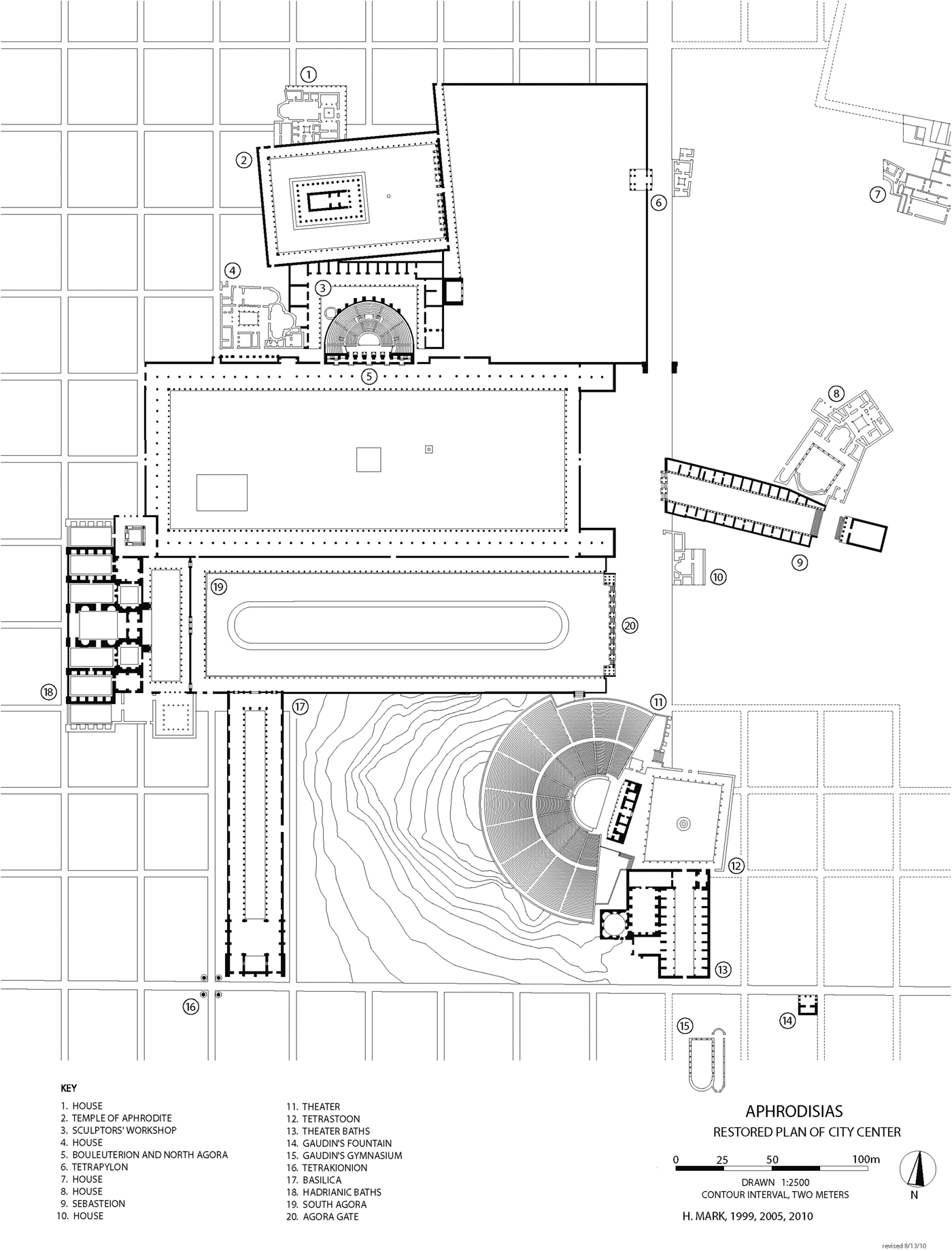
Aphrodisias was a medium-sized autonomous Greek polis within the Roman province of Asia, known for its cult of Aphrodite and its marble carvers. It was a late-comer to the city life represented by columnar architecture, and had a continuous urban history only from the later first century b.c., but lasting up to c. a.d. 600. The gridded plan represented a model late hellenistic town, with major urban complexes fitted to units of the grid (Fig. 2). These were built up over the first and second centuries a.d. By the third century the urban portfolio of public, civic, and religious buildings was complete, and the cityscape was populated with abundant statues of gods and local notables. The city became the capital of a new province of Caria in c. a.d. 300, and as a metropolis with a resident governor it was able to maintain its classical appearance into the sixth century. The city is especially well-preserved in its last functioning urban form, that of the fifth and sixth centuries, and in its archaeology we see the early imperial history of the site through the lens of late antique repair, adjustment, and conversion.Footnote 2
Aphrodisias, city centre. Restored plan. (Drawing: H. Mark)
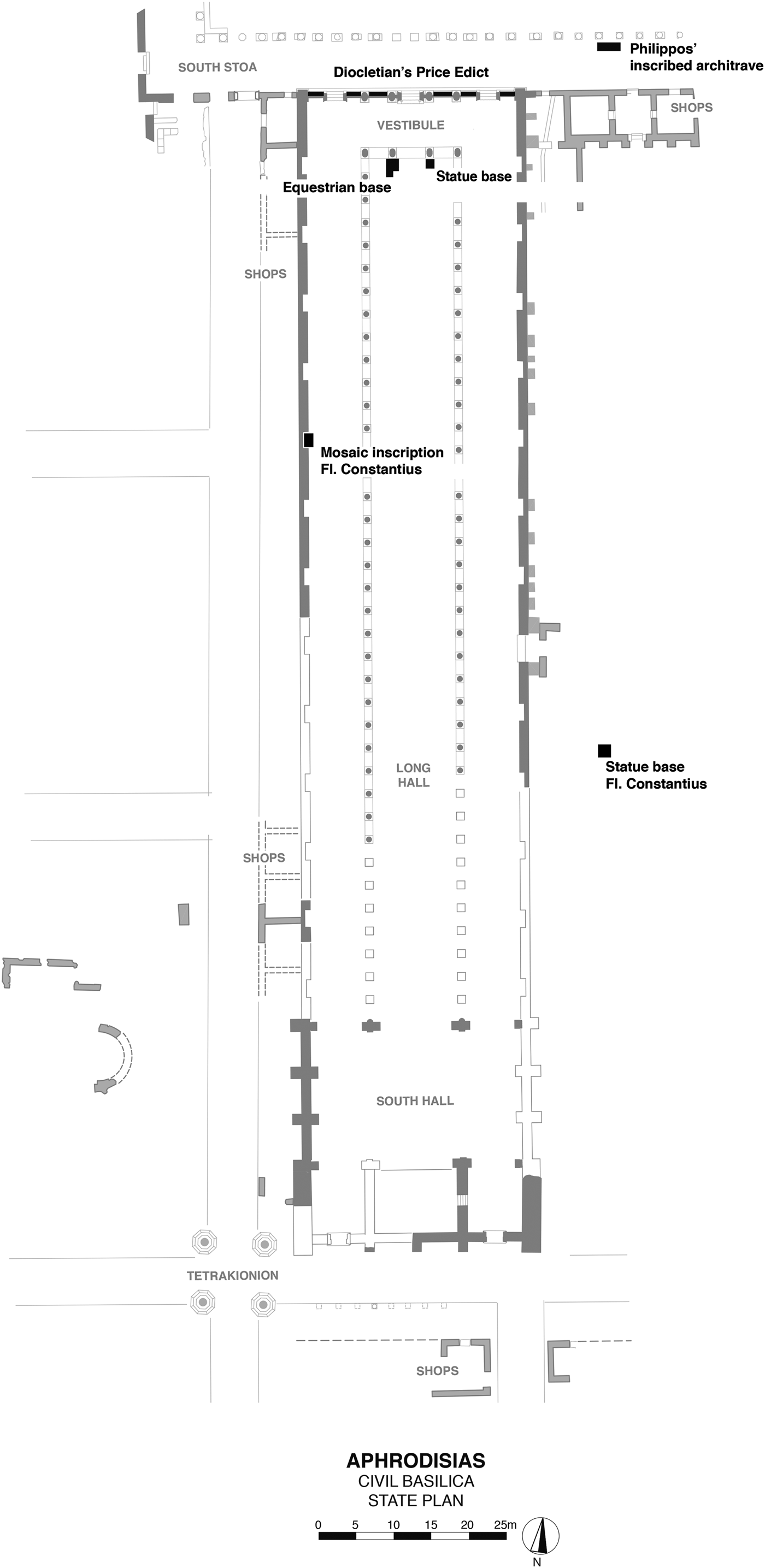
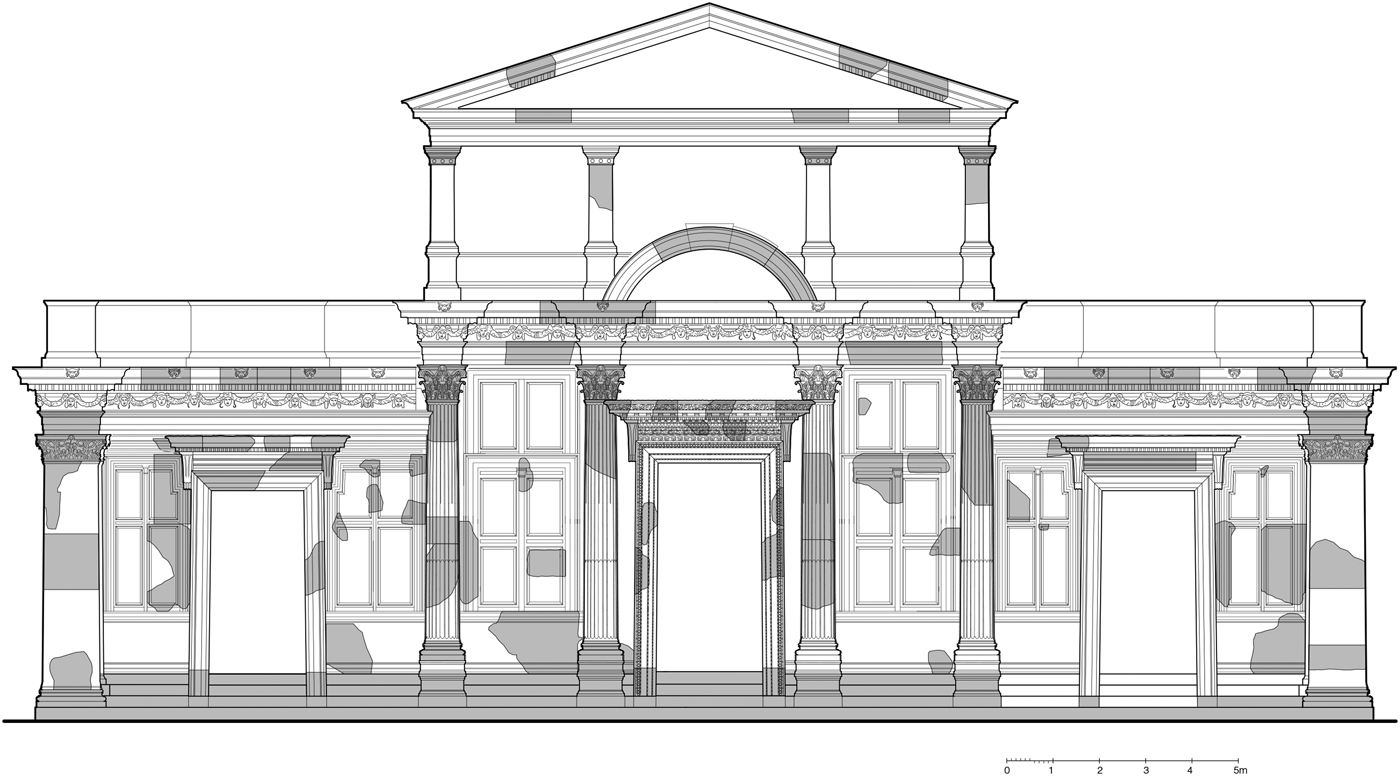
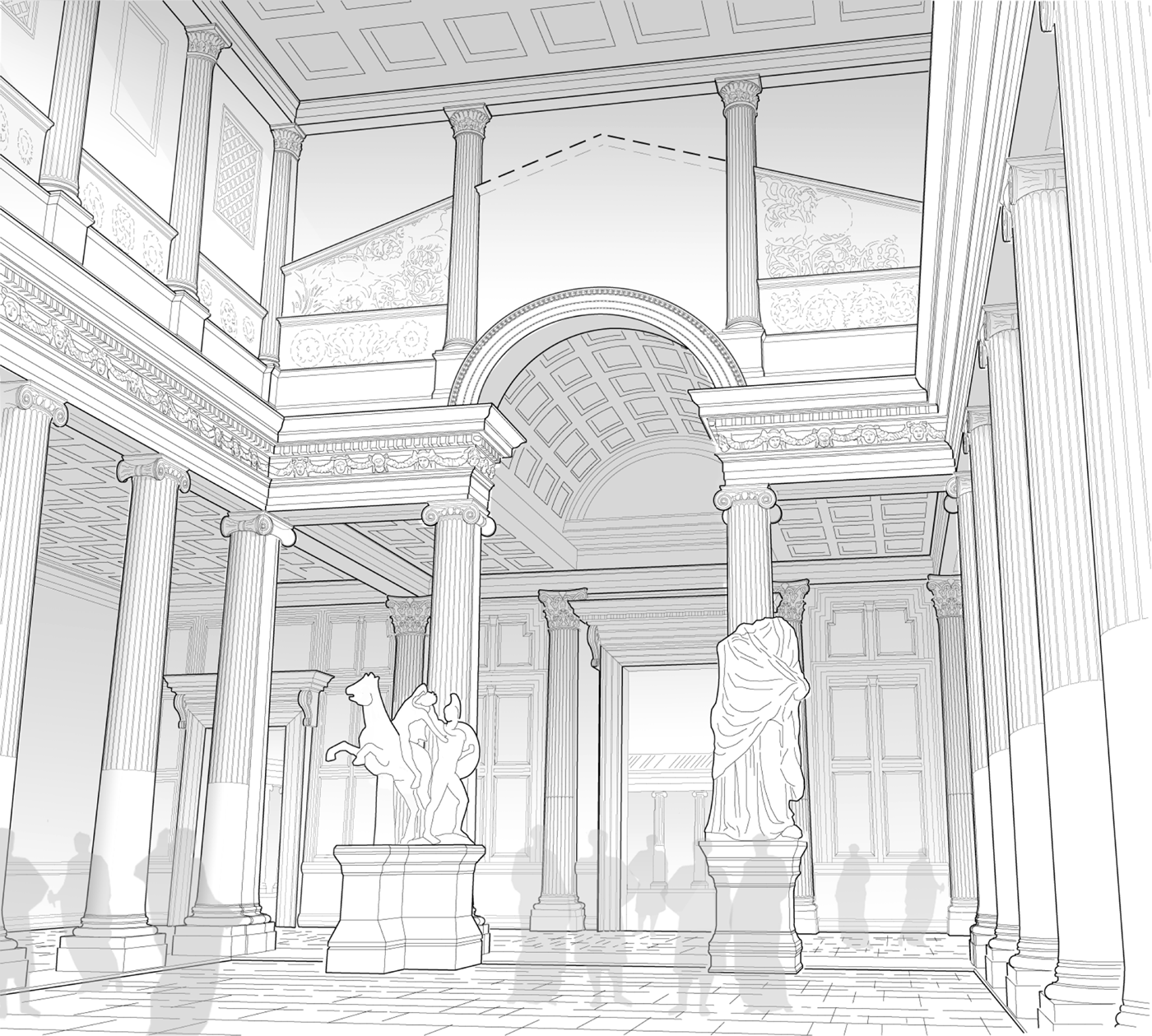
The Basilica was an elongated, three-aisled covered hall, 150 by 30 m (Fig. 3), opening off the south-west corner of the ‘South Agora’ or ‘Portico of Tiberius’. Recent research and excavation have shown that this huge colonnaded space (c. 220 by 70 m), with its long pool (170 by 25 m), was not an agora at all but a great urban park lined with palm trees, designed on the model of some of the porticus of early imperial Rome. A late antique inscription on the façade that closes the east end of the complex (Agora Gate) refers to it as the place of palms (ALA 38).Footnote 3 The Basilica was built on a low platform and was entered on its short north end, up three sets of stairs, and through an imposing engaged façade (Figs 4–5). The main long hall led south to an elaborate rectangular chamber with a kind of speaker's platform framed under an arch at its south end.Footnote 4 The Basilica could be entered at both ends, and served as a monumental covered thoroughfare between an important east–west avenue at its south end and the public square at its north end — in the manner of the grand commercial arcades of the nineteenth century.
Basilica, state plan. (Drawing: P. Stinson, H. Mark)
Basilica, from north with stepped façade in foreground. Arrow indicates base of statue group. (Photo: E. Küçük)
Basilica, façade, with surviving parts in grey. (Reconstruction: P. Stinson)
The upper storey of the Basilica's nave carried relief-decorated balustrades which, at the centre of the building, were carved with a series of mythological scenes featuring great heroic founders associated with Aphrodisias and the region: Ninos, Semiramis, Gordis, and Bellerophon.Footnote 5 The Basilica was built around a.d. 100 and was maintained through Late Antiquity. Various interventions are attested in the fourth century: (1) Diocletian's Edict of Maximum Prices and Currency Edict were inscribed in Latin across the north façade in a.d. 301 (Fig. 5). (2) A governor, Flavius Constantius, undertook work in the Basilica in the a.d. 350s (he also built the City Walls), and (3) was rewarded with an honorific statue in the building.Footnote 6 The governor's renovation in the mid-fourth century is the most likely context for what we will see was the second life of our monument. By the later fifth or early sixth century, the Basilica was already at least partly in ruins. Upper elements from its entrance architecture were re-used in the foundations of a late antique colonnade built in front of the Basilica by a local notable, a certain Philippos, in c. a.d. 500.Footnote 7
Discovery and Find Context
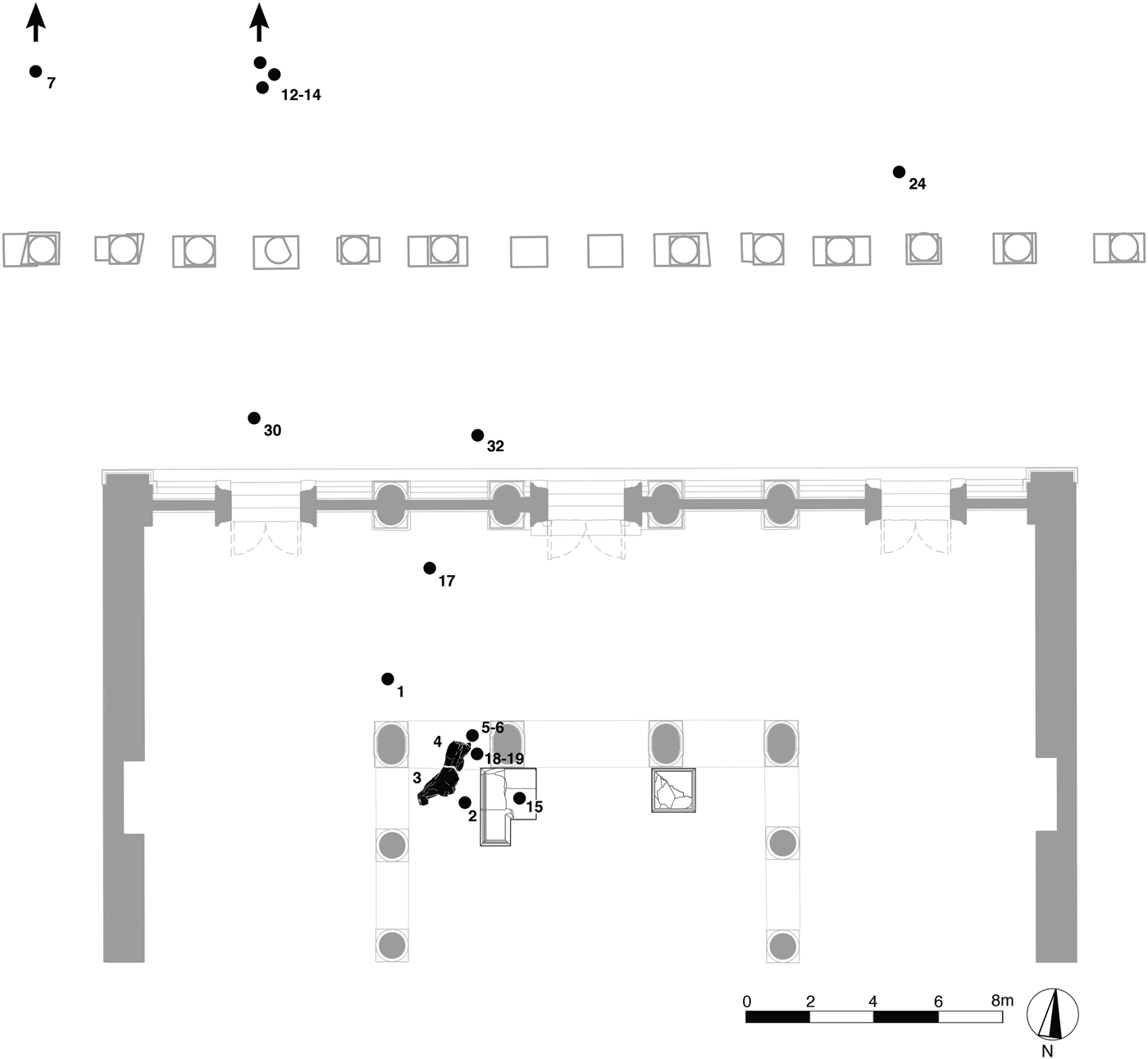
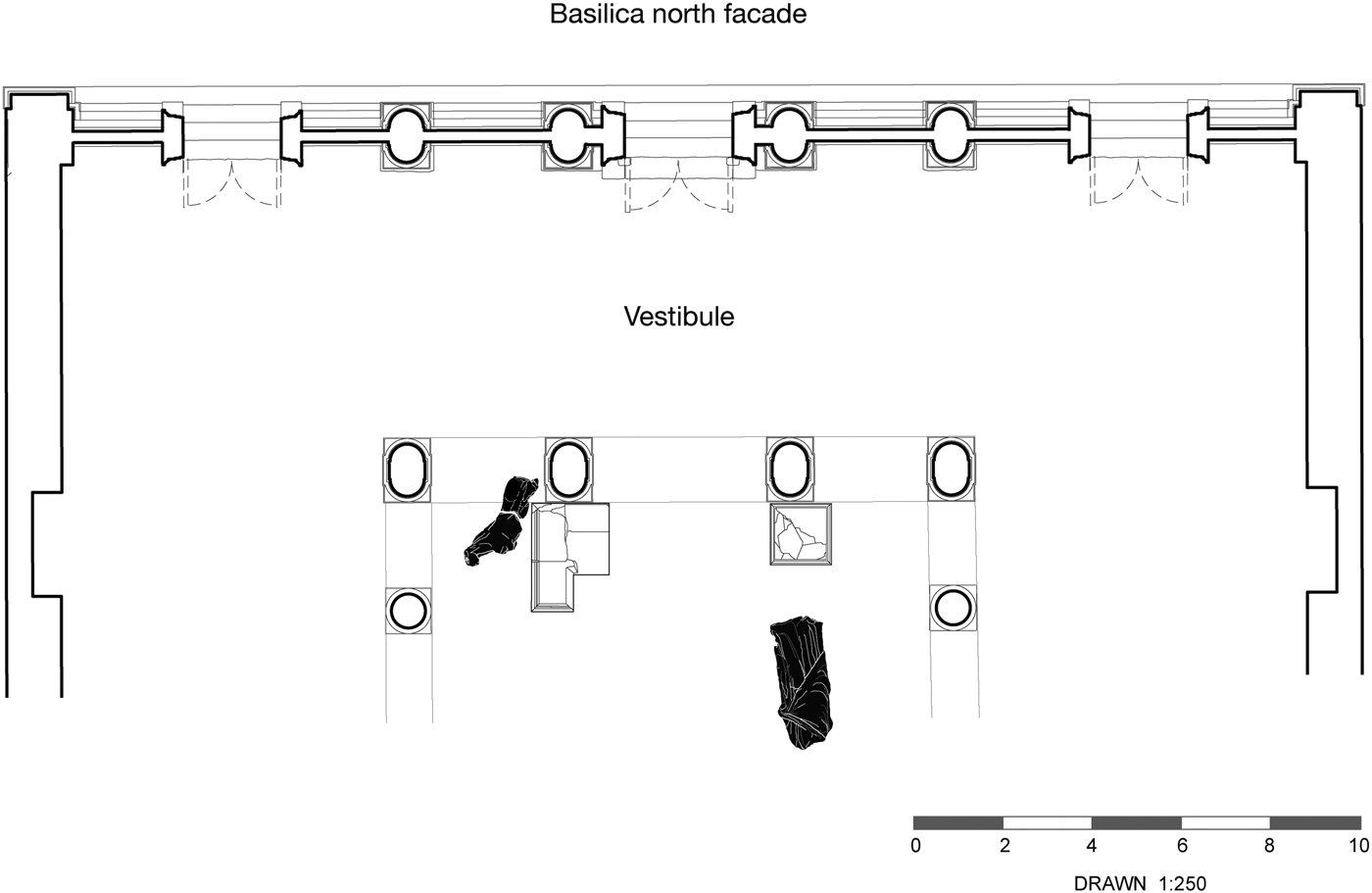
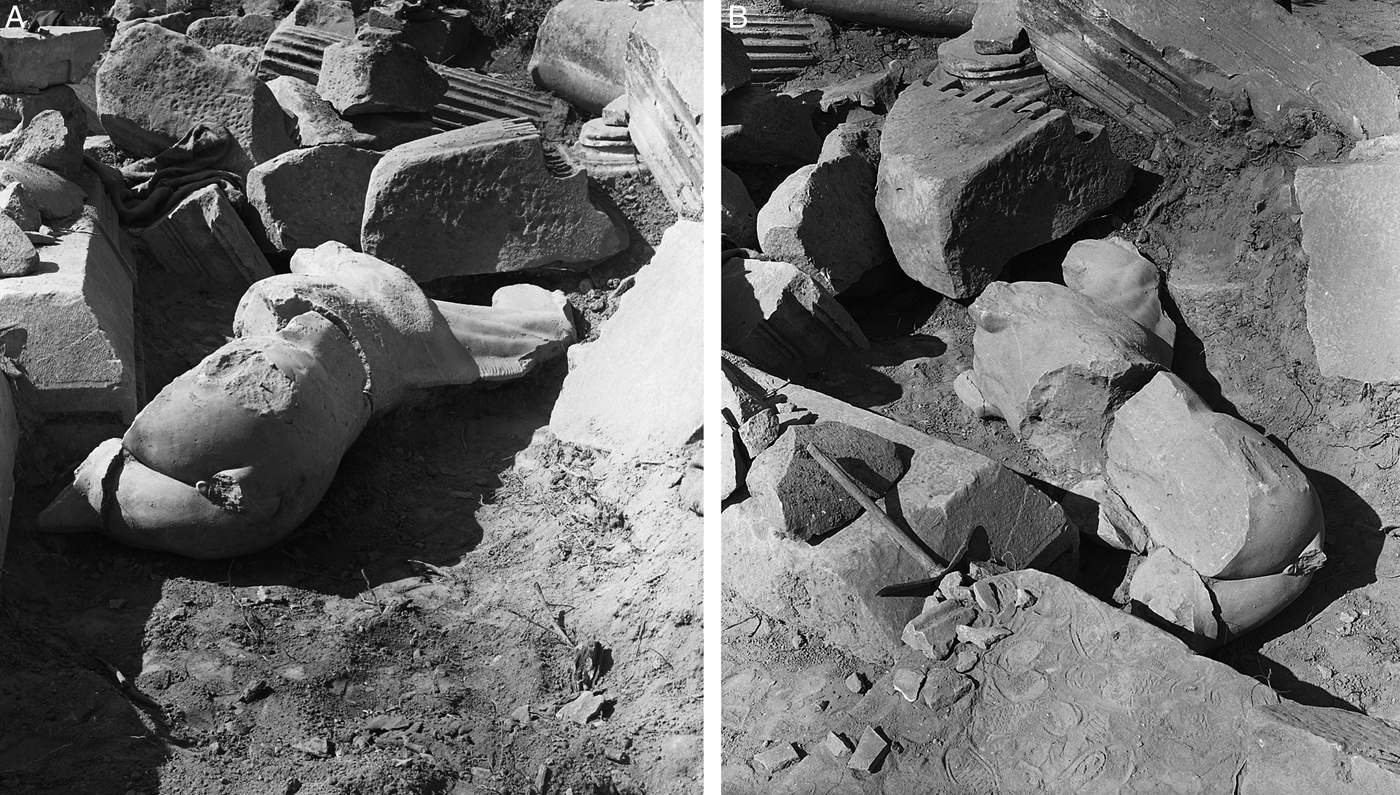
The grey marble horse was found in July 1970 at the north end of the Basilica, immediately inside the colonnade of the long hall, at its north-west corner (Figs 6–8). It was discovered fallen beside the lower part of its base, which remains in situ.Footnote 8 As one entered the building through the main doorway from the South Agora the monument was thus on the visitor's right. In the corresponding position on the visitor's left, a colossal female statue was discovered, fallen from a second in-situ base (Fig. 10).Footnote 9 The horse was found broken in two main pieces, front and rear, with the head pointing south (Figs 8–9).Footnote 10 After it fell from its base, the horse remained there, covered by three large architectural members from the superstructure of the building.Footnote 11 It was surely the collapse of these blocks which brought the horse down off its base and broke its body into its two main pieces. The collapse of the building of course also entailed other and serious damage to the monument. Further fragments were found in the same area: parts of the legs, the mane, and the rider. Some smaller pieces were found further away: the muzzle in the North Agora and other leg fragments in the South Agora, beyond its south colonnade and at the west end of the long pool (Fig. 7).
Basilica, northern part. Arrow indicates base of statue group. (Photo: E. Küçük)
Basilica, find plan of horse fragments. (Drawing: H. Mark)
Basilica, find plan of horse and colossal female statue. (Drawing: H. Mark)
A–B: Find position of main parts of horse, beside in-situ base. (Excavation photos, 1970)
Basilica, entrance from vestibule, with in-situ base of horse at left. (Photo: I. Cartwright)
The bronze saddle cloth, probably gilded, was applied separately to the horse, and was most likely removed when the horse was still standing. It would have been difficult, perhaps impossible, to retrieve it after the collapse of the building's architecture. The few surviving remains of the rider and the third figure in the group suggest they were badly broken in the collapse, and were widely dispersed or lost in small unrecognizable fragments. Although parts of the Basilica's superstructure started to collapse from the later fifth century without being repaired, the north end of the long hall, formed by the angles of the long colonnades and the robust architecture of the short north colonnade (composed of massive engaged double half-columns) remained standing much longer. It was here in a relatively strong, sheltered part of the building that the horse monument stood. Three fragments that make up the lower right foreleg of the horse were found at the west end of the pool in the South Agora, in the upper layer of the fill that covers the edge of the pool. This same layer of rubble and fill is dated elsewhere to the tenth to eleventh century. This is the latest date at which the horse monument, or parts of it, might still have been standing.
In modern times, the horse was first restored and set up (briefly) in the open-air courtyard of the Aphrodisias Museum in 1979. At that time the missing under-part of the rear fragment of the horse's body was restored in concrete. The modern dowels joining the two main parts of the horse turned out to be insufficient: the installation was unstable and was dismantled shortly afterwards. With a generous donation from Ender Mermerci, a new restoration and study of the monument was begun in 2003, in connection with research on the Basilica. The new reconstruction, published and explained here, was installed in the Sevgi Gönül Hall of the Aphrodisias Museum in 2008.Footnote 12 This installation includes the crown moulding of the base on which the monument stood in the Basilica (Figs 1 and 11). The two parts of this crown moulding are separated by a modern gap of 10 cm to allow the horse's modern stainless steel support to pass through the base without cutting the ancient blocks. The steel support extends below the floor of the museum into its own foundations, prepared during the building's construction.Footnote 13
Horse, rider, and crown moulding of base. Aphrodisias Museum. (Photo: G. Petruccioli)
II THE MONUMENT
The rider was carved from local medium-grained white marble from the main ‘city’ quarries at Aphrodisias. The horse was made from a large block of dark blueish grey marble also from the main city quarries, where a range of lighter and darker grey marbles were quarried extensively in the imperial period.Footnote 14 Large blocks of grey marble could be obtained and were used regularly for monolithic columns. The block selected for the horse was carved with its natural bedding set horizontally so that the lighter grey and white streaking in the marble runs along the horse's flanks in a calculated way that would give the impression of a real grey horse. The block was however not without its problems: the strong changes of tone and colour in the lower part of the horse's body are accompanied by extensive foliation and weakness in the stone — and it is along one of these fault lines that the lower left part of the stomach sheared off from the rear part of the horse. The sculptors were surely aware of these difficulties, but characteristically proceeded anyway, dealing with problems as they arose.
The head, neck, and body of the horse, together with its legs at least to below the knees and hocks, were made from a single block. Since the front hooves fall within the size of block needed to accommodate the nose, the front legs (and probably the back legs too) were most likely made originally in one piece with the body too. The rider and the third figure were worked separately, probably for the most part in single blocks, as was the support placed under the horse's body. The group now survives in some thirty-two fragments.Footnote 15
Rider ( Figs 22–23)
1. Left thigh and buttock of rider. Inv.: 70-570. Broken immediately above the knee, through the groin (genitals are lost), and at top of left buttock. H: 53, W: 29, D: 20 cm. Found 4 m to north-west of in-situ lower base, ‘clearing loose stone and earth from [fallen] architectural [pieces]’: NBk 83, p. 43, Find B 70-116, at depth −70 cm. Square ancient dowel hole under buttock: 3 by 3 cm on sides by 5 cm deep. Round dowel hole on inner side of thigh (diam. 5 cm), used for attaching the leg to the body of the horse in the 1979 installation, is modern. The modern character of this dowel hole is clear both from its clean passage (made by an electric drill) and from the lack of any corresponding dowel hole in the left flank of the horse in early photographs. We will see later that this is of vital importance for the reconstruction of the whole group.
2. Left hand of rider(?). Inv: 70-571. Male left hand, most of fingers broken off. H: 16, W: 13.5, D: 15 cm. Found same day as horse, during excavation west of base. NBk 83, p. 15, Find B 70-95. Hand carefully hollowed out between fingers: may have held inserted object(?). Finish similar to that of Rider (1).
Horse ( Figs 12–21)
3. Front part of horse. Inv: 70-569A. Broken through head below cheeks, middle of body, and forelegs at junction with shoulders. H: 90, L: 152, D: 50 cm. Found immediately to west of in-situ base: NBk 83, p. 17–18, Find B 70-96, at depth −70 cm, with two photos of piece in fall position. Missing: ears, right eye, muzzle, mane, and metal saddle cloth. Roughened band for added metal bridle straps, W: 2–3 cm, preserved on cheeks and over head between ears and eyes on both sides. Dowel for attachment of mane repair, L: 3, W: 2, D: 3 cm. Surviving right ear, broken off, visible in earlier photos and the first (1979) reconstruction, is now missing. Ear was bent back, like those of bronze horse from Cape Artemision. Stumps of both forelegs at shoulders of body received modern drill holes for dowels used in the 1979 reconstruction.
Horse, left side. Detail of head and repaired mane. (Photos: G. Petruccioli)
Horse with base (14). Repaired front legs (15). Front (16). Rear (17). (Photos: G. Petruccioli)
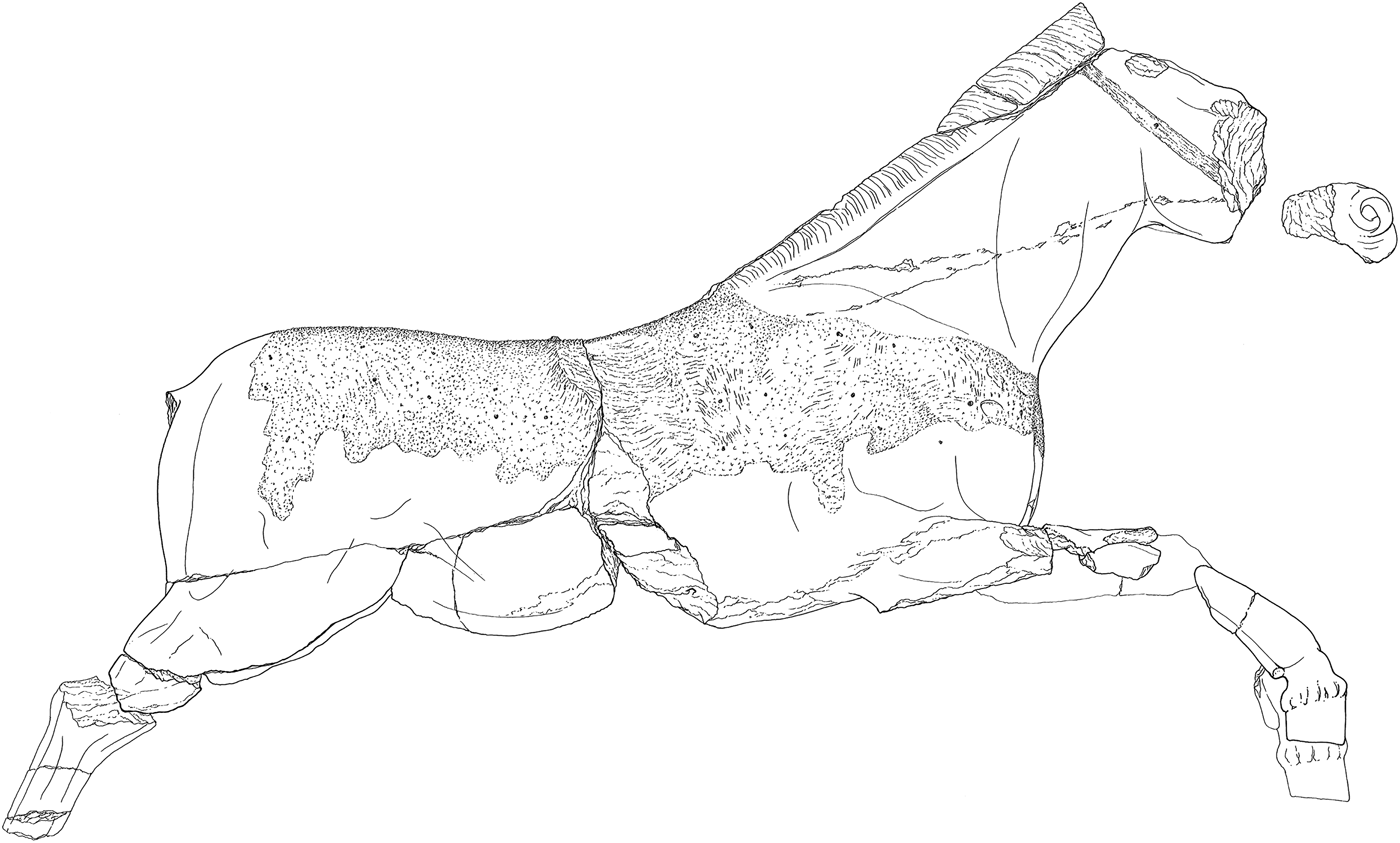
Horse, right side (18). Right thigh with vein (19). Chest (20) and right flank (21), with picked surface and iron nails for metal animal skin. (Photos: G. Petruccioli)
White marble rider, left thigh and buttock. (Photo: G. Petruccioli)
Rider, from behind: square dowel hole in left buttock and matching iron dowel in back of horse. (Photo: I. Cartwright)
Most of the large deep cutting between the chest and belly was carved for the 1979 reconstruction (and was re-used in the 2008 restoration). What we know of the attachment of the original support can be seen only in early photographs of the upturned horse (Fig. 9b): (1) a large dowel hole into the lower chest of the horse, perhaps countersunk, near the line of the main break, and (2) perhaps an angled surface (at approximately 45 degrees) between the dowel hole and the line of the break with the rear part of the horse. This could be part of an elaborate cutting to receive a massive support; however it is difficult to understand how such a cutting could come so close to the outer flank(s) of the horse without bursting them. The angled surface is probably then a natural break, where a secondary slice has been sheared off by a falling block.
4. Rear part of horse. Inv: 70-596B. Broken through middle of horse's body and upper thighs. H: 43, W: 83, D: 64 cm. Found aligned with 3, immediately to north-west of in-situ base: NBk 83, p. 17–18, Find B 70-96, at depth −70 cm. On proper left side, large slice of stomach and rear broken off on oblique line. Tail is broken off at dock in oval-section stump, W: 10, H: 9 cm. Anus represented as raised element, diam: 3.5 cm. Large dowel hole at front edge of break for attachment of rider: 3 by 4 cm, with thick iron dowel set in lead still in it. Dowel was badly twisted by collapse or removal of rider. Loss of horse's underside has removed part where genitals would have been carved. Horse should be assumed to have been male.
5–6. Mane crest (Fig. 13). Two adjoining pieces of horse's mane, both parts of an ancient repair in different grey marble. L: 37, H: 10, W: 4 cm. Found in 1970 behind in-situ base and above stylobate of short north colonnade, at same location as rear part of horse. NBk 83, p. 41, Find B 70-113 and 114 at depth −70 cm. Crude, slot-like dowel hole in underside of main piece, H: 4, W: 3 tapering to 2, D: preserved 1.5 cm. Corresponds to dowel hole on horse, and though fit is not good, it was certainly part of the horse. Smaller piece is triangular in shape and was wedged between larger piece and lower mane carved with horse's body.
7. Muzzle (Fig. 13). Inv: 03-30. Horse's nose and upper mouth, broken through lower cheeks. H: 14, W: 21, D: 11 cm. Found in excavation of sunken court at south-west corner of North Agora in 2003. Does not join but of same marble and same sensitive workmanship as body. Fragment is not broken below, but preserves carved roof of open mouth and inner corner of mouth on right side.
8–9. Right upper foreleg below shoulder (Figs 18 and 30). Two joining pieces broken from shoulder, next to the body, along line where marble layer becomes lighter grey. L: 30, W: 12, H: 7 cm.
10–11. Right upper foreleg (Figs 18 and 30). Two joining fragments, carved free from body. L: 26, W: 9, H: 12 cm. Broken horizontally, with irregular, jagged breaks at both ends. Almost certainly joins 8–9. Modern round dowel holes drilled in both ends for 1979 reconstruction. Lower dowel hole, round and modern in its inner/upper part, and rectangular and ancient in its outer/lower part, for attachment of lower replacement leg. Dowel originally extended 10 cm into upper foreleg, now broken.
12–14. Right lower foreleg and hoof (replacement) (Figs 15–16). Separately made foreleg broken in three joining fragments (hoof, ankle, part of leg). L: 42, W: 11.5, D: 12 cm. Upper fragment (12) found in 1989 at west end of pool: NBk 307, p. 27, Find 77, at depth −130 cm. Middle fragment (13), fetlock section, found in 1989 in ‘couche de destruction’ at west end of pool in South Agora: NBk 307, p. 57, Find 119. This layer covers seat-edge of pool and equates to a late rubble deposit dated to tenth to eleventh century.Footnote 16 Hoof broken at ankle (14) found in 1989, also at west end of pool: NBk 307, p. 22, Find 64, at depth -130 cm. The three fragments constitute an ancient repair in different, lighter grey marble. A small part of the upper join surface of the replacement leg survives. It has remains of a wide ancient dowel-slot, rectangular in section, which shows it was dowelled onto the original leg below the knee. The replacment leg broke directly across this dowel-slot: the slot was 7 cm long and 3 cm wide. A pour hole (diam: 1.00 cm) was drilled into the dowel slot from the upper surface of the foreleg.
15–16. Left upper foreleg (Fig. 12). Preserved in two joining pieces, shoulder to below knee. L: 34, W: 12.5, H: 17 cm. Large (upper) fragment found at in-situ base: NBk 83, p. 13, Find B 70-91, at −80 cm. Upper break has modern dowel hole for attachment of fragment to body of horse. Lower break below knee has remains of rectangular, slot-shaped ancient dowel hole (L: 6, W: 2.5 cm, D: not preserved) for attachment of replacement lower leg.
17. Left front hoof and ankle (replacement) (Figs 15–16). Broken off across upper ankle. L: 30, W: 12, D: 12.5 cm. Found north of horse, c. 3 m behind façade of Basilica: NBk 83, p. 23, Find B 70-101, at depth −50 cm. Crudely worked in different, lighter-grey streaky marble. Break at upper ankle has modern dowel hole from 1979 reconstruction, but in position of an ancient dowel since break bisects remains of ancient pour hole on inner right side (diam.: 1.00–1.50 cm).
18–19. Right upper thigh (Figs 18–19). Two joining fragments. Large thigh fragment, found with rear part of horse, joins main horse body, 5. H: 38, W: 54, D: 27 cm, measured as on horse.
20–21. Right hock. Preserved in two pieces, broken off above and below. Does not join thigh, not included in restoration. H: 28, W: 16, D: 12 cm. Fragment forms two sides of right hock broken vertically on ancient fault in stone. Part of one side is broken away revealing discoloured surface of fault, hole for an ancient pin to secure crack in stone, and remains of bisected modern dowel hole.
22. Left upper thigh (Figs 12 and 17). Fragment joins main horse body, 5. H: 28, W: 48, D: 29 cm. Surface of outer side mostly broken away. On inner side, well preserved and fully carved.
23–25. Left hock and lower leg (Figs 17 and 29–30). Three joining fragments, hock and two pieces of lower leg, broken above and below. H: 32, W: 12, D: 27 cm. Middle leg-fragment (24) found in South Agora immediately north of column 16 (counting from west) of colonnade in front of Basilica: NBk 83, p. 81, Find B 70-142, at depth −80 cm. Pierced lengthwise by modern drill hole for 1979 reconstruction.
26–29. Belly and flank fragments (Figs 18 and 30). Two belly fragments (26–27), joining rear part of horse body (4) at lower belly on right side. L: 45, H: 25, D: 16 cm. Small fragment (28), joining front part of horse (3), on right side. H: 20.5, W: 10.5, D: 10 cm. Small fragment (29), joining rear part of horse (4) on left flank. L: 15.5, H: 8, D: 7.5 cm.
30. Tail fragment(?) (Fig. 25). Inv: 04-07. Fragment from end of tail(?). L: 12, W: 5 cm. Found in 2004 in stone dump 2 m in front of west door into Basilica's north façade.
Horse, from above.
Tail fragment.
31. Part of support(?) (Fig. 28). Inv. 11-02. Part of rounded or oval element in medium-grained white marble, with roughly carved and now weathered/worn surface. H: 66, W: 30, D: 20 cm. Found in 2011 in clearing blocks immediately to north of in-situ base. Broken on two axes, leaving a small section of original object. Preserves roughly point-chiselled lower bedding surface, rounded perimeter carved in amorphous natural shape, rising towards centre with irregular rocky(?) forms and man-made forms (weapons?). Shape and carved form would be consistent with massive statue-support in shape of a tree-trunk, spreading widely at base, perhaps with other elements leaning against it (weapons?).
Standing Figure ( Figs 27–28)
32. Knee of Achilles(?) (Fig. 27). Inv: 70-616. Over life-size left knee of white, medium-grained marble, broken above and below. H: 50, W: 20, D: 12 cm. Found in front of Basilica façade 2 m to west of central doorway: NBk 82, p. 53, Find B 70-36. Knee is sharply bent and came from a lean, dynamic figure.
33. Fragment of tree trunk(?) (Fig. 26). Inv: 70-572. Broken below and on ‘inner’ side where attached to figure. H: 13, W: 10, D: 8 cm. Found day after horse in same area: NBk 83, Find 70-98. Neat line circumscribes area of attachment. Deep irregular gash cut in amorphous surface to represent bark. Probably part of support of Achilles' figure.
Tree-trunk fragment.
Knee fragment from third figure (Achilles).
Part of plinth for support under horse(?). (Photos: I. Cartwright)
Base ( Figs 29–39)
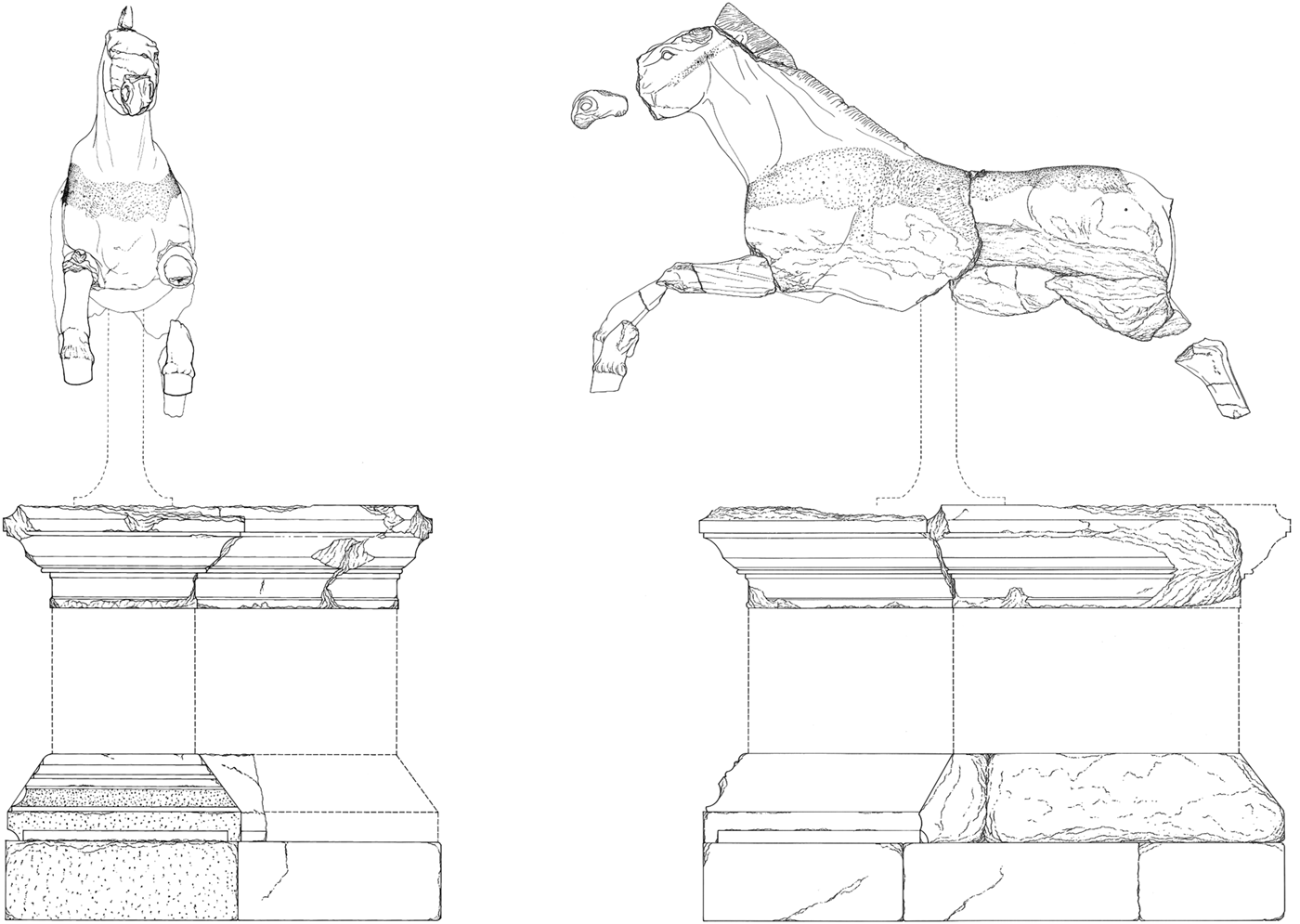
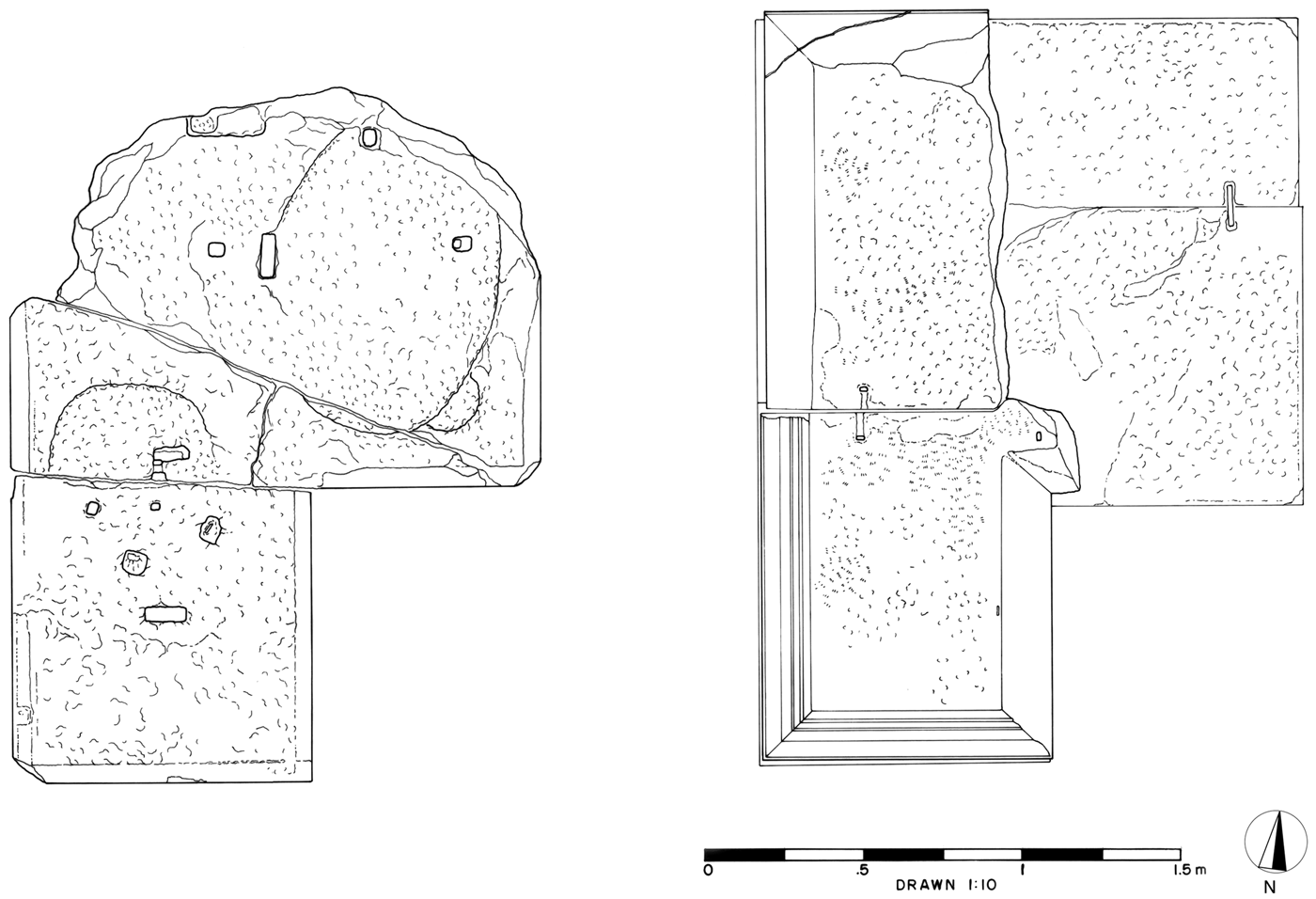
In-situ base (Figs 32–35). The lower part of the base, beside which the horse was found, is fitted against the stylobate of the western double-half-column that framed the entrance into the long hall of the Basilica. It was L-shaped with overall dimensions of 230 cm long (north–south) by 170 cm wide (east–west). This in-situ lower part is 66.5 cm high and comprises the following parts. (1) Rough foundation and levelling course of shallow irregular, re-used blocks, resting on rubble and earth (as exposed in a sondage of 2009: Fig. 35). (2) Lower plinth of four plain blocks (H: 30 cm), fitted and clamped together in irregular plan, showing as three blocks on east side, two blocks on west side. The stylobate of the entrance colonnade was cut back and cut down to receive the plinth blocks of the base, so that the base could be fitted tightly against the column base. The plinth bed sits c. 12 cm below the level of the stylobate: see Figs 34–35. (3) Moulded base course in three pieces of which two survive in situ, on west, tied together with single clamp (Fig. 31, right). The southern projection is 91.5 cm wide at the plinth, 60 cm wide on its upper bearing surface. The eastern ‘arm’, measured on exposed plinth course, measures 152.5 cm north–south by 80 cm wide east–west.
Horse on late antique base. (Drawing: N. Quiring)
Horse, right side. (Drawing: N. Quiring)
Crown moulding (left) and lower part of late antique base (right). (Drawing: P. Stinson)
In-situ base, from front.
In-situ base, from above.
In-situ base, right side.
Sondage on right (west) side of base.
Lamp from sondage. (Photos: I. Cartwright)
Crown moulding, from front. (Photo: I. Cartwright)
Crown moulding, from left side. (Photo: I. Cartwright)
Crown moulding, from behind. (Photo: I. Cartwright)
The southern block, below the front of the horse, has a summarily carved sequence of mouldings on two sides (south and west), and a plain chamfer on its inner side (east) (Fig. 33). The lower edge is recessed to form ‘feet’ at the front corners. The two external sides of the second preserved block (north and west) were both also left with a plain chamfer. The result is a disjunction on the long west side, where the moulded and unmoulded elements simply abut (Fig. 34), and at the front, south-east corner where a moulded and unmoulded side meet at the angle (Figs 32–33). The missing part of the moulded course was probably made up of a single block. The plain blocks that made up the shaft or die of the base (always the most easy to re-use) are missing and were probably removed when the horse collapsed.
Crown moulding (Figs 31 and 37–39). The crown moulding was made up of two blocks: (1) a smaller block at the front, forming the southern projection (L: 96, W: 95.5, W at level of die: 60 cm), and (2) a much larger block, preserved in three joining pieces (L: 125, W: 221 cm), with significant damage and loss at rear, north side. Overall dimensions, L: 2.21 m (north–south, under horse), W: 1.68 m (east–west), H: 41 cm. In light of their worn and battered condition, these pieces seem most likely to have been found on or near the surface during the initial cleaning operations at the north end of the Basilica in 1970. They were later moved to block fields in the south-west corner of the South Agora (probably in 1980s), where they were first identified and documented in 2004.
The two blocks were roughly pushed together and held by a single small clamp over the join in the centre, set in square holes (2.5 by 2.5 by 2.5 cm deep), and by the lower end of the horse's support that spanned the joint. The carved moulding is carried all around the three main sides; the rear, or north, side is broken and damaged — where as much as 20 cm is missing. The visible top of these crowning blocks is finished roughly and irregularly with heavy point chisels. The two blocks were lifted by broad lewis holes near their centres, both W: 4.5, L: 14, D: 6–8 cm.
Cuttings for attachment of figures. Block 1 has three different dowel or clamp cuttings, difficult to understand, that secured the support under the horse onto the base. The eastern cutting is 4 by 3 by 4 cm deep. The cutting closest to the lewis slot is 7 by 7 by 6 cm deep. And the western cutting is 8 by 5 cm and still full of lead for a narrow rectangular turn-down iron clamp. The negative form of the clamp survives in the lead. Block 2 has a cutting for the support close to the join of the two blocks, 12 by 5 by 6 cm deep. The position of the support is indicated by an irregular and shallow depression that spans both blocks. There are remains of cuttings in the break at the rear, probably for the attachment of the rear left hoof of the horse. A smaller deep cutting (8 by 6 by 10 cm deep) sits inside a broader cutting (26 by 8 by 6 cm deep) whose back ‘wall’ is broken away. The eastern ‘arm’ of Block 2 has a deep oval cutting or ‘sinking’ (95 by 90 cm and sloping from 6 to 11 cm deep towards the front) to receive a large oval statue plinth (Figs 38–39). The plinth was secured below by three large and eccentric dowel cuttings inside it: (a) on left, western edge of oval sinking, 4.5 by 5 by 7 cm deep; (b) on rear, northern edge, 5 by 6 by 8.5 cm deep; and (c) on right, eastern side, 6 by 4 by 8 cm deep.
The surviving well-muscled left thigh of the white-marble rider (1) shows that he was nude. He was a youthful but strong figure. Nothing survives of his genitals, but the soft hairless flesh of the groin indicates clearly that he was conceived as a prepubescent boy. The muscled vigour of the leg then contrasts with the apparent ‘age’ of the figure. The matter of the rider's represented age will be important later. Shallow depressions on each side of the horse received the rider's thighs, and his left buttock was attached by a large bronze dowel, still extant in the horse's back (Figs 23–24). It is significant that the two cuttings for the thighs are of different shapes and depths (deeper on the right, shallower and further back on the left), and that the surviving left thigh clearly does not sit in its current position, as restored in 1979 and again in 2008. Its correct position, we will see, would look too outlandish for such a fragment to be displayed in a comprehensible way.
The horse was galloping fast, with a slight turn to its left that runs right through the horse's body. This turn can be appreciated best from behind (Fig. 17), and is relevant for the reconstruction of the group. The horse is posed in the rising gallop in which all fast-moving horses had been represented in antiquity since the archaic period. That is, the back legs are extended, with both back hooves on the ground, and both front legs are raised. This is the pose of galloping horses from archaic Athenian vases to the hellenistic bronze horse from Cape Artemision.Footnote 17 To the modern viewer it seems as if the horse is about to leave the ground to jump a fence or an obstacle; but according to this well-known ancient visual formula, it was simply galloping fast. The Aphrodisias horse is unique in attempting such a difficult posture in a life-size marble horse in the round. Statically, it was anchored to its base at three points: the two back hooves at the rear and a support under the belly. Only a single dowel in the lower chest/belly survives to show how the support was attached to the horse (Fig. 9b).
The horse wore a separately-added metal saddle cloth, probably of gilded bronze, in the form of a feline skin. It was attached to a roughened surface over the horse's back and chest with forty-seven iron pins. The pins were attached in small drill holes (diameter 0.50 cm). Twenty-one survive as empty holes, twenty-six have iron pins or remains of iron pins still in them. The skin was that of a small-headed panther-like animal: its ‘split’ face is still traceable in outline on the chest of the horse (Figs 16 and 20). The form of the skin, extending to the horse's rear and onto its flanks, is best seen on its proper right side (Figs 18 and 30). The outline of the front feline paw is visible on the horse's shoulder, and even more clearly the rear feline leg and paw on the horse's right buttock (Fig. 21). The feline skin continued under the rider, in the shallow cuttings made to receive his thighs. This means that the rider had already fallen or been removed at the point his metal saddle cloth was taken. Since it would have been impossible to retrieve the metal sheeting from under the fallen horse with huge architectural blocks on top of it, the horse must still have been standing when the metal was removed. The monument thus suffered successive phases of post-antique dilapidation.
The horse also wore a separate metal bridle attached with two pins. Its position is still visible in the lightly roughened ‘band’ on both cheeks and running across the brow below the ears (width of ‘band’: 2–3 cm) (Figs 13 and 30). The pin holes are placed at the ‘crossing’ of the cheek and brow straps. The carving of the head is refined and expressive, from hard, flat bony cheeks to soft muzzle and flared nostrils. The preserved left eye has a sensitive, near-human formulation. The now-missing right ear was carved in the round, bent backwards like the ears of the Artemision horse and other ancient representations of galloping horses. The horse's mouth was open and no doubt had a metal bit pulled back in its corners. In the preserved fragment, the roof of the mouth is fully carved and finished. The drilling out and working of the entire inside of the mouth represented the galloping animal's vigour, animation, and powerful breathing.
The mane was trimmed into a short crest, and its original carving, seen lower down the neck and on the withers, has soft, subtly indicated hair, springing up in loose curving strands or ‘locks’ carved in low relief on either side (Fig. 13).Footnote 18 (The later repairs to the mane are discussed below.) The thin extremities of the horse — the legs and tail — required risky virtuoso carving. All four legs were most likely carved in one piece with the body of the horse. The lower forelegs and hooves are repairs, but the original upper forelegs are thin and lean, with well-articulated bone and sinew of elbow, forearm, and knee (Fig. 12).
The distinctive, careful handling of the horse's body can be seen well in its hindquarters, especially on its better preserved right side. The complex dip and transition between loin and hip and between flank and stifle is sensitively managed (Fig. 21). A series of veins is painstakingly indicated in shallow relief over the gaskin (upper thigh) (Fig. 19). The hock and surviving parts of the lower left leg have the same lean articulation as the front upper legs (Figs 17–18). As far as can be told from the surviving fragments, the horse survived into later antiquity with both its original back legs intact. The tail broke off at the dock, close to the body: the dock has a wide and realistic oval cross-section. The tail was carved in the round, free from the body, perhaps pieced. Since the tail extended horizontally behind the horse, the anus is visible and is carefully represented as a raised button with a slight indentation on top (Fig. 17).
The one small surviving fragment of the lower part of the tail (30), possibly its tip, shows its hair mass was ‘aereated’ with extensive drill work — varied holes, channels, and ‘bridge’ work (Fig. 25). The long hair strands were engraved in a light impressionistic manner, recalling the original hair of the mane over the withers. In other words this was not a horse's tail like so many earlier ones (from archaic tails to that of the Artemision horse) — a solid element with hair engraved on its surface in long lines. Instead it represented both the form and the wind-blown insubstantiality of a horse's tail. Like the open mouth finished inside, the tail was probably a sculptural tour de force.
The horse then was a daring, high-quality, virtuoso piece of carving. This can be seen, for example, in (1) the vigorous and sophisticated turn of the horse to its left (Fig. 17), (2) the sensitive and expressive handling of the head, with wide open mouth, soft-wrinkled muzzle and nostrils, and ‘pathetic’, human-style eye (Fig. 13), and (3) the great attention paid to representing details of veins, sinews, and surface textures (Fig. 19). In terms of Aphrodisian workshops, it is typical of the top-level statuary workmanship of the early imperial period. Like much of the figure carving of this period, the horse seems still attached to hellenistic sculptural practice. The enough-and-no-more technique of the unrepaired part of the mane (Fig. 13) is typical of local hair-carving in the early period. The surviving part of the rider too has a refined matte or ‘satin’ finish best attested at Aphrodisias on early imperial statuary.
The only good, large-scale ancient parallel for the group is the bronze horse and jockey from Cape Artemision now in Athens.Footnote 19 One might assume at first glance that the Aphrodisian group was a similar self-sufficient monument of a galloping race-horse and jockey — except carried out in stone. Several features however point clearly in another direction. The Artemision rider is small in relation to his horse, wears an exomis (a slave garment), and has facial features that characterize him as a mortal, lower-class jockey. The Aphrodisian rider, in contrast, is large and naked. His scale and nudity show that he should belong in a different realm, that of heroes. This is confirmed by his saddle cloth. Race-horses were ridden bareback, whereas a feline-skin saddle cloth was the mark of a hero's horse, as attested, for example, by abundant hellenistic grave reliefs of young men shown as heroes.Footnote 20 The asymmetrical posture of the rider and the presence of a third figure implied by the L-shaped base imply an action group. All these features together — the rider's nudity, scale, and feline-skin saddle cloth — indicate a mythological subject for the group, one set in the heroic past.
Repairs and Re-installation
Several major repairs were made to the horse in a second, later period. The upper part of the short mane crest is made of two separately-added pieces (5–6) (Fig. 13). They are engraved with sharp, mechanical, linear, wavy parallel strands of hair of a completely different character from the original mane. The end or ‘front’ of the added mane, facing ‘forwards’ as it were between the ears, is fully preserved and also engraved with hair strands. It makes a curiously abrupt and artificial terminus. The added pieces were roughly attached and are out of keeping with the style of the lower mane. They are clearly later ancient repairs. The upper part of the original mane was damaged, cut down, and replaced by these two ill-fitting attachments. The same is true of the front legs. Below the knees, the forelegs are heavy and crude, with clumsy oversized hooves, out of keeping with the refined realization of equine anatomy elsewhere on the horse (Figs 14–16). The new forelegs are each carved from a different grey marble — different from each other, and different from the marble of the original horse. Therefore they were not separately-pieced with the original monument, but are both later additions. These were later repairs to a damaged monument.
Careful examination of the surviving base shows that it is not the original base of the monument, that the horse has most likely been moved from somewhere else, and that this move was carried out in Late Antiquity. The crude repairs to the mane and forelegs were surely part of the second installation. The base also contains further vital information about the subject of the monument.
In a reconstruction drawing (Fig. 29), the base could pass as that of the original monument, but seen close-up it is clearly a much later confection. The surviving upper element, the crown moulding, is divided strangely and crudely into two parts held together on top by a single small clamp, and its mouldings are poorly and roughly carved (Figs 37–39). The in-situ lower part is also made of ill-fitting pieces, and its mouldings are partly carved, partly left as a plain chamfer (Figs 32–35). The tall course below is made of neatly squared, plain blocks, possibly re-used. They sit below the level of the colonnade's stylobate at the back of the monument, which has been cut down to receive them (visible in Fig. 34). Excavation of the foundations of the base (on its west side, in 2009) showed that they consist of a shallow layer of loose rubble, with some irregularly-shaped flat stones placed on top as a levelling course (Fig. 35). Among mixed pottery in the trench, a well-preserved lamp of late Roman type (Fig. 36) was found in fragments at a depth of 30 cm, sufficient to show it certainly belonged with the making of the foundation for the horse base.Footnote 21 The base, therefore, was a late antique construction, built into the Basilica floor for an early imperial horse monument not originally set up here and a fortiori brought from somewhere else.
The base is L-shaped. The galloping horse clearly belonged above its long, narrow north–south ‘projection’, facing down the length of the Basilica's interior. The shorter, wider east–west ‘arm’ of the base carries in its upper surface a deep oval cutting (95 by 90 cm) for the large plinth of a missing statue, anchored by three strong dowels (Figs 38–39). That is, the group included not only horse and rider, but also a third, large figure beside the horse. A youthful male hero on a swift galloping horse, with a large third figure close by might bring to mind, of the available choices, most easily the story of Troilos and Achilles. The L-shaped base and good iconographic parallels (Section IV) might alone have been sufficient to settle on this identification. There is, however, other, more precise evidence.
III BASE IN CITY WALL
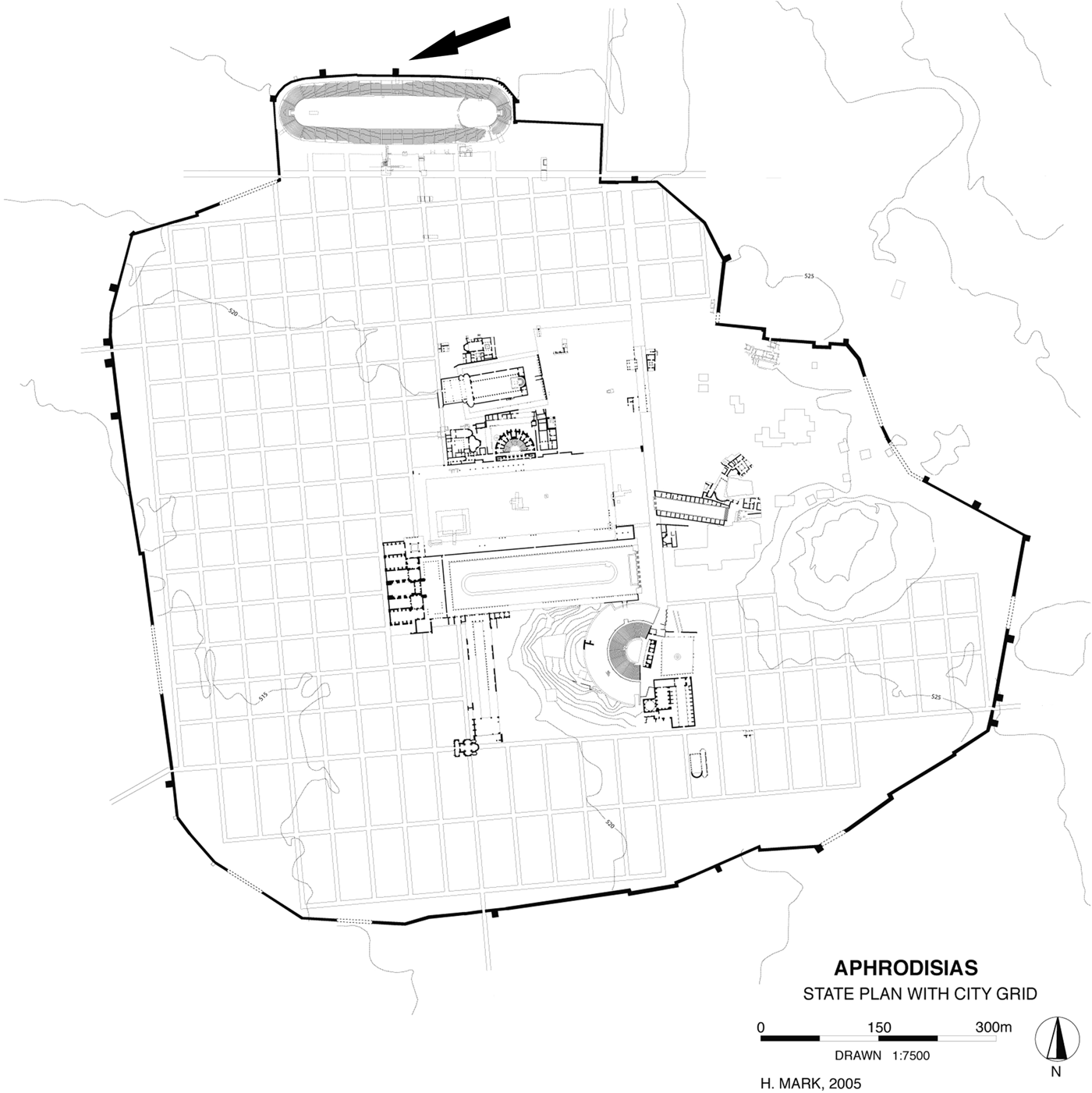
An inscribed marble block, noted already in 1893 by W. Kubitschek and W. Reichel but not published by them, was recorded in the north City Wall by the MAMA team (led by W. M. Calder) in 1934 and published in 1962 as MAMA VIII.415, by J. M. R Cormack. The block, part of a base, has been easily re-found, built into the central tower in the stretch of City Wall that surrounds the Stadium on its north side (Fig. 40). The stone had been used as part of the exposed spolia facing of the tower, on its east side (Fig. 41), as a stretcher block, with its long inscribed face upwards and originally concealed in the wall. The plain upper surface of the base was aligned with the wall face, and the short front face looked north, buried in the wall (Fig. 42). This tower was part of the original construction of the City Walls, which were built in the later a.d. 350s, principally by the governor Flavius Constantius.Footnote 22
City plan. Arrow shows position of Troilos base in tower in north Wall. (Drawing: H. Mark)
Tower in north wall, with Troilos base.
Troilos base built into tower.
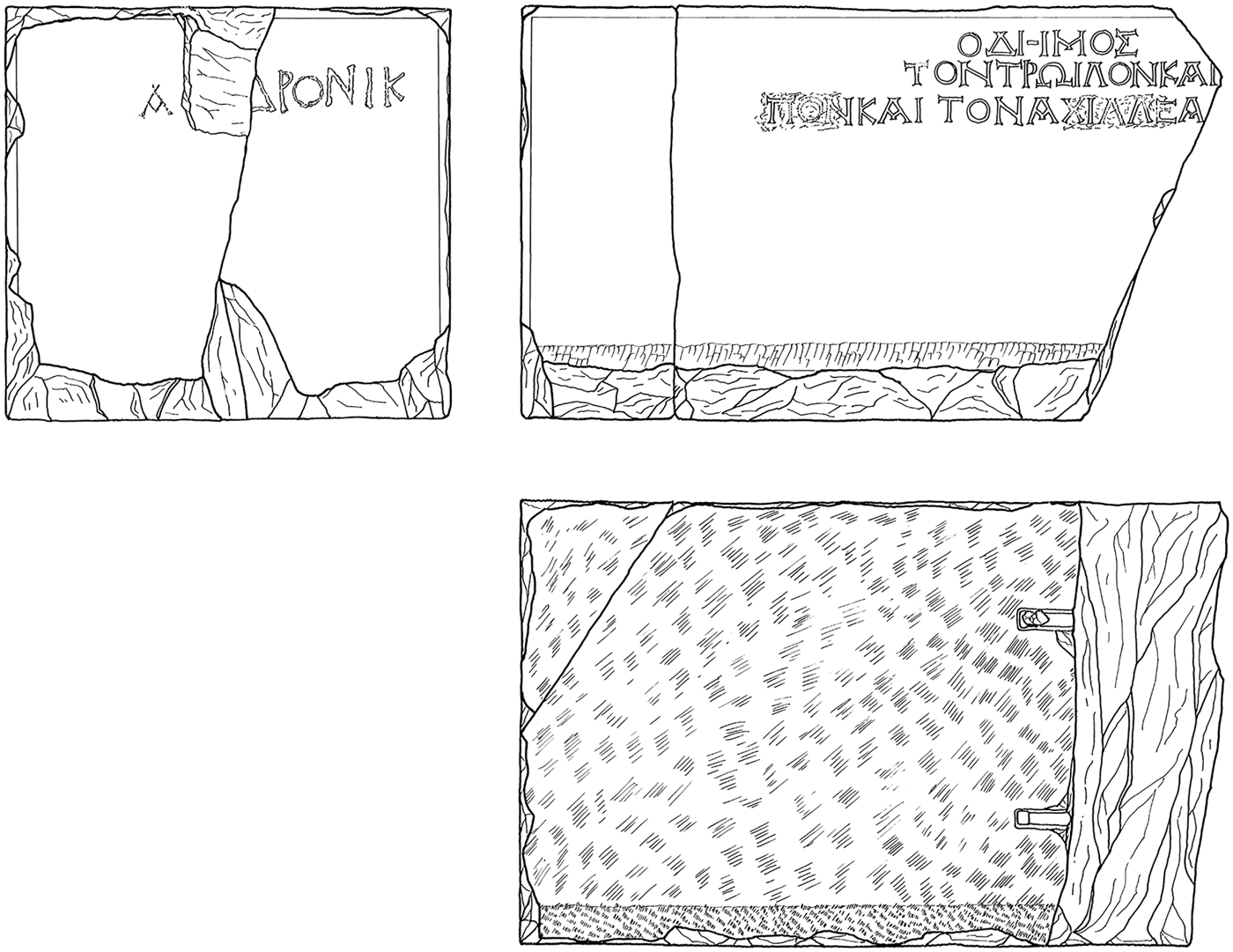
The stone was temporarily removed from the wall in 2004 and measured, and then removed from the wall to the excavation depot in 2009 (inv. 09-66). Its dimensions are H: 58.5, L: 99, and W: 64.5 cm. It is the central shaft or die of an early imperial statue base, a carefully squared block, with neat drafted edges (Figs 43–45). There was originally a lower moulded profile that was shaved off for its use as spolia in the wall. The base was broken in antiquity at the rear or right end of the block and repaired with careful clamp-cuttings in its underside (Fig. 45). It was a base with a long life that ended up in the wall after the monument to which it belonged was damaged and dismantled.
Troilos base, removed from Wall.
Troilos base, detail of inscription. (Photos: I. Cartwright)
Troilos base: front, left side, and underside. (Drawing: U. Outschar)
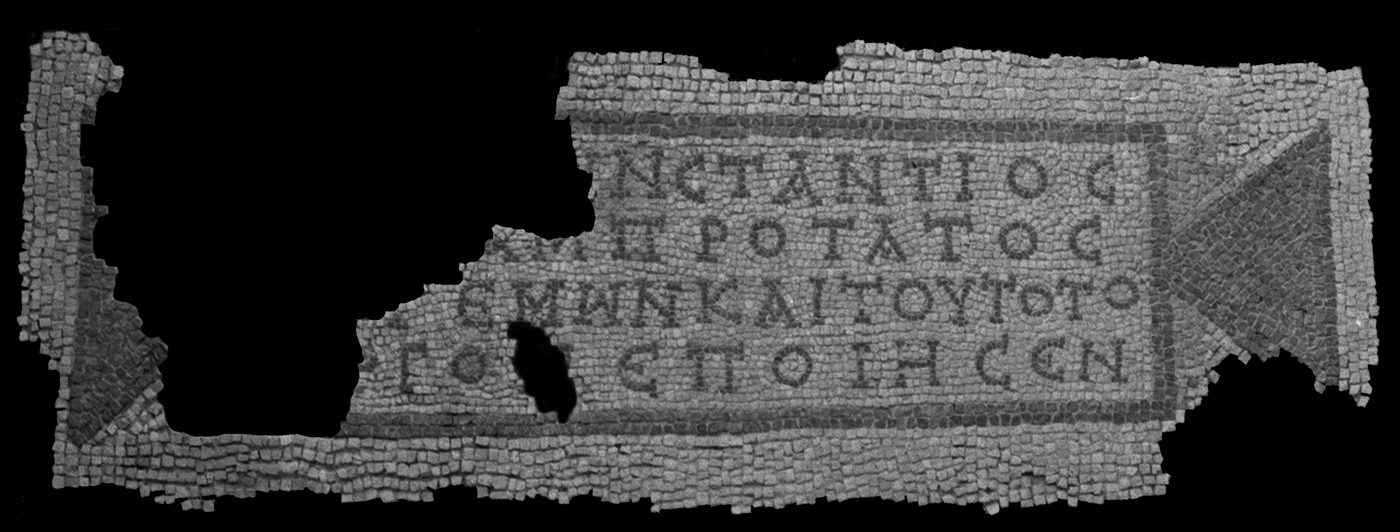
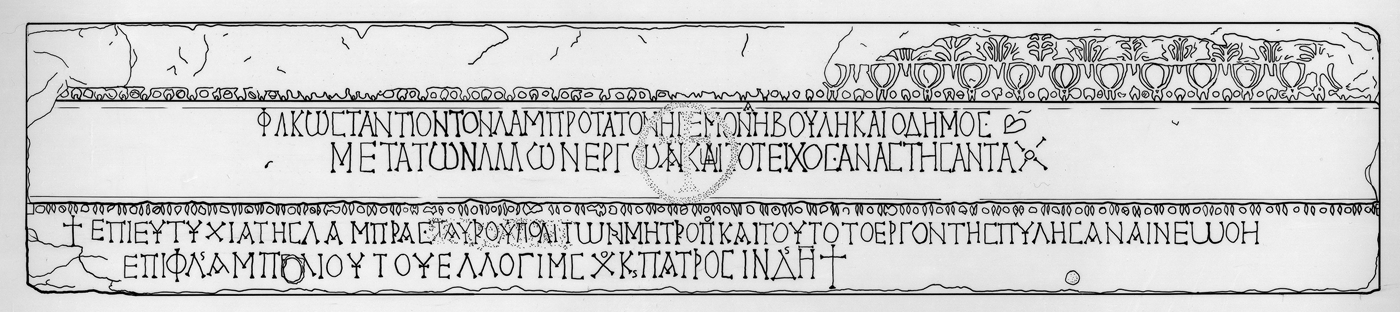
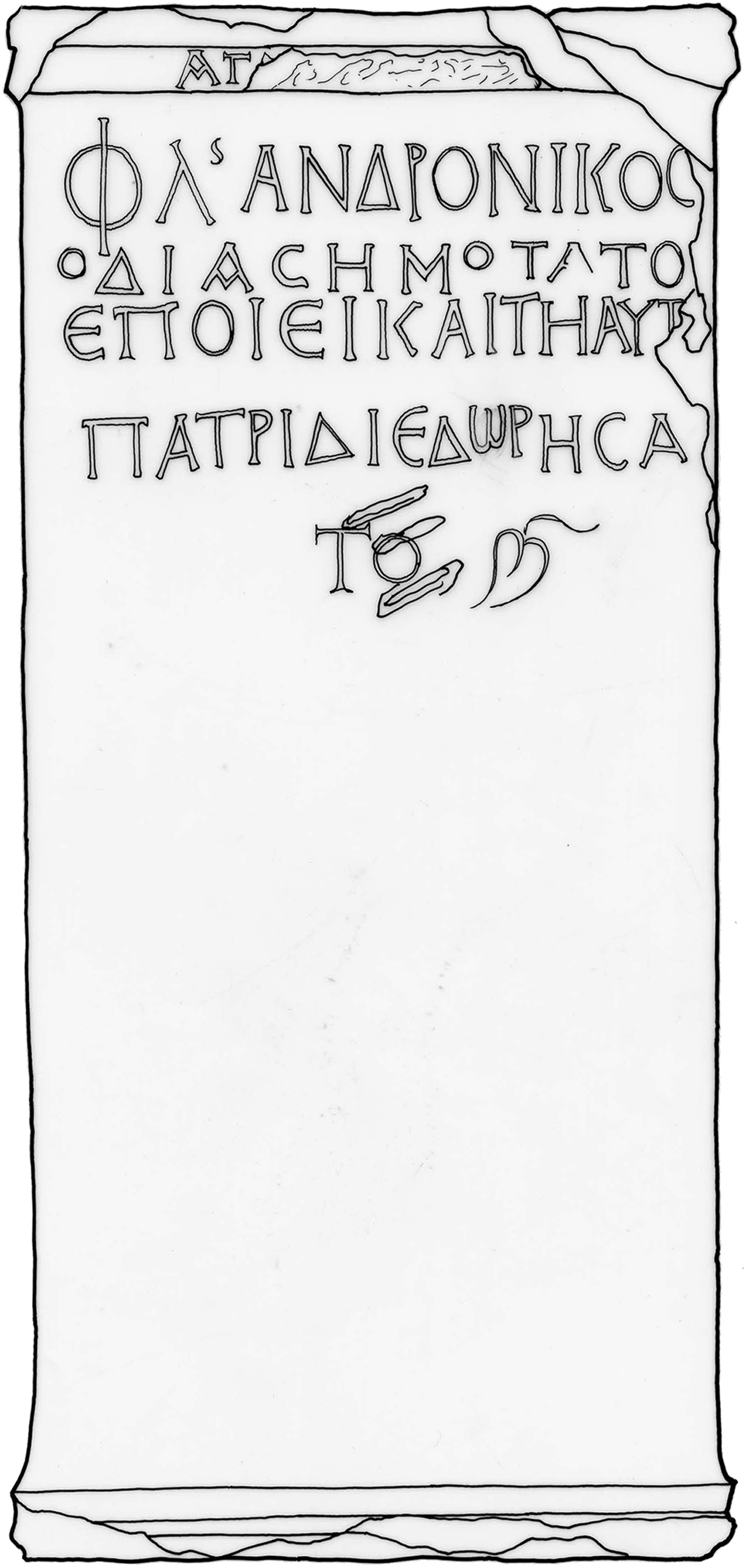
The block carries on one long side an inscription (Fig. 44) in neat, early imperial Aphrodisian lettering (letter H: 3 cm), first published in MAMA VIII.415 as:
ὁ δῆμος
τὸν Τρωΐλον καὶ
ΠΟΝ καὶ τὸν Ἀχιλλέα
The demos (set up) the Troilos and … PON and the Achilles.
So, a monument with statues of Troilos and Achilles set up by the people. L. Robert in an excoriating book-length review of MAMA VIII in his Hellenica XIII saw quickly how the not-understood ‘ΠΟΝ’ should be restored: ‘Je reconnais [τὸν ἵπ]πον’.Footnote 23 So, the demos set up a public monument with statues of ‘the Troilos and the horse and the Achilles’, in which the horse was clearly a prominent part. Its subject, as Robert noted, was surely the defining episode in Troilos' story — the young Trojan prince, son of Priam, who took his horse(s) to water at a fountain outside Troy where he was ambushed and killed by Achilles. Troilos dies a hero's death, and in the tight economy of the inscribed base he was the lead subject, the point of the monument. The interesting question of the connection of this base with the monument in the Basilica will be pursued shortly. There are first, however, a few other aspects of the Troilos inscription that should be noted.
The rôle of the horse in the monument was something about which there was clearly some thought — and second thoughts. The way the short text was laid out on the block shows that it was meant to be centred and symmetrical (as such a text in this period with plenty of space around it would normally be) and that in its first conception and layout on the stone it read as follows:
ὁ δῆμος
τὸν Τρωΐλον
καὶ τὸν Ἀχιλλέα
The Demos (set up) the Troilos and the Achilles.
That is, ὁ δῆμος is centred above τὸν Τρωΐλον (see Fig. 44). It was then decided, perhaps because of its monumental prominence and perhaps its virtuosity, to add mention of the horse. Robert did not comment on the resulting line division of his restoration, merely completing ΠΟΝ as [τὸν ἵπ]πον, without giving a new corrected text. Republishing the text, IAph2007 12.10 (repeated in PHI Aphrodisias 185) takes Robert's restoration and puts it at the beginning of the third line, immediately before ΠΟΝ, where, however, there is a vacat on the stone. The addition was not simply τὸν ἵππον, but καὶ τὸν ἵπ/πον, with a stop-point added before the καὶ, and it was divided over two lines to reduce its impact on the careful symmetry of the original text. It surely then became necessary to add a final word such as ἀνέθηκεν or ἀνέστησεν at the end of the third line to maintain the balance and symmetry of the text, and perhaps a leaf at the end of the first line. After the addition of καὶ τὸν ἵπ/πον above, the third line could not end with a ‘hanging’ empty space. Such a verb (‘dedicated’, ‘set up’) is regularly used, even in simple honorific texts.Footnote 24 With the horse added, the text should look and read as follows:
ὁ δῆμος [leaf?]
τὸν Τρωΐλον · καὶ [τὸν ἵπ-]
πον καὶ τὸν Ἀχιλλέα [ἀνέστησεν]
The Demos set up the Troilos and the horse and the Achilles.
It is clear from the now de-centred position of ὁ δῆμος — ‘pushed’ to the left by this addition — that this was a secondary adjustment. Since the lettering is indistinguishable from the rest of the inscription, however, it was contemporary and represents an addition made during the layout and cutting of the dedication. It represents immediate second thoughts.Footnote 25 On a third, later occasion, some letters, mainly in the surviving third line were damaged and/or partly erased, probably in connection with the later damage and removal of the base.Footnote 26 The block was also at some point broken and repaired with clamps underneath (Fig. 45). The care and quality of the clamp cuttings suggests an early repair, rather than a late antique one. Finally, after a long life, the block was shaved of its lower moulding and deployed as building material in the north City Wall.
The form of the inscription is interesting: it is a dedication by the people without mention of a deity, and so should have been set up more likely in a public space belonging to the demos than in a sanctuary. The text is somewhere between a dedication and a public honour, but this is not a distinction that would have been much felt in a large public monument of the early imperial period. We might compare another Aphrodisian monument, for the hero Bellerophon as a local founder, set up by the demos with a plain honorific formulation: Βελλεροϕόντ[ην] κτίστην, ὁ δῆμ[ος].Footnote 27 Other such texts can use the definite article to highlight aspects of the crafted figures when the desired specification of the statuary would not otherwise be clear. For example, when one Artemidoros Pedisas dedicated ‘the Hermes, and the gilded Aphrodite, and the Erotes carrying torches on either side, and the marble Eros in front of it’ (IAph2007 12.204), such precision about the statuary would not have been possible without the definite articles.Footnote 28 The Troilos base uses definite articles in this way for what was a complicated statue group. Since ‘the horse’ must have the article, then so too must ‘the Troilos’ and ‘the Achilles’. Such designations did not undercut the votive or honorific force of the texts and did not intend to mark them as statue depictions somehow separate from the real subjects being commended.
Horse in Basilica and Base in City Wall
The inscribed block in the north wall shows that there had been somewhere in the city a monument set up by the people with statuary figures of Troilos, a horse, and Achilles. The question naturally arises as to how the base in the City Wall and the horse in the Basilica might be connected. Is the block in the City Wall the missing die of the base in the Basilica? The block is broken at its right end, so that its original length is unknown. The full width is however preserved and demonstrates two things. Firstly, the inscribed block is too wide for the upper and lower elements from the Basilica, by c. 2 cm on each side. And secondly, the difference is small enough and the overall scale and dimensions close enough to suggest that the block from the wall does indeed have something to do with the horse we have. Separated, one is left potentially with two monumental groups representing Troilos and his horse. This is both unlikely and uneconomical as a hypothesis. We might safely assert that there cannot have been two large public monuments honouring Troilos and Achilles in the one city.
Even taking into account the looser standards and more variable forms of late antique statue bases, the inscribed block is too wide to have ever formed part of the base in the Basilica. In the emerging long biographies of base and group, we should anyway not expect them to belong together. That is, the horse monument cannot have stood as a proud ‘new’ statue group in the Basilica through Late Antiquity if an integral part of its base was already out of commission and built into the north City Wall by the 350s. The conclusion is obvious: the block in the wall belonged to the original, first base of the monument. At some point the monument was damaged and dismantled. The base was broken and went to the City Wall, and the horse group was repaired and went to the Basilica where the late antique base that we have was made for it. The reconstruction of the group and its connections back into hellenistic times may now be explored. We will return later to its late antique life (Section VII) on which there is more to say.
IV RECONSTRUCTION: A HELLENISTIC MYTHOLOGICAL GROUP
The original composition of the three-figure group can be broadly reconstructed from internal evidence of the horse and rider and from well-preserved versions of the same scheme known in other media. They and the Aphrodisias monument were all descendants of a major hellenistic mythological group, a single compositional ‘type’ of which they are demonstrably later versions and receptions. The Aphrodisias group is the first example known at full size in the round.
The primary evidence for the reconstruction of the group is the surviving fragment of the white marble rider, and the cuttings that show how it was positioned on the horse. In the new reconstruction of the group (Figs 11–12), the preserved fragment of Troilos’ left leg is fastened to the horse's left flank by means of a modern dowel. The present position of the leg is effective in suggesting a rider urging his horse forward at high speed — like a jockey. But the holes for this dowel, drilled into the inner side of the thigh and into the flank of the horse, as mentioned earlier, are both modern, made for the 1979 reconstruction. The only ancient evidence for the way the rider was originally mounted on the horse is the large squarish dowel-hole in the rider's left buttock and the remains of the iron dowel that can be seen still in place, protruding from the middle of the horse's back (Fig. 23). To this may be added the two slight depressions, one considerably deeper than the other, carved into the two flanks of the horse (Figs 23–24), which show that the right leg was set some way in front of the left, and at a different angle.
The combination of these two pieces of evidence reveals that Troilos was not securely seated on his horse. First, the ancient dowel rose vertically out of the very centre of the horse's back; yet it was inserted directly into the middle of the rider's left buttock. This must mean that Troilos was twisted in his posture, turning sharply towards his left, so that his left buttock was carried directly over the middle of the horse's back (far from its present position). Second, his right leg was clearly extended forward at quite a sharp angle, and a deeper depression had to be hollowed out where it pressed into the right flank of the horse (Fig. 24). The left leg was set considerably further back, and less hollowing out of the horse's flank was needed to accommodate it — presumably because this leg extended further away from the horse's body. All this is consistent with a violently twisting posture, and it suggests that Troilos was represented being dragged off his horse from behind. A brief review of the iconographic tradition for Troilos will show that this was in fact the most common way for him to be represented in the visual arts in the hellenistic and Roman periods.
The Iconographic Tradition
Troilos was not an especially popular figure in the visual arts, but his story was certainly well known. There are close to 200 known representations listed in the Lexicon Iconographicum Mythologiae Classicae (LIMC).Footnote 29 Almost all of them depict the story of Troilos’ fatal encounter with Achilles — by far the most important element of his story; and the majority show him either on horseback or leading two chariot horses. This close connection with horses is even acknowledged in the one mention of Troilos in the Iliad (24.257), where he is referred to as ἱππιοχάρμην, ‘chariot fighter’, a word that later came to mean simply ‘horseman’.
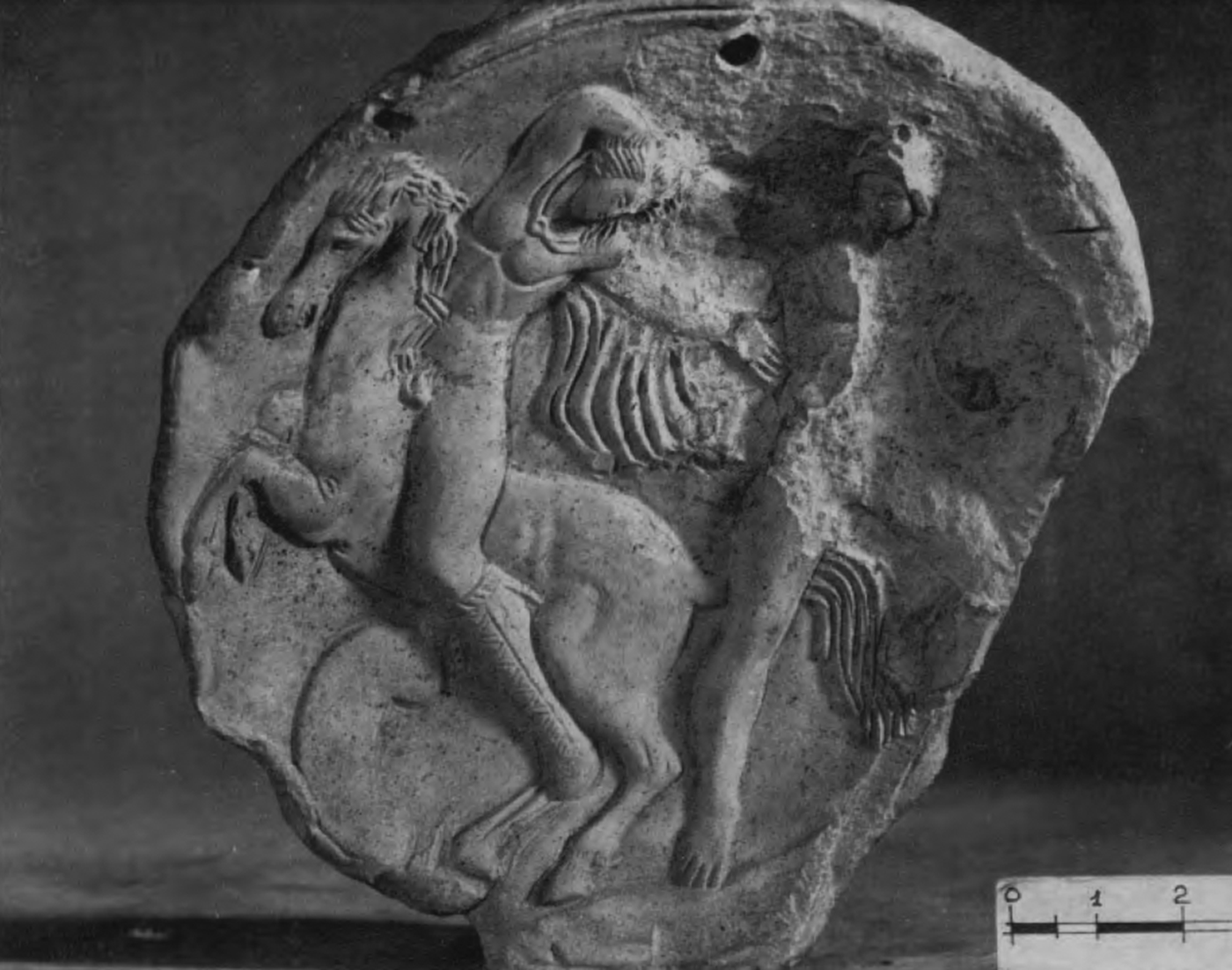
Where Troilos is shown on horseback, as in our monument, he is very often depicted fleeing for his life, with Achilles in hot pursuit — sometimes already grasping him from behind, by the hair. The earliest representations of Achilles’ dragging Troilos off his horse are found on Attic red-figure pots, and they all show considerable variation from one another.Footnote 30 By the early hellenistic period, however, there begins a series of depictions of this episode that all clearly follow a single consistent compositional scheme. There are some seven well-preserved and widely-scattered examples of this composition in different media:
(1) Terracotta relief from Athenian Agora, early hellenistic (Fig. 47).Footnote 31
(2) Limestone relief from Tarentum, probably metope from tomb-building, third century b.c. (Fig. 48).Footnote 32
(3) Relief ornament on cuirass of bronze statue of Germanicus, early first century a.d., found at Amelia 100 km north of Rome (Fig. 46).Footnote 33
(4) Glass paste cameo in New York, first century a.d. (Fig. 49).Footnote 34
(5) Sardonyx cameo from Grimani Collection, first or second century a.d. (Fig. 50).Footnote 35
(6) Terracotta disk from Pompeii, part of large lamp, first century b.c. or a.d. (Fig. 51).Footnote 36
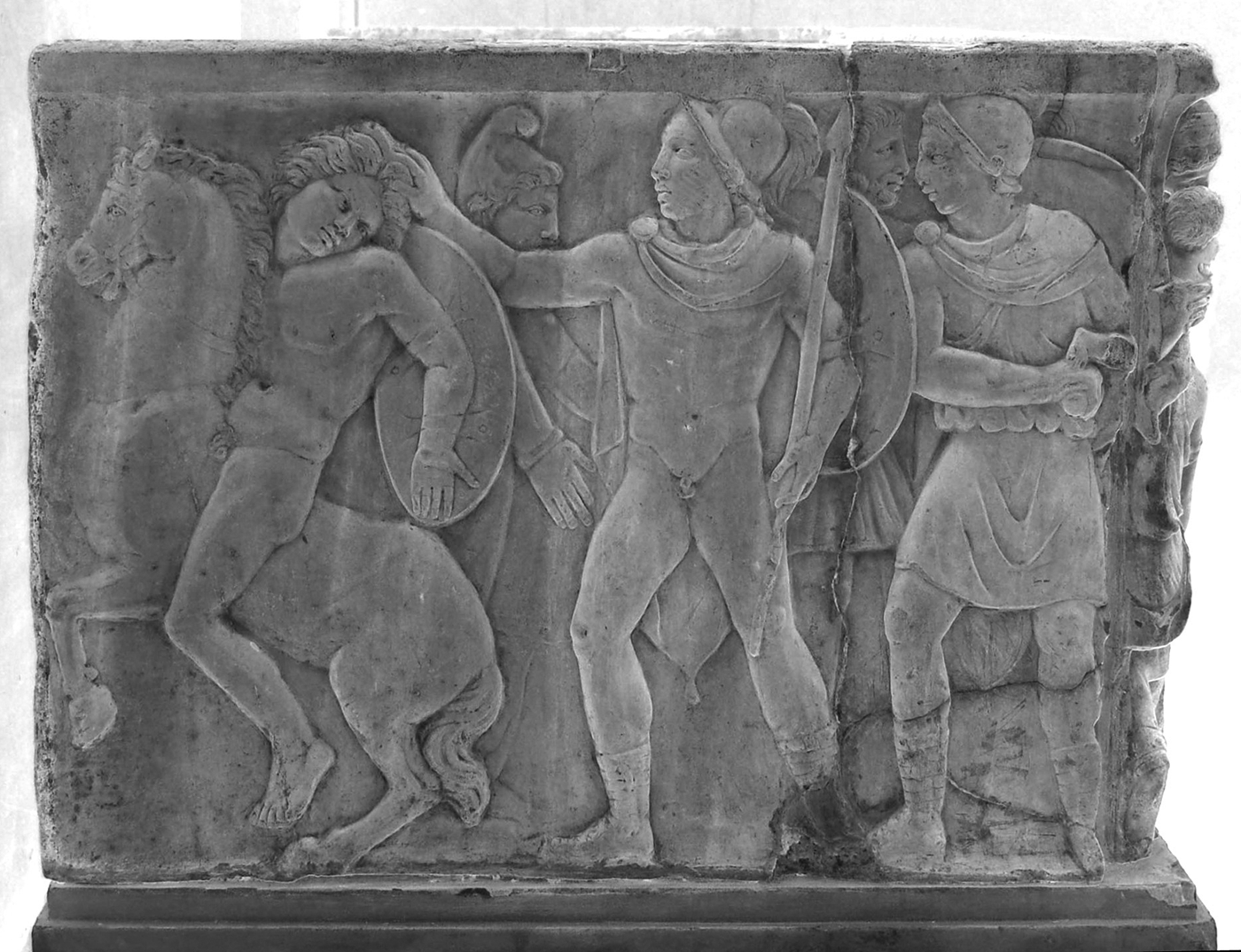
(7) Relief on short end of marble sarcophagus in Mantua, later second century a.d. (Fig. 52).Footnote 37
Cuirass from bronze statue of Germanicus, early first century a.d., from Amelia. Museo archeologico di Amelia. (Photo: Soprintendenza per i beni archeologici dell'Umbria)
Terracotta relief from Agora, c. 300 b.c. Athens, Agora Museum. (Photo: Agora Excavations)
Limestone relief from Tarentum, third century b.c. Taranto, Museo Nazionale. (Photo: Soprintendenza per i Beni Archeologici della Puglia)
Glass paste cameo, first century a.d. New York, Metropolitan Museum of Art. (Photo: courtesy Museum)
Sardonyx cameo, first/second century a.d. Private Collection. (Photo: courtesy owner)
Terracotta disk, from Pompeii, first century b.c./a.d. Naples, Museo Nazionale. (Photo: Soprintendenza speciale per Pompei, Ercolano e Stabia)
Marble sarcophagus, c. a.d. 180. Mantua, Palazzo Ducale. (Photo: Soprintendenza per i Beni Artistici Storici ed Etnoantropologici di Mantova)
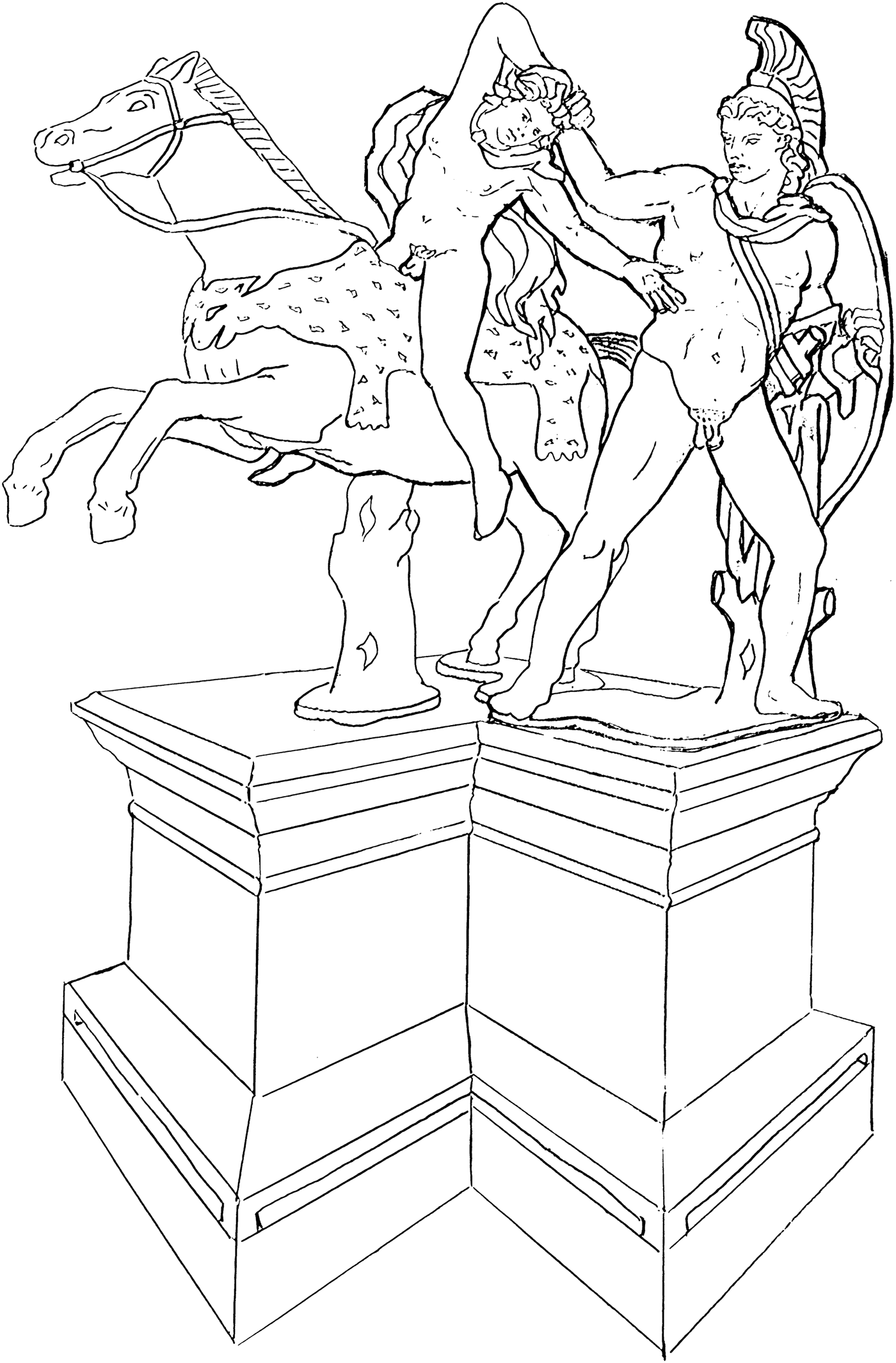
All these representations of the scene show a striking level of formal agreement. (A) Achilles has a dynamic, wide-striding posture and reaches up to grip Troilos’ hair. Achilles’ costume is also virtually identical in each case: an Attic-style helmet with a large horse-hair plume; a large round shield carried on his left arm, a short chlamys wrapped around this same arm, and visible inside the shield. (B) Troilos is being pulled backwards off the horse by his hair; his right arm is raised and bent back over his head, grasping Achilles’ forearm. His left arm is flung wildly out towards his pursuer, his hand open and slightly overlapping Achilles’ chest. Troilos too usually wears a chlamydion, though it is draped slightly differently in each case. In two instances he also wears tall riding-boots (Amelia and Pompeii: Figs 46 and 51). And (C) the galloping and rearing horse is seemingly dragged backwards in sympathy with its rider. How this could happen in life, however, is unclear, because Troilos conspicuously does not pull backwards on the reins as one might expect.
The close agreement in these key details at once suggests that from the early hellenistic period onwards we are dealing with echoes of a famous monument, a work that was so influential it determined the iconography for Troilos in most later depictions of his story. The discovery of a monumental free-standing version of this subject at Aphrodisias now makes it all but certain that this work was a large-scale statue group, rather than (for example) a major panel painting. Three versions (New York, ex-Grimani, and Pompeii; Figs 49–51) show a pelta under Troilos’ horse — in one case reaching to the horse's stomach (Pompeii, Fig. 51) — that may hint at the kind of decorated support under the original horse, included there, as in these versions, to point up the rider's eastern, Trojan identity.
If we take account of the shared features of the other versions, it is possible to gain some idea of what the missing figures of Troilos and Achilles from the Aphrodisian marble group should have looked like. The Achilles must have been a huge figure, his horse-hair plume rising to the level of the horse's head. The scale of this figure and his wide-striding movement, is already clearly suggested by the cutting in the late antique base that was made to accommodate his enormous plinth (Fig. 39). Troilos was evidently smaller in scale, as is clear from the surviving leg fragment. But he was not a boy. He was depicted as a young warrior, a more youthful figure to be sure, but hardly the immature boy of the early Attic black-figure representations of the subject.
At Aphrodisias, the three-figure group was probably made of three main large blocks of marble, with probably smaller ‘connecting’ blocks. Since little of the two human figures survives, how the joins would have been managed in such a complex three-dimensional composition is difficult now to imagine. It is a good guess, however, that Achilles’ right arm would have been worked separately and pieced. This makes sense too from the point of view of economical use of marble. Possibly it was pieced once at the shoulder, where the join would be least visible, and again at the forearm — just above where Troilos grasps his wrist. Troilos’ extended left arm was also surely pieced. What other joins were required beyond these, it is impossible now even to speculate. The reconstruction drawing in Fig. 53 is intended merely to give a general idea of the total effect of the monument. That is, it sketches in what the missing figures that went with the surviving Aphrodisian horse might have looked like. But the drawing also includes those features that are specific to our monument, and which are not found in the other hellenistic and Roman versions of the Troilos and Achilles group: the leaping-galloping posture of the horse, and the gilded bronze panther-skin saddle.
Troilos and Achilles group at Aphrodisias. (Reconstruction: C. Hallett)
An important question arises from this Troilos and Achilles group: what was celebrated or communicated by the hellenistic monument? For it is only when we have some idea of the original significance of the group that we can address the question of what this particular version of it might have meant in its local, Aphrodisian context.
V TROILOS IN THE LITERARY TRADITION
… godlike Troilos, whom Hekabe bore in holy Troy, by far the best of her unmarried sons; but from his brilliance she had no benefit, for the spear and strength of murderous Achilles robbed him of his life. (Quintus Smyrnaeus, Posthomerica, 4.419–22)
Troilos, the youngest son of king Priam by his principal wife, Hecuba, was always an important figure in the Trojan legend. He is mentioned briefly in the Iliad (24.257), when Priam is upbraiding the worthless sons that remain to him, contrasting them with the brave and brilliant ones that have already been killed. We know that Troilos’ story also featured in the epic cycle, in the Kypria; but because the Kypria is lost, it is now difficult to distinguish which aspects of the Troilos story belong to the epic cycle and which were added subsequently by classical tragedians and other poets who reworked the story.Footnote 38 The most widespread version of the myth, found both in literature and in the visual arts, includes most or all of the following elements.Footnote 39
1. Troilos was the youngest of the sons of Priam by Hecuba, his principal wife (the others are usually given as Hector, Paris, Deiphobus and Helenus).Footnote 40
2. He was killed by Achilles.
3. Troilos met his end in the early stages of the Trojan War, well before the events of the Iliad, while he was still a young boy (Sophokles calls him an ἀνδρόπαις).
4. Being too young to fight, he was not killed in battle but was ambushed by Achilles at a fountain house while watering (or exercising) his chariot horses. He mounted one of the horses and fled, being chased by Achilles, and took refuge in the nearby sanctuary of Apollo Thymbraios. He was cut down by his pursuer actually on or beside the god's altar.
5. Sometimes there is an erotic colouring to this story. Either Troilos was in the company of his sister Polyxena, with whom Achilles was in love. Or he himself was the object of Achilles’ love, and was killed for rejecting him.Footnote 41
6. His death was sometimes characterized as a necessary condition for the fall of Troy (like the taking of the palladion by Odysseus and Diomedes).Footnote 42
7. In all cases the killing of Troilos is what motivates the eventual death of Achilles. His act of sacrilege committed in Apollo's sanctuary earns him the implacable hatred of the god. Apollo eventually kills Achilles, guiding the arrow of Paris, when he is shot down by the Skaian Gates. In some late versions of the story, Troilos is even said to have been the son — not of Priam — but of Apollo himself (Apollodorus, bibl. 3 [151] 12, 15).
There is some variation in the way this, the canonical story, is related; but these are the essential elements. What Troilos was famous for, then, was his death. His death was important because it was necessary for the fall of Troy, and because it brought about the destruction of Achilles, greatest of the Greek heroes.
Further details can be added to the story, drawn from the many representations on painted pottery. Troilos is represented by archaic pot-painters as going to the fountain house to water a pair of chariot horses. Achilles was concealed there waiting to ambush him (sometimes he is shown being encouraged by Athena). Troilos is often depicted seated on one of the two horses, though he has no saddle (cavalry plays no part in Homeric epic). Even when Troilos is shown fleeing on horseback, he is usually accompanied by both horses, the second one simply running beside him. Achilles’ pursuit of Troilos was evidently regarded as a remarkable exploit: that of a man on foot and wearing armour running after and overtaking a boy on horseback. Troilos is almost always dragged off his horse by the hair. Mostly Troilos is shown unarmed; but on occasion he carries two hunting spears. Even when armed, however, he is never able to put up a fight.Footnote 43
If one studies the comparanda for our Aphrodisian group (above, Section IV, Nos 1–7), it is evident that the original composition of the early hellenistic period represented this canonical story of Troilos' death. Troilos is almost always unarmed,Footnote 44 and he rides without any kind of saddle cloth (that is, on a chariot horse). This was a pathetic and undeserved death, an ominous moment from early Greek epic and tragedy. The group presented a powerful evocation of a sacrilegious killing that will bring in its wake the death of its impious perpetrator. As such it belonged among the great series of spectacular monumental groups of the hellenistic period, such as the Achilles and Penthesileia, Ajax and Achilles (Pasquino group), Blinding of Polyphemos, Hanging Marsyas, Laocoon and his sons, Punishment of Dirke, and Skylla and Odysseus' ship.Footnote 45 These groups were concerned with heroic deeds (Achilles, Ajax, Odysseus), with pathetic deaths (Achilles, Penthesileia, Skylla), and with terrible punishments (Dirke, Laocoon, Marsyas). A monumental group showing the death of Troilos, and poignantly foreshadowing (for the educated beholder) Achilles' eventual punishment, would have been very much at home among these well-known hellenistic dedications. Like them, the original free-standing Troilos and Achilles group, of which the Aphrodisias group is a later version, was probably created as a magnificent votive dedication — a kind of monumental equivalent to the tragic plays or narrative poetry customarily written for and performed at religious festivals in the Greek world.
Local Significance
There are signs that — as early as the first century b.c. — the canonical version of the Troilos story was not the only one in circulation. In some famous lines of Vergil's Aeneid (1.474–8) a painting is described (pictura, line 464), in which the Trojan prince is shown being dragged along in the dust by his own chariot team. He is still described as very young (puer), but in this depiction he is represented as a fighter, a warrior, who evidently died in battle, fighting from a chariot.Footnote 46 In another version of the story, which once more places the emphasis on the cruelty of Achilles, Troilos also takes part in the fighting, but is taken prisoner in battle, and then has his throat cut to satisfy the vindictive anger of Achilles.Footnote 47 One surviving account even presents Troilos as the second greatest warrior on the Trojan side — after the death of Hector the de facto commander of the Trojan forces and the most important defender of the city. This is the way the story is told by the pseudonymous ‘Dares the Phrygian’, in a (rather neglected) prose account of the Trojan War, de excidio Troiae historia, which was probably written sometime in the first century a.d.Footnote 48 It is Dares’ version of the legend that may provide us with the clue to the way in which the Troilos story was remembered and understood in Asia Minor in general in the hellenistic and Roman periods, and at Aphrodisias in particular.
Narrative of ‘Dares the Phrygian’
A Trojan called Dares appears in the Iliad (5.9) as a priest of Hephaistos. A prose work purporting to be written by this same character, and claiming to be a pre-Homeric (and thus more authentic) account of the Trojan War, survives today only in Latin translation. Thus, like the comparable book by Dictys of Crete, Dares' work is an ancient forgery. The extant Latin translation is also a blatant forgery, declaring itself to have been made by Cornelius Nepos in the first century b.c., and carrying a dedication to the Latin historian Sallust. ‘Nepos’ professes to have found the Greek text in Athens; and the account of the Trojan war that is given certainly does show a marked Athenian bias, emphasizing Athenian heroes who are absent in Homer. Despite the explicit claims of the author (likely an Athenian), the work as we have it was probably written in Greek sometime in the first century a.d.Footnote 49 And it was only translated into Latin in a much later period, probably the sixth century a.d.Footnote 50 In the text, ‘Dares’ is said to be a follower of Antenor. This, of course, provides the explanation for how the author survived to write up the events he relates: the Greeks had allowed Antenor to leave Troy with his followers when the city was taken.
Troilos is singled out from the very beginning of Dares' narrative as a fighter. When Helenus, who is a seer, predicts that if Paris brings home a Greek wife, Troy will be sacked by the Greeks, Troilos urges the Trojans not to be frightened by his older brother's dire warnings, but to resist any such attack on their city (1.7). The author describes him as: ‘Troilum magnum pulcherrimum pro aetate valentem fortem cupidum virtutis’, ‘large and handsome, strong for his age, brave and eager for glory’ (1.12). When the commanders of the allied Trojan forces are mentioned, Troilos is named as one of them, and appears in the list of leaders ahead of Aeneas and Memnon (1.18). In the battles that follow, Troilos is regularly described as leading forth an army (1.20, 1.23). After the death of Hector, Troilos enjoys a kind of aristeia (beginning in 1.29), always being named as the primary leader of the Trojan forces, and slaughtering many (unnamed) Greeks. When Menelaus claims in the Greek council of war that now Hector is gone there is no one brave enough to protect the Trojans, he is answered by Diomedes and Odysseus: ‘Diomedes et Ulixes dicere coeperunt Troilum non minus quam Hectorem virum fortissimum esse’, ‘that Troilos is a very brave warrior and the equal of Hector’ (1.30). In the fighting that follows Troilos kills many more Greeks, and even wounds Menelaus (1.31). On the next day he manages to wound Diomedes. Agamemnon then asks Priam for a truce. Troilos urges the Trojans to reject the offer, but is out-voted. After the truce is over, and battle is renewed, Achilles sends his Myrmidons against the Trojans, together with the whole Greek army, but Troilos breaks their ranks and puts them all to flight. Another truce follows, but then again the war is renewed. Dares continues his account thus:
postquam primum diei tempus transit, prodit in primo Troilos caedit prosternit: Argivi fugam cum clamore fecerunt. Achilles ut animadvertit Troilum iracunde saevire et Argivis insultare simulque sine intermissione Myrmidones prosternere, procedit in bellum. quem Troilos continuo excipit et sauciat. Achilles de proelio saucius redit.
When the morning had passed Troilos advanced to the front slaughtering and scattering the Argives; he forced them to flee with a great clamour. Achilles, when he saw Troilos raging with battle fury — trampling the Argives and relentlessly slaughtering the Myrmidons — re-entered the battle. But almost immediately Troilos attacked and wounded him, and Achilles withdrew hurt from the battle. (1.33)
In this version of the story, it is the terrible onslaught of Troilos that persuades Achilles to re-enter the battle. And when Achilles does make his appearance, Troilos defeats him. Dares’ account of Troilos’ death, seven days later, follows:
die septimo dum utrique exercitus proelio facto inter se pugnant Achilles, qui aliquot dies vexatus in pugnam non prodierat, Myrmidones instruit: alloquitur hortatur ut fortitur inpressionem in Troilum faciant. postquam maior pars diei transiit, prodit Troilos ex equo laetus. Argivi maximo clamore fugam faciunt, Myrmidones supervenerunt, inpressionem in Troilum faciunt, de quorum numero multi a Troilo occiduntur: dum acriter proeliantur equus vulneratus corruit, Troilum imlicitum excutit. Eum cito Achilles adveniens occidit …
On the seventh day, while the battle between the armies was still raging, Achilles (who until then had stayed out of the action because of his wound) drew up his Myrmidons. He addressed them urging them to be brave and to make an attack against Troilos. Towards the end of the day Troilos advanced on horseback, exulting. The Argives took flight with loud cries. The Myrmidons, however, came to their rescue and made an attack against Troilos, though many of their number fell, killed by Troilos. Then, in the midst of the terrible fighting Troilos' horse was wounded and fell, entangling and throwing him off; swiftly Achilles was there to dispatch him. (1.33)
Achilles next tries to drag off Troilos' body, but Memnon comes to his rescue and drives Achilles away, wounding him in the process. In the subsequent battle Achilles also kills Memnon, and the Trojans take refuge inside the city. Priam requests a truce and holds a magnificent joint funeral for Troilos and Memnon. A day later Achilles is lured by Hecuba to the sanctuary of Thymbraean Apollo in front of the walls of Troy, and there Paris ambushes him, killing him together with his companion Antilochos (1.34).
The Troilos who emerges from the pages of Dares does not just die pitifully; he is a great warrior.Footnote 51 He fights back — even wounding Achilles. And there are two indications in our Aphrodisian monument that the local sculptors who made this version of the hellenistic group had in mind an alternative version of the Troilos story, similar to the one narrated by Dares. First of all, Dares' account of the death of Troilos (quoted above) contains a telling error. He has Troilos go into battle ‘on horseback, exulting’ (ex equo laetus). This error must have been prompted by representations of Troilos familiar from the visual arts, where he is so often shown riding. For of course there is no cavalry in Homeric warfare, and — even elsewhere in Dares' own narrative — heroes never go into battle on horseback. The Aphrodisian group, however, emphatically turns Troilos into a heroic horseman, giving him a hero's panther-skin saddle, like the innumerable heroes on Asia Minor grave reliefs of the hellenistic and Roman periods.Footnote 52 And instead of having the horse simply rearing up, as if its rider is about to be thrown, the sculptor represents the horse leaping forward at a gallop, so that Troilos appears as a dynamic cavalryman, charging fearlessly forwards, only grabbed by Achilles — as if at the very last moment — as he flashes past.
VI RECEPTION: TROILOS AND ACHILLES IN SANTA BARBARA
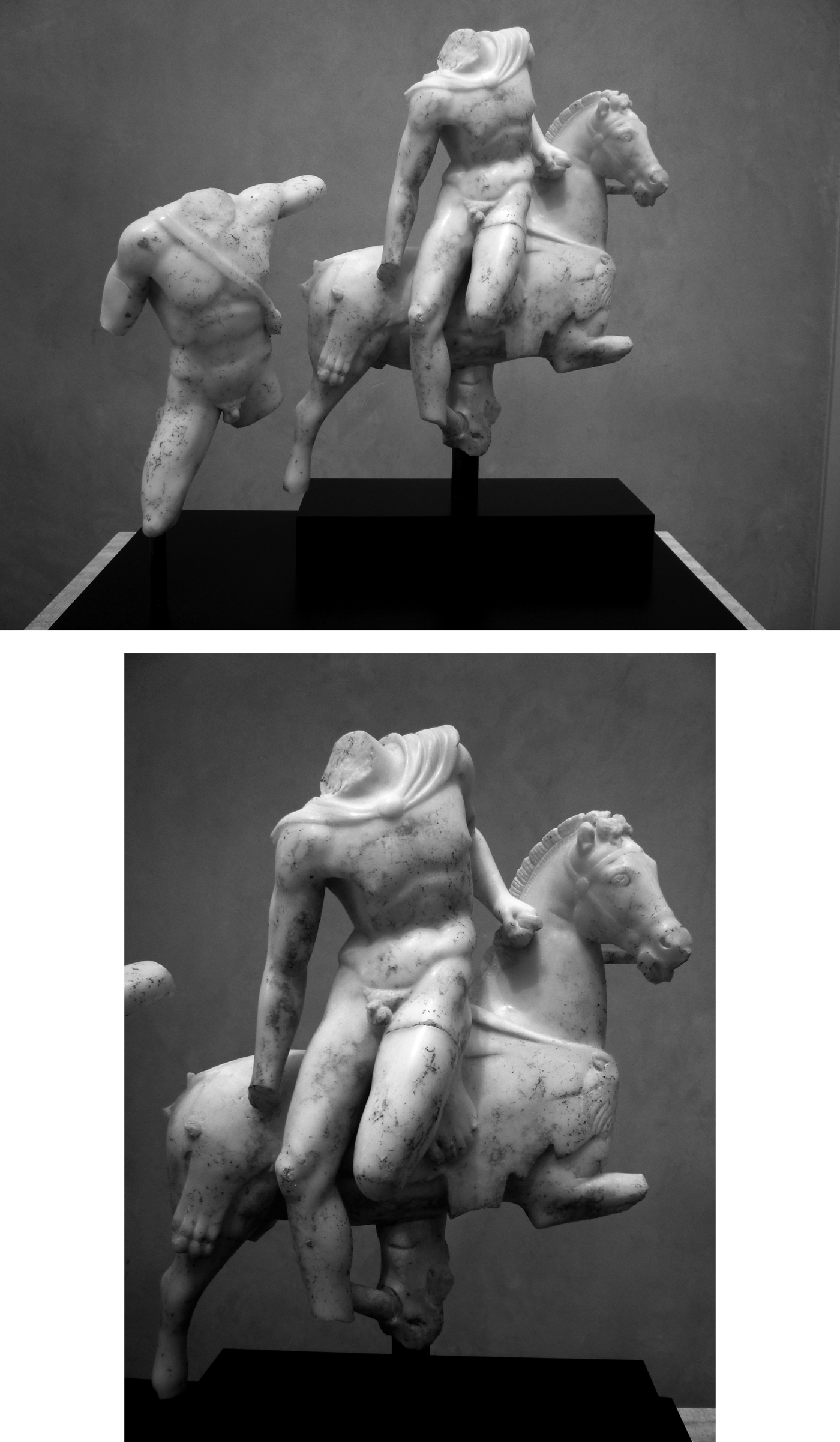
This reading of the Aphrodisian Troilos group, viewed and re-interpreted through the lens of a set of stories quite different from the canonical narrative, receives support from another sculptural version of the subject, today in the collection of the Santa Barbara Museum of Art.Footnote 53 It is the only other version to have survived that is carved fully in the round (Figs 54–55). The carving is of exquisite quality, and the design is at once recognizable as an adaptation of the same group of Troilos and Achilles. This is not affected by a few obvious changes: the composition has been reversed, Troilos' pose adjusted, and the scale reduced to that of a large statuette.
Troilos and Achilles group. Santa Barbara Museum of Art. (Photos: R. Smith)
This small-scale version is said to come from Asia Minor, and its distinctive style of carving suggests that it is very probably also the work of an Aphrodisian sculptor. In fact, the miniaturization of famous statue-groups of which full-size versions are known in the city is a well-attested phenomenon at Aphrodisias.Footnote 54 The resulting small figures and groups were probably for domestic display. Beautifully finished on all four sides, this version of the Troilos group was evidently intended to be seen from all around. A whole series of ancient repairs — the reattachment of Troilos' left leg and Achilles’ right arm, for example, and the dowel holes drilled for replacing the horse's front legs — reveal that this miniature group also had a considerable life in antiquity, perhaps, like the one from the Aphrodisian Basilica, over several centuries.
The composition has been reconstructed slightly wrongly in its modern display in the museum. This is most noticeable in the way that Achilles and the horse very obviously do not share the same ground-line. But the exaggeratedly low setting for the figure of Achilles does not prevent us from seeing at a glance the close relationship of this group to the one from the Aphrodisian Basilica. Here too Troilos has been recast as a heroic cavalryman, with a fine lion-skin saddle (somewhat larger than the one on the large blue-grey horse, and with a clear indication of the lion's mane). Strikingly, however, in this miniature version of the group, Troilos is given an even more markedly heroic stature, and now appears as a worthy opponent of Achilles.
This can be seen first in the relative scale of the figures. In the Santa Barbara group, Troilos has become precisely the same size as Achilles.Footnote 55 He is no longer visibly younger than his Greek opponent. In fact the two warriors are given a very similar physique, with short torsos and long slender arms and legs. Achilles was still evidently grabbing Troilos by the hair, as can be seen by the angle of Troilos' neck. But the sculptor, by reversing the composition has sought to improve on the original group. For Achilles grabs Troilos' hair now with his left hand (the hand that holds the shield in all other representations of the group). This frees up Achilles' right hand for him to threaten Troilos with his drawn sword.Footnote 56 The sculptor introduced another ‘improvement’ in this version: rather than simply being dragged off his horse, Troilos here seems to be dismounting of his own accord. Still holding his horse's reins in his left hand, he has lifted his left leg over its back and placed it on the horse's right flank (Fig. 55), so that he now turns to face Achilles. Very probably he also threatened Achilles with a sword held in his lowered right hand.Footnote 57 The two extended swords would have suggested with some immediacy that these heroes were evenly matched.
While Troilos has become larger, the horse has been considerably reduced in size. This is plainly the smaller, rearing horse seen in the other versions of the type (Figs 46–52), not the more imposing, galloping charger of the group from the Aphrodisian Basilica. And Troilos is raised considerably higher in the composition, so that he completely dominates his mount. His whole body is positioned in front of his horse. It is impossible to miss that it is the Trojan prince Troilos that is now emphatically the most important figure in this composition. By his change in position he has completely upstaged Achilles. One does not need an inscription in this case to realize that this group is to be understood as ‘Troilos and Achilles’ — not ‘Achilles and Troilos’.
This better-preserved version in Santa Barbara then — though different in important respects — can lend some support to our conjectural reconstruction (Fig. 53) in the following ways:
(1) The horse is supported below by a tree stump under its belly.
(2) Troilos has a small cloak (chlamydion) that once billowed out behind him, as it does in all the relief representations of the group. The cloak was worn fastened with a brooch in front of his neck. Most of the cloak is today broken off and missing, but a small strut on the lion skin behind Troilos and to his right suggests that the cloak probably reached almost to the level of the horse's back.
(3) Achilles appears in the round in exactly the same physical posture as he does in the other versions (despite the reversal, and despite his quite different action). But in this version he does not carry a shield or wear a cloak (though, of course, a tiny statuette does not need the crucial support that these could give to an over-life-size marble figure).
The Santa Barbara group also strongly reinforces our overall interpretation of the monument from the Aphrodisian Basilica. For it seems to push the composition of the original group even further in the direction of a celebration of the Trojan hero Troilos (at the expense of Achilles) — similar to the way he is celebrated by the pseudonymous ‘Dares the Phrygian’. The special resonance or ‘message’ of the monument, adjusted in this way for a local Aphrodisian and regional Anatolian audience, seems to be: Troilos was a great warrior, almost a match for the invincible Achilles, and he was one of ours, a ruler and champion of western Asia.
VII LATE ANTIQUITY: FL. CONSTANTIUS AND FL. ANDRONIKOS
The Troilos group at Aphrodisias then was a public monument of the early imperial period, a carefully adapted local version of a hellenistic group. For its original setting we might think perhaps of the South Agora, a tree-lined urban park called the place of palms (ALA 38).Footnote 58 Both its pool and its palm grove, long a symbol of the Trojan plain, would suit well a marble narration of the Troilos story. Indeed, representations of the death of Troilos in other media sometimes include a palm tree.Footnote 59 The monument also had a long second life in Late Antiquity. The precise order of local events in its second life and their chronology at Aphrodisias cannot be certainly known, but the circumstantial evidence for a re-installation of the group in the Basilica in the mid-fourth century is strong.
From the early fourth century, the copy of Diocletian's Edict of Maximum Prices and the less-well-known Currency Edict, both engraved on the Basilica façade in a.d. 301, gave the building an unusual and newly-charged prominence (Fig. 5).Footnote 60 This was a truly monumental epigraphic project, surely of the resident governor. The edicts were in Latin, a language that few Aphrodisians could read, and both their language and imperial content marked the Basilica as a place of government authority. The newly-discovered rear chamber at the south end of the Basilica, with its raised, tribunal-like platform, we may guess, provided an unmissable opportunity for the architectural mise-en-scène of the governor's appearances (Fig. 3). A rare Latin inscription in verse on a statue base for a governor(?) of probably this period or a little later mentions such a tribunal and refers to the incorruptible honorand who ‘pours out his laws’.Footnote 61
Constantius
The governor Flavius Constantius undertook major work in the building in the 350s, attested in an ‘inscribed’ tabula represented in the fragmentary mosaic floor of the west aisle (Fig. 56). The tabula fragment was located in a wall niche and reads:
[Flavius C]onstantius, the clarissimus praeses (= governor), made this work also.Footnote 62
The governor has ‘made’ all of the mosaic in addition to (καὶ) other work, presumably restoration work in the Basilica. He uses ἐποίησεν in an interesting way. He claims to have ‘made’, that is, to have had made this work. The earlier Greek ‘craft’ meaning of ἐποίησεν (‘made with his own hands’) has by this date undergone a significant shift or expansion of its semantic range. The governor's restoration work in the Basilica was sufficient for him to receive an honorific statue there. Its base was found at the Basilica in 2004 — a low base, semi-circular in plan at its rear, for fitting into a niche. In its poorly preserved text, the lamprotatos hegemōn Flavius Constantius is honoured as ktistēs, a founder, a term which had by now come to mean ‘builder’.Footnote 63 He was indeed a great builder, also honoured at the north-east city gate (Fig. 57):
The Council and the People (have honoured) Fl(avius) Co(n)stantius, clarissimus praeses (governor), who, as well as his other works, put up the wall.Footnote 64
The governor has well-known ‘other building works' to his credit and has ‘erected the wall’ — that is, the City Wall, the extant 3.5-km circuit which was built with an extravagant marble-spolia facing in a single construction phase at this time.Footnote 65 It is in relation to the building of the wall that the precise date of Flavius Constantius' governorship, in the 350s, is best assessed. This is of some interest in the present context because it is the wall in which the inscribed Troilos base was discovered.Footnote 66
Mosaic ‘signature’ of governor Fl. Constantius. (Photo: M. Ali Döğenci)
Re-used architrave over north-east city gate, with (upper) inscription honouring governor Fl. Constantius. (Drawing: Heike Kumpf)
One other suggestive adjustment was made in the Basilica in this period. Some new explanatory labels were added to the building's mythological reliefs. The three central balustrade reliefs representing local founders occupied a privileged position in the centre of the east colonnade of the long hall. Their subjects would always have been difficult to recognize. The reliefs were built in with the architecture in the Flavian period, but the lettering of the names is probably late antique (Figs 58–60). Five figures are named on three reliefs (a–c), which were arranged in the building as follows, left to right:
(a) Σεμείρα/μις – Γόρδις. (b) Πέγα/σος – Βελλερο/ϕόντης – Ἀπόλ/λων. (c) Νίνος
(a) Semeiramis – Gordis. (b) Pegasos – Bellerophontēs – Apollōn. (c) Ninos.Footnote 67
The subjects were thus made comprehensible and accessible. It is economical to suppose this was part of the governor's renovation. The resonance of the subjects and names in the reliefs is of direct interest to a group of Troilos and Achilles in the same building. The Basilica, a ‘royal (hall)’, had its regal associations enhanced by the presence of such figures. Lycian Bellerophon, Phrygian Gordis, and Assyrian Ninos and Semiramis were all figures of royal stock claimed as founding figures at Aphrodisias. Flavius Constantius, honoured in the Basilica as a (new) ktistēs, was thus set in a line of earlier ktistai honoured in the reliefs above. This connection was made sharper and more explicit by the inscribing of the names of the eastern royal founders. Troilos too was a local ‘eastern’ prince, and in the Roman period Troilos became a popular personal name in Asia Minor where its regional heroic character resonated most strongly.Footnote 68
Basilica relief: Pegasos, Bellerophon, and Apollo.
Detail. Inscribed label: APOLLŌN.
Basilica relief: Ninos makes foundation sacrifice to Zeus Nineudios. (Photos: I. Cartwright)
The Troilos group was one of two major sculptures moved to the Basilica to adorn its entranceway. The other is a colossal draped female figure, mentioned earlier — the largest surviving statue from the site. It was set up on the east side of the entranceway, opposite the Troilos monument and facing the same way down the length of the Basilica (Fig. 61). With its head (now missing), the statue was originally about 3.50 m tall,Footnote 69 while its base was a large, earlier, one-piece pedestal, re-used upside down (Figs 62–63). The base (uninscribed) was too small for the statue's plinth but was still clearly used for it, probably with a (now missing) intermediate upper moulding. The female statue was evidently here in a secondary installation, probably brought, repaired, and set up at the same time as the Troilos monument. The statue represents either a major goddess or an imperial woman, perhaps decommissioned from a public building or temple (such as — exempli gratia — the South Hall of the Basilica, which has large wall niches of the right size, or the temple at the Sebasteion, which was dismantled at some point in Late Antiquity).Footnote 70 The veiled hellenistic drapery scheme of the figure is attested elsewhere but does not support a particular original identification.Footnote 71 In its re-use in the Basilica, its identity may have been adjusted — for example, from Aphrodite to Tyche, Patris, or Metropolis. Metropolis, capital of the governor's province, in the underlying form of Aphrodite, would suit well the governor's purpose in the Basilica renovation. This giant figure was a major statue redeployment, but the precise purpose of its collocation with the Troilos monument lies just beyond our grasp.
Basilica interior, with Troilos group and colossal female statue. (Reconstruction: P. Stinson)
Colossal female statue and base. (Photos: G. Petruccioli, I. Cartwright)
The Troilos group was surely a well-known public monument — collapsed, recovered, repaired, and moved with a new base to the restored Basilica, all part of a programme of urban renewal undertaken by the governor during his tenure in the 350s. The old base, on which it was recorded that the group was originally a dedication of the demos, was sent to the City Wall, and the monument now became probably a dedication of Flavius Constantius. Both dedicator and context of display had changed.
Andronikos
If the governor commissioned and paid for the expensive renovation of the Troilos monument, who carried out the work — the moving, repairing, making of the new base, and the installation? The base in the wall, introduced earlier (Section III), has one last thing to tell us, a recent discovery. When the base was taken out of the tower in the north City Wall in 2009, it revealed another interesting and unusual inscription. While the base was still standing and before it was placed in the wall, it received another, shorter text on its short, front end (Figs 64–65) — not a graffito, not a public inscription either, but large, uneven letters (H: 5 cm), each made up of carefully punched dots spelling out an evocative name, slightly abbreviated, as follows:
The name A[N]DRONIK(vac) was most likely intended either as a nominative Ἀνδρόνικ(ος) or as a genitive of possession, Ἀνδρόνικ(ου), ‘of, or belonging to, Andronikos’. The large rough lettering on the base marks the monument probably as in some way his. Similar marks of ownership are attested at Aphrodisias and elsewhere in Late Antiquity on high-quality architectural blocks.Footnote 72 Andronikos, the new owner of the Troilos base, is most economically taken as the Flavius Andronikos, who was one of Aphrodisias' best known statue-handlers of the early to middle fourth century. We may deduce how he came to own it from a surprising body of other archaeological, sculptural, and epigraphic data. Unusually at Aphrodisias, some agency on the part of the suppliers, as opposed to the office-holding customers, can be restored to the clearly lucrative processes of storing, repairing, and recycling high-quality old statuary.
Troilos base, front face, and detail with ANDRONIK(OU) in punched dots. (Photos: I. Cartwright)
Flavius Andronikos is known on an inscribed base (Fig. 66) found at the sculptor's yard behind the Bouleuterion in the centre of Aphrodisias, which was therefore probably his local headquarters:
With Good Fortune. Fl(avius) Andronikos, perfectissimus, made (this) and gifted it to his own homeland. (ALA 13)
Base from Sculptor's Workshop, with dedication of Fl. Andronikos. (Drawing: U. Outschar)
This is one of a small group of dedications of this man and his better-known collaborator Flavius Zenon at Aphrodisias in the early to middle fourth century.Footnote 73 These dedications have in common variations on the same unusual formulation of ‘made and dedicated’ or (as here) ‘made and gifted’ the statues supported on the bases to their patris. The same two men, with a third, Flavius Chryseros, are also known from a large and notorious group of ‘signatures’ from the Esquiline in Rome inscribed on various statue plinths and statues, of which five over-life-size statues now in Copenhagen are the best known.Footnote 74 Their activity is dated certainly in the fourth century, and by a combination of their Flavius nomina and titles (perfectissimus, comes) probably but not certainly to the period a.d. 320–350.
This is not the place to address the thorny question of the nature of the business in which these highly-placed figures were engaged. A brief sketch of some possibilities will suffice. Flavius Andronikos and Flavius Zenon claimed to have ‘made’ the Esquiline statues in the signatures on their plinths. The form of the signatures was clearly intended to have the traditional meaning of ‘made with their own hands’, or ‘made in the workshop of’. Since, however, historians have learned that the assertions of inscribed documents from antiquity are not always to be taken at face value, it might fairly be asked if the claim of these signatures was fully accurate. Since much depends on the answer, we should perhaps not rush to decide. Current scholarship has been quick to see Flavius Zenon and Flavius Andronikos as normal craftsmen and workshop-owners, like those of earlier centuries, and to see the full-size Esquiline statues, of apparently Severan technique, as made in the mid-fourth century.Footnote 75
This is possible, but it is not the only possibility. Firstly, Andronikos has a high rank: he is a perfectissmus (carefully inserted later between lines 1 and 2 in the dedication quoted above, Fig. 66). Zenon is a perfectissimus as well, but he is also archiereus, probably, that is, high priest either of Caria or the metropolis Aphrodisias, an important office, and comes, a high mark of imperial distinction.Footnote 76 Such ranks and offices are unattested for sculptors in the previous three centuries, and these men simply do not sound like ordinary sculptors of earlier times.Footnote 77 Secondly, ἐποίησεν was changing meaning: the governor ‘made’ his mosaic; a centurion (Flavius Eusebius) ‘made’ parts of a building (ALA 10); and family members in Roman Anatolia often ‘made’ tombstones for their loved ones. In the late Roman period ἐποίησεν came often to mean ‘had it made’, as fecit in Latin had long meant. In this widening range of meaning for ἐποίησεν, we can perhaps not rule out a differently-shaded significance for the signatures on the Esquiline statues — such as ‘made (the installation of)’.Footnote 78 Thirdly, the Esquiline group alone includes more ‘signatures’ than from any other comparable single ancient context — some twenty. Even shared between three names, it is still an extraordinary concentration (above, n. 74). Finally, the character of the Andronikos inscription on the Troilos base is suggestive. As remarked above, it seems to be a mark of ownership: he is claiming the monument as his. Old damaged public monuments would have to be bought from the city, from the council. His name Andronik(ou) marks this monument as one bought, owned, and destined for his depot-workshop. Flavius Zenon and he would be a new kind of statue entrepreneur who put themselves between the stock of old decommissioned statues and well-attested new buyers. This was difficult, skilled work, and much in demand. Andronikos and Zenon would be providing not new statues (there were already more than enough old ones of very high quality available) but the technical infrastructure and know-how for moving, repairing, redeploying old statues for new contexts.
For the Esquiline group, we need to keep an open mind: it is possible Flavius Zenon and Flavius Andronikos made them ex novo. It is also possible they recycled them with their own company mark. For our Troilos monument, we can say it was certainly an earlier monument, redeployed in Late Antiquity with a new base, probably as part of the renovation of the Basilica by the governor Flavius Constantius, and that an Andronikos, surely our Flavius Andronikos, had a hand at some point in this process.
Both demand (new buyers) and supply (stocks of old statues) are well-attested in this period. The process of restoring decommissioned statues and their rededication by ‘builder’ governors that lies behind the life-story of the Troilos monument was big business in the fourth century. It is a process we know well from another direction — from the group of fourth-century inscriptions (principally in Italy) inscribed on the bases of restored statues that praise governors for taking the statues out of ‘places’ that are variously described as ‘dirty’ or ‘hidden’ or ‘collapsed’ and for setting them up anew as ‘ornaments of the city’.Footnote 79 In the perspective of these texts, the Troilos monument was surely from such a place — that is, its immediate origin was most likely a collapsed or damaged monument, or an intermediary storehouse or workshop.
The Sculptor's Workshop excavated behind the Bouleuterion at Aphrodisias was precisely such a facility. It was a place for storing, repairing, and reselling salvaged old statues, as well as for making new honorific statues.Footnote 80 A virtuoso unfinished late antique togatus, made around a.d. 400, was found in the workshop.Footnote 81 Other statues were clearly from time-expired and decommissioned monuments, salvaged or bought by the workshop from the city on the second-hand market.Footnote 82 Others were pieces that had been brought in because damaged or defaced.Footnote 83 This high-end Aphrodisian marble yard allows us to visualize something of what the governors’ inscriptions on recycled statues had in mind. It provides a cross-section of the fourth-century statue-trade in action. The Troilos monument is associated in the fourth century directly with the marble yard behind the Bouleuterion through the person and epigraphic trace of our Flavius Andronikos. He is named on the original Troilos base and at the yard on the dedication quoted above.
The name on the base, A[N]DRONIK(vac), was probably inscribed after the statue's collapse in order to signal that Andronikos had bought the ensemble from the city as a decommissioned public monument. The narrative of subsequent events depends on the chronology of Flavius Andronikos and Flavius Zenon. It is possible that the Troilos monument was dismantled and taken to the yard, and from there the base was eventually sold on for the Wall project, while the Troilos group was repaired and sold for the Basilica restoration. Alternatively, if, as is certainly possible, Flavius Andronikos was still working in the 350s, the base might have been sold immediately to the governor's City Wall project, and the horse taken directly from its original location to his Basilica restoration project. It might be economical to suppose the reclaiming of the horse by Andronikos and its repair and re-installation were part of the same set of events (set in motion, for example, by a strong earthquake, such as that recorded for a.d. 358: Ammianus 17.17.1). We might imagine the governor Flavius Constantius working with the highly-placed dealers and restorers Flavius Andronikos and Flavius Zenon to control and redeploy a stock of decommissioned monuments. The horse was repaired with new front legs and mane, equipped with a (rough) new base, and re-installed as a dedication by the governor in the Basilica. In this process, the real work was not the repair of the legs and making of a new base, but the transport, handling, mounting, and securing of this heavy, fragile, and awkwardly-shaped masterpiece, a complex multi-figure action group.
Aphrodisias has other good examples of such ‘moving’ monuments — the redeployment in new settings of earlier statues. Much of the statuary, for example, found with the Bouleuterion skene and the Agora Gate façade did not originally belong to those buildings.Footnote 84 They were reconfigured in Late Antiquity with some of their repaired original statuary and with ‘new’ statuary brought from elsewhere, often clearly much earlier in date than the monument of which they became part. The Hadrianic Baths was a premier locale to which old recuperated statue monuments were taken for new display.Footnote 85 Closest in spirit and purpose to the redeployment of the horse monument is the well-preserved secondary installation of the Pasquino and Achilles and Penthesileia groups in the Tetrastyle Court of the baths.Footnote 86 Both were grand local monuments, top-quality versions of famous heroic groups, moved to the Baths from another location in the city. The Troilos group, its two bases and associated inscriptions illuminate better and more precisely than any of these moving statues the different parts of the long complicated process of original manufacture and dedication, subsequent damage, recuperaton, and dismantling, then storing, repairing, moving, remounting, and rededicating.
VIII CONCLUSION
Statues had long lives, and the Troilos group from the Basilica turns out to be a monument whose ‘biography’ can be traced in unusual detail.Footnote 87 It was a heroic group representing ‘the Troilos, the horse, and the Achilles’, set up by the demos somewhere in the city centre, in a public setting. It was surely a well-known local monument, and we might imagine an original setting, for example, in the South Agora, where the pool and the palm grove, a symbol of Troy, would well suit the Troilos story. The Aphrodisian monument was a version of a famous earlier group, attested for us in a variety of other versions, that was located probably in a hellenistic centre of western Asia Minor. The hellenistic group would have been bronze, so that much of the striking effect of the Aphrodisian version was to have carried out the composition in the infinitely more difficult medium of grey and white marbles.
At some point the base and the horse were badly damaged. It was bought from the city as a decommissioned monument by Flavius Andronikos who wrote his name on it in large letters to mark it as his until such a time as he could arrange its dismantling and removal. He was a highly-placed local statue-handler, active in the early to mid-fourth century, who had business also in Rome. At Aphrodisias, Andronikos was based at the marble yard behind the Bouleuterion. He bought up the damaged Troilos monument for recycling. Its base was sold on (then or later) to the City Wall project, where it ended in a tower in the part of the circuit that runs around the Stadium. The statue group was repaired and eventually moved and re-installed on a newly confected base inside the renovated Basilica, to function there as a striking ornamentum urbis. Both the City Wall and the Basilica renovation were projects of the governor Flavius Constantius in the 350s. The re-installation of the Troilos group was surely also his project. Although it is not necessary, it would be economical to suppose the damage, dismantling, and re-use of the monument happened all around the same time. The work of recuperating, repairing, and re-installing the statue group may then also have been carried out by Flavius Andronikos, the statue-entrepreneur and master-conservator du jour.
The group enjoyed a long second life in the Basilica, where its meaning and identity remained intact — if anything, sharpened by the associations of its new setting. Troilos joined Ninos, Bellerephon and Gordis in the royal hall of Aphrodisias together with a statue of the great ‘building’ governor Flavius Constantius himself. Troilos was a figure with strong resonance for both early imperial and late antique Aphrodisias. Study of the iconographic and literary traditions shows that the story in play here was not merely the pathetic one of a boy prince who appears in heroic saga only to be slaughtered at a fountain by Achilles. At one level, of course, it was fame enough to have been part of the great epic at Troy, but Troilos was also local, a Trojan. Cities of Asia liked to link themselves with local Anatolian stories, and in the statue monument, Troilos was a large figure, a substantial hero. Its subject is less the early story we know so well from archaic art, more the Troilos as reworked later in one strand of hellenistic literature. In texts claiming to be translations of lost works contemporary with Homer written from the Trojan perspective, Troilos became a great fighter and leader, the bravest of Priam's sons after Hektor, and a worthy opponent of Achilles. We see this new fighting Troilos in the small Santa Barbara adaptation of the Troilos group. The large grey and white version of the group from the Basilica stayed closer to its hellenistic model. The Santa Barbara group, probably a local Aphrodisian reception and celebration of the full-size monument (like several others from the site), makes explicit the new stature of Troilos that was only implicit in the hellenistic group.
The monumental Troilos and Achilles group from Aphrodisias studied here is a powerful object, with a detailed local story, connected both to precise local circumstances and to wider regional currents of art and literature. It is a good example of the archaeology of ancient art in all its complexity.
ABBREVIATIONS
- ALA
= C. Roueché, Aphrodisias in Late Antiquity (London, 1989), with revised edition (2004) at http://insaph.kcl.ac.uk/ala2004 (= e-ALA2004)
- AphPapers 2
= R. R. R. Smith and K. T. Erim (eds), Aphrodisias Papers 2: The Theater, a Sculptor's Workshop, Philosophers, and Coin Types, JRA Suppl. 2 (Ann Arbor, 1991)
- AphPapers 3
= C. Roueché and R. R .R. Smith (eds), Aphrodisias Papers 3: The Setting and Quarries, Mythological and other Sculptural Decoration, Architectural Development, Portico of Tiberius and Tetrapylon, JRA Suppl. 20 (Ann Arbor, 1996)
- AphPapers 4
= C. Ratté and R. R. R. Smith (eds), Aphrodisias Papers 4: New Research on the City and its Monuments, JRA Suppl. 70 (Portsmouth, RI, 2008)
- IAph2007
= J. Reynolds, C. Roueché and G. Bodard, Inscriptions of Aphrodisias (Reference Pfuhl and Möbius2007), http://insaph.kcl.ac.uk/iaph2007
- LIMC
= Lexicon Iconographiae Mythologiae Classicae I–VIII (Zurich, 1981–1997)
- MAMA VIII
= W. M. Calder and J. M. R. Cormack (eds), Monumenta Asiae Minoris Antiqua VIII: Monuments from Lycaonia, the Pisido-Phrygian Borderland, Aphrodisias (Manchester, 1962)
- PHI
= Packard Humanities Institute: Greek Inscriptions, http://epigraphy.packhum.org/inscriptions/main