1. Introduction
Research into language acquisition has benefited greatly from a diversification of the populations and languages studied. Cross-linguistic comparisons of children developing language began to move the focus away from English to different language families and different language typologies (e.g., Berman & Slobin, Reference Berman and Slobin1994; Slobin, Reference Slobin1985). At the same time a new insight into the relationship between modality and language acquisition has been achieved by the study of children learning sign languages as native languages from their deaf parents (Anderson & Reilly Reference Anderson and Reilly1998; Morgan & Woll, Reference Morgan and Woll2002; Newport & Meier, Reference Newport, Meier and Slobin1985; Petitto & Marentette, Reference Petitto and Marentette1991). Further expansion of the field included studies of children growing up exposed to more than one language (e.g., Genesee, Nicoladis & Paradis, Reference Genesee, Nicoladis and Paradis1995). Research with children who display asynchronies in cognitive or language development can shed light on the complex developmental interactions between the linguistic and non-linguistic domains in typically developing children (Karmiloff-Smith, Reference Karmiloff-Smith1998). Additionally, our understanding of language acquisition in typically developing children has been enhanced by the documentation of language acquisition in populations where language and cognitive development is atypical because of conditions such as Down syndrome, Autistic Spectrum Disorder and Williams syndrome (e.g., Laws & Bishop, Reference Bishop2003; Tager-Flusberg, Plesa-Skwerer, Faja & Joseph, Reference Tager-Flusberg, Plesa-Skwerer, Faja and Joseph2003; Thomas, Dockrell, Messer, Parmigiani, Ansari & Karmiloff-Smith, Reference Thomas, Dockrell, Messer, Parmigiani, Ansari and Karmiloff-Smith2006). Interest in bilingualism and atypical development has been exemplified by studies of Specific Language Impairment (SLI) and Down syndrome in bilingual populations (e.g., Kay-Raining Bird, Cleave, Trudeau, Thordadottir & Sutton, Reference Kay-Raining Bird, Cleave, Trudeau, Thordadottir and Sutton2005; Paradis, Reference Paradis2007).
The study of children exposed to a sign language but following an atypical course of development because of developmental disorders is an exciting new area of study. In this population, the questions are particularly complex: Is language development affected by impairments in modality-specific or modality-independent ways? For example do children with sign language impairments have particular difficulty acquiring verb morphology or is this a consequence of SLI only in spoken languages? In cases where non-verbal cognitive deficits are present, how will these impact on the acquisition and use of a language perceived and produced in the visuo-spatial modality? For example, how does an impairment in processing non-linguistic visuo-spatial information impact on a child's acquisition of a signed language?
Typically, deafness is an exclusionary criterion for studies of language impairment because these studies have always focused on the acquisition of a spoken language. The inclusion of children exposed to signed languages but presenting with atypical development has the potential to open a new window on the question of whether language impairments originate from deficits in the cognitive, linguistic or perceptual systems. In this article we address the question of whether there are modality-independent language impairments which appear across both signed and spoken language acquisition, by reporting on a series of case studies of deaf and hearing individuals with cognitive or linguistic impairments which impact on their acquisition of British Sign Language (BSL).
1.1 Properties of the sign language signal and its processing
There are some important similarities and differences in the signal properties between signed and spoken languages (e.g., Brentari, Reference Brentari1998; Meier, Reference Meier, Meier, Cormier and Quinto-Pozos2002; Morgan, Reference Morgan and Cutler2005) and these may be important for how different profiles of linguistic and cognitive impairments manifest themselves in learners of sign language.
Movements of the hands, arms and body during signing are much larger than the movements of the articulators used for speech, and so the articulation of individual signs is about 1.5 times slower than for words (Emmorey, Reference Emmorey2002). However, propositional rate is identical in sign and spoken language, as signers distribute grammatical devices across both hands and the face simultaneously, rather than in a more linear sequence as in spoken language (Bellugi & Fischer, Reference Bellugi and Fischer1972). The phonotactic structure of the sign signal has also some important properties which may influence how language impairment manifests itself. In particular, signs are largely mono or bisyllabic and there are physical transitions in space between signs (e.g., Brentari, Reference Brentari1998; Orfanidou, Adam, Morgan & McQueen, Reference Orfanidou, Adam, Morgan and McQueen2010). In contrast, speech is characterized as rapid sequences of phonemes without overt sound gaps between words (McQueen, Reference McQueen1998) and one difficulty children with SLI have is in efficiently segmenting the speech stream to identify multisyllabic word boundaries. It follows then that the slower and less syllabically heavy sign stream might not cause problems for children with SLI exposed to BSL.
Beyond the word level, one way in which sign languages appear very different from spoken languages is that they exploit space for grammatical purposes. For example, grammatical markers of agreement appear on a discrete set of verbs in the lexicon that move between indexed locations in space. Agreement (co-location) links pronouns and noun phrases to their dependent referents and verb arguments, thereby indicating who did what to whom (see Sutton-Spence & Woll, Reference Sutton-Spence and Woll1999). Sign languages can also directly represent spatial relationships and physical forms. In a BSL sentence such as The man took down the hat from the top shelf and put it on his head, the shape of the hands in the verb represents handling a hat brim, the orientation of the hands represents the orientation of the hat, and the downward movement represents the actual path of movement of the action. Because structures of this type imply a direct mapping of real-world relationships in language, they have been described as utilizing topographic space (Sutton-Spence & Woll, Reference Sutton-Spence and Woll1999).
Children with SLI acquiring spoken languages with rich verb morphology display patterns of errors different from children acquiring languages with limited verb morphology (Leonard, Reference Leonard and Schwartz2009). Sign languages also exhibit rich morphology through the presence of polymorphemic structures that resemble noun classifiers in spoken language (Emmorey, Reference Emmorey2003; Morgan & Woll, Reference Morgan and Woll2007; Supalla, Reference Supalla and Craig1986). Entity classifiers in sign languages represent classes of nouns (e.g., flat entities, humans, animals, stick-like entities, etc.) and are essential components of spatial verbs (verbs of location and motion). The handshape encodes the class of entity and substitutes for the noun throughout the predicate (for more details, see Sutton-Spence & Woll, Reference Sutton-Spence and Woll1999). However, despite the striking differences in the surface forms of signed and spoken language, sign languages appear to be processed in the brain in largely similar ways to spoken languages (see MacSweeney, Capek, Campbell & Woll, Reference MacSweeney, Capek, Campbell and Woll2009).
2. Sign languages: acquisition
In order to understand how sign language development can be impaired we need first to document typical development of sign language in children. Children who are exposed to sign languages from early childhood show remarkable parallels in onset, rate and patterns of development compared to children learning spoken languages (see Chamberlain, Morford & Mayberry, Reference Chamberlain, Morford and Mayberry2000; Morgan & Woll, Reference Morgan and Woll2002; Schick, Marschark & Spencer, Reference Schick, Marschark and Spencer2004, for reviews). Infants exposed to sign language from birth produce manual babbling at the same age as vocal babble emerges (Petitto & Marentette, Reference Petitto and Marentette1991). The first ten signs are produced around 12 months of age, and the 50-sign milestone is recorded from 20 months onward (Mayberry & Squires, Reference Mayberry, Squires and Brown2006; Woolfe, Herman, Roy & Woll, Reference Woolfe, Herman, Roy and Woll2010). Children combine signs from 18 to 24 months, initially using uninflected noun and verb forms (Morgan, Barrière & Woll, Reference Morgan, Barrière and Woll2006; Newport & Meier, Reference Newport, Meier and Slobin1985). Following the two-sign stage, children begin to produce more complex aspects of sign language grammar: articulating the location and movement of signs in space to express linguistic relations, and using a rich set of morphological markers (Anderson & Reilly, Reference Anderson and Reilly1998; Morgan, Herman, Barrière & Woll, Reference Morgan, Herman, Barrière and Woll2008; Schick Reference Schick1990; Supalla, Reference Supalla and Craig1986).
Bilingualism is common in children learning a sign language, since there is emphasis for deaf children on acquiring the spoken/written language of the majority community. The typical language learning environment for deaf children is by nature atypical. Fewer than 10% of deaf children have deaf parents who use sign language, and therefore few are native signers (Mayberry & Eichen, Reference Mayberry and Eichen1991). The vast majority of deaf children have an atypical amount and quality of exposure to spoken and signed language. Variability is found in age of first exposure; for example, spoken language may only be accessible following cochlear implantation; sign language may not be offered to a child until after failure to learn a spoken language. Variability is also found in quality of exposure: limited quality and amount of sign language input because of parents’ limited sign language skills; limited quality and amount of spoken language input because impaired hearing limits access). Additionally, deaf and hearing children exposed to signed and spoken languages from birth onwards represent a unique type of bilingualism. Cross-modal (sign language and spoken language) bilingualism also presents a different context for language acquisition than unimodal bilingualism (two spoken languages or two sign languages), since for the former the opportunities for code-mixing in both input and output are different, with code-blending (the simultaneous articulation of a sign and a word) available as well as code-mixing (van den Bogaerde & Baker, Reference van den Bogaerde, Baker, Baker and Woll2009).
3. Hypotheses and predictions concerning modality and sign language impairment
The aim of this article is to examine what studies of hearing and deaf individuals with developmental impairments in sign language acquisition can tell us about the relationship between language impairments and modality. In addressing the central question of whether language impairments reside in a specific modality, or are an outcome of modality-independent deficits, three alternative hypotheses can be formulated:
1. If the source of the impairment arises in processing of the auditory signal, with visual and spatial processing relatively unimpaired, no serious problems should be anticipated in the acquisition of sign language (performance in BSL is better than English).
2. If the source of the impairment arises in visual and spatial processing, and auditory perception is relatively unimpaired, no serious problems should be anticipated in the acquisition of spoken language but there may be deficits in sign language acquisition (performance in English is better than BSL).
3. If, however, the problems relate to linguistic, as opposed to more general cognitive abilities, then delays and difficulties should be seen in language, regardless of modality (performance in sign language is similar to that reported for spoken language impairments).
In order to test these three hypotheses we review a series of case studies of atypical sign language acquisition and ask how the data under review provide evidence or counter-evidence for these predictions.
4. Case and group studies of language impairment in sign language
Two types of studies are presented here. Section 4.1 is concerned with hearing children and young people who are atypical speakers of English and who also use BSL. These are Stewart, a hearing young man with Landau-Kleffner Syndrome, aphasic in English but with relatively good BSL; Christopher, a linguistic savant who learned BSL as an adult despite cognitive and language impairments; and Ruthie and Sallie, hearing identical twins with Down Syndrome who are children of deaf parents. Section 4.2 discusses deaf children and young people who use BSL (and who also use English). These are Heather, a young deaf woman with specific visual–spatial impairments (Williams syndrome); Paul, a deaf native signer of BSL; and finally, a group study of deaf children with SLI in BSL.
4.1 Hearing users of sign language with atypical development
Stewart
Landau-Kleffner syndrome (LKS) is an auditory agnosia which begins between the ages of 3 and 8 years and is thought to arise from an epileptic disorder within the auditory speech cortex. Typically, children with LKS initially develop normally but then lose language skills. This is accompanied by an abnormal electroencephalogram (EEG) with the epileptic focus in the auditory cortex. Although the EEG is always grossly abnormal, many children with LKS have no clinical seizures. The epilepsy usually subsides at puberty; a severe communication impairment often persists.
Stewart is a left-handed male who was a young adult at the time of the study (Sieratzki, Calvert, Brammer, Campbell, David & Woll, Reference Sieratzki, Calvert, Brammer, Campbell, David and Woll2001). His LKS began between 4 and 5 years, and he is still globally aphasic in English. He was initially educated in a school for children with severe language impairments, but because of a lack of improvement in his English language skills he was transferred to a school for deaf children at the age of 13 years, where he learned BSL.
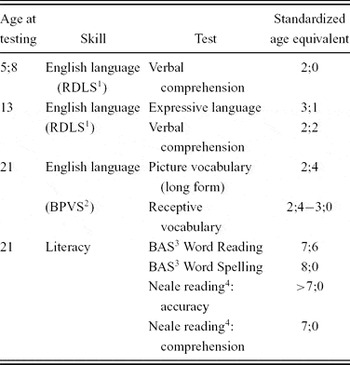
Stewart demonstrated severe impairments in English on all measures, including impaired phonological discrimination as measured on subtests of the Psycholinguistic Assessments of Language Processing in Aphasia – PALPA (Kay, Lesser & Coltheart, Reference Kay, Lesser and Coltheart1992) and poor syntactic ability, measured by the Test of Reception Of Grammar – TROG (Bishop, Reference Bishop2003). His performance on the TROG was extremely poor, characterized by errors with verbs, plurals, comparatives, passives and locatives. His scores from previous language testing were available and demonstrated no improvements since childhood (see Table 1 and Sieratzki et al., Reference Sieratzki, Calvert, Brammer, Campbell, David and Woll2001, for additional details).
Stewart's spoken language and literacy from age 5;8 to 21 years.

1 NOTES: Reynell Developmental Language Scales.
2 British Picture Vocabulary Scales.
3 British Ability Scales.
4 Neale Analysis of Reading Ability (Neale, Reference Neale1997).
Stewart's reading ability was around the 7-year-old level on a variety of standardized tests. As part of the study undertaken when Stewart was 26, fifty items from the Snodgrass and Vanderwart (Reference Snodgrass and Vanderwart1980) picture set were presented to Stewart who was asked to name the object in spoken English and then in BSL. In English, he produced 17/50 responses with correct meaning and articulation or only minor errors. He made phonological errors of an apraxic nature in over 50% of phonemes in 15/50 items and produced semantic errors on 8 items. Ten responses were unintelligible and uncategorizable in terms of semantic or phonological similarity.
A similar analysis was undertaken for Stewart's responses in BSL to the Snodgrass and Vanderwart (Reference Snodgrass and Vanderwart1980) set of pictures, using recognized articulatory parameters, i.e., combinations of handshape, location, movement and hand orientation. Stewart produced 29/50 items entirely correctly in meaning and articulation, and a further 13 items with single-parameter articulation errors. Ten of the 13 errors were in sign movements, with a tendency to perseverate or enlarge movements, and there were 3 handshape errors. Only 2/50 responses showed dual-parameter errors in both movement and handshape. There were no errors in location or orientation. Non-articulatory errors occurred in 6/50 responses.
A BSL vocabulary comprehension test patterned after the British Picture Vocabulary Scales but designed to exclude iconic items which can be guessed by non-signers was administered. Although the test was not normed, mean age scores were available from a previous study with 70 deaf children aged 4–11 years (Kirk, Kyle, Ackerman & Woll, Reference Kirk, Kyle, Ackerman, Woll and Kyle1990). Stewart achieved a score of 54/68, exceeding the mean score of 45/68 for 11-year-old deaf children of hearing parents, and estimated to correspond to the expected performance of a 14-year-old. Eight of Stewart's 14 errors occurred in a single sequence close to the end of the test, raising the possibility of a transient absence.
Stewart was also assessed on a BSL grammar comprehension test standardized on native signing children aged 3–11 years (Herman, Holmes & Woll, Reference Herman, Holmes and Woll1999). Eleven-year-old native signers score near ceiling on this test, as the acquisition of BSL morphology grammar is essentially complete by this age. Stewart scored 28/40, equivalent to an average 9-year-old native signer, and corresponding to performance of a 12-year-old deaf child of hearing parents (see Table 1). Sign language, which Stewart first learned at the age of 13 years, is thus by far his most efficient communication modality. He has normal vocabulary and can process articulatory elements, implying the use of phonological mechanisms in BSL. He shows, however, strikingly uneven scores across the various subtests (number/distribution, negation, noun/verb distinctions, spatial verbs, size and shape specifiers, and handling classifiers), with high scores on spatial verbs and number/distribution but poor scores on negation, in contrast to lower scores across all subtests for deaf children of hearing parents. The uneven pattern Stewart exhibits is more typical of late learners of sign language as a primary language, i.e., subjects born deaf who are only exposed to a sign language after childhood, following failure to acquire a spoken language. However, having learned English early in life, Stewart does not fit straightforwardly into this category. It is of interest whether introduction to BSL earlier than age 13 would have enabled him to achieve a higher level of grammatical competence.
Christopher
Christopher (born 1962) possesses a remarkable ability for learning new languages alongside serious disabilities in other domains. He is mildly autistic and severely apraxic; he lives in sheltered accommodation because he is unable to look after himself.
Christopher's knowledge of English syntax is essentially normal. Perhaps uniquely, he can read, write, speak, understand and translate some twenty or more languages while on tests of non-verbal intelligence he scores relatively poorly (see Smith & Tsimpli, Reference Smith and Tsimpli1995).
At the time of the study (Morgan, Smith, Tsimpli & Woll, Reference Morgan, Herman and Woll2007; Smith, Tsimpli, Morgan & Woll, Reference Smith, Tsimpli, Morgan and Woll2010), Christopher was exposed to a typical first course in BSL which ran for eight months and included 24 hours of instruction in both taught and conversational modes. He also had access to BSL books and videos which he studied between classes. All his exposure to BSL came from native adult signers. We compared Christopher's learning with a control group of forty (30 female, 10 male) hearing university students. They were taught in groups and were exposed to the same content (although over a shorter time period) as Christopher by a native BSL signer. Christopher's general BSL learning was within the normal range of the control group's abilities (Smith, Tsimpli, Morgan & Woll, Reference Smith, Tsimpli, Morgan and Woll2010). The one area where Christopher performed significantly worse than the control group, was with comprehension and production of BSL entity classifiers (see Section 1.1 above). In a task in which subjects had to match a signed sentence to a written English translation, Christopher scored 20% correct (chance was 33%); the scores of the control group were between 80% and 100% (mean 89%, SD = 9.9%). In a second task involving the matching of a signed sentence to a picture Christopher scored 10% correct (chance was 25%), whereas the controls scored between 50% and100% (mean 72%, SD = 13.8%). Compared with controls, Christopher's performance on both tests was therefore extremely poor (see Morgan, Smith, Tsimpli & Woll, Reference Morgan, Herman and Woll2007, for more details of tests). In his processing of entity classifiers Christopher had some success identifying the class of referent that the handshape represents (curved versus straight objects, for example) but was not able to process the spatial location or movement that the whole utterance encoded. For instance, after seeing the sign sequence CL-Bent-B-BOOK-ON-CL-B-BED, which translated as ‘a book on a bed’, Christopher chose the picture of “a book under a bed”, rather than either of the other pictures which showed “a ball under a chair” and “a comb on a bed”. Christopher had particular difficulty with the classifier component of signing while performance of the controls was consistent across different BSL domains. These results suggest that there is a fundamental modality-dependent difference for Christopher in the processing and learning of a second language.
Ruthie and Sallie
Ruthie and Sallie are monozygotic twins who were born in May 1985 and have Mosaic Down syndrome (DS). Both parents are deaf and members of the Deaf community. At the time of the study (Woll & Grove, Reference Woll and Grove1996), the twins were 10 years old, and being educated in a mainstream setting, attached to a unit for children with special needs in their local primary school. In the presence of their parents and other deaf people they mostly use BSL without voice, although in such contexts they occasionally address English-only utterances to each other (these appear to function as private asides). They also produce occasional single-word English-only utterances and utterances produced with simultaneous sign and voice addressed to their parents. In the presence of hearing children and adults and when playing together, they use English. They have not been observed to use BSL with each other when there are no deaf adults present. In this sense English appears to be their dominant language.
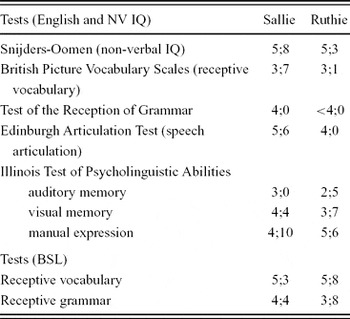
Assessments of the twins’ verbal and non-verbal ability show that non-verbal cognitive skills are in advance of their verbal skills.
As can be seen in Table 2, Sallie's scores are consistently higher than Ruthie's, except for manual gesture. On comprehension measures of vocabulary (BPVS) and grammar (TROG), they are functioning between the level of three and four years. Both show evidence of developing morphology and simple syntax in a range of English structures, including negation, plurals, locative constructions and interrogatives. Overall, the pattern of scores suggests that, as might be expected, visual and motor skills are relative strengths for both girls.
Age equivalents of Ruthie and Sallie's test results (age 10 years).

The twins show relatively higher skills for BSL vocabulary comprehension than for English. This pattern is even more apparent in a second round of data collection undertaken when the twins were 16 (Grove & Woll, unpublished observations) with BSL vocabulary continuing to increase while English vocabulary remained relatively static. It may be that this sign advantage is related to the presence of iconicity in many signs and the consequent resemblance of signs to gestures. Although typically developing children show no effect of iconicity in the acquisition of sign language, this may not be the case for atypically developing children. The lexical advantage for signs is not seen in morphology. Receptive skills were tested using the BSL Receptive Skills Test (Herman et al., Reference Herman, Holmes and Woll1999). Expressive skills were tested by asking the twins to describe pictures from the Receptive Skills Test. Sallie's BSL is more advanced than Ruthie's, but neither Sallie nor Ruthie has full mastery of the adult BSL system; some of Sallie's and many of Ruthie's responses omit spatial relationships completely; in others, they use lexical signs such as IN FRONT and ON (English-like structures), rather than representing spatial relationships directly. Full details may be found in Woll and Grove (Reference Woll and Grove1996).
Across various areas of morphosyntax in BSL, both girls have difficulty with those of the greatest complexity. These include structures requiring simultaneous marking of morphology and three-dimensional representations of space. In conclusion, Ruthie and Sallie apparently find the grammatical system of a sign language no easier to master than that of a spoken language.
4.2 Deaf users of sign language with atypical development
Heather
Early studies of language in Williams syndrome (WS) reported dissociations between profound visual–spatial deficits and impressive receptive and productive language skills (see, e.g., Bellugi, Marks, Bihrle & Sabo, Reference Bellugi, Marks, Bihrle, Sabo, Bishop and Mogford1988). While these early studies suggest that language in WS may be intact, recent research has been more sensitive to patterns of relative strengths and weaknesses across domains, and it has become clear that language is not wholly intact in WS. A new picture has emerged which suggests that language should be viewed as relatively spared rather than normal (see, e.g., Karmiloff Smith, Reference Karmiloff-Smith, Nelson and Luciana2008).
Studies of WS in populations speaking languages other than English indicate patterns of impairment in grammar, as the relatively limited extent of morphological marking in English may mask processing difficulties. Volterra, Capirci, Pezzini, Sabbadini and Vicari (Reference Volterra, Capirci, Pezzini, Sabbadini and Vicari1996) found that Italian-speaking subjects with WS produced ungrammatical or grammatical but atypical constructions in sentence repetition and story description tasks and made frequent preposition errors. English speakers with WS show subtle linguistic impairments that may be related to problems with visuo-spatial cognition. These findings suggest either that language impairments may arise from impairments in visuo-spatial cognitive domains or that spatial aspects of both cognition and language are controlled by a higher-level representational system.
One group of languages for which the consequence of specific visuo-spatial learning difficulties might be particularly severe is sign language. The case of a signer with WS is thus of interest since there is the possibility of a more transparent interaction between visual–spatial abilities and language.
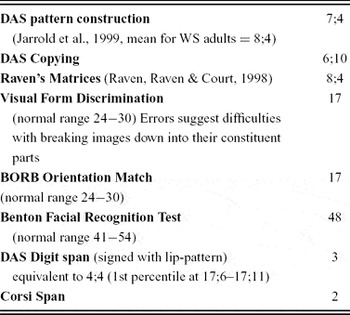
Heather is a young deaf woman aged 34 years at the time of the study (Atkinson, Woll & Gathercole, Reference Atkinson, Woll and Gathercole2002). She is of short stature, with a facial appearance and behavioural profile characteristic of WS. Heather uses BSL as her preferred method of communication, although she has some limited ability to lip-read and use spoken and written English. She was educated in a school for children with learning disabilities where the Makaton and Paget-Gorman sign systems were used, together with rudimentary BSL. Heather first came into contact with adult Deaf native signers at 14 years of age. Little is known about the quality of her language models prior to this age. She lives independently in sheltered housing for Deaf people with additional disabilities and regularly attends local Deaf clubs and mixes in the Deaf community. Her command of BSL is strikingly different from her Deaf intellectual peers living in the same sheltered accommodation, in terms of fluency and complexity. However, although not immediately apparent in spontaneous conversation, she does make consistent errors in her use of some features of BSL. The precise nature of Heather's visuo-spatial difficulties were investigated using standardized tests of visual and spatial abilities (see Table 3).
Heather's performance on tests of visual and spatial abilities.

These results show clear impairments in visuo-spatial ability, in contrast to Heather's preserved ability to discriminate faces: she scored 48/54 on the Benton Test of Facial Recognition (Benton, Hamsher, Varney & Spreen, Reference Benton, Hamsher, Varney and Spreen1983), which is in the middle of the normal range for adults. It is clear that Heather shows the dissociation between intact face recognition and impaired visuo-spatial construction which is characteristic of the WS profile.
Heather was tested both on comprehension and production of spatialized syntax at sentential level and connected discourse. The BSL production test (Herman, Grove, Holmes, Morgan, Sutherland & Woll, Reference Herman, Grove, Holmes, Morgan, Sutherland and Woll2004) although designed for use with children, allowed Heather to be assessed on BSL narrative in a systematic way. This test assesses a deaf signer's expressive language by eliciting a narrative. The participant watches a short language-free story acted out by two deaf children, which is presented on a DVD. The participant is then asked to tell the story, which is video-recorded for subsequent scoring. The assessment is scored in three parts: (1) the propositional content of the story (i.e., how much information children include in their narrative); (2) structural components of the narrative (i.e., introducing the participants and the setting, reporting the key events leading up to the climax of the story, and telling how the story ends); and (3) aspects of BSL grammar (including use of spatial location, person and object classifiers, and role shift.
Heather displayed marked problems with structures using space for grammatical purposes. At sentential level these difficulties include problems with ensuring that verbs correctly indicate semantic roles. Heather's production of spatial verbs shows consistent impairment in spatial representations. She appears to try to deal with her difficulties by choosing English-like structures and a fixed sign order resembling English. For example, Heather uses the prepositions UNDER, ON and IN rather than classifiers located in spatial relationships to each other to incorporate information about referents and the spatial relationships between them. Static locatives using topographic space are rarely used. (For example, the pencil is on the table should be produced by first signing TABLE, then PENCIL, and then placing the classifier for PENCIL in a location in space immediately above where TABLE was signed. Instead, Heather prefers signing PENCIL ON TABLE, without the required spatial relationship between the signs.) In general, Heather avoids using classifiers and prefers to use an undifferentiated point with her index finger to locate referents in space. Where she does use classifiers these are often bizarre (see Atkinson, Woll & Gathercole, Reference Atkinson, Woll and Gathercole2002, for full details).
In the context of the narrative, Heather also had difficulties with ensuring maintenance of topographic locations across sentences. The results from all the BSL assessments show a disruption in the use of space within BSL, while linguistic devices which do not incorporate spatial relationships, such as noun–verb distinctions and negation, are preserved. Heather provides an interesting comparison with Christopher in this regard.
Paul
Paul is a congenitally deaf son of deaf parents, aged 5;2 at the time of the study (Morgan, Herman & Woll, Reference Morgan, Herman and Woll2007). Paul was exposed to fluent BSL from birth and from 2 years attended a mainstream kindergarten and later a school with sign language support. He was referred for assessment by the school because of worries about his BSL development, which was described as being unusually slow for a native signer. His non-verbal cognitive abilities, assessed with the Snijders-Oomen non-verbal intelligence test (Snijders, Tellegen & Laros, Reference Snijders, Tellegen and Laros1989) when he was 5;0, revealed no cognitive delays. It might be expected that SLI in BSL would affect comprehension and production of structures involving polymorphemic verbs (agreeing, spatial and classifiers) and complex syntactic structures involving simultaneous manual and non-manual markers (negation). His BSL grammar was assessed using the BSL Receptive Skills Test (Herman et al., Reference Herman, Holmes and Woll1999). Paul scored 1.3 standard deviations below the mean for grammar. His performance was atypical, with success on some difficult items, and failure on many easier ones. He was particularly poor on negation, spatial verbs and classifiers.
We elicited production data of BSL grammatical structures by asking Paul to describe pictures taken from the BSL receptive skills test (Herman et al., Reference Herman, Holmes and Woll1999). For example, Paul was asked to describe a picture of a man giving a boy a letter. Typically developing native signers of his age use inflectional morphology on the verb GIVE to indicate subject and object: MAN LETTER GIVE-3 (the man gives the letter to him/her). In contrast Paul signed the following sequence of uninflected signs (P = Paul; A = Deaf adult).
P: GIVE GIVE SQUARE GIVE (citation forms) give, give the square thing give
A: SQUARE GIVE WHO? who gives the square thing?
P: GIVE GIVE POINT (picture) LETTER give, give, (point), letter
A: PICTURE WHAT? what is in the picture?
P: LETTER POINT (picture) a letter (point)
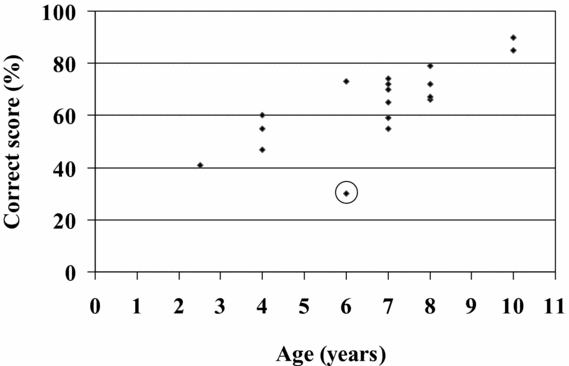
Paul was also tested on a pilot version of the Non-Sign Repetition Test (Marshall, Denmark & Morgan, Reference Marshall, Denmark and Morgan2006). This assessment tool evaluates the participant's ability to copy a set of forty nonsense but possible BSL signs of varying phonological complexity (for completed test and norms see Mann, Marshall, Mason & Morgan, Reference Mann, Marshall, Mason and Morgan2010). The pilot version was administered to Paul and a group of eighteen native signers aged between 2 and 10 years (see Figure 1). Paul's performance was severely impaired (below the score of a 2;6 control).
Paul's performance (circled) on the non-sign repetition test compared to that of eighteen native signers aged 2–10 years.

Nonword repetition has been reported to be a robust marker of SLI in children acquiring spoken languages. However Stokes, Wong, Fletcher and Leonard (Reference Stokes, Wong, Fletcher and Leonard2006) tested Cantonese children using multisyllabic nonwords and found no difference between SLI and age-matched control children. The authors suggested that this was because Cantonese does not contain the complex phonotactic structures, variable stress patterns and difficult-to-articulate consonants that make nonword repetition in languages such as English and Swedish so difficult.
From this case study it was hypothesized that SLI in sign language would affect those areas previously identified as fragile in spoken language acquisition – specifically complex morphological marking and nonword repetition. In order to confirm this hypothesis a group study was undertaken.
SLI group study
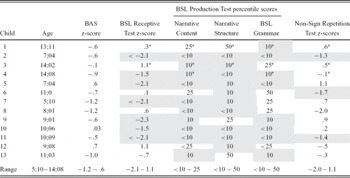
The SLI group study is of thirteen deaf children aged 5;10 to 14;8 whose first language was BSL. The children were referred for assessment by teachers or speech and language therapists because of concerns about their sign language development in comparison with their peers (Mason et al., Reference Mason, Rowley, Marshall, Atkinson, Herman, Woll and Morgan2010). The youngest child (aged 5;10) had deaf parents; the remaining twelve children were aged between 7 and 14 years. Children under 7 years from hearing families were not included in the study so as to minimize the possible effects of late exposure to sign language. All children had been exposed for at least four years to native signers of BSL. All had normal motor and cognitive development, with motor skills assessed using a bead threading task for which scores had been obtained for typically developing deaf children (Mann et al., Reference Mann, Marshall, Mason and Morgan2010). Nonverbal cognitive abilities were assessed using three subtests of the British Ability Scales: pattern construction, matrices and recall of designs (Elliot, Smith & McCulloch, Reference Elliot, Smith and McCulloch1996). The children were also assessed on non-sign repetition, BSL receptive grammar, and grammatical and pragmatic skills (Herman et al., Reference Herman, Holmes and Woll1999; Herman et al., Reference Herman, Grove, Holmes, Morgan, Sutherland and Woll2004). Table 4 presents the findings from these assessments. Shaded areas represent performance considered impaired following standard criteria.
Data for individual children with suspected SLI in BSL (from Mason et al., Reference Mason, Rowley, Marshall, Atkinson, Herman, Woll and Morgan2010).

* child older than range for standardized scores.
To summarize these data, 7/13 children displayed impaired receptive grammar, 8/13 had impaired productive grammar, but only 4/13 had impaired non-sign repetition. More analysis of how typically developing children perform on this task is required before we discount sign phonology as a sign SLI marker (Marshall, Denmark & Morgan, Reference Marshall, Denmark and Morgan2006). However, it was clearer that complex morphology did appear to be impaired in this group study. The results also suggest different profiles of impairment in individual children: phonological, receptive grammar, productive grammar, pragmatics and discourse (as measured by narrative structure). These findings suggest SLI appears to affect language acquisition in similar ways in both the spoken and signed modalities but that language typology also influences which aspects of linguistic structure are more or less affected. Sign languages do not have multisyllable words but do have complex verb morphology, so phonology is relatively less impaired than morphology.
5. Discussion
In the questions posed at the beginning of this article, we asked whether language impairments reside in a specific modality and are thus linked to acquisition difficulties with auditory or visual signals, or are modality-independent deficits. It is possible that these two options are not mutually exclusive. Specific perceptual processing or cognitive difficulties in the learner might interact with properties of the language modality. For example, difficulties in processing rapid sequences of closely related phonemes may create problems for the child acquiring spoken language but may be less problematic for the acquisition of a signed language. Conversely, cognitive difficulties with representing three-dimensional space might not be crucial for acquiring spoken languages but might prevent learners of signed languages from fully mastering the grammar. This may be the case with Heather and Christopher, although the impact of a visuo-spatial impairment on each individual's sign acquisition was different. Heather, deaf and immersed in the Deaf community, was able to circumvent her particular problems with BSL and became a skilled signer. Christopher, despite being a superlative language learner, found the morphosyntax space interface very difficult to master, perhaps because his age of acquisition was later than Heather's and because he was hearing he used BSL far less than Heather (Smith et al., Reference Smith, Tsimpli, Morgan and Woll2010).
The second option is that there may be difficulties with language acquisition (whether signed or spoken) that represent core processing problems at a higher level than those associated with the perceptual carrier of the signal. A difficulty with the representation and processing of grammatical rules which allow the child to build up knowledge of the morphosyntactic regularities of the language they are acquiring would affect complex morphosyntax in both modalities, as appeared to be the case with Paul (Morgan, Herman & Woll, Reference Morgan, Herman and Woll2007) and some of the children in the group study of SLI (Mason et al., Reference Mason, Rowley, Marshall, Atkinson, Herman, Woll and Morgan2010).
The various cases presented here provide contrasting evidence to address the question of whether different language impairments originate from cognitive, linguistic or perceptual systems. In some cases similar impairments are found in both modalities, suggesting an impairment independent of modality. In other cases, subjects show differences in language abilities in the two modalities. In the sections below, we review our initial hypotheses in the light of data from these studies.
5.1 Hearing users of sign language with atypical development
Performance in BSL is spared relative to performance in English (Stewart)
The first hypothesis we considered predicted that if the source of the impairment arises in the processing of the auditory signal, with visual and spatial processing relatively unimpaired, no serious problems should be anticipated in the acquisition of sign language. LKS is an auditory phonological processing disorder. Stewart's BSL is significantly better than his English despite very late exposure. Sign language thus appears to be an effective means of communication even in the face of severe spoken language aphasia for this group.
Performance in English is comparable to performance in BSL (Ruthie and Sallie)
Where problems relate to linguistic, as opposed to more general cognitive, abilities, it was hypothesized that delays and difficulties should be seen in language, regardless of modality. The twins’ BSL grammar is at a comparable level to their English grammar. Sallie, the more able twin in English, is also better at BSL. This suggests a cross-modal linguistic deficit, with the pattern of varying competences in both languages related to the complexity of the required linguistic devices, and consistent with observations of difficulties in the acquisition and generalization of rules affecting complex sentence structure in children with DS. Some studies of children with DS suggest that although their visual–spatial skills are generally more advanced than their auditory–vocal skills, there may be impairments in the area of spatial representation (Uecker, Mangan, Obrzut, & Nadel, Reference Uecker, Mangan, Obrzut and Nadel1993; Vallar & Papagno, Reference Vallar and Papagno1993) and this may suggest differences in the sources of their difficulties in the two languages. In particular, their difficulties in BSL grammar cluster around hierarchically complex structures of a type not found in non-linguistic spatial cognition. Unlike the relative similarities in grammar cross-modally, their BSL vocabulary is an area of strength compared to English. This in turn raises further questions about the nature of the sign lexicon in terms of such issues as iconicity and phonological structure.
Performance in English is impaired relative to BSL (Christopher)
If the source of the impairment arises in visual and spatial processing, and auditory perception is relatively unimpaired, it was hypothesized that no serious problems should be anticipated in the acquisition of spoken language but there might be deficits in sign language acquisition. Christopher was an adult learner of BSL but he did not go on to master the language as he has done for his many other spoken second languages. He did acquire an impressive single-sign lexicon both in comprehension and production and in doing so overcame his typical aversion to looking at people's faces when he communicates. His general BSL developed to a level comparable with other hearing sign language learners. But his acquisition differed from the control group in specific areas of the grammar. He was unable to overcome his difficulty with representing three-dimensional space and manipulations of these arrays in the non-verbal domain in order to use physical space for linguistic mapping. His sign language abilities at the level of spatial syntax and morphology were thus limited by his cognitive impairments in non-verbal spatial processing. He did not experience this plateau in the acquisition of morphology in other second languages in the spoken modality and so his general cognitive impairment affects only his sign language learning.
5.2 Deaf users of sign language with atypical development
Evidence for different patterns of impairment was also found in the deaf signers.
Performance in BSL is impaired relative to that reported for spoken English in hearing individuals with WS (Heather)
Heather's language abilities in general are well in advance of her visuo-spatial abilities. Her language profile differs from that of a hearing individual with WS: the subtle impairments found in spoken language in Williams syndrome are more transparent in BSL. Most strikingly, there is a clear dissociation between grammar that relies on space, and grammar that can be specified lexically (e.g., plurals, static locatives). This suggests that although the learning of a visuo-spatial language is not in itself dependent on intact visuo-spatial cognition (see Morgan, Smith, Tsimpli & Woll, Reference Morgan and Woll2002), the pattern of breakdown in BSL abilities indicates a dissociation within BSL grammar between devices that depend on grammatical processes involving space and those that do not. Heather's command of grammar appears well preserved except where spatial relationships are conveyed directly. In the latter circumstances, visuo-spatial impairment overrides general grammatical ability and Heather prefers to use English-like constructions which make fewer direct demands on visual–spatial cognition.
Performance in BSL is similar to that reported for spoken language impairments (Paul and SLI group study)
The deaf children with SLI show comparable impairments to those found in hearing children with SLI. In both of the SLI studies, impairment was reported for sign language grammatical constructions involving verb agreement. Paul used uninflected verb forms despite being prompted by the deaf native-signing tester that these utterances were unclear. His difficulty in using BSL verb morphology might be linked to the nature of meaning–form mappings using agreement verbs in BSL. In changing the morphology of the verb by inflecting movement between two locations in sign space, signers map out the core meaning (e.g., “giving”) but the direction of the inflection also simultaneously encodes argument structure (i.e., the identity of the agent and patient). This packaging of information into a single unit with several components requires good language skills. Paul preferred to map out each part of the proposition in a sequence of signs using points to agent and patient arguments and an uninflected verb. This type of error resembles the BSL produced by much younger typically developing signers (Morgan et al., Reference Morgan, Barrière and Woll2006). In the assessment of the production of BSL grammatical devices in narratives from the group study of sign SLI, 8 of the 13 children were impaired. The sets of data from Paul and from the group study suggest that SLI affects BSL verb morphology in similar ways in spoken and signed language (Leonard, Reference Leonard and Schwartz2009). Where this is the case, the inclusion of sign languages in research cannot help us to decide whether difficulties with grammatical rules originate from domain-general impairments in information processing which would affect the rule learning underpinning language and also other complex systems (Kail, Reference Kail1994) or represent a domain-specific linguistic impairment (van der Lely, Reference van der Lely2005) but do suggest that modality-related processing difficulties cannot be the source.
6. Conclusions
The report of the UK government's Foresight Cognitive Systems Project (Marslen-Wilson, Reference Marslen-Wilson2003) identified the potentially unique contribution of sign language research to understanding how the brain processes language: “A more dramatic type of cross-linguistic contrast that may be uniquely valuable in elucidating the underlying properties of speech and language, comes through the comparison between spoken languages and native sign languages, such as BSL” (p. 9). The studies presented in this article are examples of how cases of sign language impairments can provide a unique perspective and a model for investigating how different language impairments originate from different parts of the cognitive, linguistic and perceptual systems. They also enable direct study of impairments in the context of cross-modal bilingualism. Finally, such profiles provide an evidence base for the development of appropriate interventions for use with deaf and hearing children.