Introduction
Avis: the headquarters of a military order and the name of a dynasty of heroic kings. There is not much left from its glory days except a convent in ruins, two churches, parts of the city wall and three towers. By the eighteenth century, Avis was already an obscure village, lost in the middle of the Alentejo region, of little interest to its landlords who lived off their rents. Many of this region's features remained throughout the centuries: a very concentrated agrarian structure, a homogeneous group of landowners and a high percentage of waged land workers who were mostly journeymen. During the nineteenth century many tenants of the largest estates bought their lands and became landowners themselves, but the elite group remained the same and its social and economic behaviour and its local political control altered very little. The same families presided over Avis’ political institutions for at least two centuries, several revolutions and three major changes in Portugal's regime, from Absolutism to Liberalism in 1834, from the Monarchy to the Republic in 1910, and from the Republic to Salazar's New State in 1933, after the 1926 military coup.
Avis in the spring. (See online for a colour version of this figure.)

The contrast between this elite group and the land workers was huge in many ways, but particularly in housing, food, clothes, education and healthcare (Almeida, Reference Almeida1997). This produced tension, which was variously dealt with at different times. The Portuguese ‘Agrarian Question’ has occupied scholars for centuries and created the most imaginative solutions (Cabral, Reference Cabral1974; Santos, Reference Santos1993). Our history is filled with treaties and legislation written with the Alentejo in mind and motivated by the perpetual desire to transform the region into the Portuguese bread basket (Santos, Reference Santos1995). It was expected to produce all the corn the country needed to survive and when it failed to do so, as it usually did, something had to be wrong with it. Explanations ranged from the lack of water, to the lack of people, or the laziness of its population caused by the heat, or its Moorish origins. Any cause was possible. But mostly fingers were pointed to the large size of its estates and the latifundia regime. And the solutions were always very simple: divide the property; put other people in the Alentejo; take people from the North and make them work on the South; build dams; irrigate. Even though some attempts were made over the centuries to put these projects into practice, the results were always precarious. The region's speciality is its montado, a typical Mediterranean ecosystem that includes cork and olive trees, pastures for swine and goats who eat acorns from the cork trees, and cattle breeding. Corn has always been the least profitable product, even when incentives have been given to farmers, so that this type of agriculture could only be viable in the large estates which were in the hands of a limited elite who enjoyed hunting and a lifestyle that was quite different from the rest of the population.
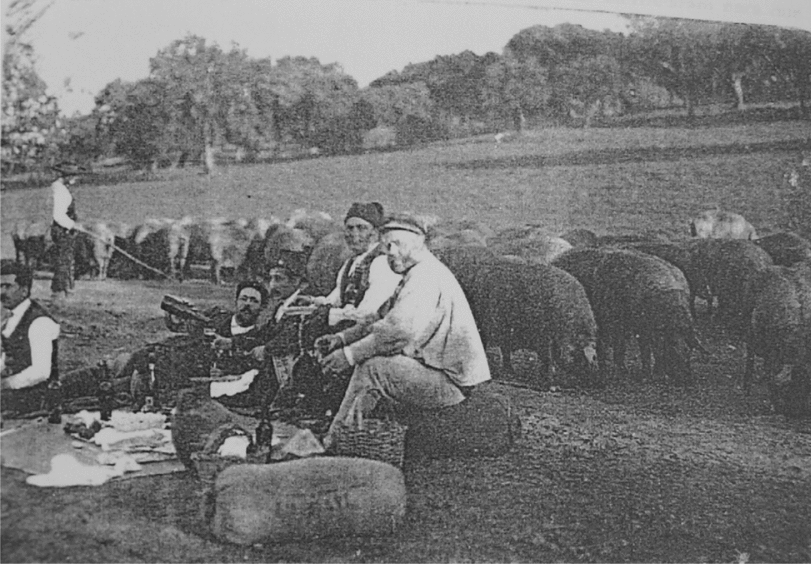
A picnic in the country: farmers and swineherds circa 1900. Source: local family archives.
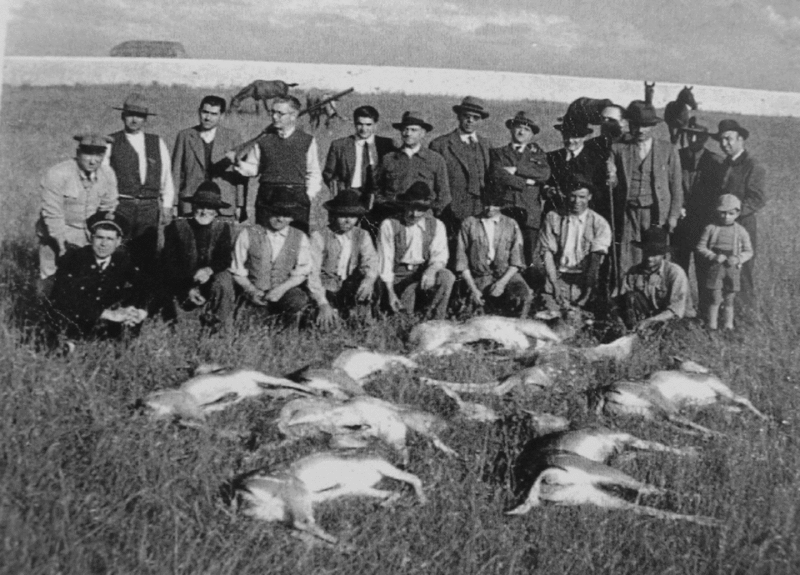
A hunting party circa 1945: landowners, farm workers, policemen and guests. Source: local family archives.
This situation is portrayed in political treatises and in the Neo-Realistic literature from the 1930s and 1940s, where all the landowner bosses are represented as evil and all journeymen are poor and great sufferers. Alves Redol, Manuel da Fonseca, Fernando Namora and later, in the 1980s, Nobel Prize winner José Saramago wrote some of the best pieces of Portuguese literature on this subject. They all heard the same stories told by the same people about the hardness of rural life, the unemployment periods, the hunger, half a sardine to eat, children with no shoes, little boys helping shepherds and swineherds, little girls waitressing in houses or begging on the streets. These were the same stories that I heard about a history that has not been forgotten, but they were already part of the remote past in the early 1970s when agrarian reform was set in motion.
Sources
Studies of local elites have bloomed in the Portuguese social sciences after the pioneer works of José Cutileiro (Reference Cutileiro1971), Helder Fonseca (Reference Fonseca1996), Rui Santos (Reference Santos1993, Reference Santos1995), Conceição A. Martins (Reference Martins1992), Ana C. Matos (1982), Manuela Rocha (Reference Rocha1993), Jorge Fonseca (Reference Fonseca1986) and a few others. Many sources are now being used to understand the behaviour of the families that controlled local politics, economics and social and cultural lives. For this article, local archives, both public and private, including the archives of the municipality and private farm records, were used.
From 1690 to 1836 there was a military tax of a tenth of all income. In each municipality there are books with the records of these taxes, with names, addresses and amounts paid. These are priceless sources for determining incomes, social status and even the geographic distribution of families and social groups. They produce accurate portraits of local societies. From 1836 onwards there are books of registered voters. Up to 1910 these books supply valuable information on income and taxes, as well as professional classifications and literacy, because those were conditions of enfranchisement. After 1910 only professions are mentioned. Women appear on the records after 1933, but only formally educated women or family heads were allowed to vote until 1975. Before 1974, during the Estado Novo regime, mayors were appointed by the government and these appointments were published in the official journal. From 1976 mayors were elected. Electoral results are public and have been gathered by the author on a database with over 3000 mayors from 1936 to 2012.
There are also estate inventories of dead people, municipal meeting records and parish records, with information on births, marriages and deaths, including godmothers and godfathers, and professional qualifications. This combination of data has provided the necessary information to establish important social relations. The archives of Santa Casa da Misericórdia, a private social welfare provider established in the fifteenth century, have also proved to be useful. They were the main providers of health and social care at the local level and their records contain important information on the social structure. For instance, throughout the centuries their administrators came from the same local elites that presided over the municipalities. In Avis, the Misericórdia hospital records provide information on patients, including profession, age, disease and time of stay (Almeida, Reference Almeida and Freire2008b).
In terms of private sources, I have researched private farm archives, account books and deeds and have visited peoples’ houses and observed their furniture, wardrobes and family photographs. Other important local sources include the distribution of streets, mansions, poorer neighbourhoods, street nameplates, monuments, graveyards and the spatial distribution of graves. The city of the dead mirrors the city of the living (Fonseca, Reference Fonseca1996). Literature, folk songs, poetry, arts and crafts have also been used as historical sources (Almeida, Reference Almeida2008a).
In conclusion, for the reconstruction of the main events of the last two and a half centuries, different and varied sources have been used, including written local documents, literature, ethnographic, political and economic studies, legislation, the press and a source which proved to be most valuable of all, local memories and oral history. The result of more than sixty interviews was an overall feeling of frustration and deceit on the part of an entire population which did not benefit from the agrarian reform and which still feels betrayed by ‘someone’ who cannot clearly be identified (Almeida, Reference Almeida2010). ‘They’ misled them; ‘they’ kept the money ‘they’ had promised; ‘they’ kept everything and the poor remained poor. ‘Everything is worse off now’; ‘everybody has departed’; and the images of rural desertification and an aged population are ever present.
Avis’ Graveyard in the present day. Photograph taken by the author. (See online for a colour version of this figure.)
Avis’ society in 1778, from the 1/10 tax books (See online for a colour version of this figure.)
An Alentejo monte, a farmhouse or head of a latifundium in the present day. Photograph taken by the author. (See online for a colour version of this figure.)
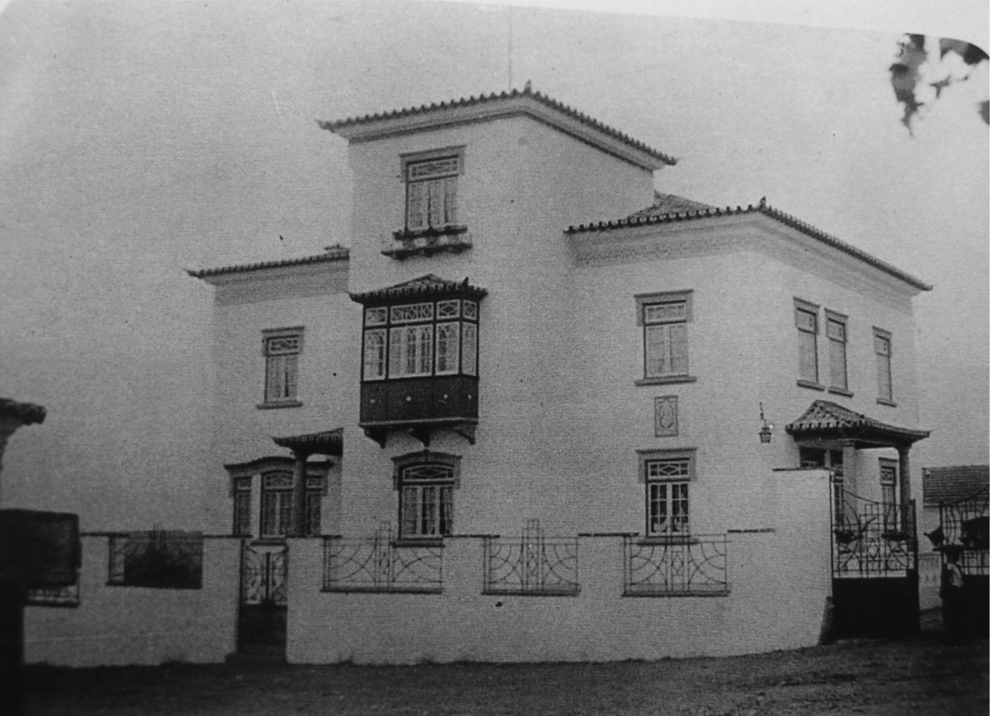
A village house of the local elites, c. 1930. Source: local family archives.
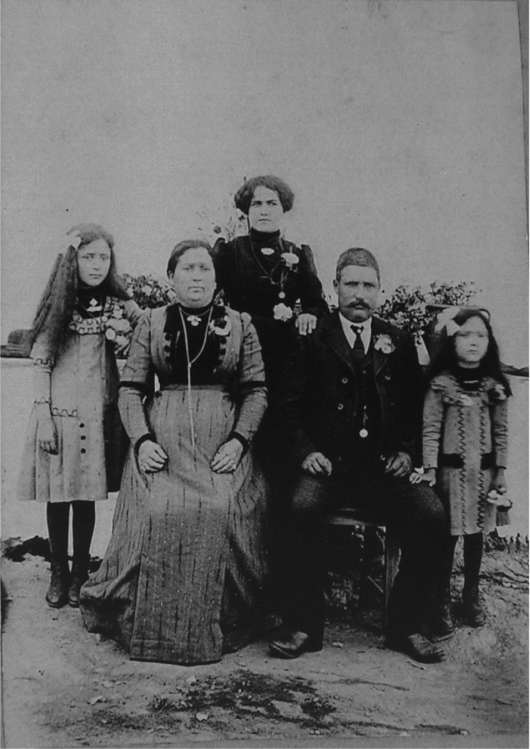
Poinsard's ‘paysans enrichis’, an Avis landowner family
Before 1974
The books of the one-tenth tax in Avis in 1778 reveal a rural society where twenty-three per cent of the population were farmers, both landowners and tenants, and fifty-nine per cent worked for them as paid workers, without land. Six per cent were craftsmen, who either did independent work or went to the farms to work, and only a very small percentage worked as clerks, doctors, chemists, and so on. In 1778 Avis had 152 large farms, or latifundia, and this number did not alter much over the next two centuries. In 1836 there were 169 and in 1975 there were 141, mostly with the same name and the same owners or tenants. Their average size was 340 hectares, but the largest was 4500 hectares.
As in all latifundia regions in the late eighteenth century, most of the land was owned by absent nobles, convents and the Misericórdia. The nobles did not leave their mark on the local landscape, but their tenants did. They ruled the land, presided over the Municipality and the Misericórdia, held military jobs, paid taxes and eventually, in the late nineteenth century, bought the land their families had rented for generations and moved to the village, where they built huge mansions. These investments were made with money they earned from their own farms, for which they paid rather low rents. They also occasionally used credit, although this was rare, and also owned urban property for rent. All this information is confirmed by local written sources, where the same names are repeated over and over through the nineteenth and twentieth centuries. Some members of the urban elites, such as lawyers, doctors and chemists, also owned urban real estate, which gave them the status to marry into the rural elites. This was an interesting business for both parties, because the cultural and professional status of a doctor or a chemist was a step up for a farmer's daughter, and the money and properties of the father in-law were always of interest to anyone who dared propose.
The lists of voters reveal that in 1910 most of the former tenants were now landowners but the structure of society remained the same: the seven largest taxpayers paid fifty-one per cent of the amount paid by the forty largest taxpayers. The first one alone paid twelve per cent of the total. Among the first seven, two were brothers-in-law. Léon de Poinsard, a Frenchman visiting Portugal, wrote an essay on the unknown Portugal, ‘Le Portugal Inconnu. Paysans, Marins et Mineurs’, in which he describes the Alentejo landowners as enriched peasants. They are ‘simples paysans enrichis, soit par des héritages, soit par un accroissement successif du domaine, au moyen d'économies qui augmentent naturellement avec l'étendue de la propriété’ (Poinsard, Reference Poinsard1910). This perfectly fits the description of landowners in Avis in the late nineteenth century. After this, however, a change occurred: they began to send their children to school and to the universities in Coimbra and Lisbon. Most of them studied medicine, law, veterinary science, agronomy and pharmacy and in the early twentieth century landowners were more educated and started to improve their farms. The revolutionary transitions of Monarchy to Republic in 1910, and then to the Estado Novo regime in 1933, did nothing to change the local elites in Avis. Both the municipality and the Misericórdia remained in the hands of the same families. With the Estado Novo there was an attempt to centralise the administration of the state. Corporative institutions were created to control industry, agriculture, and all sorts of associations. Local elites simply took control of the new institutions, because there was nobody else with the skills to do so.
The list of voters in 1941 shows a very similar social structure to that in 1778: fifty-eight per cent were farm workers without any land of their own. Traditional landowner families continued to control local political institutions until 1950. In this year, for the first time, a mayor was nominated who had no links to landownership: he was a chemist who was an active member of the single political party of the regime. He was followed by a school teacher (Almeida, Reference Almeida2003).
Avis’ society in 1941, from the voters’ list (See online for a colour version of this figure.)
Since the beginning of the 1960s, life in the countryside has changed, mostly due to emigration and the mechanisation of agricultural work. In Avis, a dam was built to generate electricity and supply water for agriculture and industry. The farm labourers who worked on its construction for years did not want to go back to agriculture's lower wages when it was finished. Most of them moved to the Lisbon suburbs, where they started a new life working in construction, or they went to the army, to fight the colonial war. At the same time, a new middle class had been given the chance to rise in this rural society, comprised of journeymen who specialised in providing services with recently acquired machines paid for with subsidised credit, and tenants who sublet parts of their land to tomato growers during the summer season. Yellow cornfields were turning into red tomato crops to feed ketchup factories. These industries had grown and benefited from the creation of the European Free Trade Association in 1960, of which Portugal was a founding member, and they provided an alternative to agricultural work in traditional rural areas. Wages rose and living conditions improved. The children of workers who had gone to work with bare feet when they were six years old could now go to high school, and even to university. Illiterate grandparents had grandchildren who were doctors and engineers. But their poverty stricken past was there to haunt them (Almeida, Reference Almeida2006, Reference Almeida and Freire2007b).
After 1974
The revolution of 25th April 1974 introduced new groups into the municipalities and meant that landownership was no longer a criterion for becoming mayor or joining the local political elite. On the same day of the revolution, all the former regime's political elites were dismissed. Law number one, dated 25th April, removed the president of the republic and all members of the government and the parliament. Civil governors were discharged by a decree issued on the same day. From 2nd May, mayors started being replaced one by one, as administrative commissions were appointed for each municipality. These commissions were supposed to be composed of ‘independent personalities or groups and political currents which identify themselves with the Movement of Armed Forces’ (the authors of the revolution), and should function until the first democratic local elections (Decree n. 236/74, 3rd June 1974). In most cases, local citizen committees affiliated to the communist party presented the lists of the commission members to the Ministry of Interior who immediately approved them. In the Alentejo region, this was accompanied by a huge people's movement, led by local communist representatives. All the farm workers were out on the streets and landowners started to be afraid. There were road blocks and arms searches made by people's committees, and any sign of luxury became a symbol of fascism.
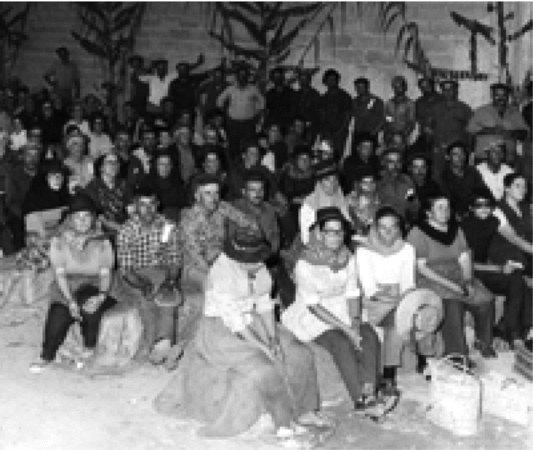
A labourers meeting prior to the Agrarian Reform in Avis, 1974
In the southern region of Alentejo, which occupies forty-one per cent of Portugal's area, there was an agrarian reform which seized all large estates. It was the result of radical legislation produced by the early governments in 1974 and 1975. The first law established the concept of economic sabotage: when it was considered that an industry or a property was not producing as much as it could, it was classified as underused and became a target of government intervention and nationalisation (Decree n. 660/74, 25th November 1974). This law was the perfect excuse for the first land occupations in the end of 1974 and farm workers acted immediately. When the revolution came and communist propaganda told them they could own their bosses’ land, they believed it (Carvalho, Reference Carvalho1977, Garin, Reference Garin1977, Maltez, Reference Maltez1989). When the military, with long beards and red scarves and flags, instructed them to move on and occupy the land, they marched on. Women were first, shouting and blustering as they had never done before.
In Avis a charismatic communist leader called José Luís had the power to move crowds. He led them throughout the spring and summer of 1975, with parties, banquets and cattle slaughtering. He even led the occupation of lands in neighbouring municipalities and was known, feared and admired everywhere. The next law included the goals of ‘liquidating fascism and landowners’ and ‘a general attack on private property and the capitalistic exploitation of the land’ (Decree n. 406-A/75, 29th July 1975). Over one million hectares of land were occupied by workers, and Collective Production Units on the Soviet model were created to manage them. Avis was one of the municipalities where this process was most significant, with 40,666 hectares occupied, which represents sixty-seven per cent of its total area and seventy-one per cent of its farming area. Six cooperatives were created, each with an average of 6000 hectares and 137 workers each. The largest of these reached 11,000 hectares and 400 workers.
People came from Lisbon and from abroad to live and be a part of the agrarian reform. They wanted to participate in the movement, to work on the crops, to sweat with the workers who helped to feed the country. It did not work. The concentration of land was too much for these workers to manage. There were too many salaries to pay and not enough money. Production and productivity did not go up during those euphoric years, as claimed by the Portuguese Communist Party reports. On the contrary, corn production did not reach the high levels of the 1960s, even though corn fields were enlarged. Cattle numbers were reduced, olive oil and wine production fell to practically zero, and cork, the region's biggest source of wealth, was stolen by corrupt industrialists. Salaries remained the same as before and the only advantages to the workers were job stability and the end of unemployment. But all those sharecroppers who had previously improved their lifestyles, now had to enter cooperatives in order to survive, and this was a step back for them. They did not like being paid the same as all the other workers and were the first to leave when conditions were created for them to rent land again.
Meanwhile, landowners, tenants and traditional farmers were expelled. Some collapsed when they saw their life's work ruined. This was particularly the case with the tenants, who were treated in exactly the same way as the landowners, on the grounds that they were ‘bosses’ and therefore ‘fascists’. Older people remained in their houses, living off their savings and on a survival subsidy given to them by the government. Younger landowners had to find jobs in other areas. Many of them were agronomic engineers and veterinarians who went into other jobs, for example as high school teachers. Most of the younger generation went away to school, found jobs in different areas, and never came back. By 1977 the cooperatives were living on borrowed money, with huge interest to pay. When the Prime Minister, Mário Soares, told the agricultural minister, Lopes Cardoso, that he did not want to support the communist revolution in the Alentejo any further, the minister resigned. António Barreto, the new minister, proposed a new agrarian reform, with socialist rather than communist characteristics. This involved splitting the land instead of concentrating it, by taking land away from the cooperatives and giving parts to single farmers. These policies were latter known as the Sá Carneiro Laws, because of the prime minister who enforced them. It worked, for every single anti-communist farmer applied to rent a piece of land, and all the former sharecroppers and tenants left the cooperatives in order to work for themselves. It was war on a system that could not function and the victory of individualism. On top of everything, credit was restricted, and without money to pay for salaries, the cooperatives could not survive.
The whole agrarian reform was reversed a few years later and lands were returned to their previous owners. But although the landowning families regained their properties, they did not regain political control of the region. Nor were they interested in doing so. With Portugal's European integration in 1986, several changes were inserted in the legislation in order to adapt Portuguese agriculture to European standards. A new vocabulary was produced and new concepts invaded the fields, leading to a totally different approach to a profession that had remained the same for centuries. Portuguese farmers were urged to behave differently in order to move towards Europe. They were encouraged to strengthen bonds with the local community; to improve their workers' social and economic conditions; to protect natural resources; to increase soil fertility; to intensify, modernise and diversify their agricultural activities; to promote agricultural associations; and, most importantly, to create forestry areas and to combine the production of raw materials with hunting, fishing and pasture in an integrated economy. This was no different from what had been done for centuries in the Alentejo region and throughout the whole country until the late eighteenth century. But for the first time it was put into law, regardless of the need to increase wheat production. Cereals finally lost the pre-eminent position they had occupied for centuries in the minds of urban intellectuals as other products and activities in the rural areas were considered more important.
The landowners with larger properties had to adapt and improve their management skills, or hire someone else to do the job, in order to survive. Michel Drain, a long-time observer of the Portuguese revolution and agrarian reform, stated that one of the negative impacts of the European Economic Community on Portuguese fields was the increase in state intervention, which is inefficient, bureaucratic and discouraging to the producers’ initiative (Drain, Reference Drain1995). On the other side, Scott Pearson (Reference Pearson1987) has argued that Portuguese farmers were quite capable of responding to price changes, and indeed they saved, invested, introduced technology and prospered. Besides, Portugal has shown itself to be surprisingly efficient in attracting European funds.
Rural abandonment continued in Portugal, cities grew by the sea, as they always have done, and the countryside became more and more a place to visit at weekends. Small rural villages are nowadays nothing but old people's homes. Municipalities provide most of the employment to the few young people who remain. In the Alentejo region, city and village councils have also changed with the revolution. A new group, with completely different origins and professional qualifications, including clerks, civil servants, doctors, teachers and bank tellers, has replaced the old largely landowning elite as mayors of the municipalities (Almeida, Reference Almeida2003). The lords of the land are clearly no longer the lords of the village that they have been for centuries (Santos, Reference Santos1993).
There are a few possible explanations for this. One of them is the agrarian reform itself and the post-traumatic stress it left on occupied landowners. Although it did not result in a definitive transfer of property, it generated fear and took away the desire for any investment in agriculture. Ancient elites were removed from local politics, and, in most cases, from agriculture itself. Many of these families had members with other professions, but there was always one who devoted his life to agriculture, even if he also had another profession (women were very rarely active farmers). Land occupations forced most landowners and their children to follow different professional paths, instead of rather than as well as agriculture. Present day farmers of the Alentejo still hold large estates and many of them are directly descended from the old elites. Others have arrived more recently and bought land just as many industrialists and other urban professionals did in the mid-nineteenth century, in a bid to acquire social status. Yet, ownership of land no longer provides the economic status that it did fifty years ago, so that land owning in the Alentejo is now more of a recreational activity for a few privileged people. It represents the fulfilment of a fashionable aspiration to leave polluted and stressful cities on holidays in order to have a better ‘quality of life’, while maintaining urban professional activities as a main source of income. This does not apply, however, to the owners of large estates and cork forests, who can still live rather well exclusively from agricultural activity.
Results of 1999 elections, in which the Portuguese Communist Party obtained over fifty per cent of votes only in Avis and Serpa, both in the South of Portugal (See online for a colour version of this figure.)
These characteristics of the rural world in the south of Portugal have direct consequences on the absence of the former elite from local politics. The new landowners are tourists and complete outsiders, divorced from local social life and local people, with stronger ties to Lisbon, from whence they arrive in little over an hour. With little demand for local labour in modern agriculture, they have scant contact with the rest of the local population. Fifty years ago these farms hired dozens, sometimes hundreds, of journeymen during the cropping seasons, quite apart from the permanent staff. Nowadays, they use few hired staff, machines do all the work and outsiders are brought in to perform specialised jobs. Thus large estates are owned by a few people who do not participate in social and economic life, while the rest of the population is elderly, with practically no job opportunities and their children have moved to Lisbon or abroad. This situation produces resentment that is reflected in electoral results. The Communist Party still has a strong presence in this region, and wins every election in the municipality of Avis with over fifty per cent of votes, and it will take a few generations for local voters to forget and overcome the motives that led to the agrarian reform.
On the other hand, city people have begun to acquire the habit of travelling to the countryside. In the words of David Lowenthal (Reference Lowenthal1985), we are in the middle of an ‘eco-nostalgia crisis’, which promotes eco-tourism. It is not only nostalgic but more importantly it is fashionable to spend a weekend in the Alentejo. Roads have been improved, highways have been built and distances have been shortened. People with old farmhouses have been given incentives and subsidies to renew their montes (farm headquarters) and laws have been passed to increase rural tourism. In the Alentejo, rural tourism is mostly a complement to active agricultural activity. Old houses have been rebuilt, but tourism cannot replace agriculture and cattle breeding. It can only help to keep the house in a proper condition and provide work for a few former farm workers, while the landowner entertains his guests with old hunting stories and regional food tasting. New functions have been introduced in the rural world and old farms have become a space for recreational activities. These functions are not new, but in the past they were reserved for a very small and privileged group. Farm managers have been forced to embrace new roles within their jobs, with new functions such as grants manager, nature gardener and preserver, host, cook, nature and tourist guide, horse-riding school manager or teacher, bicycle renter, hunting organiser and zoology teacher to people who have never seen a live rabbit or deer (Almeida and Melo, Reference Almeida, Melo and Motta2007).
For city people, these days seem a paradise. They can see a vegetable garden, pick fruit from a tree and eat it, and listen to a cock crowing in the morning. Their children can see real eggs, from real hens, not the dead chicken in the supermarket. But most of these new tourists are hunters. Nowadays they no longer need to be friends with the landowner to have the privilege of an invitation to hunt: they simply pay for it. After the extermination of species that followed the revolution, when hunting was made free, new animals were artificially introduced and some species were recovered and raised for the pleasure of hunters. New laws were passed and special reserves were created, in order to contain and control this activity. Not only the wealthier people can benefit from this regime: there are still free hunting grounds, where general laws are enforced, and municipal associations, approved by the forestry department, control large areas of land where each hunter owns a share. The big difference is local consumption: while rich hunters stay for a few days in those rural tourism facilities and eat in restaurants, all the others leave Lisbon at 4 am, hunt all day, take a picnic and come back home at night.
Large properties survive, but they can no longer depend solely on their agricultural activity. Landowners sell forestry products, such as cork, wood and timber; they invest in cattle, mostly cows, and highly specialised wine and olive oil production; they sell hunting trips and entertain guests. In particular, they preserve nature and keep it ‘nice’ in order to attract tourists. They breed hunting species such as deer, pheasants, and ducks, and take care of huge packs of hounds. The modern agricultural enterprise is supported by a multiplicity of products, not a single one and farmers have to be real entrepreneurs and improvise every day (Almeida, Reference Almeida, Dentinho and Rodrigues2007a).
Conclusion
For over two hundred years and through three regime-changing revolutions, local elites remained the same in Avis until the Carnation Revolution in 1974 totally replaced them. Now, landowners do not even run for local elections and economic power is no longer a way of conquering local political leadership. New professions have emerged in the group that controls political jobs. Economic elites based on landownership are completely and deliberately absent from local politics. Agrarian reform seized lands; landowners moved away and pursued other professional interests. When they returned, they were not interested in political power. Political jobs are no longer of interest to these groups, whose professional activities either in agriculture or elsewhere are increasingly time consuming and provide them with incomes that are far more appealing than a mayor's salary. Elections are now held and the communist party continues to win in the region, as a consequence of a consolidation of communist tendencies in a proletarian society which has developed over two centuries.
There is now little left from the agrarian reform. It remains in the memories of the older generations who experienced it, but among youngsters there is no interest in the concept, just as there is no interest in agriculture as a professional occupation. The rural world is no longer based on agriculture as the main economic activity. Nature has become a hiking ground or an all-terrain vehicles track. The future is elsewhere. And the present economic situation and absence of elites has transformed the Portuguese rural world into a depopulated region.