INTRODUCTION
Lead carbonates were one of the major materials used in art and archaeology from Antiquity to the 19th century. Various phases of lead carbonate were used as ingredients in cosmetics and paints. Cerussite (PbCO3) and phosgenite (Pb2Cl2CO3) were employed in cosmetic powders by ancient Egyptians, Greeks and Romans (Lucas Reference Lucas1930; Walter et al. Reference Walter, Martinetto, Tsoucaris, Bréniaux, Lefebvre, Richard, Talabot and Dooryhee1999; Welcomme et al. Reference Welcomme, Walter, Van Elslande and Tsoucaris2006; Martinetto et al. Reference Martinetto, Anne, Dooryhée, Drakopoulos, Dubus, Salomon, Simonovici and Walter2001; Katsaros et al. Reference Katsaros, Liritzis and Laskaris2010). Cerussite and hydrocerussite (Pb3(CO3)2(OH)2) were the compounds of lead white (Welcomme et al. Reference Welcomme, Walter, Bleuet, Hodeau, Dooryhee, Martinetto and Menu2007; de Viguerie et al. Reference de Viguerie, Beck and Salomon2009; Beck et al. Reference Beck, de Viguerie and Walter2010; Gonzalez et al. Reference Gonzalez, Gourier, Calligaro, Toussaint, Wallez and Menu2017a), which was the most widely used white pigment until its poisonous effect restricted its manufacture in the 20th century (Gettens et al. Reference Gettens, Kühn, Chase and Roy1993). Lead carbonates exist as natural minerals and as manufactured compounds. The production of cerussite is described in several historical written sources in Antiquity (Theophrasus, Dioscorides, Pliny the Elder) and from the Renaissance to the 19th century (Stols-Witlox Reference Stols-Witlox2014). The historical method of preparing lead white pigment is based on the process generally known as the “stack process” where metallic lead is exposed to vapors of acetic acid and carbon dioxide (Stols-Witlox Reference Stols-Witlox2014; Gonzalez et al. Reference Gonzalez, Wallez, Calligaro, Cotte, de Nolf, Eveno, Ravaud and Menu2017b). Lead corrodes, forming lead acetate and lead carbonates. At the end of the process, the surface of the metal is covered with flakes of lead white. From Antiquity to the 19th century, the acetic acid was in the form of vinegar and carbon dioxide gas came from the fermentation of natural organic matter such as horse manure or tanner bark (Pulsifer Reference Pulsifer1888; Stols-Witlox Reference Stols-Witlox2014). Considering this method, we recently demonstrated that radiocarbon (14C) was incorporated during the synthesis and we successfully dated lead carbonates in ancient cosmetics (Beck et al. Reference Beck, Caffy, Delqué-Kolic, Moreau, Dumoulin, Perron, Guichard and Jeammet2018). Here, we aim to extend the method to paintings as also proposed by Hendriks et al. (Reference Hendriks, Hajdas, Ferreira, Scherrer, Zumbühl, Küffner, Carlyle, Synal and Günther2019) in a recent publicationFootnote 1. Dating lead white pigment can be an alternative or a complement to 14C measurements on canvas, wood or binder for their authentication (Caforio et al. Reference Caforio, Fedi, Liccioli and Salvini2013; Fedi et al. Reference Fedi, Caforio, Liccioli, Mandò, Salvini and Taccetti2014; Hendriks et al. Reference Hendriks, Hajdas, McIntyre, Küffner, Scherrer and Ferreira2016, Reference Hendriks, Hajdas, Ferreira, Scherrer, Zumbühl, Küffner, Wacker, Synal and Günther2018; Brock et al. Reference Brock, Eastaugh, Ford and Townsend2018).
The preparation of carbonate samples for 14C analysis is usually carried out by acid hydrolysis. CO2 is recovered from carbonate samples using pure phosphoric acid (H3PO4). However, in the case of a mixture of carbonates, typically the mixture of lead white with chalk that is very common in paintings (Stols-Witlox Reference Stols-Witlox and Spring2011), hydrolysis will extract CO2 from all carbonates. As chalk contains dead carbon, we anticipated that this process would not be suitable for real samples and therefore explored another approach based on thermal decomposition. Carbonates undergo thermal decomposition to give the metal oxide and carbon dioxide gas (Beck Reference Beck1950).
Differential thermal analysis of cerussite and hydrocerussite has been extensively studied in the past in various conditions such as CO2 and inert atmospheres (Warne and Bayliss Reference Warne and Bayliss1962; Ball and Casson Reference Ball and Casson1975; Ciomartan et al. Reference Ciomartan, Clark, McDonald and Odlyha1996). Thermal decomposition produces the evolution of CO2, the decomposition product being either the corresponding oxide or a basic carbonate, the latter decomposing with further evolution of CO2 as the temperature is raised. In order to determine the appropriate conditions for the preparation of lead white for 14C dating, we investigated the thermal decomposition of PbCO3 with two goals in mind: optimizing the CO2 production yield and collecting CO2 from lead carbonate only. CO2 extraction yield, scanning electron microscopy (SEM) and x-ray photoelectron spectroscopy (XPS) were used to characterize the process. This procedure was then applied to mixtures of lead white with other paint components (oil as binder, calcite as filler/extender) and to historical samples: a Greek cosmetic from the Louvre Museum and two painted gilt leather wall hangings from a private collection.
MATERIALS AND METHOD
Sample Description and Material Analysis
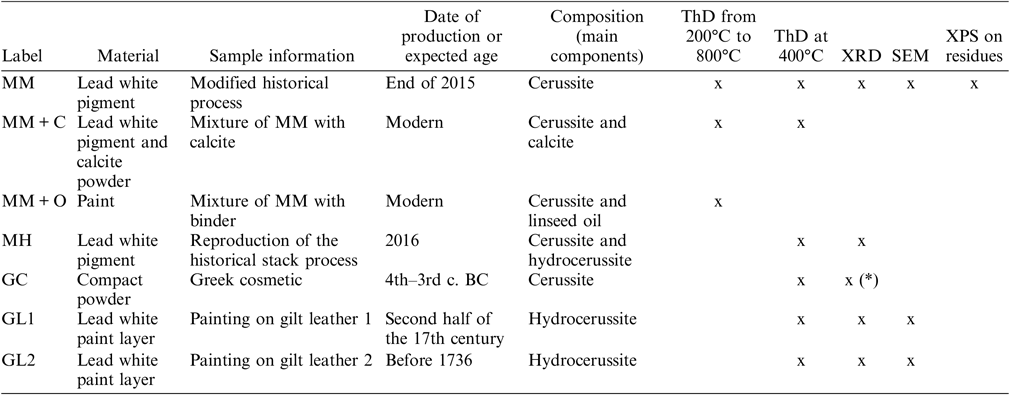
Modern materials were first used to explore the experimental conditions for the preparation of lead white and then historical samples were prepared and dated. A commercial lead white pigment was obtained from a supplier who reproduces or adapts historical processes. For this study, two types of commercial products were available. For the thermal decomposition experiments, we used a lead white pigment produced according to the historical process, slightly modified: the carbon dioxide gas was provided by the fermentation of sugar and yeast dissolved in water (sample MM). According to the supplier, this method makes it easier to control the amount of CO2 and to produce a homogenous pigment structure. White flakes were collected, crumbled and milled with water to obtain a fine powder. Then the pigment was washed several times and air dried. X-ray diffraction showed that the lead white powder produced in that condition is composed of pure cerussite (PbCO3). Mixtures of MM with calcite (sample MM + C) or with linseed oil (sample MM + O) were also thermally studied. The second type of lead white was a modern reproduction of the historical stack process using horse manure. This pigment was made for restoration purposes in 2016 and was used in this study as a test sample (sample MH). X-ray diffraction showed that this lead white powder is composed of cerussite (PbCO3) and hydrocerussite (Pb3(CO3)2(OH)2) in similar amounts. To further validate the method, three historical samples were prepared and dated: one Greek cosmetic powder (GC) composed of cerussite and dated from the 4th–3rd centuries BC (Hasselin Rous and Huguenot Reference Hasselin Rous and Huguenot2017) and two paint samples (GL1 and GL2) taken from two gilt leathers used as decorative wall coverings between the 17th and the 18th centuries (Bonnot-Diconne et al. Reference Bonnot-Diconne, Robinet, Pacheco, Iole and Paris2014). The description of the samples and the method used for their characterization are reported in Table 1.
Lead white materials and analytical methods used in this study. Cerussite = PbCO3; hydrocerussite = Pb3(CO3)2(OH)2; calcite = CaCO3; ThD = thermal decomposition; XRD = x-ray diffraction; SEM = scanning electron microscopy; XPS = x-ray photoelectron spectroscopy; (*) Hasselin Rous and Huguenot (Reference Hasselin Rous and Huguenot2017).

Sample Preparation
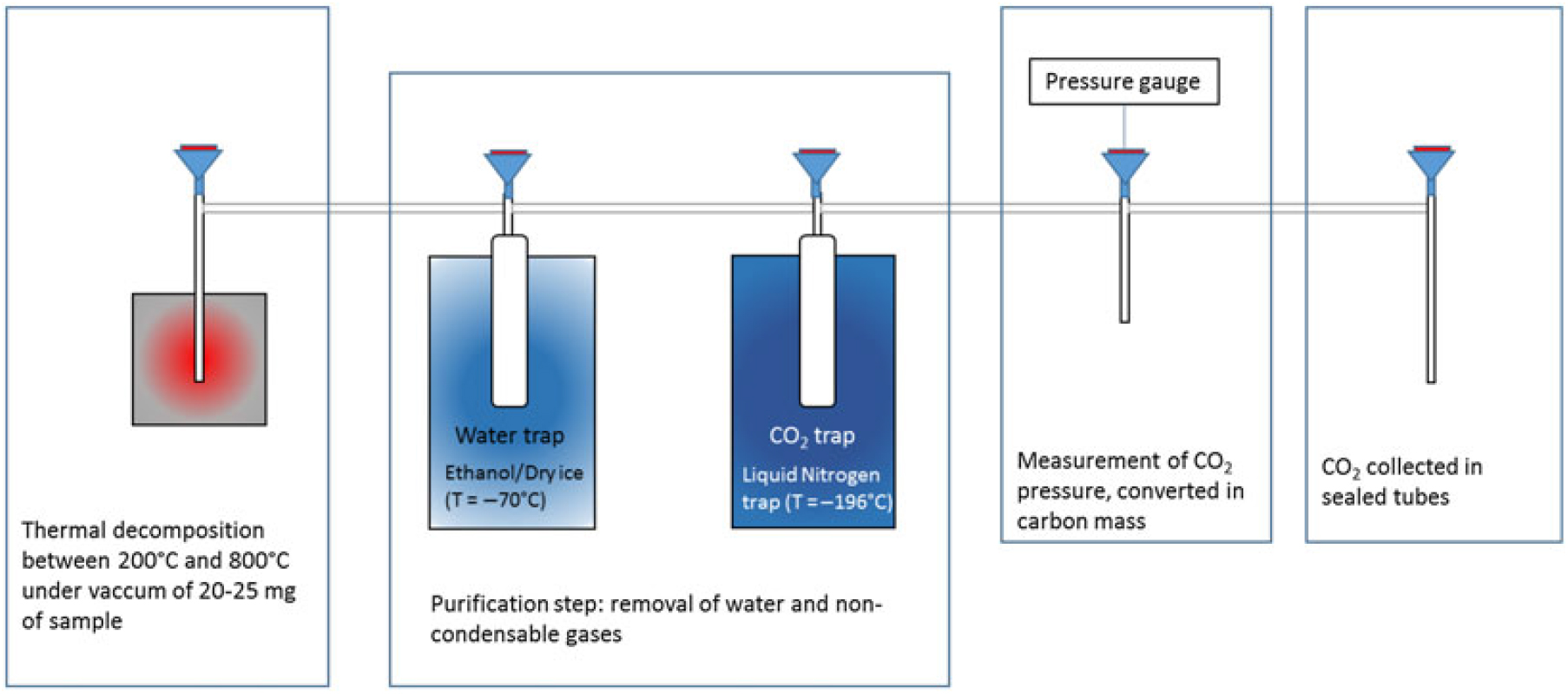
Lead white preparation for 14C dating was investigated by studying the thermal decomposition of sample MM composed of cerussite. Samples were heated at different temperatures (from 200 to 800°C) on a manual vacuum line (Figure 1). For each temperature, 20–25 mg of lead white was decomposed in vacuum (5 × 10⁻⁶ mbar) for 1 or 2 hr, producing carbon dioxide and water. CO2 was separated from H2O using a dry ice/alcohol trap (–78°C) and the pressure of each CO2 sample was measured to determine the extracted carbon content (Dumoulin et al. Reference Dumoulin, Comby-Zerbino, Delqué-Kolic, Moreau, Caffy, Hain, Perron, Thellier, Setti, Berthier and Beck2017). For each temperature, the total released CO2 was collected in a Pyrex tube sealed after collecting. Residues of the decomposition were preserved for their characterization by SEM (see Supplementary material) and XPS. The XPS device was a VG ESCALAB 220i XL spectrometer with a Al-Kα x-ray source (1486.6 eV).
CO2 collection line for lead carbonate preparation at LMC14.

The same procedure was applied to mixed carbonates containing 25 mg of lead white (PbCO3) and 10 mg of CaCO3 (sample MM + C) and to a paint prepared in the laboratory with lead white and linseed oil (sample MM + O). For the test (MH) and the historical samples, the decomposition was carried out at 400°C, according to the results obtained from the preceding experiments and presented in the next section.
As support for the paintings, leather samples were also dated for comparison. They were prepared using the standard acid-base-acid method (0.5 M HCl at 80°C, 1 hr/0.1 M NaOH at 80°C, 1 hr/0.5 M HCl at 80°C, 1 hr), rinsed with ultra-pure water until neutral pH and then dried under vacuum overnight (60°C, 0.1 mbar). CO2 was obtained by combustion (5 hr, 850°C) in a quartz sealed tube with an excess of CuO (400–500 mg) and a 1-cm Ag wire. CO2 was finally dried and collected on a semi-automated rig (Dumoulin et al. Reference Dumoulin, Comby-Zerbino, Delqué-Kolic, Moreau, Caffy, Hain, Perron, Thellier, Setti, Berthier and Beck2017).
CO2 of all the samples was then reduced to graphite with hydrogen over iron catalyst. 14C measurements were performed by accelerator mass spectrometry (AMS) using the LMC14/ARTEMIS facility (Moreau et al. Reference Moreau, Caffy, Comby, Delqué-Kolic, Dumoulin, Hain, Quiles, Setti, Souprayen, Thellier and Vincent2013). 14C ages were calculated using the Mook and van der Plicht (Reference Mook and van der Plicht1999) recommendations and calibrated using OxCal v4.2 (Bronk Ramsey et al. Reference Bronk Ramsey, Scott and van der Plicht2013) and the IntCal13 atmospheric calibration curve (Reimer et al. Reference Reimer, Bard, Bayliss, Warren Beck, Blackwell, Bronk Ramsey, Buck, Cheng, Lawrence Edwards, Friedrich, Grootes, Guilderson, Haflidason, Hajdas, Hatté, Heaton, Hoffmann, Hogg, Hughen, Kaiser, Kromer, Manning, Niu, Reimer, Richards, Marian Scott, Southon, Staff, Turney and van der Plicht2013) for past ages and CaliBomb and the Levin curve (Levin and Kromer Reference Levin and Kromer2004) for pMC.
RESULTS
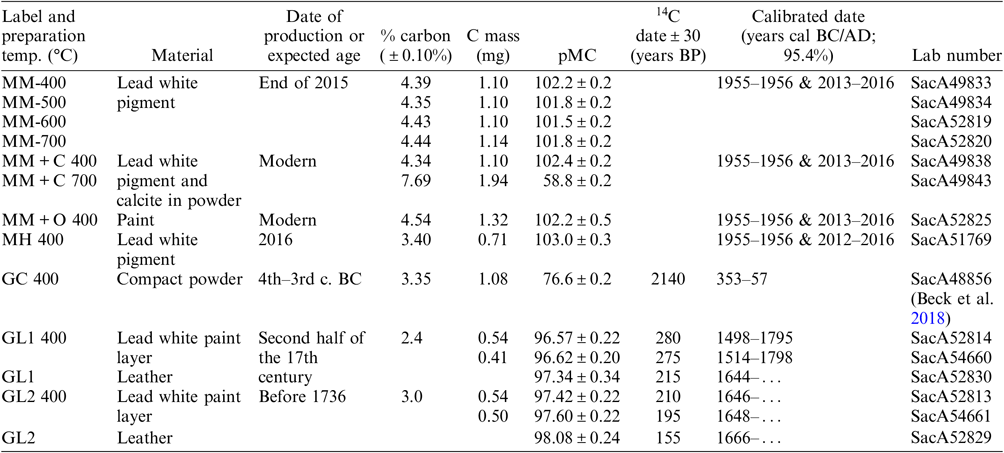
The results are presented in two sections. The first section deals with the development of the sample preparation for pure pigment, mixed pigments (lead white and calcite), paint, and historical samples. The second section shows the dating results. All the data are reported in Table 2.
Extracted carbon content, carbon mass, pMC, and 14C dating results of modern lead white pigments and historical samples of cosmetic and paintings. Results on leather supports are indicated for comparison.

Sample Preparation: Carbon Extraction by Thermal Decomposition
Pure Lead White
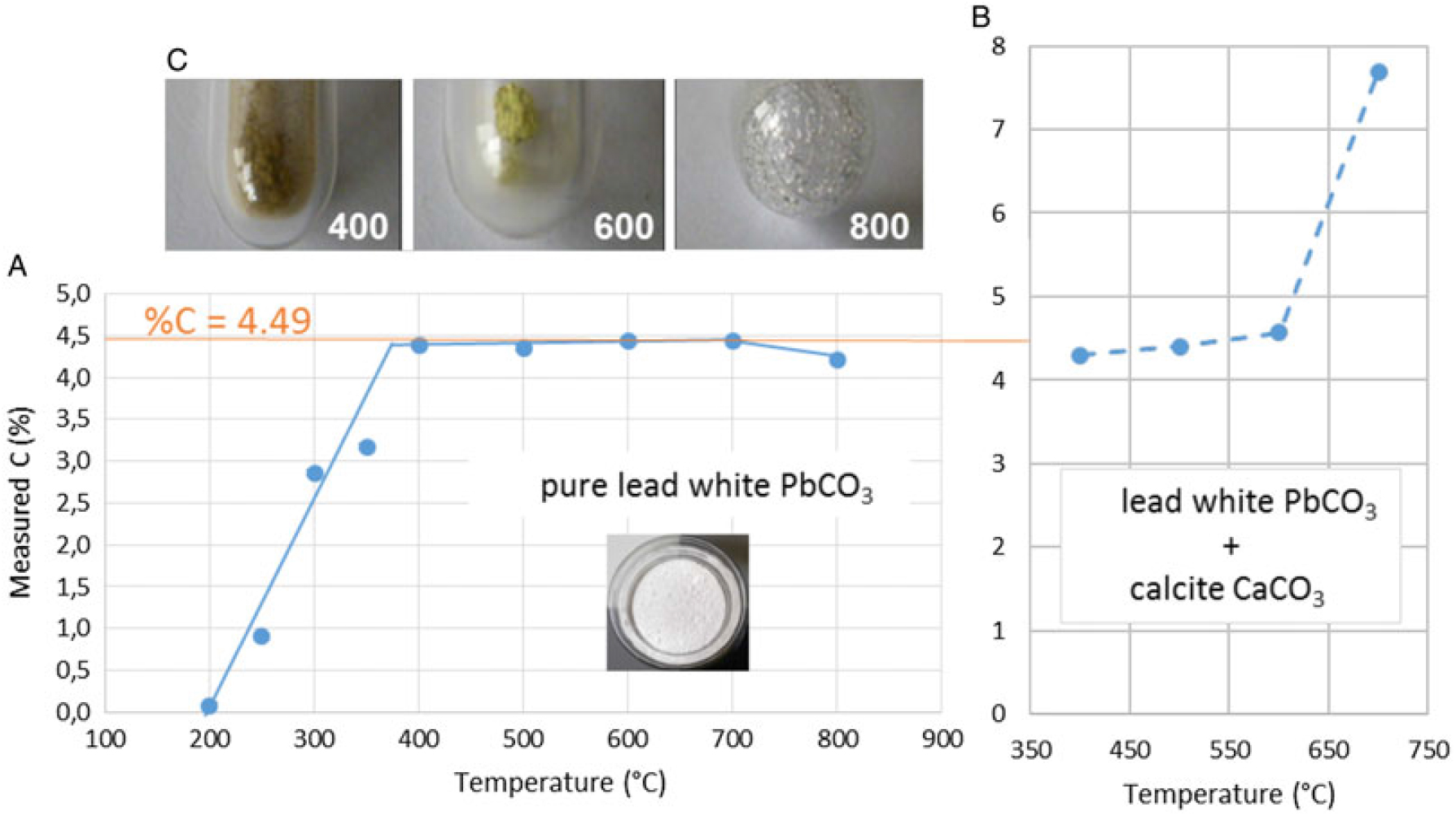
Total CO2 released after heating of 20 mg of lead white (samples MM) for 2 hr was collected for each temperature. Figure 2a reports the total carbon content obtained as a function of the temperature. At 200, 250, 300, 350, and 400°C, the amount of collected carbon was 0.1, 0.9, 2.9, 3.2 and 4.4%. The values from 0.1 to 3.2% correspond to the CO2 release during the first steps of decomposition. At low temperatures, lead white was partially decomposed and two intermediate oxy-carbonates PbCO3·PbO and PbCO3·2PbO were obtained according to Equations (1) and (2):
 $$2PbC{O_3}\buildrel {} \over \longrightarrow PbC{O_3}·PbO + C{O_2}$$
 $$3(PbC{O_3}·PbO)\buildrel {} \over \longrightarrow 2(PbC{O_3}·2PbO) + C{O_2}$$
Total amount of carbon released (in absolute percentage with ± 0.1% uncertainty) from A) pure lead white (sample MM) and B) a mixture of lead white with calcite (sample MM + C) as a function of the heating temperature. C) From left to right: residues after decomposition at 400, 600, and 800°C

At 400°C, the collected carbon content reached the value of 4.44%, which is close to the carbon content in PbCO3 (4.49)%. This value was constant for temperatures between 400 and 700°C, indicating that the CO2 release was complete. At these temperatures, the final dissociation of the oxy-carbonate forms lead monoxide (Equation 3).
 $$PbC{O_3}·2PbO\buildrel {} \over \longrightarrow 3PbO + C{O_2}$$
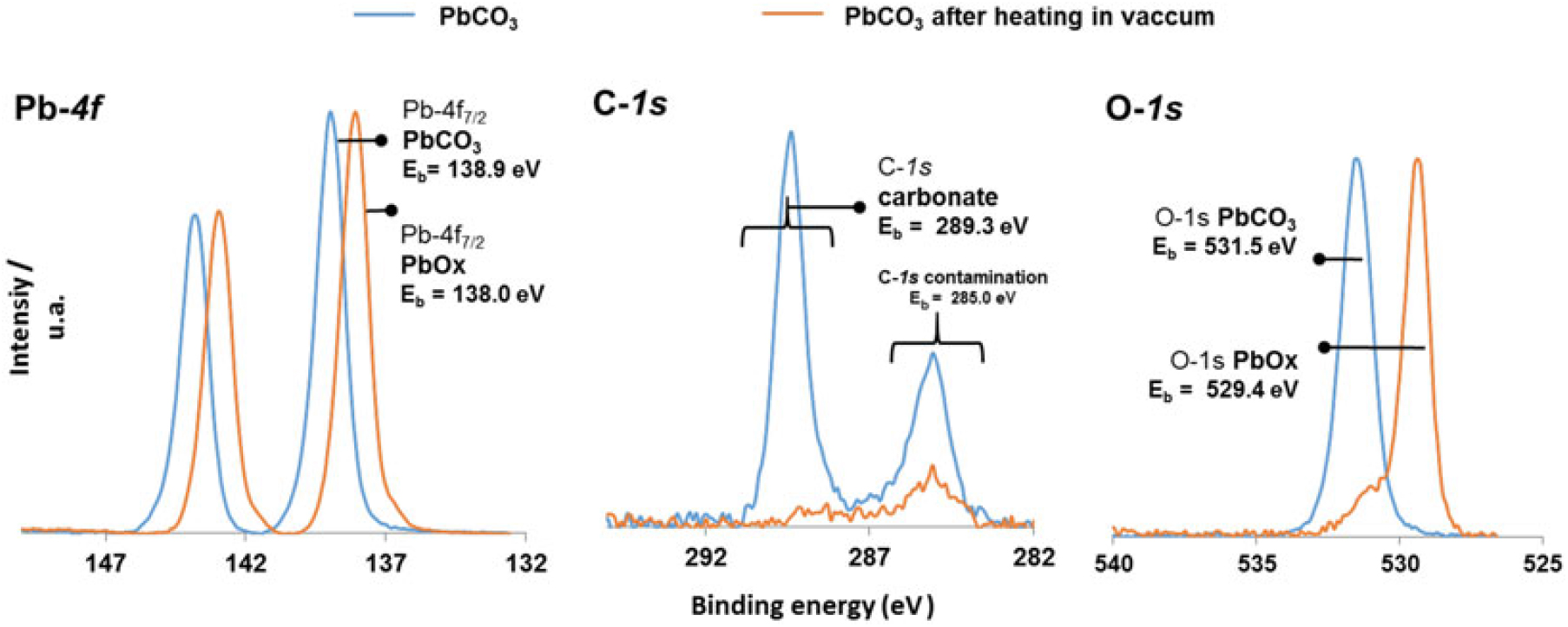
The formation of PbO was indicated by the reddish and yellow colors of the combustion residues, characteristic of massicot (orthorhombic PbO) (Figure 2c) and confirmed by XPS (Figure 3).
Pb-4f, C-1 s, and O-1 s XPS spectra of lead white before (in blue) and after heating (in orange), showing the vanishing of the carbonate structure and the formation of lead oxide (color images online).
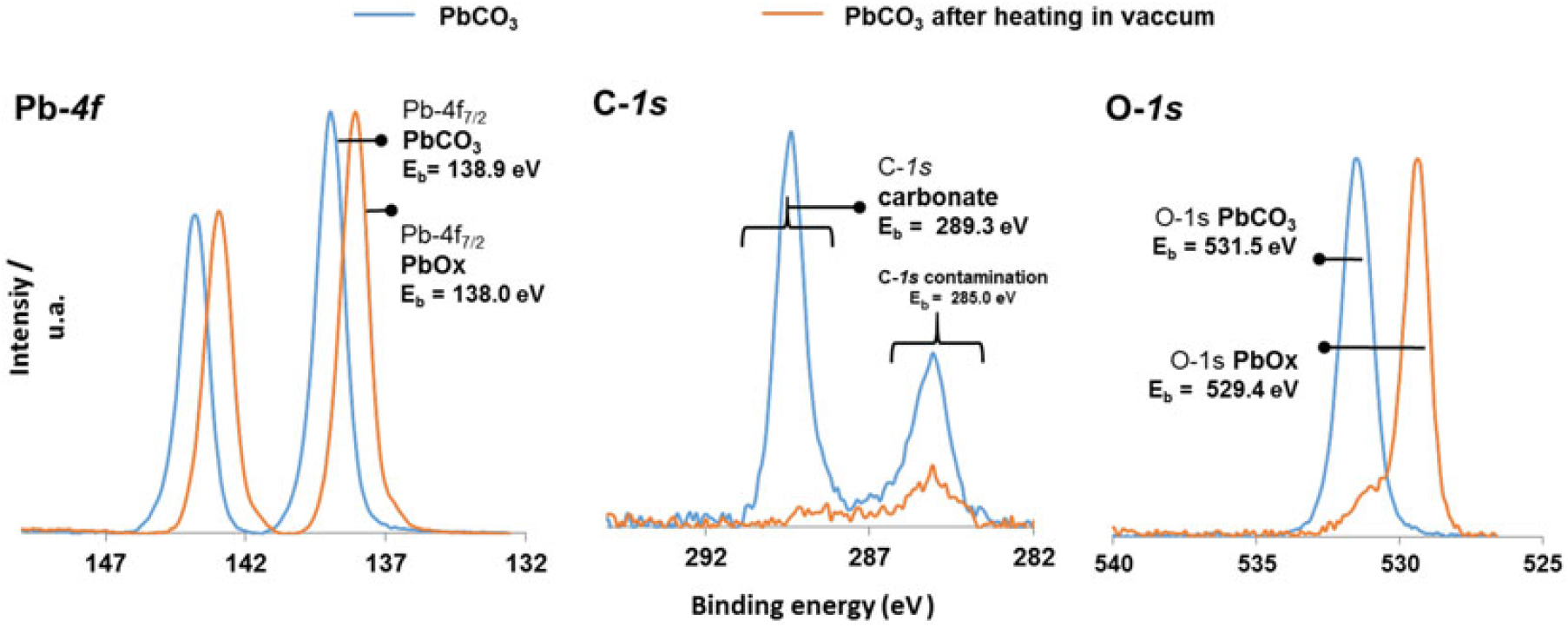
The total decomposition reaction can be summarized by: PbCO3 → PbO + CO2. At 400°C, we can consider that the total recovery of CO2 means that the total original content of carbon contained in PbCO3 has been collected. At higher temperature (800°C), the residue melts as observed in Figure 2c. Decomposition experiments were also conducted for 1 hr, leading to the same results.
Mixed Carbonates: Lead White and Calcite
As all carbonates undergo thermal decomposition to give the metal oxide and carbon dioxide gas, we also investigated the decomposition of mixtures of lead white and calcite between 400 and 700°C (Figure 2b). At 400 and 500°C, the percentage of carbon collected was close to 4.49% corresponding to the CO2 released by the lead carbonate. At higher temperatures, the content of collected carbon strongly increased, indicating that from 600°C, calcite partially decomposes producing also CO2. This contamination in dead carbon must be avoided in order to obtain reliable results from lead white. As a result, we selected the temperature of 400°C as the best condition to optimize the CO2 production yield and to collect CO2 from lead carbonate only. The choice of this condition was confirmed by heating pure calcite at 400 and 500°C: no release of CO2 was observed. For future experiments, we plan to implement a two-step procedure to assess the efficiency of the selective separation of lead white and chalk to obtain age determinations for each subsample.
Paint: Lead White and Linseed Oil
The decomposition of the paint was carried out at 400 and 500°C. The percentages of carbon collected were 4.54% and 4.7%, respectively. These values are slightly above 4.49% due to the contribution of the oil. As the linseed oil is generally produced in the same period of time as the pigment, we assume that the contamination by the binder will not significantly alter the dating results.
Test Sample, Ancient Cosmetic and Paintings
The decomposition of the pigment (MH), the cosmetic powder (GC) and the painting samples (GL) was carried out at 400°C. The collected carbon contents were between 2.4 and 3% (Table 2) due to the presence of hydrocerussite (%C = 3.1%).
14C Measurements
The results of the 14C measurements are reported in Table 2, in pMC for the modern samples and in years BP for the historical samples. For the modern pigments, we obtained pMC values from 101.5 ± 0.2 to 103.0 ± 0.3, except for the sample MM mixed with calcite and decomposed at 700°C (58.8 ± 0.2 pMC). The high pMC values are in agreement with the dates of the pigment production in 2015–2016. The low pMC value is due to dead carbon contamination since at this temperature, we observed that calcite starts to decompose. These results confirm that the preparation of lead white must be carried out at 400°C to prevent any contamination from calcite decomposition. The presence of oil (sample MM + O) did not affect the result (102.2 ± 0.5 pMC), indicating that the linseed oil was also produced recently.
The Greek cosmetic sample (GC), composed of pure cerussite, was preserved in a small box found in a tomb discovered in Eretria (Greece). This tomb was dated on a numismatic basis from ca. 330 to ca. 266 BC (Hasselin Rous and Huguenot Reference Hasselin Rous and Huguenot2017). Two previous 14C dates measured on an almond seed were also available: 359–112 calBC and 375–203 calBC (Gandolfo and Richardin Reference Gandolfo and Richardin2011). The dating of the cerussite powder gives a date range of 353 to 57 BC (95.4%) (Table 2). This date is in agreement with the numismatic result and consistent with the almond seed results as shown by a chi squared test value of T = 3.7 < 6 published in Beck et al. (Reference Beck, Caffy, Delqué-Kolic, Moreau, Dumoulin, Perron, Guichard and Jeammet2018).
The two samples of paint layers come from decorated leathers which were used to cover walls. The leather was first gilt with silver leaves and then partially painted. Two specimens painted with lead white were taken at the surface of the leather fragments. According to the historical or stylistic information, the gilt leather #1 dates from the second half of the 17th century and the gilt leather #2 was mentioned in a castle record in 1736.
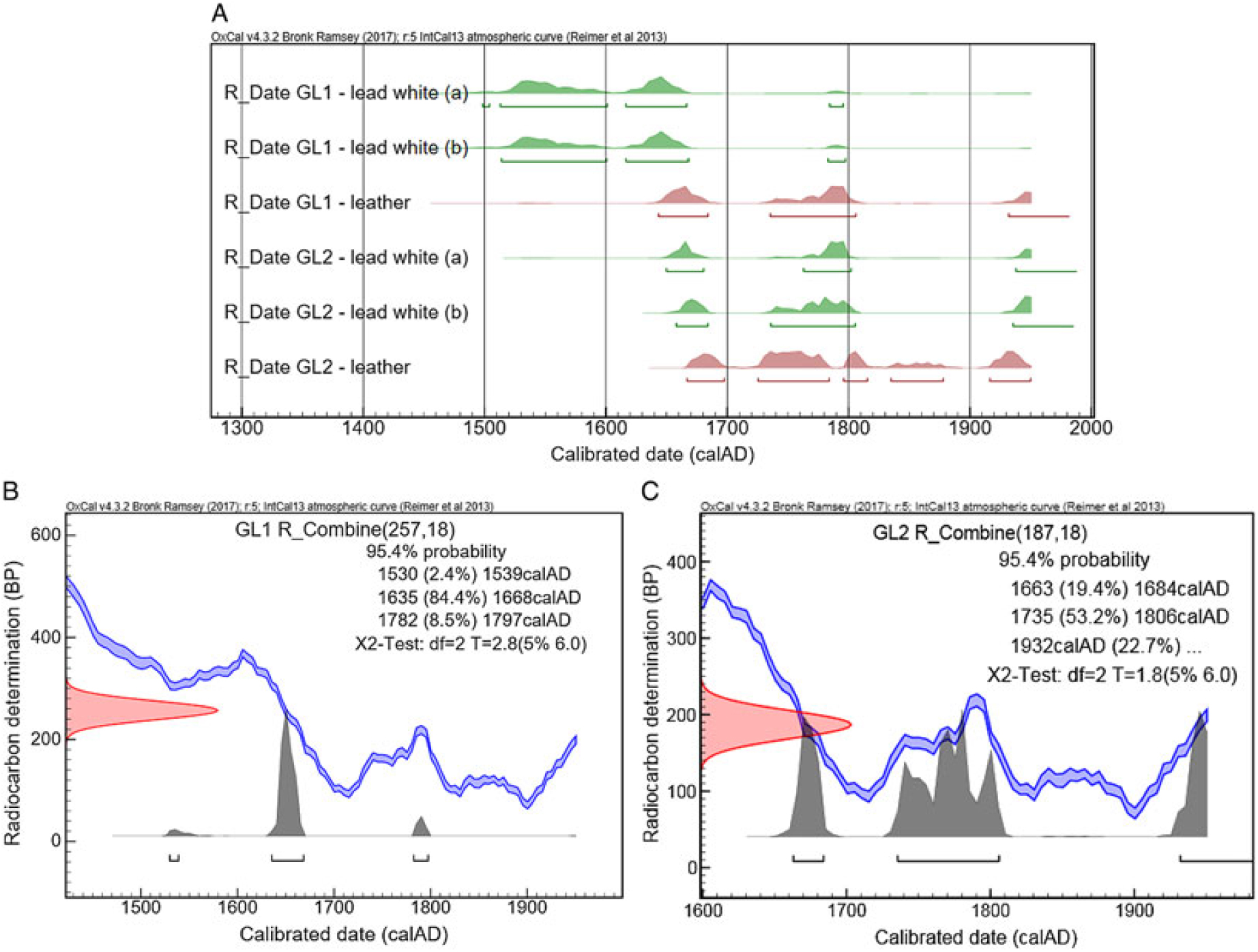
The results on the lead whites and the leathers are reported in Table 2 and compared after calibration in Figure 4a. We can observe a very good agreement between the paint layer dates and the leather date for GL2 but to a lesser extent for GL1. However, the consistency of the dates is demonstrated in both cases by the chi squared test values (T = 2.8 < 5 for GL1 and T = 4.4 < 5 for GL2). Regarding GL1, manufacture of the lead white pigment earlier than the animal death cannot be excluded.
Dating results of the gilt leathers 1 and 2: A) comparison of the age distribution of the leather (in red) and two lead white samples taken from the paint layer (in green); B) and C) combination of the three age distributions obtained on GL1 and GL2. (Please see electronic version for color figures.)

The dates are also in agreement with the historical information. For GL1, the most probable range of dates (1635–1668 [84.4%]; Figure 4b) is very close to the expected time of its manufacture in the second half of the 17th century. For GL2, due to the fluctuations of the calibration curve, we obtained a large probability distribution. The first interval (1663–1684; Figure 4c) fits with the historical record mentioning that the decor was already in place in 1736. This information makes it possible to exclude the latest dates and suggests that the leather was decorated and painted at the end of the 17th century.
Despite the fluctuations of the calibration curves, we obtained 14C measurements in agreement with the expected dates for modern samples as well as for historical specimens of lead white, whatever the composition (cerussite/hydocerussite) and the time scale. These results validate the preparation protocol based on thermal decomposition for producing CO2. They also confirm that lead white incorporates 14C during its manufacture.
CONCLUSION
The possibility of 14C dating lead white pigment has been investigated. The preparation protocol based on the thermal decomposition of lead carbonates was characterized by SEM, XRD and XPS. A decomposition temperature of 400°C was determined to extract CO2 from lead white and to prevent contamination by other carbonates such as calcite. This selective process is necessary as adulteration of lead white with chalk was often reported in the past to reduce the cost of the paints (Stols-Witlox Reference Stols-Witlox and Spring2011). For future experiments, we plan to implement a systematic two-step thermal procedure to check the efficiency of the selective separation and obtain age determinations for each subsample of lead white and chalk.
Successful 14C measurements of modern and historical lead whites have been obtained. An ancient Greek cosmetic powder and two samples taken from paint layers of the 17th century have been dated and the results are in agreement with the expected ages. The results confirm our experimental approach and further validate the assumption that 14C dating of lead white can be based on the principle of the incorporation of 14C when its synthesis uses organic reagents. This study demonstrates that paintings can be dated by dating the lead white pigment in addition to the binder and support (canvas or wood). Support ages can be subjected to discussion regarding possible reuse and the binder can be contaminated by varnish or later restorations. Combining 14C dating of these three components—pigment, binder, support—may provide a more reliable age for the paintings and stronger evidence for their authentication.
ACKNOWLEDGMENTS
The authors thank P. Bonnaillie (CEA/DEN/DMN/SRMP) for SEM experiments presented in the supplementary material section. This is LSCE contribution no. 6502.
SUPPLEMENTARY MATERIAL
To view supplementary material for this article, please visit https://doi.org/10.1017/RDC.2019.64.