


Introduction
Obsessive-compulsive disorder (OCD) is considered among the most incapacitating anxiety disorders (World Health Organization, 1996), with an estimated lifetime prevalence of 1–3% (Torres et al., Reference Torres, Prince, Bebbington, Bhugra, Farrell and Jenkins2006). Although cognitive-behavioural therapy (CBT) is now a well-established treatment for OCD (National Institute for Health and Clinical Excellence, 2005), there is consistent evidence that 30% of individuals referred for CBT do not benefit from it, and only 55% see a benefit 1–6 years after treatment (Abramowitz, Reference Abramowitz2006). Despite much research refining the cognitive model of OCD, the latest meta-analysis suggests that treatment effectiveness has not improved substantively over recent years (Olatunji, Davis, Powers and Smits, Reference Olatunji, Davis, Powers and Smits2013). Recent developments in cognitive-behavioural models of OCD have therefore attempted to make the theoretical models underlying CBT more comprehensive by investigating “higher-order” vulnerability factors for the disorder's development (Bhar and Kyrios, Reference Bhar and Kyrios2007; Doron, Kyrios and Moulding, Reference Doron, Kyrios and Moulding2007; Doron, Moulding, Kyrios and Nedeljkovic, Reference Doron, Moulding, Kyrios and Nedeljkovic2008), in particular those relating to the structure of the “self” (Doron and Kyrios, Reference Doron and Kyrios2005; Kempke and Luyten, Reference Kempke and Luyten2007). In this paper we explore whether obsessive-compulsive behaviour might occur as a response to a salient uncertainty about the status of one's self as moral.
The cognitive-behavioural model of OCD is based on the premise that obsessions are more frequent and distressing versions of otherwise normal intrusive thoughts (Clark and Rhyno, Reference Clark, Rhyno and Clark2005). What leads to those thoughts becoming obsessions is theorized to be a person's appraisal of them (Salkovskis, Reference Salkovskis1999). Compulsions, in turn, are thought to arise as a means for the person to manage the distress that this appraisal causes (Clark, Reference Clark2004). This response leads to the negative reinforcement of compulsions and the maintenance of the belief in the significance of the intrusive thoughts. One factor that has been theorized to contribute to these unhelpful appraisals is what the person with OCD fears their intrusions imply about the traits they have or might acquire (Aardema and O’Connor, Reference Aardema and O’Connor2007).
The inclusion of self-perception variables into cognitive-behavioural models of OCD is consistent with the idea that obsessional thoughts are often appraised as ego-dystonic, that is, inconsistent with a person's sense of self (Aardema and O’Connor, Reference Aardema and O’Connor2007). Indeed, in one study participants with OCD were found to rate their most upsetting obsession as being one that contradicted an important aspect of their self (Rowa, Purdon, Summerfeldt and Antony, Reference Rowa, Purdon, Summerfeldt and Antony2005). The present paper focuses on the moral aspect of the self, as people with OCD often draw negative inferences from their intrusions in terms of their perceptions of themselves as moral beings (Ferrier and Brewin, Reference Ferrier and Brewin2005).
Experimental research supports a causal link between threats to morality and obsessive-compulsive phenomena: Elliott and Radomsky (Reference Elliott and Radomsky2009) played female undergraduates an audio-recording describing a kiss – either consensual or non-consensual – with a man who was described as either moral or immoral. In both the consensual and non-consensual groups, participants reported greater feelings of mental contamination (i.e. feelings of dirtiness) when the man was adjudged immoral, and some participants reported greater subsequent urges to wash. However, research supporting the notion that threats to morality underlie some obsessive-compulsive behaviours does not explain why people with OCD misappraise intrusive thoughts as morally-threatening (Bhar and Kyrios, Reference Bhar and Kyrios2007); indeed, people ordinarily reject negative information about themselves to protect their sense of self-worth (Sherman and Cohen, Reference Sherman and Cohen2002). Research has begun to specify some potential vulnerability factors for developing these responses to intrusions (Doron and Kyrios, Reference Doron and Kyrios2005).
One vulnerability factor that may be important is moral self-ambivalence. Self-ambivalence is defined as uncertainty about and preoccupation with a dichotomous self-construct. For example, someone might be unsure and concerned about which half of two extremes of a dimension, such as morality, they belong to (Bhar and Kyrios, Reference Bhar and Kyrios2007). This can involve contradictory beliefs about the self, such as “I am a good person” and “I am a bad person”, resulting in uncertainty about one's self-worth and attempts to ascertain the “truth” about oneself (Guidano and Liotti, Reference Guidano and Liotti1983). The finding that intrusive thoughts may escalate into obsessions and compulsions because they are experienced as threatening in the context of an uncertain sense of self has been theoretically connected to beliefs about inflated responsibility (Doron, Moulding, Kyrios, Nedeljkovic and Mikulincer, Reference Doron and Moulding2009). These are beliefs that one is instrumentally responsible for preventing harm, which are often key in OCD (Obsessive Compulsive Cognitions Working Group, 1997; Salkovskis, Reference Salkovskis1999). Inflated responsibility beliefs and responses have been conceptualized as ways of restoring a more certain sense of self in the face of threatening intrusions (Doron et al., Reference Doron, Moulding, Kyrios, Nedeljkovic and Mikulincer2009; Kempke and Luyten, Reference Kempke and Luyten2007).
Supporting this theory, in clinical populations correlations have been shown between moral self-ambivalence and OCD symptomatology (Bhar and Kyrios, Reference Bhar and Kyrios2007), yet these findings call for experimental studies to explore the causality of the relationship (Bhar and Kyrios, Reference Bhar and Kyrios2007; Doron et al., Reference Doron, Moulding, Kyrios and Nedeljkovic2008). Probably the most relevant experimental research is a recent series of studies by Doron, Sar-El and Mikulincer (Reference Doron, Sar-El and Mikulincer2012), who manipulated moral self-sensitivity – a related construct that concerns the placing of considerable self-worth upon aspects of morality, yet feeling incompetent in those aspects (Doron and Moulding, Reference Doron and Moulding2009). Non-clinical participants simply positioned items on graphs, with the labels of the graphs designed to make claims either about the participant's morality, their sports ability, or no quality. Participants next read scenarios describing contamination concerns, and rated their urge to act in response to each worry, and their likelihood of acting. Participants who received negative information about their own morality reported the greatest urges and likelihoods of acting, suggesting that threatening the participants’ sense of morality motivated them to neutralize that threat. However, this research only assessed participants’ reported urges to act, not their actual behaviour.
In the present study, we tested whether a manipulation involving moral self-ambivalence would provoke greater deliberative behaviour when resolving ethical dilemmas: a variable that we argue could be analogous to obsessive-compulsive-like behaviour. We predicted that the effect of this manipulation would be particularly strong for participants with a pre-existing tendency to be self-ambivalent in the moral domain, as it is these participants who should be most motivated to act in response to moral ambiguity (Guidano and Liotti, Reference Guidano and Liotti1983). To this end, we used priming tasks with participants intended to temporarily increase the salience of either moral self-ambivalence, general uncertainty, or neither. All participants then responded to moral dilemmas. Like other similar studies, we measured the time participants took to respond (e.g. Arntz, Voncken and Goosen, Reference Arntz, Voncken and Goosen2007); as an additional measure of deliberation we also calculated the length of their written justifications.
Method
Participants and design
Participants responded to an advertisement on a University research recruitment webpage, with the only eligibility criterion being that their first language was English. To improve the sample size and diversity, participants were encouraged to pass the study details on to others. A total of 217 adults (68% female, 32% male; M Age = 21.73, SD = 6.30) completed the online study, and were entered into a prize draw to win £25. Participants were randomly allocated by the online experimental software to either the Experimental, Uncertainty control, or Neutral control condition.
Measures
The Self-Ambivalence Measure (SAM; Bhar, Reference Bhar2004) comprises two subscales: self-worth ambivalence and moral ambivalence. The Moral Ambivalence subscale most strongly predicted endorsement of inflated responsibility beliefs in previous research (Bhar and Kyrios, Reference Bhar and Kyrios2007); therefore we used only this subscale, which has six items. Respondents rate their agreement with each item using 5-point scales (α = .80 in this sample).
Participants also completed the Generalized Anxiety Disorder Assessment (GAD-7; Spitzer, Kroenke, Williams and Löwe, Reference Spitzer, Kroenke, Williams and Löwe2006; α = .89 in this sample), the Patient Health Questionnaire (PHQ-9; Kroenke, Spitzer and Williams, Reference Kroenke, Spitzer and Williams2001; α = .87 in this sample), and the Checking and Contamination subscales of the Obsessive-Compulsive Inventory-Revised (OCI-R; Foa et al., Reference Foa, Huppert, Leiberg, Langner, Kichic and Hajcak2002; α = .86 and .81 in this sample respectively) to provide measures of anxiety, depressive symptomatology, and OCD-related compulsions.
There were no significant differences across conditions on the SAM, F(2, 195) = 0.08, p = .93, the GAD-7, F(2, 195) = 0.36, p = .70, the PHQ-9, F(2, 195) = 0.46, p = .63, the OCI-R (Checking subscale), F(2, 195) = 0.30, p = .74, or the OCI-R (Contamination subscale), F(2, 195) = 0.11, p = .90; participants overall scored low on all measures (Table 1).
Participants’ mean psychometric scores overall and split into subgroups by moral self-ambivalence (standard deviations are in parentheses)

**p < .01; ***p < .001
Procedure
Our procedure was approved by the University of Surrey's Ethics Committee. Participants first completed the measures described above, followed by the experimental manipulation tasks, and finally our moral decision-making task.
Experimental manipulation
Two tasks were used to prime either moral self-ambivalence (in the Experimental condition), general uncertainty (Uncertainty control condition), or neither (Neutral control condition). We used two tasks – the first more “implicit” and the second more “explicit” – to maximize the chances that moral self-ambivalence or general uncertainty would be activated. All participants completed both tasks, but the stimuli used in each task differed, dependent on which of the three conditions the participant had been allocated to.
Task 1. Unscrambling sentences
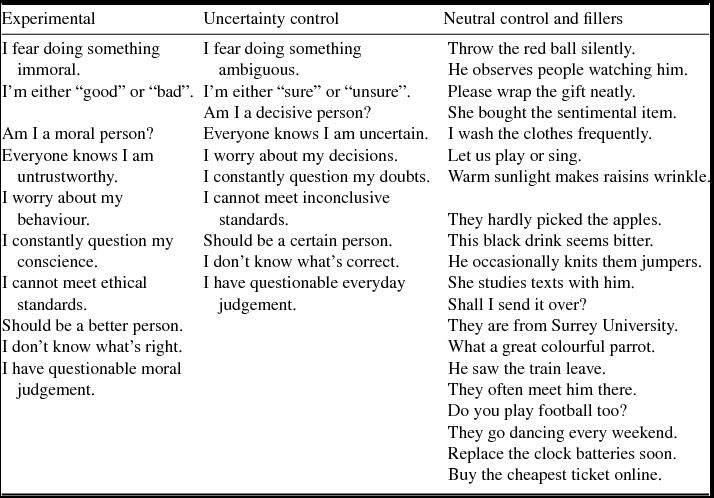
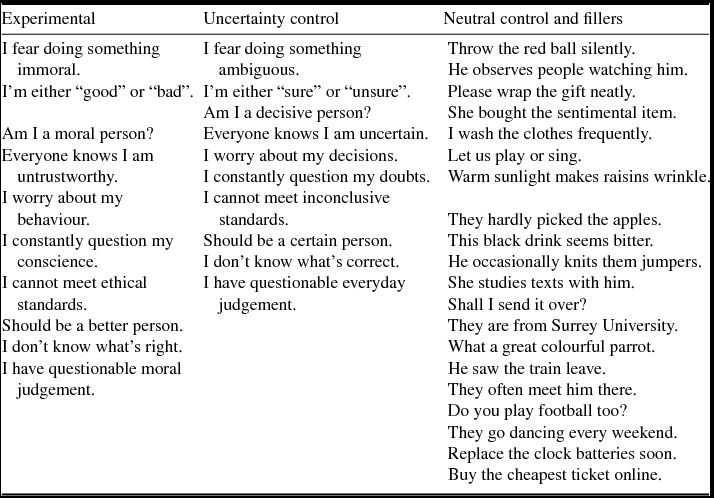
The first task required participants to unscramble 20 five-word sentences. This method has been used to repeatedly expose participants to a target concept, thus priming it (Bargh and Chartrand, Reference Bargh, Chartrand, Reiss and Judd2000). For Experimental and Uncertain Control participants, half of the sentences were primes, which were mixed in with fillers. Priming sentences in the Experimental condition were based on descriptions of moral self-ambivalence in the research literature and the SAM (see Appendix). Priming sentences in the Uncertainty Control condition were adapted from Experimental items to refer instead to general uncertainty. The task in the Neutral Control condition consisted entirely of fillers taken from priming tasks used in prior studies and supplemented by others devised by us.
Task 2. Writing about experiences
In the second task, all participants wrote about a past personal experience. Participants in the Experimental condition wrote three details about a time when they were unsure whether they were a good or bad person; those in the Uncertainty Control condition wrote about a time when they were uncertain; and those in the Neutral Control condition wrote about a time when they made a decision. This task was derived from research into attitudinal uncertainty (e.g. Grant and Hogg, Reference Grant and Hogg2012). Our only criterion for judging participants to have successfully completed this task was that they wrote a relevant sentence in all three boxes; this was determined by the first author alone, who inspected participants’ responses separately from all other data in order to achieve blindness to condition.
Moral decision-making task
Finally, participants were presented with five scenarios from Greene, Nystrom, Engell, Darley and Cohen (Reference Greene, Nystrom, Engell, Darley and Cohen2004), and asked for each to decide whether a particular course of action is right, and to justify their answer. All scenarios represented cases in which causing harm to one person could prevent harm against a greater number of people. As with Task 2, participants were judged to have successfully completed this task if they wrote a relevant sentence in all five boxes; this was determined by the first author blind to condition. We measured response time (how long participants took to respond to each scenario, as measured automatically by the online software) and response length (the number of characters they used in each response).
Results
Nineteen participants were excluded from analysis either because they failed to follow instructions (e.g. writing nonsense strings of letters as responses) or because they spent more than three standard deviations above the mean time to complete the three tasks. This latter criterion was used because priming effects are typically short-lived (Bargh and Chartrand, Reference Bargh, Chartrand, Reiss and Judd2000), and the online nature of the study precluded us from verifying that participants completed it without disengaging. The excluded participants (58% females; M Age = 18.47, SD = 0.77) came approximately equally from all three conditions (7 Experimental condition; 7 Uncertainty Control; 5 Neutral Control). This left 198 participants for analysis (69% females; M Age = 22.04, SD = 6.50). There were no significant differences across conditions in terms of age, F(2, 195) = 0.98, p = .38, or gender, χ2(2) = 5.90, p = .052; however, because the gender differences were marginally-significant, we accounted for this in the analysis reported later.
We categorized as “high” in moral self-ambivalence those participants whose SAM scores were more than one standard deviation above the sample mean. This categorization applied to 32 participants; the remainder were categorized as “low-medium” in moral self-ambivalence. Table 1 contains psychometric scores for the two groups. We averaged the response time and length data across the five moral dilemmas, and log-transformed these values to correct for skewness. We assumed that these variables would represent different indexes of the same thing: the extent to which participants deliberated when responding to the ethical dilemmas (indeed, the two were strongly correlated, r = .73). Therefore, we maximized statistical power by using a principal components analysis (PCA). This technique permits the reduction of two or more collinear variables into fewer factors that each measures a unique construct. In this way, we reduced both transformed variables into one combined measure, which we label “deliberation”. This component had an eigenvalue of 1.73 and explained 86.4% of the overall variance. The deliberation scores obtained from the PCA were therefore used in all analysis. It is noteworthy that these scores were not correlated with SAM scores (r = .05; p = .51); we return to this point in the Discussion.
We ran a two-way univariate ANOVA with Condition (Experimental vs. Uncertainty control vs. Neutral Control), and Moral Self-Ambivalence (High vs. Low-Medium) as the independent variables. The analysis revealed a non-significant main effect of Moral Self-Ambivalence, F(1, 192) = 0.06, p = .94, η2 p < .001, and a marginally-significant main effect of Condition, F(2, 192) = 2.83, p = .06, η2 p = .02. There was, however, a significant two-way interaction, F(2, 192) = 3.12, p = .047, η2 p = .03 (Figure 1). Follow-up analyses showed that the effect of Condition was significant among participants who scored highly on Moral Self-Ambivalence, F(2, 29) = 3.58, p = .04, η2 p = .20, but not among those in the low-medium range, F(2, 163) = 1.78, p = .17, η2 p = .02. Planned contrasts showed that highly self-ambivalent participants’ deliberation scores were significantly greater in the Experimental condition than in the other two conditions, t(29) = 2.66, p = .01, r = .44. The Uncertain and Neutral Control groups did not differ, t(29) = 0.47, p = .64, r = .09.
Participants’ mean deliberation factor scores derived from response times and lengths, as a function of experimental condition and moral self-ambivalence. Error bars indicate standard error of the mean.

We repeated the above ANOVA controlling for participants’ anxiety, depression and checking scores (all of which differed significantly by Moral Self-Ambivalence; Table 1) and gender (which differed marginally by Condition). The two-way interaction remained significant, F(2, 188) = 3.36, p = .04, η2 p = .04, and the main effect of Condition became significant, F(2, 188) = 3.27, p = .04, η2 p = .03. There was no main effect of Moral Self-Ambivalence, F(2, 188) = 0.01, p = .91, η2 p < .01.
Discussion
Our data show that experimentally priming moral self-ambivalence increased the deliberation that individuals invested in responding to moral dilemmas, but only among participants with high baseline levels of moral self-ambivalence. The effect can be compared to laboratory studies in which participants whose inflated responsibility was primed took longer and made more checks to sort medication into containers (Arntz et al., Reference Arntz, Voncken and Goosen2007); such measures have been posited as analogues of obsessive-compulsive behaviour. Although previous experimental research has challenged participants’ perceptions of their morality with explicitly negative information (Doron et al., Reference Doron, Sar-El and Mikulincer2012; Teachman and Clerkin, Reference Teachman and Clerkin2007), this study is the first to demonstrate an effect on individuals’ actual decision-making behaviour, and that this can be related to trait moral self-ambivalence.
Because participants’ deliberation scores were not correlated with their SAM scores, it seems unlikely that deliberation was merely a behavioural manifestation of moral self-ambivalence. Instead, it is more likely that our priming tasks increased the salience of certain participants’ pre-existing self-ambivalence, rather than increasing moral self-ambivalence per se. Several possible mechanisms might underlie our effect. For example, by investing greater deliberation into their dilemma responses, self-ambivalent participants might have been attempting to restore confidence in their own morality after their ambivalence had been made salient. Alternatively, this salience might have been cognitively disruptive for self-ambivalent participants, perhaps causing their reasoning to be less straightforward. Further investigations would be needed to confirm whether these or other mechanisms are responsible, and our novel priming methodology could be used in such research. In this case, though, it would be important to validate our presumption that moral self-ambivalence was indeed the construct activated. Here we inferred that the manipulation was successful on the basis that it produced the predicted effects upon deliberation; nonetheless without a direct manipulation check we cannot rule out the possibility that we actually activated some alternative construct with compatible effects. Relatedly, it would be useful to know whether both priming tasks were successful in this regard, or whether the observed effects were driven by just one task.
Our findings build upon recent efforts to update the cognitive-behavioural model of OCD, which have shown that negative self-appraisals may be significant in the development of the disorder (Doron et al., Reference Doron, Moulding, Kyrios, Nedeljkovic and Mikulincer2009; Ferrier and Brewin, Reference Ferrier and Brewin2005; Kempke and Luyten, Reference Kempke and Luyten2007). Specifically, this study provides further indication that “higher-level” cognitive vulnerabilities such as moral self-ambivalence contribute to OCD symptomatology (Doron and Kyrios, Reference Doron and Kyrios2005). The wider theoretical implication is that models of OCD could benefit from being expanded by incorporating constructs underlying key belief domains such as inflated responsibility (Doron and Kyrios, Reference Doron and Kyrios2005; Solem, Myers, Fisher, Vogel and Wells, Reference Solem, Myers, Fisher, Vogel and Wells2010). Expansion of this sort would increase the explanatory power of cognitive models of OCD aetiology (Marker, Calamari, Woodard and Riemann, Reference Marker, Calamari, Woodard and Riemann2006), as well as identifying broader factors that interventions could target. Whereas previous research into the aetiology of OCD has focussed on potential developmental pathways for inflated responsibility (Salkovskis, Shafran, Rachman and Freeston, Reference Salkovskis1999), understanding developmental pathways that lead specifically towards moral self-ambivalence may further improve explanatory models.
Of course, one cannot assume that our findings would be replicated in people who meet diagnostic criteria for OCD. Indeed, a limitation was the relatively small proportion of participants with high levels of moral self-ambivalence. However, if the results were replicated in a clinical sample with more participants “high” in moral self-ambivalence, then this might offer support for addressing moral self-ambivalence directly in clinical work. This notion fits with Doron and Moulding's (Reference Doron and Moulding2009) recommendation for addressing the self-perception of clients who do not benefit from classical CBT. Further studies should also explore the conditions under which moral self-ambivalence will be most likely to lead to obsessive-compulsive behaviour. For example, such behaviour might be less likely among people who perceive the moral self as less important, or among people who are capable of effectively neutralizing or suppressing intrusive thoughts (Julien, O’Connor and Aardema, Reference Julien, O’Connor and Aardema2007; Purdon, Rowa and Antony, Reference Purdon, Rowa and Antony2005).
In conclusion, our findings suggest that when individuals who are morally self-ambivalent experience situations that make this ambivalence salient, their vulnerability to obsessive-compulsive behaviour might be heightened.
(Unscrambled) sentences used in the Unscrambling sentences task





Comments
No Comments have been published for this article.