INTRODUCTION
Ascaris lumbricoides and A. suum are important parasites of humans and pigs respectively (O'Lorcain and Holland, Reference O'Lorcain and Holland2000; Crompton, Reference Crompton2001). The frequency distribution of Ascaris in humans tends to be highly aggregated in which relatively few people are host to the majority of worms (Crompton and Tulley, Reference Crompton and Tulley1987; Guyatt et al. Reference Guyatt, Bundy, Medley and Grenfell1990; Thein Hlaing, Reference Thein1993; Holland and Boes, Reference Holland, Boes, Holland and Kennedy2002). Studies in human populations have provided evidence that the intensity of reinfection with Ascaris is not random, and that certain individuals are predisposed to infection and consequently develop heavy worm burdens. As well as being an age-related effect, this phenomenon appears to be under genetic control (Holland et al. Reference Holland, Asaolu, Crompton, Stoddart, Macdonald and Torimiro1989; Guyatt et al. Reference Guyatt, Bundy, Medley and Grenfell1990; Wong et al. Reference Wong, Bundy and Golden1991; Hall and Anwar, Reference Hall and Anwar1992; Chan et al. Reference Chan, Bundy and Kan1993; Palmer et al. Reference Palmer, Hall, Hague and Anwar1995; Peng et al. Reference Peng, Zhou, Cui, Crompton, Whitehead, Xiong, Wu, Peng, Yang, Wu, Xu and Yan1996; Williams-Blangero et al. Reference Williams-Blangero, Subedi, Upadhayay, Manral, Rai, Jha, Robinson and Blangero1999, Reference Williams-Blangero, Vandeberg, Subedi, Aivaliotis, Rai, Upadhayay, Jha and Blangero2002) and this is also relevant in experimental and natural infections in pigs (Roepstorff et al. Reference Roepstorff, Eriksen, Slotved and Nansen1997; Boes et al. Reference Boes, Medley, Eriksen, Roepstorff and Nansen1998). There are important implications for selective approaches to chemotherapeutic control, the distribution of morbidity within the host populations and the dynamics of transmission. However, the mechanistic basis for predisposition has yet to be elucidated. Since mice are known to vary in their susceptibility to infection with Ascaris (Mitchell et al. Reference Mitchell, Hogarth-Scott, Edwards, Lewers, Cousins and Moore1976; Lewis et al. Reference Lewis, Behnke, Stafford and Holland2006) they provide a convenient model for investigating the basis of variation in establishment and the successive migration of larvae through the liver and lungs of a host species that is readily available for laboratory experimentation in a range of defined genotypes.
Innate resistance traditionally encompasses a physiological/morphological incompatibility between parasite and host environment that prevents invasion, establishment or survival (Wakelin, Reference Wakelin1996), but underlying this is the host genotype. Furthermore, a host with a genotype capable of generating an appropriate immune response to the presence of the parasite may nonetheless fail to control infection if it is susceptible to immunomodulation by the parasite. Resistance to A. suum in pigs has been suggested to involve the elimination of the parasite both during migration by white spot formation (an inflammatory reaction in the liver in response to the presence of larvae) in the liver and during the early pre-patent period expulsion from the gut (Eriksen et al. Reference Eriksen, Andersen, Nielsen, Pedersen and Nielsen1980). Migrating Ascaris larvae are known to cause an inflammatory reaction in the liver, the lungs and the small intestine of infected animals, as well as human hosts (Vogel and Minning, Reference Vogel and Minning1942; Beaver and Danaraj, Reference Beaver and Danaraj1958; Ronéus, Reference Ronéus1966; Spillmann, Reference Spillmann1975; Eriksen et al. Reference Eriksen, Andersen, Nielsen, Pedersen and Nielsen1980; Eriksen, Reference Eriksen1981; McSharry et al. Reference McSharry, Xia, Holland and Kennedy1999; Cooper et al. Reference Cooper, Chico, Sandoval, Espinel, Guevara, Kennedy, Urban, Griffin and Nutman2000; Pérez et al. Reference Pérez, García, Mozos, Bautista and Carrasco2001; Frontera et al. Reference Frontera, Roepstorff, Gázquez, Reina, Serrano and Navarrete2003, Reference Frontera, Roepstorff, Serrano, Gázquez, Reina and Navarrete2004; Miquel et al. Reference Miquel, Roepstorff, Bailey and Eriksen2005) although the incidence of this reaction in the human liver has been disputed.
The occurrence of a pulmonary inflammatory response has previously been studied in helminth infections. However, there has been no direct evidence that this response has a protective function in primary infections. Nevertheless, the passage of A. lumbricoides and A. suum through the pulmonary tissue of their natural hosts is known to be associated with severe respiratory distress (Matsuyama et al. Reference Matsuyama, Mizoguchi, Iwami, Kawabata and Osame1998) and peripheral eosinophilia has also been reported. Loeffler (Reference Loeffler1932) described a respiratory illness, later termed ‘Loeffler's syndrome’ and which may be caused by the migrating larvae of A. lumbricoides in human populations (Vogel and Minning, Reference Vogel and Minning1942; Loeffler, Reference Loeffler1956). These symptoms of respiratory distress are also seen in pigs infected with larval A. suum (Slotved, Reference Slotved1997). Bronchovascular damage caused by the parasite may result in secondary infections by opportunistic bacteria that may proliferate in the inflamed pulmonary tissues and invade the host vasculature (Keller et al. Reference Keller, Hillstrom and Gass1932; Liljegren et al. Reference Liljegren, Aalbæk, Nielsen and Jensen2003; Tjørnehøj et al. Reference Tjørnehøj, Eriksen, Aalbæk and Nansen1992).
In this paper, exploiting 2 strains of mice that show contrasting phenotypes of resistance/susceptibility to infection with A. suum, we first quantify parasite burdens in all the key anatomical locations during the early tissue-migratory phase of infection in order to identify the time and place at which the worm burdens first differ between the strains. Then, we assess the effect of steroid-mediated immunosuppression on the genetic resistance, and we quantify the bronchoalveolar response of the 2 mouse strains, in order to determine whether the pulmonary response is responsible for the difference between the strains. Our results may help to clarify what role, if any, the inflammatory process plays in protecting hosts against larval ascariasis.
MATERIALS AND METHODS
Experimental animals
One hundred and two male inbred mice (51 C57BL/6j and 51 CBA/Ca) were purchased for Experiment 1, seventy inbred mice (35 C57BL/6j and 35 CBA/Ca) for Experiment 2 and 88 mice of each strain were procured for Experiment 3. All mice were male and purchased from Harlan, UK and were 8 weeks old upon commencement of the initial infections. Animals were maintained under standard conditions. Water and pelleted commercial food were provided ad libitum. All mice, unless otherwise stated, were euthanased by cervical dislocation. Age-matched control mice were maintained separately from infected mice and appropriate measures were used to prevent cross-contamination. Mice were weighed pre-infection and on the day of post-mortem. These experiments were reviewed and approved by the University research ethics committee and the Department of Health and Children (Ireland).
Parasite
Approximately 4 000 000 embryonated ova (batch no.: 8/2002) were provided by the Danish Centre for Experimental Parasitology (CEP), Copenhagen. These eggs were used in previous procedures by Lewis et al. (Reference Lewis, Behnke, Stafford and Holland2006). Prior to inoculation, the doses were carefully adjusted to the desired number of fully embryonated eggs. Mice were inoculated by gastric intubation between 8 and 10 a.m. (Lewis et al. Reference Lewis, Behnke, Stafford and Holland2006). Placebo doses consisted of intubation media only.
Experimental design and worm recovery
Exp. 1
In this experiment worm numbers in the 2 mouse strains in strategic tissue sites were compared during the migration from the gut lumen to the lungs. Mice were inoculated with 500 fully embryonated eggs by stomach intubation. Six mice inoculated with A. suum were euthanased from each strain daily between day 0 (at 6 h p.i.) and 5 post-inoculation, inclusive and a further 5 mice per strain were euthanased daily from day 6 to 8 inclusively. At 6 h p.i. the large intestine, the rectum, the liver and lungs were removed. The large intestine (including the caecum and colon) and the rectum were treated as separate organs. The contents were collected by washing the relevant opened intestinal section with 30 ml of 0·9% saline in a 50 ml centrifuge tube (Lewis, Reference Lewis2006). The contents were then fixed in formalin. The intestinal walls were then completely submerged in 0·9% saline by suspending them from a wire in another centrifuge tube and incubated overnight at 37·5°C in a vertical position. The recovery of larvae, using centrifugation at 1000 g for 5 min, was performed on all the samples of washed contents and the incubated intestinal sections.
At all other post-mortem examinations, only the liver and the lungs were removed for enumeration of larval burdens by a modified Baermann method. The procedure involved and the subsequent recovery of viable larvae were described comprehensively by Lewis et al. (Reference Lewis, Behnke, Stafford and Holland2006). Larval counts were performed on the 4 ml solution and pellet in the centrifuge tube. Five, 200 μl samples were then placed on a slide and the number of larvae were counted with a phase-contrast stereomicroscope at ×40 magnification. The sum of the larvae counted in the 5 aliquots was then calculated using the appropriate calculations (Lewis et al. Reference Lewis, Behnke, Stafford and Holland2006).
Exp. 2
In this experiment the effect of the immunosuppressant hydrocortisone on larval burdens was assessed, in particular on the disparity in worm burdens between the 2 strains. Thirty mice from each strain were inoculated with 500 fully embryonated eggs by stomach intubation as previously described on day 0. Half of each group was additionally treated with hydrocortisone, while the other half received 0·9% saline as a placebo treatment. Five mice treated with hydrocortisone and 5 placebo treated mice from each strain were euthanased on days 6, 7 and 8. The liver and lungs were removed and examined for larvae. The spleen was also removed for examination. The post-mortem procedure was performed as described by Lewis et al. Reference Lewis, Behnke, Stafford and Holland2006. A further 5 non-infected mice from each strain, the placebo control group, were similarly inoculated with medium alone and were euthanased on day 5 p.i. to provide information on the spleen weights of uninfected animals. Thirty mice (15 of each strain) were treated with hydrocortisone as explained below. Larvae were recovered from the liver and lungs on days 6–8 p.i. as described for Exp. 1.
Exp. 3
In this experiment we compared the bronchoalveolar response of the 2 mouse strains. Forty-eight mice (24 of each strain) were inoculated with 1500 embryonated A. suum eggs in 100 μl of solution and 5 mice of each strain were provided with a placebo dose consisting of intubation medium and no A. suum eggs as controls on day 0. Days 8, 9 and 10 were selected for necropsy on the basis of previous work in which the first indications of a pulmonary inflammatory response were detected on day 8 and by day 10 this reaction was reported to be intense (Eriksen, Reference Eriksen1981). Five mice from both strains were sacrificed on each day for the examination of BAL fluid, euthanasia being by carbon dioxide (CO2) asphyxiation to prevent damage to the airways. Susceptibility was once again assessed by the number of larvae recovered from the lungs and 3 mice from each strain were euthanased daily on days 7, 8 and 9 for this purpose and to provide comparative data between worm burdens and leukocyte populations. The placebo group from each strain was euthanased on day 7 to determine the base level of the leukocyte population. This experiment also provided information on the rate of recovery from an intermediate dose of eggs (1500) not examined in earlier work (Lewis et al. Reference Lewis2006 where the range examined was 100–3000 A. suum eggs). An additional 18 mice (9 of each strain) were inoculated with 1500 embryonated A. suum eggs in 100 μl of solution. Three mice from both strains were sacrificed on each day post-inoculation (days 8–10) to determine histopathological changes in the lungs. Two control mice per strain were euthanased on day 7 for comparative purposes of pulmonary structure in uninfected individuals.
The administration of hydrocortisone
Of the 60 mice inoculated with infective A. suum ova in Exp. 2, 15 from each strain were inoculated subcutaneously, on days -1 (the day prior to infection), 1, 3 and 5 (post-inoculation), with a total of 10 mg of hydrocortisone acetate (stock solution of 12·5 mg/ml) administered each day at the rate of 2·5 mg/0·2 ml (1·25 mg per 0·1 ml of hydrocortisone acetate). Hydrocortisone acetate was purchased from Sigma-Aldrich® as a pre-prepared solution and administered subcutaneoulsy. Hydrocortisone administered at this intensity is immunosuppressive (Behnke and Parish, Reference Behnke and Parish1979; Wahid and Behnke, Reference Wahid and Behnke1996).
Bronchoalveolar lavage (BAL) of the murine lung and quantification of cell types
Mice in the BAL group had their thoracic cavity and trachea exposed and the lungs were left in situ. Then 0·5 ml of prepared phosphate-buffered saline (PBS – a mixture of sodium phosphate and potassium phosphate, pH 7·2 commercial purchased in tablet form from Sigma-Aldrich® combined with 500 ml of 0·9% saline) was infused into the lungs and the plunger withdrawn immediately to aspirate the BAL fluid. The aspirated BAL fluid was deposited into a sterile Eppendorff tube. This procedure was repeated with another 0·5 ml of PBS (Lewis, Reference Lewis2006).
Total cell counts were carried out within 2 h of recovery. The technique used to prepare the bronchoalveolar fluid for counting and staining was that described by Kim et al. (Reference Kim, Kim, Lim, Kim, Han, Kang, Min, Kim, Lee and Kim2002) and is known as the undiluted erythrocyte lysing technique. Briefly, 500 μl of the BAL sample from an individual were added to 9·5 ml of lysis solution (0·1 m HCl). The sample was centrifuged at 800 g for 10 min at 20°C. Using the aspirator, the supernatant was discarded and the final volume adjusted to 500 μl. The leukocyte pellet was carefully re-suspended and the leukocyte total cell counts were done immediately, using an improved Neubauer counting chamber.
For differential cell counts, thick films of cells were smeared. Pre-prepared ACCUSTAIN® Wright stain (Sigma-Aldrich®) was used for the staining of the BAL fluid film. The stained BAL film was mounted in DPX and a glass cover-slip was placed on top. Differential leukocyte counts were performed using an inverted phase-contrast microscope (Axiovert) under an oil immersion. A total of 500 cells were counted per slide and the cell types were differentiated with the assistance of 2 experienced observers (Dr Paul Voorheis and Dr Derek Nolan, of the Biochemistry Department in Trinity College Dublin). This process was repeated twice for each BAL fluid slide preparation for each individual and the average from the 2 counts was taken. The differentiated cells were calculated as a percentage of the 500 cells and this value was used to determine the number of specifically differentiated cells of each cell type present in the total number of leukocytes in a millilitre (ml) of BAL fluid.
Histopathological examination
Each mouse was weighed prior to sacrifice by carbon dioxide (CO2) asphyxiation. The post-mortem procedure was similar to that performed on mice examined by bronchoalveolar lavage. The lungs were left in situ. The trachea was exposed and 0·5 ml of Carnoy's fixative was subsequently infused into the lungs. The hypodermic needle was withdrawn and a thread was securely tightened around the trachea. The lungs were left in situ for 5 min and then excised as a whole and immersed in Carnoy's fixative for 4 h (Lewis, Reference Lewis2006). After this period the lungs were removed from the fixative and divided into the left and right hand side and transferred to separate vessels containing 70% ethanol for histological examination. Lungs were embedded in paraffin wax prior to sectioning. Five μm sections were stained with haemotoxylin and eosin. Three μm sections were stained with Alcian blue, Periodic Acid Schiff (PAS), and with Discombe's eosin and haematoxylin respectively. The pulmonary inflammatory response was scored semi-quantitatively ranging from + (mild inflammation) to +++ (severe inflammation) by a pathologist without prior knowledge of the relative susceptibility or immune responses of C57BL/6j and CBA/Ca mice to migrating A. suum.
Statistical analysis
Larval recovery data were assessed for normality visually and statistically. The influence of the various factors on larval burden was analysed by analysis of variance (ANOVA in SPSS 12.0.1), using 1- 2- or 3-way ANOVAs depending on the number of explanatory factors and covariates involved. Full-factorial models were simplified by step-wise deletion of non-significant terms beginning with the 3-way interactions, and minimum sufficient models in which only significant terms remained were used to assess significance of fitted factors. In some cases least squares difference (LSD) post-hoc tests were applied to tease out the major sources of variation within factors. Statistical analysis was carried out at a confidence limit of 95% (α=0·05). Since in Exp. 1, larvae were located in 1 of 5 possible locations in each mouse (walls of the large intestine, lumen of the large intestine as unhatched eggs, lumen of the large intestine as larvae, walls of the rectum and larvae in the rectum), the worm burdens recovered from these individual locations are not independent of each other. Therefore, the data were analysed by repeated measures rmANOVA (GLM) in SPSS, with the different sites as the within-subject factor, and mouse strain as the between subject factor. Since the data did not meet the requirements of sphericity, the Huynh-Feldt adjustment to the degrees of freedom was used to interpret the output on the side of caution.
RESULTS
Location of larvae in the intestine 6 h post-inoculation in C57BL/6j and CBA/Ca mice
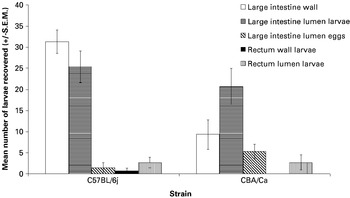
The main site of larval recovery at 6 h p.i. was the large intestine in both C57BL/6j and CBA/Ca mice and this comprised larvae recovered from the intestinal contents and larvae actively migrating through the large intestine (LI) wall. A relatively small number of unhatched eggs were also recovered from the contents of the large intestine of both strains. However, only larvae were recovered from the contents of the rectum, there being no unhatched eggs present (Fig. 1). The overall percentage of the total inoculum recovered from the large intestine/rectum was higher in C57BL/6j mice (12·3%) in contrast to CBA/Ca (7·6%) at this time-point and this difference was significant (Fig. 1; Rm ANOVA, main effect of mouse strain (between subject analysis) on worm burdens, F 1,10=8·3, P=0·016, model R 2adj=0·791). The locations within the gastrointestinal tract [Fig. 1, the large intestinal wall (larvae) or lumen (unhatched eggs and larvae) and the rectum wall (larvae) or lumen (larvae)] from which larvae were recovered was the most significant factor in determining larval burden, worm burdens varying markedly in both strains between locations (main effect of location (within-subject analysis) F 2·6,25·9=37·3, P⩽0·001). There was also a significant interaction between strain and location of larval recovery (F 2·6,25·9=8·25, P=0·001) which was attributable to the greater number of larvae recovered from the large intestinal and rectal walls of C57BL/6j mice.
Mean number of larvae and unhatched eggs recovered from the large intestine (LI) and rectum (6 h p.i.) of C57BL/6j and CBA/Ca mice.

A. suum migration in the liver of C57BL/6j and CBA/Ca mice from days 0 to 8 p.i
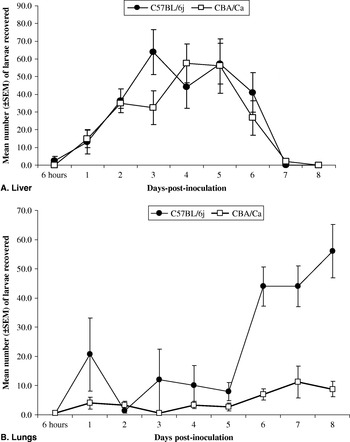
Larvae first appeared in the liver of C57BL/6j mice by 6 h p.i., however there were very few individuals recovered at this early stage (2·5±2·5). There was gradual accumulation in the early days of infection (1–2 days p.i.), building to a peak on days 3–5 p.i. Thereafter there was a steady decline in the liver in both strains thus showing a significant effect of day (Fig. 2A; 2-way ANOVA with day and strain as factors, model R 2adj=0·62, main effect of time, F 8,52=15·2, P⩽0·0001) and this coincided with the accumulation of larvae in the lungs (Fig. 2B). There was no significant difference in the number of larvae in the liver between the 2 strains during the infection period (main effect of strain F 1,52=0·9, P=N.S. and 2-way interaction strain∗time F 8,52=1·2, P=N.S.). The pattern of migration in the liver of both mouse strains was very similar.
Changes in worm burdens in the liver and lungs of mice, during the tissue migratory phase of infection with Ascaris suum following inoculation with 500 eggs. (A) Larval migration through the liver of the two strains of mice (C57BL/6j and CBA/Ca) on days 0–8. (B) Larval migration through the lungs of C57BL/6j and CBA/Ca mice on days 0–8.

A. suum migration in the lungs of C57BL/6j and CBA/Ca mice from days 0 to 8 p.i
The disparity in larval burdens between these 2 mouse strains was most evident on the latter days of infection in the lungs (Fig. 2B). As the numbers of larvae recovered from the liver (Fig. 2A) declined there was an increase in the numbers of larvae recovered in the lungs on days 6–8 p.i. (Fig. 2B). Larval burdens remained low until day 6 when the migration of greater numbers of juveniles into the lungs was expected. There was a significant change in the worm burden of the lungs associated with time (2-way ANOVA with day and strain as factors on lung worm burdens, model R 2adj=0·56, main effect of day, F 8,81=8·7, P⩽0·0001). In respect of pulmonary larval burden there was a marked difference between the strains in contrast to the larval burden in the hepatic tissue (Fig. 2B, main effect of strain F 1,81=42·4, P⩽0·0001 and 2-way interaction strain∗time, F 8,81=4·7, P⩽0·0001). The greatest difference in the mean number of larvae recovered between the 2 strains was observed in the lungs between days 6 and 8 p.i. Larvae numbers were greatest on day 8 in the pulmonary tissue of C57BL/6j mice, and not on day 7 as previously reported (Lewis et al. Reference Lewis, Behnke, Stafford and Holland2006), although an LSD post-hoc test showed that there was no significant difference between these 2 days in terms of larval burden.
The effect of hydrocortisone on the number of larvae recovered from the lungs of C57BL/6j and CBA/Ca mice
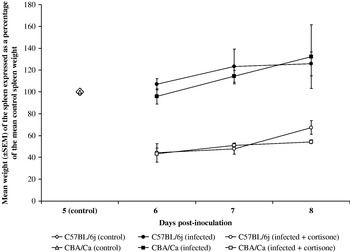
First the weight of spleens from the experimental mice was assessed in relation to the 3 treatment types (mice inoculated with both cortisone and A. suum, those only infected with A. suum and the uninfected age-matched control mice). There was a significant reduction in the weight of the spleen of both strains of mice when inoculated with both cortisone and A. suum on days 6–8 in contrast to the spleen weight of uninfected control mice (day 5) and A. suum-infected mice that did not receive cortisone (Fig. 3; initially 3-way ANOVA, with strain and treatment as factors and day as covariate, R 2adj=0·684, main effect of treatment, F 2,63=72·0, P⩽0·0001). Spleen weight was also influenced by the day post-inoculation (main effect of day, F 1,63=9·9, P=0·0026). There was no significant difference between the strains in spleen weight (full factorial model, main effect of strain F 1,63=0·17, P=N.S.).
Changes in spleen weight following infection with Ascaris suum and treatment with hydrocortisone. Mean spleen weights (±s.e.m.) on days 6, 7 and 8 are shown expressed as a percentage of the mean weight of the control mouse spleen weight (100%) on day 5 in C57BL/6j [◊] and CBA/Ca [△] mice. C57BL/6j mice inoculated with A. suum and placebo treated with water (●) and mice inoculated with A. suum and treated with hydrocortisone (○) are shown. For CBA/Ca mice, the corresponding groups were mice infected with A. suum (■) and those infected with A. suum and treated with hydrocortisone (□).

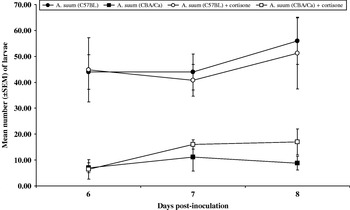
Movement of larvae into the lungs of fully intact infected mice followed the prescribed pattern with similar numbers of worms recovered to those in previous experiments (see above). The maximum larval burden of C57BL/6j mice was 56±9·1 (11·2% of the administered dose) and this was recorded on day 8. The burden on day 7 in CBA/Ca mice was 11·2±5·4 (2·2%). The percentage difference on day 7 p.i. between the 2 strains was 74·5% and this was within the range established in our earlier study and thus further substantiated the trend of inoculation dose/larval burden recovery in mice (Lewis et al. Reference Lewis, Behnke, Stafford and Holland2006). As expected, there were significant differences between the strains in relation to the larval burdens enumerated in the lungs (3-way ANOVA, with strain, treatment (those inoculated with hydrocortisone and those mice administered the saline placebo) and day as factors, full factorial model R 2adj=0·53, main effect of strain, F 1,45=67·0, P⩽0·0001). However, the administration of hydrocortisone did not influence worm burdens (Fig. 4; effect of treatment, F 1,45=0·04, P=N.S.) and all interactions involving treatment were not significant. Worm burdens in the lungs did not change significantly with time (main effect of day, F 2,45=1·08, P=N.S.). This indicated that there was no change in larval burden that was directly associated with the administration of hydrocortisone, although the lungs of hydrocortisone inoculated CBA/Ca mice showed slightly higher mean larval burdens on days 7 and 8 in contrast to their non-treated infected counterparts (Fig. 4). Equally, the disparity in worm burdens between the two strains was not altered by treatment with the steroid.
Mean number (±s.e.m.) of larvae recovered from the lungs of the two strains of mice on days 6, 7 and 8 post-inoculation. The larval burdens of mice inoculated with Ascaris suum and treated with placebo are shown in filled-in symbols and mice inoculated with A. suum and treated with hydrocortisone as open symbols.

Larval migration through the lungs of C57BL/6j and CBA/Ca mice on days 7 to 9 p.i
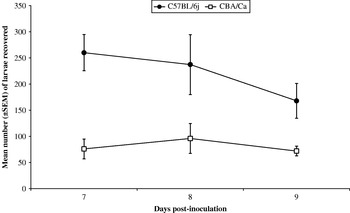
This group of mice were inoculated with 1500 A. suum eggs, a dose 3 times higher than the 500 ova in the preceding experiments. As previously, there was a highly significant difference between the 2 strains in larval burdens in the pulmonary tissues on the latter days of infection (Fig. 5; 2-way ANOVA with strain and day as factors, model R 2adj=0·60, main effect of strain F 1,12=26·0, P=0·0003) but no significant interaction between strain and day. Because this experiment was restricted to the later days of infection (i.e. days 7–9), and given the variation in recovery within the subgroups particularly on day 8, overall worm burdens did not vary significantly between days (main effect of day F 2,12=1·3, P=N.S.). Thus the difference between the strains was sustained across the 3 days of this experiment and, as can be seen numerically (mean worm burdens in Fig. 5) larval burdens were much higher in C57BL/6j mice throughout. Larvae peaked in the lungs of C57BL/6j mice on day 7 (260±34·6) and declined thereafter (Fig. 5). The pattern of migration in the lung of CBA/Ca mice was consistent with previous results (Lewis et al. Reference Lewis, Behnke, Stafford and Holland2006) except that the peak of the movement into this organ was on day 8 (96·0±34·6) and lower larval numbers were observed either side (Fig. 5).
Mean number (±s.e.m.) of larvae recovered from the lungs of both C57BL/6j and CBA/Ca mice inoculated with 1500 infective Ascaris suum eggs on days 7, 8 and 9 post-inoculation.

An estimated number of larvae that should be recovered after the administration of a dose of 1500 A. suum eggs on day 7 can be calculated from the dose-larval recovery graph (see Lewis et al. Reference Lewis, Behnke, Stafford and Holland2006). The larval burden in both strains in the current investigation confirmed these expected results and the percentage difference between the 2 strains was within the predicted range. C57BL/6j mice had a maximum average of 17·3% of the administered dose on day 7 p.i. The number of worms recovered from the lungs of CBA/Ca mice also lay within the predicted range of the administered dose recovered on day 7 p.i. (5·1%).
Changes in bronchoalveolar leukocytes during infection with A. suum
The lungs of both C57BL/6j and CBA/Ca strains inoculated with 1500 infective A. suum ova were assessed for changes in the classes of bronchoalveolar leukocytes present in the fluid aspirated from the lungs. Control mice provided the expected total numbers of leukocytes in uninfected individuals for comparative purposes. Differences between day age-matched controls and the other 3 post-mortem days (8–10), principally on the latter days of infection, highlighted the effect of A. suum migration on the bronchoalveolar leukocyte population (Table 1). Table 1 shows the total number of leukocytes recovered from each group (×105 ml−1) and also the percentage of each class present on those days. The leukocyte population of the uninfected mice is also shown on this table (age-matched control). The leukocyte count of uninfected C57BL/6j mice was approximately 1·21 (±0·390)×105 ml−1 and for CBA/Ca it was 1·40 (±0·684)×105 ml−1. The predominant cell type of uninfected control mice were macrophages, accounting for 80·5% and 75·2% of the nucleated cells in C57BL/6j and CBA/Ca mice, respectively (Table 1).
Mean total number of leukocytes (±s.e.m.) recovered from the bronchoalveolar fluid (BALF) of the two mouse strains on days 7 (control mice) 8, 9 and 10 and the percentage (±s.e.m.) of each differential leukocyte in the BALF of those groups
(Also included in parentheses is the total number of cells recovered for each cell type.)

During the infection period there was a greater increase in the total number of leukocytes of C57BL/6j mice (2-way ANOVA with strain and day as factors, model R 2adj=0·53, main effect of strain F 1,24=15·4, P=0·0006) and this appeared to be related to the magnitude of the worm burden. There was also a significant day effect which was demonstrated by increased immunological responses as the time of infection progressed (main effect of day F 2,24=8·6, P=0·0015). However, there was no difference in the magnitude of the response with time between the 2 mouse strains (2-way interaction strain∗day F 2,24=2·3, P=N.S.). The results of an LSD post-hoc analysis, which included the day 7 control group, confirmed that the immune response was slow to react to the presence of larvae. Thus, on day 7 total bronchoalveolar leukocytes (the control group) did not differ significantly from the total number recovered in the BAL fluid of mice on day 8 in both mouse strains. However, these 2 days were significantly different from both day 9 (day 7; P=0·0061 and day 8; P=0·0092) and day 10 (P⩽0·0001 for both days) in both strains.
Lymphocytes were the most abundant leukocyte cell type in both strains during early infection, composing nearly 50% or more of the population in both strains, in contrast to respective naïve control mice in which they accounted for approximately 10%. In C57BL/6j mice lymphocyte numbers increased dramatically during the observation period peaking on day 9 but remaining high on day 10. A proportional increase was observed in the percentage of lymphocytes produced with increasing total leukocytes between days 8 and 9 but this was reversed and reduced again on day 10 (Table 1). In contrast in CBA/Ca mice there was a delayed response in the accumulation of lymphocytes in the lungs. The total number of leukocytes remained low on day 8 but increased on day 10 (Table 1).
Neutrophil levels were low in control mice of both strains (⩽5%). Although the total number of neutrophils did increase in C57BL/6j mice this was not proportional to the total leukocyte production and overall there was a reduction in the percentage of these cells produced (Table 1). There was no noticeable difference between the days under investigation with regards to the production of neutrophils by CBA/Ca mice. Eosinophils accounted for less than 3% of the control mouse leukocyte population. They did not form an extensive proportion of the BAL cells during the early stages of infection but increased appreciably on the latter days, in particular in the susceptible strain. The percentage of total leukocytes accounted for by eosinophils increased daily in C57BL/6j mice and there was a 3-fold increase between day 8 and day 10. The response of CBA/Ca mice was less vigorous throughout the investigation. Proportionally this number was also lower than that of C57BL/6j; however, there was a similar 3-fold increase of these cells in CBA/Ca mice although they remained at a lower absolute level of concentration (Table 1). Basophil numbers were constantly lower than other leukocytes forming a miniscule proportion of the total number of leukocytes when contrasted to the other classes and never accounted for more than 0·2% of the population in C57BL/6j and 0·32% in CBA/Ca infected mice (Table 1).
The proportion of the population composed of macrophages was considerably higher in uninfected individuals in contrast to A. suum-infected mice, although the macrophage population was highly variable in all individuals on all days. The number of macrophages present in the BAL fluid of C57BL/6j increased during the period of observation, although proportionally this increase was negligible (Table 1). In contrast, the total number of macrophages increased markedly between the days 8 and 9 in CBA/Ca mice.
Histopathological examination of lung sections
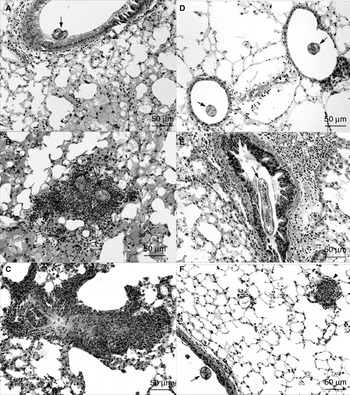
Semi-quantitative grading of pulmonary inflammation revealed increasingly severe inflammation in both mouse types over days 8, 9 and 10 p.i. with C57BL/6j having relatively more severe inflammation than CBA/Ca mice at each time-point (Fig. 6). In both mouse strains, cross-sections of helminth larvae were frequently noted in association with this inflammatory response within alveolar and bronchiolar lumens at all 3 time-points (Fig. 6). Inflammation in both mouse types consisted of multifocal infiltrates of neutrophils, eosinophils, macrophages and lymphocytes, particularly centred around bronchioles and blood vessels and within the walls of adjacent alveoli. In addition, intra-alveolar haemorrhage (Fig. 6), oedema, fibrin deposition and haemosiderophages were detected indicating previous and recent vascular injury. At days 9 and 10 p.i., larvae were noted within the lung parenchyma, surrounded by aggregates of neutrophils, eosinophils, macrophages, multinucleate macrophage giant cells and lymphocytes representing early granuloma formation (Fig. 6). However, larvae were not always detectable within granulomas. There was no observable difference in the number of granulomas formed in the pulmonary tissue of the 2 strains.
Photomicrographs of lung sections illustrating quantitative differences in inflammation between C57BL/6j (A, B, and C) and CBA/Ca mice (D, E and F) at days 8, 9 and 10 post-inoculation (p.i) with Ascaris suum larvae. (A and D) Greater intra-alveolar haemorrhage (indicated by asterisk *) and more severe peri-bronchiolar inflammation (grade ++ relative to grade +) in C57BL/6j relative to CBA/Ca mice at day 8 p.i. Transverse cross-sections of ascarid larvae are visible within bronchiolar lumens (arrows). (B and E) More severe pulmonary inflammation (grade +++ relative to grade ++) and intra-alveolar haemorrhage (indicated by asterisk *) associated with ascarid larvae (arrows) in C57BL/6j relative to CBA/Ca mice at day 9 p.i. (C and F) More severe pulmonary inflammation (grade +++ relative to grade ++) in C57BL/6j relative to CBA/Ca mice at day 10 p.i. A typical small focus of inflammation (arrowhead) and a larval cross-section (arrow) in a CBA/Ca mouse at this time-point are illustrated in (F). Haematoxylin and eosin stain.

DISCUSSION
The results of this study provide strong evidence that the period of migration between the liver and lungs is the stage at which onward larval migration is impeded in resistant mouse strains, and hence the point at which the phenotypic differences in response between strains originate. Larval numbers were significantly reduced in CBA/Ca mice in contrast to C57BL/6j mice during this phase of movement, suggesting some late hepatic/post-hepatic/early pulmonary factor that varies between the 2 strains preventing further migration. Analysis of the combined results relating to corticosteroid treatment, BAL fluid and histopathological examination suggest that the pulmonary inflammatory response is unlikely to be a major determinant of the contrasting host response phenotypes. Worm burdens already differed markedly in the lungs between the 2 strains before the BAL response was detectable, and when it occurred, it was the most susceptible strain (C57BL/6j) that exhibited the most intense response. Hence the intensity of the inflammation correlated with the magnitude of the worm burden and the induced pulmonary injury rather that with host resistance.
There are very few studies reporting on larval recovery of newly hatched larvae from the intestinal wall and this could be because efficient methods of recovery were lacking until recently (Slotved, Reference Slotved1997; Slotved et al. Reference Slotved, Eriksen, Murrell and Nansen1997). Slotved (Reference Slotved1997) compared 4 procedures for recovering larvae from the intestinal wall and found that simple incubation of the intestinal wall proved to be considerably more efficient than other methods (13·6% recovery at 4 h p.i.). This recovery method was chosen for the current investigation. At 6 h p.i. approximately 6% of the inoculum was recovered from the large intestinal wall. It was suggested that the majority of larvae capable of migrating had penetrated the intestinal mucosa at this stage and were beginning their onward migration. There were similar numbers of free larvae in the contents of the large intestine at this time-point (5%). The intestinal contents of CBA/Ca mice contained comparable numbers of free larvae but the number of actively migrating larvae was lower (2%). Although there were more larvae migrating through the wall of C57BL/6j mice at 6 h.p.i., this appeared to reflect a difference in the speed at which larvae and eggs were passed through the intestinal tract as the total number of larvae successfully migrating to the liver was comparable in the 2 strains. Very few larvae were recovered from the rectum, most probably because larvae are likely to be quickly expelled from this site (Slotved et al. Reference Slotved, Eriksen, Murrell and Nansen1998).
Larvae were observed in the liver as early as 6 h p.i. but at very low burdens. There was continuous movement into the liver between days 2 and 5, and worm burdens accumulated. The constant increase in larvae after 24 h when all larvae capable of migrating are expected to have successfully penetrated the intestinal wall indicates that larvae were arriving from other locations and perhaps had become temporarily lost or trapped in other host tissues. The overall pattern of migration and the larval burden in the livers of the 2 strains was very similar on all post-mortem days. The liver has been cited as an important site in the destruction of migrating larvae (Taffs, Reference Taffs1968; Mitchell et al. Reference Mitchell, Hogarth-Scott, Edwards, Lewers, Cousins and Moore1976; Johnstone et al. Reference Johnstone, Leventhal and Soulsby1978) rather than the previous suggestions of the GI tract (Bindseil, Reference Bindseil1970) and appears, at least in part, to play a defensive role. Migrating A. suum larvae caused an inflammatory reaction in the liver in experimental groups of pigs that was not observed in uninfected animals (Frontera et al. Reference Frontera, Roepstorff, Gázquez, Reina, Serrano and Navarrete2003). The importance of this stage of infection may be to prevent larvae developing further in preparation for the migration to the lungs. It was at this latter stage that a distinction in larval burdens was observed between the strains with higher rates of attrition at some point before arrival in the pulmonary tissue of CBA/Ca mice.
The initial larvae were recovered from the lungs as early as 6 h.p.i. and this was consistent with the observation of Slotved et al. (Reference Slotved, Eriksen, Murrell and Nansen1998). There was a noticeable increase in the number of larvae in the lungs of C57BL/6j mice on day 1 p.i. but there was considerable variation in the number of worms recovered from individual mice at this time, ranging from 0 to 64 larvae and this impacted on the average burden. These early arrivals in the lungs were worms that had probably by-passed the liver and migrated directly from the gut to the lungs, probably by the blood stream, but whether such worms can go on to develop further without undergoing a liver phase is not certain. The observation that pulmonary worm burdens fell almost immediately suggests that unlike later arrivals these early stages did not stay long, and perhaps migrated onwards to the liver before returning to the lungs subsequently or were expelled. Larval burdens remained low thereafter until day 6 when the migration of greater numbers of juveniles into the lungs was expected (Lewis et al. Reference Lewis, Behnke, Stafford and Holland2006).
A. suum larval tissue migration in pigs is known to stimulate an inflammatory response, involving tissue infiltration by neutrophils, mononuclear cells, eosinophils, and mast cells at the site of infection (Eriksen et al. Reference Eriksen, Andersen, Nielsen, Pedersen and Nielsen1980; Jungersen, Reference Jungersen, Holland and Kennedy2002). Hydrocortisone is known to be a powerful anti-inflammatory and immunosuppressive agent. The reduction in the spleen weight of cortisone-inoculated mice would suggest that this treatment was indeed immunosuppressive. The conclusion from this experiment and that monitoring the intensity of the concomitant leukocyte population in the BAL fluid of mice infected with A. suum suggested that the pulmonary inflammatory immune response was not prominently involved in the protection of mice against A. suum infection. C57BL/6j mice, with heavier burdens, responded more intensely, but this was a response to damage rather than a protective response. This was further supported by the histopathological examination of the pulmonary tissue in which a greater inflammatory response was observed in the tissues of C57BL/6j mice. The failure of the pulmonary inflammatory response to provide protection against migrating larvae suggests that the success of larvae is primarily determined in the hepatic/post-hepatic stage prior to their arrival in the lungs. If the difference between the 2 strains had been dependent primarily on an inflammatory reaction in the lungs then the administration of hydrocortisone should have reduced the level of resistance of CBA/Ca mice. This proved not to be the case. Clearly then, the lung burdens in C57BL/6j mice represent the maximum possible number of juveniles that can migrate through the host's tissues, following infection with a standard dose of eggs, and in other strains the lower pulmonary worm burdens reflect some resistance at an earlier point on the migration route. While it is likely that the lungs are a site of further larval entrapment prior to their migration to the intestine as illustrated by pulmonary granuloma formation around larvae, no differences were detected in the number of such granulomas between the 2 mouse strains. However, the pulmonary inflammation was quantitatively greater in the C57BL/6j relative to the CBA/Ca mice.
In both strains, BAL showed that the inflammatory response was slow to appear, and the leukocyte numbers were not significantly different between day 7 controls and day 8 infected mice. However, there was a marked inflammatory response after this day. These observations correspond to those of Eriksen (Reference Eriksen1981) who described the first signs of pulmonary inflammation in histological sections on day 8 but this became more intense on day 10. The level of response to parasitic invasion or tissue damage caused by the migrating larvae appeared to be strain specific. Wilkinson et al. (Reference Wilkinson, Wells and Behnke1990) noted that the passage of the larval stages of Necator americanus through the lungs of BALB/c mice was associated with marked changes in the leukocyte population of the organ. However, during primary infection this response occurred after the majority of the larvae had left the lungs and therefore was unlikely to have a significant protective role. This corresponds to the observations of the present study.
Intra-alveolar haemorrhage, fibrin deposition and oedema were more severe in the susceptible C57BL/6j mice indicating greater vascular damage by larvae migrating into alveoli in this strain. This would support the presence of more larvae in the lungs of these mice that were capable of onward migration. These protein-rich exudates that accompany larval migration have implications in relation to secondary pulmonary infection in that they favour opportunistic bacterial proliferation. Tjørnehøj et al. (Reference Tjørnehøj, Eriksen, Aalbæk and Nansen1992) demonstrated that on days 8–12, following inoculation with A. suum, mice were more susceptible to pneumonia and septicaemia following aerosol Pasteurella multocida infection.
The period of migration from the liver into the lungs then appears to be the most important period determining the relative resistance/susceptibility of the 2 mouse strains. Mitchell et al. (Reference Mitchell, Hogarth-Scott, Edwards, Lewers, Cousins and Moore1976) originally found that resistance either to second infection in susceptible C57BL/6 mice or in relatively resistant strains of mice was not determined by the site of penetration in the intestinal wall or migration to the liver but instead during the period of residency in the liver or en route to the lungs, and our data concur. During this period CBA/Ca mice showed a reduction in the number of larvae that successfully migrate into the lungs whereas in C57BL/6j mice larval burdens remained relatively high, and showed little change between the liver and the lung phases. We can suggest 3 possible mechanisms for this observed variation (i) anatomical differences between the strains which impede migration to the lungs (ii) differences in resistance mechanisms that either incapacitate the larvae late during the liver stage or block entry to the lungs and (iii) tropic differences between the strains which impede migration to the lungs. The latter is likely to be dependent on host cues that are exploited by the parasite to guide their homing to the pulmonary tissues, and it may be that the relevant signals vary between mouse strains. Finally it is possible that on arriving in the lungs more larvae fail to establish in resistant mice, or are actively expelled by a host response, possibly through the bronchial airways and mediated by coughing. However, we feel that such an explanation can be discounted because treatment with hydrocortisone did not reduce resistance in CBA/Ca mice in the current investigation, and this together with Mitchell's finding that T-cell deprived CBA mice were not more susceptible to infection supports the hypothesis that the host response phenotype of mice to infection with A. suum is not primarily determined by differences in the adaptive immune system between mouse strains, but rather by a component/s of innate resistance.
We thank the Irish Research Council for Science Engineering and Technology and the EMBARK initiative for funding the research, and Professor Lis Eriksen in the Royal Veterinary College in Denmark for provision of A. suum infective eggs and her help and support. We would like to thank Dr Paul Voorheis and Dr Derek Nolan, of the Biochemistry Department (TCD) for their technical assistance and the use of their laboratories. We would also like to thank Alison Boyce and Clare Hamilton in Trinity College and the staff in the veterinary pathology department in UCD for their hard work in the laboratory and Sheila Worrell and Brian Cloak in UCD for their advice and assistance.
We would like to dedicate this paper to the memory of Professor Lis Eriksen, a pioneer in Ascaris suum research in general and Ascaris in mice in particular. She was a friend and colleague and will be sadly missed.