No doubt since humans first began to read, there have been those who struggled with the printed word. The seeming ease with which most children learn to read contrasts sharply with the travails of a surprisingly large subgroup of children as they try to extract meaning from print. How we read and why some very bright children and adults struggle to read has intrigued and challenged generations of investigators. More recently, particularly with the advent of the powerful tools of modern neuroscience, the very act of reading has become visible. The ability to image reading (and dyslexia) has provided a neurobiological framework within which to incorporate advances in cognitive psychology, developmental psychology, linguistics, neurology, genetics, epidemiology, and education to provide an increasingly specified and fine-grained account of reading and dyslexia. The perspectives gained from such a multilevel integration, particularly emerging insights into the role of attentional processes in deciphering the code, suggest new avenues of scientific exploration and perhaps newer therapeutic targets and strategies to improving reading. We first consider how children learn to read and why reading is much more difficult than speaking.
How We Read
Although print emerged from, and maintains its roots in, the language system, the differences between written and spoken language provide an account of why reading is difficult and speaking is easy. This relationship between spoken and written language is perhaps best captured by the statement, “Writing is not language, but merely a way of recording [spoken] language by visible marks” (Bloomfield, Reference Bloomfield1933, p. 21). A number of theories of dyslexia have been proposed, including phonological theory (Liberman, Shankweiler, & Liberman, Reference Liberman, Shankweiler, Liberman, Shankweiler and Liberman1989; Ramus et al., Reference Ramus, Rosen, Dakin, Day, Castellote and White2003), rapid auditory processing theory (Tallal, Reference Tallal1980, Reference Tallal2000; Tallal, Miller, & Fitch, Reference Tallal, Miller and Fitch1993), visual theory (Livingstone, Rosen, Drislane, & Galaburda, Reference Livingstone, Rosen, Drislane and Galaburda1991; Lovegrove, Bowling, Badcock, & Blackwood, Reference Lovegrove, Bowling, Badcock and Blackwood1980), cerebellar theory (Nicolson & Fawcett, Reference Nicolson and Fawcett1990; Nicolson, Fawcett, & Dean, Reference Nicolson, Fawcett and Dean2001), and magnocellular theory (Galaburda, Menard, & Rosen, Reference Galaburda, Menard and Rosen1994; Livingstone et al., Reference Livingstone, Rosen, Drislane and Galaburda1991; Stein, Reference Stein2003; Stein & Walsh, Reference Stein and Walsh1997). Ramus et al. (Reference Ramus, Rosen, Dakin, Day, Castellote and White2003) provide a review and critique of the various theories. Of the several theories suggested, an explanation reflecting what is known about the relationship between spoken and written language, the phonological model, has received the most support (Hulme, Snowling, Caravolas, & Carroll, Reference Hulme, Snowling, Caravolas and Carroll2005; Ramus et al., Reference Ramus, Rosen, Dakin, Day, Castellote and White2003; Rayner, Foorman, Perfetti, Pesetsky, & Seidenberg, Reference Rayner, Foorman, Perfetti, Pesetsky and Seidenberg2001; Shaywitz, Reference Shaywitz2003; Snowling, Reference Snowling2000).
To understand why print has meaning and why reading presents a challenge, we consider first the language system, and then why reading is more difficult than speaking. The language system is conceptualized as a hierarchy of component modules (Fodor, Reference Fodor1983); at the lowest level is the phonological module, dedicated to processing the elemental units of language, phonemes. The phonological module assembles the phonemes into words for the speaker and disassembles the words back into phonemes for the listener. Reflecting a process referred to as coarticulation, spoken language appears seamless to the listener, with no clues to its segmental nature (Liberman, Cooper, Shankweiler, & Studdert-Kennedy, Reference Liberman, Cooper, Shankweiler and Studdert-Kennedy1967). Thus, the word “mat” comprises three phonemes “m” “aaaa” “t” but the listener hears this as the holistic word “mat,” not as three separate sounds. It is the seamless nature of spoken language, giving no clue to its underlying segmental nature, that presents an early challenge to the would-be reader.
Spoken language is observed in all societies on earth, and has been with us for hundreds of thousands of years. Exposing a baby to a natural speaking environment results in the development of spoken language; spoken language does not need to be specifically taught, and may even be innate. In contrast, print is artificial; many societies still rely primarily on spoken language and from an evolutionary perspective, reading is rather new, only several thousand years old (Lawler, Reference Lawler2001). Consequently, in contrast to spoken language, written language is acquired and must be taught. Learning to read requires multiple skills including developing an awareness that spoken language can be segmented into smaller elements (i.e., phonemes), identifying letters, learning the rules of how print maps onto sound, recognizing whole words not only accurately but also rapidly (automatically), acquiring a vocabulary, and extracting meaning from the printed word(s).
In the process of learning to read, a critical and, for some children, forbidding step is recoding the letters (orthography) into their sounds (phonology). It is not surprising that this process has been the focus of intense study. Over three decades ago researchers proposed two routes for transforming print into speech (Forster & Chambers, Reference Forster and Chambers1973; Marshall & Newcombe, Reference Marshall and Newcombe1973): a so-called lexical or more direct route and a sublexical or rule-based pathway. This dual route model of reading print aloud has been further elaborated, mainly through the work of Coltheart and colleagues (Coltheart, Reference Coltheart and Underwood1978, Reference Coltheart, Posner and Marin1985; Coltheart, Curtis, Atkins, & Haller, Reference Coltheart, Curtis, Atkins and Haller1993; Coltheart & Rastle, Reference Coltheart and Rastle1994; Harris & Coltheart, Reference Harris and Coltheart1986); more recently, a computational model of this process referred to as the dual route cascaded model has been proposed (Coltheart, Rastle, Perry, Langdon, & Ziegler, Reference Coltheart, Rastle, Perry, Langdon and Ziegler2001; see also Coltheart et al., Reference Coltheart, Curtis, Atkins and Haller1993; Rastle & Coltheart Reference Rastle and Coltheart1998, Reference Rastle and Coltheart1999a, Reference Rastle and Coltheart1999b). The lexical route relies on the mental (orthographic) lexicon where representations of printed words are stored; a reader sees a printed word, looks it up in his mental lexicon, activating representations in the phonological lexicon (referred to as addressed phonology) and reads the word aloud. In contrast, the sublexical route relies on the serial mapping, left to right, of each letter in a letter string to its corresponding sound (referred to as assembled phonology); once the letters are mapped, the word is read aloud. Given the vagaries of the English language, some words, for example, irregular words such as though and shoulder and yacht cannot be sounded out (their spellings do not follow the rules) and must be identified more holistically through the lexical route. In contrast, pseudowords that follow the rules but are made up and have never been seen by the reader previously are not present in the reader's lexicon and must be sounded out through the sublexical route, for example, scrower or thracting. Thus, within a dual route model, the critical process of phonological recoding (translating letters to sound) can occur via two different mechanisms: one, a lexical mechanism that addresses the phonological code directly from the stored lexical representations and the other, a sublexical mechanism that assembles the phonological code serially, letter-by-letter. As will be discussed below, these mechanisms may be represented in brain by separate, although obviously interrelated, left hemisphere neural systems, addressed phonology by a more ventral system and assembled phonology by a more dorsal system.
Beginning reading instruction focuses on teaching children the rules for mapping the orthography (letters) onto the elemental sounds of spoken language (phonemes). From a developmental perspective, children initially learn to read words by mapping letters to sounds, and eventually, it is thought, after reading and rereading a word correctly, the child can read the word not only accurately but also fluently (and, it is inferred, automatically). Fluent reading refers to the ability to read text not only accurately but also rapidly and with proper expression (National Reading Panel, 2000). As experience with reading instruction accumulates, it is increasingly clear that, although teaching children how the alphabetic system works achieves accurate reading, large numbers of children remain unable to read fluently (Lovett, Ransby, Hardwick, Johns, & Donaldson, Reference Lovett, Ransby, Hardwick, Johns and Donaldson1989; Shaywitz, Reference Shaywitz2003; Shaywitz, Morris, & Shaywitz, Reference Shaywitz, Morris and Shaywitz2008; Torgesen, Wagner, & Rashotte, Reference Torgesen, Wagner and Rashotte1997). The increasing appreciation of the importance and elusiveness of fluent reading, particularly its disruption in dyslexic readers, is evident in the most recent definition of dyslexia (discussed below). Although the previous definition refers to “single-word decoding” (Lyon, Reference Lyon1995), the newer, updated definition describes “difficulties with accurate and/or fluent word recognition,” acknowledging converging data indicating the failure of the development of fluent reading as a hallmark of dyslexia that persists into adolescence and then adulthood, even when accuracy improves. The lack of fluent reading is observed clinically by reading that is effortful and slow; it is often considered the sine qua non of dyslexia, especially in young adult and adult readers (Bruck, Reference Bruck, Hulme and Joshi1998; Lefly & Pennington, Reference Lefly and Pennington1991; Shaywitz, Reference Shaywitz2003).
Reading and Attention
An assumption underlying the generation of phonological codes from print is that these processes are automatic and do not require much, if any, attentional resources (Gronau & Frost, Reference Gronau and Frost1997; Johnston & Castles, Reference Johnston, Castles, Kinoshita and Lupker2003; Lukatela & Turvey, Reference Lukatela and Turvey1994a, Reference Lukatela and Turvey1994b; Luo, Johnson, & Gallo, Reference Luo, Johnson and Gallo1998; Perfetti, Bell, & Delaney, Reference Perfetti, Bell and Delaney1988; Xu & Perfetti, Reference Xu and Perfetti1999). Recent evidence, however, questions this assumption, that is, the seemingly dogmatic belief that reading processes require only phonological mechanisms. For example, Reynolds and Besner (Reference Reynolds and Besner2006) suggest that attention is a critical, overlooked component, integral for translating print into speech, necessary for achieving fluent reading. Further evidence that attentional processes may be critical in reading comes from studies emphasizing the comorbidity of dyslexia and attention-deficit/hyperactivity disorder (ADHD), disorders that clinically are frequently observed in the same individual (August & Garfinkel, Reference August and Garfinkel1990; Dykman & Ackerman, Reference Dykman and Ackerman1991; Shaywitz, Fletcher, & Shaywitz, Reference Shaywitz, Fletcher and Shaywitz1994; Willcutt & Pennington, Reference Willcutt and Pennington2000). Below we review the theoretical studies that provide further support for the proposal that attentional mechanisms may play an important role in reading, particularly in the development of fluent, automatic reading.
An automatic process is often viewed as synonymous with a process not requiring effort or attention. Within such a conceptualization, skilled or fluent reading is considered to be automatic and not dependent on attentional mechanisms. The development of automaticity or skill has long been linked to practice, based on the notion that “repetition progressively frees the mind from attention to details, makes facile the total act, shortens the time, and reduces the extent to which consciousness must concern itself with the process” (Huey, Reference Huey1908, p. 104). In their influential paper, LaBerge and Samuels (Reference LaBerge and Samuels1974) presented a theory of automatic information processing in reading, emphasizing word identification in which the reader progresses through a series of stages in which he learns each subskill component for reading, beginning with an attention demanding the slow process of learning to read a word accurately and progressing to an automatic process where the word is now read fluently and automatically. Accordingly, these researchers proposed two distinct criteria of achievement: accuracy and automaticity (fluency). Of interest, they also emphasize the importance of dependency on attention in determining readiness to advance to the next skill. For example, they indicate accuracy in reading a letter or word alone is insufficient as a criterion for determining readiness for the next step and suggest that the “amount of attention required” be used as part of the criterion for readiness (LaBerge & Samuels, Reference LaBerge and Samuels1974, p. 319). They posit that once lower level subskills are automatized, attention would then be freed and could be allocated for higher level functions such as semantics and text comprehension.
Since the publication of LaBerge and Samuels' (1974) theory, investigators have sought to describe the characteristics of what is meant by automaticity, and more recently, proceeded to examine the mechanisms underlying automaticity and their relationship to attention and other cognitive processes (Logan, Reference Logan1988a, Reference Logan, Hockley and Lewandowsky1991; Logan & Etherton, Reference Logan and Etherton1998; Logan, Taylor, & Etherton, Reference Logan, Taylor and Etherton1996, Reference Logan, Taylor and Etherton1999). Although rooted in LaBerge and Samuel's general theory of automaticity, Logan and colleagues conceptualize a somewhat broader view of automaticity and reading.
Logan summarizes the perceived properties of automatic processes as fast, effortless, autonomous (not reliant on intention), and unconscious (Logan, Reference Logan1997). Rather than an all or none phenomenon, automatic processes may possess several, but not all of these properties, and possess each in different degrees. In this view, automaticity is a continuum, with more properties developing and developing in greater degrees through practice.
Logan proposes the “instance theory” to conceptualize learning (to read); within this framework, the mechanism is memory, more specifically, episodic memory, with attention featured prominently (Logan, Reference Logan1988a, Reference Logan1988b, Reference Logan1990, Reference Logan1992, Reference Logan2002). Instance theory offers three assumptions: obligatory encoding, obligatory retrieval, and instance representation (Logan, Reference Logan1988a, Reference Logan1988b, Reference Logan1990). In the instance theory, attention is critical to obligatory encoding and to obligatory retrieval. Attention to an object is “sufficient to cause it to be encoded into memory,” whereas attention to an object is “sufficient to cause things associated with it in the past to be retrieved (Logan, Reference Logan1997, p. 128).
According to instance theory, with practice, the number of memory traces or representations increases, resulting in increasingly greater ease in retrieval of such instances. It is the change in memory retrieval that is reflected in automatization of the response. Logan contrasts the fast and effortless retrieval characterizing automatic performance with the slow, effortful novice performance necessary when first learning a task. With automaticity there is no longer a dependence on solving the problem; rather, algorithmic multistep performance is shifted to a holistic, rapid retrieval of the memory trace or “instance” of the solution. Thus, the critical requirement for automaticity is for the reader to encode the relevant items in memory and to retrieve them on a subsequent encounter, and for both encoding and retrieval, attention is central.
As discussed, in considering the relation between phonological recoding and attention, a prevalent view holds the generation of the phonological code from print to be modular, which is automatic and not attention demanding, and does not require any other cognitive process. Recent evidence presents a competing view, suggesting that attention is necessary for the computation of phonology resulting in reading the word aloud. The results of a series of experiments designed to test the claim that phonological codes are generated automatically from print led Reynolds and Besner (Reference Reynolds and Besner2006) to conclude that mechanisms characterizing the lexical and sublexical components of the dual route addressed phonological recoding and assembled phonological recoding, respectively, rely on and require attention.
The demonstration of the critical role of attention in phonological recoding processes now mandate a closer examination of attention itself and its role in reading as well as an investigation of the possibility that it is the lack or deficiency of attention that plays a causal role in reading difficulties. Much of the focus of recent pedagogy in teaching reading and remediating reading difficulties has centered on teaching children how letters map to sounds. These newer data now suggest that in addition it may be useful to consider the role of attentional mechanisms in support of reading and their disruption as a factor in reading difficulties and also, to begin to consider potential approaches to improving attention in struggling readers. In the remainder of this paper we discuss reading and attention from the perspective of potential neurobiological commonalities that may lead to a deeper understanding of their relationship and the possible impact of one on the other in normal development and in developmental dyslexia.
Definition and Epidemiology
Prior to discussing newer developments in the neurobiology of reading and dyslexia (here, developmental dyslexia and dyslexia are used interchangeably), basic parameters of the reading disorder, including its definition and epidemiology will be briefly reviewed. Developmental dyslexia reflects an unexpected difficulty in reading in children and adults who appear to have all the factors present (intelligence, motivation, exposure to reasonable reading instruction) that are necessary to turn print into meaning (Shaywitz, Reference Shaywitz1996, Reference Shaywitz2003). That is to say, in dyslexic individuals, their reading, especially reading fluency, is below that expected for a person of their level of education, intelligence, or professional status. This notion of an “unexpected” difficulty in reading was reflected in the first report of developmental dyslexia appearing in the literature. The report, titled “A Case of Congenital Word Blindness,” recorded the observations of a British physician, W. Pringle Morgan, of his patient Percy F., age 14 years, in the British Medical Journal:
He has always been a bright and intelligent boy, quick at games, and in no way inferior to others his age. His great difficulty has been—and is now—his inability to read. He has been at school or under tutors since he was 7 years old, and the greatest efforts have been made to teach him to read, but, in spite of this laborious and persistent training, he can only with difficulty spell out words of one syllable …
I might add that the boy is bright and of average intelligence in conversation. His eyes are normal … and his eyesight is good. The schoolmaster who has taught him for some years says that he would be the smartest lad in the school if the instruction were entirely in oral … (Morgan, Reference Morgan1896, p. 1378)
In 2008 Percy would be diagnosed with developmental dyslexia. Since Morgan's first description over a century ago, the notion of dyslexia as an unexpected difficulty in reading has endured as parents, educators, clinicians, and investigators continue to become aware, both of the large numbers of individuals affected by the disorder, and also learn more about the basic mechanisms underlying it.
Reflecting accumulating empiric data, a working group provided the following updated definition of developmental dyslexia:
Dyslexia is a specific learning disability that is neurobiological in origin. It is characterized by difficulties with accurate and/or fluent word recognition and poor spelling and decoding abilities. These difficulties typically result from a deficit in the phonological component of language that is often unexpected in relation to other cognitive abilities and the provision of effective classroom instruction … (Lyon, Shaywitz, & Shaywitz, Reference Lyon, Shaywitz and Shaywitz2003, p. 2)
Dyslexia (also referred to as specific reading disability) is a member of the family of learning disabilities; in fact, reading disability is by far the most common learning disability, affecting over 80% of those identified as learning disabled (Lerner, Reference Lerner1989).
As with other entities, the specific prevalence rate for dyslexia will reflect the particular definition and cut points established as criteria for identification. Data emanating from multiple sources indicate that for large segments of the population, reading remains effortful and skilled reading elusive. For example, results of the 2005 National Assessment of Educational Progress indicate 27% of high school seniors are reading below the most basic levels (minimum level at which a student can demonstrate an understanding of what s/he has read; Grigg, Donahue, & Dion, Reference Grigg, Donahue and Dion2007) and 36% of fourth-grade children are reading below basic levels (Perie, Grigg, & Donahue, Reference Perie, Grigg and Donahue2005). In the Connecticut Longitudinal Study (CLS) sample survey in which each participant was individually assessed, 17.5% of students were reading below age or ability levels (Shaywitz et al., Reference Shaywitz, Fletcher and Shaywitz1994). The CLS population has been followed continuously since 1983, with yearly individual assessments of cognitive, academic, behavioral, social, and more recently, neurobiological characteristics. Accordingly, these longitudinal data permit examination of issues relating to the developmental course of reading difficulties. These data indicate the persistence and chronicity of reading problems, refuting the notion, long and tightly held, that reading difficulties are outgrown or somehow reflect a developmental lag (Francis, Shaywitz, Stuebing, Shaywitz, & Fletcher, Reference Francis, Shaywitz, Stuebing, Shaywitz and Fletcher1996; Shaywitz et al., Reference Shaywitz, Holford, Holahan, Fletcher, Stuebing and Francis1995). Although persistent, it is important to keep in mind that the expression of the reading difficulty may change with time, so that difficulties with reading accuracy, especially in very bright children, often evolve into relatively accurate, but not fluent, reading.
Functional Magnetic Resonance Imaging (fMRI) in Studies of Reading and Dyslexia
General considerations
These advances in understanding the cognitive basis of dyslexia have largely informed and facilitated studies examining the neurobiological underpinnings of reading and dyslexia. The most consistent and replicable data on the location of the neural systems for reading and how they differ in dyslexic readers has come from studies using fMRI. Other functional brain imaging modalities have also been used to study dyslexia (e.g., electrophysiologic methods such as event-related potentials and magnetoencephalography are particularly suited for examining the chronometry or time course of the reading process). fMRI is noninvasive and safe and can be used repeatedly, properties that make it ideal for studying humans, especially children. The signal used to construct MRI images derives from the determination of the blood oxygen level dependent (BOLD) response; the increase in BOLD signal in regions that are activated by a stimulus or task results from the combined effects of increases in the tissue blood flow, volume, and oxygenation, and in cognitive tasks the changes are typically in the order of 1–5%. Details of fMRI are reviewed by Anderson and Gore (Reference Anderson, Gore, Lewis and Peterson1997), Frackowiak et al. (Reference Frackowiak, Friston, Frith, Dolan, Price and Zeki2004), and Jezzard, Matthews, and Smith (Reference Jezzard, Matthews and Smith2001).
Neural systems for reading
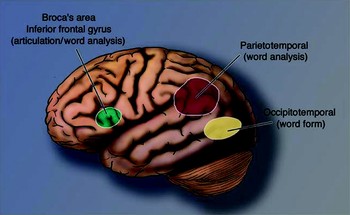
Data from laboratories around the world indicate that there are a number of interrelated neural systems used in reading, at least two in posterior brain regions as well as distinct and related systems in anterior regions. We refer to “systems” rather than “regions” because each of the areas of the brain (e.g., occipitotemporal) related to reading generally encompasses more than a single brain region (Figure 1).
Neural systems for reading. Three neural systems for reading are illustrated for the surface of the left hemisphere: an anterior system in the region of the inferior frontal gyrus (Broca's area), which is believed to serve articulation and word analysis, and two posterior systems, one in the parietotemporal region, which is believed to serve word analysis, and a second in the occipitotemporal region (the word-form area), which is believed to serve for the rapid, automatic, fluent identification of words. Adapted from Overcoming dyslexia: A new and complete science-based program for reading problems at any level, by S. Shaywitz, Reference Shaywitz2003. New York: Alfred A. Knopf. Copyright 2003 by S. Shaywitz. Adapted with permission.

These systems have been documented by many laboratories using brain imaging studies (e.g., Brambati et al., Reference Brambati, Termine, Ruffino, Danna, Lanzi and Stella2006; Fiebach, Friederici, Muller, & Cramon, Reference Fiebach, Friederici, Muller and Cramon2002; Gaillard, Balsamo, Ibrahim, Sachs, & Xu, Reference Gaillard, Balsamo, Ibrahim, Sachs and Xu2003; Helenius, Tarkiainen, Cornelissen, Hansen, & Salmelin, Reference Helenius, Tarkiainen, Cornelissen, Hansen and Salmelin1999; Horwitz, Rumsey, & Donohue, Reference Horwitz, Rumsey and Donohue1998; Kronbichler et al., Reference Kronbichler, Hutzler, Staffen, Mair, Ladurner and Wimmer2006; Nakamura, Dehaene, Jobert, Le Bihan, & Kouider, in press; Nakamura et al., Reference Nakamura, Hara, Kouider, Takayama, Hanajima and Sakai2006; Paulesu et al., Reference Paulesu, Demonet, Fazio, McCrory, Chanoine and Brunswick2001; Rumsey et al., Reference Rumsey, Andreason, Zametkin, Aquino, King and Hamburber1992; Salmelin, Service, Kiesila, Uutela, & Salonen, Reference Salmelin, Service, Kiesila, Uutela and Salonen1996; Seki et al., Reference Seki, Koeda, Sugihara, Kamba, Hirata and Ogawa2001; Shaywitz et al., Reference Shaywitz, Shaywitz, Pugh, Fulbright, Constable and Mencl1998, Reference Shaywitz, Shaywitz, Pugh, Mencl, Fulbright and Skudlarski2002b, Reference Shaywitz, Shaywitz, Fulbright, Skudlarski, Mencl and Constable2003; Temple et al., Reference Temple, Poldrack, Protopapas, Nagarajan, Salz and Tallal2000, Reference Temple, Poldrack, Salidis, Deutsch, Tallal and Merzenich2001; Xu et al., Reference Xu, Grafman, Gaillard, Ishii, Vega-Bermudez and Pietrini2001). As early as Reference Dejerine1891, Dejerine suggested that a portion of the posterior brain (which includes the angular gyrus and supramarginal gyrus in the inferior parietal lobule, and the posterior aspect of the superior temporal gyrus) is critical for reading. Since that time, a large literature on acquired inability to read (acquired alexia) describes neuroanatomic lesions in the parietotemporal system as pivotal in mapping the visual percept of the print onto the phonologic structures of the language system (Damasio & Damasio, Reference Damasio and Damasio1983; Friedman, Ween, & Albert, Reference Friedman, Ween, Albert, Heilman and Valenstein1993; Geschwind, Reference Geschwind1965). Many recent brain imaging studies in patients with developmental dyslexia (see below) have documented the importance of the parietotemporal system in reading, properties involving word analysis, operating on individual units of words (e.g., phonemes). In our figure we refer to the parietotemporal system that encompasses portions of the supramarginal gyrus in the inferior parietal lobule, portions of the posterior aspect of the superior temporal gyrus, and in some studies may even encompass portions of the angular gyrus in the parietal lobe.
A second posterior reading system of particular importance for skilled, fluent reading was first reported by Dejerine in Reference Dejerine1892 in association with acquired alexia; since that time acquired alexia resulting from disruption of this system has been demonstrated repeatedly, usually as a result of posterior cerebral artery thrombosis (Binder & Mohr, Reference Binder and Mohr1992; Leff, Spitsyna, Plant, & Wise, Reference Leff, Spitsyna, Plant and Wise2006). More recent studies indicate that this second posterior system is localized in the occipitotemporal area, which Cohen and Dehaene have termed the visual word-form area (VWFA; Cohen et al., Reference Cohen, Dehaene, Naccache, Lehericy, Dehaene-Lambertz and Henaff2000; Dehaene, Cohen, Sigman, & Vinckier, Reference Dehaene, Cohen, Sigman and Vinckier2005; Dehaene et al., Reference Dehaene, Naccache, Cohen, Le Bihan, Mangin and Poline2001; McCandliss, Cohen, & Dehaene, Reference McCandliss, Cohen and Dehaene2003; Vinckier et al., Reference Vinckier, Dehaene, Jobert, Dubus, Sigman and Cohen2007). A recent report (Gaillard et al., Reference Gaillard, Naccache, Pinel, Clemenceau, Volle and Hasboun2006) provides more convincing cause and effect evidence of the critical role of the VWFA in fluent reading. In this case, a 46-year-old right-handed man developed alexia after resection of a large portion of the posterior brain involving the left inferior occipital/temporal and the fusiform gyri. Following surgery, reading was slow and inaccurate though other cognitive skills (e.g., object naming, face recognition, language, and writing to dictation) remained normal. Brain activation in the left occipitotemporal system in response to words was normal prior to surgery but was not apparent following resection of the VWFA.
Just how the VWFA functions to integrate phonology (sounds) and orthography (print) is as yet unknown. Some have questioned whether the behavioral effects of lesions of the VWFA are limited to letters and words or if damage to this region results in a more general visual processing deficit (Price & Devlin, Reference Price and Devlin2003, Reference Price and Devlin2004). Starrfelt and Gerlach (Reference Starrfelt and Gerlach2007) find that although activation of the VWFA is greater during word than during picture processing, these differences are attenuated when the picture processing tasks require more elaborate processing. Such findings suggest that activation of the VWFA may not be specific for words “ … but rather reflects an operation common to word and picture processing that may be differentially affected by task demands.” Xue Chen, Jin, and Dong (Reference Xue, Chen, Jin and Dong2006) devised an artificial language and explored the role of the VWFA to acquisition of reading. Their results “ … suggest that visual familiarity, phonological processing, and semantic processing all make significant but different contributions to shaping the fusiform activation.”
Debate continues as to whether visual word recognition takes place serially, in a progressive, step-by-step approach (Dehaene et al., Reference Dehaene, Cohen, Sigman and Vinckier2005) or conversely, if the left anterior lateral occipitotemporal system functions as an interface between bottom-up visual form information and top-down semantic and phonologic properties in a more dynamic integrative process (McCrory, Mechelli, Frith, & Price, Reference McCrory, Mechelli, Frith and Price2005; Price & Devlin, Reference Price and Devlin2003). Studies using functional imaging combined with sophisticated task presentations may help to resolve this question (Devlin, Jamison, Gonnerman, & Matthews, Reference Devlin, Jamison, Gonnerman and Matthews2006). Patients with alexia compensate for the damage to their VWFA by perceptual tuning of intact right hemisphere homologs in the symmetrical R-VWFA (Cohen et al., Reference Cohen, Martinaud, Lemer, Lehericy, Samson and Obadia2003, Reference Cohen, Lehericy, Henry, Bourgeois, Larroque and Sainte-Rose2004; Henry et al., Reference Henry, Gaillard, Volle, Chiras, Ferrieux and Dehaene2005). Cognitively this reliance on intact neural systems results in the use of both bottom-up and top-down information to decode words. In the case of acquired alexia with damage to the VWFA, alexic patients rely more heavily on intact top-down (semantically based) information in reading (Johnson & Rayner, Reference Johnson and Rayner2007).
Another reading-related neural circuit involves an anterior system in the inferior frontal gyrus (Broca's area), a system that has long been associated with articulation and also serves an important function in silent reading and naming (Fiez & Peterson, Reference Fiez and Peterson1998; Frackowiak et al., Reference Frackowiak, Friston, Frith, Dolan, Price and Zeki2004). Most recently, Nakamura et al. (Reference Nakamura, Dehaene, Jobert, Le Bihan and Kouider2007) described two additional anterior systems for reading, these in the premotor region: one more dorsal, the other more ventral. We refer to the anterior system as encompassing not only the traditional Broca's area in the left inferior frontal gyrus but also these other systems, that is, the dorsal and ventral premotor regions.
The reading systems in dyslexia in children and adults
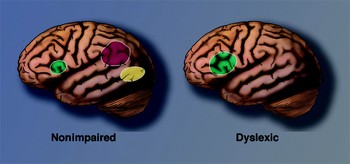
Converging evidence from many laboratories around the world has demonstrated what has been termed “a neural signature for dyslexia,” that is, a disruption of posterior reading systems during the reading of real words and pseudowords and often what has been considered as compensatory overactivation in other parts of the reading system (Figure 2).
Neural signature for dyslexia. A neural signature for dyslexia is illustrated in this schematic view of left hemisphere brain systems in (left) nonimpaired and (right) dyslexic readers. In nonimpaired readers, the three systems provided in Figure 1 are shown. In dyslexic readers, the anterior system is slightly overactivated compared with systems of nonimpaired readers; in contrast, the two posterior systems are underactivated. This pattern of underactivation in left posterior reading systems is referred to as the neural signature for dyslexia. Adapted from Overcoming dyslexia: A new and complete science-based program for reading problems at any level, by S. Shaywitz, Reference Shaywitz2003. New York: Alfred A. Knopf. Copyright 2003 by S. Shaywitz. Adapted with permission.

In a study of children with dyslexia, Shaywitz et al. (Reference Shaywitz, Shaywitz, Pugh, Mencl, Fulbright and Skudlarski2002a) used fMRI to study 144 dyslexic and nonimpaired boys and girls as they read pseudowords and real words. This study was designed to minimize some of the problems encountered in previous studies, and thus examined a large sample, particularly for a functional imaging study. Results indicated that during phonologic analysis, nonimpaired children demonstrate significantly greater activation than do dyslexic children in predominantly left hemisphere sites (representing the anterior reading system around the inferior frontal region, and two posterior sites, one in the parietotemporal system, the other in the occipitotemporal system). Studies in dyslexic children are particularly important because they indicate that dysfunction in left hemisphere posterior reading circuits is already present in dyslexic children and cannot be ascribed simply to a lifetime of poor reading. Further, this study found that, although the posterior reading systems were disrupted in dyslexic readers, compensatory systems developed with an increased activation noted in the left inferior frontal gyrus, activation in the right inferior frontal gyrus, and increased activation in the homolog of the VWFA in the right occipitotemporal area.
It is possible that what is considered compensatory activation in dyslexic readers in the right occipitotemporal area may reflect right-sided activation that is concomitant with activation in nonimpaired readers, although the data remains unclear. Dehaene and associates (Vinckier et al., Reference Vinckier, Dehaene, Jobert, Dubus, Sigman and Cohen2007) indicate that although both the left and right hemisphere occipitotemporal areas are activated during reading, their data indicate that the activations are “asymmetrical in favor of the left hemisphere.” Other investigators suggest that both left and right occipitotemporal areas are used in typical reading. For example, in an fMRI study contrasting brain activation of words and pseudowords, Fiebach et al. (Reference Fiebach, Friederici, Muller and Cramon2002) found that words produced greater activation in bilateral occipitotemporal and posterior left middle temporal areas. More recently, Ben Shachar, Dougherty, Deutsch, and Wandell (Reference Ben-Shachar, Dougherty, Deutsch and Wandell2007) reported increased activation in the VWFA as masked words became more visible, suggesting that both left and right occiptiotemporal areas are important in processing shapes in general, and the visually presented word, in particular.
Whether the occipitotemporal areas in nonimpaired readers are activated bilaterally or primarily in left hemisphere, the data from fMRI studies in children with dyslexia reported by our group converge with reports from many investigators using functional brain imaging, which show a failure of left hemisphere posterior brain systems to function properly during reading (Helenius et al., Reference Helenius, Tarkiainen, Cornelissen, Hansen and Salmelin1999; Horwitz et al., Reference Horwitz, Rumsey and Donohue1998; Paulesu et al., Reference Paulesu, Demonet, Fazio, McCrory, Chanoine and Brunswick2001; Rumsey et al., Reference Rumsey, Andreason, Zametkin, Aquino, King and Hamburber1992; Salmelin et al., Reference Salmelin, Service, Kiesila, Uutela and Salonen1996; Seki et al., Reference Seki, Koeda, Sugihara, Kamba, Hirata and Ogawa2001; Shaywitz et al., Reference Shaywitz, Shaywitz, Pugh, Fulbright, Constable and Mencl1998, Reference Shaywitz, Shaywitz, Pugh, Mencl, Fulbright and Skudlarski2002a, Reference Shaywitz, Shaywitz, Fulbright, Skudlarski, Mencl and Constable2003; Temple et al., Reference Temple, Poldrack, Protopapas, Nagarajan, Salz and Tallal2000, Reference Temple, Poldrack, Salidis, Deutsch, Tallal and Merzenich2001). Recent studies report similar findings in German and Italian dyslexic readers. Kronblicher et al. (2006) used sentences and studied dysfluent compared to fluent German readers. Dyslexics demonstrated reduced activation in the left supramarginal gyrus (parietotemporal system) and left occipitotemporal system with compensatory activation in left inferior frontal area. Brambati et al. (Reference Brambati, Termine, Ruffino, Danna, Lanzi and Stella2006), studied dyslexic Italian adults with a family history of dyslexia and found reduced activation in dyslexics in posterior reading systems, paralleling results in English-speaking and German-speaking dyslexic readers, and confirming the findings from voxel-based morphometry reported by these investigators previously indicating reductions of gray matter volume in posterior reading systems in bilateral inferior and superior temporal lobe areas in familial dyslexia (Brambati et al., Reference Brambati, Termine, Ruffino, Stella, Fazio and Cappa2004).
Development of reading systems in dyslexia and the importance of the occipitotemporal reading system
Although converging evidence points to three important neural systems for reading, few studies have examined age-related changes in these systems in typical readers or in dyslexic children. In a recent report, Shaywitz et al. (Reference Shaywitz, Skudlarski, Holahan, Marchione, Constable and Fulbright2007) used fMRI to study age-related changes in reading in a cross-sectional study of 232 dyslexic and nonimpaired boys and girls as they read pseudowords. Findings indicated that the neural systems for reading that develop with age in nonimpaired readers differ from those which develop in dyslexic readers. These findings noted below now permit a more fine-grained analysis of the word-form area by identifying two systems within the greater word form area. Specifically, a system for reading that develops with age in dyslexic readers differs from that in nonimpaired readers, primarily to being a more posterior and medial system, rather than a more anterior and lateral system within the left occipitotemporal area. Of interest, this difference in activation patterns between the two groups of readers has parallels to reported brain activation differences observed during reading of two Japanese writing systems: Kana and Kanji. Left anterior lateral occipitotemporal activation, similar to that seen in nonimpaired readers, occurred during reading Kana (Nakamura, Dehaene, Jobert, Le Bihan, & Kouider, Reference Nakamura, Dehaene, Jobert, Le Bihan and Kouider2005). Kana script employs symbols that are linked to the sound or phonologic element (comparable to English and other alphabetic scripts). In Kana and in alphabetic scripts, children initially learn to read words by learning how letters and sounds are linked and then, over time, these linkages are integrated and permanently instantiated as a word form. Recall, knowledge of how letters and sounds are linked, allows a reader to sound out and read new words.
In contrast, posterior medial occipitotemporal activation, comparable to that observed in dyslexic readers, was noted during reading of Kanji script (Nakamura et al., Reference Nakamura, Dehaene, Jobert, Le Bihan and Kouider2005). Consideration of the mechanisms used for reading Kanji compared to Kana provide insights into potentially different mechanisms that develop with age in dyslexic contrasted to nonimpaired readers. Kanji script uses ideographs where each character must be memorized suggesting that the posterior medial occipitotemporal system functions as a memory-based system. It is reasonable to suppose that as dyslexic children mature this posterior medial system supports memorization rather than the progressive sound–symbol linkages observed in nonimpaired readers. There is evidence that dyslexic readers are not able to make good use of sound–symbol linkages as they mature, and instead, come to rely on memorized words. For example, phonologic deficits continue to characterize struggling readers even as they enter adolescence and adult life (Bruck, Reference Bruck1992; Shaywitz et al., Reference Shaywitz, Fletcher, Holahan, Shneider, Marchione and Stuebing1999), and, as described in the next section, persistently poor adult readers read words by memorization so that they are able to read familiar words but have difficulty reading unfamiliar words (Shaywitz et al., Reference Shaywitz, Shaywitz, Fulbright, Skudlarski, Mencl and Constable2003).
Thus, these results support and now extend previous findings to indicate that the system responsible for the integration of letters and sounds, the anterior lateral occipitotemporal system, is the neural circuit that develops with age in nonimpaired readers. Conversely, dyslexic readers, who struggle to read new or unfamiliar words, come to rely on an alternate system, the posterior medial occipitotemporal system, that functions via memory networks. The importance of compensatory systems for reading that engage components of the memory system is also shown in a study described below.
Types of reading disabilities
Shaywitz et al. (Reference Shaywitz, Shaywitz, Fulbright, Skudlarski, Mencl and Constable2003) examined the neural systems for reading in two groups of young adults who were poor readers as children, a relatively compensated group and a group with persistent reading difficulties, and compared them to nonimpaired readers. In addition, compensated and persistently poor readers were compared to see whether there were any factors distinguishing the compensated from persistently poor readers that might account for their different outcomes. The study took advantage of the availability of a cohort who are participants in the CLS representative sample of now young adults who have been prospectively followed since 1983 when they were age 5 years, and who have had their reading performance assessed yearly throughout their primary and secondary schooling (Ferrer et al., Reference Ferrer, McArdle, Shaywitz, Holahan, Marchione and Shaywitz2007; Shaywitz et al., Reference Shaywitz, Fletcher, Holahan, Shneider, Marchione and Stuebing1999; Shaywitz, Escobar, Shaywitz, Fletcher, & Makuch, Reference Shaywitz, Escobar, Shaywitz, Fletcher and Makuch1992; Shaywitz, Fletcher, Holahan, & Shaywitz, Reference Shaywitz, Fletcher, Holahan and Shaywitz1992; Shaywitz, Shaywitz, Fletcher, & Escobar, Reference Shaywitz, Shaywitz, Fletcher and Escobar1990).
Three groups of young adults were classified as (a) persistently poor readers (PPR), (b) accuracy (but not fluency) improved (compensated) readers (AIR), and (c) nonimpaired readers (NI). Findings during pseudoword rhyming in both groups of poor readers (AIR, PPR) were similar to those observed in previous studies, that is, a relative underactivation in posterior neural systems located in the superior temporal and the occipitotemporal areas. But when reading real words, brain activation patterns in the AIR and PPR readers diverged. As they had for pseudoword reading, compared to NI, AIR (compensated dyslexic readers) demonstrated relative underactivation in left posterior systems. In contrast, during real-word reading PPR subjects activated posterior systems. Thus, we observed (during real-word reading) comparable activation in NI and PPR in the posterior reading systems, findings that were both new and unexpected. Despite the significantly better reading performance in NI compared to PPR on every reading task administered, left posterior reading systems were activated during reading real words in both NI and PPR.
Shaywitz et al. (2003) hypothesized that the PPR readers were reading real words very differently from NI readers, reading the very simple real words primarily by memory. Functional connectivity analysis (in contrast to, e.g., structural connectivity measured by diffusion tensor imaging [DTI]) was used to examine how the skilled reading area in the left occipitotemporal VWFA was connected in NI compared to PPR readers (McIntosh, Bookstein, Haxby, & Grady, Reference McIntosh, Bookstein, Haxby and Grady1996; McIntosh, Nyberg, Bookstein, & Tulving, Reference McIntosh, Nyberg, Bookstein and Tulving1997). Findings indicated that NI readers demonstrated connectivity between the left occipitotemporal VWFA and the left inferior frontal gyrus, a traditional language region. In contrast, PPR subjects demonstrated functional connectivity between the VWFA and right prefrontal areas often associated with working memory and memory retrieval (Fletcher, Frith, & Rugg, Reference Fletcher, Frith and Rugg1997; MacLeod, Buckner, Miezin, Petersen, & Raichle, Reference MacLeod, Buckner, Miezin, Petersen and Raichle1998), an observation consistent with the hypothesis that in the persistently poor readers the occipitotemporal system functions as a component of a memory network. This finding, together with the more recent data on the development of reading systems described in the previous section, amplify the importance of memory systems in dyslexic readers.
Insight to some of the factors responsible for compensation on the one hand and persistence on the other comes from an examination of the early childhood measures. The two groups of disabled readers (AIR and PPR) began school with comparable reading skills but with PPR compared to AIR having poorer cognitive ability and tending to attend more disadvantaged schools. These data suggest that the PPR may be doubly disadvantaged in perhaps being exposed to a less rich language environment at home (Hart & Risley, Reference Hart and Risley1995) and then less effective reading instruction at school. In contrast, the presence of compensatory factors such as stronger cognitive ability allowed the AIR to minimize, in part, the consequences of their phonologic deficit so that as adults AIR were indistinguishable from NI on a measure of reading comprehension and a measure of prose literacy. These findings are consonant with a large body of evidence indicating that the impact of dyslexia can be modified by the availability of compensatory resources, for example, semantic knowledge (Snowling, Reference Snowling2000), use of context (Frith & Snowling, Reference Frith and Snowling1983; Nation & Snowling, Reference Nation and Snowling1997), and verbal ability (Torgesen et al., Reference Torgesen, Alexander, Wagner, Rashotte, Voeller and Conway2001) to compensate for phonologic deficits.
Effects of reading interventions on neural systems for reading
Given the converging evidence of a disruption of posterior reading systems in dyslexia, an obvious question relates to the plasticity of these neural systems, that is, whether they are malleable and can be changed by an effective reading intervention. Shaywitz et al. (Reference Shaywitz, Shaywitz, Blachman, Pugh, Fulbright and Skudlarski2004) hypothesized that the provision of an evidence-based, phonologically mediated reading intervention would improve reading and the development of the neural systems serving reading. The experimental intervention was structured to help children gain phonological knowledge (develop an awareness of the internal structure of spoken words), and at the same time, develop their understanding of how the orthography represents the phonology.
Two groups of dyslexic readers as well as a control group were studied. One group of dyslexic readers received an experimental intervention that provided second and third grade poor readers with 50 min of daily individual tutoring that was explicit and systematic and focused on helping children understand the alphabetic principle (how letters and combinations of letters represent the small segments of speech known as phonemes) and provided many opportunities to practice applying the letter–sound linkages taught. The other group of dyslexic readers received what the investigators termed “community intervention, “that is, a variety of interventions commonly provided within the school. However, specific, systematic, explicit phonologically based interventions comparable to the experimental intervention were not used in any of reading programs that were provided to the community group. The children were imaged on three occasions: preintervention, immediately postintervention, and 1 year after the intervention was complete.
Children who received the experimental intervention not only improved their reading but also demonstrated an increase in activation in the anterior system as well as in the parietotemporal and occipitotemporal systems, compared to their preintervention brain activation patterns. Other laboratories have also found that an effective reading intervention influences neural systems in the brain in much the same fashion. Thus, the Gabrieli laboratory examined both adults and children with dyslexia who received auditory processing training requiring that subjects respond to a high pitched stimulus. Following 33 training days, subjects demonstrated not only improvement on both rapid auditory processing and auditory language comprehension but also greater activation in the left prefrontal cortex (PFC) after training compared to before training (Temple et al., Reference Temple, Poldrack, Protopapas, Nagarajan, Salz and Tallal2000). In a study of children with dyslexia, the same intervention resulted in improvement in reading accuracy and increased brain activation in the posterior reading systems as well as in right hemisphere and cingulate cortex (Temple et al., Reference Temple, Deutsch, Poldrack, Miller, Tallal and Merzenich2003). Richards et al. (Reference Richards, Corina, Serafini, Steury, Echelard and Dager2000) used proton MR spectroscopy to measure brain lactate concentrations at two time points, 1 year apart, in dyslexic and control boys before and after 3 weeks of a phonologically based reading intervention. Measuring lactate is a direct measure of brain metabolism, with lower levels presumably reflecting more efficient metabolism. Before treatment dyslexic boys demonstrated increased lactate concentration (compared to controls) in the left anterior quadrant during a phonologic task. After treatment, brain lactate concentrations were no different in the dyslexic and control boys, and reading improved after treatment, presumably reflecting an improvement in the efficiency of brain function after the intervention. This same investigative group reported fMRI changes in posterior reading areas following 28 hr of an intensive phonological and morphological reading intervention (Aylward et al., Reference Aylward, Richards, Berninger, Nagy, Field and Grimme2003). Using a phonologically based intervention consisting of 3-hr daily sessions for 8 weeks, Eden et al. (Reference Eden, Jones, Cappell, Gareau, Wood and Zeffiro2004) compared adults who had been diagnosed as dyslexic as children to adults who did not receive the intervention. Although real word reading did not improve, tests of phonemic awareness did improve, and posterior brain systems in left hemisphere (as well as right hemisphere homologs) increased in activation compared to the preintervention imaging.
In summary, these data demonstrate that an intensive evidence-based reading intervention brings about significant changes in brain organization so that brain activation patterns resemble those of typical readers. These data have important implications for public policy regarding teaching children to read: The provision of an evidence-based reading intervention at an early age improves reading and facilitates the development of those neural systems that underlie reading. Further studies are necessary to clarify the long-term impact of these interventions, particularly on the development of fluency, and the neural systems serving fluent reading.
Neurobiological Mechanisms in Attention
In previous sections, we discussed the cognitive theories of reading and dyslexia, indicating that an account of the contribution of attentional mechanisms are critical to a full understanding of the reading process. The neurobiology of reading was reviewed, so we now turn our attention to neurobiological mechanisms in attention. Considerable evidence from a number of lines of investigation points to (a) the role of higher association cortices, particularly the PFC, and (b) the role of catecholaminergic systems in attentional mechanisms. In general, higher order sensory cortices, such as the inferior temporal cortex, influence attentional mechanisms by focusing on particular details; the posterior parietal cortex also plays a role in attention, presumably by allocating attentional resources via connections with the PFC. It is the PFC that has long been suspected of regulating attention by inhibiting irrelevant stimuli as well as sustaining attention and dividing attention (reviewed in Arnsten, Reference Arnsten2006a).
Catecholaminergic systems in attention
Extensive research links catecholaminergic mechanisms to the cortical and subcortical neural systems serving attention. Subcortical systems in basal ganglia have long been linked to catecholaminergic, primarily dopaminergic, systems and studies that are nearly 30 years old link catecholaminergic mechanisms to the PFC (Brozoski, Brown, Rosvold, & Goldman, Reference Brozoski, Brown, Rosvold and Goldman1979). More recent studies (reviewed in Arnsten, Reference Arnsten2006a) elaborate on the role of dopamine on PFC. These studies indicate that stimulation of D1 receptors in PFC produce an inverted U-shaped dose response, with modest levels of D1 stimulation important for normal PFC function, whereas greater stimulation of these same receptors impair attentional and memory systems in the PFC.
Noradrenergic mechanisms also appear to play an important role in attentional mechanisms. Noradrenergic neurons arise from brain stem nuclei within the locus coeruleus and project to widespread cortical regions, including the PFC (Ramos & Arnsten, Reference Ramos and Arnsten2007). Norepinephrine stimulates three types of postsynaptic receptors, and stimulation of each receptor results in somewhat different actions on attentional mechanisms. For example, PFC function is improved by stimulation of a2a receptors with agents such as the a2a agonist guanfacine. In contrast, stimulation of a1 receptors (by agonists such as phenylephrine) and b1 receptors (by agonists such as betaxalol) impairs PFC function (Birnbaum, Gobeske, Auerbach, Taylor, & Arnsten, Reference Birnbaum, Gobeske, Auerbach, Taylor and Arnsten1999; Birnbaum et al., Reference Birnbaum, Yuan, Wang, Vijayraghavan, Bloom and Davis2004). Studies in animal models of attention indicate that administration of stimulant medications (methylphenidate, d-amphetamine, atomoxetine) result in not only increased release of dopamine in basal ganglia but also pronounced effects in the PFC, with high levels of norepinephrine release and significant but lower levels of dopamine release (Bymaster et al., Reference Bymaster, Katner, Nelson, Hemrick-Luecke, Threlkeld and Heiligenstein2002).
Stimulants such as d-amphetamine, methylphenidate, and atomoxetine have long been known to affect attention in the clinical syndrome of ADHD. This new understanding of catecholaminergic actions in the brain led Arnsten (Reference Arnsten2006b) to note that d-amphetamine and methylphenidate affect catecholaminergic systems in the brain and that newer agents such as “… atomoxetine (Strattera) also increases norepinephrine and dopamine release in the prefrontal cortex … ,” suggesting “that catecholamine release in the prefrontal cortex may be a common action for many ADHD therapeutics” (Arnsten, Reference Arnsten2006b, p. 2). Stimulants have also been found to improve other prefrontal cognitive functions such as spatial working memory, response inhibition, and set shifting in “normal” college students (Elliott et al., Reference Elliott, Sahakian, Matthews, Bannerjea, Rimmer and Robbins1997; Mehta et al., Reference Mehta, Owen, Sahakian, Mavaddat, Pickard and Robbins2000) and in children and adults with ADHD (Aron, Dowson, Sahakian, & Robbins, Reference Aron, Dowson, Sahakian and Robbins2003; Bedard, Jain, Johnson, & Tannock, Reference Bedard, Jain, Johnson and Tannock2007; McInnes, Bedard, Hogg-Johnson, & Tannock, Reference McInnes, Bedard, Hogg-Johnson and Tannock2007; Mehta, Goodyer, & Sahakian, Reference Mehta, Goodyer and Sahakian2004). Further support for the role of noradrenergic mechanisms in general (and presumably their effects on the PFC) come from genetic studies. Thus, in addition to associations among ADHD and the genes encoding for the dopamine transporter and the D1, D4, and D5 receptors, genes related to noradrenergic mechanisms (dopamine beta hydroxylase; gene encoding for the a2A adrenoceptor) have been associated with ADHD (Park et al., Reference Park, Nigg, Waldman, Nummy, Huang-Pollock and Rappley2005; Roman et al., Reference Roman, Schmitz, Polanczyk, Eizirik, Rohde and Hutz2003).
Structural MRI and fMRI studies of attentional mechanisms in ADHD
Structural MRI studies, particularly a recent meta-analysis (Valera, Faraone, Murray, & Seidman, Reference Valera, Faraone, Murray and Seidman2007), have shown a reduction in volume in a number of brain regions in patients with ADHD including the caudate, cerebellar vermis, and corpus callosum, as well as the prefrontal and frontal lobes. A longitudinal structural MRI study (Shaw et al., Reference Shaw, Lerch, Greenstein, Sharp, Clasen and Evans2006) suggests that these neuranatomical abnormalities are present early in childhood. Specifically, children with ADHD exhibited thinning of the cerebral cortex, particularly over the medial and superior prefrontal and precentral regions, with those with worse clinical outcome having a thinner left medial PFC at baseline. There was also a suggestion that normalization of cortical thickness over the 5-year period of follow-up occurred only in the better outcome group.
fMRI studies of ADHD have demonstrated dysfunction in multiple neural systems including those in the prefrontal and frontal cortex, caudate nucleus, cerebellum, and parietal cortex (reviewed in Bush, Valera, & Seidman, Reference Bush, Valera and Seidman2005; Casey, Nigg, & Durston, Reference Casey, Nigg and Durston2007; Epstein et al., Reference Epstein, Casey, Tonev, Davidson, Reiss and Garrett2007). These systems have been demonstrated during tasks tapping cognitive control, including the go/no-go (Durston et al., Reference Durston, Davidson, Mulder, Spicer, Galvan and Tottenham2007; Epstein et al., Reference Epstein, Casey, Tonev, Davidson, Reiss and Garrett2007), stop signal tasks, and Stroop tasks (Bush et al., Reference Bush, Frazier, Rauch, Seidman, Whalen and Jenike1999). In general, children with ADHD exhibit hypoactivation of these regions compared to controls, and this hypoactivation has been shown to normalize with stimulant medication (Epstein et al., Reference Epstein, Casey, Tonev, Davidson, Reiss and Garrett2007; Shafritz, Marchione, Gore, Shaywitz, & Shaywitz, Reference Shafritz, Marchione, Gore, Shaywitz and Shaywitz2004; Vaidya et al., Reference Vaidya, Austin, Kirkorian, Ridlehuber, Desmond and Glover1998). Most recently, DTI has been used to demonstrate disruption of frontostriatal white matter tracts in children with ADHD (Casey et al., Reference Casey, Epstein, Buhle, Liston, Davidson and Tonev2007).
Importance of the parietotemporal reading system in developmental dyslexia: A potential link to attentional mechanisms serving reading
A potential neural mechanism that may help better understand the role of attentional processes in dyslexia comes from studies demonstrating that the posterior parietal cortex appears to play an important role in attention, presumably via connections between the posterior parietal cortex and PFC. Good evidence suggests that competing stimuli result in activation of this parietal–prefrontal pathway, essentially a top-down biasing of attention in favor of one stimulus over another. At the same time, many studies have implicated the left parietal cortex in reading and dyslexia. For example, in two studies, one involving whether two words rhymed (Cao, Bitan, Chou, Burman, & Booth, Reference Cao, Bitan, Chou, Burman and Booth2006) and one involving whether two real words were related (Booth, Bebko, Burman, & Bitan, Reference Booth, Bebko, Burman and Bitan2007), children with dyslexia exhibited reduced activation in a left hemisphere network involving the inferior parietal lobule. These studies are consistent with previous studies in dyslexic children (Shaywitz et al., 2002; Temple et al., Reference Temple, Poldrack, Salidis, Deutsch, Tallal and Merzenich2001) and consistent with studies showing that the inferior parietal lobule is implicated in mapping between orthographic and phonological representations (Booth et al., Reference Booth, Burman, Meyer, Gitelman, Parrish and Mesulam2002, Reference Booth, Burman, Meyer, Gitelman, Parrish and Mesulam2003; Nakamura et al., Reference Nakamura, Hara, Kouider, Takayama, Hanajima and Sakai2006, in press; Price, Moore, & Frackowiak, Reference Price, Moore and Frackowiak1996; Xu et al., Reference Xu, Grafman, Gaillard, Ishii, Vega-Bermudez and Pietrini2001). The inferior parietal lobule is also activated during listening comprehension, perhaps representing an indirect route to speech processing (Schmithorst & Holland, Reference Schmithorst and Holland2006, Reference Schmithorst and Holland2007).
An accumulating literature has begun to emphasize the relationship linking attention, the inferior parietal cortex, and reading. As discussed in the previous section, the inferior parietal lobule is involved in and and plays a significant role in attentional mechanisms. One important piece of evidence comes from a study of a patient with bilateral parietal atrophy, a syndrome known as Balint syndrome (Vinckier et al., Reference Vinckier, Naccache, Papeix, Forget, Hahn-Barma and Dehaene2006). Through an accident of nature, this unfortunate woman was left with a dysfunctional parietal component of the reading pathways but an intact occipitotemporal reading system. Evidence of parietal system influence on reading was demonstrated when geometric features of the display were altered; for example, if words were rotated, letters were separated by double spaces or words were written in mirror reversal. Thus, depending on these critical geometric features (rotation angle, letter spacing, mirror reversal, tasks that seem to tap the parietal system), the patient switched from a good reading performance (when words were displayed normally engaging her intact ventral pathway) to severely impaired reading, when the task required parietal systems.
Perhaps the strongest evidence linking attention, the inferior parietal cortex and reading comes from a study by Nakamura et al. (Reference Nakamura, Dehaene, Jobert, Le Bihan and Kouider2005), involving the combined use of visual masking and the disruption of specific components of the reading system by transcranial magnetic stimulation. Using this paradigm, Nakamura et al.'s (2005) findings suggest that a more dorsally placed neural system involving the left hemisphere inferior parietal lobule and premotor cortex are involved in print to sound conversion, consistent with much previous data. This system links to word recognition systems in the occipitotemporal cortex. A more ventral system, involving the occipitotemporal, middle temporal, and premotor cortex are involved in lexical decision. This is consistent with many previous studies described earlier. These systems may be the neural correlates of the dual route to reading discussed earlier. What is new is that Nakamura postulates that attentional systems in the PFC act to activate the more dorsal system: “ … because brain activation triggered by the conscious perception of wordlike stimuli should be subject to the top-down attentional amplification by the prefrontal cortex. This, in turn, produces a distributed activation of the fronto-temporo-parietal network, …” This is significant and suggests an alternative intervention strategy for reading, a strategy that focuses on activating prefrontal attentional systems (presumably noradrenergic) that then activate the posterior reading systems.
Catecholaminergic systems and reading
Of particular interest to studies of reading are reports indicating that stimulants may have beneficial effects on reading in children with both ADHD and dyslexia (Grizenko, Bhat, Schwartz, Ter-Sttepanian, & Joober, Reference Grizenko, Bhat, Schwartz, Ter-Sttepanian and Joober2006; Keulers et al., Reference Keulers, Hendriksen, Feron, Wassenberg, Wuisman-Frerker and Jolles2007; Richardson, Kupietz, Winsberg, Maitinsky, & Mendell, Reference Richardson, Kupietz, Winsberg, Maitinsky and Mendell1988). Pharmacological studies using stimulants that presumably stimulate prefrontal catecholaminergic systems (noradrenergic and dopaminergic) suggest improvement in reading in dyslexic children, perhaps by the mechanism proposed by Nakamura et al. (Reference Nakamura, Dehaene, Jobert, Le Bihan and Kouider2005). This seems to be a promising strategy for further exploration, particularly in view of the great difficulty in finding interventions that improve reading fluency.
Summary and Future Directions
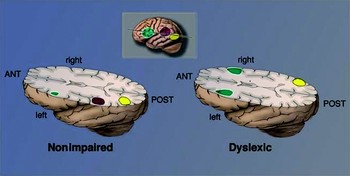
Recent technological and conceptual advances offer the hope of understanding reading and reading disabilities at a level that could not have been imagined even a decade ago. As noted above, converging evidence from laboratories around the world now demonstrates a neural signature for dyslexia, specifically, a disruption of posterior neural systems serving reading. Such a demonstration provides unequivocal evidence that what was once a hidden disability is real. Furthermore, these fMRI studies now indicate the neural basis for the accommodation of extra time provided on standardized tests to dyslexic students: a disruption of posterior systems for skilled reading, with the development of compensatory ancillary pathways anteriorly and in the right hemisphere. As shown in Figure 3, in contrast to typical readers, dyslexic readers demonstrate a disruption of posterior reading systems in the left parietotemporal and occipitotemporal areas, but appear to develop compensatory systems in left anterior and right anterior areas and the right hemisphere homolog of the left hemisphere VWFA. These ancillary systems allow the dyslexic reader to decode words, but slowly and not automatically. This lack of automatic, fluent reading means that the dyslexic reader may be able to decode words, but is still not able to read quickly and continues to be at a disadvantage compared to nondyslexic peers when taking high-stakes standardized tests such as SATs, Graduate Management Admission Test, Graduate Record Examination, and so forth. However, we caution, as did Bush et al. (Reference Bush, Valera and Seidman2005) in discussing neuroimaging of ADHD, that the neural signature of dyslexia using fMRI has been demonstrated in studies of groups of disabled readers while neuroimaging in individual subjects to date has not proven sensitive enough as a either a biomarker for dyslexia or as a measure of therapeutic effect.
Compensatory neural systems and the neural basis for the requirement for extended time for dyslexic students on high stakes testing. The image is a cutaway view of the brain showing the left and right hemispheres. Nonimpaired readers activate three left hemisphere neural systems for reading: an anterior system and two posterior systems. Dyslexic readers have a disruption in the left hemisphere posterior neural systems for reading but compensate by developing anterior systems in the left and right hemispheres and the posterior homolog of the visual word form area in the right hemisphere. Adapted from Overcoming dyslexia: A new and complete science-based program for reading problems at any level, by S. Shaywitz, Reference Shaywitz2003. New York: Alfred A. Knopf. Copyright 2003 by S. Shaywitz. Adapted with permission.

For almost two decades, the central dogma in reading research has been that the generation of the phonological code from print is modular, that is, automatic and not attention demanding and not requiring any other cognitive process. Recent findings now present a competing view, suggesting that attentional mechanisms play a critical role in reading and that disruption of these attentional mechanisms plays a causal role in reading difficulties.
The recognition of the role of attention in reading leads to perhaps the most exciting new development on the horizon: the potential use of pharmacologic agents that may serve as a pharmacologic probe to begin to understand the neurochemical mechanisms of reading and dyslexia and their relationship to those mechanisms in ADHD. In particular, the contrast between agents primarily effective on dopaminergic striatal systems (methylphenidate, d-amphetamine) and those more selective on noradrenergic systems (atomexetine, guafecine) may provide a window into the neurochemical mechanisms underlying dyslexia as well as potential new avenues for intervention.