I. Introduction: The Mass-Clock and the Spy
At the back of a pocket-sized missal distributed by the National Catholic Community Service (NCCS), U.S. military personnel serving in World War II could find a particularly useful wartime device. The two-page spread centered on an image that would have been vaguely familiar to most U.S. Catholics. The largest feature was a sun-like circle rising and radiating out from a smaller ciborium beneath. In more familiar Catholic imagery the circle appeared sometimes as the sun, sometimes as the Eucharistic host itself. It was typically embossed with the letters “IHS,” a Greek-derived abbreviation of the Holy Name of Jesus, or with the Greek letters AΩ, representing Jesus as Alpha and Omega, the beginning and end of all. In these familiar forms, the image signaled the centrality and efficacy of the sacrament of communion in the religious life of Catholics. Through communion, received in the form of the Eucharistic bread consecrated and delivered by the hands of an ordained priest, Catholics united themselves with Christ, whose very name was woven into the fabric of the universe. Participation in Holy Communion, which for the properly scrupulous was preceded always by the sacrament of confession, united Catholics with Christ, activated the flow of grace into their lives, and ensured their eternal proximity to God.
Global warfare pressed this imagery into new realms. Instead of a host or the sun rising up, the circular form here took the shape of a clock face. Inside the clock face, instead of the letters “IHS,” readers found a world map, including the six inhabited continents viewed from a point high above the North Pole. In each hour segment of the clock face, the names of two different regions were listed. Text below and on the facing page offered instructions if one was “unable to attend Mass because of military service or the absence of a chaplain.” Using this “World-Mass-Clock” and the accompanying “Mass-Clock-Prayer” Catholics could join themselves spiritually with the sacrifice of the Mass as it was happening at any given moment, somewhere in the world. “No matter when you look at your clock,” the pages explained, “it is early morning somewhere … and some Priest is offering Mass!” With these pages at hand, Catholics could discover where in the world, at that precise moment, the church was uniting itself with Christ's original sacrifice. In addition to studying the catechism assigned to that week's Mass (found earlier in the booklet), servicemen could recite the “Mass-Clock-Prayer” which began:
Eternal Father, through the Immaculate Heart of Mary, I wish to unite myself with Jesus, now offering His Precious Blood in < < mention name of country > > in the Holy Sacrifice of the Mass.
“Mass,” the text reiterated, “travels with sun”; they calculated 300,000 masses offered every twenty four hours. Servicemen need never feel spiritually isolated (Figure 1).
“Mass Clock” from the back of My Military Missal, ed. Rev. Joseph F. Stedman (Brooklyn, N.Y.: Confraternity of the Precious Blood, 1942), 128–129. Used with permission of the Confraternity of the Precious Blood.

But the connections were not just between far-flung servicemen and the church in some other region of the world. Instead, since the clock worked via calculation of the current time with reference to U.S. central time, servicemen were also invited to make a mental journey back home. If far-flung Catholics could determine that it was 3a.m. U.S. central time, they could also know that at that moment priests in Brazil were offering mass. At 8 p.m. central time their prayer joined them with those celebrating the Eucharist in Persia. In this way, the bonds multiplied to include the image of loved ones at home, whether they were at mass at that moment or not.Footnote 1
This device tapped into long-standing affirmations about the universality of the Catholic Church. The notion of the church united as a single “Mystical Body” had been a central topic of theological reflection beginning in the 1920s and 1930s, especially among early American adherents of liturgical reform.Footnote 2 In 1943, in the midst of the war, Pope Pius XII amplified and elaborated on this notion of the church in his encyclical Mystici Corporis Christi. The diffusion and secularization of the “long nineteenth century” had prompted church officials, instead of merely lamenting the fracture of their authority, to shift the conversation by celebrating the mystical body as a spiritualized form of union, subjected to the authority of the head in Rome, across time and space.Footnote 3 If the church's temporal power was slipping, its vast spiritual union remained ultimately potent. United by the sacraments, Catholics could be confident of their global reach, their transcendence of national borders, and their union with one another. This mode of talking about the church and its sacramental life became especially crucial during wartime. The rise of secular democracies called for new modes of spreading church influence in the early twentieth century. The separations and perils of wartime elicited even more concentrated efforts to affirm the abiding presence and potency of the Catholic moral and spiritual system. Sacramentals like the “mass clock” were especially important since the war made it less likely that Catholics would have regular access to full sacraments mediated by a priest.Footnote 4 The second part of this essay documents the eager distribution, absorption, and accounting of sacramentals as a crucial aspect of wartime Catholicism.
But Catholics did not rest solely on the assurances provided by these powerful prayers, objects, and actions. Alongside the heavy traffic of sacramentals and stories about their potency, Catholics eagerly disseminated separatist narratives of U.S. Catholic triumph. “Mack,” a “twentieth-century G.I.,” offered one of these stories for the editors of the NCCS's wartime newsletter entitled Contact. The editors, Fr. Theodore M. Hesburgh and Philip Wendell Shay of the NCCS, included Mack's letter in an end-of-war commemorative booklet capturing the “best” material from the series.Footnote 5
Well-versed in Catholic expectations for the lay apostolate, Mack riffed on the motto of Catholic Action—a very twentieth century plan for extending Catholic influence in secular democracies—to describe his role as a Catholic in the U.S. military. The main fruit of this experience, he averred, would be relatively slow to develop. Military service was a time to “OBSERVE and JUDGE,” a chance for “sizing up what is pagan in our environment.” Armed with “a knowledge of what this environment should be,” “Contact men”—those lined up with the Catholic approach to the war—could also use their time in the service to forge plans “to change what is into what should be.” “ACT,” the implementation phase of the Catholic Action mandate, would have to wait until later, when the hindrances of military life—“army discipline and organization, schedules, breaking up of outfits, fatigue, discouragement”—had been left behind.
In the meantime, “day-to-day living in the midst of the men,” what Mack described as life in a “pagan” environment, could be a kind of religious ordeal. Military life, he wrote, is “unconsciously sounding our spiritual depths and ploughing furrows in the very fibers of our being.” With war's end, the “days of reconstruction” would begin, and tested and focused Catholics would manifest “a spiritual ripeness hitherto unknown to us” in the form of Catholic Action. Catholics in the military should understand themselves as spies behind enemy lines, immersed in a trying reconnaissance mission on behalf of the church. The enemy was not Germany or Japan, not Nazism or totalitarianism, nor even the lurking menace of communism. The enemy was a wayward America. Catholicism, mobilized through informed and eager lay Catholics, could be America's only hope in a future clouded by indifference, immorality, and paganism.Footnote 6
Together these stories capture an essential element of U.S. Catholics' engagement with World War II. The two encounters—the sacramental density of the “mass clock” and the published accounts of heroic Catholic morality among the ranks—share a common commitment to affirming and ensuring distinctive Catholic presence in the war. They sought to establish, each in their own way, a crucial link between Catholics at home and those displaced by the war. Rosaries in hand, salvific prayers in their pockets, and stories of Catholic exemplars in their ears, Catholics could forge bonds among themselves and those they worried about. Catholics' pursuit of this kind of “contact” with one another was the driving force of their wartime effort. Whatever the circumstances, Catholicism had both to be there and be known to have been there. A “church that is present,” wrote one priest in 1943, “is the appeal of the Church to a nation at war.”Footnote 7 For Catholics, the war was a drama of presence and absence. In this drama, rosaries, mass clocks, and crucifixes played the same role as tense stories of faithful Catholic men like Mack; both aimed to confirm the ongoing vitality of distinctive Catholic modes of engaging the world, even amid the tumult of war.
Exploring the contours of U.S. Catholics' engagements with World War II requires a focus on the work of the NCCS, which was the key agency, second only to the chaplaincy, in directing outreach to U.S. Catholics involved in the war effort. This organization—through the distribution and production of Catholic literature, spaces, and objects—instructed Catholics at home and abroad about the meanings of the war as a religious matter. Emphasizing their successes, the organization's records suggest that mobilized Catholics were eager for NCCS ministrations. But while the sheer number of (and widely acknowledged thirst for) religious objects distributed reveals a lot about the atmosphere this agency was able to create, it does not reveal how (or whether) those objects were used. Likewise, the letters and stories from Catholics reprinted by NCCS offer some leverage into everyday religiosity, but they cannot necessarily be taken as representative. Certainly NCCS desires for Catholicization were not perfectly reflected among the rank and file. But the NCCS was not necessarily hiding its struggles or downplaying the challenges it faced. It is possible to discern gaps—in the frustrations and anxieties expressed by NCCS writers—between their hopes and the attitudes of some of those they were trying to reach. Any lived history of Catholics in the war will have to take account of the tremendous effort on the part of this organization to Catholicize the war.
The NCCS—lay, episcopal, and priestly Catholics working for the organization—framed the problem of the war not as a matter of geo-politics or justice, but as a challenge to the moral and spiritual authority of the church. The “mass-clock” was just one of a wide ranging set of objects and prayers employed to ensure an abiding Catholic presence among the millions of Americans displaced by the war effort. Stories of Catholic Action in the ranks were just one means of communicating a Catholic moral stability that could serve as a practical demonstration the superiority of the Catholic system. They both epitomize the eagerness, precision, and creativity with which the NCCS sought to transform the war from a threat into an opportunity for deeper Catholicization.
II. Thickening the Religious History of World War II
To talk of the war and Catholicization is to offer a subtle but important reframing of prevailing historical conversations about the religious history of World War II. For many decades, the war's religious history has been understood primarily in terms of its contribution to American religious pluralism. Wartime stories of interfaith cooperation have made the war a key pivot point in descriptions of U.S. religious history. The war, with its tremendous demands, geographical uprooting, and religiously intolerant enemy, moved Americans to break down religious and ethnic boundaries that had divided them in the past. With the painful and yet triumphant work of the war behind them, the nation was primed to inaugurate an America of diverse but relatively cooperative believers; a pluralist consensus was set to emerge.Footnote 8
Instead of top-down change beginning with, say, the American presidency or theologically trained elites, this history locates the roots of change in the everyday worlds of American military personnel. Ground-level collaboration and camaraderie, along with postwar economic and social changes related to generational shifts, set the stage for the kinds of thinking about religious pluralism that would flower in later decades. Despite crises and lingering bigotries, the story of Americans' willingness to see beyond religious differences toward a set of goods they might share in common captures an essential and even inspiring aspect of the history of the late twentieth century. Histories from the vantage point of marginal religious groups—especially Catholics and Jews—have amplified the theme by seeing the war as the crucial, if controversial and “ambivalent,” turning point in a process of “Americanization.”Footnote 9 Religious pluralism emerged from the ground-up, with the experiences of World War II offering a crucial context.
But these stories have not always left room for consideration of the religious atmosphere within which Americans conducted their wartime work. Alongside celebrations of religious pluralism as an anti-Nazi rallying point, many religious Americans worked diligently during the war to reinforce particular and even exclusive religious orientations among their widely dispersed co-religionists. For Catholics, mobilization meant something more than enlistment and contribution to war production, bond drives, and rationing. It also meant the creation and mobilization of certain uniquely Catholic modes of engaging the war. If the emerging pluralist consensus did not exactly ask Catholics to give up these means, it nonetheless threatened to diminish the sense of their exclusivity and priority. The consensus is thus noticeably absent from much of what Catholics did and said during the war. The NCCS fixated instead on the celebration and dispersal of Catholic modes of engaging the war. Exploring NCCS war stories—animated alternately by sacramental presence and a sense of moral exceptionalism—thickens the religious history of World War II.
III. Interwar Catholic Exceptionalism and its Persistence
The theological conditions of the interwar period provide crucial context for making sense of the Catholic war effort. Catholics in the interwar period faced new expectations about their status as Americans. Like the “Mystical Body of Christ” theology and the Catholic Action mandate, these new expectations would profoundly shape the ways Catholics thought about the war. In an intellectual history entitled The Survival of American Innocence (1980), William M. Halsey describes interwar Catholics as the special keepers of “innocence”—a cluster of ideals including moral certainty, nationalist optimism, and trust in reason—which had been lost to most Americans as the confidence and hopefulness of previous generations lay wasted in the wake of World War I and the social crises of industrialization. Catholics and their newfound protestant admirers saw the church, with its signature combination of Thomistic Catholic certainty and an idealized eighteenth-century American optimism, as the ultimate antidote to postwar disillusionment and moral confusion.Footnote 10
This romantic amalgam ignited Catholic assertiveness, and opened the way for the flowering of scores of Catholic organizations and the articulation of a unique and totalizing Catholic “way.” Halsey describes World War II as an accelerant for the fires driving Catholics' positioning as the “saviors of American ideals.”Footnote 11 Wartime dispersal and the accompanying threat of moral contamination challenged Catholics' rising status as exemplary Americans. The war was a crisis of Catholicization. Among popular Catholic writers, these threats often called up a combative triumphalism. Catholics found opportunity to turn the conflict into a referendum on religious history and a mandate for Catholic self-assertion.
Popular writer Daniel Lord, S.J. exemplified this approach when he turned attention to the meanings of the war for those on the home front. In “The War and Ourselves,” a 1942 pamphlet reprinted six times before the end of the war, Lord raised the stakes of the war for those at home. According to Lord, they had the difficult task of coming to terms with the causes of the war and ensuring that those mistakes would not be repeated once this war was won. They could not allow soldiers to win on behalf of home, only to come back to find that “home no longer really exists.”
Lord's religious history of the interwar period motivated this argument. The idea that Catholics were special keepers of American “innocence” radiated from Lord's history and his approach to World War II. After World War I, he argued, Americans had turned their backs on the ideals they had fought for. They had abandoned Wilson and the League of Nations and had lost their sense of responsibility toward others and God. Lord framed this history as matter of irresponsible and libertine non-Catholics against “the Church.” Whereas “they” went out for a world of “hot music and cold hearts, of soaring stocks and falling morals,” “we”—good Catholics—resisted the claims of “a thousand cynical writers.” These popular American writers had abandoned the ideals of democracy and railed not only against the idea of just war, but even against arming the country for basic self-defense.
In addition to “cynical writers,” Lord placed blame on other religious Americans and their unseemly partnerships in the interwar years. Protestants, with their “peace-at-all-price” sermons, provided fodder for “Red[s]” and “pink[s]” who decried all war while hypocritically calling out for class-based civil conflict. Religious differences were paramount here, as many Catholics would have understood the invocation of American communists and their sympathizers to be a reference to American Jews.Footnote 12 Protestants, the target of Lord's attack on “cocktail parties and easy divorces and casual marriages,” were even more directly condemned. Protestants' supposed tolerance of birth control in the interwar years meant that American Catholics were left as the sole producers of “savingly large” families, whose boys would then be sent off to fight the next war in numbers disproportionate to their percentage of the population as a whole.Footnote 13 Lord's disdain for “Back Bay Brahmins” and “the country-club set” radiated from his history.Footnote 14
Catholic triumph sat at the root of Lord's plans for the war. In a section on the “Happy Results” of war, Lord cited the Irish defeat at the hands of Oliver Cromwell's forces in 1652. While the Catholics of Ireland lost that war, God drew good from it by sending the defeated Irish to the New World, where they would hasten the “doom of Puritanism.” Just as the Crusades had “kept Europe from becoming one vast Mohammedan harem and bazaar and slave mart,” so too this new war could save the world from non-Catholic influence. Amid these subtle and overt condemnations of protestants and Jews (not to mention Muslims), Lord's final invocation of “the splendid Christian American Way of Life” takes on decidedly non-pluralist implications. For historians of this period, such overheated language from Catholic prelates is not surprising. However, the way in which American Catholics went on to understand their role in a mobilized nation at war is surprising. Catholics were being encouraged to approach wartime with deep suspicions about their fellow Americans and even deeper hopes that the war could be an opportunity for Catholic triumph.
IV. Catholics and the “Home Away from Home”
This kind of narrative, which advanced a notion of the true American “home” rooted in a distinctively Catholic moral foundation, both informed and complicated the wartime efforts of the NCCS. Founded in 1941 as U.S. mobilization for the war ramped up, the NCCS was intended to consolidate the authority of U.S. bishops over the Catholic war effort.Footnote 15 The momentous upheaval of the period underscored the urgency of efficient organization and rapid mobilization. Challenges were already at hand. Before the war meant possible death at the hands of an enemy, it first meant the dissolution of family and disruption of community.Footnote 16 Acknowledging this upheaval, Americans prepared for World War II with a palpable moral panic. Unsettled young people were likely to lose track of their moral bearings, and behave in ways that would threaten not only their own souls, but also jeopardize the very future of the country and the qualities of civilization it represented.Footnote 17 The idea of “home”—whether Catholic or not—was under serious duress.
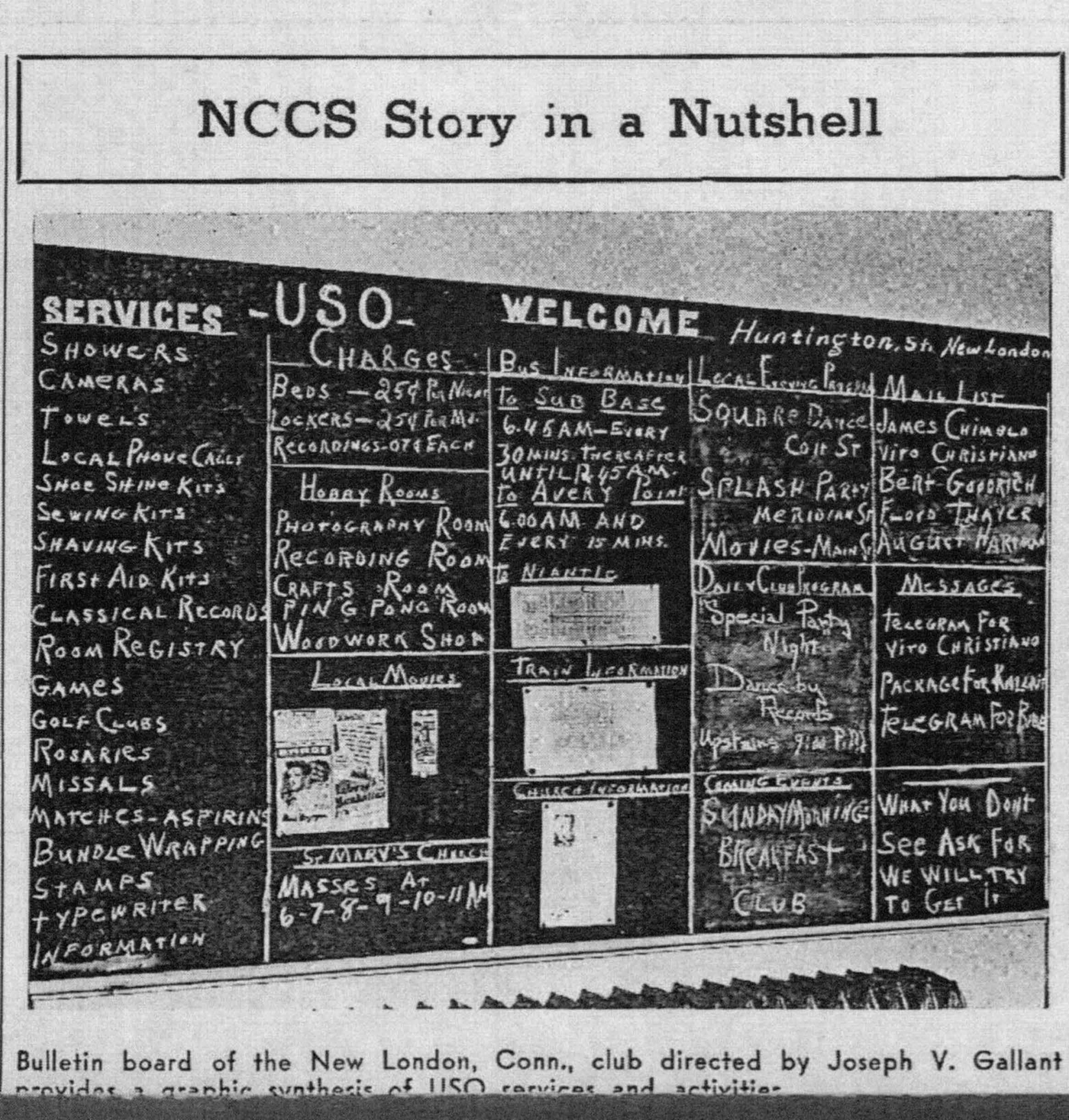
In the early 1940s the NCCS was just one of several religious organizations preparing to insert itself into this drama.Footnote 18 Pressed by the War Department to collaborate more than they had in World War I, the groups soon joined together as the United Service Organizations (USO).Footnote 19 The USO framed its job as a complement to the military chaplaincy, which was perpetually overworked and understaffed and which operated under a strict military chain of command.Footnote 20 They sought to establish social clubs, which would provide opportunities for wholesome activity, religious influence, and moral guidance for both war workers and military personnel during their leisure time (Figure 2).Footnote 21
Chalkboard listing services at an NCCS-run USO club. From The NCCS Bulletin II, no. 3 (May 1943), New York Public Library Archives, 4.
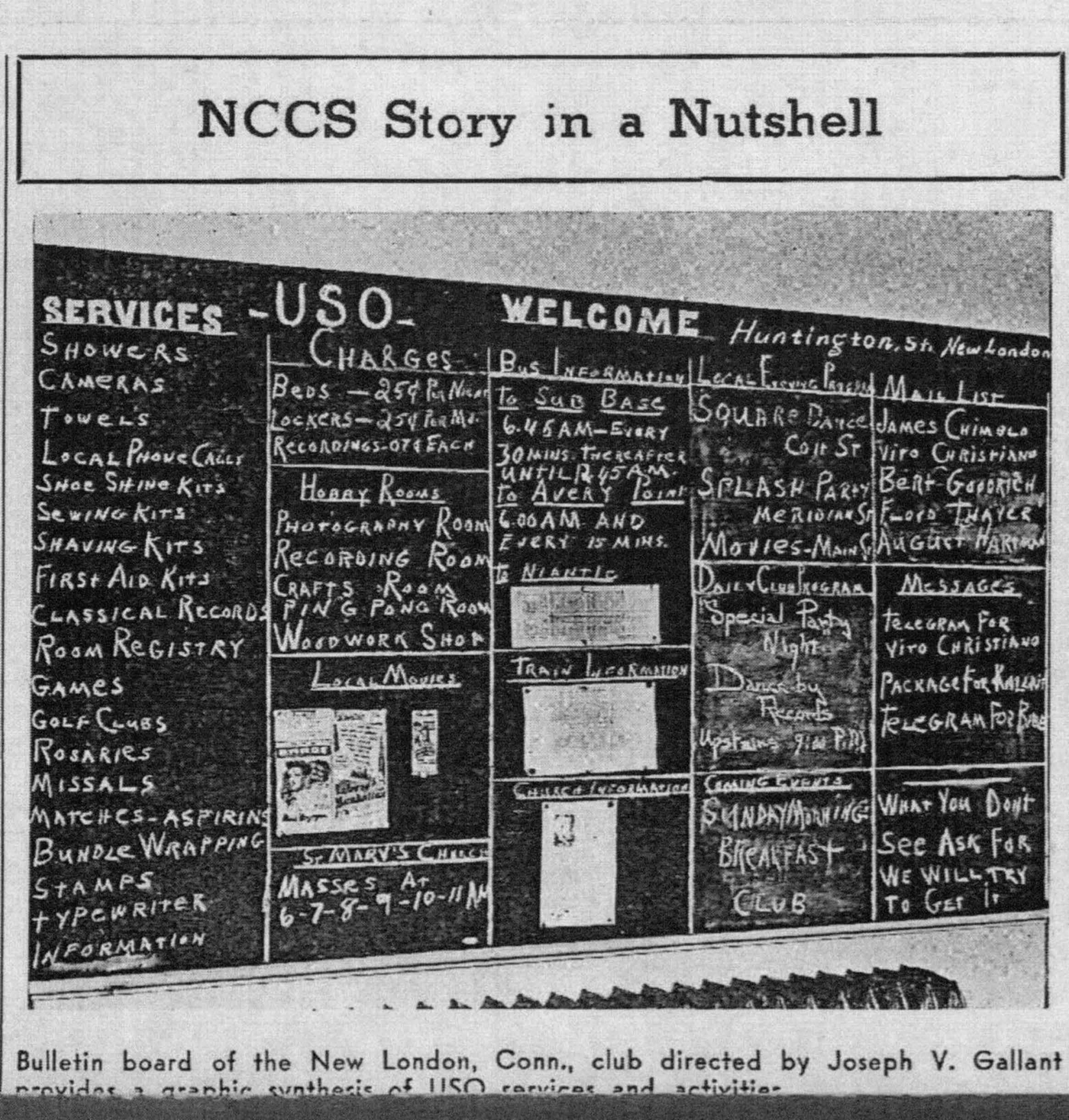
“Home” became the primary organizing motif for these clubs. They were stocked with reading material, comfortable seating, games, and the tools for hobbies and tinkering. The atmosphere was intended to be adaptable. If an industrial plant worker needed housing advice, she should be able to find it. If a private was lonely and needed conversation, the staff at the USO club could fill the gap. If another simply wanted a place to be alone and paint, the USO club had the space and supplies. If a local pastor or rabbi wanted to advertise services, the USO bulletin board would be available. Showers, fruit, telephones, letter-writing supplies, and coffee were among the most attractive amenities.Footnote 22 Senior hostesses were instructed to act as nurturing mothers, while junior hostesses offered stimulating conversation, endless dances, attentive listening, and a whiff of romance.Footnote 23 If camps and barracks were impersonal and bars degrading, USO clubs could be a “home away from home.”Footnote 24
This home front religious collaboration, which began as a practical necessity, immediately became an ideological weapon in the fight against Nazis.Footnote 25 Historian Kevin Schultz notes that President Roosevelt reveled in the collaborative aspect of the project, calling the USO's religious diversity “a perfectly magnificent thing.”Footnote 26 Even the NCCS celebrated this dimension of the USO, at least in its public pronouncements. In a fourth-year anniversary pamphlet the agency proudly quoted an article from Catholic World praising the NCCS, which, through its “close cooperation with those of other religious beliefs,” added “something new” to the “Catholic banner of service in this war.” Likewise, they flaunted the summary of the Religious News Reporter, which described the USO as “the greatest example of cooperation among religious groups that the world has ever witnessed.”Footnote 27 It was a remarkable effort indeed. By 1944, the number of USO clubs had increased to 3,035. In that year, one million men and women passed through their doors each day.Footnote 28 The NCCS counted more than 250 million visitors in more than five hundred NCCS clubs over the course of the war.Footnote 29
But beneath these Americanist themes, Catholics of the NCCS worried profusely about the limits and meanings of their collaboration with protestants, Jews, and the government. On the one hand eager to participate in the ideological and financial windfalls of the USO as a collaborative agency, Catholics also chaffed at the constraints placed upon the NCCS. The history of the NCCS reveals many points of friction related to Catholics' insistence on the essentially and distinctively Catholic nature of its operations. NCCS officials agreed to join the USO uneasily, and with the frank commitment to avoid any activities or arrangements that might suggest the appearance of an equivalence of Catholicism with protestantism and Judaism.Footnote 30
They lobbied the board for less central oversight, sought to house NCCS clubs in church (rather than government) buildings whenever possible, and even prohibited Catholic literature from appearing on the same shelf as Protestant or Jewish texts.Footnote 31 They routinely threatened to leave the USO if its religious operations became too muted. “It was repeatedly declared,” remarked the organization's historian in 1949, “that if the whole USO enterprise could not be put on a higher level than mere recreation, the NCCS had no interest in it and would withdraw in order to carry out a program on its own.”Footnote 32 If the financial boon of the USO desiccated this threat, their relentless focus on the Catholicity of their efforts did aim to signal to fellow-Catholics and others that USO pluralism had its limits.Footnote 33 USO expectations of relatively anonymous clubhouses and subtle religiosity threatened Catholics' sense of themselves as exceptional.Footnote 34 In some cases, Catholics' insistence on their religious mandate alienated others. The NCCS “received numerous complaints from various quarters” related to the centrality of its “religious objectives.” Complaints about NCCS clubs included the aggressive dispersal of Catholic literature, overly zealous club leaders, and the obtrusive performance of Catholic ceremonies in the clubs.Footnote 35
It is worth noting here that Lynn, the author of the organization's one and only history, who was then graduate student at Catholic University, trumpeted these conflicts between Catholics and the USO. In close contact with the organization's leaders as she wrote, Lynn focused attention on Catholics' uneasiness in the USO and its relentless attention to its religious mission. In the process, her work signals the ongoing anxiety among a certain sector of influential Catholics about the threat the war and its memory posed to Catholic exceptionalism. They wanted everyone to know that Catholics' participation in the USO did not mean that their religious mission had been watered down. Pluralism was acceptable when it bolstered the U.S. cause against Nazi intolerance, but Catholic leaders continued to cherish the idea that their tradition offered the country its best hope against a perilous future.
V. Contact: Ensuring Catholic Presence Overseas
As proud of their USO clubs as they were, NCCS leaders understood that these venues alone could not Catholicize the war. They wanted Catholic presence to extend beyond the confines of the United States and to reach not only Catholics who were preparing or returning from battle, but also those in the midst of it. This feeling was even more pressing in light of the Red Cross's unparalleled access to Catholic men overseas. A 1943 fact-finding mission to Britain confirmed the feelings of NCCS officials back home: “The wonderful social work of the American Red Cross can not take the place of American Catholic work for American Catholic soldiers.” Raising the stakes, they drew on a British bishop's witness to argue that the “future interest of the Church in the United States” depended upon “direct intervention of American Catholics in the daily lives of their young American Catholics in or near the fighting line.”Footnote 36 Stateside, they reasoned, there awaited thousands of volunteers eager to help address the challenges that Catholic chaplains and overseas dioceses were straining to meet.
Seeking to avoid complicating its infrastructure, the government persisted in prohibiting the NCCS (and all other USO agencies) from combat-zone operations. In the ensuing years the organization opened a few overseas clubs—in liberated Rome, for example—but not in combat areas, where they most urgently wanted to be present. The NCCS resolved to make Catholic presence known overseas by other means. Contact, the troop-oriented newsletter jointly produced by the Holy Cross Fathers and the NCCS, was one tool in this effort. The newsletter's title perfectly captured the anxieties attending the diffusion of U.S. Catholics around the globe in the company of non-Catholics. The journal aimed to mitigate the effects of this dispersal, providing dedicated Catholics with helpful instruction and inspiration amid the challenges of a multi-faith and morally questionable environment. The journal sought to be “a kind of spiritual blood bank stimulating the flow of strengthening graces” throughout the armed forces. In return, those writing in with their stories offered editors at home and readers abroad a way to detect “the presence of healthy blood in the veins of that part of Christ's Mystical Body in uniform.” More than any other wartime source, Contact signals the robust parallel conversation Catholics were having in relation to emerging pluralism.
There was something special, irreducible, and triumphant about Catholicism; Contact took it as its mission to explain and advertise this fact so that military personnel and anyone else reading their pages could be prepared to preserve and extend Catholic influence over the war and the country in its aftermath. The pages of Contact revel in the triumph of Catholics' good example, sacramental potency, and moral and military might. If Catholics did undergo a “rite of passage” toward assimilation, this ran exactly contrary to what “Contact men” were supposed to want from the war.Footnote 37 If anything, the rite of passage they hoped for was something closer to the purifying “sounding [of] spiritual depths” Mack described in its pages. Tested by war and the pagan military environment, Catholics would be renewed in their faith and more deeply convinced of its unique and essential role in ensuring America's future. Beyond this, the war could bring wayward Catholics back into the fold and attract Protestants and Jews to the truths of Catholicism.
One of the key arguments published repeatedly in Contact laid out the case for Catholics' special preparation for the challenges of war. Although certainly difficult and painful, the threats of war were not all that bad when put into the proper perspective. One Contact story, “Killing Our Own,” vividly illustrated the point. “Killing Our Own” is a remarkable little note, especially because by 1945 Allied soldiers and their leaders had become acutely aware of the serious risks of so-called “friendly fire.”Footnote 38 The piece opened with a description of disasters of friendly fire, including recent incidents at Normandy and the invasion of Sicily. But it quickly moved in a different direction. “While you're feeling indignant,” it scolded, “give a thought to the more widespread and worse killing of our own that is going on in every camp and station all over the globe.” The killing of greatest concern was not from bombs from one's own airplanes, or even from enemy attack, but from soldiers' “dirty stories” and “drunken spree[s].” Dirty stories, the piece warned, send “up a murderous flak to choke the life of Christ from men's souls.” Likewise, those Catholic servicemen who had time for boozing but not for mass and confession killed their own through “bad example.” Friendly fire had been spiritualized. The war's moral stakes exceeded its threats to the bodies of America's soldiers. Catholic disciplines offered the best antidote to the moral degeneracy so frequently diagnosed among America's troops.
Catholicism provided the ultimate spiritual corrective to misperceptions about the stakes of the war. In an undated edition of Contact entitled “Building for Tomorrow,” the editors explained Catholics' opportunities to put suffering and death in perspective. “Face the facts! You're fighting a terrible war,” they began. Instead of mere acquiescence or outrage, Catholics had the means to “capitalize on their suffering by using it for what it is worth.” Agonies of war were, on the supernatural level, simply reminders of the “pain in Christ's body.” Those sleeping in “fighting holes with water collecting at the bottom” could recall that “Christ ‘had not whereon to lay his head.’” Those fretting with “the fear of death” could take solace from the fact that “Christ sweat blood at the vision of his coming crucifixion.” More than simple divine commiseration, this theology of soldierly suffering joined sufferers with Jesus on the cross.
Immersed in this mode, the ideal U.S. Catholic could come to “gladly” accept the suffering of the war “as a means of reparation to Christ for your many abuses of the graces He has brought you.” He could, like Christ, take on his “buddies' sins” too. “The way to Calvary was traced in blood,” the editors wrote. War roles were “only a channel in which love is poured, a setting in which love is lived.” Love like Jesus' was available especially to Catholics whose theology of suffering helped them understand with unique clarity the need for pain. The Catholic GI who “spreadeagled over a Jap grenade just before it exploded” did so because “he knew that the fellows on the other side of him weren't in spiritual shape to meet God.”Footnote 39 Rather than religious leveling, it was this “supernatural” work, made possible by a distinctly Catholic theology of suffering, that would really beat “down the one big barrier to lasting peace.” If Catholics were asked to reach across inter-religious boundaries with “strong manly fellow-love,” they were to do so with the saving tools of Catholicism in their hands.Footnote 40
The war, in Catholic writers' hands, was an opportunity to extend their influence as America's best hope in a tumultuous world. Catholics, Contact's editors insisted, are responsible for their brothers' souls; anyone in dereliction of this duty whether through “bad, or indifferent, or weak-kneed Catholic life” should be prepared to hear Christ deny them at the gates of heaven. Each troop's true apostolate was likened to that of the chaplain: “make Christ the King of every heart.” The war itself opened up possibilities for leadership that should not be missed: one issue relayed the story of an exemplary marine who slyly discovered who in his barracks was Catholic by asking him his blood type and reaching for his “dog tags,” ostensibly to check. If he spied the little “C” (letters indicating religious affiliation were added so that burial rites might be properly administered), he knew he had found a fertile field. But the outreach work of good Catholics extended beyond their co-religionists. Another unnamed exemplar exulted in the “open field that existed” in the military for the “spread of Catholic life.”Footnote 41 “If Contact men seized the opportunity presented to them, very much good may yet be drawn from the appalling evil of this war,” the editors instructed.Footnote 42 The stress and strain of war promised to make Catholic outreach even more effective.
Contact did make concessions for the diverse environment of the military by offering specific advice about how “Contact men” could ensure maximum impact without alienating their buddies with a superior attitude. One need not be a “religious nut” or a “saint,” they advised. Simply lead by example. Be liked and respected among your peers. “You have to be ‘in’,” the “Pointers for Leaders” advised, “and if you're not, you have to work yourself ‘in.’” The plan included “doing the ordinary things of life as other men do them,” being “one of the gang,” and being not only accepted but “wanted.” If your fellows were indifferent about you joining them at an event, “this is about the worst thing (short of expressions of dislike)” that they could feel about you. Having established their credibility as regular guys, “resourceful” Catholics could then go about transforming their environment in unobtrusive but powerful ways.
The military's common spaces provided myriad opportunities. Instead of saying one's nighttime prayers laying down, one could make a habit of kneeling on the floor before bed. Aware of the power of such demonstration, one unnamed ensign complained that Catholics preferred to keep any prayers to themselves. “I've yet to see one Catholic besides myself get down on his knees before hitting the sack,” he explained. “Catholics often don't know or just don't care to show that good example,” even telling stories “just as filthy as any other.” Noting this crisis of Catholicization, the editors thought the hyper-masculine environment of the military might be a stumbling block. But instead of critiquing masculinity, they doubled down. “There is nothing soft or sentimental” about prayer, they assured their readers, “nothing ‘old womanish’” about it. Even the “virile,” “genuine hair-chested he-man” could pray; after all, prayer is nothing but “straight-from-the-shoulder, reverent heart-to-heart talk with God.” In fact, because it unleashes “a roaring powerhouse of God's grace,” prayer is “the most manly act a he-man can perform.”Footnote 43 Good Catholic action did not mean abdication of American manhood.
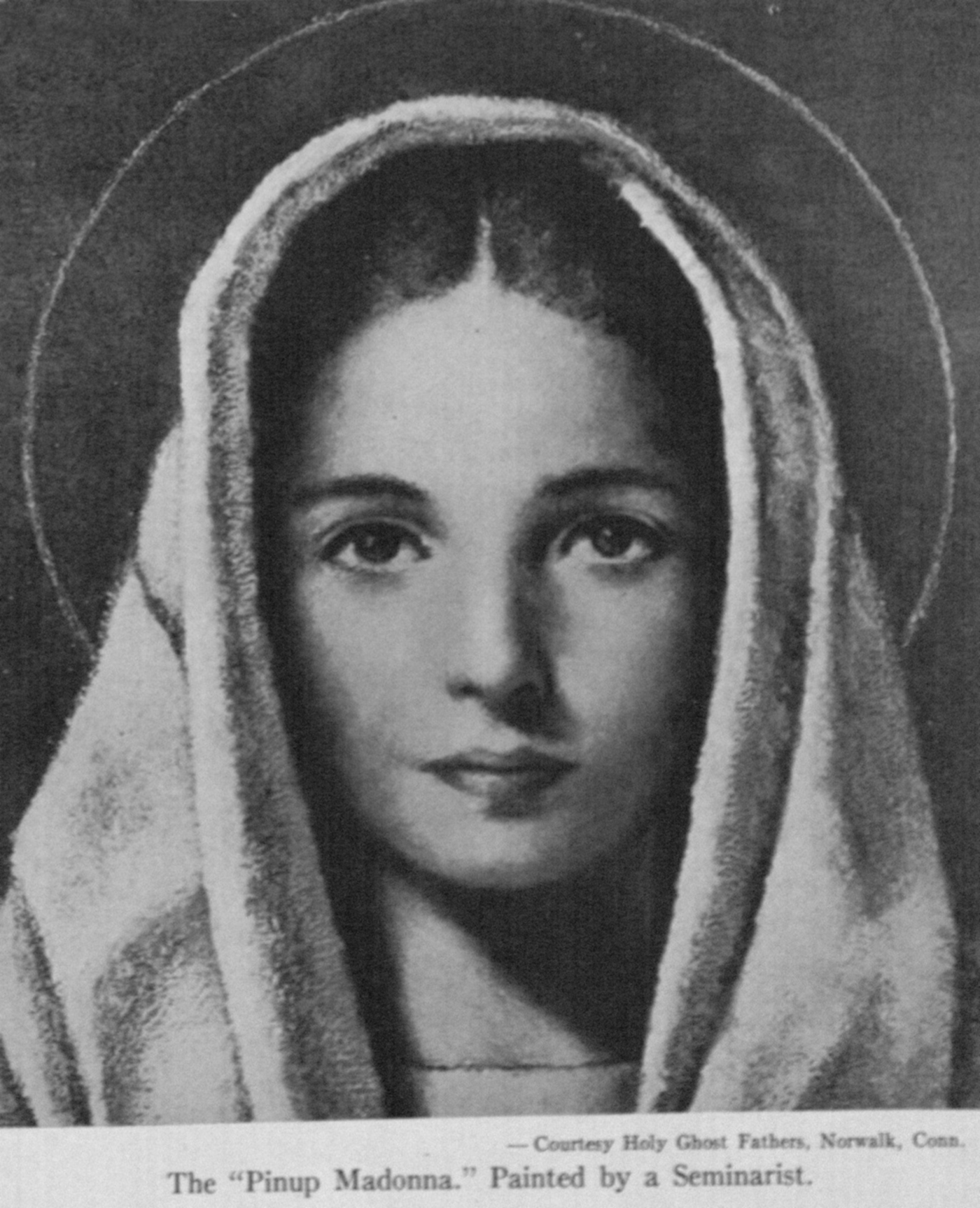
Acceptance of the standards of masculinity came along with suspicion about its abuses. Readers of Contact were repeatedly reminded about the proper dignity and purity of women, epitomized perfectly by the Virgin Mary. Images of the Madonna, whether on holy cards or medals or simply in the imagination, offered Catholics the chance to remind their fellows that women did not “exist merely to satisfy men's desires.”Footnote 44 Whereas the chastening presence of “wives, mothers and sweethearts” was “hard to bring into the barracks,” Mary was always “at your side ready to help.” Catholics could “give her a thought” and get ample defense from the “ack-ack of filthy stories, hot times, etc” (Figure 3).
“Pinup Madonna” featured in Dorothy Fremont Grant's War is My Parish (Milwaukee, Wisc.: Bruce Publishing, 1944). Used with permission of the U.S. Provincial of the Congregation of the Holy Spirit.
The editors were confident that dedication to Mary could transform the barracks. Playing out this possibility, they constructed a narrative about the devotion of (a seemingly fictional) “Mac” who had quickly transformed the “smart guys” and “big boys” who were “sexually in the know.” Mac began excusing himself from dirty chat sessions and praying the rosary each morning and night. While outwardly dismissive, Mac's imagined fellows actually “admired” him “down deep.” Soon a few of them came around.
Mac hadn't done it alone. If “sweethearts” were not, like Mary, a “great spiritual force” able to “keep your soul in A-1 shape,” their presence in Catholic men's lives, through pictures or memories, could have the same effect. “Mac” had begun his devotion to Mary when he had suddenly thought of his girlfriend during the usual degrading chatter about women. After rededicating his life to Mary, Mac had taken down the pictures of “pin-up girls tossing fire in his eyes” and replaced them with a picture of “his girl.” Seeing that photo, the editors explained, carried Mac back to his devotion to the Blessed Virgin.Footnote 45 Because they had special and unapologetic access to Mary, Catholics had the opportunity to build the kind of spiritual love triangle that could redeem not only the self, but the military and the home front as well. Contact offered a powerful means for reminding dedicated Catholics that their responsibilities in the war extended far beyond winning the fight against the nation's enemies. Myriad threats at home and in one's own soul called out for the application of Catholic moral and spiritual solutions.
VI. Sacramentals: Catholic Bridges Across the War
As this last story indicates, moral example, religious outreach, and a proper attitude toward suffering were important, but these were simply outgrowths of the most important tool in Catholicizing the war—sacramentals. These special objects and prayers—which obtained spiritual effects by channeling the prayers of the entire church on behalf of their users—were the best means Catholics had for ensuring a distinctively Catholic presence in the war. Others had some share of good morality, patriotism, and bravery, but Catholics cherished their special access to objects and prayers that promised profound spiritual benefits, from which these other goods would flow.
Crucially, sacramentals operated outside of the presence of a priest and the even-more-reliable sacraments they administered. As a kind of lesser sacrament, these objects and prayers offered the spiritual potency of the church without the formality, personal exposure, and time commitment associated with mass and confession. Sacramentals were therefore uniquely adaptable to the conditions of war, when access to a Catholic chaplain could be limited or simply unwanted. Moreover, as objects and utterances, the experience of sacramentals could be shared across time and place. The “mass clock prayer” is a perfect example, since it aimed to link Catholics in a sacramental chain that circled the globe and transcended time. But medals and rosaries could have a similar effect: fingering the beads or feeling the bump of a medal against one's chest offered tactile links to others experiencing the same thing in other places and times. The intimacy, autonomy, and potency of these objects and prayers gave them a special place in the Catholic war effort.
The sheer numbers, fastidiously documented and actively publicized by the NCCS, communicate this fact quite clearly. While Contact was crucial, it circulated at its peak about 100,000 issues each month.Footnote 46 Even more impressive is the number of religious objects transferred to Catholics through the work of the NCCS. From 1941-1946, the NCCS delivered approximately 4.3 million rosaries to military personnel both at home and abroad. Another 12.6 million prayer books and missals went out over that same span, in addition to 12.2 million pamphlets, leaflets, and booklets (Contact included); 4.3 million medals; 4.8 million “miscellaneous items;” and millions of other objects including Christmas cards and crucifixes.Footnote 47 Altogether, the NCCS counted a total of sixty million items delivered between 1941 and 1947. Spread evenly, this would equal about twelve individual items for every single Catholic in the service.Footnote 48 Even with all this effort, the organization's leaders routinely noted that they could never fulfill all the demands placed upon them by military chaplains and average soldiers alike.Footnote 49
The NCCS eagerly counted and reported on the quantity of objects distributed during the war. But they also published descriptions—in staff bulletins, in missals and prayer books, and in Contact—of the impact that these objects might have if used properly. These descriptions often highlighted the ability of Catholic sacramentals to build spiritual bonds between men and women displaced by war and the people they had left behind. One method connected loved-ones out of temporal reach through “spiritual bouquets.” Over the course of the war Catholic chaplains and the NCCS staff routinely encouraged service men and women to say novenas or receive communion as a spiritual investment of sorts into the storehouse of grace.Footnote 50
These investments, through the intention of the donating Catholic, could be directed to radiate out elsewhere. Mothers were the prime recipients of these bouquets, which were announced through the delivery of pledge cards signed by their sons or daughters at work on the war effort. Each card, the agency's Bulletin confirmed on Mother's Day 1943, would “bring immeasurable consolation to those who will receive it.” According to the Bulletin, this consolation was as much a signal of the persistence of Catholic influence over those displaced by the war as it was a matter of spiritual graces conferred. The cards offered “reassurance that years of careful religious training at home and in school are not being undone by the distractions of military service.” There were other benefits as well. The Bulletin, which was directed toward staff at NCCS facilities, wanted its readers to know that the 500,000 cards the NCCS planned to send out in May 1943 were also important markers of the “spiritual vitality of USO.” If these club leaders cooperated, sacramental objects would provide powerful evidence that war could not upend Catholicization.Footnote 51
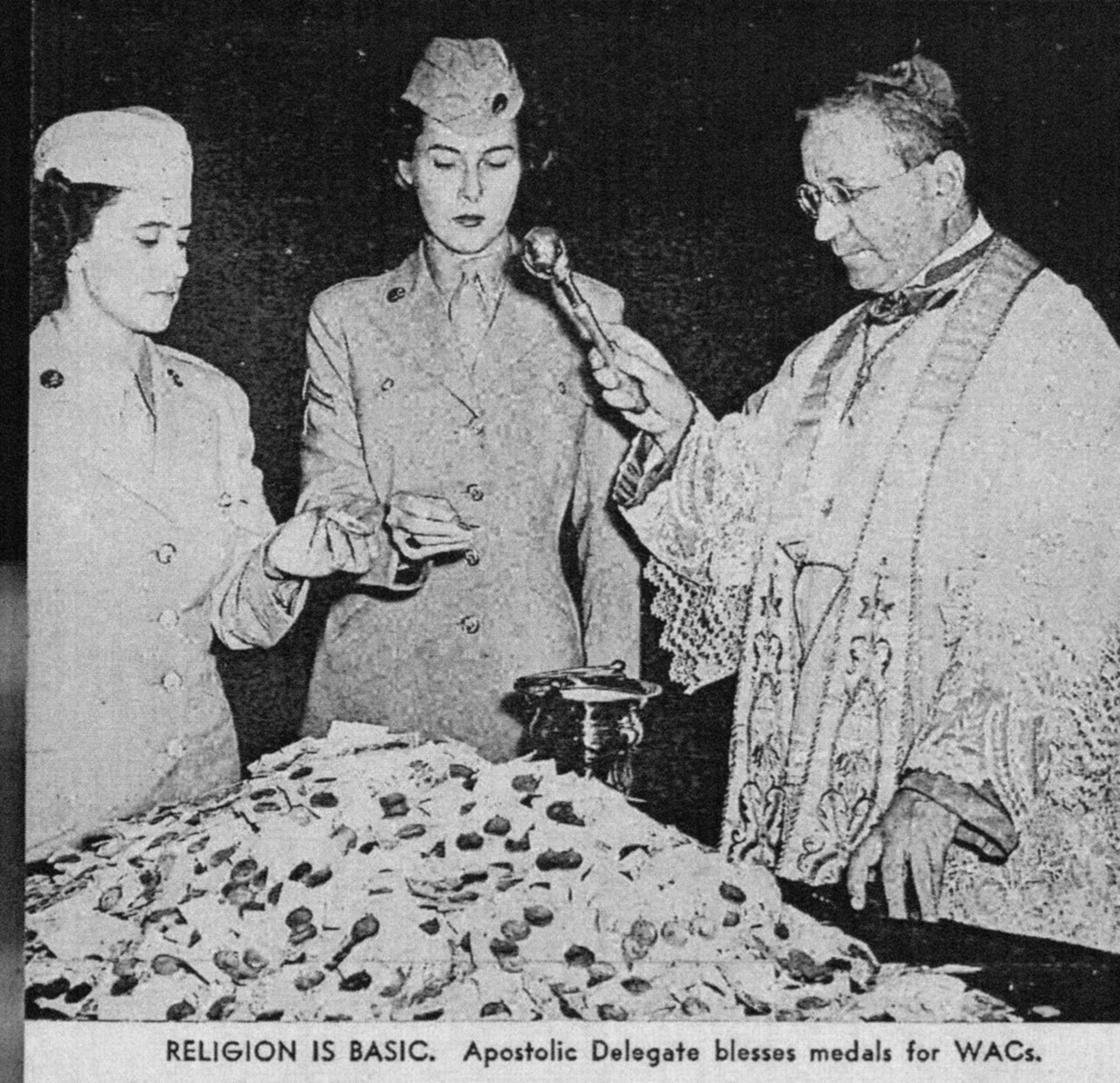
Holy medals were another important source of Catholic outreach. Catholics understood the distribution of medals to service members, especially those in combat settings, to be an essential duty of their wartime effort. A photograph and caption for the July 1943 NCCS Bulletin expressed the concept with clarity: in the photo two members of the Women's Army Corps look on solemnly as an “apostolic delegate” sprinkles holy water on a pile of medals bound for their fellow WACs. “Religion is Basic,” reads the caption.Footnote 52 The simple consonance here of holy medals with “religion” suggests the extent to which Catholics saw their distribution and use of sacramentals as fundamental to the war effort (Figure 4).
A vast pile of medals is blessed before being distributed by the NCCS. From “Homefronters Today . . . Homemakers Tomorrow,” The NCCS Bulletin IV, no. 4 (August 1944), New York Public Library Archives, 2-3.
Contact elaborated on this theme in a “best-of” edition entitled “Things Catholic at War.” In a section on “Medals and Dog Tags,” the editors explained the purpose and power of medals for the Catholic serviceman and those around him. First of all, medals were important because they “tell everyone you're a Catholic.”Footnote 53 Life in the military entailed bodily exposure, and just as kneeling to pray could communicate devotion, those wearing a medal while showering or shaving could help combat the “deadening pagan influences which are all around us.”Footnote 54 But those wearing medals should be reminded of the responsibility they took on by doing so. A medal no more made you a good Catholic than a dog tag made you a good soldier. There were those, the editors reported, wearing medals depicting the Blessed Virgin, who retained “a few inches down” in their hearts “a desire to treat a girl . . . as though she were not a Temple of God.” Likewise, those with Christ “beaten and crowned, bleeding and crucified” around their necks could violate the sacramental by failing to live up to Christ's example. “Softies in sin, gold-brickers at work, chaplain-dodgers, verbal-garbage slingers” undermined the example of Christ, “the epitome of courage and moral strength.”Footnote 55 In this way, sacramentals functioned as “reminders” of moral, patriotic, and spiritual duties as well as inspiration to “live” and not just “talk” or “pray” faith.Footnote 56
But “the Square G.I.” who “lived up” to his medals, also had the opportunity to gain the benefits of the “tremendous prayer-power—power of the Church praying” for himself. The church “ask[s] special favors and helps for the wearers of its insignia,” the writers explained. Recognizing the likely critiques, the editors aimed to convince readers of the reasonableness of this system: “It's not silly—it's not superstitious,” they protested. Just as a uniform earned its wearer “favors and priorities” unavailable to civilians, Catholic medals—the “Catholic Identification Tag”—did “the same in a spiritual way for the Catholic G.I.” This worked in part because although to the uninformed Jesus, Mary, and the saints were “dead,” they were “alive and powerful to you who can see as far as the stars.” These holy figures were also steeped in suffering, which helped them understand the struggles of the average soldier. They had “sweated out life's battle just as you are doing now.” Faithful Catholics could be sure they would “give you a hand when they see you carrying their pictures around your neck.” Here a narrative of interpersonal care augmented the relatively impersonal notion of the power of the “Church's prayer” attached to medals. Metaphysical reflections on the circulation of grace came to rest on a more relational and familial set of explanations. A third party, the women of the home front, completed the relational network: “If you don't have a medal, ask your girl or your mother to send you one, then have your chaplain bless it.”Footnote 57 Catholic objects became the bridges connecting church, soldiers, and home.
The rosary, perhaps more than any other object, served the effort to Catholicize the war. “The rosary,” the NCCS advised, “is a GI's prayer.” Rather than an “old woman's prayer” or a “moron's prayer” it was a “fighting prayer, because it has won battles and stopped wars.” The editors gave the rosary credit for several important moments in Christian history, including the defeat of the Albigensian heresy and the halting of the Turks, which “left us with our religion and wearing hats and pants instead of turbans and towels.” It accounted for the persistence of Ireland's Catholicism and the apparitions at Lourdes and Fatima. Stretching the battlefield metaphors so common to this genre, the editors even suggested that the rosary “catches God, so to speak, in crossfire.” Providing “quick contact with God through his mother,” the rosary could also “keep you ready” in case “it's your time to die.” More practically-speaking the beads and rhythms of the prayer could be a great help in lonely or fearful moments. The “mysteries” of the rosary could “keep your mind active” for the night watch, and the “beads slipping through your fingers could help to keep you awake.” Its steady cadencies, especially when said in a “team,” reminded the authors of a march: “Everyone knows where he's going. There's no halting, about facing or back-tracking. It's a sound of marching feet through heaven” (Figure 5).Footnote 58
An NCCS senior hostess in Alexandria, Va. prays the rosary with a private from Brooklyn, NY. The NCCS Bulletin III, no. 6 (May 1946), New York Public Library Archives.
Soldiers wrote to Contact to confirm the potency of the rosary. One Technical Sergeant wrote to describe a sixteen-day ordeal in a life raft after a plane crash. According to his reckoning, most of the stranded soldiers were not “deeply religious.” But their dire conditions and the presence of “Ed's rosary” inspired them to say the prayer daily. He was certain that “Ed's rosary saved us.” Another sergeant explained that since a small group of his unit had begun saying the Rosary each day “not one of us has been hurt seriously.” More modest stories circulated as well. A private wrote to explain that he was thrilled suddenly to discover, after having been to the sacraments three weeks in a row, that his “stand to” duty was a “grand opportunity” to say “night prayers and the Rosary.” The prayers made the work lighter and the hour quicker, leaving the private feeling “refreshed.” Another private wrote from a Los Angeles hospital having lost a foot to frostbite and contracting gangrene. “The Rosary,” he reported, “has been one of my greatest consolations.”Footnote 59 The NCCS Bulletin reported enigmatically on a stateside visit of a Navy combat veteran to an NCCS club:
Looking up at the Crucifix in the Director's office, he began talking, to no one in particular. “You don't know what it is out there. Confession sometimes takes a while, because you have to stop to pick off the snipers, but the padre understands. The guns keep firing as you stand at Mass. You have a revolver in one hand and a rosary in the other.”Footnote 60
The story stands alone in the Bulletin, trailing off without additional commentary or explanation. The veteran's vacancy, emotional distance, and perplexity are counterbalanced by the presence of the sacraments, just as the gun in one hand is balanced out by the rosary in the other. More than a celebration of the Catholic contribution to the war effort, and more than a Catholic endorsement of the American war aims, the story speaks to the relentlessness of Catholics' sacramental desire and the success of Catholic efforts to feed it.
Catholic objects also worked as markers of Catholic distinctiveness, and, in the eyes of some, of Catholic superiority. As one Army officer put it, “the Catholic soldier has it all over the non-Catholic lad simply because he has an ‘ace in the hole’—his rosary.” Whether under the pillow, in his pack, or in his bedroll, the “beads” offered Catholics a “tremendous morale factor.” “What a comfort! What a boost!” the officer enthused. The rosary provided more than reassurance; it offered confidence and self-possession: “You grab those beads and fall asleep trying to say them, completely satisfied that yours is the cause justified … You are a Catholic! You sleep. You are ready the next day—ready to go. You might even be happy about it.” Readiness extended beyond military maneuvers. Taking the example of medical surgery in case of injury, the officer identified Catholics as uniquely sturdy: “Our boys … don't question the ability of the surgeon, they don't wimper. They ask for the padre and let it go at that.”Footnote 61 The prayers and mechanisms of Catholic sacramentals, far from undermining Catholics' potential as American heroes, positioned them instead as uniquely courageous and tough, precisely what the country would need in order to secure the future.
The power of the rosary, however, leaked out beyond the confines of the Catholic community. One prominent theme in Catholic war stories was the observation of non-Catholics gaining respect for and even dependence upon the rosary. One sergeant, writing to Contact from the Seventh Army in France, added to the lore of the rosary when he related the story of an opium dealing, car stealing, former gambler in his unit. This gunner, a “veteran combat man,” once asked the sergeant about what he was doing with beads while out on watch. After he explained the basics, the unit as a whole became interested. As they battled their way through Italy, “many incidents occurred, not miracles perhaps, yet attributable to the guidance of the Blessed Virgin” whose presence the rosary invokes. Soon, the whole group “had rosary beads along with them” as the unit helped in the invasion of southern France. The miscreant gunner was later killed, the sergeant reported, with what he called his “Rose Beads” “around his neck.” The sergeant saw this non-Catholic's death as providential. Mary, he wrote, “helped a good thief recognize his mother.” Catholic example, and the sacramentals integral to it, had given this sinner a chance to be reconciled to his true spiritual home with Mary.Footnote 62
In a book entitled War is My Parish, popular writer Dorothy Fremont Grant gathered stories from the Catholic press to document the Catholicization of the war. Catholic objects featured prominently. None were more important than the rosary, which, crucially, had potency beyond Catholic circles. She relayed the story of a chaplain returning to base on a hobbled B-17 with wounded men on board. Having done all they could for the wounded, the chaplain and an “Irishman” decided to say the rosary together. As they did so, the plane's “Jewish gunner” crawled from his “bullet ridden cage in the tail” “to join us for a smoke and a chat.” Seeing the prayers in progress, the man did not retreat, but “pulled a miraculous medal from his blouse and held it tight.” Later, once the pilot had landed the plane, the “Jewish boy” explained that he “always carr[ied] the Blessed Mother with me.” More than a simple good luck charm, the medal had supernatural potency for this non-Catholic. “I know,” he reportedly confessed, “that she's the person who gets us out of these scrapes.”
Grant included other stories of non-Catholic use of sacramentals, including the story of a young corporal who told his mother of the remarkable “faith of the non-Catholic fellows.” Rather than appreciation of non-Catholic faith, the story revolves around others' appropriation of the rosary. “You may not believe it,” the corporal wrote, “but every last one of them with us here puts a rosary around his neck before we go out on our missions.”Footnote 63 Another G.I. reported a similar phenomenon, describing the men in his unit crouching “alone in the terrible darkness” of patrol. “Each lad,” he reported, mustered the “necessary courage” by clutching the “crucifix of his rosary.” “The broken, mangled body of Christ” offered strength to the “weary bodies of our boys.”Footnote 64 Non-Catholics' ability to appreciate the potency of the rosary offered remarkable evidence, for an eager Catholic audience at home and abroad, of the effective Catholicization of the war.
Rosary stories often involved the “good death” of Catholic or non-Catholic soldiers by virtue of their dedication to the rosary.Footnote 65 The story of Pat Morris was typical. This soldier had started a Rosary Club among his fellow soldiers while stationed at Vella Lavella in the Solomon Islands. But he had also written about the club to his pastor back home, whom he hoped could publicize the idea among “parents, wives or sweethearts.” These men and women could then write of the idea to their servicemen overseas, “and thus honor to Our Lady would increase on all fronts.” This kind of work assured Grant that when Pat Morris “approached the Great Divide” Our Lady “extended her hand.” According to Grant, death for someone like Pat Morris did not hold any terror, but only the promise of eternal proximity to God and the saints.Footnote 66
The rosary was an important player in many “good death” stories. Grant provided a particularly moving example when she described a Los Angeles-based chaplain watching from the deck of an aircraft carrier as the plane of a pilot friend crashed into the sea. Tears blurred the chaplain's vision as he began to read prayers of absolution over the plane sinking in the distance. Later he explained how the disaster took on the form of a decorous Catholic burial: “His plane was his casket, the sea the cemetery, his shipmates standing helplessly about became his mourners.” A treasured rosary provided the last piece when the chaplain took it from his pocket, “looked at it once more; kissed the crucifix for the last time and threw it overboard to make a Christian grave.” For Grant, the pilot's grave while “unmarked,” was profoundly “marked” by the sacramental presence of the Blessed Virgin.Footnote 67
Another chaplain garnered praise for having launched a popular Catholic confraternity from the Army Air base at Santa Ana, California. Father William J. Clasby reported receiving thousands of letters from the sixteen thousand members of the airmen's group, Our Lady's Knights of the Skies. Each member, in joining, had pledged to recite “at least one decade of the rosary daily.” Again this sacramental included recognition of a link back home: soldiers could take solace in the knowledge that “Holy Hour is offered at the base chapel at Santa Ana every Thursday evening.” The confraternity moved one member to pen a letter praying to Mary for a good death: “May my plane one day mount very high, very high right up to heaven. Take me then and make me quickly enter to be near you.” Grant offered elegiac confirmation of this wish, noting that his “earthly mother” opened the note after his death over North Africa. Grant suggested that the letter, and the spiritual state it revealed, were enough to help this unfortunate mother cope with her son's untimely death.Footnote 68
If this was perhaps not enough, Catholics found other opportunities in the sacramentals. In particular, the “act of contrition” aimed to put Catholics at greater ease in the midst of death. These prayers—to be uttered for forgiveness of sins when confession was not possible—offered full cleansing of the soul from all mortal sin. Unlike Confession, this cleansing was possible only if the prayer was accompanied not simply by fear of punishment for sin, but by perfect love of God and the deepest distress for offenses against God. Wary of setting the bar too high, the editors of NCCS wanted to reassure their readers that it was not so hard: “It is not easy and yet it is not difficult,” they wrote. It was even possible for non-Catholics to earn this forgiveness and grace if they prayed with pure motives. Catholics, then, were duty-bound by charity to “see that your buddies know about it.”Footnote 69 This sacramental made it possible for Catholics and non-Catholics to gain access to sanctifying grace at any moment.
War made this recognition a matter of grave urgency. “What if an enemy bullet had found its mark and you were left alone to die on the battlefield?” Contact asked its readers. “What if you had lost control of your plane? What if your ship was sinking?” What if all this was happening “and no priest was there to hear your confession?” Stories from the ranks confirmed the seriousness of the issue and spoke to the power of Catholic sacramentals. One corporal wrote of a GI heard over the radio on a doomed “flying fortress.” While others cursed and yelled and screamed, this GI “had the presence of mind to start an Act of Contrition.” While those listening on the other side knew the plane and everyone on it was doomed, the “calm and clear” voice of this Catholic GI “made a deep impression.” Another soldier's story may have given words to the meaning of this kind of impression. After he and a friend had been hit with gunfire, his friend told him to send his love to his mother and his “sweetheart” and then asked him to pull the “little black missal out of my hip pocket and read me the act of Perfect Contrition.” After his friend died, the author lay next to him for a whole day, until he could move under cover of darkness. “I've come back to God now,” the man told Contact.Footnote 70 Not only could sacramentals rescue you from eternal damnation, they could also radiate to transform those around you.
VII. Conclusion
Dramatic changes in Catholics' educational and class standing after the war have conspired to mute many aspects of the religious history of World War II. Focused on Catholics' surging college enrollments and suburbanization, Catholic war histories have in fact most often been histories of social changes made possible by new aspects of the postwar economic, cultural, and social arenas. However, the religious environment within which Catholics conducted their wartime work was just as important. Triumphalism, moral exceptionalism, and sacramentalism defined the contours of a very robust effort among Catholic leaders to Catholicize the war.
Given the overriding consensus about Catholics' post-war assimilation and the rise of religious pluralism, exceptionalist Catholics from the war years might be easily dismissed as irrelevant. A broader and persistent tendency to remember World War II as “good” adds to the willingness to ignore Catholics whose exceptionalist tone undermines the harmony historians expect to hear from the period. Moreover, Catholics did sometimes join the chorus of pluralist voices. As the “Judeo-Christian” idea gained momentum as an ideological weapon in the fight against Nazi intolerance, many Catholics jumped aboard. Catholics would not be wholly left out of the “Judeo-Christian” consensus. If they wanted to participate in the national conversation about America's future, they had to learn to speak this way. But records of Catholic organizations and the popular texts they produced during the war indicate a deep uneasiness, subtle undermining, and often overt rejection of this way of thinking about America and its religious future.
Evidence of war-borne assimilation and the rise of pluralism among Catholics must take account of the opposition or undermining of these values echoing from Catholic sources during and after the war. Assimilation and pluralism become much more interesting and vexed categories when understood to have arisen against a backdrop of official exceptionalism.Footnote 71 Attending to these discordant voices not only provides a richer understanding of wartime religion, it also reframes the experiences of the postwar era. It highlights the fragility of pluralist impulses, and helps make sense of continuing American Catholic exceptionalism after the war. It also undermines the idea, nearly enshrined in our national histories of World War II, that fighting a common enemy inevitably brings people together. In some cases it provides a chance to observe and try to transform them.
Historians Kenneth Rose, Thomas Childers, and John Bodnar have led the way in revisiting the history of World War II after a number of overtly celebratory accounts gained cultural prominence in the 1990s. Responding to the vastly popular works of Stephen Ambrose and Tom Brokaw, and attending to postwar cultural strife as well as the skeptical novels and memoirs of veterans and their children, these historians complicate the baldly triumphal “Greatest Generation” account of World War II. Their work seeks neither to diminish the threats facing the United States in the early 1940s nor to deny the bravery and sacrifice of America's war veterans. Instead these authors aim to “humanize” the war generation and gain perspective on their lives by acknowledging the struggles and complications of their time in the war and after.Footnote 72
One such struggle may have been the effort to reconcile their experiences of war with their religious leaders' expectations of them. Evidence from Contact, NCCS history and its Bulletin, as well as other important Catholic sources from the war suggest official disinterest—beneath the surface of anti-Nazi American pluralism—in cultivating robust solidarity with non-Catholic others. If postwar assimilation was truly as widespread as recent histories have claimed, historians may be justified in wondering whether the American Catholic exceptionalism which was so pronounced in Catholics' wartime publication was itself partly responsible for pushing Catholics away from an exceptionalist sensibility and toward a more pluralist orientation. If the severity of Catholic moral and spiritual exceptionalism could be tolerated and even embraced in peacetime, the difficult conditions of war may have helped undermine its message. When faced with a choice between worrying about the spiritual “killing” caused by swearing and drinking and the physical killing caused by accidents, guns, and bombs, Catholics may have found more congenial partners in their camps and barracks than in the lofty terrain of American Catholic moral and spiritual warfare. As Halsey states, there is “nothing wrong with having answers.” But when those answers run up so starkly against experience—as when fears are dismissed as petulant distraction from one's own sins—it would be surprising not to find “the quiet rumblings of discontent.”Footnote 73
Catholics' sense of newfound unity with others may have been a result, not of their hard-won acceptance by others, but of their own rejection of the model the church laid out for them. In this case, the exuberance of 1950s parish life amid the postwar “revival” would have existed alongside a submerged but vivid disaffection with American Catholic exceptionalism. Halsey identifies a similar combination of feelings in 1950s Catholic America as an “unholy mix,” troubling a select elite of sensitive converts and intellectuals whose voices gained prominence only in the early 1960s, when social and church upheaval amplified their concerns. But Catholics' gradual “dispossession” of innocence may have had roots as well in the unholy tragedies and ironies accompanying even “good” war. Awash in these conflicting forces, veterans and their families may have been carriers of the “disease” of uncertainty and fragmentation that Halsey diagnoses in a small subset of Catholic elites.Footnote 74 In this case, the stories of the phantom Catholics from Contact and other wartime sources—the Catholics who were not kneeling to pray at night, the “chaplain-dodgers,” and those telling stories as dirty as the next guy—may offer the most important, if obscure, passageway into a new religious history of the war.
But the conversation cannot stop there, for Catholic war efforts were not only characterized by moral and spiritual exceptionalism and its evasion, but also by a robust sacramentalism. In addition to communion, confession, and absolution—which were largely the province of chaplains—the eager distribution and accounting of sacramentals by the NCCS testifies to their importance in the broad-based effort to Catholicize the war. Investigating this aspect of wartime Catholicism exposes the flip side of the triumphalism so integral to much of Catholic activity during the war. Sacramentals did not reverse the harshness of Catholics' moral and spiritual exceptionalism. But understanding the eager trafficking, documentation, and embrace of Catholic sacramentals helps reframe those other activities as mechanisms of contact. Like sacramentals, they offered assurance that someone was watching out for the health and well-being of those displaced by the war. In both triumphalism and sacramentalism, each Catholic man or woman mattered, not just abstractly, but particularly and in a frame that was at once cosmic and interpersonal. If sacramentals promised to bring individual men and women into the entire church's flow of grace, Catholic triumphalism put the weight of the American future, and with it the future of civilization itself, on their shoulders. Both modes of Catholicizing the war hinged on the contacts they made possible. Study of these contacts—between people at home and abroad, between U.S. Catholics and Catholics of all times and places, between Americans and Jesus and the saints—will provide a foundation for a new religious history of World War II.