An overview of poultry production in Vietnam
Vietnam, a country located in Southeast Asia, has a small total land use area of approximately 33,095,000 ha, of which, approximately 10,151,000 ha is used for the agricultural production including crop land and animal raising land (GSO, 2013). With a subtropical monsoon climate, abundant water resources and regular long day lengths, Vietnam has favourable conditions for agricultural development including poultry production. Vietnam is listed among the countries where multiple domestication events of the Red Jungle Fowl may have taken place more than 7000 years ago (Eltanany and Distl, Reference ELTANANY and DISTL2010). Many statues of chickens in Vietnam, from the early Bronze Age and the early Stone Age have been discovered by archaeologists, showing the importance of chickens in Vietnamese civilisation (Vo, Reference VO1978; Higham et al., Reference HIGHAM, HIGHAM, CIARLA, DOUKA, KIJNGAM and RISPOLI2011). Poultry rearing in Vietnam was reported to have started in the Tam Dao valley and the mountain of Ba Vi, which currently belongs to Vinh Phuc and Ha Noi provinces (Duc and Long, Reference DUC and LONG2008). According to the perception of Vietnamese people, local poultry farming is not easily replaced by others since it requires low investment, has short production cycle, and high marketing value. Gradually, poultry production became a traditional occupation in Vietnam. In 2013, the General Statistics Office of Vietnam reported that the poultry meat production in 2012 yielded 724.9 thousand tons, and was ranked the second largest after pork. In addition, egg production in 2012 reached 7299 million pieces (GSO, 2013).
village chicken production systems
Traditional extensive backyard poultry production system, classified by FAO in 2004, which is defined as ‘village farming system’ by the Vietnamese Ministry of Agriculture and Rural Development in 2006 was by far the most common production system across the country (Burgos et al., Reference BURGOS, HONG HANH, ROLAND-HOIST and BURGOS2007). This system is practised by 84-85% of rural families in the Northeast-Northwest of Vietnam and between 42-71% of those in the Southeast-Mekong River Delta regions (Epprecht and Robinson, Reference EPPRECHT and ROBINSON2007). The system is continuous and considered to be small scale, with flock sizes less than 50 birds. Farmers remove birds from flocks either for self-consumption or for sale to nearby markets and urban areas through informal channels, while simultaneously introducing new ones (Ifft and Zilberman, Reference IFFT and ZILBERMAN2012). However, farmers hardly know exactly how many birds they own and rarely document. Their knowledge to rear chicken in this system is often passed from generation to generation (Duc and Long, Reference DUC and LONG2008). Rural families living in South Vietnam tend to keep more chickens in an intensive and market-oriented production system with higher inputs (Epprecht and Robinson, Reference EPPRECHT and ROBINSON2007). Burgos et al. (Reference BURGOS, HONG HANH, ROLAND-HOIST and BURGOS2007) proposed to divide this kind of system into two categories, the semi-intensive commercial poultry production system and the intensive industrial poultry production system. In this case, birds are selected to grow fast in small spaces and under a diet of concentrate feed. Some of final products are sold in traditional markets, but much of it is sold in supermarkets or to food companies. Mixed farming systems such as a garden-fish pond-chicken cages system (Viet Ly, Reference VIET LY2004) or an integrated crop-chicken production system (Devendra, Reference DEVENDRA2007), are also common in the rural areas.
local Vietnamese chicken breeds and their relevance
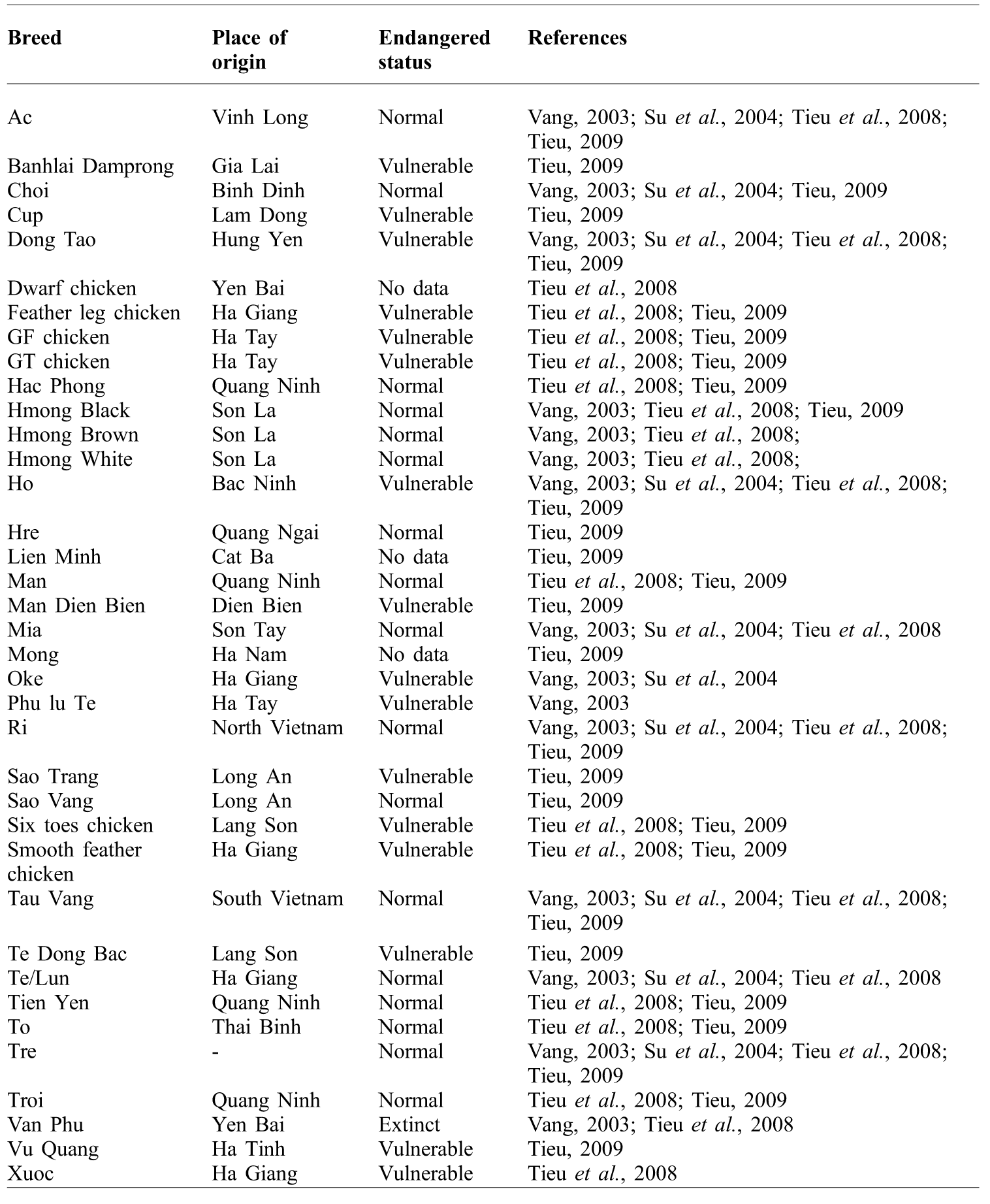
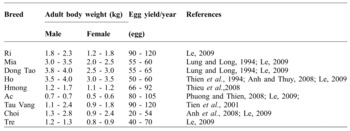
Backyard flocks represent around 80% of poultry stocks in many developing countries (Pym et al., Reference PYM, GUERNE BLEICH and HOFFMANN2006), and often consisting of free indigenous, unselected breeds of various ages, mixed in the same flock (Gueye, Reference GUEYE2005). Adopting the breed definition of FAO in 2007, Vietnamese researchers detected more than 30 native chicken breeds. Place of origin and the endangered status of these chicken breeds are listed in Table 1 with related references. The terms ‘normal’, ‘vulnerable’ and ‘extinct’ are used according to FAO definitions. These breeds are popular in either village farming or mixed farming systems. They vary in size but generally exhibit low performance (Minh et al., Reference MINH, LINDBERGE and OGLE2006; Duc and Long, Reference DUC and LONG2008). Local breeds start their productive life between the 28th and 32nd week (Teufel et al., Reference TEUFEL, MARKEMANN, KAUFMANN, VALLE ZÁRATE and OTTE2010). They grow slowly, generally require few inputs and are known for being able to handle a free-range environment (Ifft and Zilberman, Reference IFFT and ZILBERMAN2012). Adult body weight and egg production of some local Vietnamese chicken breeds with related references are described in Table 2. In 1998, Viet Ly reported that local Vietnamese chicken breeds made up more than 80% of the chicken population in the whole country and in 2007, local Vietnamese chicken populations still accounted for more than 70% of the country's total number of chickens (Hong Hanh et al., Reference HONG HANH, BURGOS and ROLAND HOLST2007). It is in accordance with the data of Tieu et al. (Reference TIEU, LY, SAT, CUONG and SU2008) who also reported that 75% of eggs are produced by local chicken breeds. Although the population of imported exotic chicken breeds and crossbreeds between local and imported ones with higher productivity (Vang et al., Reference VANG, XUAN, TIEN, NGA and HUNG2001; Coi et al., Reference COI, LONG and HOANG2006; Nga et al., Reference NGA, VANG, XUAN, TIEN, LONG and LOAN2006) increases year by year, the local Vietnamese chickens seem to remain popular and keep a wide diffusion role in achieving various goals of individual smallholders living in underdeveloped and underprivileged regions.
List of 37 Vietnamese native chicken breeds with origin and endangered status.

Adult body weight and egg production of popular local Vietnamese chicken breeds.

Conservation traditions of native Vietnamese chicken breeds
socio-cultural aspects
In several countries, poultry rearing and consumption are linked to socio-cultural factors (Aklilu et al., Reference AKLILU, UDO, ALMEKINDERS and VAN DER ZIJPP2008; Wilson, Reference WILSON2010). Particularly in Vietnamese agriculture, chicken is an indicator of civilisation and culture. Various local chicken breeds have appeared in Vietnamese poetry and folk paintings with the meaning of peace and prosperity. For hundreds of years, local chickens have been given as a gift for maintaining relationships that are not economic in nature but rather based on exchange and reciprocity which reinforces the social bond within the family and community. According to the Vietnamese historians, the peasants used to offer the specially raised Mia chickens (Duong Lam village), Ho chickens (Dong Ho village) and Dong Tao chickens (Hung Yen) to the King. They also give away a live backyard chicken to relatives and neighbours as a gesture to thank them for helping with agricultural work or as a special present to ill people. Meanwhile, the local chickens are also consumed as part of ritual and secular celebration. They are sacrificed for honouring the ancestors, for worshiping heaven and earth, for exchange related to marriage. Some traditional ceremonies of Vietnamese in the northern regions require a chicken with particular colour, such as Ri chicken with yellow skin (Moula et al., Reference MOULA, LUC, DANG, FARNIR, TON, LEROY and ANTOINE-MOUSSIAUX2011). Chickens that satisfy these unique requirements are the found at the local market. In addition, the local chickens obviously illustrate the rich human-animal relationship. Chicken ownership can be a measure of social status, competence and prestige of farmers in the rural area. Choi chicken is a classic sample. This chicken is raised to target traditional cock fighting events, held annually. Choi is selected for its strong shank with sharp heel. The performance of these cocks provides not only social entertainment, but also represents the owner's honour and strength. Furthermore, the importance of keeping backyard chickens for Vietnamese women has been reported in several articles (Cuc et al., Reference CUC, MUCHADEYI, BAULAIN, EDING, WEIGEND and WOLLNY2006; Burgos et al., Reference BURGOS, HINRICHS, OTTE, PFEIFFER-ROLAND-HOLST, SCHWABENBAUER and THIEME2008). Backyard chickens are generally accepted as one of the ‘women's capital’. Vietnamese women act as a day-to-day manager of backyard chickens with help from their children and family elders. Vietnamese women are the ones who feed the chickens, clean the coops and apply veterinary treatments (Tung, Reference TUNG2005). On one hand, keeping backyard chicken is a suitable income-generating activity that Vietnamese women can carry parallel with other domestic duties. On the other hand, it requires low investment and generates quick returns, which fits well in the picture of women's day-to-day expenditure as a household caretaker. As a consequence, chicken offer the Vietnamese women a chance to earn respect for their contribution as a family labour as well as create an at-home job for the elderly.
economic aspects
The backyard chicken systems take advantages of not only family labour but also feed resources which have no or partial value. All family members are partly involved in this system and women usually play the main role in management (Moula et al., Reference MOULA, LUC, DANG, FARNIR, TON, LEROY and ANTOINE-MOUSSIAUX2011). Backyard chickens are allowed to wander freely and scavenge for most of their food. The basis of backyard chicken feeding are rice (cooked grains, meal or bran), maize, cassava, aquatic plant (Ipomoea aquatic), and kitchen residues. The amount of feed taken depends heavily on the need of chickens and availability of grains that the owners have in their storage. Chick replacement is generally hatched from the farmer's own stock eggs and rarely purchased from the local market. These facts result in low input and low labour requirement, a very characteristic feature of backyard chicken keeping. According to the perception of Vietnamese famers, backyard chicken farming has a short production cycle and high marketability with low exclusion risk (Hong Hanh et al., Reference HONG HANH, BURGOS and ROLAND HOLST2007). The low exclusion risk means the Vietnamese local chicken breeds are not easily replaced by other farm animals. The farmers can utilise the backyard chickens as a cheap but high quality source of protein for home consumption. Meanwhile, they can gain some amount of cash income by selling various backyard chicken products such as meat, egg, viscera, feather and even chicken manure, at different stages of production throughout the year easily to traders, to other farmers in the vicinity. Thus, backyard chickens can be considered as a form of saving. Although this form of saving is small and limited, it can be converted into cash rapidly and efficiently with relatively low transaction costs (Gueye, Reference GUEYE2005). It contributes about 35% of the household's income originating from animal husbandry (Cuong, Reference CUONG2010) and can reach more than 30% of the total household income (Burgos et al., Reference BURGOS, HINRICHS, OTTE, PFEIFFER-ROLAND-HOLST, SCHWABENBAUER and THIEME2008). This contribution is essential for the households living below the poverty level in rural areas, this contribution is essential. In the poorest Vietnamese households, a few backyard chickens may be the only valuable asset that they can use to cover some immediate but small expense. The lower the income group, the higher and more important the average contribution to income made by poultry (Epprecht, Reference EPPRECHT2005).
veterinary aspects
There are very limited data regarding the veterinary status of local chickens, and therefore its effect on the production and liveability of many breeds is hard to evaluate. In 1956, Newcastle disease (ND) was first recognised in Vietnam. Although, vaccination of ND is available such as Australian I2 vaccine strain which maintains its potency even if not transported and stored under refrigeration (Tu et al., Reference TU, PHUC, DINH, QUOC and SPRADBROW1998), a survey conducted in Hau Giang province showed that the effect of ND causing mortality is higher than that of other diseases in village chickens (Thu, Reference THU2012). At the beginning, ND appeared to be seasonal and occurred most often between November and March. However, this is no longer true in regions where new poultry production enterprises have been established (Dung, Reference DUNG1992; Vui et al., Reference VUI, LOHR, KYULE, ZESSIN and BAUMANN2002). ND is a significant problem on the outskirts of big cities, whereas it is not so serious in remote regions where native chickens breeds are usually kept (Dung, Reference DUNG1992). Survival rate of local chickens still seems to be normal, and levels reported for some of the popular breeds were 91-99% for Hmong chicken (Thieu et al., Reference THIEU, TIEU, SU, SON, SON and NHAN2008); 97-98% for Tau Vang chicken (Thanh et al., Reference THANH, DAT, SU and TIEU2008); 86% for Mia chicken (Dat et al., Reference DAT, TUNG, HUNG, SON and THIEN2008); 70-85% for Ho chicken (Anh and Thuy, Reference THUY2008).
In 2004, the emergence and spread of a zoonotic virus Highly Pathogenic Avian Influenza (HPAI) subtype A/H5N1 (Fauci, Reference FAUCI2006; Van Kerkhove et al., Reference VAN KERKHOVE, MUMFORD, MOUNTS, BRESEE, LY, BRIDGES and OTTE2011), added public health dimension to the economic impact of poultry diseases. HPAI-A/H5N1 viruses were considered enzootic in at least six countries, including Vietnam (FAO, 2011). During the HPAI epidemic, many native Vietnamese chicken flocks were destroyed (FAO, 2014). In total, 59.3 million of heads of poultry were culled due to HPAI epidemic control (Burgos et al., Reference BURGOS, HINRICHS, OTTE, PFEIFFER-ROLAND-HOLST, SCHWABENBAUER and THIEME2008). Direct losses from culled birds, lost production, costs of culling and disinfection in 2004, estimated by the Government of Vietnam, was US$205 million (GSO, 2004) and the average loss per farm was US$1702 (Otte et al., Reference OTTE, HINRICHS, RUSHTON, ROLAND-HOLST and ZILBERMAN2008). Inadequate hygiene, live poultry trading and lack of scientific knowledge are often viewed as risk factors of HPAI in backyard systems (Permin and Detmer, Reference PERMIN and DETMER2007; Thang et al., Reference THANG, BRIGITTE, PHILIPPE and TON2010; Desvaux et al., Reference DESVAUX, GROSBOIS, PHAM, FENWICK, TOLLIS, PHAM, TRAN and ROGER2011; Thang et al., Reference THANG, TON, BRIGITTE and PHILIPPE2013), not the breeds themselves. Before introduction of HPAI vaccination, some scientists reported that 6% of 379 Vietnamese backyard chickens tested survived after exposing to HPAI and developed antibodies against HPAI virus (Phuong et al., Reference PHUONG, DUNG and CHRISTESEN2006). In 2006, GRAIN (a small international non-profit organisation that works to support small farmers and social movements in their struggles for community-controlled and biodiversity-based food system) suggested that native chickens may be less susceptible to infection with HPAI viruses. Native breeds, which have more diverse gene pool than commercial strains, may potentially provide greater protection against diseases (Hillel et al., Reference HILLEL, GROENEN, TIXIER-BOICHARD, KOROL, DAVID, KIRZHNER, BURKE, BARRE-DIRIE, CROOIJMANS, ELO, FELDMAN, FREIDLIN, MAKI-TANILA, OORTWIJN, THOMSON, VIGNAL, WIMMERS and WEIGEND2003; Granevitze et al., Reference GRANEVITZE, HILLEL, CHEN, CUC, FELDMAN, EDING and WEIGEND2007). In order to minimise the economic loss due to such an infectious disease, biosecurity measures should be adapted for backyard poultry flocks in low income settings (Conan et al., Reference CONAN, GOUTARD, SORN and VONG2012) and involving community members to raise awareness should be recommended (Conan et al., Reference CONAN, PONSICH, GOUTARD, KHIEV, TARANTOLA, SORN and VONG2013). Moreover, further works to determine whether native chicken breeds display any natural resistance to infection or disease caused by HPAI viruses may be useful.
genetic conservation aspects
The conservation programmes such as collecting the Hmong chicken for breeding purposes (Thieu et al., Reference THIEU, TIEU, SU, SON, SON and NHAN2008); somatic cells’ preservation of Ri, Mia, Ho, Cho, Dong Tao, Ac, Hmong, Tre, Tau Vang chicken (Thuy, Reference THUY2008) and research studies of the local chicken breeds such as Ho chicken (Anh and Thuy, Reference THUY2008); Ac chicken (Phuong and Thien, Reference PHUONG and THIEN2008); Dong Tao, Mia, Mong chicken (Dat et al., Reference DAT, TUNG, HUNG, SON and THIEN2008); Tau Vang chicken (Thanh et al., Reference THANH, DAT, SU and TIEU2008) were present but very sporadic and unsystematic. The small amount of subsidy provided to the farmers by local government to keep rare breeds might not prevent the loss of traditional Vietnamese genetic resources. However, the traditional Vietnamese chicken breeds are rather conserved naturally as backyard chickens in family farming than in the official conservation programmes. By this means, the chicken smallholders participate in maintaining the traditional, native Vietnamese chicken breeds without being aware of their important roles.
Utilising native Vietnamese chicken breeds in sustainable rural farming
Definitions and concepts of sustainable agriculture cited by Keeney (Reference KEENEY2013), which is resting on the principle to meet the needs of the present without compromising the ability of future generations to meet their own needs, is also valid for poultry production. According to multicriteria approach, suggested by Castellini et al. (Reference CASTELLINI, BOGGIA, CORTINA, DAL BOSCO, PAOLOTTI, NOVELLI and MUGNAI2012), in which they combined social, cultural and economic indicators into the many dimensions of sustainability to evaluate better sustainable farming systems, all the characters of local Vietnamese chicken breeds seem to fit well into the framework of sustainable agriculture. However, the relevant questions are, how to reach equilibrium between social, cultural and economic performance of these breeds and how to integrate them efficiently into sustainable farming along with the rapidly changing domestic poultry industry. From this point of view, it is essential to start with different strategies specifically designed for the extensive keeping system using improved old chicken breeds that maintain adaptability to the natural environment while simultaneously having acceptable productive efficiency. The Association of Hungarian Small Animal Breeders in Hungary (MGE) once suggested that the utilisation of Vietnamese local chicken genetic resources in sustainable rural development can be considered at three levels: (1) high quality product and natural production oriented farming; (2) ecology oriented farming; (3) agro-environment oriented use of local breeds (Szalay et al., Reference SZALAY, FERENCZ, KISS-PETŐ and DONG XUAN2003). According to conservationists, the resistance and tolerance to the environment of old breeds are much higher and lower performance is compensated by special quality and cultural importance. The evolution and formation of local breeds is the result of natural adaptation process of animals to the local natural and human environment, which is the basis of their sustainable existence in the present agricultural practice of Vietnam. On contrary, the commercial breeds adapted in intensive/semi-intensive keeping system, are mainly imported from abroad, and selected for production within a narrow frame of artificial and uniform environment where disease resistance and tolerance can be overcome by application of appropriate technologies. On one hand, they cannot be used efficiently and sustainably in natural condition (Steinfeld et al., Reference STEINFELD, DE HAAN and BLACKBURN1997). On the other hand, both over-selection and providing ‘artificial’ environments is leading industrial production towards the ‘safe and free of everything’ status, and at the same time changes the traditional taste of chicken products (Szalay and Dong Xuan, Reference SZALAY and DONG XUAN2007). This might be why domestic markets still place a premium on special traditional chicken varieties compared to the industrial ones. In urban or suburban regions, where both income and the consumption of animal protein is increasing as markets have become saturated, the Vietnamese tend to look for native chicken products with specific quality and they are willing to pay higher price for them than for industrial chickens. In 2011, Ifft reported that a significant willingness to pay for free range chicken in Hanoi was approximately a 10-15% premium. As such, the low performance of these native chickens can be compensated by the higher price. Vietnamese poultry production is under globalisation pressure to change into the new and intensive system which tends to focus on a short-extent profit instead of the long-term ‘sustainability’. Although the transition to larger scale industrial production of part of Vietnam's poultry sector is inevitable, many domestic markets provide opportunities for traditional small producers (Hong Hanh et al., Reference HONG HANH, BURGOS and ROLAND HOLST2007), therefore the relation of consumers to the local chicken breeds and their products still remain positive.
In rural regions, where the poor are preoccupied with day-to-day survival, quantitative food production tends to take precedence over qualitative concerns. The rural dwellers have a very limited scope to make long term investments in natural resources or consume good quality products. Instead, they keep backyard chickens as an additional income or a small-unit saving. Based on recent agricultural conditions, Vietnam has a great chance to develop family-scale ecological type production by utilising the local chicken breeds along with backyard systems as a unique, well-recognised brand. The entire production line should be ensured by full involvement of the government, educational units, financial supports, and the educated local breeders and consistent with overall social objectives. A complete, well-organised and market-driven strategy must be instructed, in which the whole input including animal resources, feeds, houses, slaughtering facilities and the veterinary services should be covered by financial sponsors. Since the adaptation of local chicken breeds to backyard farming requires relatively small input and subsidy, the local, regional or national governments may offer this support to start with. The rural dwellers, especially women, can be used as extension workers and trained to become local breeders. Meanwhile, they can be involved in various other regional developmental projects such as on-farm selling of local products, rural tourism. As long as this natural and traditional production is under strictly controlled regulation established by the government, the final products can be certified and classified as safe, high quality premium local products. Certification is the determining factor that improves the product's market price as well as increases the scope for national chicken product and industrial diversification. The system may utilise pure local chicken breeds which can be commercialised in a way that make consumers recognise their specific appearance and characteristics such as the ‘big shank’ of Dong Tao chicken, ‘black meat’ of Hmong chicken, ‘traditional tonic’, a medication prepared from Ac chicken or typical colour of skin and egg yolk, tenderness of the meat. The other proposed solution is to elaborate crosses of indigenous breeds with intensive ones which produce well under natural conditions. If the optimal balance of quality and quantity and the outlet of the final products are ensured, this family-scale ecological type chicken production will be effective for sustainable rural development in Vietnam (Szalay et al., Reference SZALAY, FERENCZ, KISS-PETŐ and DONG XUAN2003).
Conclusions
It was believed that the chances for lowering the overall demand of the domestic population of Vietnam to accept the low performance of local chicken breeds are not high and that the right of Vietnamese government to choose a short term profit of mass chicken production to feed its population of more than ninety million people should be respected. Likewise, the lessons learned from European countries regarding management and production should be taken into consideration in order to make suitable decisions. Simply copying the poultry production model of developed countries, however, will not help reduce poverty. Hodges (Reference HODGES2006) characterised the western situation that the close symbiotic relationship of man and domestic animals is changing. Subsequently, understanding of sustainability together with the related historic culture among urban communities is getting lost. Therefore, present day Vietnamese conservation programmes must consider rural culture, agriculture, traditions and needs, and should act to develop traditional farming in a sustainable way. In contrast to pigs, which is the most important backyard livestock in term of the income generation and meat production for the export market (Maltsoglou and Rapsomanikis, Reference MALTSOGLOU and RAPSOMANIKIS2005), chickens contribute primarily to the household economy through home consumption and local markets. It fulfils very special roles in other household economies, thus providing a distinct mode of poverty alleviation. Therefore, the policies which address local livestock in connection with rural development should be flexible, site-specific and well-targeted according to the ‘real’ situation of each region across the country. The interactions between local chicken breeds within traditional backyard farming systems and rural development has attracted some attention, is still underestimated. If development of high quality premium local products from native chicken breeds and a certification system is considered and the strategy of chicken production, based mainly on available local resources, is applied correctly, it can increase the production value added products and contribute to generate acceptable income of rural dwellers. As a result, the rural people will not leave the countryside for urban areas (Dong Xuan and Szalay, Reference DONG XUAN and SZALAY2003). This strategy, on one hand, can lay a basic foundation for a consistent financially self-maintaining chicken production later in rural regions of Vietnam. On the other hand, it can slow down the recent urbanisation process which is damaging the agricultural traditions. More importantly, it can be a potential tool for the poor of Vietnam to improve the quality of their life as well as for long term genetic conservation of the traditional Vietnamese chicken genetic resources. The natural way of conservation, i.e. local farmers’ insistence on their own breeds and varieties, which is even more emphasised in the local ethnic groups, still provides the most important basis for local chicken diversity throughout the country. If governmental conservation efforts meet the natural way to save the breeds by local inhabitants, villages or micro-regions, a unique and sustainable on farm conservation pattern can be elaborated not only for Vietnam's chicken diversity but for the majority of local farm animal genetic resources of many countries or regions being in the possession of similarly rich and valuable biodiversity, agro-biodiversity and agricultural tradition. To achieve this goal, local researchers should be encouraged to study economic traits, veterinary status, and all special characteristics of the local breeds in the frames of an official, national gene conservation programme.