Introduction
Individuals diagnosed with a psychotic disorder report suffering a high prevalence of stressful and traumatic life events (Bebbington et al. Reference Bebbington, Bhugra, Brugha, Singleton, Farrell, Jenkins, Lewis and Meltzer2004) with childhood trauma specifically indicated as a risk factor for diagnosis (Matheson et al. Reference Matheson, Shepherd, Pinchbeck, Laurens and Carr2013). The prevalence of post-traumatic stress disorder (PTSD) has been estimated to be approximately 15% within this group (Achim et al. Reference Achim, Maziade, Raymond, Olivier, Mérette and Roy2011; Grubaugh et al. Reference Grubaugh, Zinzow, Paul, Egede and Frueh2011; de Bont et al. Reference de Bont, van den Berg, van der Vleugel, de Roos, de Jongh, van der Gaag and van Minnen2015). This co-morbid presentation is associated with a poor prognosis and increased use of healthcare (Switzer et al. Reference Switzer, Dew, Thompson, Goycoolea, Derricott and Mullins1999), contributing to calls for the routine assessment of trauma symptoms within the psychiatric system (Rose et al. Reference Rose, Freeman and Proudlock2012).
An increased awareness of the association between stressful life events and the onset and maintenance of psychotic symptoms has also contributed to the development of theoretical models aimed at informing psychological interventions (e.g. Morrison et al. Reference Morrison, Renton, Dunn, Williams and Bentall2003; Steel et al. Reference Steel, Fowler and Holmes2005; Read et al. Reference Read, Fosse, Moskowitz and Perry2014). One approach is to work towards a cognitive–behavioural formulation in which reactions to early trauma are embedded within a developmental framework. Links are made between these life events and psychotic experiences such as paranoia. On the basis of this formulation, interventions are adopted which target unhelpful appraisals driven by core beliefs, such as ‘others are not to be trusted’ (e.g. Smith et al. Reference Smith, Steel, Rollinson, Freeman, Hardy, Kuipers, Bebbington, Garety, Fowler, Larkin and Morrison2006).
An alternative approach is to adopt a psychological intervention that has been established as a treatment for the symptoms of post-traumatic stress within a non-psychotic patient population. One such established treatment is cognitive–behavioural therapy (CBT) for PTSD (Foa, Reference Foa2008) which includes exposure therapy and/or cognitive restructuring. Prolonged exposure to the memory of traumatic events in order to elaborate and contextualize these memories is a critical component of several evidence-based treatments for PTSD (e.g. Clark & Ehlers, Reference Clark, Ehlers and Leahy2004; Foa et al. Reference Foa, Hembree, Cahill, Rauch, Riggs, Feeny and Yadin2005). A recent clinical trial suggests that exposure-based interventions are effective in individuals diagnosed with a psychotic disorder (van den Berg et al. Reference van den Berg, de Bont, van der Vleugel, de Roos, de Jongh, Van Minnen and van der Gaag2015). However, the sensitivity to stress associated with this group (Lataster et al. Reference Lataster, Valmaggia, Lardinois, Van Os and Myin-Germeys2013) has led to concern among clinicians about using this approach (Meyer et al. Reference Meyer, Farrell, Kemp, Blakey and Deacon2014). This is a challenge within the delivery of UK psychosis services, where only 10% of eligible service users receive any type of psychotherapy (Schizophrenia Commission, 2012).
Clinical studies of participants diagnosed with PTSD but not psychotic disorder indicate that cognitive restructuring and exposure are equally effective in supporting emotional processing of trauma memory and reduction of PTSD symptoms (Marks, Reference Marks1998; Tarrier et al. Reference Tarrier, Pilgrim, Sommerfield, Faragher, Reynolds, Graham and Barrowclough1999; Resnick et al. Reference Resnick, Bond and Mueser2003). Therefore, based on the assumption that cognitive restructuring is less stressful than exposure therapy, Mueser et al. (Reference Mueser, Rosenberg, Xie, Jankowski, Bolton, Lu, Hamblen, Rosenberg, Mchugo and Wolfe2008, Reference Mueser, Gottlieb, Xie, Lu, Yanos, Rosenberg, Silverstein, Duva, Minsky, Wolfe and McHugo2015) developed a structured cognitive–behavioural programme for treating PTSD in individuals exhibiting a range of complex presentations, including people diagnosed with schizophrenia, with a primary focus on cognitive restructuring. The 12- to 16-session programme includes psychoeducation, breathing training and cognitive restructuring, and has been shown to be effective in reducing PTSD symptoms in those diagnosed with severe mental health problems in two randomized controlled trials (Mueser et al. Reference Mueser, Rosenberg, Xie, Jankowski, Bolton, Lu, Hamblen, Rosenberg, Mchugo and Wolfe2008, Reference Mueser, Gottlieb, Xie, Lu, Yanos, Rosenberg, Silverstein, Duva, Minsky, Wolfe and McHugo2015). However, these studies contained samples in which the majority of participants had severe mood disorders, and less than one-third had a schizophrenia-spectrum disorder. Therefore the programme needs further investigation to determine its effectiveness for people diagnosed with a psychotic disorder, and schizophrenia or schizo-affective disorder in particular. This was the aim of the current study.
It was hypothesized that CBT in addition to treatment as usual (TAU) would result in large reductions in post-traumatic stress symptoms.
Method
Trial design
This was a single-blind randomized controlled trial of CBT v. TAU with a 6-month treatment phase and a 12-month follow-up phase. Up to 16 sessions of treatment were available within the 6-month period, with six or more sessions being considered minimal exposure to the treatment protocol.
Robust procedures were adopted to minimize the risk of interviewers being able to identify the group allocation of participants. Blind was broken in 10 (6.4%) of the 157 completed assessments. Of these, seven (4.5%) assessments were subsequently conducted by a new masked interviewer. Three (1.9%) assessments took place with the mask broken and an audio recording was sent to a masked interviewer to conduct the ratings.
All interviewers were trained for reliability on the Clinician Administered PTSD Scale for Schizophrenia (CAPS-S) and Positive and Negative Syndrome Scale (PANSS), and subsequently attended monthly meetings in which a trial assessment was rated by all interviewers in order to assess for any drift in inter-rater agreements.
The study was conducted in two large National Health Service (NHS) trusts located in the South of England, namely Berkshire Healthcare Foundation Trust (BHFT) and North East London Foundation Trust (NELFT). The trial was given ethical approval by Berkshire Research Ethics Committee (SC/09/H0505/85) and was registered as ISTCRN 67096137.
Sample-size calculation
Power analysis was based on obtaining a reduction of 15 points on the CAPS-S, which represents a clinically meaningful change (Weathers et al. Reference Weathers, Keane and Davidson2001). Using a conservative estimate of the standard deviation of the change score (s.d. = 15) derived from a previous study (Rosenberg et al. Reference Rosenberg, Mueser, Jankowski, Salyers and Acker2004), and assuming that mean scores in the TAU group do not change over the treatment period, a mean reduction of 15 points in the CBT group translates into a large effect size (d = 1). To detect such an effect, or a larger one, using an independent-samples t test at the conservative 5% significance level (two-tailed) with 95% power, a sample size of 26 per group would be needed. Assuming a 15% drop-out rate, a sample of 31 patients per group was required.
Participants
Participants were eligible if they were aged between 18 and 65 years, had stable living arrangements, met Diagnostic and Statistical Manual of Mental Disorders, fourth edition (DSM-IV) (American Psychiatric Association, 2000) criteria for schizophrenia, schizo-affective disorder or schizophreniform disorder, and met DSM-IV criteria for PTSD. Exclusion criteria were organic impairment or insufficient command of English.
Measures
Screening
History of trauma exposure was evaluated with the Trauma History Questionnaire (THQ; Green, Reference Green and Stamm1996), which has been previously adapted for use with people with severe mental health problems (Mueser et al. Reference Mueser, Rosenberg, Xie, Jankowski, Bolton, Lu, Hamblen, Rosenberg, Mchugo and Wolfe2008). The original 16-item version was extended to include two extra items relevant to the current population, namely psychiatric treatment and psychotic experiences which were experienced as a threat to the self (see Picken & Tarrier, Reference Picken and Tarrier2011). Eligibility was initially assessed using a brief self-report measure, the Posttraumatic Stress Disorder Checklist, Civilian version (PCL-C; Blanchard et al. Reference Blanchard, Jones-Alexander, Buckley and Forneris1996) which contains 17 items on a five-point scale (range 17–85).
Primary outcome
PTSD symptom severity was assessed with the CAPS-S (Gearon et al. Reference Gearon, Bellack and Tenhula2004). The CAPS-S is an adapted version of the CAPS (Blake et al. Reference Blake, Weathers, Nagy, Kaloupek, Gusman, Charney and Keane1995) which has been shown to be reliable and valid when used with people diagnosed with severe mental health problems (Mueser et al. Reference Mueser, Salyers, Rosenberg, Ford, Fox and Carty2001). For each symptom, a frequency and intensity rating is provided, with overall severity scores computed by summing the frequency and intensity scores for all of the PTSD symptoms (CAPS-S total).
Secondary outcome
Positive symptoms of psychosis were assessed with the PANSS (Kay et al. Reference Kay, Fiszbein and Opfer1987). The PANSS includes items measuring positive symptoms, negative symptoms and other symptoms, and is used widely in research with people diagnosed with schizophrenia.
Other measures
Severity of hallucinations and delusions
Severity of hallucinations and delusions was assessed using the Psychotic Symptom Rating Scale (PSYRATS; Haddock et al. Reference Haddock, McCarron, Tarrier and Faragher1999).
Trauma-related cognitions
Trauma-related cognitions were assessed with the Posttraumatic Cognitions Inventory (PTCI; Foa et al. Reference Foa, Ehlers, Clark, Orsillo and Tolin1999), a self-report measure of common negative beliefs about oneself, other people and the world, which relate to traumatic experiences. Greater endorsement of negative beliefs is indicated by a high score.
Depression and anxiety
Depression and anxiety were rated with the Beck Depression Inventory (BDI-II; Beck et al. Reference Beck, Steer and Brown1996) and the Beck Anxiety Inventory (BAI; Beck & Steer, Reference Beck and Steer1993).
Functioning
Functioning was assessed using the Global Assessment of Functioning (GAF; Hall, Reference Hall1995) which produces a rating from 0 to 100, with a high score indicating higher functioning.
Quality of life
Quality of life was measured using the Quality of Life Scale (QLS; Heinrichs et al. Reference Heinrichs, Hanlon and Carpenter1984).
Procedures
Recruitment was conducted by trained research assistants and clinical studies officers from the National Institute for Health Research (NIHR) Clinical Research Network Mental Health at both sites. Recruitment was systematic with each mental health team responsible for a geographical location being approached in turn. Research assistants contacted all care coordinators in order to identify potentially eligible participants.
When individuals provided consent, research assistants then checked health care records to assess eligibility in relation to primary diagnosis and demographics. The modified THQ was then completed with potential participants identifying which event was currently associated with the most distress. The PCL-C was then completed in relation to that event. If an individual scored 44 or higher they were invited to complete a clinical interview to assess the symptoms of PTSD with the CAPS-S.
Recruitment commenced in May 2010 with an entry criterion of diagnostic PTSD. Due to lower than anticipated recruitment rates, in May 2011 the CAPS-S entry criterion was amended to include those who fulfilled criteria A (event), B (intrusive symptoms), E (time duration) and F (functional impairment) but not necessarily criterion C (avoidance) or D (hyperarousal). Traumatic events related to psychosis were not required to meet criterion A (objective physical threat) for eligibility, although a subjective perception of threat to self or others was present. A maximum of four separate traumas were assessed using the CAPS-S within any potential participant in order to determine eligibility.
Eligible participants were randomized immediately after the completion of baseline assessments. Block randomization was conducted independently of the research team through the OpenCDMS database specifically developed for the study and was stratified for site and PTSD symptom severity (CAPS-S ⩾65).
Interventions
CBT for PTSD
The intervention followed the protocol adopted in previous trials (see Mueser et al. Reference Mueser, Rosenberg, Xie, Jankowski, Bolton, Lu, Hamblen, Rosenberg, Mchugo and Wolfe2008) with minor adaptations made for use in the UK. The 12- to 16-session programme followed a structured format and included handouts, worksheets and homework assignments. All sessions were conducted at the clients’ local community mental health centre or at their home. There was regular contact and coordination between trial therapists and NHS treatment teams. Individuals allocated to CBT also received the routine clinical services available to the TAU group.
TAU
Clients assigned to TAU continued to receive the usual services available to them through their clinical teams. Type and dose of medication were determined by NHS clinicians, and were not affected by the trial protocol.
Trial therapists
There were 13 trial therapists comprised of seven clinical psychologists, three British Association for Behavioural & Cognitive Psychotherapies (BABCP)-accredited CBT therapists, two counselling psychologists and one trainee clinical psychologist. Of the 30 cases allocated to treatment, 23 (77%) were seen by clinicians with over 5 years’ experience of delivering psychological interventions with individuals diagnosed with psychosis, three (10%) by clinicians with 1 to 5 years’ experience and four (13%) by clinicians with less than 1 year's experience. Training in the trial protocol was delivered by J.D.G. over a 2-day period. Ongoing fortnightly supervision was delivered by B.S. and A.H. for all therapists.
Overall, 25% of recorded sessions were assessed using a measure of competence and adherence and were judged to be of at least an adequate level.
Statistical analysis
To allow for correlation between the post-treatment and follow-up value of the same variable, linear mixed (covariance pattern) models with unstructured covariance matrices were fitted using SAS PROC MIXED. Otherwise known as marginal models, this approach is equivalent to fitting models with random intercepts that vary at the level of study participants. Maximum likelihood estimation procedures ensure that inferences will remain valid in the presence of missing data, provided the missing value-generating mechanism is missing at random (not missing completely at random) and is therefore a less restrictive approach than the conventional complete case analysis. Analyses were adjusted for baseline response, whether or not inclusion in the study was based on the initial eligibility criteria and for the randomization stratifier (CAPS-S severity with a cut-off at 65) by including these as fixed explanatory variables in the models. Time and treatment × time interaction terms were retained in all models and group differences estimated at each post-randomization time point. Residual diagnostics were conducted to check violation of normality assumptions. Post-treatment and follow-up effect sizes based on adjusted treatment means were computed using Cohen's d along with 95% confidence intervals (CIs). The same approach was adopted for the main outcome (CAPS-S) as for the secondary outcome (PANSS positive) and the other outcome measures.
Results
Sample characteristics
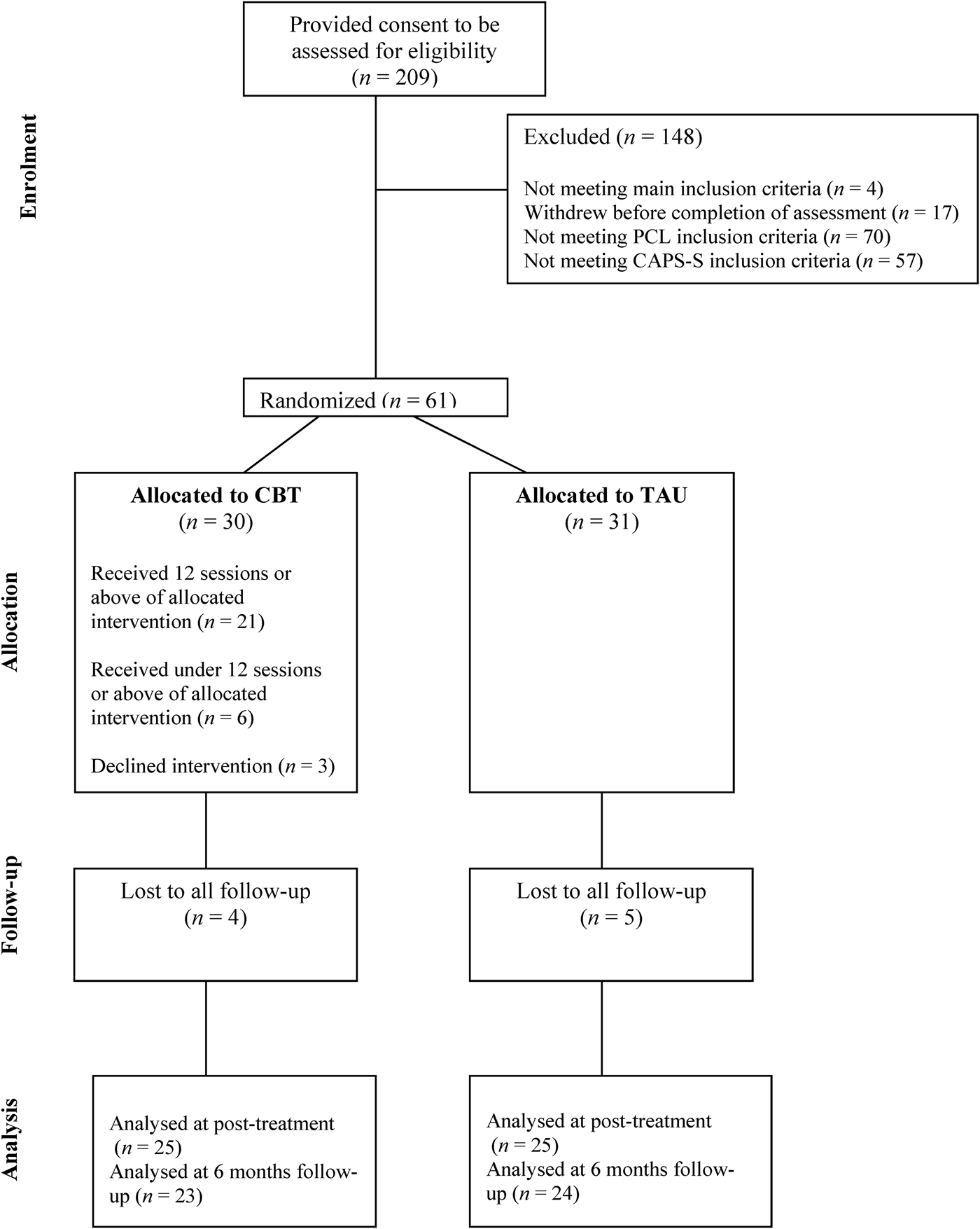
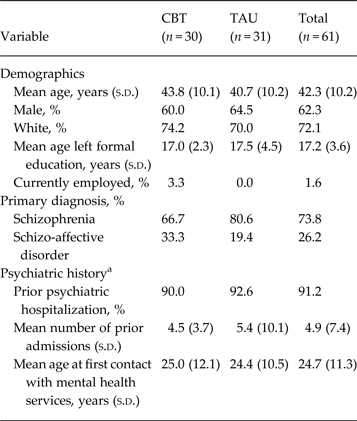
In total 1465 referrals were provided for the trial, of whom 209 gave consent to be assessed and 61 were eligible. See Fig. 1 for the trial CONSORT (Consolidated Standards of Reporting Trials) diagram. The characteristics of the participants allocated to CBT and TAU are summarized in Table 1. The two trial arms were similar in terms of diagnostic, demographic and baseline measures.
Consolidated Standards of Reporting Trials (CONSORT) diagram of recruitment to the study. PCL, Posttraumatic Stress Disorder Checklist; CAPS-S, Clinician Administered PTSD Scale for Schizophrenia; CBT, cognitive–behavioural therapy; TAU, treatment as usual.

Baseline characteristics of the sample

CBT, Cognitive–behavioural therapy; TAU, treatment as usual; s.d., standard deviation.
a Data on psychiatric history were missing for four patients in the CBT group.
The most commonly reported traumatic events associated with eligibility were the experience of a distressing psychotic episode (n = 11, 18%) and sexual abuse whilst under the age of 16 years (n = 11, 18%). A range of other events were reported, with none being experienced by more than 10% of the sample.
For those allocated to the CBT group, the mean number of therapy sessions was 12.3 (range = 0–16, s.d. = 5.3). Of the participants, 21 (70%) received the full protocol of 12 sessions or more and 26 (87%) received at least six sessions, which is considered minimal exposure to the intervention (Mueser et al. Reference Mueser, Gottlieb, Xie, Lu, Yanos, Rosenberg, Silverstein, Duva, Minsky, Wolfe and McHugo2015).
Outcome measures
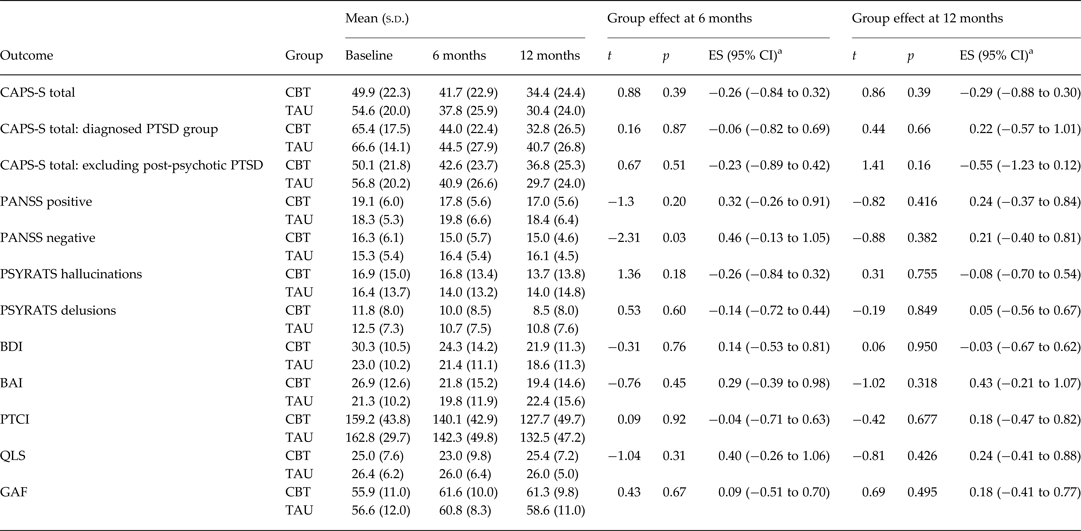
There was no significant difference between the intervention and control groups in the primary outcome of PTSD symptoms on the CAPS-S at the end of treatment (p > 0.1, between-group d = −0.26, 95% CI −0.84 to 0.32), or in the secondary outcome of the positive symptoms on PANSS positive (p > 0.1, between-group d = 0.32, 95% CI −0.26 to 0.91). There were no significant differences between groups within any of the other outcome measures (see Table 2).
Assessment of CBT and TAU groups during the intervention and follow-up periods

CBT, Cognitive–behavioural therapy; TAU, treatment as usual; s.d., standard deviation; ES, effect size; CI, confidence interval; CAPS-S, Clinician Administered PTSD Scale for Schizophrenia; PTSD, post-traumatic stress disorder; PANSS, Positive and Negative Syndrome Scale; PSYRATS, Psychotic Symptom Rating Scale; BDI, Beck Depression Inventory; BAI, Beck Anxiety Inventory; PTCI, Posttraumatic Cognitions Inventory; QLS, Quality of Life Scale; GAF, Global Assessment of Functioning.
a ES measures change from baseline in CBT relative to change in TAU.
Although there was no significant difference between the treatment and control groups regarding the main outcome of PTSD symptoms, the severity of the post-traumatic stress symptoms declined within the combined group over the 12-month period (CBT: F = 4.41, p < 0.01; TAU: F = 8.51, p < 0.01).
Discussion
The current study is one of only two published clinical trials that have aimed to evaluate the effectiveness of an evidence-based psychological intervention for PTSD solely within individuals diagnosed with a psychotic disorder. Our results do not provide evidence for cognitive restructuring with no direct exposure, the protocol adopted in the current study, reducing the symptoms of PTSD or psychosis beyond that achieved through TAU within this group. Of individuals allocated to treatment, 87% received a ‘dose’ of the protocol (i.e. at least six sessions). Treatment delivery data combined with the high level of methodological rigour as regards blind assessments, randomization procedures and data analysis suggest that the non-significant outcome is a valid result. The CIs of the effect size suggest that there is less than a 5% chance of the ‘true’ effect size being above 0.32. This result should be considered within the context of meta-analyses which suggest the overall effect size of generic CBT for psychosis to be in the region of 0.4 (Wykes et al. Reference Wykes, Steel, Everitt and Tarrier2008; van der Gaag et al. Reference van der Gaag, Valmaggia and Smit2014).
Given that Mueser et al. (Reference Mueser, Rosenberg, Xie, Jankowski, Bolton, Lu, Hamblen, Rosenberg, Mchugo and Wolfe2008, Reference Mueser, Gottlieb, Xie, Lu, Yanos, Rosenberg, Silverstein, Duva, Minsky, Wolfe and McHugo2015) report that a cognitive restructuring intervention is effective for a heterogeneous sample suffering from a range of severe mental health problems, it is important to consider any methodological differences between these trials and the current study.
First, unlike Mueser et al. (Reference Mueser, Rosenberg, Xie, Jankowski, Bolton, Lu, Hamblen, Rosenberg, Mchugo and Wolfe2008, Reference Mueser, Gottlieb, Xie, Lu, Yanos, Rosenberg, Silverstein, Duva, Minsky, Wolfe and McHugo2015), the current study included individuals suffering from post-traumatic stress symptoms but who did not exhibit a fully diagnostic level of PTSD. Therefore, further analyses were conducted excluding the participants within the current sample who did not present with a diagnostic level of PTSD symptoms. There was no effect of treatment within this fully diagnostic subgroup (see Table 2). Although the small sample size limits the reliability of this post-hoc analysis, the result is in line with a recent meta-analysis which indicates that the Mueser et al. (Reference Mueser, Rosenberg, Xie, Jankowski, Bolton, Lu, Hamblen, Rosenberg, Mchugo and Wolfe2008, Reference Mueser, Gottlieb, Xie, Lu, Yanos, Rosenberg, Silverstein, Duva, Minsky, Wolfe and McHugo2015) studies did not produce a significant treatment effect within the subgroup of their samples which were diagnosed with schizophrenia (Sin & Spain, Reference Sin and Spain2016). However, it should be noted that the majority of participants in the Mueser et al. (Reference Mueser, Rosenberg, Xie, Jankowski, Bolton, Lu, Hamblen, Rosenberg, Mchugo and Wolfe2008, Reference Mueser, Gottlieb, Xie, Lu, Yanos, Rosenberg, Silverstein, Duva, Minsky, Wolfe and McHugo2015) studies were diagnosed with severe levels of PTSD (i.e. a CAP-S score above 65), whilst the current study did not recruit enough participants in this subgroup in order to conduct a meaningful analysis. Therefore, our study does not exclude the possibility of the cognitive restructuring programme being effective with this more severe group.
Second, the current study included psychotic experiences and psychiatric treatment as potentially eligible stressful life events whereas Mueser et al. (Reference Mueser, Rosenberg, Xie, Jankowski, Bolton, Lu, Hamblen, Rosenberg, Mchugo and Wolfe2008, Reference Mueser, Gottlieb, Xie, Lu, Yanos, Rosenberg, Silverstein, Duva, Minsky, Wolfe and McHugo2015) did not. Of the participants, 11 were eligible on the basis of their reaction to a past psychotic episode although none was eligible in relation to psychiatric treatment. Whilst the concept of post-psychotic PTSD has gained validity (Mueser et al. Reference Mueser, Lu, Rosenberg and Wolfe2010), specific traumatic events may be associated with distinct responses to a psychological intervention. However, further post-hoc analyses in which these 11 participants were excluded revealed a non-significant treatment effect (see Table 2).
Both the intervention and control groups showed a significant reduction in PTSD symptoms over the 12-month study period. Van den Berg et al. (Reference van den Berg, de Bont, van der Vleugel, de Roos, de Jongh, Van Minnen and van der Gaag2015) also report a reduction (16 points) in the CAPS ratings of individuals who did not receive a psychological treatment within a 12-month period. These results are inconsistent with data indicating that co-morbid PTSD is indicative of a poor prognosis within individuals diagnosed with a psychotic disorder (Switzer et al. Reference Switzer, Dew, Thompson, Goycoolea, Derricott and Mullins1999). One possibility is that individuals who consent for treatment within a clinical trial are a ‘help-seeking’ subgroup and may not be representative of a wider clinical group exhibiting the same symptom profile. Another possibility is that the symptoms of post-traumatic stress may fluctuate over time. Therefore, a proportion of the current sample may have entered the clinical trial at a more severe stage of a cyclical presentation and would experience a subsequent drop in symptoms whether or not they received an intervention. It is of note that the test–retest reliability of the CAPS when used with people diagnosed with severe mental health problems increases in line with the severity of PTSD symptoms (Mueser et al. Reference Mueser, Salyers, Rosenberg, Ford, Fox and Carty2001), suggesting that symptom fluctuation is more likely to occur within the non-severe group which are the majority within the current study. This effect is likely to have contributed to the unexpected significant reduction of symptoms within the control group. It is therefore a limitation of the current trial that the stability of post-traumatic stress symptoms were not assessed over a period of time before eligibility was confirmed.
Our aim was to evaluate the effectiveness of cognitive restructuring for the treatment of post-traumatic stress symptoms specifically within individuals diagnosed with schizophrenia. Our results do not provide evidence for the use of this intervention within this group. A recently published process analysis based on recordings of the intervention sessions from the current study suggests that, whilst engagement remained high, the level of emotional processing may not have been sufficient to support adaptation to trauma memories and reductions in PTSD symptoms (O'Driscoll et al. Reference O'Driscoll, Mason, Brady, Smith and Steel2016). Therefore, cognitive restructuring programmes may require further adaptation to promote emotional processing of traumatic memories within people diagnosed with a psychotic disorder.
To conclude, the current results do not provide support for the use of cognitive restructuring alone for the treatment of post-traumatic symptoms within people diagnosed with schizophrenia. However, given that the Mueser et al. (Reference Mueser, Gottlieb, Xie, Lu, Yanos, Rosenberg, Silverstein, Duva, Minsky, Wolfe and McHugo2015) study was targeted specifically at individuals suffering from severe levels of PTSD, it may be that such an approach is effective within the severe subgroup. However, any future research would benefit from an adapted protocol. Therefore, despite anxiety within some mental health professionals, current evidence indicates that exposure is required in order to treat trauma symptoms within this group. The positive symptoms of psychosis may be exacerbated by the presence of decontextualized intrusive memories, such that trauma memories may need to be directly retrieved and elaborated in order for the symptoms of post-traumatic stress to reduce (Steel et al. Reference Steel, Fowler and Holmes2005; Longden et al. Reference Longden, Madill and Waterman2012; Steel, Reference Steel2015). This conclusion would be consistent with the positive results recently obtained using direct memory exposure interventions (prolonged exposure and eye movement desensitization and reprocessing) for the treatment of PTSD in psychotic disorder (van den Berg et al. Reference van den Berg, de Bont, van der Vleugel, de Roos, de Jongh, Van Minnen and van der Gaag2015).
Acknowledgements
This article presents independent research funded by the NIHR under its Research for Patient Benefit (RfPB) Programme (grant reference number PB-PG-1207-15077). The views expressed are those of the authors and not necessarily those of the NHS, the NIHR or the Department of Health.
Declaration of Interest
None.