





Introduction
Barnyardgrass, broadleaf signalgrass, and alligatorweed are all problematic weed species that compete with rice (Holm et al. Reference Holm, Plucknett, Pancho and Herberger1977; USDA-NRCS 2026; Van Wychen Reference Van Wychen2023). Barnyardgrass and broadleaf signalgrass have been documented to reduce rice yield by 70% and 48%, respectively (McGregor et al. Reference McGregor, Smith and Talbert1988; Smith Reference Smith1988). Alligatorweed is a perennial amaranthaceae species that requires adequate moisture and reproduces through vegetative reproduction (Allen et al. Reference Allen, Hepp and Miller2007; Spencer and Coulson Reference Spencer and Coulson1976). Alligatorweed can be hard to control in rice production, and herbicide options are limited (Pellerin et al. Reference Pellerin, Webster, Zhang and Blouin2004; Willingham et al. Reference Willingham, Bagavathiannan, Carson, Cogdill, McCauley and Chandler2015).
Herbicide resistance is a major challenge for producers. Management options for barnyardgrass have declined over the past several years; for example, Damalas and Koutroubas (Reference Damalas and Koutroubas2023) suggest that nearly half of the resistance issues in rice are related to barnyardgrass. In 2014, Nissan Chemical Corporation (Tokyo, Japan) filed an international patent for the herbicide 3-[(isopropylsulfonyl)methyl]-N-(5-methyl-1,3,4-oxadiazol-2-yl)-5-(trifluoromethyl)-[1,2,4]triazolo[4,3-a]pyridine-8-carboxamide, also known as iptriazopyrid. Nissan has formed an agreement with Gowan Company (Yuma, Arizona) to integrate iptriazopyrid into rice production in the United States. Iptriazopyrid is a novel herbicide that inhibits 4-hydroxyphenylpyruvate dioxygenase (HPPD) in Group 27 (as categorized by the Herbicide Resistance Action Committee, HRAC) and will belong to the azole carboxamide family (HRAC 2026; Nishio et al. Reference Nishio, Nishijima, Kubota, Furuhata, Nanao, Permana, Furuhashi and Kato2025). Due to the recent introduction of iptriazopyrid, published research is limited. However, Nishio et al. (Reference Nishio, Nishijima, Kubota, Furuhata, Nanao, Permana, Furuhashi and Kato2025) observed crop safety in rice when iptriazopyrid was applied as a foliar application, suggesting the potential of iptriazopyrid to be used for selective weed control in crops.
Group 27 herbicides inhibit the conversion of HPPD to homogentisic acid, resulting in lower carotenoid levels, chlorophyll destruction, and oxidative damage (Jablonkai Reference Jablonkai and Hasaneen2011; Jhala et al. Reference Jhala, Kumar, Yadav, Jha, Jugulam, Williams, Hausman, Dayan, Burton, Dale and Norsworthy2023). The disruption of carotenoid production leaves chlorophyll unprotected and susceptible to destruction by reactive oxygen species. However, when considering the HPPD-inhibiting herbicides available, the chemical structure of iptriazopyrid is unlike others and could be beneficial for controlling herbicide-resistant species (Nishio et al. Reference Nishio, Nishijima, Kubota, Furuhata, Nanao, Permana, Furuhashi and Kato2025). When the phytotoxicity levels of iptriazopyrid were compared to mesotrione in barnyardgrass, Nishio et al. (Reference Nishio, Nishijima, Kubota, Furuhata, Nanao, Permana, Furuhashi and Kato2025) documented that iptriazopyrid was active at lower concentrations than mesotrione.
The expected single-use rate of iptriazopyrid will range from 100 to 150 g ai ha−1, while sequential applications will range from 75 to 150 g ha−1, depending on the time interval between applications (C. Sandoski, Gowan Company, personal communication). Once it is registered for use, iptriazopyrid is expected to control a wide spectrum of weeds when applied in a sequential application program. Due to the novelty of iptriazopyrid, half-life and soil activity studies have not been published; furthermore, residual weed control has not been documented following applications of iptriazopyrid (C. Webster, Louisiana State University AgCenter, personal communication).
Synthetic auxin herbicides date back to World War II and have become one of the most used groups of herbicides worldwide (Grossmann, Reference Grossmann2003; Mithila et al. Reference Mithila, Hall, Johnson, Kelley and Riechers2011; Troyer Reference Troyer2001). Auxin herbicides mimic the naturally produced plant hormone indole-3-acetic acid (IAA) and selectively control broadleaf, grass, and sedge species (Busi et al. Reference Busi, Goggin, Heap, Horak, Jugulam, Masters, Napier, Riar, Satchivi, Torra and Westra2018; Grossmann Reference Grossmann1998, Reference Grossmann2003; Reference Grossmann2007; Miller and Norsworthy Reference Miller and Norsworthy2018; Todd et al. Reference Todd, Figueiredo, Morran, Soni, Preston, Kubeš, Napier and Gaines2020). The IAA natural auxin hormone works in conjunction with other plant hormones to regulate cell growth, whereas the synthetic auxin herbicide mimics the natural auxin to successfully disrupt the signaling pathway through increased auxin levels (Devine et al. Reference Devine, Duke and Fedke1993; Grossmann Reference Grossmann2007; Todd et al. Reference Todd, Figueiredo, Morran, Soni, Preston, Kubeš, Napier and Gaines2020). While synthetic auxin herbicides act similarly to the natural auxin hormone, the increased auxin levels within the plant cause cell elongation rather than cell division and can result in plant death. However, the full explanation including the exact mechanism used by auxin herbicides is not fully understood.
One of the first synthetic auxin herbicides used in agriculture was 2,4-D (Grossmann Reference Grossmann2003). The phenoxycarboxylic acid 2,4-D has been used in crop production for broadleaf and sedge control for years and is still popular to this day (Peterson et al. Reference Peterson, McMaster, Riechers, Skelton and Stahlman2016). Auxin herbicides have shown both synergistic and antagonistic interactions when mixed with glyphosate depending on the weed species; however, 2,4-D and triclopyr have been known to cause negative interactions when mixed with grass herbicides (Barbieri et al. Reference Barbieri, Young, Dayan, Streibig, Takano, Merotto and Avila2022; Flint and Barrett Reference Flint and Barrett1989a, Reference Flint and Barrett1989b; Mueller et al. Reference Mueller, Witt and Barrett1989; Webster et al. Reference Webster, Rustom, McKnight, Blouin and Teló2019). When 2,4-D and dicamba were added to glyphosate and applied to johnsongrass (Sorghum halepense L. Pers.), Flint and Barrett (Reference Flint and Barrett1989a, Reference Flint and Barrett1989b) documented a negative interaction for johnsongrass control. However, the same mixtures resulted in a synergistic interaction or no effect for field bindweed (Convolvulus arvensis L.) control. Mueller et al. (Reference Mueller, Witt and Barrett1989) also observed a reduction in johnsongrass control when mixing 2,4-D with fenoxaprop, haloxyfop, and sethoxydim. In 2019, Webster et al. (Reference Webster, Rustom, McKnight, Blouin and Teló2019) observed antagonism for barnyardgrass control when 2,4-D, quinclorac, and triclopyr were mixed with quizalofop.
Producers mix herbicides to achieve multiple modes of action, increase herbicide activity, broaden the weed control spectrum, and delay further evolution of herbicide resistance (Barbieri et al. Reference Barbieri, Young, Dayan, Streibig, Takano, Merotto and Avila2022; Miller and Norsworthy Reference Miller and Norsworthy2018; Mueller et al. Reference Mueller, Witt and Barrett1989; Zhang et al. Reference Zhang, Webster, Blouin and Leon2005). However, when herbicides with different modes of action are mixed, the response can be antagonistic, synergistic, or neutral (Blackshaw et al. Reference Blackshaw, Harker, Clayton and O’Donovan2006; Blouin et al. Reference Blouin, Webster and Zhang2004, Reference Blouin, Webster and Bond2010; Fish et al. Reference Fish, Webster, Blouin and Bond2015, Reference Fish, Webster, Blouin and Bond2016; Hatzios and Penner Reference Hatzios and Penner1985). These terms were defined by Colby (Reference Colby1967) as the observed response being greater than, less than, or equal to that of the herbicides applied alone, respectively. However, herbicide interactions cannot be entirely predictable and are dependent on the mixture partners, herbicide rates, weed species, weed size, and environment (Barbieri et al. Reference Barbieri, Young, Dayan, Streibig, Takano, Merotto and Avila2022; Hammerton Reference Hammerton1967; Mueller et al. Reference Mueller, Witt and Barrett1989; Shaw and Wesley Reference Shaw and Wesley1993).
The method proposed by Colby (Reference Colby1967) is the most popular model used to calculate expected levels of control when classifying mixture interactions, although there are limitations when it comes to analyzing mean separation (Blouin et al Reference Blouin, Webster and Zhang2004, Reference Blouin, Webster and Bond2010; Flint et al. Reference Flint, Cornelius and Barrett1988; Zhang et al. Reference Zhang, Webster, Blouin and Leon2005). Colby’s equation is still useful for calculating the expected levels of control; however, the model proposed by Blouin et al. (Reference Blouin, Webster and Bond2010) is recommended for comparing means. Colby’s (Reference Colby1967) equation does not generate a P-value, which limits the scope for possible analysis. For years the standard procedure for determining antagonistic responses was to use the method proposed by Flint et al. (Reference Flint, Cornelius and Barrett1988) or a Fisher standard LSD method. However, these methods treat the expected value as a mean and treat the interaction as a linear relationship. Blouin et al. (Reference Blouin, Webster and Zhang2004, Reference Blouin, Webster and Bond2010) concluded that the expected value generated from the Colby equation is not a mean but is a function of multiple means and that herbicide interactions do not always interact in a linear manner. When herbicides interact in a nonlinear fashion and act independently, a multiplicative model is needed to increase accuracy (Blouin et al. Reference Blouin, Webster and Bond2010). Due to the nonlinear function of multiple means, the data in this study were analyzed using Blouin’s augmented mixed model to classify mixture interactions as synergistic, antagonistic, or neutral compared to the expected level of control when herbicides were applied alone (Blouin et al. Reference Blouin, Webster and Zhang2004, Reference Blouin, Webster and Bond2010; Fish et al. Reference Fish, Webster, Blouin and Bond2015, Reference Fish, Webster, Blouin and Bond2016; Webster et al. Reference Webster, Webster, Blouin and McKnight2021).
This study was conducted to provide producers with the information they need to avoid antagonistic mixtures and maximize weed control efficacy. As mentioned previously, the novelty of iptriazopyrid highlights the need for research to determine which herbicides are not compatible with iptriazopyrid. Avoiding ineffective herbicide applications will allow producers to slow down the advancement of herbicide resistance and reduce yield loss caused by weeds. In 2026, input costs continue to increase, and it is critically necessary to make efficient herbicide applications and avoid costly antagonistic interactions (Rhodes and Coble Reference Rhodes and Coble1984). This study will evaluate iptriazopyrid mixed with common auxin herbicides used in rice production.
Materials and Methods
Studies were conducted in 2024 and 2025 at the H. Rouse Caffey Rice Research Station (RRS) near Crowley, Louisiana (30.17850°N, 92.35482°W) to evaluate herbicide mixture interactions when iptriazopyrid was applied independently or co-applied with auxin herbicides. The soil type at the RRS is a Crowley silt loam (Fine, smectitic, thermic Typic Albaqualfs) (3% sand, 69% silt, 28% clay), pH 6.4, and with 1.4% organic matter. Field preparation consisted of fall and spring tillage followed by a field cultivator consisting of rolling baskets and S-tine harrows to create an even surface. Prior to planting, 8-24-24 (N-P2O5-K2O) fertilizer was applied at 280 kg ha−1 followed by a preflood application of urea (46-0-0) at 280 kg ha−1 when rice was at the 4-leaf to 1-tiller growth stage. Immediately following the preflood urea application a permanent 10-cm flood was established. The flood was held on the crop until 2 wk before harvest. The research area received a uniform standard treatment of pendimethalin (925 g ai ha−1) + halosulfuron (35 g ai ha−1) to maintain the area and prevent sedges from dominating the study until the post-flood application. Insect and disease management practices were implemented based on common practices in Louisiana.
Plot size was 3.0 by 9.1 m2 with 16 drill-seeded rows spaced 17.8 cm apart, planted with the PVL03 variety of rice (Provisia Horizon Ag, Memphis, TN) at a rate of 78.4 kg ha−1. Rice was planted on April 2, 2024, and April 14, 2025. Research sites are left fallow every other year to allow natural weed populations to be established. At the time of application, the area of the study was naturally infested with 15 to 20 barnyardgrass plants at the 1- to 2-tiller stage, 18 to 25 broadleaf signalgrass plants at the 5-leaf- to 1-tiller stage, and 1 to 2 alligatorweed plants with 25 to 35 leaves per plant per square meter. Each herbicide treatment was applied post-flood, when the rice was between the green ring and half-inch internode growth stages, using a CO2-pressurized backpack sprayer calibrated to deliver 93.5 L ha−1 with seven flat-fan nozzles (model 11001 Flat Fan AirMix Venturi Nozzle, Greenleaf Technologies, Covington, LA) spaced 50.8 cm apart. The boom height remained at 50.8 cm above the crop canopy, and the boom traveled at 4.8 kph throughout the application.
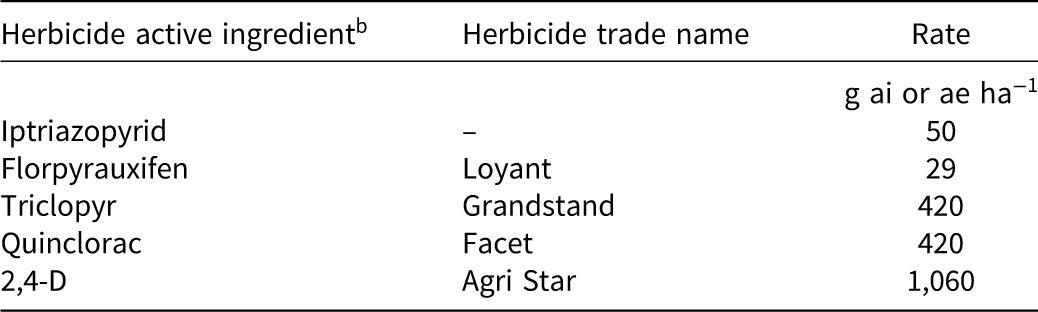
The study was a randomized complete block with a two-factor factorial arrangement of treatments with three replications. Factor A consisted of either no iptriazopyrid or iptriazopyrid applied at 50 g ai ha−1 (Table 1). Factor B consisted of either no herbicide, florpyrauxifen (29 g ai ha−1), triclopyr (420 g ae ha−1), quinclorac (420 g ae ha−1), or 2,4-D (1,060 g ae ha−1). Methylated seed oil was added to each herbicide treatment at a rate of 10 mL L−1. Visual ratings for crop injury and weed control were recorded at 21, 28, and 35 d after treatment (DAT). Ratings were based on a scale ranging from 0 to 100% where 0 = no plant injury and 100 = total plant death. The center 1.5 m of each plot was harvested with a Quantum Pro combine (Wintersteiger, Salt Lake City, UT) to measure rough rice yield and grain yield was adjusted to 12% moisture. Rough rice yield data were analyzed using the GLIMMIX procedure in SAS software (v. 9.4, SAS Institute, Cary, NC). Herbicide treatment was treated as a fixed effect whereas random effects included block nested within year. Year was treated as a fixed effect but was not significant so data were pooled across years.
Herbicide product information. a

Table 1. Long description
A table with three columns and six rows, including a header row. The columns are labeled ‘Herbicide active ingredient’, ‘Herbicide trade name’, and ‘Rate’. The rows list different herbicides and their respective trade names and application rates. Row 1: Iptriazopyrid, no trade name, 50 g ai or ae ha^-1. Row 2: Florpyrauxifen, Loyant, 29 g ai or ae ha^-1. Row 3: Triclopyr, Grandstand, 420 g ai or ae ha^-1. Row 4: Quinclorac, Facet, 420 g ai or ae ha^-1. Row 5: 2,4-D, Agri Star, 1,060 g ai or ae ha^-1.
a All treatments contained methylated seed oil (10 mL L−1) (Dyne-Amic; Helena Chemical Company, Collierville, TN).
b Herbicide manufacturers: iptriazopyrid, Gowan Company, Yuma, AZ; florpyrauxifen and triclopyr, Corteva Agriscience, Indianapolis, IN; Quinclorac, BASF Corporation, Research Triangle Park, NC; 2,4-D, Albaugh LLC, Ankeny, IA.
The expected value is a basis needed to compare herbicide activity independently to mixtures and consider how the combined effect influences the combination (Colby Reference Colby1967). Expected values used to determine interaction responses were calculated using the Colby (Reference Colby1967) equation, E = X + Y – (XY / 100), where X and Y represent control levels of herbicides A and B applied alone and E represents the expected value of the herbicides applied together. The data were then analyzed using the augmented mixed method described by Blouin et al. (Reference Blouin, Webster and Bond2010) to compare the expected value calculated from the Colby equation to the observed control when herbicides were applied independently with the herbicide mixtures and classify the combination effect as synergistic, antagonistic, or neutral (Blouin et al. Reference Blouin, Webster and Zhang2004, Reference Blouin, Webster and Bond2010; Fish et al. Reference Fish, Webster, Blouin and Bond2015, Reference Fish, Webster, Blouin and Bond2016; Webster et al. Reference Webster, Webster, Blouin and McKnight2021). First, the MIXED procedure with the interaction effect of DAT × herbicide treatments was used to obtain means with their variances and covariances for herbicide treatments at each timing in SAS. Then, the IML (interactive matrix language) procedure was used to calculate the joint-action effects and implement the Delta method to calculate standard errors and test statistics for each mixture combination. Finally, a two-tailed z-test was used to obtain P-values for each herbicide mixture. Random effects included block nested within year (Blouin et al. Reference Blouin, Webster and Bond2010). Year was considered a fixed effect and there was no significant interaction with treatment effects; therefore, the results were pooled across years. The UNIVARIATE procedure of the SAS software was used to check the normality of effects across all evaluation dates.
Results and Discussion
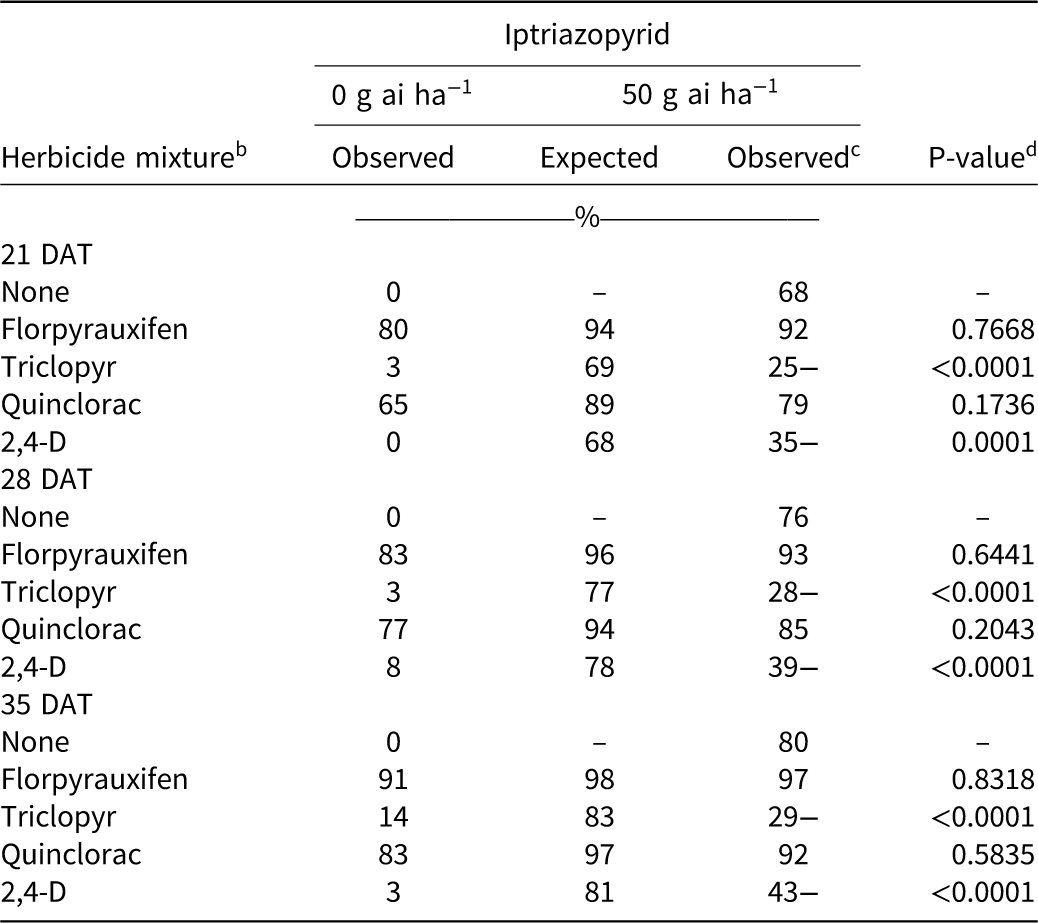
Iptriazopyrid applied alone at 50 g ha−1 provided 68%, 76%, and 80% control of barnyardgrass at 21, 28, and 35 DAT, respectively (Table 2). The 80% barnyardgrass control observed at 35 DAT compared with 68% control at 21 DAT suggests that iptriazopyrid needs longer than 21 DAT to work through the plant. At each rating interval, only the addition of triclopyr and 2,4-D resulted in antagonism of barnyardgrass control. However, when iptriazopyrid was mixed with florpyrauxifen and quinclorac a neutral interaction was observed.
Barnyardgrass control with iptriazopyrid applied alone or mixed with auxin herbicides. a

Table 2. Long description
A table comparing barnyardgrass control with iptriazopyrid applied alone or mixed with auxin herbicides. The table has 7 rows and 5 columns. Column headers are Herbicide mixture, 0 g ai ha^-1 Observed, 50 g ai ha^-1 Expected, 50 g ai ha^-1 Observed, and P-value. Row labels are 21 DAT None, Florpyrauxifen, Triclopyr, Quinclorac, 2,4-D, 28 DAT None, Florpyrauxifen, Triclopyr, Quinclorac, 2,4-D, 35 DAT None, Florpyrauxifen, Triclopyr, Quinclorac, 2,4-D. The table shows the observed and expected percentages of barnyardgrass control and the P-values for each herbicide mixture at 21, 28, and 35 days after treatment (DAT). Notable trends include the consistent control with florpyrauxifen and quinclorac mixtures, and antagonistic effects with triclopyr and 2,4-D mixtures.
a Abbreviation: DAT, days after treatment.
b Iptriazopyrid (at either 0 or 50 g ai ha−1) was applied with other herbicides as follows: florpyrauxifen, 29 g ai ha−1; triclopyr, 420 g ae ha−1; quinclorac, 420 g ae ha−1; 2,4-D, 1,060 g ae ha−1.
c Observed means followed by a minus symbol (−) or a plus symbol (+) are significantly different from Blouin’s Modified Colby’s expected responses at the 5% level, indicating a synergistic or an antagonistic response. No plus (+) or minus (−) indicates a neutral response.
d P < 0.05 indicates an antagonistic or synergistic response.
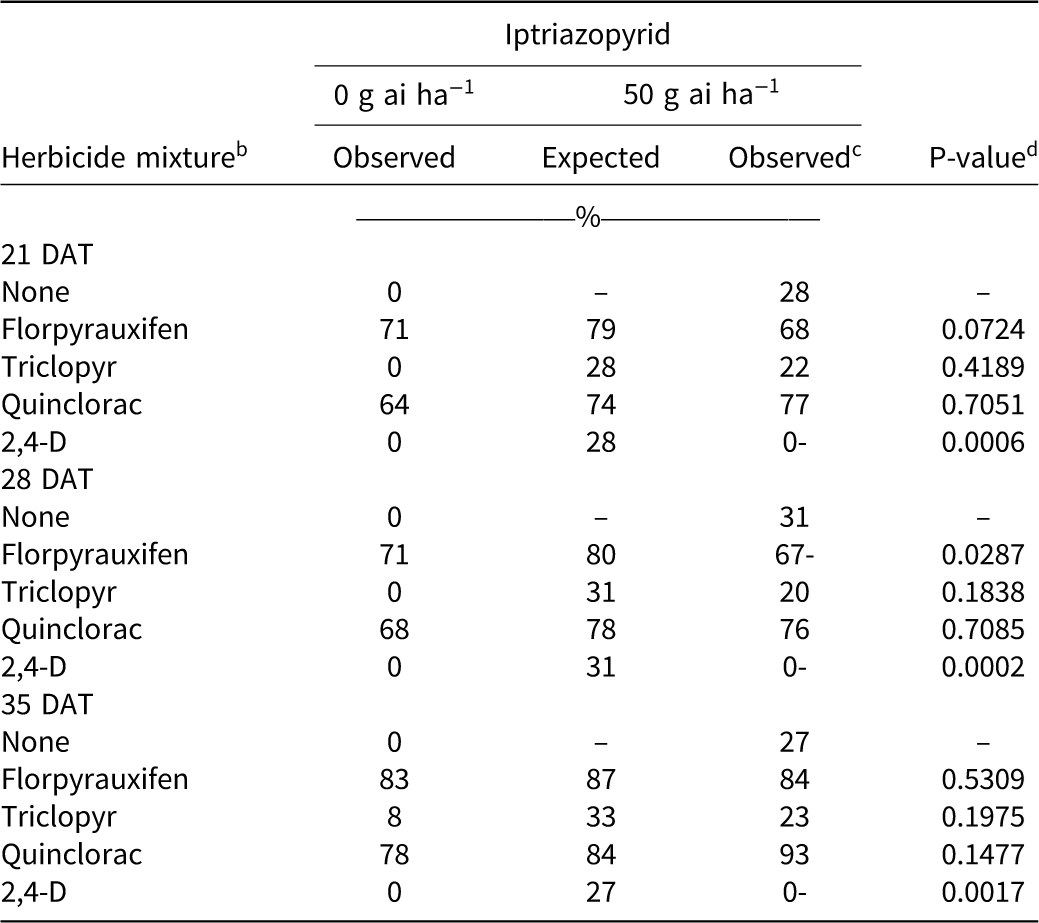
At 21 DAT, iptriazopyrid mixed with triclopyr or 2,4-D provided 25% and 35% control of barnyardgrass compared with the expected control of 69% and 68%, respectively (Table 2). Similar results were observed at 28 and 35 DAT. These results are supported by the findings reported by Webster et al. (Reference Webster, Rustom, McKnight, Blouin and Teló2019) that triclopyr and 2,4-D were antagonistic when mixed with quizalofop; in addition, antagonism was also observed when quinclorac was mixed with quizalofop, whereas in the current study a neutral interaction was observed with quinclorac. Mueller et al. (Reference Mueller, Witt and Barrett1989) reported antagonism observed when 2,4-D was used as a mixture partner with fenoxaprop, haloxyfop, and sethoxydim, all herbicides that inhibit acetyl-CoA carboxylase, while Flint and Barrett (Reference Flint and Barrett1989b) reported antagonism when 2,4-D was mixed with glyphosate. Iptriazopyrid applied alone provided 28%, 31%, and 27% control of broadleaf signalgrass at 21, 28, and 35 DAT, respectively (Table 3). When iptriazopyrid was mixed with 2,4-D, similar to the observations for barnyardgrass control, antagonism occurred at all rating intervals. The broadleaf signalgrass control observed when iptriazopyrid and 2,4-D were applied was 0% at each rating interval compared with the expected control of 28%, 31%, and 27% at 21, 28, and 35 DAT, respectively (Table 3).
Broadleaf signalgrass control with iptriazopyrid applied alone or mixed with auxin herbicides. a

Table 3. Long description
A table comparing the effectiveness of iptriazopyrid alone and mixed with various herbicides on broadleaf signalgrass control at different days after treatment. The table has 10 rows and 6 columns. The columns are labeled as follows: Herbicide mixture, 0 g ai ha^-1 Observed, 50 g ai ha^-1 Expected, 50 g ai ha^-1 Observed, and P-value. The rows are labeled as follows: 21 DAT None, 21 DAT Florpyrauxifen, 21 DAT Triclopyr, 21 DAT Quinclorac, 21 DAT 2,4-D, 28 DAT None, 28 DAT Florpyrauxifen, 28 DAT Triclopyr, 28 DAT Quinclorac, 28 DAT 2,4-D, 35 DAT None, 35 DAT Florpyrauxifen, 35 DAT Triclopyr, 35 DAT Quinclorac, 35 DAT 2,4-D. The values in the table represent the percentage of broadleaf signalgrass control observed and expected at different days after treatment (DAT). Notable trends include the consistent 0% control when iptriazopyrid is mixed with 2,4-D at all rating intervals, indicating antagonism. The P-values indicate the statistical significance of the observed differences.
a Abbreviation: DAT, days after treatment.
b Iptriazopyrid (at either 0 or 50 g ai ha−1) was applied with other herbicides as follows: florpyrauxifen, 29 g ai ha−1; triclopyr, 420 g ae ha−1; quinclorac, 420 g ae ha−1; 2,4-D, 1,060 g ae ha−1.
c Observed means followed by a minus symbol (−) or a plus symbol (+) are significantly different from Blouin’s Modified Colby’s expected responses at the 5% level, indicating a synergistic or an antagonistic response. No plus (+) or minus (−) indicates a neutral response.
d P < 0.05 indicates an antagonistic or synergistic response.
Antagonism was observed for broadleaf signalgrass control at 28 DAT when iptriazopyrid was mixed with florpyrauxifen; however, by 35 DAT, a neutral interaction was observed. The antagonism observed at 28 DAT could have been from the herbicide activity being delayed. Miller and Norsworthy (Reference Miller and Norsworthy2018) reported neutral interactions for control of barnyardgrass, hemp sesbania [Sesbania herbacea (Mill.) McVaugh], and yellow nutsedge (Cyperus esculentus L.) when florpyrauxifen was mixed with a variety of contact and systemic herbicides used on rice crops. In contrast to barnyardgrass, the mixture of iptriazopyrid with triclopyr was not antagonistic for broadleaf signalgrass control. The neutral interaction observed when triclopyr was the mixture partner could be due to the lack of broadleaf signalgrass control from iptriazopyrid. All other treatments evaluated resulted in neutral interactions for broadleaf signalgrass control at each rating interval.
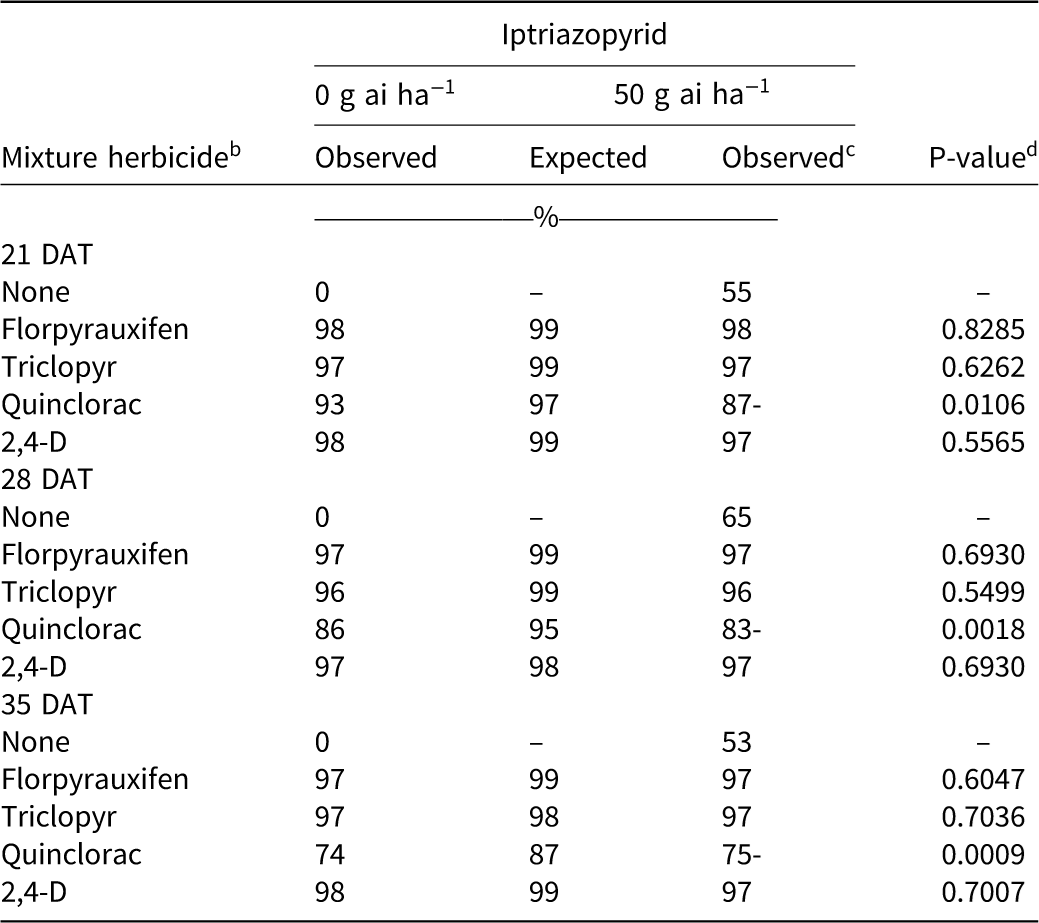
Iptriazopyrid applied alone provided 55%, 65%, and 53% control of alligatorweed when observed at 21, 28, and 35 DAT, respectively (Table 4). The antagonism observed in grass control when iptriazopyrid was mixed with 2,4-D and triclopyr was not observed in alligatorweed. All mixtures, minus quinclorac, resulted in a neutral interaction at each rating interval for alligatorweed control. When iptriazopyrid was mixed with quinclorac alligatorweed control of 87%, 83%, and 75% was observed compared with the expected control of 97%, 95%, and 87% at 21, 28, and 35 DAT, respectively. Gobi et al. (Reference Gobi, Ahmad-Hamdani, Zakaria, Dilipkumar and Chuah2025) documented antagonism when quinclorac was mixed with propanil at a 20:80 ratio for barnyardgrass. The addition of florpyrauxifen, triclopyr, or 2,4-D to iptriazopyrid controlled alligatorweed by more than 96% at each evaluation interval.
Alligatorweed control with iptriazopyrid applied alone or mixed with auxin herbicides. a

Table 4. Long description
A table comparing the effectiveness of iptriazopyrid alone and in mixtures with auxin herbicides for controlling alligatorweed. The table has 3 rows and 6 columns. Column headers are: Mixture herbicide, Observed, Expected, Observed, P-value. Row labels are: 21 DAT, 28 DAT, 35 DAT. Each row further breaks down into None, Florpyrauxifen, Triclopyr, Quinclorac, 2,4-D. Values are percentages and P-values. Notable trends include high control percentages with Florpyrauxifen, Triclopyr, and 2,4-D mixtures, while Quinclorac shows lower control percentages compared to expected values.
a Abbreviation: DAT, days after treatment.
b Iptriazopyrid (at either 0 or 50 g ai ha−1) was applied with other herbicides as follows: florpyrauxifen, 29 g ai ha−1; triclopyr, 420 g ae ha−1; quinclorac, 420 g ae ha−1; 2,4-D, 1,060 g ae ha−1.
c Observed means followed by a minus symbol (−) or a plus symbol (+) are significantly different from Blouin’s Modified Colby’s expected responses at the 5% level, indicating a synergistic or an antagonistic response. No plus (+) or minus (−) indicates a neutral response.
d P < 0.05 indicates an antagonistic or synergistic response.
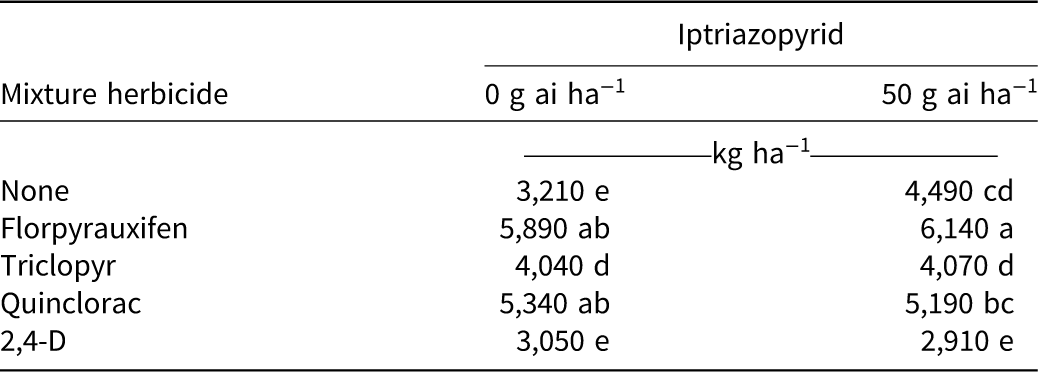
The PVL03 rice variety yielded 3,210 kg ha−1 from nontreated plots compared with 4,490 kg ha−1 from plots where iptriazopyrid was applied alone (Table 5). However, rice treated with iptriazopyrid mixed with 2,4-D yielded 35% less than with iptriazopyrid alone, which can be attributed to the antagonism that was observed with barnyardgrass and broadleaf signalgrass control. When triclopyr and 2,4-D were added to iptriazopyrid, similar antagonistic interactions were observed for barnyardgrass control, but rice treated with iptriazopyrid and triclopyr did not reflect the negative impact on rough rice yield. However, rice yield was 4,070 kg ha−1 when treated with iptriazopyrid + triclopyr compared with 2,910 kg ha−1 when treated with iptriazopyrid plus 2,4-D. Therefore, the neutral interaction observed for broadleaf signalgrass control when iptriazopyrid was mixed with triclopyr could justify these yields.
Rough rice yield of PVL03 rice variety treated with iptriazopyrid alone or mixed with auxin herbicides. a

Table 5. Long description
A table comparing rough rice yield of PVL03 rice variety treated with iptriazopyrid alone or mixed with auxin herbicides. The table has 5 rows and 3 columns. Column headers are Mixture herbicide, 0 g ai ha^-1, and 50 g ai ha^-1. Row labels are None, Florpyrauxifen, Triclopyr, Quinclorac, and 2,4-D. Row 1: None, 3,210 e, 4,490 cd. Row 2: Florpyrauxifen, 5,890 ab, 6,140 d. Row 3: Triclopyr, 4,040 d, 4,070 d. Row 4: Quinclorac, 5,340 ab, 5,190 bc. Row 5: 2,4-D, 3,050 e, 2,910 e.
a Means followed by a common letter are not different at P = 0.05.
When florpyrauxifen was mixed with iptriazopyrid, rice yield was 6,140 kg ha−1 compared with 4,490 kg ha−1 when iptriazopyrid was applied alone and resulted in the highest rough rice yield out of all iptriazopyrid mixtures (Table 5). The florpyrauxifen mixture did not antagonize the control of any of the weeds evaluated, which is reflected by the greater yield. Barnyardgrass is the most yield-limiting weed species at the Crowley RRS due to its density. The florpyrauxifen + iptriazopyrid mixture provided up to 97% control of barnyardgrass at 35 DAT. Therefore, the impact of antagonism on rice yield is highlighted when the yield from rice treated with the florpyrauxifen mixture is compared with that from rice treated with the 2,4-D or triclopyr mixtures.
Practical Implications
The herbicides 2,4-D and triclopyr were antagonistic for barnyardgrass at all evaluation intervals. However, the most compatible mixture partner for iptriazopyrid in this study was florpyrauxifen. Adding florpyrauxifen to iptriazopyrid resulted in a greater rice yield compared with yield after iptriazopyrid was applied alone. Iptriazopyrid applied alone provided 68% to 80% control of barnyardgrass, whereas broadleaf signalgrass was controlled by only 27% to 31%. The lack of broadleaf signalgrass control from iptriazopyrid could be one reason there was a neutral interaction when it was mixed with triclopyr. If alligatorweed, barnyardgrass, and broadleaf signalgrass are the target weed species, the authors recommend mixing florpyrauxifen with iptriazopyrid. Miller and Norsworthy (Reference Miller and Norsworthy2018) also suggested that florpyrauxifen is a compatible mixture partner for a variety of contact and systemic herbicides.
Others have observed antagonism for grass control when 2,4-D was mixed with a variety of herbicides and concluded the negative interaction could be due to the 2,4-D preventing absorption and translocation through the plant (Gillespie and Nalewaja Reference Gillespie and Nalewaja1989; Mueller et al. Reference Mueller, Barrett and Witt1990; Peterson et al. Reference Peterson, McMaster, Riechers, Skelton and Stahlman2016). However, Nishio et al. (Reference Nishio, Nishijima, Kubota, Furuhata, Nanao, Permana, Furuhashi and Kato2025) reported that iptriazopyrid’s inactivity against barnyardgrass stemmed from the plant’s inability to metabolize iptriazopyrid. Therefore, a more likely explanation for the antagonism observed in this study is that 2,4-D catalyzes the P-450 metabolism and causes grasses to detoxify iptriazopyrid (Han et al. Reference Han, Yu, Cawthray and Powles2013; Mueller et al. Reference Mueller, Barrett and Witt1990; Peterson et al. Reference Peterson, McMaster, Riechers, Skelton and Stahlman2016). Han et al. Reference Han, Yu, Cawthray and Powles2013 observed an increase in metabolism of diclofop and chlorsulfuron when 2,4-D was applied to rigid ryegrass (Lolium rigidum). In that same study, when malathion, a P-450 inhibitor, was applied following the 2,4-D application, the chlorsulfuron activity was not affected, suggesting that the reduced control resulted from enhanced metabolism. In addition, resistance to HPPD-inhibiting herbicides evolves through enhanced metabolism rather than target-site mechanisms (Ma et al. Reference Ma, Kaundun, Tranel, Riggins, McGinness and Hager2013). Neither triclopyr nor 2,4-D had much activity against grass weeds, which could be another reason the metabolism is enhanced and antagonism was observed for barnyardgrass control.
If triclopyr or 2,4-D are needed to broaden the weed control spectrum the authors recommend that these herbicides not be mixed with iptriazopyrid. These herbicides may be applied in a split application (i.e., separately), or the rate of the antagonized herbicide could be increased to the 1 × rate to try to avoid antagonism (Green Reference Green1989; Mueller et al. Reference Mueller, Witt and Barrett1989; Rhodes and Coble Reference Rhodes and Coble1984). The severity of antagonism observed in this study is suspected to be influenced by the reduced rate of iptriazopyrid. However, this theory is not confirmed, and future research will address the interaction of iptriazopyrid with antagonistic mixing partners when the rate is increased. Additional research should also include evaluations of iptriazopyrid when mixed it is with residual herbicides.
Acknowledgments
Published with the approval of the Director of the Louisiana Agricultural Experiment Station and the Louisiana State University Agricultural Center, Baton Rouge, LA 70803, as manuscript number 2026-306-40996. We thank the staff members of the Louisiana State University Agricultural Center’s H. Rouse Caffey Rice Research Station.
Funding
The Louisiana Rice Research Board and Gowan Company provided partial funding for this project.
Competing Interests
The author declares they have no competing interests.

 Open access

