Introduction
Clinical experience with elderly patients has called attention to the fact that mental and somatoform disorders can be partially evaluated as post-traumatic stress disorder (PTSD), which could be considered to result from a reactivation of traumatic experiences from their earlier lives (Phifer and Norris, Reference Phifer and Norris1989; Macleod, Reference Macleod1994; Averill and Beck, Reference Averill and Beck2000; Maercker, Reference Maercker2002; Radebold, Reference Radebold2003; Bramsen et al., Reference Bramsen, Van Der Ploeg and Boers2006; Heuft, Reference Heuft, Radebold, Heuft and Fooken2006; Kuwert et al., Reference Kuwert, Braehler, Glaesmer, Freyberger and Decker2009). These experiences can lie decades in the past. For the generation that experienced youth or young adulthood during World War II, war-related trauma such as bombings, military war service, displacement or war captivity play a central role. This generation experienced such trauma in a phase of life that is not equipped with the ability to differentiate and cope with situations in comparison to the middle and later years of adult life, resulting in an increased vulnerability to post-traumatic stress disorder (Maercker, Reference Maercker2002). These experiences had potential consequences for the development of the personality – creating social contacts or developing coping strategies for the demands and burdens of life, which form the mental resources that are later mobilized for dealing with the aging process (Schneider et al., Reference Schneider, Driesch, Kruse, Nehen and Heuft2006). Advanced age itself can also involve accumulating burdens, experiences of loss, and developmental crises based on growing age-related risks for decreasing cognitive capabilities, a dwindling social network, loss of roles in life and/or the development of chronic illnesses. This can result in a depletion of psychological coping mechanisms, allowing earlier traumatic experiences to take effect again (Maercker, Reference Maercker2002). Being confronted with the losses connected with advanced age can also call up the remembrance of losses connected with earlier traumatic experiences (Solomon and Ginzburg, Reference Solomon, Ginzburg, Maercker, Schutzwohl and Solomon1999). In addition, the feeling of being at the mercy of the irreversible and unavoidable changes occurring in advanced age can also cause trauma-reactivation (Heuft, Reference Heuft2004).
More recent studies have suggested that chronic PTSD, linked to the events of World War II, are apparent among up to 5% of all elderly persons (Teegen and Meister, Reference Teegen and Meister2000; Hunt and Robbins, Reference Hunt and Robbins2001; Teegen and Handwerk, Reference Teegen and Handwerk2006; Maercker et al., Reference Maercker2008a). However, several studies indicate frequencies between 10% and 20% (Favaro et al., Reference Favaro, Tenconi, Colombo and Santonastaso2006; Fischer et al., Reference Fischer, Struwe and Lemke2006; Kuwert et al., Reference Kuwert, Spitzer, Rosenthal and Freyberger2008). Yet the studies dealing with this question are very heterogeneous concerning the groups studied (e.g. child soldiers, victims of flight and displacement, nurses from the war front, children growing up with no fathers, prisoners of war), the sampling procedure, the operationalization of trauma consequences and the conclusions drawn about their effects on advanced age. In addition, some previous studies relied on convenience samples of elderly persons – i.e. elderly individuals who responded to a call for participation in a study of their traumatic experiences during the war. This calls into question the extent to which the data can be generalized to apply to the entire elderly population, since those not wanting to be confronted with their earlier traumatic experiences or those less burdened and not interested in participating will not have responded. Some studies were based on clinical samples (e.g. geriatric patients, psychiatric patients, psychotherapy patients) and thus their results are also difficult to apply to the general population.
Our study aims to determine (1) the frequency of war-related and non-war-related potentially traumatic experiences in the elderly general population in Germany, (2) the prevalence rates of post-traumatic stress disorder in the different age groups of the elderly and in both genders, and (3) the frequency of the different post-traumatic symptoms in the different age groups of the elderly and in both genders.
The data are from a large scale population-based representative study. An experience of trauma was not a criterion for inclusion in the study. The data determined here may thus provide a more realistic estimation of the prevalence of traumatization and PTSD in advanced age than is the case with the recently available studies specifically dealing with trauma experiences or with clinical samples. Results of representative surveys across age groups have already been reported elsewhere (Maercker et al., Reference Maercker, Forstmeier, Wagner, Glaesmer and Brahler2008b).
Methods
Subjects
A representative sample of the German general population was selected with the assistance of a demographic consulting company (USUMA, Berlin). The area of Germany was divided into 258 sampling areas representing the different regions of the country. Households in the respective area and members of this household fulfilling the inclusion criteria (age at or above 14, able to read and understand the German language) were selected randomly. The sample was aimed to be representative in terms of age, gender, and education. A first attempt involved 4,243 addresses, of which 4,118 were valid. If no-one was at home, a maximum of three attempts were made to contact the selected person. Nine hundred and ninety-nine subjects (24.3%) refused participation, 543 subjects (13.2%) could not be reached after four attempts, and 27 subjects (0.6%) refused participation because of severe health problems. All subjects were visited by a study assistant, who informed them about the investigation and gave them a self-rating questionnaire. The assistant waited until participants answered all the questions, and offered help where necessary. A total of 2,507 people between the ages of 14 and 92 years completed the self-rating questionnaires (participation rate: 60.9% of valid addresses) in 2005, of which 42 (1.7%) were not useable. The ethical guidelines of the international codex for the practice of social and marketing research of the European Society for Opinion and Marketing Research were observed.
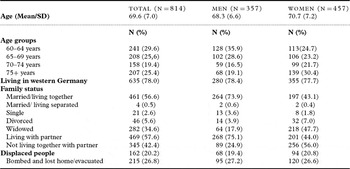
The results relating to the frequency of traumatic experiences and of PTSD in the entire sample are presented in Maercker et al. (Reference Maercker, Forstmeier, Wagner, Glaesmer and Brahler2008b). For the current study everyone who was at least 60 years old at the time of the survey was included. The people in this cohort therefore belonged to a group born in 1945 or before and so would have experienced the war years and its aftermath as children or young adults. This random sample encompasses 814 persons. Table 1 shows the sociodemographic characteristics of the sample.
Sociodemographic characteristics of the sample

Instruments
List of traumatic events
Corresponding to the trauma list of the PTSD module (Perkonigg et al., Reference Perkonigg, Kessler, Storz and Wittchen2000) of the Munich Composite International Diagnostic Interview (M-CIDI) (Wittchen and Pfister, Reference Wittchen and Pfister1997), eight potential traumatizing events are presented to the participants
• You were the victim of a rape
• You were the victim of a natural disaster
• You received strong bodily threats (e.g. with a weapon), were attacked, injured, or tortured
• You had horrible experiences during military war service
• You experienced another terrible event or a catastrophe
• You were bombed
• You were driven out of your homeland
• You have been diagnosed with a life-threatening illness
After the presentation of these potential traumatic events, an item representing the DSM-IV A2 criterion (intensive fear, shock, and helplessness) was presented. Finally, questions were asked about the most harrowing event (if more than one event had been mentioned). If the participants had talked about several events, the follow-up questions and the determination of symptoms were related to the event that troubled them most.
Modified PTSD symptom scale
The diagnostic criteria for PTSD according to DSM-IV were assessed using the Post-Traumatic Symptom Scale (PSS) (Foa et al., Reference Foa, Riggs, Dancu and Rothbaum1993), which is based on the occurrence of symptoms in the last month on a 4-point scale from 0 (“not at all”), 1 (“once a week or more seldom”), 2 (two to four times per week/half the time”) to 3 (“several times per week/almost always”). Some of the PTSD symptom criteria which, according to Breslau et al. (Reference Breslau, Peterson, Kessler and Schultz1999), show a negligible diagnostic prediction (sensitivity, specificity), were not included (criteria B3, B4, C2, C3, D2–D4), based on their screening character. The F-criterion (general DSM-IV restriction criteria based on normal life before trauma) was retained.
PSS has shown very satisfactory reliability and validity in studies carried out in the U.S.A. (Foa et al., Reference Foa, Riggs, Dancu and Rothbaum1993) and in Germany (Stieglitz et al., Reference Stieglitz, Frommberger, Foa and Berger2001). The abbreviated item selection from Breslau et al., which turned out to be the most effective item selection according to receiver operating characteristic analysis, defined positive PTSD cases compared to the complete symptom criteria list with 80% sensitivity, a specificity of 97%, a positive predictive value of 71% and a negative predictive value of 98% (Breslau et al., Reference Breslau, Peterson, Kessler and Schultz1999). In our study the PSS shows very good internal consistency (Cronbach's α = 0.93).
PTSD diagnosis and partial PTBS
A PTSD Diagnosis was determined according to the DSM-IV criteria by using the algorithm of the modified PTSD symptom scale according to Breslau (with the A1 and A2 criteria, B criteria at least 4 of 7 symptoms according to Breslau with scale values ≥2 and F criteria). Since epidemiological and clinical studies are already accustomed to analyzing partial (subsyndromal) distortion images (Schuetzwohl and Maercker, Reference Schuetzwohl and Maercker1999), and since the DSM-IV criteria contain a more strict definition of PTSD than the more broadly defined ICD-10 description of PTSD (Rosner and Powell, Reference Rosner and Powell2007), this study has also used the more broadly defined criteria for partial PTBS. In recent times the clinical impairment criterion has been a particular focus, since its status for the mental burden resulting from PTSD is still uncertain (Breslau and Alvarado, Reference Breslau and Alvarado2007).
Two partial PTSD syndromes were specified:
Partial PTSD I: At least two symptoms from the symptom clusters B to D and the F criterion (impairment criterion in the DSM IV) must be fulfilled (Schuetzwohl and Maercker, Reference Schuetzwohl and Maercker1999)
Partial PTSD II: As with partial PTSD I, at least two symptoms from the cluster B to D are fulfilled, yet the F criterion is not mentioned (Breslau and Alvarado, Reference Breslau and Alvarado2007).
Statistical analyes
Statistical analyses were conducted using the SPSS 15.0 statistical package. Since χ2 tests require 80% of expected values to be greater than 5, and our sample shows partially lower values, Fisher's exact tests were applied to test the differences of traumatic events and of post-traumatic symptoms between the different age groups.
Results
Frequency of potentially traumatic experiences
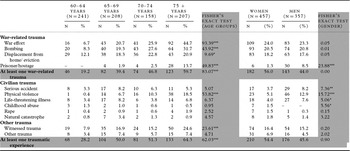
Table 2 shows the frequencies for the different events from the trauma list for the different age groups and both genders.
Frequency of potential traumatic experiences in people aged 60+ years by age groups

*p<0.05; **p<0.01; ***p<0.001.
The percentage of persons who had experienced at least one trauma during their life increases across the age groups. Those aged 75 years and older show the highest percentage (64.3%) (Table 2). All age groups experienced more war-related trauma than civilian trauma, but increasing age is associated with an increasing frequency of different war-related traumatic experiences: 64.3% of the oldest age group reported at least one traumatic event, and 59.7% reported at least one war-related traumatic event (Table 2). Additionally, the frequency of experiences of physical violence and witnessing traumatic events increases significantly with increasing age.
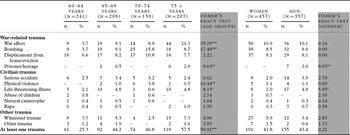
In a second step, people were asked to indicate their worst traumatic experience. War and violence-related experiences are frequently evaluated as the worst traumatic experiences, even though these experiences took place decades ago. Except for displacement from home, the frequencies of all war- and violence-related events significantly increase over the age groups (see Table 3).
Worst traumatic experience by age groups

*p<0.05; **p<0.01; ***p<0.001.
As well as the differences across age groups, some gender differences were found. Interestingly, women are exposed to as many different war-related traumatic events as men. Only imprisonment/hostage is experienced significantly more often by men. Men experienced serious accidents, physical violence and life-threatening illnesses significantly more often (Table 2), but only life-threatening illnesses and imprisonment/hostage were mentioned significantly more often as the worst traumatic experience in men compared to women (Table 3).
Frequency of PTSD in advanced age
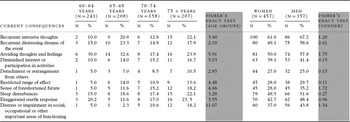
The individual symptoms of PTSD resulting from war-related traumatic experiences are listed in Table 4. With a prevalence of 25% across all age groups, avoidance of thoughts and feelings is the most frequent symptom cluster, followed by sleep disturbances, recurrent intrusive thoughts and an exaggerated startle response (Table 4). Differences in the symptoms across the age groups and both genders were tested using Fisher's exact tests. No significant differences were found.
Current consequences of war trauma (war service, being bombed, displacement from home, prisoner/hostage) by age group#

2–4 times/week and almost always.
*p < 0.05; **p < 0.01; ***p < 0.001
# Referring to the subjects (n = 230) who indicated a war-related trauma as the worst traumatic experience.
A PTSD within the last four weeks was determined in 3.4% of the elderly, with 1.0% showing a partial PTSD with impairment (Partial PTSD I), and 2.8% showing a partial PTSD without impairment (Partial PTSD II). In summary, 7.2% of those aged over 60 years showed significant symptoms of PTSD.
Discussion
The present study examines experiences of war-related and civilian trauma in a representative sample of elderly persons (60+ years of age) from the German general population (using data collected for the study in 2005). This cohort experienced World War II during childhood and adolescence. Using established instruments, the prevalence of PTSD according to DSM-IV and according to partial syndromes was examined. The experience of trauma was not a selection criterion in the sampling procedure.
In the elderly German general population, war and violence-related traumatic events were experienced to a markedly greater extent than civilian trauma. Increasing age brought about an increasing proportion of persons having experienced war and violence-related trauma and having witnessed a traumatic event. Moreover, an age-specific distribution of the traumatic events shows that, in the oldest age groups, nearly 45% of participants indicated war service as their traumatic experience, since these people are old enough to have played an active part in the war. On the other hand, the differences between the age groups concerning displacement and eviction as a traumatic experience are less obvious, because the younger age groups were affected as children while the oldest age groups were affected as young adults. The war-related traumatic experiences are also frequently evaluated as the worst traumatic experience, although these events are decades in the past. Additionally, only life-threatening illness plays an important role as the worst traumatic experience. This finding agrees with expectations, because health problems intensify in the elderly. In contrast with the war-related experiences, which took place a long time ago, illness-related events are expected in old age, making them proxy experiences.
As mentioned above, in the group born at the end of World War II (the youngest age group) there is a lower frequency of war-related traumatic experiences than in the generation having consciously experienced war and its consequences as children or young adults. While Radebold (Reference Radebold, Radebold, Heuft and Fooken2006) estimates that about one-third of the generation of war children/youth had specific experiences of a mild nature, and a further third had experiences of extreme nature, this current study has found frequencies of nearly 20% for the 60–64 year olds. But almost 40% of the 65–79 year olds, 47% of the 70–74 year olds, and 66% of those aged 75+ can remember war-related trauma.
Even though age differences in the traumatic experiences have been shown, no age differences in the post-traumatic symptoms were found. This seems to suggest that the people who were younger and experienced less traumatic events are equally affected by post-traumatic symptomatology. One possible explanation is that the younger children were more vulnerable in the war. Only a few gender differences in the frequency of traumatic experiences were found in our study, especially for war-related traumatic events. This is a very interesting finding, as men are first and foremost seen as those affected by direct acts of war. Nevertheless, there are no gender differences in recent the post-traumatic symptoms.
Based on the findings of our study, PTSD is apparent in 3.4% of the elderly population. When partial post-traumatic stress syndromes are included, this rises to 7.2%. The study by Teegen and Meister (Reference Teegen and Meister2000) revealed a prevalence rate of 5%; however, those data originate from a convenience sample recruited following a newspaper advertisement for participants. In the study by Maercker et al. (Reference Maercker, Herrle and Grimm1999), which surveyed the victims of the Dresden bombings, the prevalence of PTSD was about 4%. Our survey of persons from the general population, who were not selected according to a criterion of having suffered some degree of war trauma, leads to a slightly lower estimation of PTSD. In a study of people with specific war experiences, it is possible that those who agree to participate may still be reliving their experiences or have a special sensitivity to this topic due to the enduring mental consequences. Moreover, the results are comparable to European studies from countries involved in World War II, like the Netherlands (van Zelst et al., Reference van Zelst, de Beurs, Beekman, Deeg and van Dyck2003) and France (Legeai et al., Reference Legeai, Gilber and Kovess-Masfety2009), and with a study from Australia (Creamer et al., Reference Creamer, Burgess and McFarlane2001). War experiences do not have to have a direct connection to current PTSD symptoms, but they can increase the risk of incidences of new symptomatology after subsequent trauma (e.g. Perkonigg et al., Reference Perkonigg, Kessler, Storz and Wittchen2000). Yet Maercker et al. (2008a) found markedly lower prevalence rates for PTSD of 0.7% in a study of the elderly in Switzerland – much lower than in the general elderly German population studied here. This supports the idea that traumatization in childhood or youth in World War II results in a higher prevalence of PTSD, since Switzerland escaped much war-related trauma.
A number of shortcomings of the study need to be noted. One is the restrictive definition of trauma. Furthermore, retrospective studies have to consider the possible distortion of memory or memory problems whenever events in the distant past need to be recorded or when the interviewees were infants during World War II. The exclusive gathering of point prevalences of the disorders can also be considered as a weakness of the study. Finally, because the PSS (according to Breslau et al. Reference Breslau, Peterson, Kessler and Schultz1999) includes only 10 of the 17 symptoms of PTSD, it can be assumed that this could influence the prevalence rates identified in the study. As mentioned above, our findings are consistent with comparable studies, and the psychometric properties of the PSS according to Breslau have now been confirmed in two other investigations (Siegrist and Maercker, in press; Bohnert and Breslau, in press), making this objection seemingly negligible. On the other hand, it is well known that prevalence rates depend on the instruments used, as shown in relation to PTSD by Spiro et al. (Reference Spiro, Schnurr and Aldwin1994), for example.
Based on the prevalences determined here, increasing symptom frequency with increasing age has important psychiatric-psychotherapeutic consequences (Cook and O'Donnell, Reference Cook and O'Donnell2005; Radebold, Reference Radebold2005; Tagay et al., Reference Tagay, Gunzelmann and Braehler2009). The current results confirm the clinical experience of several authors, such as Radebold (Reference Radebold2005), who argue that a historical-biographical perspective is necessary for understanding mental burdens among the elderly. On the other hand, the prevalence rates of 3–5% also demonstrate that those who experienced war-related trauma nevertheless deal with it rather well in advanced old age. This speaks for salutogenetic developments and for the potential of personal growth after trauma. The results of a study by Kuwert et al. (Reference Kuwert, Spitzer, Rosenthal and Freyberger2008), which looked at a group of former World War II child soldiers and the possible influence of a sense of coherence in coping with war experiences, underpin this presumption. Forstmeier et al. (Reference Forstmeier, Kuwert, Spitzer, Freyberger and Maercker2009) found that the most important predictors for post-traumatic growth among former child soldiers from World War II were social recognition as survivors and an increased sense of coherence. Viewed from a resource-oriented perspective, future studies should pay special attention to the psychosocial adaptations that are being activated by the elderly and the important therapeutic approaches that could result from this.
In summary, the German elderly population frequently experienced war and violence-related trauma in World War II. These experiences were mostly evaluated as the worst traumatic experiences of their lives and induced relevant traumatic symptoms and PTSDs even 60 years later. These findings underpin the widespread and long-lasting consequences of wars.
Conflict of interest
None.
Description of authors’ roles
Heide Glaesmer and Thomas Gunzelmann wrote the paper and undertook the statistical analyses; Elmar Braehler and Andreas Maercker were responsible for designing the study; and Simon Forstmeier assisted in writing the paper.