INTRODUCTIONFootnote 1
There is a considerable body of literature on the history of the study of the Iron Age and the reception of Roman models during the nineteenth and early twentieth centuries.Footnote 2 However, assessments of how these periods, together with post-Roman pasts, are drawn upon today are relatively rare.Footnote 3 This issue also relates to a more general dearth of analysis of public perceptions and experience of ‘specific pasts’ via the application of social research methods and frameworks.Footnote 4 In this article, we discuss values and limitations of the concept of ‘insistent dualities’ in researching the Iron Age and Roman periods in the British Isles as well as some of the actors and social practices that account for their contemporary rehashing.Footnote 5
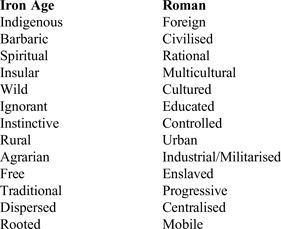
The idea of insistent dualities partly derives from the Classical literature that addressed the gradual incorporation of ‘barbarian’ peoples across the north-west of Europe into the Roman Empire.Footnote 6 Despite heavy criticism of the continued use of dualities in Roman archaeology over the last three decades,Footnote 7 such oppositions persist and are employed to emphasise the progress and power gained from the adoption of Roman ways and innovations brought to Britain following the conquest. Here, we explore the currency of these dichotomies by examining a number of themes that characterise the Iron Age and Roman worlds in school education, TV programmes and series, and museum displays (Table 1). We set off in our project with the aim of assessing the currency of insistent dualities and challenging their relevance. Our conclusion is that, rather than seeking to replace such dualities, an emphasis on their ambiguity enables communications about the Iron Age, Roman and post-Roman past that are less prone to facilitate political instrumentalisations.
A LIST OF DUALITIES FOR IRON AGE AND ROMAN HERITAGESFootnote 45

A startling example of insistent dualities is the contrast between an ‘indigenous’ Iron Age and ‘mobile’ Romans. ‘Indigenous’ has often been chosen by scholars in Romano-British studies to avoid the colonial associations of the concept of ‘native’.Footnote 8 Since the 1980s, there has been growing concern in the World Archaeology movement to afford rights to indigenous groups in formerly colonised areas of the world.Footnote 9 Claims to ‘indigenous’ origins in Europe have, however, frequently been defined in opposition to the idea of migrants in narratives that seek to back the primacy of people who assert descent from the first settlers.Footnote 10 As researchers we need to be critically-aware of the potentially divisive use of the term ‘indigenous’.Footnote 11 The concept of ‘mobility’ is also increasingly being adopted in Roman studies to reflect the large-scale movement of people and objects across the Roman Empire,Footnote 12 and research in Roman archaeology has recently focused on assessing the extent to which people migrated into Britain during the period of Roman control.Footnote 13
The use of the words ‘indigenous’ and ‘mobile’ in discussions of the Roman world prompts questions about how the past is being recreated and how these accounts reflect upon the present.Footnote 14 For instance, how do they relate to the fact that the idea of ancient indigenous groups across Western Europe has been politically instrumentalised to claim exclusive rights to territories and resources and to exclude, marginalise or eradicate ‘others’?Footnote 15 In the final section of this article we ‘sense’ the recurrence of dualities in online public discussions about Brexit, the exit of Great Britain from the European Union on which most UK citizens were called to cast a vote on 23 June 2016.Footnote 16 The initial analysis indicates that some understandings of the past that academics see as more accurate and/or progressive can be turned around and used to support different political positions.
ROMAN BRITAIN AS A ‘GOOD THING’
In their study of museum displays of the Romans in Britain, Beard and Henderson define what they term the ‘insistent duality’ of Boudica/Boadicea, to reveal tensions in the ways that the Roman intervention and assimilation of ancient Britain is perceived.Footnote 17 They ask:
Is Roman Britain Roman or native? British or foreign? Part of the seamless web of ‘our island story’, or an ignominious period of enemy occupation? The origins of (European) ‘civilization’ on our shores, or an unpleasant, artificial intrusion that actually managed to postpone (British) ‘civilization’ for almost a thousand years? Can we avoid taking sides? And if not, whose side are we on?Footnote 18
The notion of insistent dualities is thus characterised by opposing ideas about the past, many of which appear able to co-exist even in the mind of a single individual.Footnote 19 Kristian Kristiansen frames the concept of dualities in a similar way, when defining two European myths of origin that derive from a Classical dichotomy between ‘civilisation’ and ‘barbarism’.Footnote 20 He argues that:
This dichotomy … has produced two dominant European myths of origin: (i) The first emphasises the importance of cultural transmission from the so-called centres of ‘Civilisation’ in the origins of Europe, focusing on the barbarian destruction of Classical Rome and the subsequent revitalisation of ‘Classical Civilisation’ from the Renaissance onwards; (ii) In contrast, the second stresses the indigenous nature of European origins and situates ‘Barbarism’ as the original source of uncorrupted freedom providing a vital alternative to the despotism of the Classical empires.
These concepts are comparable to those defined by Alfredo Gonzáles-Ruibal when he describes two types of colonialist discourse current from the mid-nineteenth to the mid-twentieth centuries: ‘the discourse of civilisation and the discourse of origins’.Footnote 21
The articulation of these dualities often seems to relate to the ways that we understand our places in the present and derives potency from the inherent ambiguity of the concepts in Classical texts that address Britain.Footnote 22 Ideas about the Iron Age and Roman pasts have long called upon the writings of Classical authors, including the works of Caesar, Tacitus and Cassius Dio.Footnote 23 The conceptions derived from these accounts have changed substantially over time, as a result of research and also due to changes in how people conceive the world.Footnote 24 Gradually, a knowledge of the pre-Roman and Roman past has emerged that has distanced itself from the Classical texts, although the descriptions included in these literary sources remain at the core of contemporary understanding.Footnote 25 Inherited dualities, therefore, still operate powerfully in British culture.
School teaching, television and museums play a key role in the shaping of dominant narratives in contemporary British society.Footnote 26 Television coverage of Iron Age and Roman Britain in the programmes ‘What the Romans Did for Us’, ‘Meet the Ancestors’ and ‘Time Team’ — and some museum displays — suggests that the Roman invasion was a ‘good thing’ for those living to the south of Hadrian's Wall.Footnote 27 In some cases they emphasise the idea that the Iron Age people of Britain were ‘barbarians’ who lacked any form of evolved civilisation.Footnote 28 Similarly, the post-Roman period is often described as a move to a ‘darker age’, another expression of Kristiansen's myth of origin,Footnote 29 which opposes civilised Romans with uncivilised barbarians.Footnote 30
Pete Wilson has suggested that the prominence of the Roman past on TV reflects the ‘tele-visual’ character of Roman sites and finds and the fact that coverage of Roman Britain in the National Curriculum in England (Key Stage 2) makes this period familiar to the public.Footnote 31 Until recently, the teaching of history in English schools commenced with the Roman invasion — a stark contrast with the emphasis on Iron Age Celts in Welsh schools at that time.Footnote 32 It included the ‘barbarian’ ancient Britons that were first mentioned in Classical texts (including Caratacus and Boudica), but excluded the previous millennia of settled life in Britain. In 2010, the All-Party Parliamentary Archaeology Action Group led an important and successful initiative for prehistory to be included in the English National Curriculum, noting that ‘the UK is the only European State to neglect prehistory in this way’.Footnote 33
The new National Curriculum, introduced in 2013, includes the option of teaching the ‘Stone Age to the Iron Age’ at Key Stage 2, while Key Stage 3 has optional topics on the Neolithic and Iron Age.Footnote 34 It is stated that pupils ‘should’ be taught about ‘Changes in Britain from the Stone Age to the Iron Age’, with cited examples:
• Late Neolithic hunger-gathers [sic] and early farmers, for example, Skara Brae.
• Bronze Age religion, technology and travel, for example, Stonehenge.
• Iron Age hill forts: tribal kingdoms, farming, art and culture.
For the ‘Roman Empire and its impact on Britain’, the examples are:
• Julius Caesar's attempted invasion in 55–54 B.C.
• The Roman Empire by A.D. 42 and the power of its army.
• Successful invasion by Claudius and conquest, including Hadrian's Wall.
• British resistance, for example, Boudica.
• ‘Romanisation’ of Britain: sites such as Caerwent and the impact of technology, culture and belief, including early Christianity’.Footnote 35
The main emphasis in the teaching of the ancient past in England remains on Roman history, highlighting invasion, resistance and Romanisation.
The British Broadcasting Corporation (BBC) provides a website to support history teaching at Key Stage 2, which includes the following titles:
• How the Romans conquered Britain
• What was life like in the Roman army?
• What was it like in Roman Britain?
• How did the Romans change Britain?Footnote 36
Aimed at a young audience, this includes discussions about how the ‘Celts’ fought back against the Roman invaders, life as a Roman legionary, visiting a Roman town, looking around a Roman villa, the nature of the technology that the Romans brought to Britain and how the Romans left their mark on Britain.Footnote 37
Nigel Mills has observed that images and concepts derived from the teaching of the Roman past in schools may be perceived as boring and predictable today.Footnote 38 The English educational system emphasises that knowledge of the Romans in Britain is well established and definitive, that we now know what we need to know, and also that the Romans were rather like us: they lived in a relatively ordered and settled world, with law, education, literature, theatre, sports, taxes and clear class divisions. The Iron Age peoples seem, by contrast, somewhat ‘other’, having lived in tribal kingdoms with no urban centres, created hillforts, passed down oral traditions and having been subjected to armed invasion.Footnote 39
The critical assessment of concepts of ‘Celtic’ identities in archaeology has also highlighted the problems of drawing direct comparisons between populations resident in Europe in the ancient past and the present.Footnote 40 Until recently, the National Curriculum in Wales strongly emphasised the Celtic Iron Age and the Celtic origins of the Welsh.Footnote 41 The new Welsh National Curriculum for History, published in 2008, instead specifies that Stage 2 pupils should be given the opportunity to study either the ‘Iron Age Celts or the Romans’ alongside a range of other options.Footnote 42 It stresses that pupils should develop knowledge that is based in ‘the local area within the wider context of Wales, but including examples from Britain and other countries’. This can help to dilute the earlier educational focus on the Celtic past, which did not necessarily contribute to creating or projecting an inclusive image for Welsh society today.Footnote 43
Based on these narratives, we suggest a range of insistent dualities as shown in Table 1.Footnote 44 These themes were discussed at workshops in Durham in November 2016 and March 2017. These are outlined to illustrate some of the dualistic concepts on which many interpretations of the Iron Age and Roman pasts often seem to be focused and they form the basis for our research which is exploring the ambiguity in the ways that these concepts are communicated. The core of this paper addresses how a number of these concepts, related primarily to stability and movement, appear to remain central to recent archaeological research and the media coverage and public reuse of Iron Age and Roman pasts. Although this case study may seem to exclude certain of the listed dualities, many of these concepts are represented in the ways that ideas about population stability and movement are communicated in archaeological accounts and in items in the social media that draw upon these.
AN ‘INDIGENOUS’ IRON AGE
This section picks up on the ideas of Iron Age people as indigenous, insular, wild, free, traditional and rooted. Classical authors gave ‘tribal’ and personal names to ‘barbarian’ peoples, providing a potent foundation for ideas of identity, since these were the first ancient peoples to be named by literary sources. From the sixteenth century, these communities were often mentioned in contexts where contemporary societies felt culturally dominated or militarily threatened by powerful kingdoms, states or empires.Footnote 46 During the nineteenth and twentieth centuries, concepts of indigenous origins became caught up with debates and narratives that addressed national identity. Hobsbawm has argued that the understanding of nations as a natural, or ‘God-given’, way of classifying people is a myth springing from modernity.Footnote 47 Such conceptions have drawn upon ideas derived, for example, from the Celtic and Germanic identities of communities laying claim to historical roots and continue to be of concern when adopted in an essentialist fashion.Footnote 48
It is unlikely that Classical writers such as Julius Caesar and Tacitus had access to any detailed information regarding the origins of the Iron Age peoples of Britain, but this did not prevent them speculating. Caesar, for example, had direct experience of Britain from his two invasion campaigns of the South-East, in 55 and 54 b.c., and observed:
The inland part of Britain is inhabited by inhabitants declared in their own tradition to be indigenous to the island, the maritime part by those that migrated at an earlier time from the land of the Belgae to seek booty and invasion. Nearly all of these latter are called after the names of the states from which they sprang when they went to Britain; and after the invasion they lived there and began to till the fields.Footnote 49
Tacitus described the initial conquest of Britain during the period from a.d. 43 to the later first century.Footnote 50 He also discussed British origins, noting that it was not clear whether the first inhabitants of Britain were natives or immigrants and that:
The reddish hair and large limbs of the Caledonian proclaims a Germanic origin: the swarthy faces of the Silures, the tendency of the hair to curl and the fact that Spain lies opposite, all lead one to believe that Spaniards crossed in ancient times and occupied that part of the country. The people nearest to Gaul likewise resemble them. It may be that they still show the effects of a common origin; or perhaps it is climatic conditions that have produced this physical type in lands that converge so closely from north to south. On the whole, however, it seems likely that Gauls settled on the islands lying so close to their shores. In both countries you find the same ritual and religious beliefs. There is no great difference in their language …
These accounts, although in no way reliable as ethnographic descriptions,Footnote 51 have formerly been taken to suggest that the peoples of Iron Age Britain had rather mixed cultural origins. Prior to the 1960s, Iron Age archaeologists explained many aspects of the archaeological record by referring to the invasions of new people from continental Europe, a model termed the ‘invasion hypothesis’.Footnote 52 Since then, however, interpretations have turned away from the concept of Iron Age invasions and migrations towards the idea that many of the peoples of Iron Age Britain may have been indigenous to the areas in which they lived. Cunliffe, for example, has presented a balanced perspective:
There can be no doubt … that the communities of the south and east of Britain were in frequent, if not constant, contact with the adjacent Continent. … there may well have been a trickle of immigrants who would have merged imperceptibly with the native communities. On some occasions larger groups may have arrived, but unless they were numerous enough and determined enough to have maintained their alien identity over several generations they are unlikely now to be archaeologically visible, and their cultural contribution, like their genes, will have been absorbed into the indigenous pool.Footnote 53
This focus on ‘indigenous’ Iron Age peoples is part of a far wider tradition in which archaeologists have become broadly resistant to the idea of large-scale migration in the prehistoric past, looking determinedly for indigenous origins across the globe.Footnote 54 Recent research is once again, however, beginning to emphasise the level of interaction between south-eastern Britain and the Continent during the late Iron Age and the increasing mobility of people.Footnote 55 Counter to this, developing scientific techniques may inadvertently be adding authority to the image of the indigenous Iron Age.
An article in the magazine British Archaeology, entitled ‘The ancient British genome’,Footnote 56 outlines recent attempts to define a characteristic genome for Iron Age British populations using aDNA investigation of ancient skeletal remains.Footnote 57 Most significant studies of DNA have examined samples from living people, although it is becoming increasingly possible to extract aDNA from ancient human remains, constituting the beginning of a ‘revolution’ in the field of ancient human genetic history.Footnote 58 Projects across England have published the genomes of 23 people, 4 from the Iron Age, 11 from the Roman period and 8 from the Anglo-Saxon period. Mike Pitts has asked ‘How much are modern Britons Anglo-Saxon, Roman or ancient British?’Footnote 59 We wonder if this is actually a valid question to ask at all since it focuses on the idea of the passing on of specific ancient genes to modern populations.
Two significant studies of ancient genomes have been published in Nature Communications.Footnote 60 Research by Schiffels et al. analysed ten aDNA samples from excavations in eastern England. These included three Iron Age samples from Cambridgeshire used as proxies for the ‘indigenous British population’.Footnote 61 The authors note that the Iron Age samples ‘preferentially merged at the base of the ancestral branch for all modern Northern European samples’.Footnote 62 The second study, by Martiniano et al., addressed nine ancient samples from a burial area at York, including six Roman-period individuals whose genomes showed similarities with a sample derived from a single Iron Age burial, a finding that the authors have taken to suggest population continuity.Footnote 63 This research emphasises the potential complexity of the genetics of the ancient population of Britain.Footnote 64 Although this literature on aDNA offers major opportunities to contemplate the complexity of the population of Iron Age Britain, it still uses the term ‘indigenous’ to address Iron Age people and their descendants.Footnote 65
A burial from the outskirts of early Roman London offers a particularly interesting perspective on Iron Age mobilities and identities.Footnote 66 The ‘Harper Road woman’ was buried in a wooden coffin, well beyond the southern boundary of the early city of Londinium, on higher ground in Southwark. The skeleton was found in an extended position and accompanied by an array of grave goods, some interpreted by archaeologists as ‘indigenous’ and others as ‘Roman’.Footnote 67 These included a mirror, a toilet-set, a neck-ring, a flagon, two samian dishes and pig bones. The flagon and samian vessels suggest that the burial may date to before a.d. 65.Footnote 68 The neck-ring resembles a number of arm-rings and torcs from Hertfordshire and East Anglia, while the two-piece toilet-set has an Iron Age pedigree.Footnote 69 The aDNA analysis indicates that this person had brown eyes and dark hair and, although the style of burial and the skeletal anatomy were indicative of a female, the chromosomes were male (XY).Footnote 70 Stable isotope analysis has suggested that this individual was probably born in Britain.Footnote 71 We need to consider ‘internal’ movement within Iron Age and Roman Britain, since discourses of mobility often exclude this category.Footnote 72 It is likely that he/she came from a family resident in Britain at the conquest of a.d. 43, who buried them on the periphery of the early city — an indigenous response to the rapid changes occurring in south-eastern Britain.Footnote 73 The stable isotope analysis also indicated that a maternal ancestor of the Harper Road burial may have travelled from eastern Europe or further afield.Footnote 74 The results of research into the remarkable burial deposit at Cliffs End Farm (Isle of Thanet, Kent), using stable oxygen and style strontium isotope analysis, indicate the presence of people from Scandinavia and southern Europe at this site during the late Bronze Age and Iron Age.Footnote 75
Iron Age people evidently did move around and we are concerned that attempts to define an Iron Age genome (or genomes) could potentially reinforce the efforts of some self-defined groups in Britain to claim territory and resources, and to marginalise the rights of people they have defined as ‘other’.Footnote 76 Recent scientific work on the DNA of contemporary communities has challenged the idea of a single Iron Age or Celtic genome across the UK by highlighting 17 regionally distinct ‘genetic clusters’.Footnote 77 Despite this it may prove difficult to replace the idea of indigenous Iron Age peoples in narratives about the past.
Environmental interpretations of the Iron Age also reflect this indigenous concept. Robert Witcher has reviewed a narrative in ecological studies, arguing that the Iron Age is usually seen as a time when Britain was dominated by ‘native’ species, forming a direct contrast to the supposedly large-scale importation of new (or ‘alien’) species by the Romans.Footnote 78 Witcher has observed that some consider the Iron Age environment to have been ‘dull and in need of enrichment’,Footnote 79 despite the fact that the archaeological record is too fragmentary to be sure that some ‘alien’ species were not already present prior to the Roman invasion.Footnote 80 The extent to which new species of animals and plants may have been imported to the British Isles prior to the Roman conquest is thus a relevant field for further research.Footnote 81
ROMAN MOBILITY: MIGRATION AND ‘LOCAL’ PEOPLES
Here we reflect on the Roman populations of Britain as foreign, multicultural, controlled, urban, centralised and mobile (Table 1). The previous emphasis on the Romanisation of the ancient Britons has been challenged over the past 25 years by a body of research that presents a range of alternative approaches.Footnote 82 One important innovation has been deeper reflection on population movement.Footnote 83 This has highlighted how the control and administration of the extensive lands incorporated into the Roman Empire depended on large-scale mobility that included significant numbers of soldiers, imperial officials and traders; people travelled long distances.Footnote 84
An ambitious programme of scientific analysis of human remains has focused on tracing the areas from which people living in Britannia originated, aiming to assess the degree of migration and also the presence of ‘local’ people in the burial record, through cranial, stable isotope and aDNA analyses.Footnote 85 Results from a project that examined a group of late Roman burials from the cemetery at Lankhills, Winchester (Hants.), suggested that some of the individual burials were ‘exotic’, or a ‘putatively immigrant population’.Footnote 86 The ‘Roman Diaspora’ project analysed skeletons from cemeteries at York, Catterick, Gloucester and Winchester (Lankhills) in order to explore the presence of migrants from across the Roman world.Footnote 87 Additional research has sampled 20 individuals from contexts across Roman London, identifying several who may have been from territories ‘local’ to Londinium as well as a number who may have come from the Mediterranean.Footnote 88 Examination of 22 skeletons from the Lant Street cemetery in Southwark (the southern burial area of Roman London) has also indicated that there was sustained migration into the city from areas of the Mediterranean, including North Africa and the Middle East.Footnote 89
The combined results of these studies suggest that some of these urban centres received migrants from across the Empire throughout the Roman period.Footnote 90 Evidence reveals a range of burial practices for individuals who derived from locations across the Roman world. These include people who appear, from stable isotopic analysis and assessment of their burials, to have been ‘local’.Footnote 91 Eckardt et al. have discussed the meaning of the concept of being ‘local’, which might relate to having origins from the particular place at which the individual was buried or, alternatively, to having an origin within Britain.Footnote 92 These studies also challenge any simple categorisation of immigrant groups in terms of burial practices and the artefacts that accompanied them into the afterlife.Footnote 93
A counter to this image of substantial population movement is provided by stable isotope analysis of human bone from burials at the Roman small town and military centre at Catterick (North Yorks.), which appears to show a markedly less diverse population than is indicated for larger towns.Footnote 94 In addition, stable isotope studies from other cemeteries have identified individuals who may have been ‘local’, and it is argued that the genomes of six skeletons from a Roman-period cemetery in York show affinities with the ‘Iron Age genome’ derived from an earlier burial from a cemetery at Melton in East Yorkshire, suggesting population continuity from Iron Age to Roman times.Footnote 95
The majority of scientific analysis of geographical origins has been undertaken on human remains from the Roman cities and towns at York, Winchester, Gloucester and London — among the most likely destinations for migration to Britain in Roman times. London was the primary port, market and administrative centre of Britannia; York included a legionary fortress and a Roman colony; and Gloucester was also a colony. Britannia was, however, a primarily rural society, with perhaps around 90 per cent of the population living in the countryside and small towns.Footnote 96 Relatively little research has been undertaken on burials from such sites. Moreover, stable isotopic investigations have, to date, often focused on Roman burials with unusual grave goods instead of exploring a diverse range of burials with different attributes, again biasing the results obtained.Footnote 97
The data currently available do not, therefore, provide an entirely reliable representation of the degree of migration into Roman Britain. Eckardt et al. have emphasised the need to undertake stable isotope analysis of burials that better reflect the whole Roman population of Britain, including ‘low-status graves’ and those associated with rural communities.Footnote 98 The project undertaken by Shaw et al. deliberately searched for diversity in Roman burials across London, in order to create a more representative picture of the human population, at least for Londinium.Footnote 99 It is interesting to note that far fewer studies have undertaken stable isotopic research on skeletal remains from parts of the Roman world other than Britannia.Footnote 100 There has also been little research to address those peoples emigrating from Britannia to other parts of the Roman Empire.Footnote 101 To consider mobilities in border terms we need more research across the entire area once controlled by Rome.
The character of Britain as a territory that was only partly conquered by Rome provides the opportunity to address population mobility beyond the borders. Studies of artefacts derived from the Empire but found in contexts beyond the imperial frontiers have long been used to argue for the increased mobility of human populations across these border areas during the period of Roman control.Footnote 102 The acidic soils across much of the northern and western British Isles tend to result in the poor preservation of human skeletal remains, but stable isotope analysis of a number of unusual inhumation burials with distinctive artefacts from Ireland has been used to argue that these individuals originated from outside the island.Footnote 103
Several studies have been undertaken in England to assess the potential value of Roman migration in the context of the diverse communities that characterise contemporary Britain.Footnote 104 Results from the ‘Roman Diaspora’ project were used as part of a campaign to lobby for the inclusion of the history of migration in Britain into the new English National Curriculum during 2013.Footnote 105 A printed teaching resource derived from that project, accompanied by a website, ‘Romans Revealed’, is now available for children aged 7 to 11 to explore the evidence from ‘Roman Britain, archaeology and diversity’.Footnote 106 Additionally, the information for migration into Roman Britain has been promoted extensively through websites and digital applications, and museum displays in York, London and on Hadrian's Wall.Footnote 107 In Autumn 2016, the first episode of the BBC television series ‘Black and British’ highlighted the movement of people from the south and east of the Mediterranean into Britain in the Roman period.Footnote 108 Finally, during the summer of 2017 there has been a flurry of activity on the Web related to the topic of claims that the Romans were not ethnically diverse,Footnote 109 claims that contest the conclusions of archaeological work.
SENSING PUBLIC DISCUSSIONS ON ISSUES OF BORDERING AND MOBILITY
So far, this article has focused on the degree to which the past and the present are not separate entities and the importance of seeking to understand how archaeological research has exploited this interrelationship.Footnote 110 In this section, we will show how insistent dualities emerge in current discourse around present-day mobility and borders and will reflect on the processes via which some of the information and knowledge presented beforehand is utilised by different stakeholders. The initial sensing of public opinions reported here is not intended to offer a comprehensive study of current uses of Iron Age and Roman pasts in relation to Brexit.Footnote 111 Instead, we aim to demonstrate how the insistence of dualities within and beyond (and partly as a result of) ‘institutional’ media presentations (e.g. television) and formal education provides a framework to understand the deconstruction and reconstruction of ancient pasts for contemporary purposes and discourses. We also prove that what has been invoked by some academics to promote ‘positive messages’ (e.g. a revision of Roman Britain to emphasise mobility and multiculturality) is actually being used to support very different ideological positions.Footnote 112 This discussion leverages and qualitatively and selectively exemplifies a number of the dualities listed on Table 1, especially indigenous–foreign, barbaric–civilised, insular–multicultural, free–enslaved and rooted–mobile.
On 23 June 2016, British citizens were called to decide upon Britain's possible withdrawal as a member of the European Union. The event was preceded and followed by substantial public discussion, which has been populating, among other media and platforms, 364 public Facebook pages specifically dedicated to ‘Brexit’. These are the public Facebook pages containing the word ‘Brexit’ in their title as of April 2017, and whose posts could be extracted for subsequent search and analysis.Footnote 113 Some of the messages posted to these pages include references to Roman, pre- and post-Roman pasts.Footnote 114 While such mentions are not frequent (they feature in 58 posts), they were ‘spontaneously’ offered and thus have potent utility in our attempts to understand how the periods examined are leveraged in the context of heated social media debates around contemporary identities and politics.
Posts that invoke past periods in relation to Brexit refer mainly to the idea of a Roman Empire, with previous and subsequent times drawn upon in order to underline differences and contrasts. This is not surprising given that the European Union takes deep inspiration from imperial Rome to inform its policies for integration and the dissolution of borders.Footnote 115 The entangled concepts of Britishness, Englishness, Brexit and imperial structures (the Roman Empire and the British Empire in particular) have also been the subject of recent scrutiny.Footnote 116 A first parallel that is evidenced in support of so-called ‘leave’ positions relates to the (perceived) despotic nature of the imperial rule that Britain faces, which is compared to that which characterised ‘the days of the Roman Empire’ (direct quotation from the first of the two comments reported below). The following excerpts document this stance and how it is set in opposition to ideas of democratic freedom that are seen as underlying the structures of nation states.
In the current debate we have not heard very much about the concept and reality of the ‘nation state’. It is true that the United Kingdom is an unusual nation state in that it is comprised of different nations, but we do have a UK parliament, the composition of which changes after every general election. Our parliament and only parliament, has executive powers. We currently live in a supranational entity, which is the current European Union. It is not even a proper federation, but headed by ‘The Council of the European Union’ and the ‘Commission of the European Union’ both of which bodies have executive functions and whose members cannot be voted in or out by anyone in the UK. The last time that Britain faced imperial rule was in the days of the Roman Empire. Vote to Leave the EU on the 23rd June to get back our hard won democratic freedoms [emphasis by the authors].Footnote 117
BREXIT why? Simple:
Sovereignty – every nation state needs to have a constitution … and last I checked the European Constitution is yet to be ratified by all states and yet Britain is being bullied to join this ‘roman empire’ with no constitution in place yet? Blimey have you gone bonkers? Exit is the only solution […].Footnote 118
A consequence of the EU's (felt) ‘despotism’ and a further motivation to reject the EU project is the fact that the latter is perceived to override cultural specificities. Here too, a comparison is made with the Roman Empire that directly reflects the lack of impact of recent research aiming to communicate the multivalency of the Roman past across Britain. The Empire is seen as imposing a homogenising globalisation that (in the words of the Facebook contributor) ‘smashes together’ local traits:
Some things you can run centrally but you cannot centralise the vast cultural and regional differences, you cannot even begin to understand centrally the local issues so if anything we should see more devolution from the centre not more. If you want to have a truly centralised state then you have to smash together cultures and override any regional variations, which, is what we tried to do a few hundred Years ago with the British Empire, what the Roman's tried to do, what the USSR tried to do and many other ‘super’ states over the centuries. This is your last chance to vote on the EU, the next time, maybe not in your life time but most certainly in your children's they will be part of such civil and political unrest as the EU collapses that it will put Europe back 100 Years.
A second pro-leave point that surfaces from our initial scoping concerns mobility and migrations, with policies of integration identified as a reason for the ‘fall’ of the Roman Empire and the possible ‘fall’ of Britain in future:
‘Nothing last forever but be careful what you wish for’
The Romans allowed other nationals to integrate and they fell.
[…] PLEASE BE WISE AND VOTE OUTFootnote 119
The passage above contains a distant echo of the debate relating to the end of the Roman Empire. Academic positions on this matter have changed substantially in recent years and are far from settled, with intense reactions to, for example, Ward-Perkins’ The Fall of Rome. Footnote 120 This volume strongly re-affirms, among other things, the violent nature of the movement of people into and across the Empire in the fourth and fifth centuries and refutes the idea of peaceful processes of ‘acculturation’ and ‘accommodation’, the theoretical roots of which can be found especially in 1970s historiography.Footnote 121 Responses to this stance have spanned from acceptance to rejection, but there is, today, an overall tendency to agree on the multifaceted nature — cultural, economic, military — of the causes leading to the passage from the Roman to the post-Roman period across Europe and the Mediterranean.
Arguments in favour of continued EU membership revolve, instead, around the supposed ‘civilising power’ of the Roman Empire, highlighting a contrast between some public perceptions and recent academic critiques of the concept of ‘Romanisation’. In invoking this theme, one Facebook user stressed that ‘without the Roman empire, you [the contributor is not of British origin] would be still barbarians living in huts’;Footnote 122 the latter comment fully exposes the implied counter-part of the idea of civilised Romans bringing progress, that of a generic ‘barbaric’ and pre-Roman population. A second commentator even referred to the TV programme ‘What have the Romans ever done for us?’,Footnote 123 signalling the agenda-setting role of television.Footnote 124
SUMMARY
To emphasise the binary thinking contrasting indigenous ancient Britons and Roman-period migrants is not to dismiss the research that lies behind some of the contemporary understanding, or the important results that have already accrued.
Future work on aDNA may further complicate assumptions about ‘indigenous’ Iron Age populations. Ideas about migration into Britain during the Roman period are currently, largely conjectural: the amount of available material from aDNA and stable isotope analysis remains limited and is biased toward significant urban sites likely to have more migrants than rural areas. Yet new reflection about mobility has a potentially important role in persuading people that the perspective outlined by the English National Curriculum for schools oversimplifies the degree to which indigenous ancient Britons became ‘civilised’ through a simple linear process of Romanisation. A more balanced conception of the diverse character of the people of Roman Britain will promote an increasingly nuanced understanding — including information about slaves, agricultural peasants, industry, gender and identity — which might move us beyond the territory of dualistic thought.Footnote 125
Additional work is also required to address the ways in which narratives created by a range of stakeholders including ‘archaeological experts’ contribute to shaping the identities and roles of people today.Footnote 126 This in turn might also lead to rethinking the actual meanings and defining characters of expert practices in archaeology. Research for this paper suggests that such studies will need to navigate around the issue of insistent dualities, while working towards a deeper comprehension of the ways in which such oppositions are linked to each other and the overarching thematic webs that they create. Crucially, we will also need to explore and take into account the extent to which these webs form along at least three key spectra that relate to the ways in which people engage with the past and which move, respectively, from fictional to factual, from engagement with present-day issues to escapism, and from the construction of personal identities to the framing of collective ones.
Many of these entrenched dualities are too powerful simply to replace and, indeed, academic research in our supposedly ‘post-colonial’ age often continues to reproduce them, even while challenging them. Building upon the idea of ambiguity inherent in these concepts could help to develop their potential as tools to provoke critical thinking. It is important to persist in questioning how useful some of the insistent dualities identified in this paper may be to discuss the complexity of both the past and the present.
ACKNOWLEDGEMENTS
This paper derives from the project ‘Iron Age and Roman Heritages: Exploring Ancient Identities in Modern Britain’ (Ancient Identities in Modern Britain), funded by the Arts and Humanities Research Council under a Standard Research Grant (2016–2019; Project reference: AH/N006151/1). The project data will be archived at the completion of the project in 2019 (Ancient Identities 2017). The paper draws upon Hingley's long contemplation of approaches to Roman identity and cultural change, the history of the studies of Roman Britain and the making of Roman Frontier Studies; it also substantially draws on Bonacchi's work on the remediation and public experience of the past, digital heritage, and bordering and mobility, especially for the post-Roman and contemporary periods (including the Brexit case study). Sharpe provided general input and assistance with the research. We are grateful to a number of colleagues for discussing these ideas and approaches, particularly to Tom Yarrow, and to Andrew Gardner, Natasha Harlow, Colin Haselgrove, Tom Moore, Darrell Rohl, Christina Unwin and Robert Witcher. Rebecca Redfern provided helpful comments on an earlier version of this text. We are grateful to two anonymous referees for their helpful comments.