Background
Heart transplantation in children is still considered to be the “gold standard” for management of end-stage heart failure secondary to congenital heart disease and cardiomyopathy, particularly after failure of medical and/or surgical therapies.Reference Morales, Dreyer and Denfield1 Median survival after paediatric heart transplantation has increased over time with recent International Society of Heart Lung Transplantation data now reporting survival between 16 (adolescents) and >25 years (infants) post-transplantation in patients that survive the first post-transplant year.Reference Dipchand, Edwards and Kucheryavaya2 These patients are subject to life-long surveillance, must comply with strict medication regimens, and may develop other complications over time, which are associated with physical discomfort and impairment. Therefore, paediatric transplant recipients continue to face the prospect of reduced life expectancy in comparison to their peers and quality of life can be significantly impacted.Reference Benden, Goldfarb and Edwards3, Reference Dipchand, Kirk and Edwards4
When evaluating the success of heart transplantation in children, the assessment of quality of life is becoming increasingly important, as patients are now surviving further into adulthood.Reference Farmer, Grady and Wang5 Quantitative data around long-term quality of life are required to adequately counsel patients and their families about management options for advanced heart failure including transplantation.Reference Farmer, Grady and Wang5 In addition, the rate of non-compliance with post-transplant care, which impacts directly on outcomes, is influenced by psychosocial factors, with quality of life being one of the main considerations.Reference Bell, Bartosh and Davis6, Reference Oliva, Singh and Gauvreau7 However, despite the increasing recognition that quality of life is an important outcome variable in studies on transplantation, it is not often formally assessed during routine clinical care. Consequently, information regarding quality of life of paediatric heart transplant recipients is limited, particularly in adult survivors.Reference Petroski, Grady and Rodgers8
In Australia, paediatric heart transplantation is centralised at The Royal Children’s Hospital, Melbourne, and quality of life outcomes in paediatric heart transplant patients who have reached adulthood have not yet been formally assessed. Therefore, the aim of our study was to evaluate quality of life in adults (aged >18 years) who underwent heart transplantation during childhood through Australia’s nationally funded centre for paediatric heart transplantation.
Methods
Patients
We sent surveys to all living heart transplant recipients from The Royal Children’s Hospital, Melbourne, aged over 18 years at the time of the study. Combined heart-lung transplant recipients were excluded.
Procedures
Institutional ethics approval was obtained to perform a retrospective review of the medical records to obtain demographics and comorbidities and to initiate patient contact for participation in the quality of life survey. Updated follow-up data were obtained from adult institutions within ethics approval guidelines. We assessed quality of life using the Rand Short Form-36 Health Survey, which is a validated multidimensional instrument that allows for self-reported scores of physical, mental, and emotional wellbeing. Surveys were sent by mail with a list of additional questions included to gain further understanding of the level of education reached, activities of daily living, and employment status. Self-reported raw scores were reverse scored and linearly transformed on a 0–100 scale with higher scores indicating better quality of life. Means were calculated for each dimension as per the relevant Rand Health Short Form-36 instructions.9 Comparison data for the Short Form-36 were obtained from the National Health Survey Short Form-36 Population Norms scores (combined gender and age unstandardised).10 Data were collected from February to August 2017.
Definitions
Renal dysfunction was defined as an estimated glomerular filtration rate <60 mL/min/1.73 m2 as measured using the Schwartz formula.Reference Schwartz, Brion and Spitzer11 Coronary allograft vasculopathy was diagnosed qualitatively using angiography as most studies preceded current consensus grading guidelines.Reference Costanzo, Dipchand and Starling12 Rejection was defined as any episode of rejection requiring treatment and that was diagnosed on endomyocardial biopsy or clinically with haemodynamic instability.
Statistical analysis
Statistical analysis was performed using SPSS 23.0 statistical software (SPSS Inc. Chicago, IL, USA). Categorical variables were expressed as counts with percentages and continuous variables were expressed as mean with standard deviation (SD) and/or median with interquartile range (IQR). Means were compared using the independent sample t-test for comparison between two groups. Correlation was assessed using the Pearson Correlation for variables with a linear relationship and Spearman Correlation for variables with a non-linear relationship. Confidence intervals (CI) and p-values (of <0.05) were used to indicate statistical significance.
Results
Patient characteristics
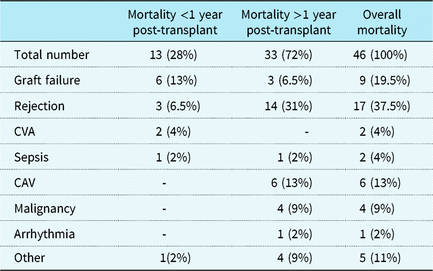
Between 1988 and 2016, 151 patients received a heart transplant at The Royal Children’s Hospital, Melbourne. Overall survival after transplantation was 91% at 1 year, 84% at 5 years, 73% at 10 years, and 65% at 15 years. Causes of mortality are outlined in Table 1.
Causes of death after paediatric heart transplantation. Data are expressed as frequencies (percentages of total deaths).

CAV=Coronary Allograft Vasculopathy; CVA=Cerebrovascular Accident
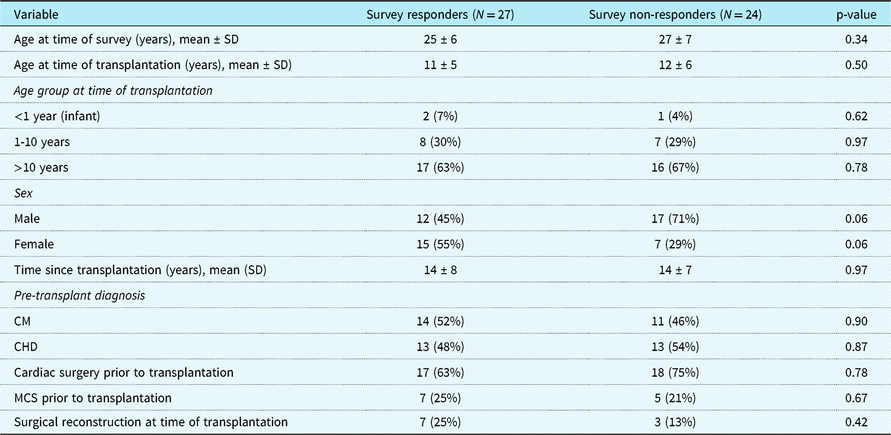
A total of 64 (64/151, 42%) patients reached adulthood following paediatric transplantation. However, 13 of these patients died prior to the commencement of this study leaving 51 living patients aged over 18 years. After sending the survey to all eligible patients (n = 51), we had a response rate of 53% (n = 27). In total 17 (17/51, 33%) of the non-responders could not be contacted to follow up on the survey and 7 (7/51, 14%) were contacted but did not return their survey despite stating they were willing to participate. Demographics for both survey responders (n = 27) and non-responders (n = 24) are displayed in Table 2. Almost 90% of patients who responded were more than 5 years post-transplantation and 67% of patients (18/27) were more than 10 years post-transplantation. Two patients were still receiving follow-up care at our paediatric institution and the other 25 patients had been transitioned to adult care centres. Median time from transition to adult care to completion of the survey was 4 years (IQR 3–8).
Demographics of adult survivors of paediatric heart transplantation: survey responders compared to non-responders.

CM=cardiomyopathy; CHD=congenital heart disease; MCS=mechanical circulatory support; SD=standard deviation
Median follow-up time for all responders was 11 years (IQR 7–19). Amongst the responders, 14 patients (14/27, 52%) had developed renal dysfunction since transplantation, two of whom required renal transplantation. Six patients (6/27, 22%) had developed post-transplant lymphoproliferative disorder. Two patients (2/27, 7%) had a formal diagnosis of coronary disease, one of whom required percutaneous intervention and coronary artery stent placement. A total of 11 patients (11/27, 41%) had developed none of these three complications (renal dysfunction, malignancy or coronary allograft vasculopathy), 11 patients (11/27, 41%) had developed one of these complications, and 5 patients (5/27, 18%) had developed two of these complications. The mean number of rejection episodes since transplantation was 1 ± 1. No patients had been listed for or had undergone re-transplantation at the time of survey participation.
Amongst non-responders, one patient was also lost to medical follow up. Of the remainder (n = 23), four patients (17%) had undergone re-transplantation, four (17%) had been diagnosed with coronary allograft vasculopathy (three of whom had later undergone re-transplantation), three (13%) had developed post-transplant lymphoproliferative disorder, and fourteen (61%) had developed renal dysfunction.
Employment, education, and daily living
In total 20 patients of the 27 responders (74%) stated that they had completed secondary school and 14 (14/27, 52%) stated that they had completed further study in the form of a certificate, diploma or tertiary degree. Twenty-three responders (23/27, 85%) were either currently working or studying and five (5/27, 19%) were receiving a disability support pension. All patients stated that they did not require any assistance with activities of daily living (e.g. dressing, showering etc.) and were all New York Heart Association Class I or II.
Self-reported quality of life scores
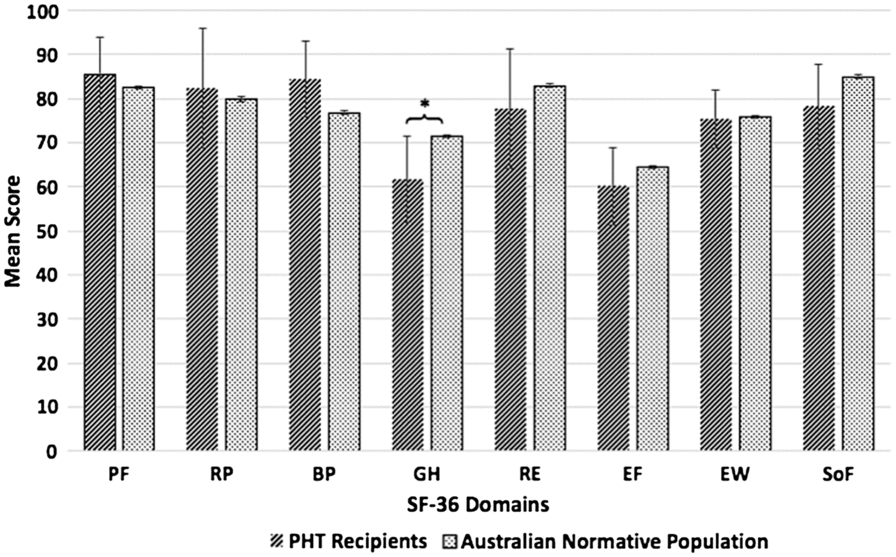
Mean scores for the Short Form-36 dimensions are displayed in Fig 1. Most of the self-reported quality of life scores were not significantly different from the Australian normative population data (1995).10 The self-reported “General Health” was the only score found to be significantly worse than the normative data (p = 0.02, 95% CI [−17.94, −1.86]).
RAND SF-36 domain scores in PHT recipients compared with general population SF-36 data.10

A negative correlation was found between “General Health” and the time since transplantation (R = −0.383, p = 0.049). However, when recipients were asked to rate their general health on an ordinal scale compared to one-year prior, most (25/27, 93%) reported that it was either about the same (n = 14), somewhat better (n = 9), or much better (n = 2). There were no significant correlations demonstrated between other quality of life scores and time since transplantation. There were also no significant correlations by age at transplantation or time after transition to adult care. Scores were not significantly different in patients that had been diagnosed with renal dysfunction, post-transplant lymphoproliferative disorder, or coronary allograft vasculopathy.
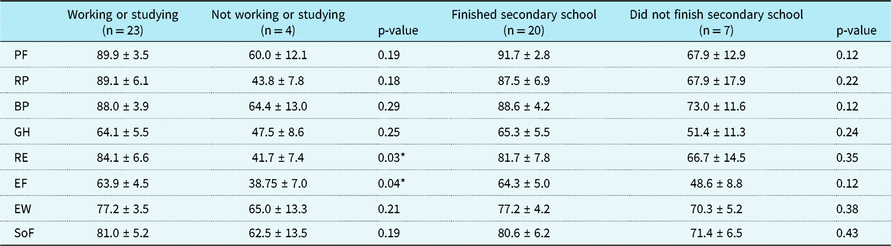
Comparisons of scores by employment status and secondary education achievement are displayed in Table 3. Patients who stated that they were currently employed or studying (n = 23) had significantly better “Energy and Fatigue” dimension scores (p = 0.04, 95% CI [−49.27, −1.06]) and “Role Limitations due to Emotional Health” (p = 0.03, 95% CI [−79.20, −5.58]) when compared with patients who were not currently working or studying (n = 4). No significant differences were shown in any other dimensions for those who were currently working or studying. Furthermore, no significant differences in scores were found comparing patients who completed secondary school education (n = 20) to those who did not (n = 7).
Comparison of quality of life scores in adult survivors of paediatric heart transplantation by employment and education

BP=bodily pains; EF=energy/fatigue; EW=emotional wellbeing; GH=general health; PF=physical functioning; RE=role limitations due to personal or emotional problems; RP=role limitations due to physical health problems; SoF=social functioning
Quality of life scores are expressed as mean with standard error
* Statistically significant
Discussion
Paediatric patients who undergo heart transplantation are now surviving further into adulthood.Reference Dipchand, Edwards and Kucheryavaya2 However, the health, wellbeing, and quality of life of long-term survivors of transplantation continue to be challenged by the lifelong demands of post-transplant care and the occurrence of medical complications over time.Reference Petroski, Grady and Rodgers8 Psychosocial factors, including motivation and comorbidities such as depression and anxiety disorders, strongly influence compliance with post-transplant care and, hence, long-term medical outcomes in transplant recipients, particularly amongst adolescent recipients.Reference Pollock-BarZiv, Anthony, Niedra, Dipchand and West13 This becomes especially important after patients have transitioned to adult care providers at which time patients are required to take more personal responsibility for their health.Reference Anthony, Martin, Drabble, Seifert-Hansen, Dipchand and Kaufman14 There is likely to be an important relationship between perceived quality of life, the above psychosocial mediators, and hence compliance with medical therapy.Reference Shellmer, Dabbs and Dew15, Reference Dipchand16 Given this, assessment of quality of life and the capacity for paediatric heart transplant recipients to lead a relatively normal adult life is increasingly being recognised as an important outcome following transplantation.Reference Dipchand16, Reference Hollander, Chen and Luikart17
In our study, Australian paediatric heart transplant recipients who had reached adulthood demonstrated good self-reported quality of life scores that were mostly comparable to the Australian normative population.10 General health was the only exception and this is in keeping with other studies using the Short Form-36 for assessment of quality of life in older paediatric heart transplant recipients internationally.Reference Petroski, Grady and Rodgers8, Reference Albert, Gresch, Huelsen and Hetzer18 In this study, self-reported general health also appeared to decline over time since transplantation but this may be related to an increasing burden of medical comorbidities with time. A similar study to ours by Petroski et al. (2009) that surveyed 23 paediatric heart transplant recipients aged ≥18 years had a raw mean Short Form-36 score for the “General Health” subscale of 47.98 ± 12.28.Reference Petroski, Grady and Rodgers8 This score was not significantly different to their normative data from the United States but was still one of the lowest scores in their study. Reasons for poor perceptions of general health in paediatric heart transplant recipients have not been elicited in other studies and our study was not designed to achieve this.Reference Petroski, Grady and Rodgers8, Reference Albert, Gresch, Huelsen and Hetzer18 That being said, it would be reasonable to postulate that poor perceptions of general health in transplant recipients, particularly in comparison to the general population, are related to the burdens of medical therapy and surveillance, and complications related to therapy, including immunosuppression, and transplantation itself.Reference Petroski, Grady and Rodgers8
Employment is considered to be an outcome measure of successful transition to adult care and is a goal for most transplant recipients and their families.Reference Coyne, Hallowell and Thompson19 Unemployment after heart transplantation in adult recipients has been shown to be associated with increased rates of rejection and medical complications in general.Reference White-Williams, Jalowiec and Grady20 Despite this, our study demonstrated high levels of independence in relation to activities of daily living and employment. The high rate of participants receiving a disability support pension is to be expected given the chronic nature of transplantation. According to Australian Bureau of Statistics data, between 75% and 77% of people aged 20 to 29 years old had completed secondary school.21 Therefore, the rate of secondary education attainment in our study appears to be consistent with the general population. These results were similar to that of Hollander et al. (2015), who demonstrated impressive employment rates and overall good quality of life scores in adult survivors of paediatric heart transplantation.Reference Hollander, Chen and Luikart17 In addition, the majority of participants in our study were adolescents at the time of transplantation who are known to be particularly at risk of poor psychosocial outcomes especially following transition to adult care.Reference Albert, Hetzer and Hudalla22–Reference Putschoegl, Dipchand, Ross, Chaparro and Johnson25 In general, adolescents with chronic conditions are significantly less likely to complete secondary school, undertake further education, and find employment in adulthood than their healthy peers.Reference Hale, Bevilacqua and Viner26 These patients are also more likely to remain unemployed and have significantly lower earnings as an adult.Reference Hale, Bevilacqua and Viner26 The results from our study contribute to the growing evidence that paediatric heart transplant recipients, even those transplanted during adolescence, are able to lead a relatively normal and satisfying adult life, in contrast to patients with many other chronic conditions.
Study limitations
Our study is limited by a small sample size and lack of additional assessment to explore potential mediators of the reported quality of life outcomes in these patients. There may also have been a response bias with such a high proportion of responders being educated and employed as well as being more than 5 years post-transplantation. When comparing responders with non-responders, the demographics were generally similar. However, non-responders did appear to have a slightly higher rate of complications than responders. The self-reported scores did not appear to be significantly altered by the presence of these conditions amongst responders but this may have been secondary to the low numbers of patients with these outcomes. These long-term survivors are likely to have the benefit of hindsight and their lives are likely to be less impacted by post-transplant care than patients who were transplanted more recently. Despite the small numbers, we were still able to capture a large proportion of recipients who experienced a complicated pre- and post-transplant course. Therefore, whilst we may have had a skewed response, it is reassuring that these patients were able to achieve this despite significant ongoing health issues.
We chose to use the Rand Short Form-36 due to the public availability of the survey. However, the Australian normative population data was obtained using the original Short Form-36 survey, which has subtle differences in scoring.Reference Hays, Sherbourne and Mazel27 The two dimensions that have been identified as being scored differently between the two versions are the “Bodily Pain” and “General Health” dimensions. Hays et al. (1993) found that the original Short Form-36 scores for “General Health” and “Bodily Pain” correlated to 0.99 of the Rand Short Form-36 scores thereby making the differences minimal.Reference Hays, Sherbourne and Mazel27 It should also be noted that only “General Health” was found to be significantly different between the groups in our study. The use of only one validated tool for assessment of quality of life and the use of old and non-specific population normative data are additional limitations of our study. Regardless, the results from this pilot study can provide an overview of quality of life in a population of paediatric heart transplant recipients in which quality of life had not been assessed previously. In addition, we did not formally assess or collect data in relation to psychiatric outcomes in these patients but this may be a consideration for future studies.
Conclusion
Australian paediatric heart transplant recipients who survive to adulthood demonstrate good quality of life in a variety of domains. Educational attainment and employment are achievable and can positively influence perceptions of quality of life. Perceptions of general health may be negatively affected by the burdens of transplantation. This study informs counselling of patients and their families as they contemplate the option of transplantation and the long journey thereafter. Knowledge about this area of transplantation care and counselling may be extended by future studies that explore mediators of the quality of life outcomes that we have measured.
Author ORCIDs
Alice Parker 0000-0002-7110-6940
Acknowledgements
The authors would like to acknowledge Dr Christina Kure, Prof. David McGiffin, Dr Min-Er Ching, and Prof. Anne Keogh for their assistance in obtaining follow-up data.
Financial Support
This research did not receive any specific grant from funding agencies in the public, commercial, or not-for-profit sectors.
Conflicts of Interest
None.