Introduction
Inquisitors famously burned books. Writings were censored; books prohibited; ships, stores, and libraries inspected; and onerous literary legislation enacted. This has led some historians to conclude that the Inquisition aided in the downfall of literature and learning. Others argue that censorship lacked strict enforcement, ports were porous, and other countries engaged in book burning, religious discrimination, and executions of offenders. Hence, the conclusion is drawn that the Inquisition did not damage scholarship relative to other countries (Kamen Reference Kamen1998).
To test the potency of the Inquisition on scholarship I provide an analytic approach. The Complete Dictionary of Scientific Biography (2008; hereafter CDSB) is a 27-volume encyclopedia set that includes more than 5,700 entries on “the lives and careers of great scientists, mathematicians, and natural philosophers.” More than 1,200 individuals of the 5,700 lived in Europe from 1000 to 1749, the time frame of this study. This is augmented with more than 800 top-tier artists, authors, and composers (AACs) that lived throughout the same period (Murray Reference Murray2003). To measure the effects of the Inquisition on scholarship the number of geniuses alive across countries is compared. For the purposes of this article, a genius is by definition any individual included in CDSB or Murray.Footnote 1 This measure allows for quantification of scholarship to some degree, which then can be used to measure how scholarship changed over time within a country and relative to other countries.
These sources are utilized to maintain a consistent definition on who to include in the data set. Composed over multiple decades with hundreds of contributors, the CDSB earned the Dartmouth Medal, which “honors the creation of a reference work of outstanding quality and significance,” in 1981.Footnote 2 Using this source eliminates any author bias in the definition regarding who to include or exclude and gives standardized data. The Murray data is described in more detail in the following text.
In analyzing where these 2,000 highly accomplished individuals lived, I find that inquisitions had a highly significant negative effect on the number of geniuses living in the inquisitorial countries of Portugal, Spain, and Italy.Footnote 3 Not only did the number of scholars decline in inquisitorial areas, it increased in other countries creating a divergence in high levels of human capital between inquisitorial countries and other areas.
The rise of systematic censorship occurred shortly following the invention of the printing press. Areas with printing had faster urban growth rates, around 60 percent more from 1500 to 1600 than comparable nonpress cities (Dittmar Reference Dittmar2011). With a novel and disruptive technology, elites who expected to lose power sought to suppress or control printing. The Ottoman Empire successfully prevented the printing press from majority usage as it would have disrupted political power. Aware of the benefits, the elites allowed some minorities to publish, such as Armenians, but prevented Arabic presses as it would have eroded their control. Arabic printing only became acceptable after other forms of legitimization arose (Coşgel et al. Reference Coşgel, Miceli and Rubin2012).
The printing press disruption affected the Christian world. A Dominican defender of the Inquisition complained: “Ever since they began to practice this perverse excess of printing books the church has been greatly damaged and every day it is confronted by greater and more obvious perils as men exchange the ancient and secure doctrine of the virtuous doctors for the sophisticated and adulterated one of the moderns.” Books were known as “silent heretics” (Bosmajian Reference Bosmajian2006: 66). In 1584 Mendoza de Porres argued astrology should be judged by scientists and not theologians; a censor replied theologians decided truth. In 1559 the Spaniard Antonio de Araoz said, “The times are such that one should think carefully before writing books” (Kamen Reference Kamen1998: 103).
Kings, who to some extent derived legitimacy from religion, aided in censorship to maintain control. This benefited inquisitors as it allowed Catholic elites to maintain and display power, not only from religious rivals but also from scientists who provided a substitute for or challenged religious explanations on nature. Catholic elites had reason to fear the press; Protestants greatly used printing. Luther sold 300,000 copies of his writings between 1517 and 1520. Holy Roman Empire cities with a press in 1500 had at least a 29 percent higher probability of being Protestant a century later. This eroded Catholic power as destruction or confiscation of church wealth usually occurred with the acceptance of Protestantism (Rubin Reference Rubin2014). The Inquisition, in this aspect, can be interpreted as a Catholic response to Protestant printing power.
Inquisitorial Censorship
Three major post-Medieval inquisitions existed: the Portuguese, the Spanish, and the Roman. Spain is the best studied with contradicting strands of thought on the impact of censorship. Traditionalists assert no negative influence; literature flourished during the golden years concurrent with the Inquisition. Despite censorship, prohibited book denouncing remained rare; not due to successful banning but rather to an implicit agreement among intellectuals to conceal their libraries. Inquisitors complained about illicit books and their preservation, even in monastic libraries (Contreras Reference Contreras and Alcalá1987: 156). Marcelin Defourneaux (Reference Defourneaux1963) argues the Spanish censored less rigorously than Rome. Spain had weak information networks leading to limited censorship of literary and foreign works, excepting theological books. Books entered the country by smugglers through ports and frontier lands. Defourneaux (Reference Defourneaux1963: 166) concludes the Inquisition did not close Spain to European culture, and that the entire history of the seventeenth century shows this. Henry Kamen takes a similar position: “The Inquisition's overseeing of literature, in short, looked imposing in theory but was unimpressive in practice” (1998: 133). An inquisitor commented in 1532, “From one hour to the next books keep arriving from Germany.” In 1569 Barcelona bookshops sold “many forbidden books.” English ships had protection against inspection after 1605 and inquisitors complained in 1606 that “it is reported that many of the books ordered to be picked up are not being collected.” Even though inquisitors engaged in simultaneous inspections of bookshops; they rarely occurred and only in larger towns (ibid.: 118–20). Costly to maintain, the Index remained dated and difficult to enforce. Furthermore, it excluded most creative and scientific literature. Historians' “treatises of mathematics, botany, metallurgy and shipbuilding” were never blacklisted, and if one wanted a banned book it was easy to obtain (ibid.: 131–33).
Taking the opposite view, more modern studies claim that Spaniards “virtually ceased to write and think” (ibid.: 133). This dates to contemporaries of the institution. Antonio Marquez (Reference Márquez1980) noted that books disappeared in the sixteenth century, with some books lacking reprinting for two centuries. José Tomás (Reference Tomás1991) analyzed the sixteenth- and seventeenth-century lists of confiscated scientific books. Four hundred and sixty-one scientific authors between 1559 and 1707 had 759 scientific works cited either as expurgated or prohibited altogether. In 1634 a memoranda listed 3,021 confiscated books with 356 of them being scientific, with the majority not appearing in the indexes; implying that censorship went beyond formal requirements.
Studies in Italian censorship are rare—with most focusing on Venice and Naples. It is unknown how much censorship affected the rest of Italy. Paul Grendler (Reference Grendler1977: 288) found the Roman Inquisition somewhat ineffective with persistent cultural links between Italy and the rest of Europe. This contrasts with António Rotondò (Reference Rotondò1973) who emphasized the split between Italian and European culture over this time. Suppressed in Italy, confiscated books written by Erasmus declined from 1555 to the second half of the eighteenth century (Menchi Reference Menchi1987). Additionally, vernacular Bibles disappeared for several centuries in Italy (Bethencourt 2009: 235–36).
In explaining these conflicting views of inquisitorial effectiveness Francisco Bethencourt (ibid.: 232) summarizes: “it is difficult to establish with any degree of certainty the effectiveness of these control mechanisms [on books].” To better grasp the effect of the Inquisition on scholarship I created a database of scholars across 16 European countries covering 750 years. There are two types of top-tier scholars: scientific (comprised of chemists, mathematicians, physicists, biologists, etc.) and AACs. Scientists come from CDSB, which provided (for almost everyone) the years of birth and death, and the years when he or she moved countries. Using this information I compiled a database on how many scholars lived in each country for every year from 1000 to 1749. As an example, born circa 1450 the Spaniard Abraham Zacuto moved to Portugal in 1492 where he died circa 1522.Footnote 4 This gives Spain a scholar from 1450 to 1491 and Portugal a scholar from 1492 to 1522. Attending a university did not count as moving to a country due the scarcity of this data. With an unknown exact birth or death year, as in Zacuto's case, the estimated year was used. Each of the more than 1,200 scholars was assigned to the country where he or she lived for each year of their life in this manner, then aggregated.Footnote 5 Migration to colonies is considered as leaving the country. A rare event, few scholars followed this path.
Charles Murray (Reference Murray2003) analyzed human accomplishment in various fields, including art, literature, and music, which I use here. Murray consulted historical biographic encyclopedias and listed those mentioned in at least half of the sources (79). He included 12 sources for (European) artists, 13 for authors, and 13 for composers (477). This resulted in more than 800 significant figures that lived from 1000 to 1749. I use his data as an outside source that minimizes bias and standardizes inclusion. His data included the birth and death year of these individuals and their movements were tracked similar to scientists. Sources used to identify when the significant figures moved countries include the Encyclopedia Britannica, Catholic Encyclopedia, Dictionary of Renaissance Art, www.classical.net, www.allmusic.com, and Wikipedia.
These two data sets combined provide more than 2,000 top-tier scientific, artistic, literary, and musical geniuses across Europe that lived for more than 100,000 cumulative years. This database allows for a comparison on how the highest intellectual achievers reacted to the inquisitions within and across countries. The writings, compositions, and output of scholars are not considered here. Scholarly output ranges from difficult to impossible to measure and compare across specialties. Instead of equating Philosophiæ Naturalis Principia Mathematica with a sonnet or the Mona Lisa with a sketch—or using a function to derive a relationship between output of geniuses across disparate fields—only the top achievers' lives will be counted. Despite scholarly disparity this allows for analysis on the Inquisition's effect on scholarship.
Life spans range from birth to death. While this clearly includes time when scholars did not produce when both young and old, finding a consistent age by which to begin and end counting is elusive. Évariste Galois made significant and lasting mathematical advancements but died at the age of 20 while other scholars did not become notable until later in life. Using birth and death gives a consistent and unambiguous beginning and end point—instead of estimating for each individual their first and last major contribution.
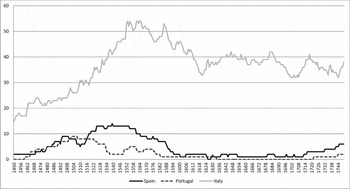
Figure 1 shows the number of high-level scientists living in inquisitorial countries per year. Italian scientific genius peaks in the early 1560s, about two decades after the creation of the Inquisition. Despite its relative inquisitorial tolerance, the assault on books and scholarship had an effect outside of theology. Italy maintained a near monotonic increase of scholars from the mid-fifteenth century until its acme; with an average of 52 scientific geniuses from 1550 to 1569. Italian genius then plummeted to 39 a year from 1600 to 1699 after the impact of censorship spread across the peninsula—a 25 percent decline. Like Italy, top-tier scientific scholars collapsed in Iberia. Portuguese scientific genius fell to zero and Spain returned to pre–printing press levels. The collapse is even more severe than shown in the figure, as it does not control for population growth.
Number of Scientific Scholars Living Per Year in Inquisitorial Countries

Roman Inquisition
Pope Paul III established the Roman Inquisition in 1542. Lacking political unity, the institution did not centralize across the peninsula until a decade or two after its establishment. The Roman Inquisition even reached the Kingdom of Naples and Spanish controlled territories (Black Reference Black2009: 19). Due to Italy's politically disunified nature the Papacy negotiated with local rulers to establish tribunals. Yet inquisitors still prosecuted even in the absence of a formal tribunal, especially shortly following its establishment (ibid.: 27–28). Thus, while Italy did not exist as such during the time of the Inquisition, the Roman Tribunal did span across modern-day Italy shortly following its establishment and is treated as a single unit here.
Issued in 1543 the first Roman Inquisition censorship edict stipulated heavy fines for selling or trading banned books (ibid.: 21). The book industry fought back but lost: “In the 1560s the Italians reached the conclusion that their religious consciences were fundamentally Catholic and that heretics and heretical books should be suppressed” (Grendler Reference Grendler1977: 128). The preacher Francesco Panigarola explained that the Inquisition and Index of banned books guaranteed peace and security in a calamitous world (ibid.: 181).
Regular bookshop inspections occurred in the Papal States, as well as customs' posts in seaports. In other regions, inquisitors summoned booksellers and printers to the tribunal to impose control and censorship. Despite less visible intervention compared to Iberia, Italian inquisitors compiled superior information on books printed in Protestant countries. Agents attended Frankfurt fairs to catalogue publications on new books and recommend immediate prohibitions; with this list being used in Iberia (Bethencourt Reference Bethencourt and Birrell2009: 234).
Inquisitors issued hundreds of decrees on books with the first Roman Index Librorum Prohibitorum published in 1559. The majority of special edicts in Italy dealt with prohibited books along with rules for booksellers, printers, merchants, owners of libraries, and anyone associated with printing. For example, Bologna published edicts in 1607, 1614, 1638, 1652, 1670, 1682, and 1706. Owners of prohibited books faced excommunication. Printers swore oaths that they followed procedures and banned from working without a license. Regulations required bookshops to maintain lists of their stock, as well as heirs and executors of libraries of the deceased. Even peddlers who sold and circulated booklets, songs, tales, comedies, and engravings needed licenses (ibid.: 209–10).Footnote 6
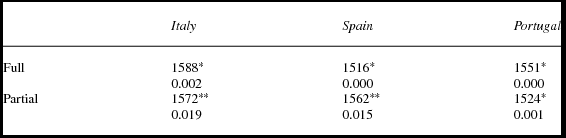
Table 1 gives blind breakpoints for scientific genius by inquisitorial country (for 1450 to 1749). Annual regressions were run with a fully specified model (as seen in the panel data regressions), or with a partially specified model of only a lag, time, and inquisitorial dummy. Italy experienced a structural break sometime in the 1570s to 1580s.
Blind breakpoint tests on scientific scholars 1450 to 1749.

Note: Full model includes constant, lags, time, Inquisition dummy, war, urbanization, institutional quality, number of universities, number of printing presses, and population. Partial model includes constant, lags, time, and Inquisition. Data sources are given in the text.
Value below year is p-value; significance: *1%, **5%.
After the establishment of the Inquisition it would not be expected for scholars to immediately decrease. Rules and censorship were implemented with a lag, and it would take time for scholars to react to the new bureaucracy. In Italy the scientific decline began about a generation after the Inquisition began.
Spanish Inquisition
The Spanish Inquisition began in 1478 and had early book burning. However, decades passed before inquisitors controlled censorship and acted in a systemic fashion differing from noninquisitorial countries. A list of prohibited books first appeared in 1547; with additional lists in 1551, 1559, 1568, 1583–84, 1612, 1632, 1640, 1707, 1747, and 1790. Fanfare accompanied the pronouncement of prohibited books, including parades and music (Bethencourt Reference Bethencourt and Birrell2009: 205; Polastron Reference Polastron2007: 115).
Half a century lapsed before the Inquisition regulated book imports; the first instructions appeared in 1533 and jurisdiction recognized in 1558. In regressions in the following text, the year 1533 is used for the Spanish Inquisition as that is the first year of formal censorship and regulation. Inquisitors checked the cargo before customs officials and interrogated captains and officers. The rigor of the ships' visits relaxed somewhat at the end of the sixteenth century and died out in southern Spain (Bethencourt Reference Bethencourt and Birrell2009: 230–34). In 1539 Pope Paul III allowed the Inquisitor General to sentence owners of books authored by heretics; Pope Julius III in 1550 broadened the jurisdiction to include those who owned or read forbidden books. By the mid-sixteenth century the Inquisition had an efficient and monopolistic censorship system (Pinto Reference Pinto and Alcalá1987: 304–5).
In 1559 the inquisitor Fernando de Valdés published a list of about 700 prohibited books—the same year as the Roman Index Librorum Prohibitorum. It forbade books written by heretics, religious books authored by the inquisitorially condemned, heretical and vernacular translations of the Bible, devotional works in the vernacular, all books on magic, books with profane biblical quotations, books printed since 1515 without the author and publisher, all anti-Catholic books, and any book with religiously disrespectful pictures or figures (Kamen Reference Kamen1998: 109).
The regulations adversely impacted scholarship: from 1600 to 1699 Spain averaged just 1.4 scientific geniuses per year, whereas over the prior century it surpassed nine; a spectacular 85 percent decline. Spanish blind breakpoints tests (table 1) give a wider range than Italy—from 1516 to 1562—with Spanish control of censorship growing and changing over this time. Similar to Italy the impact followed the establishment of the Inquisition as the system of censorship took decades before becoming fully implemented, and the decline of scholars correspondingly lagged the creation of the institution.
Portuguese Inquisition
Established in 1536 to combat crypto-Judaism, the Portuguese Inquisition quickly turned to censorship. Edicts prohibiting books appeared in 1547, 1551, 1559, 1561, 1564, 1581, 1597, and 1624. The 1551 edict authorized the inspection of bookshops and libraries in Portugal. Additionally, inquisitors issued isolated edicts for specific books between publications of the lists (Bethencourt Reference Bethencourt and Birrell2009: 196, 205).
Inspectors visited libraries and printing houses. The Lisbon Academy of Sciences library had inspections in 1566, 1573, 1574, 1575, 1625, 1626, 1629, and 1633 (ibid.: 227). Visits to bookshops regularly occurred up to at least the beginning of the seventeenth century. A visitation in 1606 went across all of Portugal and booksellers had to present under oath a list of books in their shops. Bookshop inspection did not seem to continue for long as self-censorship was used; only a few dozen book professionals existed in the country until the eighteenth century. Inquisitors, however, vigilantly inspected ships. Upon the arrival of a foreign boat, an inspector and translator gathered names of the ship, captain, and passengers; the ship's origin and cargo carried; as well as the ages, nationalities, and religious affiliation of everyone onboard. The inspector then searched the boat for books, especially Bibles (Amiel Reference Amiel, Henningsen and Tedeschi1986: 89–90).
Scientific scholars in Portugal directly relate to the Jewish/New Christian population. Of the eight Portuguese-born geniuses over this time, five have Jewish descent.Footnote 7 However, the collapse in Portuguese scholars appears before the Inquisition began. A massive New Christian massacre that occurred in 1506 led to an outmigration, which continued over the centuries. This decade corresponds to the maximal number of scientific scholars in Portugal, with a general decline afterward. Nobility pushed for years to create an Inquisition, with it being prevented by New Christian wealth buying off the Vatican. After its founding in 1536, it is not surprising that an institution designed to persecute New Christians and learning would have such a notable and drastic effect on top-tier scholarship in the country. From 1634 to 1699 no top-tier scientists lived in the country. Breakpoints for Portugal range from 1524 to 1551. The inquisitorial effect happened sooner in Portugal than Spain or Italy relative to the establishment of the institution, but kings had attempted for decades to implement the institution giving New Christians time to flee the country before it began.
Inquisitorial Intellectual Impact
One argument against significant inquisitorial impact on scholarship is European-wide censorship and intolerance. Inquisitorial countries did not monopolize censorship or book burning; other countries likewise had oppression even if lacking a devoted bureaucracy. Book censorship legislation existed across the continent and universities took part in censoring; in 1683 Oxford University issued a decree for a public book burning. Ironically, Parliament in 1710 sentenced the decree to be burnt. An author who offended Queen Mary was hung, quartered, and had his head set on London Bridge. Queen Elizabeth had raids to destroy books. France executed publishers by Notre Dame as their books burned beside them. A printer who wrote against the Cardinal of Lorraine in 1560 was killed. In general, book burning was common across Europe in the sixteenth and seventeenth centuries (Bosmajian Reference Bosmajian2006). Oddly, no author or printer in Spain was put to death—except Protestant heretics—whereas England and France had executions, meaning inquisitorial countries were in some sense more lenient than noninquisitorial ones (Kamen Reference Kamen1998: 106).
The section Inquisitorial Censorship analyzed geniuses living in inquisitorial countries individually, finding a break in scholarship shortly following the establishment of inquisitions. Inquisitorial countries are analyzed here along with 13 othersFootnote 8 that also experienced censorship and slaughter but without a formal institution designed to persecute. Data is averaged over 25-year blocks from 1000 to 1749. The series begins in the year 1000 as earlier various control data is lacking and few top-tiered scholars lived pre-1000. Beginning before the establishment of the inquisitions gives a comparison to how Iberia and Italy fared beforehand and illustrates the shock of the institution. The data set ends in 1749 to maintain all data in a preindustrial world and eliminate any effects industrialization would have on human capital. Additionally, the Italian Inquisition ended in a piecemeal fashion. In Milan it slowly died beginning in 1771, the Naples tribunal ended in 1782, Como in 1782, Lombardy in 1797, Venice in 1794, Tuscany lost book censorship in 1743 and the Inquisition ended in 1786, Parma and Piacenza in 1778–79, Modena in 1785, Bologna in 1798, and so forth (Black Reference Black2009: 54–55). Because the unit of measurement is on the (modern) country level the data set ends before the closing of localized tribunals.
Panel unit root tests following Im et al. Reference Im, Hashem Pesaran and Yongcheol(2003) or Maddala and Wu (Reference Maddala and Wu1999) reject unit roots with three lags and a linear trend for all scholars and for scientific scholars. Unit roots are rejected with one lag and a linear trend for AACs. The appropriate lags are included in all regressions.
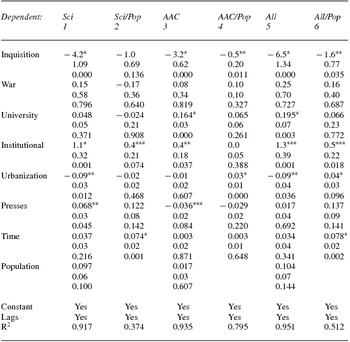
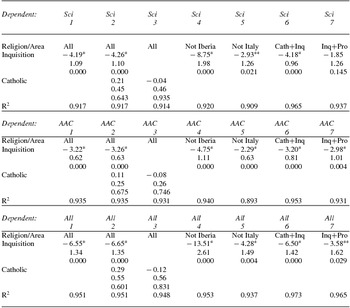
Table 2 measures scholars in both absolute and per capita terms. Regressions (1) and (2) only are scientific scholars, (3) to (4) are AACs, and the last two columns are both combined. The Inquisition is negative for all kinds of scholars and only not statistically significant for scientists per capita, a surprising finding but just outside of 10 percent significance. In absolute terms, inquisitorial countries lost seven top-tier scholars and AACs per quarter century.
Top-tier scholars 1000 to 1749.

Note: The dependent variable is the number of top-tiered scholars living in a country. Sci are top-tiered scientific scholars; AAC are artists, authors, and composers; and All are scientists plus artists, authors, and composers. Data sources for all variables are given in the text.
Panel unit roots are rejected with tests following Im et al. (Reference Im, Hashem Pesaran and Yongcheol2003) and Maddala and Wu (Reference Maddala and Wu1999).
Values below the coefficient are standard errors then p-values; Significance: *1%, **5%, ***10%.
The following controls that could potentially impact scholarship are included: time, warfare (Kohn Reference Kohn1986), population (McEvedy and Jones Reference McEvedy and Jones1978), urbanization and institutional quality (Acemoglu et al. Reference Acemoglu, Johnson and Robinson2002), universities (Cantoni and Yuchtman Reference Cantoni and Yuchtman2012; Rashdall Reference Rashdall1895; de Rüegg and Ridder-Symoens Reference De Rüegg and Ridder-Symoens1996), and printing presses (Claire Reference Clair1976; Febvre and Martin Reference Febvre and Martin1976). As these variables are available on a country level, I use modern country borders despite the fact that Germany and Italy did not exist as such over the time frame considered here.
War is insignificant, resembling results from both Simonton (Reference Simonton1997: 17) and Murray (Reference Murray2003: 332). As universities attract and train scholars their presence could impact the number of top-tier academics in a country. The number of universities per country are mostly positively but not always significantly related to genius. Higher-quality institutions could potentially attract scholars and foster greater intellectual openness; and institutional quality is highly correlated with genius except AACs in per capita terms. Larger populations could obviously lead to higher scholars; population is positively related but outside of statistical significance.Footnote 9 A common proxy for wealth, urbanization could lead to more scholars. However, unexpectedly, urbanization is mostly negatively related to scholarship.Footnote 10
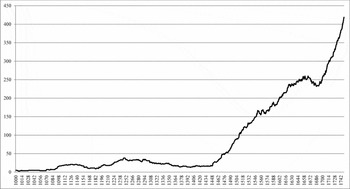
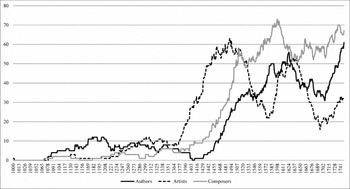
Figure 2 shows the number of scientific geniuses living in the 16-country sample by year, with a clear shock at the mid-fifteenth century following the invention of the printing press. Presses are measured as zero before its invention, then counted by country until 1500 and afterward the 1500 level is constant to the end of the series. While the coefficient on the press is mostly insignificant, it only has two time periods of variance. Restricting the sample to end in 1524 the press is significant at the 1 percent level for repeated regressions of (1), (2), and (5) and at the 2 percent level for (6). For AACs presses are negatively related. However, this is partly driven by artists, which peaked in the fifteenth century before declining by more than half (see figure 3). Repeating the regressions with only authors' and musicians' presses becomes positive and significant for (3) but remains negative and insignificant for (4).Footnote 11
Top Tier Scientific Scholars living in Europe 1000 to 1749

Top Tier Artists, Authors and Composers living in Europe 1000 to 1749

Artists, Authors and Composers by Religion of Country

Scientists clearly differ from AACs. The Catholic Church supported artists and others to some degree leaving the result of a negative impact somewhat surprising. Yet inquisitors did persecute and examine authors and others. Rodrigo Manrique, the nephew of a famous poet and son of the Inquisitor General stated, “[I]t is increasingly evident that no one will be able to cultivate belles lettres in Spain without there immediately being found in him a multitude of heresies, errors, and Judaic defects. In this way silence has been imposed on the learned, and a tremendous terror has been inspired in those who would have called themselves scholars.” The Spanish Humanist López Pinciano wrote 30 years later: “Worst of all is that [inquisitors] would have no one develop an interest in these human letters because of the dangers, they say, that are in them that just as a Humanist would alter a text by Cicero, he might alter one of the Holy Scriptures. . . . These and other similar stupidities upset me and take away my desire to continue” (Alcalá Reference Alcalá and Alcalá1987a: 327). In 1583 biblical stories in literary works, especially theater, became banned in Spain (Pinto Reference Pinto and Alcalá1987: 317). While inquisitors focused mainly on scholarly works, their censorship spanned to other fields.
Table 3 is similar to table 2 but focuses on the Inquisition, as this is the variable of interest. Non-Inquisition variables are not shown but are similar to those in table 2. In almost all regressions the Inquisition is significant at the 1 percent level and is always negative. Regressions (2) and (3) add a Catholic dummy, which is highly insignificant even when dropping the Inquisition variable. Because Iberia began at a much lower level of scholarship than Italy (4) removes Iberia from the regression and the inquisitorial effect is roughly twice as large for scientific scholars and overall. Column (5) drops Italy and the effect is smaller. Column (6) includes the three Catholic inquisitorial countries and the Catholic countries of France, Belgium, Austria, and Poland, which results in a stronger inquisitorial effect for scientists. Column (7) compares Inquisition countries to four Protestant countries that border the four Catholic countries used in (6) (allowing for the United Kingdom to border France).Footnote 12 The effects are slightly smaller than in comparison to Catholic countries and insignificant at standard levels for scientists.
Effects of the Inquisition on top-tier scholars.

Note: The dependent variable is the number of top-tiered scholars living in a country. Sci are top-tiered scientific scholars; AAC are artists, authors, and composers; and All are scientists plus artists, authors, and composers.
For Religion/Area:
Inq = Inquisition = Italy + Spain + Portugal
Pro = Protestant = UK + Netherlands + Switzerland + Germany
Cath = Catholic = France + Belgium + Austria + Poland
All = Inq + Cath + Pro + Norway + Sweden + Denmark + Russia + Czechoslovakia
Included in all regressions: constant, lags, war, urbanization, institutional quality, number of universities, number of printing presses, population, and time; standard error than the p-values are below the coefficients; significance: *1%, **5%.
Medieval Inquisition
A notable excluded variable in the preceding tables is the Medieval Inquisition. The early Inquisition formed to combat heresies, most notably the Cathars and Waldensians. The date of inquisitorial inception varies according to source; one even places it at the Creation with God as the first inquisitor (Turberville Reference Turberville1964: 144). Once it began, inquisitors spread across Europe. The Toulouse Inquisition formed in 1233 with an inquisitor appointed for Burgundy in the same year and in 1238 in Aragon. Giovanni da Vicenza became Perpetual Inquisitor in 1247 in Italy, with the Kingdom of Naples and Sicily establishing the institution in 1268 or 1269. Inquisitors arrived in Bosnia in thirteenth century. The King of Bohemia requested aid to end heresy and in 1257 two inquisitors were appointed. In Germany it lacked organization until 1317Footnote 13 to counter the Beghards (or Lollards) (Gorham Reference Gorham1918: 33, 49, 54, 57, 59–63, 66, 68).
End dates for inquisitorial activity is hard to pinpoint. In Aragon not much inquisitorial activity is recorded and in 1360 an inquisitor complained of the institution's poverty (Turberville Reference Turberville1964: 172–73). German activity seems to have ended by 1377 or sooner (Maycock Reference Maycock1931: 239). The French Inquisition over time became absorbed by secular courts and lost royal funding during wars against Britain. In 1451 Pope Nicholas V attempted to increase activity without success and in 1458 residents of Lyon incarcerated an inquisitor (Gorham Reference Gorham1918: 55). A bull of Martin V in 1418 urged inquisitors to hunt down heretics in Bohemia and an inquisitor was appointed in 1436, although no detailed records exist (ibid.: 70). Dominican Order members often acted as Medieval Italian inquisitors during its later phase and little is known of their activities (Black Reference Black2009: 5). Vague beginnings combined with nebulous end dates create difficulty in controlling for the Medieval Inquisition.
More importantly here, the Medieval Inquisition lacked a focus on censorship—inquisitors focused on heresies and demonic magic. The first papal statement on book suppression came from a Bull by Gregory XI in 1376, more than a century following the Inquisition's founding. An archbishop of Prague burned writings of John Wycliffe but exceeded his powers. Not until the Counter Reformation did systematic censorship arise (Gorham Reference Gorham1918: 97–98). As this article focuses on systemic censorship, controls for the earlier noncensoring Inquisition are excluded.
Gross Domestic Product (GDP)
GDP is excluded in all regressions as estimates back to the year 1000 are unreliable.Footnote 14 A potential explanatory relationship is that national wealth leads to higher levels of scholars living in the country, and diminished wealth a decrease. Yet looking closer at individual economic histories, GDP cannot explain the fall of scientific scholars in inquisitorial countries.
From 1494 to 1559 the Italian peninsula experienced some combination of famine, plague, and war for almost all years (Alfani Reference Alfani2010: 31–32). By the early seventeenth century Italy had “a healthy and very advanced economy” with the decline of the economy beginning in the 1620s (Alfani Reference Alfani2013a: 171–72). Worse in Italy than Northern Europe, plagues probably damaged the economy in the seventeenth century (Alfani Reference Alfani2013b). Despite the advanced Italian economy in the early 1600s human capital had already been collapsing for three decades. This is in stark contrast to the time of calamity where scientific scholars increased from 24 in 1494 to 51 in 1559 and peaking shortly thereafter. Thus a worsening economy cannot describe the decrease of scholars in Italy as the decline began more than a generation before the economy faltered but scholarship had substantially increased during persistent war, plague, and famine.
Portugal's Golden Age lasted from 1500 to 1580, with Portugal dominating European trade with Asia. Despite Portugal's economic power and a global empire, top-level scholars nearly disappeared from the country prior to post–Golden Age economic decline, meaning the decline in scholars living in Portugal cannot be fully explained by losing wealth in the late sixteenth century as scholarship had long been reduced by then.
The Spanish empire is typically seen as reaching its peak during the reign of Philip II (1556 to 1598) with an empire on which the sun never set. Spain monopolized New World trade and imported vast quantities of silver. Much of this wealth went to warfare, and Philip defaulted various times. While the death of Philip II is often given as the beginning of Spanish decline, the economy worsened earlier in the 1570s (Drelichman Reference Drelichman2005a, Reference Drelichman2005b). However, by this time Spain was already a few decades off its peak scientific genius level, falling from 14 in 1539 to an average of 8.2 over the 1570s. By the time Philip II died in 1598, only two remained. Spain's economy improved during the reigns of Philip IV (1621 to 1665) and Charles II (1665 to 1700) concurrent with political decline (Philips Reference Phillips1987: 532). However, during this eight-decade time span scientific scholars peaked at two and averaged about 1.3.
Spanish AACs collapsed later than did their scientists. Over the Golden Age AACs peaked at 17 in the late 1540s, only surpassed by Italy and France. Spain then began a slow descent to zero in 1691. Despite Spain's high initial level, its decline contrasted to other countries that increased. Note that the level is not necessarily what is of interest, but rather the relative rate of change. The glories of the Golden Age notwithstanding, Spain lagged relatively behind other countries following inquisitorial control of censorship.
GDP did not drive the rise of scholars in other countries. The Dutch economy improved in the 1590s preceding the Dutch Golden Age during the seventeenth century (Israel Reference Israel1995: 241). However, Holland increased in scientific genius nearly a century before its economic rise. By the 1570s—when Spain and Portugal had global empires and Holland and Spain were at war—more top-tier scientific scholars resided in the Netherlands than all of Iberia. By 1600 Holland attained near peak scientific scholar levels.
England followed Holland's path to some degree. England did not begin to become an empire until later in the sixteenth century. By this time scholarship had already been increasing for a century, reaching 23 in 1588—nearly four times the Iberian level—when England defeated the Spanish Armada. England did not experience modern growth until 1630 to 1690, with Malthusian stagnation in prior times (Clark Reference Clark2005). Yet by 1630 the United Kingdom had reached a level of 60 top-tier scientific scholars—higher than any other country except France.
Genius collapsed in Spain and Portugal even as they ruled vast wealthy empires. Italy's economy was advanced in the early seventeenth century while its scholarship declined. Holland and England increased in high-level human capital before their economies/empires expanded. Thus the state of the economy cannot explain the shift of scholarship from the southern peninsulas to Northern Europe; but rather the imposition of inquisitions and systemic censorship is correlated with the decline of scholarship in Iberia and Italy.
Bias in the Data
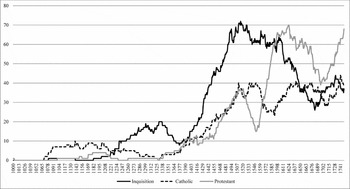
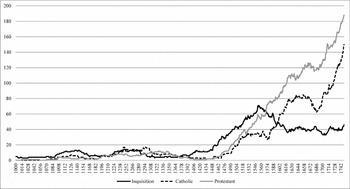
As mentioned in the introduction, using the CDSB as the main data source eliminates any author biases while providing a consistent measure for inclusion. However, the CDSB could potentially be biased in the scientists chosen to include. While a possibility, this is highly unlikely. Composed over decades, the encyclopedia relied on hundreds upon hundreds of contributors and is highly regarded as comprehensive. Figure 5 further casts doubt on the CDSB being biased. Inquisition countries from roughly 1200 to 1400 had similar levels of scholars as the Catholic or Protestant countries used as a comparison. From 1400 to 1550 the Inquisition countries had more before falling behind after the mid-sixteenth century. If CDSB biases drive the results, then that implies the encyclopedia is unbiased for 200 years, biased toward southern Europe and against northern Europe for a century and a half, and then the bias reverses direction. Coordinating such a systemic bias across hundreds of contributors and decades of compilation is unlikely.
Scientific Scholars by Religion of Country

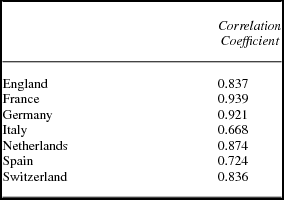
Beyond AACs Murray (Reference Murray2003: 501–3) compiled data on scientists and mathematicians from 34 sources; including the CDSB. All but 362 European individuals overlapped with the CDSB from the 33 non-CDSB sources. Life spans of these high achievers were compared to the life spans of those in the CDSB based on the country of birth.Footnote 15 The correlation coefficients are given in table 4; with all correlations significant at the 1 percent level.
Correlation between CDSB and Murray scientific non-CDSB scholars.

This second database suffers from small sample size, yet this is necessary as the CDSB contains major scientists, which are removed because including them would clearly cause a high degree of correlation. As a simple check on the CDSB, it supports the notion of a lack of bias in the data as distinct scientists from 33 additional sources show the same trends as the main data set.
Discussion
Devised to combat heresy the inquisitions extended to persecution of science and other areas. This caused top-level scholars to decline both absolutely and relative to other countries that increased in scholarship. It is plausible that the decline in high levels of scholarship would negatively impact economies with the onset of the Industrial Revolution that relied more on human capital relative to Malthusian economies. While not shown analytically, narratives are given to support this possibility.
The Inquisition can be related to Oded Galor's unified growth theory. He models two identical Malthusian economies except in “characteristics that contribute to human capital formation” (Galor Reference Galor2011: 191–93). The economy with the higher human capital potential has a lower threshold for takeoff. Once growth fueled by human capital begins, the high human capital economy will grow, while the other remains Malthusian. Consistent with Galor, inquisitorial countries with suppressed scholarship lagged economically behind Northern Europe following the Industrial Revolution when human capital became more valuable.
Despite the narrowness of this measure of human capital, the oppression of a small elite can have large impacts on society. Russian areas with larger Jewish populations before World War II have subsequently performed worse economically following the Russian Holocaust. Over two-thirds of Jews held white-collar jobs, as compared to about 15 percent of non-Jews. It is postulated that the elimination of a productive class of people, even though small, caused the long-term decline (Acemoglu et al. 2011). Following the American Revolutionary War a large economic decline comparable to the Great Depression occurred. A potential causal factor for the large recession was the “crisis at the top.” While skilled loyalists who fled comprised only 3 percent of the free population, urban areas had a concentrated decline, contributing to the recession (Lindert and Williamson Reference Lindert and Williamson2013). Similar to these studies, the Inquisition oppressed elite scholars, leading to a large and significant decline in their population. This could potentially have impacted subsequent growth, or lack thereof, through a couple of channels: decreased participation in the Enlightenment and worse institutions.
Joel Mokyr (Reference Mokyr2002, Reference Mokyr2005, Reference Mokyr2009) contends that the growth of learning and knowledge during the Enlightenment paved the way for the Industrial Revolution through various mechanisms—reduced rent seeking, freer trade, institutions promoting technology, advancement of science, and so forth. As the Inquisition had a negative effect on scholars living in Italy and Iberia, it is quite possible that the centuries-long persecution of scientists and others led to a delay of development in these areas. Indeed, while Italy was at the forefront of the Renaissance, it lagged scientifically during the Enlightenment and subsequently industrialized later than other countries.
A differing approach to economic growth is through improved institutions (Acemoglu and Robinson Reference Acemoglu and Robinson2012); although this mechanism is influenced by scholarship to some extent (Mokyr Reference Mokyr2002). One can view inquisitions as extractive institutions, with confiscations, lengthy incarcerations, and rent-seeking inquisitors (Anderson Reference Anderson2013). Hence, if one accepts the institutional channel for growth it should be expected for inquisitorial countries to fare worse than those without a systemic extractive institution.
In general, higher human capital from 1450 to 1800 is related to higher growth. Joerg Baten and Jan van Zanden (Reference Baten and van Zanden2008) constructed a database of book production across eight Western European countries. Book production correlates with literacy and with faster real wage growth. They conclude that human capital is a “crucial determinant of long-term growth.” It is of note that despite being a high-producing book country in the mid-sixteenth century, Italy fell to the third lowest during 1750–99. The decline coincides with the Inquisition and suppression of scholars. While Spain was the second- to third-lowest book producer from 1450 to 1600, it lagged significantly behind all other book producers from 1600 to 1700 following the consolidation of inquisitorial censorship and remained the lowest-producing country until the end of the data series (220).
Persecution of scholars is known to have negative effects on various outcomes.Footnote 16 Indeed, Jordi Vidal-Robert (Reference Vidal-Robert2014) finds that areas in Spain that had more inquisitorial trails have less patent production and a negative attitude toward new technologies. More generally, the Inquisition led to a decline of scholars living in Italy and Iberia; and they lagged economically behind other areas of Europe following the Industrial Revolution, which is consistent with the role of human capital in economic growth.
Conclusion
Commentary on the inquisitorial effect on scholarship has continued since the institution existed. Claims about the Inquisition range from its censorship had debilitating effects on scholarship to the censorship lacked sufficient enforcement and had no major effect.Footnote 17 Both of these divergent interpretations lack a rigorous cross-country empirical approach. Using more than 2,000 top-tier academic achievers from 1000 to 1749 as my dependent variable, I find that both scientific scholars and notable artists, authors, and composers declined with the imposition of the Inquisition. The timing of the decline within inquisitorial countries coincides with the institution's systematic persecution of scholars. Other Catholic countries did not see such a decline; implying religion did not cause the northward shift of scholarship but rather the inquisitorial institution. Black (Reference Black2009: 207) comments that “the ‘books never written’, and the importance of self-censorship, are the major imponderables.” These findings suggest that many books went unwritten due to inquisitorial activities.
It is quite plausible that having a persecuting bureaucracy would delay economic development. Human capital is well known to be correlated with growth. The Inquisition drastically decreased the number of scholars living in their areas and functioned as a highly exclusive and exploitative institution. Hence, the influence of the Inquisition could have had further reaching effects then just religious.
Appendix Brief Biographies of Selected Persecuted Scholars
To demonstrate the effect of intolerance on scholarship, some examples of persecution are given here.Footnote 18 Galileo Galilei is the most famous example of inquisitors and scholars clashing. In 1632 Galileo was put on trial where his book Dialogue was banned and he was given life imprisonment, which was reduced to house arrest.
Italy
The philosopher Giordano Bruno is one of the most famous inquisitorial victims. While in Naples he fell under heretical suspicions; he moved to Rome, then Switzerland, then France, and then England in 1583. His books were clandestinely published with false imprints. He returned to France but was forced to flee to Germany. He lived in various cities before relocating to Venice. He was imprisoned by inquisitors, with his trial being sent to Rome where it lasted for eight years before he was burned alive as a heretic.
Tommaso Campanella was an Italian natural philosopher born in 1568. He entered the Dominican order and moved to Naples where he met a Jewish astrologer and became part of a group that engaged in experimentalism. His views became heretical and he was denounced to the Inquisition in 1592. In addition to being tortured he was incarcerated in Naples from 1599 to 1626 and in Rome from 1626 to 1629. He managed to write in prison, with his works being smuggled to Germany to be published because they were banned in Italy. He eventually fled to France to escape further punishment from inquisitors.
The mathematician and astronomer Franciscus Barocius was born in Venetian Crete in 1537. Accused of sorcery and causing a terrible rainstorm in Crete by inquisitors in 1587, he had to pay 100 ducats worth of silver crosses and remain in jail at the inquisitors' pleasure.
Born in Yugoslavia in 1560, Marko Antonije Dominis was a physicist educated in Italy. The archbishop of Split, he had to flee to England for his religious views. He returned to Rome and incarcerated by inquisitors where he died. Nonetheless, he was still found guilty of heresy and his body was burned.
The mathematician, physicist, and philosopher Girolamo Cardano was imprisoned by the Roman Inquisition in 1570 for heresy for casting the horoscope of Christ and attributing events of Christ's life to the stars.
The natural philosopher and theologian Paolo Sarpi was born in Venice in 1552. He was appointed as state theologian of Venice in 1606 and counseled to defy the bull of interdict and excommunication against Venice. He did not go to his inquisitorial hearing and was excommunicated. In 1607 he was almost assassinated, which Sarpi accused the Roman Curia of doing.
Moving to inquisitorial countries was hazardous. Volcher Coiter was born in the Netherlands in 1534 and was notable in anatomy, physiology, ornithology, embryology, and medicine. He went to Italy to teach and “a brilliant career seemed assured” but he was arrested by inquisitors and imprisoned in Rome and Bologna—most likely for being Protestant. He eventually left and died in France.
Portugal
Francisco Sanchez was born about 1550 and was most likely of Jewish descent (a New Christian). His family fled to Bordeaux, a common destination for New Christians. There he was a professor of philosophy and medicine, rector of a university, and director of a hospital.
Amatus Lusitanus, or João Rodrigues, was of Jewish descent and born in 1511. A doctor, he migrated to Antwerp, most likely due to harassment. He then became a professor in Ferrara and practiced medicine around Italy. When a new pope increased New Christian persecution, he fled to Salonika and became an open Jew.
Garcia D'Orta was born in Portugal of Spanish Jews who fled Spain to escape forced baptism. He was born in 1500 and hence a Christian by force of law in Portugal. He was an expert in botany, pharmacology, tropical medicine, and anthropology. He moved with his sisters to India to escape the Inquisition. D'Orta admired Chinese medicine and civilization, used Arab authors in his studies, and challenged authority of classical texts. He was eventually investigated by the now established Goan Inquisition, but his prestige possibly kept his family safe. After he died his sister was slaughtered by order of the Inquisition, with his remains being exhumed and burnt and the rest of his family deported to Portugal.
Spain
The Jewish astrologist Abaham Bar Samuel Zacuto was born in Spain in 1450. In 1492 he fled to Portugal to escape forced baptism, but ended up having to become a Christian when Portugal required the same.
The Geographer al-Hasan ibn Muhammad al-Wazzān al-Zayyāatī al-Gharnātī, better known as Leo the African, was born in Grenada around 1485. After the fall of the kingdom his family fled to Fez. He extensively traveled and was captured by Italian pirates and became a slave to Pope Leo X. He converted to Catholicism (and took the pope's name as his own). In 1529 Leo returned to North Africa and to Islam.
France
Inquisitorial countries did not monopolize intolerance toward intellectuals of the wrong religion. The mathematician and linguist Antoine Arnauld was born in Paris in 1612. He earned a doctorate in theology in 1641 but was expelled from the Sorbonne in 1656 for his Jansenist views and died in self-imposed exile in Belgium.
The mathematician Albert Girard was born in France in 1595. However, he was a member of the Reformed church and fled to the Netherlands.
Louis Bourguet was born in France in 1678, but his family fled to Switzerland following the revocation of the Edict of Nantes. He was skilled in archaeology, philology, philosophy, biology, geology, crystallography, and physics.
Joannes Guinter was born in Germany in 1505 and known for his skill in medicine. He worked in Paris but had to flee due to religious intolerance to Strasbourg.
Born to Huguenot parents in 1683 John Theophilus Desaguliers fled France with his parents when he was three. He became a noted experimental natural philosopher and lived in England for the rest of his life.
Abraham De Moivre was born in France in 1667 and known for his work in probability. After the Revoking of the Edict of Nantes in 1685 he fled to England. Some say he was imprisoned in France until 1688 for his religion, whereas other sources have him in England in 1686. Either way, he joined the Royal Society of London and died there in 1754.
The French natural historian Bernard Palissy became a Protestant in 1546 and was imprisoned in Bordeaux about 1559. He would have been executed if not for Medici intervention.
Gaspard Bauhin was born in Switzerland in 1560 because his Protestant father had to flee France. He became notable for anatomy and botany.
Joseph Duchesne or Josephus Quercetanus was a French chemist who left the country due to religious persecution. After living in Germany and Switzerland, he returned to France to be a physician to King Henry IV.
The son of a Protestant; Nicolas Lemery was a French chemist and pharmacist born in 1645. He was forced to flee to England for religious reasons but returned after failing to receive an appointment. After the Revoking of the Edict of Nantes he became a Catholic to regain his rights and continue his work.
Joseph Saurin, a French-born mathematician and cosmologist had to flee to Switzerland due to his sermons. He became a Catholic in 1690 and lived the rest of his life in France.
Other Countries
The theologian Sebastian Franck was born in Germany in 1499. He entered the Catholic priesthood, but turned to Protestantism. He moved from one town to another across Germany, being banned from cities for his writings. He was allowed to stay at Ulm if he submitted to censorship, although he eventually was banished from there as well and moved to Switzerland.
Sebastian Münster was a German geographer born in 1489 who became a Protestant and moved to Switzerland.
Leonhard Rauwolf was a botanist born in Augsburg, Bavaria in 1535. The leaders of Augsburg switched to Catholicism, while Rauwolf heading the Protestants against Catholic festivals led to his being forced out of the city. He went to Linz, Austria before being killed while at war in Hungry.
England was not exempt from intolerance. William Ames was an English theologian and natural philosopher born in 1576. A leading Puritan at Cambridge, he was expelled in 1609 and moved to the Netherlands in 1610.
Richard Norwood was a mathematician and surveyor also famous for navigation. As a nonconformist he fled England for Bermuda in 1638 where he died a few decades later. The botanist Robert Morison was a Scotsman born in 1620. He had to flee to France during the civil war as a loyalist. He later returned after the Restoration.
The 1561 Belgium-born Philip Van Lansberge had to flee to France then England for religious reasons when young. After the Spanish conquest of Antwerp in 1585 he moved to the Netherlands where he became known for geometry and astronomy.