Implications
Lambs born to ewes consuming high amounts of salt have suppressed renin activity in the early postnatal period, a time when renin activity would normally be high. This could cause permanent changes in the mechanisms by which these sheep balance salt in their body. These changes may include alterations in blood pressure, salt and water regulation and preference for salt in later life. If these changes occur, they may influence the ability of the offspring to cope with a high-salt diet, such as saltbush, when they consume it as adults.
Introduction
When animals consume diets high in salt (NaCl), their rate of salt excretion increases because they have lower renin activity in their kidney. When less renin is released from the kidney, the formation of angiotensin II and aldosterone is slowed, which signals the kidney to retain less salt (Morgan, Reference Morgan2001). The renin–angiotensin system (RAS) plays a critical role in the foetus and newborn by regulating the maturation of the kidney and processes that control salt balance (Gomez and Norwood, Reference Gomez and Norwood1995; Matsusaka et al., Reference Matsusaka, Miyazaki and Ichikawa2002). Suppression of the RAS during development can lead to physiological changes in the animal that can alter permanently the animal’s salt and water handling capability, blood pressure and salt preference (Alves da Silva et al., Reference Alves da Silva, de Noronha, de Oliveira, Malheiros and Heimann2003; Curtis et al., Reference Curtis, Krause, Wong and Contreras2004). When pregnant rats are fed a high-salt diet, their offspring’s angiotensin receptors are down-regulated and the renin mRNA levels in their kidney are also suppressed in the first few days after birth (Ingelfinger et al., Reference Ingelfinger, Haveran, Hsu and Woods1998; Balbi et al., Reference Balbi, Costa and Coimbra2004). Therefore, if pregnant animals consume large amounts of salt, the renin activity of their offspring may be suppressed, which could alter their ability to cope with a high-salt diet as adults.
Pregnant ewes consume high amounts of salt (mainly NaCl) when they are grazing saltbush, a halophytic plant that is grown on salt land and is used widely in agriculture (Masters et al., Reference Masters, Norman and Dynes2001). Lambs born to ewes consuming saltbush may have suppressed renin activity because of their mother’s high-salt diet. Lambs receive almost all their nourishment from ewe’s milk for the first 3 weeks of their life and, if the mineral (Na as well as other minerals) content of the milk is increased by the high-salt diet of the ewe, the lambs would ingest more minerals, which would depress their RAS. Hence, any postnatal alteration to the RAS activity in lambs may be linked to either their development in utero or an increased mineral intake from their mother’s milk. Therefore, our first hypothesis is that feeding pregnant ewes a high-salt diet or saltbush will suppress their renin levels during pregnancy and those of their lambs during the early postnatal period (birth and at 3 weeks of age).
Although highly protected, milk composition can be changed by the diet of the ewe. Both sodium and potassium levels in the milk of rats can be altered by feeding them a low-salt or a high-salt diet (Dlouha et al., Reference Dlouha, Erdosova, Kraus and Skopkova1973; Vijande et al., Reference Vijande, Brime, Lopez-Sela, Costales and Arguelles1996). When a high-salt diet (about 13%) was fed to pregnant ewes there was no change in the sodium concentration in their milk but, chloride levels in the milk increased (Meyer and Weir, 1954). It is possible that consuming excessive amounts of sodium and chloride could alter the regulation of other minerals in the milk because, if chloride increases and sodium remains the same, concentrations of other cations such as potassium, calcium or magnesium would be expected to increase to balance the charge. If the mineral content of the milk can be altered by the diet of the ewe, it is likely that the lamb’s consumption of minerals will increase and its RAS will be depressed when consuming this milk. The second hypothesis tested was that feeding ewes a high-salt diet or saltbush would increase the concentration of cations, particularly potassium, in their milk.
The high-salt diet of the ewe should not change her plasma sodium concentration but may increase her plasma chloride concentration, as shown in previous studies with sheep (Meyer and Weir, Reference Meyer and Weir1954; Potter and McIntosh, Reference Potter and McIntosh1974). However, results from rat dams consuming large amounts salt have shown that although the plasma sodium of the mother may not change, the plasma sodium of the offspring may increase because of the immaturity of their kidney (Deloof et al., Reference Deloof, De Seze, Montel and Chatelain2000). Hence, our third hypothesis is that a high-salt diet or saltbush will increase plasma concentrations of chloride and keep sodium the same in ewes but increase plasma concentrations of both chloride and sodium in lambs at birth.
To test these hypotheses we conducted an animal house experiment where ewes were fed a high-salt diet (14%) or a control diet (2%). We also conducted a field study where pregnant ewes grazed saltbush or a control diet of pasture based on sub-clover grown on non-saline land. These two experiments were analysed separately although the data appear in the same figures and tables.
Material and methods
Animals and diets
Two-year-old Merino ewes were artificially inseminated using semen from the same ram. They grazed the same clover-based pasture until day 55 of gestation when they were pregnancy scanned. Sixty single-bearing ewes were housed in individual pens and were termed ‘animal house ewes’. They were assigned to either a high-salt diet (14%) or control diet (2%) and the control ewes were pair-fed to the salt ewes. Another 70 ewes were placed in either the saltbush or pasture treatments. These ewes are referred to as ‘field ewes’ and they grazed saltbush or grazed the control diet of dry pasture based in subterranean clover. Treatments commenced on day 60 of pregnancy and concluded when the lambs were an average of 3 weeks old. Plasma renin activity of the ewes was measured before the treatments at 60 days gestation, then at 90 and 130 days gestation and at 21 days lactation. Plasma renin activity of the lambs was measured at birth (within 24 h), 21 days of age and at weaning at 15 weeks. Plasma sodium and chloride concentration was measured in the ewes at 130 days gestation and in the lambs at birth. Milk samples were taken on day 21 of lactation. After the lambs were 3 weeks old, ewes were taken off their treatment diets and all ewes and their lambs grazed together on pasture.
Animal house ewes
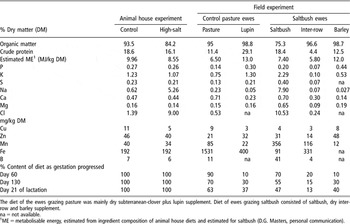
Thirty ewes were fed a diet containing approximately 14% salt and termed ‘high-salt ewes’. Another 30 ewes were fed the control diet (termed ‘control ewes’) and were pair-fed to ewes on the high-salt diet in such a way that each control ewe consumed the same daily amount of organic matter as its salt-fed partner. Ewes were fed to maintain conceptus-free weight throughout pregnancy (SCARM (Standing Committee on Agricultural and Resource Management), 1990) (Table 1). Water intake of the ewes was not measured.
Composition of diets of ewes in the animal house and ewes in the field

The diet of the ewes grazing pasture was mainly dry subterranean-clover plus lupin supplement. Diet of ewes grazing saltbush consisted of saltbush, dry inter-row and barley supplement.
na = not available.
1ME = metabolisable energy, estimated from ingredient composition of animal house diets and estimated for saltbush (D.G. Masters, personal communication).
Field ewes
Thirty-five ewes were allocated to the saltbush treatment and termed ‘saltbush ewes’ and another 35 were allocated to graze the control diet of pasture, termed ‘control pasture ewes’. Ewes from each treatment were divided into three groups, two of single-bearing ewes (12 ewes in each) and one group of twin-bearing ewes (11 ewes). The three groups of saltbush ewes were rotationally grazed on 12, 1-ha, saltbush plots. From day 60 to day 108 they were grazed on River Saltbush (Atriplex amnicola) and, from day 108 to week 3 of lactation, they grazed Oldman Saltbush (Atriplex nummularia). Ewes grazing saltbush were supplemented with barley to meet their energy requirements to maintain their conceptus-free weight throughout pregnancy, with twin-bearing ewes fed proportionally more supplement than single-bearing ewes to achieve this (SCARM, 1990). The two groups of single-bearing ewes in the pasture treatment grazed a pasture based on subterranean clover (80%), annual ryegrass (10%) and cape weed (10%) in two separate 10 ha plots. These ewes were supplemented with lupins to match the higher crude protein intake of the saltbush ewes and these were fed to maintain the ewe’s conceptus-free weight (SCARM, 1990) (Table 1). The twin group grazed barley crop residue (stubble) and was supplemented with lupins and barley at a higher rate than single-bearing ewes in order to maintain their conceptus-free weight (SCARM, 1990). Ewes were weighed every 2 weeks and the level of supplementary feeding was adjusted according to weight change, so all ewes maintained their conceptus-free weight (Wheeler et al., Reference Wheeler, Reardon, Hedges and Rocks1971).
Offspring
Lambs were weighed within 24 h of birth and at 3 weeks of age when the treatments stopped, and at 15, 20 and 24 weeks of age to determine whether there was a longer-term effect of treatment on liveweight. Blood samples were assayed from 23 high-salt offspring (13 females and 10 males) and 21 control offspring (10 females and 11 males). In the field experiment blood samples were assayed from 25 saltbush offspring (11 females and 14 males), and of these offspring, 19 were single-born and 6 were twin-born. Blood samples were assayed from 23 pasture offspring (12 females and 11 males), and of these, 17 were single-born and 6 were twin-born. In the case of twins, both lambs were studied.
Blood samples
Ewes were blood sampled before treatments commenced at day 60, then at days 90 and 130 of gestation and approximately 3 weeks into lactation before ewes were taken off their treatment diets. Within 24 h after birth, lambs were weighed and 5–10 ml of blood was taken from the jugular vein of the lambs. Blood samples from the Animal house lambs were often taken immediately after birth, before the lamb had suckled. In the field experiment where ewes were not confined with their lamb, the lamb suckled before the blood sample was taken so as not to disturb the ewe–lamb-bonding process. Lambs were blood sampled again at 3 weeks of age. However, the field lambs were blood sampled 3 days later than the animal house lambs due to logistical reasons and at weaning when they were 15 weeks of age. All blood samples were kept at room temperature for no longer than 10 min before centrifugation for 15 min at 1500 × g and frozen at −20°C until analysed. Plasma renin activity was measured as the rate of formation of angiotensin I using a commercially available kit (Gamma Coat Plasma Renin Activity RIA kit; DiaSorin, Stillwater, MN, USA). The inter-assay coefficient of variation was 7.2% and the intra-assay coefficient of variation was 5%. The detection limit after 18 h incubation was 0.01 ng/ml per hour. Plasma concentration of sodium and chloride was measured using ion selective electrode and was run on an Olympus AU400 automated chemistry analyser (Olympus Optical Co. Ltd, Tokyo, Japan).
We attempted to minimize stress on ewes and lambs when blood samples were collected because stress can increase renin activity. We did this by having the ewes and their lambs in close proximity in pens for at least an hour before, and during sampling. An exception was the sample collected from lambs at birth in the field because we did not confine ewes prior to lambing so that they could continue to graze.
Milk samples
Milk samples were collected before the ewes were taken off their treatment diets at week 3 of lactation. Lambs were separated from the ewes for 3 h before the foremilk was collected (20 ml) at 11 a.m. Samples were frozen at −20°C until analysis. Mineral composition of milk was determined using an inductively coupled plasma optical emission spectrometer, performed on an ARL 3580 B machine.
Statistical analysis
The statistics programme Genstat (10th Edition, VSN International Ltd) was used to analyse the data. Plasma renin activity results were analysed using a residual maximum likelihood (REML) linear mixed model with diet of the ewe and time as fixed effects and tag number as a random effect. Lamb renin values were transformed by natural log to obtain a normal distribution before analysis using REML. Gender of the offspring was also incorporated into the fixed effects as well as birth status of the lamb (single or twin-born) for the offspring born in the field experiment. Simple linear regression was used on the natural log of renin activity to calculate the relationship between the lamb’s renin concentration and that of its mother. All other results were analysed using ANOVA.
All procedures were approved by the CSIRO Animal Ethics Committee (Floreat, Western Australia).
Results
Plasma renin activity of ewes
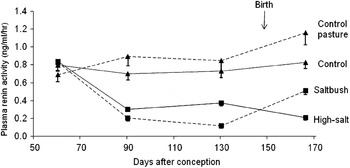
Renin activity was lowered (P < 0.001) by an average of two-thirds in ewes consuming a high-salt diet or grazing saltbush during pregnancy and early lactation (90 and 130 days of gestation and at 3 weeks lactation) compared to their counterparts consuming the control diet or pasture. All ewes had similar renin activity at day 60 of gestation before treatments commenced (Figure 1).
Plasma renin activity (mean value±s.e.) of pregnant ewes consuming a high-salt (n = 30) or control (n = 30) diet in the animal house and ewes grazing saltbush (n = 35) or dry pasture (n = 35) in the field. Significant differences existed between the salt treatments and their controls (P < 0.001).

Plasma renin activity of offspring
In the animal house study, lambs from ewes fed a high-salt diet had 20% lower renin activity (P = 0.07) than control lambs in the early postnatal period from birth to 3 weeks of age. There was no age × treatment effect because the difference in renin activity of the high-salt and the control lambs was unchanged between birth and 3 weeks (Table 2). At 15 weeks of age (weaning) plasma renin levels of high-salt lambs were similar to control lambs (control 1.5 ± 0.25 v. high salt 1.5 ± 1.33).
Plasma renin activity (ng/ml per hour) (±s.e.) of lambs during the early postnatal period of birth and 3 weeks of age

tTreatment effect.
taTreatment by age effect.
There was an interaction between age and treatment for renin activity in lambs in the field experiment. Feeding saltbush to ewes during the last 3 months of pregnancy and 3 weeks after birth suppressed the renin activity of their lambs at 3 weeks of age to one-sixth of the renin activity of the control pasture lambs (P < 0.001). No difference existed at birth (Table 2). Saltbush lambs had similar renin activity to control pasture lambs at weaning (pasture 1.4 ± 0.06 v. saltbush 1.3 ± 0.08; P = 0.1). Gender, birth status (single or twin) or birth weight had no significant effect on any of the parameters measured (P > 0.05) with the exception of twins having a lower birth weight, which is reported later.
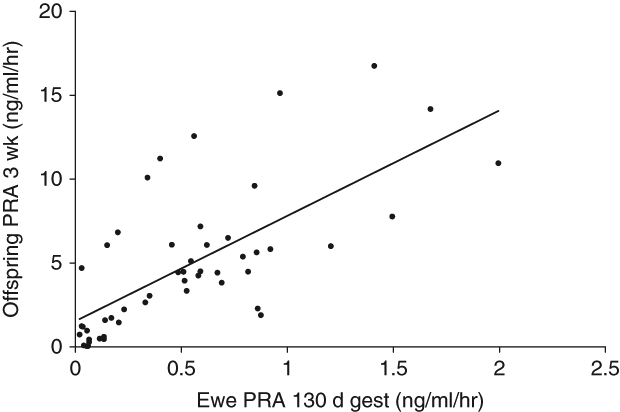
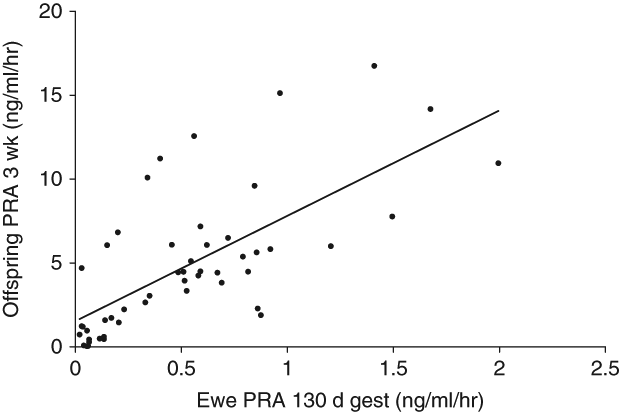
In the animal house experiment, renin activity of lambs at birth was correlated to that of their mothers at 130 days of pregnancy (y = 13.79x + 6.65; P = 0.002, R 2 = 0.4). However, this relationship was not found in the field experiment. When data from both experiments were combined, plasma renin activity of the lambs at 3 weeks old was not related to that of their mothers at the same time (i.e., week 3 of lactation) but there was a significant correlation between renin activity of the lamb at 3 weeks of age and that of their mothers at 130 days of pregnancy (y = 6.282x + 1.53; P < 0.001, R 2 = 0.4; Figure 2).
Relationship between plasma renin activity (PRA) of the ewe at day 130 of gestation and the PRA of her lamb at 3 weeks of age. Data from both the animal house experiment and the field experiment were combined (y = 6.28x + 1.53, R 2 = 0.48, P = 0.002).
Mineral concentration in milk
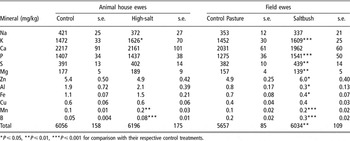
Feeding lactating ewes a high-salt diet increased (P values varying from P ⩽ 0.05 to P < 0.001) the concentration of K, Mn and B in the milk compared to control animals. However, total mineral content of the milk was not significantly different between ewes consuming the high-salt diet and ewes consuming the control diet.
Ewes grazing saltbush also had higher (P < 0.001) K, Mn, B and P concentrations in their milk. In addition, they had higher (P ⩽ 0.05) Zn levels but lower (P ⩽ 0.05) Al and Fe concentrations. Ewes grazing pasture had lower (P ⩽ 0.01) total mineral content in their milk than saltbush ewes (Table 3). Unfortunately, repeatable results for the concentration of chloride in milk samples could not be obtained.
Comparison of mineral content of milk (mean value in mg/kg, with s.e.) at week 3 of lactation from ewes fed control or high-salt diet in an animal house or ewes grazing pasture or saltbush in the field

*P ⩽ 0.05, **P ⩽ 0.01, ***P ⩽ 0.001 for comparison with their respective control treatments.
Plasma sodium and chloride concentration
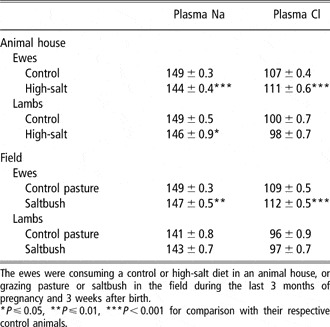
The high-salt diet of the ewes in the animal house lowered (P < 0.001) their plasma sodium and increased (P < 0.001) their plasma chloride concentration at 130 days gestation. Lambs from ewes that received the high-salt diet also had a lower (P ⩽ 0.05) plasma sodium at birth, but their plasma chloride concentration was not significantly different from control lambs.
Saltbush ewes followed the same trend and had lower (P ⩽ 0.01) plasma sodium and higher (P < 0.001) plasma chloride concentration than control pasture ewes. However, this did not influence the plasma sodium or chloride concentration in their lambs (Table 4).
Concentration of sodium and chloride in plasma (mean value in mmol/l, with s.e.) of ewes at 130 days gestation and their lambs at birth

The ewes were consuming a control or high-salt diet in an animal house, or grazing pasture or saltbush in the field during the last 3 months of pregnancy and 3 weeks after birth.
*P ⩽ 0.05, **P ⩽ 0.01, ***P < 0.001 for comparison with their respective control animals.
Birth weight and growth
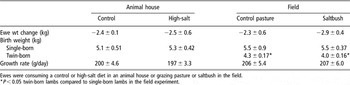
Birth weight and growth rate of lambs from ewes that received the high-salt or control diets were similar. Lambs from ewes grazing saltbush or pasture also had similar birth weights and growth rates up to 6 months of age. Twin-born lambs had a lower birth weight than single-born lambs (P < 0.05) but there were no differences between treatments (P > 0.05) (Table 5).
Change in conceptus-free weight of ewes from day 60 of pregnancy to 3 weeks lactation and birth weight and growth rate of their lambs up to 6 months of age

Ewes were consuming a control or high-salt diet in an animal house or grazing pasture or saltbush in the field.
*P < 0.05 twin-born lambs compared to single-born lambs in the field experiment.
Discussion
Plasma renin activity was suppressed in both ewes (from mid-gestation through to 3 weeks of lactation) and their lambs at 3 weeks of age by feeding a high-salt diet or saltbush to the ewe from mid-pregnancy to early lactation, a finding that supported our first hypothesis. The reason for the changes in circulating renin activity of the lamb in the first 3 weeks of life could be due to either an in utero effect or the mineral composition of the mother’s milk, but the data reported here suggest the former is more likely. A linear regression showed that the lamb’s renin levels at 3 weeks were related to its mother’s renin at day 130 of gestation, but not at 3 weeks lactation. This suggests that the renin activity of lambs in the early postnatal period is influenced mainly by the salt that the mother consumes in gestation rather than during lactation. However, this could also be due to alterations in the ewe’s RAS due to the transition from pregnancy to lactation. It is unlikely that the mineral composition of the mother’s milk was a key determinant of neonatal renin activity because the difference in renin activity across the four groups was not always associated with differences in the mineral content of milk. For example, ewes in the animal house experiment and ewes grazing saltbush had similar mineral content in their milk, but their offspring had different renin activity. The postnatal renin activity of the offspring could be influenced by substances other than minerals in the milk that may inhibit the lamb’s RAS (Contreras, Reference Contreras1993; Park et al., Reference Park, Juarez, Ramos and Haenlein2007). Our experimental design could not differentiate between prenatal and postnatal effects of the mother’s diet on the renin activity of the lambs because lambs were not cross-fostered after birth. However, the linear regression data support the theory that the lamb’s in utero environment, rather than its postnatal environment, has suppressed its renin activity in the high-salt and saltbush treatments.
The renin activity of saltbush and pasture lambs was different at 3 weeks of age as anticipated but it was similar at birth, a curious and unexpected result. One explanation for this result is stress. Stress increases the activity of the sympathetic nervous system, a potent stimulant of renin secretion (Richardson Morton et al., Reference Richardson Morton, Johnson and Van de Kar1995). In the field, lambs were born in a large paddock and had to be chased before they were caught for blood sampling. Hence, catching and separating lambs from their mothers in the field represented a stress that may have swamped any effects on their renin activity that were caused by the treatments. This could explain why the renin activity of the field lambs at birth was not related to that of their mothers. The correlation existed at 3 weeks, possibly because lambs were in confined pens in close contact with their mothers for this sampling and, consequently, under less stress. By contrast, ewes and lambs in the animal house were in confined pens with their mothers at birth and 3 weeks so that taking blood samples from these lambs were likely to be less stressful than collecting blood from the field lambs. Accordingly, in the animal house experiment, renin activity was consistently lower in the high-salt lambs at birth and 3 weeks, and renin levels of lambs at birth reflected those of their mothers as was expected. However, the renin activity of the field offspring was similar to the renin activity of the control offspring in the animal house experiment. This may be because the renin activity of some of the field animals reached its maximum value, which is thought to be around 25 ng/ml per hour (Fleischman et al., Reference Fleischman, Oakes, Epstein, Catt and Chez1975), and even when stressed, renin could not exceed this level of activity.
Consuming high amounts of salt suppressed the renin activity of the ewe and it also suppressed the renin activity of their lamb at 3 weeks of age. All offspring had very high renin activity at birth, which then declined with age, a result that has been shown in other studies in sheep and rats (Broughton Pipkin et al., Reference Broughton Pipkin, Lumbers and Mott1974; Hilgers et al., Reference Hilgers, Norwood and Gomez1997). Since the field lambs were blood sampled 3 days later than the animal house lambs, this could be why the field offspring tended to have a lower renin activity than the animal house offspring at 3 weeks of age. Suppression of the lamb’s renin activity in the early postnatal period most likely originates from changes at a molecular level. Feeding pregnant rats a high-salt diet has been shown to down-regulate angiotensin receptor (AT1) protein expression in the offspring and lower the number of cells in the renal cortex expressing angiotensin II in the offspring (calculated by immonohistochemical analysis) (Balbi et al., Reference Balbi, Costa and Coimbra2004). Feeding a high-salt diet to pregnant rats has also been shown to suppress renin mRNA levels in the kidney of the offspring (Ingelfinger et al., Reference Ingelfinger, Haveran, Hsu and Woods1998). The high-salt diet of the ewe could have down-regulated renin mRNA in their lambs, leading to the lower activity of circulating renin. These molecular changes could have had a lasting effect on the lamb throughout the early perinatal period. However, there was no difference in renin activity between treatment groups at 15 weeks of age. This could suggest that the lower renin levels of the lambs from the salt treatments is not permanent, although this needs to be confirmed when the offspring reach adulthood.
Our second hypothesis was supported as the concentration of cations in milk, especially potassium, increases in ewes receiving a high-salt diet. Unfortunately, repeatable results were not obtained for the chloride concentration in milk, but plasma concentration of chloride increased in ewes consuming a high-salt diet, so it is possible that the chloride concentration in their milk also increased. If this occurred, the negative charge of the chloride would have to be balanced by an increase in the concentration of cations. The low activity of the RAS decreases aldosterone secretion, which compromises the ability of the kidney to excrete potassium (Potter and McIntosh, Reference Potter and McIntosh1974; Giebisch and Stanton, Reference Giebisch and Stanton1979). This could be why potassium concentration showed the largest increase in milk in both the high-salt and saltbush ewes. The increased P, S and Mg concentrations in the milk of the saltbush ewes compared to the pasture ewes may be a reflection of the increased levels of these minerals in their diet.
Our third hypothesis was partly supported as the high-salt diet on the ewe increased the chloride concentration in the plasma but an unexpected result was that plasma sodium was lowered by consuming high amounts of salt. A reason for this decrease in sodium concentration in the plasma of ewes could be because of the increased water intake of animals consuming a high-salt diet. Although we did not measure water intake of the ewes, we assume it would have increased by at least two-fold based on the findings of Digby et al. (Reference Digby, Masters, Blache, Blackberry, Hynd and Revell2008), who fed a similarly high-salt diet to ewes during pregnancy. Consuming salt proportionally increases water intake (Gamble et al., Reference Gamble, Putnam and McKhann1929; Stricker et al., Reference Stricker, Hoffmann, Riccardi and Smith2003). Consuming large amounts of water have been shown to decrease plasma sodium concentration proportionately (Nose et al., Reference Nose, Sugimoto, Okuno and Morimoto1987). However, our results differ from those of Meyer and Weir (Reference Meyer and Weir1954) who found no difference in the sodium concentration of plasma of ewes when they were fed a high-salt diet (13.1%) throughout pregnancy. Ewes in the study by Meyer and Weir (Reference Meyer and Weir1954) lost more weight during pregnancy so they may not have been consuming as much of the diet as the ewes in our experiment that were fed 14% salt. Therefore the ewes in our experiment would have been consuming more salt, and presumably, more water.
The plasma sodium concentration of the high-salt offspring was lower than the control offspring, which could influence their physiology in later life. However, unlike the high-salt offspring, the saltbush offspring did not have a lower plasma sodium concentration at birth. This could be due to the buffering capacity of the mother (Dancis and Springer, Reference Dancis and Springer1970) or the time after birth that the blood sample was taken. The saltbush lambs may have been well buffered from the 2 mmol/l decrease in their mother’s plasma sodium but the 5 mmol/l decrease in plasma sodium seen in the ewes consuming the high-salt diet in the animal house may have been too much to buffer so that the plasma sodium of the high-salt lambs decreased by 10 percent. The plasma sodium of the lambs in the animal house experiment seemed to closely resemble that of their mothers, whereas the plasma sodium of the field lambs are much less than their mothers. A reason for this could be that blood samples were often taken immediately after birth in lambs born in the animal house experiment. However, in the field experiment where ewes and lambs were not confined, blood samples were taken later after the lamb had suckled. Therefore the plasma sodium of the lambs in the field may have been influenced more by their mother’s milk rather than by their mother’s plasma sodium concentration. The lower plasma sodium of the high-salt offspring could have long-term consequences for the animal. Alterations in plasma sodium and plasma osmolarity early in life have been shown to re-set thresholds for the release of AVP (Desai et al., Reference Desai, Guerra, Wang and Ross2003). Therefore, the high-salt offspring may have altered regulation of water balance as adults.
The high-salt or saltbush treatments did not affect birth weight or growth of the lambs up to 6 months of age. This result supports that of other studies that do not show any adverse effects on the birth weight or growth of the lamb from the ewe consuming a high-salt diet (Meyer and Weir, Reference Meyer and Weir1954; Digby et al., Reference Digby, Masters, Blache, Blackberry, Hynd and Revell2008). Lambs born as a twin had a lower birth weight than single-born lambs, which is to be expected (Baharin and Beilharz, Reference Baharin and Beilharz1977).
Acknowledgements
This work was jointly funded by the Future Farm Industries Co-operative Research Centre, CSIRO and the University of Western Australia.