Before speakers formulate utterances, they have to establish the message that they wish to convey. Apart from having to choose both the message and the wording, they must decide which element should receive emphasis and therefore be treated as the topic of the sentence (see e.g., Reinhart, Reference Reinhart1982).Footnote 1 In this paper we address two questions. First, do speakers construct a level of information structure (e.g., Vallduví, Reference Vallduví1992) at which emphasis is represented? Second, is this level shared between languages in people who speak more than one language (bilinguals)?
Levelt's (Reference Levelt1989) model suggests the existence of three levels of processing, namely the conceptualizer, the formulator, and the articulator. The message is constructed during conceptualization. The message then inputs into the formulator, which draws on lexical information to perform grammatical and phonological encoding in turn. The speaker uses the articulator to produce sound. Theories of bilingual production make broadly similar assumptions and are concerned with the degree to which the levels are integrated across languages (de Bot, Reference De Bot1992). Thus, we can ask whether and how emphasis is represented during conceptualization and whether it is shared across languages. It can be realized in different ways in different languages. It is often marked prosodically, for example by pitch, duration, or loudness (Büring, Reference Büring, Ramchand and Reiss2007), though it can also be marked morphologically (Féry, Reference Féry2008). But our interest is in the effects of emphasis on syntax. To address these questions, we employ cross-linguistic structural priming between Polish and English, making critical use of utterances that have very different syntax to each other but share the way in which they express emphasis.
Consider the English passive sentence in (1).
(1) The snake charmer is splashed by the cake.
In this sentence, the subject the snake charmer is the patient of the splashing event and is emphasized (i.e., it is the topic of the sentence). The speaker must first decide that she wishes to convey the message that a cake is splashing a snake charmer. To do this, she constructs a representation in which the snake charmer is the patient, the cake is the agent, and the event is the event of splashing. She then also has to decide which entity to emphasize, and in this case decides on the snake charmer. We assume that information about events, entities, thematic roles, and emphasis is incorporated into a representation of information structure, though it is important to note that there is no consensus about the nature of this representation. This representation serves as input to the formulator. In this case, the speaker emphasizes the patient by producing a passive.
For example, Prat-Sala and Branigan (Reference Prat-Sala and Branigan2000) had participants hear stories introducing two entities, one of which was made salient. Speakers were then asked to describe pictures of transitive actions in English or Spanish. In both languages, they were more likely to produce passives if the patient had been made salient than if the agent had been made salient. In Spanish, they were also more likely to produce sentences such as the one in (2).
(2)


Such sentences have object–verb–subject (OVS) word order (with the clitic a associated with the object) but are in the active voice. In such OVS sentences, the first-mentioned entity is the patient but not the subject of the sentence (see also Christianson & Ferreira, Reference Christianson and Ferreira2005; Ferreira & Yoshita, Reference Ferriera and Yoshita2003). Prat-Sala and Branigan's (Reference Prat-Sala and Branigan2000) findings therefore suggest that sentences that are syntactically unrelated may share a representation at the level of information structure.
To determine whether speakers formulate representations of a level of information structure and whether it can be shared across languages, we turn to structural priming. Since Bock (Reference Bock1986), researchers have known that speakers repeat syntactic form across utterances (see Pickering & Ferreira, Reference Pickering and Ferreira2008). In her study, participants repeated a prime sentence and then described a picture. Transitive primes were either active (One of the fans punched the referee) or passive (The referee was punched by one of the fans); dative primes were either prepositional-object sentences (A rock star sold some cocaine to an undercover agent) or double-object sentences (A rock star sold an undercover agent some cocaine). Participants were more likely to produce a passive sentence after a passive prime than an active prime, and to produce a double-object sentence after a double-object prime than a prepositional-object prime. Similar effects occur in other paradigms, such as written or spoken sentence completion (Branigan, Pickering, Stewart & McLean, Reference Branigan, Pickering, Stewart and McLean2000b; Pickering & Branigan, Reference Pickering and Branigan1998) and sentence recall (Potter & Lombardi, Reference Potter and Lombardi1998), and between comprehension and production in spoken and written dialogue (Branigan, Pickering & Cleland, Reference Branigan, Pickering and Cleland2000a; Hartsuiker, Bernolet, Schoonbaert, Speybroeck & Vanderelst, Reference Hartsuiker, Bernolet, Schoonbaert, Speybroeck and Vanderelst2008). Analyses of linguistic corpora have shown that people also tend to repeat themselves and others in naturalistic conversations (e.g., Gries, Reference Gries2005; Szmrecsanyi, Reference Szmrecsanyi2006; Weiner & Labov, Reference Weiner and Labov1983). Importantly, structural priming occurs in many different types of utterance, such as passives and datives (Bock, Reference Bock1986), the form of complement clauses (Ferreira, Reference Ferreira2003), the order of verb and auxiliary in Dutch (Hartsuiker & Westenberg, Reference Hartsuiker and Westenberg2000), the order of particle and object in English (Konopka & Bock, Reference Konopka and Bock2009), and the form of complex noun phrases in English (Cleland & Pickering, Reference Cleland and Pickering2003).
Much of this work has been used to provide evidence that speakers compute syntactic representations. For example, Bock (Reference Bock1989) showed that priming occurred in the absence of lexical repetition, and Hartuiker and Westenberg (Reference Hartsuiker and Westenberg2000) found priming when the alternative constructions could not be distinguished in terms of meaning. On this basis, it appears that a major component of structural priming taps into the construction of syntactic representations (henceforth syntactic priming). However, there is increasing evidence for the priming of non-syntactic representations as well – representations that may be concerned with conceptualization as well as formulation. Much of the evidence relates to thematic roles: abstract aspects of meaning concerned with the roles that entities play in an event, such as agent and patient. Bock and Loebell (Reference Bock and Loebell1990) found that sentences in which a by-phrase referred to a location (e.g., The foreigner was loitering by the broken traffic light) primed passives in which the by-phrase referred to an agent, thus suggesting that thematic roles were not relevant to priming.
However, Griffin and Weinstein-Tull (Reference Griffin and Weinstein-Tull2003) showed that priming of the form of a complement was enhanced when prime and target had the same number of thematic roles. Chang, Bock and Goldberg (Reference Chang, Bock and Goldberg2003) found that speakers were more likely to produce sentences with theme–location order after another sentence with theme–location order than after a syntactically equivalent sentence with location–theme order. Thematic roles represent meaning and are therefore most likely assigned during conceptualization. It may therefore be that particular roles can be emphasized, and that the association of thematic roles with emphasis can be primed. Griffin and Weinstein-Tull's (Reference Griffin and Weinstein-Tull2003) results could also reflect a tendency to repeat the order of thematic roles across utterances. However, Vernice, Pickering and Hartsuiker (in press) found that Dutch participants were more likely to produce passives after (3a) than after (3b):
(3)

In both sentences, “the cowboy” is emphasised, but in the former case it is the patient, whereas in the latter case it is the agent. As both prime sentences have the same order of words and neither is a passive, the effects cannot be due to syntactic priming. They also cannot be due to a tendency to repeat thematic role order, as patient–agent order primes led to agent–patient order targets and vice versa. Instead, Vernice et al. (in press) suggest that speakers perseverate in the assignment of emphasis to a particular thematic role (agent or patient). Note also that Bock and Loebell (Reference Bock and Loebell1990) and Vernice et al. demonstrated priming between clearly different syntactic constructions.
Many experiments have shown that structural priming occurs between languages, in particular Dutch and English (Salamoura & Williams, Reference Salamoura and Williams2006; Schoonbaert, Hartsuiker & Pickering, Reference Schoonbaert, Hartsuiker and Pickering2007; Desmet & Declercq, Reference Desmet and Declercq2006), English and German (Loebell & Bock, Reference Loebell and Bock2003), German and Dutch (Bernolet, Hartsuiker & Pickering, Reference Bernolet, Hartsuiker and Pickering2007), Spanish and English (Hartsuiker, Pickering & Veltkamp, Reference Hartsuiker, Pickering and Veltkamp2004; Vasilyeva, Waterfall, Gámez, Gómez, Bowers & Shimpi, Reference Vasilyeva, Waterfall, Gámez, Gómez, Bowers and Shimpi2010, with children), Greek and English (Salamoura & Williams, Reference Salamoura and Williams2007), Swedish and English (Kantola & Van Gompel, Reference Kantola and Van Gompel2011), Korean and English (Shin & Christianson, Reference Shin and Christianson2009), and Mandarin and Cantonese (Cai, Pickering, Yan & Branigan, Reference Cai, Pickering, Yan and Branigan2011). These studies have used different constructions (e.g., transitives, datives, noun phrases) and methods (e.g., picture description, sentence completion). Effects can be similar to within-language priming (e.g., Kantola & Van Gompel, Reference Kantola and Van Gompel2011; Schoonbaert et al., Reference Schoonbaert, Hartsuiker and Pickering2007) or somewhat reduced (Cai et al., Reference Cai, Pickering, Yan and Branigan2011), and occur both from the speaker's native language (or L1) to their non-native language (or L2), and vice versa.
Most of these studies, as might be expected, specifically provide evidence for syntactic priming, and therefore for the sharing of syntactic information across languages in language production (see Hartsuiker & Pickering, Reference Hartsuiker and Pickering2008). However, three studies are relevant to the question of whether information structure can be shared. Two asked whether English passives can be primed by German and Spanish sentences that are similar to Polish OVS sentences. First, Heydel and Murray (Reference Heydel, Murray, Vincenzi and Lombardo2000) briefly described an unpublished experiment in which they presented German–English participants with picture cards and a German sentence prime, which was active, passive or OVS, all exemplified in (4).
(4)

Participants decided whether the prime matched the picture cards; for experimental items, they did not match. They then described each picture in English. Participants produced 8–11% more English passives following German passives and OVS sentences than following actives. However, there is an uncertainty as to how participants conducted this task; for example, they may have constructed a description of the picture during prime-sentence matching and then translated that description.
Second, Hartsuiker et al. (Reference Hartsuiker, Pickering and Veltkamp2004) had a confederate produce active, passive, OVS, or intransitive Spanish sentences to bilingual Spanish–English participants. Participants were more likely to produce English passives after Spanish passives than after intransitives. They produced numerically more passives after OVS sentences than after intransitives, but the effect was not significant. Note also that OVS sentences in Spanish include a preposition before the object (when it is animate) and a clitic pronoun (as in Prat-Sala & Branigan, Reference Prat-Sala and Branigan2000), and therefore do not simply involve reversing the subject and object.
Finally, Bernolet, Hartsuiker and Pickering (Reference Bernolet, Hartsuiker and Pickering2009) had participants produce English active or passive descriptions after Dutch actives (as in (5a)), intransitive baseline sentences, and three types of passives (as in (5b–d)), in which the prepositional phrase (PP) occurred sentence-initially, medially, or finally.
(5)

English actives were most frequent after actives, less frequent after PP-initial passives, less frequent still after PP-medial passives, and least frequent after PP-final passives. A norming study showed that participants regarded “the agent de bliksem” as most emphasized in the active, followed by the PP-initial passive, followed by the other two passives (which did not differ). Bernolet et al. (Reference Bernolet, Hartsuiker and Pickering2009) argued that these results could not be explained by constituent-structure priming alone, because they showed priming between passives with different constituent structure. The results are also not consistent with priming of the order of thematic roles, grammatical function, or passive morphology. However, the data are consistent with information-structure priming, with the infrequency of English passives after Dutch PP-initial passives reflecting the results of the norming study: The agent receives some emphasis in PP-initial passives, which therefore prime English actives to some extent. In conclusion, three studies that investigated issues relevant to information-structure priming cross-linguistically produced a complex pattern of results.
To investigate whether the representation of information structure is shared across languages, we tested whether OVS sentences containing a noun phrase, verb, and noun phrase (and nothing else) cross-linguistically primed the production of passives or actives, in a standard structural priming task. To do this, we turned to Polish, which allows (subject–verb–object) actives, passives, and OVS sentences:
(6)

As is apparent from these examples, Polish has relatively free word order (and makes considerable use of inflection to disambiguate sentences). It typically uses this freedom to assign emphasis to the first element in the sentence (Swan, Reference Swan2002). Moreover, the word-order freedom may justify the clear difference in information structure between “standard” actives such as (6a) and OVS sentences such as (6c) (Kubiński, Reference Kubiński1999). Sentence (6a) is a “standard” active, with subject–verb–object word order; the agent serves as the subject and is emphasized (i.e., it is the topic). Sentence (6b) is a passive; the patient serves as the subject and is emphasized. Both (6a) and (6b) correspond straightforwardly to English sentences. In contrast, (6c) is an active sentence but with OVS word order, the agent serves as the subject, but the patient is emphasized. Critically, although (6b) and (6c) do not share syntactic structure, they both emphasize the patient (whereas (6a) emphasizes the agent). In Polish, elements in initial position are more likely to be definite than sentence-final elements (Szwedek, Reference Szwedek1974). In fact OVS sentences in Polish have patterns of emphasis similar to both English and Polish passives.
In Polish, standard actives such as (6a) and OVS sentences such as (6c) have exactly the same word order, apart from the reversal of subject and object (in contrast to Spanish). Moreover, the standard actives and OVS sentences have the same word order as English actives. We can therefore use them to determine whether cross-linguistic priming is due to the priming of thematic emphasis or of constituent structure. As priming is strongly affected by repetition of word order (e.g., Hartsuiker & Westenberg, Reference Hartsuiker and Westenberg2000; Pickering, Branigan & McLean, Reference Pickering, Branigan and McLean2002), any tendency to use English passives rather than actives after Polish OVS primes would strongly support priming of thematic emphasis. Note, however, that such a pattern of results would also be compatible with priming of the order of thematic roles (i.e., the tendency to repeat patient–agent vs. agent–patient order); see the “Discussion” section below.
The evidence for cross-linguistic structural priming suggests that a Polish–English bilingual speaker who processes a Polish passive such as (6b) should tend to produce an English passive afterwards, because they share syntactic structure. If speakers construct a level of information structure that encodes both thematic roles and emphasis, and such a representation is shared across languages, then we predict that a Polish–English bilingual speaker who processes an OVS sentence such as (6c) should also tend to produce an English passive afterwards, because both Polish OVS sentences and English passives emphasize the patient.
We used the confederate-scripted dialogue technique (Branigan et al., Reference Branigan, Pickering and Cleland2000a; Hartsuiker et al., Reference Hartsuiker, Pickering and Veltkamp2004) to examine cross-linguistic priming from Polish to English. This method involves a participant and a confederate, who take turns to describe pictures to each other and to match those pictures. The confederate produces scripted responses of the form in (6a–c) or a conjoined noun phrase baseline. Since the OVS responses are not possible in English, the participants should produce only actives or passives. We predict that participants will tend to produce English actives after Polish actives and English passives after Polish passives. If speakers produce a level of information structure that is shared across languages, we predict that participants should tend to produce English passives after Polish OVS sentences. There is no reason to predict priming of either actives or passives by conjoined noun phrases.
Note that target pictures used inanimate agents and animate patients, in order to maximize the proportion of passive descriptions (e.g., Bock, Loebell & Morey, Reference Bock, Loebell and Morey1992; Hartsuiker et al., Reference Hartsuiker, Pickering and Veltkamp2004). However, prime sentences involved animate agents and patients, so that any priming effect could not be due to a tendency to repeat animate subjects, animate-first order, or emphasis on animate entities. Note also that prime sentences and target picture descriptions involved unrelated verbs, in order to make any conclusion about the sharing of information structure across languages as general as possible.
Method
Participants
Twenty-four Polish–English bilingual students (16 female, mean age 23 years) from Adam Mickiewicz University in Poznań, Poland, took part. They were native speakers of Polish, and English was their second language. They had an average of 13 years (SD = 3.4) formal instruction in English. A post-experiment questionnaire of English competence found that participants’ mean self-ratings (1 = very low; 7 = very high) were 6.5 (SD = 0.76) for reading, 5.7 (SD = 0.8) for writing, 6.0 (SD = 0.8) for speaking, and 5.5 (SD = 0.88) for grammar.
Items
We prepared two sets of 128 cards depicting actions. We termed one set the Participant's Description Set and the other the Confederate's Description Set (note that the confederate read the descriptions from a script; see below). In each set, 32 of the cards were experimental cards (see Figure 1 and Appendix for descriptions) and the remaining 96 were filler cards. In the Participant's Description Set, the experimental cards all depicted a transitive action with two entities: an entity doing an action (the agent) and an entity undergoing the action (the patient). The agent was always inanimate and the patient was animate. There were four cards for each of the eight verbs (splash, strike, wake, knock over, lift, squash, hit, pull). There were also 96 filler cards, 72 of which depicted an intransitive action involving one entity (e.g., of a mermaid sleeping), and 24 of which depicted two entities (e.g., a cowboy and a nun). All the cards had the verb (or conjunction) printed below the picture in English. In the Participant's Description Set, half the pictures had the inanimate agent depicted on the left; the other half had the inanimate agent on the right.
An example of a target picture.

The pictures in the Confederate's Description Set were matched with Polish sentences (see Appendix). There were four versions of each item: Active (e.g., (6a)), Passive (e.g., (6b)), OVS (e.g., (6c)), and a Baseline Condition involving a noun phrase conjunction (e.g. (7); the associated picture for this condition simply involved two entities next to each other):
(7)

The prime sentences used the same eight verbs as the Participant's Description Set, four times each. Each sentence had an animate agent and an animate patient. The sentences in the Confederate's Description Set were ordered so that every prime sentence was followed by a target description from the Participant's Description Set. The prime sentences and the targets used different nouns and verbs.
We constructed four lists containing 32 experimental items, eight from each condition, and 96 fillers. One version of each item appeared in each list. The order of the cards was randomized for each participant. Additionally, the confederate had a scripted list of the prime descriptions. Both the participant and the confederate had a Selection Set of cards to choose from arranged on the table (together with distracters).
Procedure
Each session involved a participant and a male confederate, who behaved as though he were another participant. The experiment took place in a quiet room. The participant and confederate sat at two desks that were divided by a screen which prevented them from seeing one another. The Participant's Description Set was placed in front of the participant and the order of the cards was randomized for each participant with at least two filler cards between target cards. The Participant's Selection Set was organized in an alphabetical order by verb with a separate stack for the noun phrase conjunctions. The Confederate's Description Set was placed in front of the confederate together with a script for the description of each card (see Figure 2).
Experiment set-up.

The experimenter told the participants in Polish that the experiment tested how bilinguals communicate when they cannot see each other. The participant and confederate were instructed to take turns to describe the pictures in their card-filled box to each other, and to find cards that matched their partner's descriptions and place them in the selection box. If they did not understand a description, they could tell their partner to repeat (in Polish) but nothing else. Note that on a Confederate Description trial, the Confederate would read out a scripted sentence. Before the experiment, there was a practice session. In this session and in the main experiment, the Confederate first gave a description in Polish, so that a prime sentence was always followed by the participant's description of a target item in English.
The experiment was audio recorded on a digital recorder using a highly sensitive microphone. The participant's descriptions of the experimental items were then orthographically transcribed. Each session lasted approximately 50 minutes.
Scoring
The descriptions were marked as “active”, “passive”, or “other”. For a description to be scored as “active”, it had to contain an agent denoted by the subject noun phrase, a verb, and a patient denoted by the object noun phrase. A description was scored as “passive” if it contained a noun phrase with the patient, a form of the verb to be, a participle, and a by-phrase followed by a noun phrase containing the agent. All remaining utterances were scored as “other”, including passives that lacked the by-phrase (e.g., The matador is being hit), descriptions that treated the animate entity as the agent (e.g., A parachute jumper is pulling a tank), and descriptions involving relative clauses (e.g., A snake whisperer hit by a present).
Results
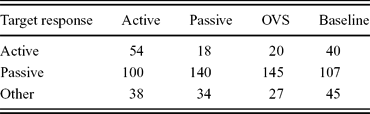
The frequency of active, passive, and other target responses for each Prime Condition are shown in Table 1. As the dependent variable was binomial (active or passive target response; other responses were excluded from the analysis), we modeled the responses using logit mixed effects models (Breslow & Clayton, Reference Breslow and Clayton1993; Debroy & Bates, Reference Debroy and Bates2004).Footnote 2 Mixed models allow the simultaneous inclusion of by-participant and by-item variation and thus remove the need for separate F1 and F2 analyses. These models can be thought of as predicting the probability of a specific response (a passive target response) in the different conditions (see Agresti, Reference Agresti2002; Jaeger, Reference Jaeger2008). Factor labels were transformed into numerical values, and centered prior to analysis, so as to have a mean of 0 and a range of 1. This procedure minimizes collinearity between variables (Baayen, Reference Baayen2008), and, in combination with sum coding of contrasts, allows coefficients to be interpreted in a way analogous to the main effects and interactions in an analysis of variance. For each result, we report the coefficient for each independent variable and its level of significance. Coefficients in mixed logit models are given in log-odds, hence the coefficients reported are the log-odds of a passive response. Significant positive coefficients show that a passive target response is more likely in the tested level of the variable than the other.
The frequency of responses in each Prime Condition (total of 768 target responses).

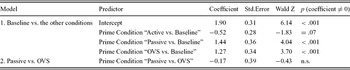
We ran models with Prime Condition as a fixed factor, and participant and items as random effects. In the first model, we used contrast coding to explore whether there was a difference in the number of Passive target responses after each of the Active, Passive, and OVS condition compared to the Baseline Condition, respectively. In a second model, we used contrast coding to explore whether the number of Passive responses differed after Passive and OVS primes. We added random slope parameters for participants and items using forward selection (Baayen, Reference Baayen2008), but the final models incorporated only those random slope parameters whose inclusion resulted in a better model fit than simpler models.
The best fit model for both analyses is summarized in Table 2; no random slope parameters were included. There was a main effect of Prime Condition for Passive vs. Baseline prime sentences: Participants produced more Passive target responses following Passive prime sentences (22.4%) than Baseline sentences (17.1%). There was also a main effect of Prime Condition for OVS vs. Baseline: Participants produced more Passive target responses following OVS prime sentences (22.6%) than Baseline sentences (17.1%). There was no difference in the number of Passive target sentences for Active vs. Baseline prime sentences (though this difference approached significance; 16.0% vs. 17.1%), or Passive vs. OVS prime sentences (22.4% vs. 22.6%).
Model coefficients and probabilities for best-fitting models. The intercept represents the log-odds for the specified response (passive response).

Note: We used centering to reduce collinearity. The upper correlation coefficients for each model were 0.11 and 0.14, which suggests that collinearity was not a problem.
Discussion
Our experiment showed that participants were more likely to produce English passives after hearing either a Polish passive or a Polish OVS sentence than after hearing a Polish baseline sentence. The proportion of English passives after Polish passives or Polish OVS sentences did not differ. Additionally, English passives showed a tendency to be less frequent after Polish actives than after Polish baseline sentences.
Clearly, the priming from Polish OVS to English passives cannot be syntactic: OVS and passive sentences differ dramatically in constituent structure (as well as in voice), and indeed the OVS is syntactically more similar to the active than the passive. Our design also rules out an explanation in terms of animacy. Instead we propose that passive and OVS sentences share the property that the patient is emphasized (unlike active sentences). These results are therefore compatible with the claim that speakers construct a level of information structure that represents entities, the thematic roles they play in the event being described, and their emphasis. (Note that we cannot determine whether emphasis is all-or-nothing, or whether different entities can be assigned different degrees of emphasis.) Moreover, this level of representation is shared across languages.
Note that our results are also compatible with an account in which the priming is due to the repetition of the order of thematic roles: Both Polish passive and OVS sentences have patient–agent order (whereas Polish active sentences have agent–patient order), as do English passive sentences. If so, the effects would still reflect the repetition of a level of representation concerned with semantics that is shared between languages. In addition, the thematic emphasis account is compatible with Vernice et al.'s (in press) within-language priming, which could not be due to repetition of thematic role order.
One question is why there was no sign of a difference between the Passive and OVS conditions. It might be expected that speakers would more likely produce passives after passives (because they share both thematic emphasis and syntax) than after OVS sentences (because they share thematic emphasis but not syntax). Indeed, we might expect that OVS sentences share syntax with actives, though of course their syntactic representations may be sufficiently different to prevent priming (a conclusion supported by evidence that word-order repetition is important for priming; Bernolet et al., Reference Bernolet, Hartsuiker and Pickering2007; Pickering et al., Reference Pickering, Branigan and McLean2002). The absence of a difference between Passive and OVS conditions is likely because the decision about information structure is made before the decision about syntax. A speaker who is primed to assign emphasis to the patient searches for a construction that is compatible with this assignment; in English, this must be the passive. However, it is also possible that we have failed to detect a small difference between Passive and OVS primes (a finding which would be compatible with the small difference between PP-medial and PP-final primes in Bernolet et al., Reference Bernolet, Hartsuiker and Pickering2009).
Previous studies have suggested that similarity of word order may be necessary for cross-linguistic priming (e.g., Bernolet et al., Reference Bernolet, Hartsuiker and Pickering2007; Loebell & Bock, Reference Loebell and Bock2003; Meijer & Fox Tree, Reference Meijer and Fox Tree2003; Salamoura & Williams, Reference Salamoura and Williams2007). In contrast, Bernolet et al. (Reference Bernolet, Hartsuiker and Pickering2009) found some priming without such persistence. Our results provide stronger evidence for this claim. They do not of course suggest that word-order repetition is unimportant for priming. Instead, it may be that word-order repetition is necessary for syntactic priming but that priming of information structure is unaffected by word order.
The finding that bilinguals share important aspects of semantic representation (such as emphasis) across languages helps constrain theories of bilingual language production (see Hartsuiker & Pickering, Reference Hartsuiker and Pickering2008). As we have noted, Levelt (Reference Levelt1989) constructed a model in which language production involves stages of conceptualization (constructing the message), formulation (constructing syntactic and phonological representations), and articulation. De Bot (Reference De Bot1992) proposed that bilinguals have two separate formulators but partly overlapping conceptualizers. This is compatible with Levelt's proposals, which assumed that languages share some aspects of conceptual representations but differ in other respects (e.g., the way that they represent the spatial relations between entities). Our data are consistent with this in suggesting that the aspects of conceptual representation associated with information structure (including thematic roles and emphasis) are shared across languages.
However, our data are more straightforwardly compatible with an account in which bilinguals have a single integrated formulator. On the basis of cross-linguistic priming of syntax, Hartsuiker and Pickering (Reference Hartsuiker and Pickering2008) proposed that syntactic aspects of formulation were also shared between languages. In their model, speakers construct sentences by activating lemma nodes (corresponding to the verb that they use) and associated nodes such as category nodes (e.g., verb) and combinatorial nodes (e.g., active, passive). Bilinguals represent the lemma nodes for translation-equivalent words separately, but they share the verb node and the combinatorial node when the constructions are formed the same way. In addition, they assume that translation equivalents share a semantic representation at the conceptual stratum. If such an account is correct, we would also assume that active and OVS constructions would involve different combinatorial nodes (or else we would expect priming from Polish OVS sentences to English passives). This account is of course consistent with the sharing of information structure (but does not require it).
In conclusion, we propose that the speaker has to decide whether to emphasize the agent or the patient when describing a transitive event in English. Her choice is affected by whether she has just encountered an emphasized agent or an emphasized patient, even when they are part of a sentence produced in a different language. After making this decision, she constructs an active or a passive sentence, and is more likely to produce a passive after encountering an emphasized patient than an emphasized agent. Our study showed cross-linguistic priming, with speakers being more likely to produce English passives after Polish passive or OVS sentences than after Polish conjoined noun phrases or active sentences. It therefore suggests that bilinguals construct a language-independent level associated with semantics during speaking, and we propose that the level is concerned with the representation of information structure.
Appendix. Experimental items
We first give the Prime Conditions (with English translations in square brackets) in the order Active – Passive – OVS – Conjoined Noun Phrase Baseline, and then a description of the target card.
1. Aniołek uderza mumię.
“The angel hits the mummy.”
Mumia jest uderzana przez aniołka.
“The mummy is hit by the angel.”
Mumię uderza aniołek.
“The mummy [O] hit the angel [S].”
aniołek i mumia “the angel and the mummy”
GIFT SPLASH SPORTSMAN
2. Syrena podnosi diabła.
“The mermaid lifts the devil.”
Diabeł jest podnoszony przez syrenę.
“The devil is lifted by the mermaid.”
Diabła podnosi syrena.
“The devil [O] lift the mermaid [S].”
syrena i diabeł “the mermaid and the devil”
FLOWER SPLASH SPORTSMAN
3. Sportowiec przygniata baletnicę.
“The sportsman squashes the ballet dancer.”
Baletnica jest przygniatana przez sportowca.
“The ballet dancer is squashed by the sportsman.”
Baletnicę przygniata sportowiec.
“The ballet dancer [O] squash the sportsman [S].”
baletnica i sportowiec “the ballet dancer and the sportsman”
CAKE SPLASH SNAKE CHARMER
4. Baletnica budzi kowboja.
“The ballet dancer wakes the cowboy.”
Kowboj jest budzony przez baletnicę.
“The cowboy is waked by the ballet dancer.”
Kowboja budzi baletnica.
“The cowboy [O] wake the ballet dancer [S].”
baletnica i kowboj “the ballet dancer and the cowboy”
HAT SPLASH PILOT
5. Piłkarz ochlapuje kosmitę.
“The football player splashes the alien.”
Kosmita jest ochlapywany przez piłkarza.
“The alien is splashed by the football player.”
Kosmitę ochlapuje piłkarz.
“The alien [O] splash the football player [S].”
piłkarz i kosmita “the football player and the alien”
FLOWER HIT MATADOR
6. Listonosz potrąca profesora.
“The mailman knocks over the professor.”
Profesor jest potrącany przez listonosza.
“The professor is knocked over by the mailman.”
Profesora potrąca listonosz.
“The professor [O] knock over the mailman [S].”
listonosz i profesor “the mailman and the professor”
HAT HIT RAP SINGER
7. Spadochroniarz przygniata zakonnicę.
“The parachutist squashes the nun.”
Zakonnica jest przygniatana przez spadochroniarza.
“The nun is squashed by the parachutist.”
Zakonnicę przygniata spadochroniarz.
“The nun [O] squash the parachutist [S].”
spadochroniarz i zakonnica “the parachutist and the nun”
GIFT HIT SNAKE CHARMER
8. Pastor podnosi lekarza.
“The pastor lifts the doctor.”
Lekarz jest podnoszony przez pastora.
“The doctor is lifted by the pastor.”
Lekarza podnosi pastor.
“The doctor [O] lift the pastor [S].”
pastor i lekarz “the pastor and the doctor”
HAT HIT MATADOR
9. Sportowiec uderza rapera.
“The sportsman hits the rap singer.”
Raper jest uderzany przez sportowca.
“The rap singer is hit by the sportsman.”
Rapera uderza sportowiec.
“The rap singer [O] hit the sportsman [S].”
sportowiec i raper
“the sportsman and the rap singer”
FIRE ALARM WAKE PUNK
10. Pielęgniarka ochlapuje pastora.
“The nurse splashes the pastor.”
Pastor jest ochlapywany przez pielęgniarkę.
“The pastor is splashed by the nurse.”
Pastora ochlapuje pielęgniarka.
“The pastor [O] splash the nurse [S].”
pielęgniarka i pastor “the nurse and the pastor”
ALARM CLOCK WAKE RAP SINGER
11. Torreador potrąca astronautę.
“The matador knocks over the astronaut.”
Astronauta jest potrącany przez torreadora.
“The astronaut is knocked over by the matador.”
Astronautę potrąca torreador.
“The astronaut [O] knock over the matador [S].”
torreador i astronauta “the matador and the astronaut”
BELLS WAKE FOOTBALL PLAYER
12. Spadochroniarz tłucze mumię.
“The parachutist strikes the mummy.”
Mumia jest tłuczona przez spadochroniarza.
“The mummy is struck by the parachutist.”
Mumię tłucze spadochroniarz.
“The mummy [O] strike the parachutist [S].”
spadochroniarz i mumia “the parachutist and the mummy”
PLANE WAKE COWBOY
13. Listonosz ciągnie syrenę.
“The mailman pulls the mermaid.”
Syrena jest ciągnięta przez listonosza.
“The mermaid is pulled by the mailman.”
Syrenę ciągnie listonosz.
“The mermaid [O] pull the mailman [S].”
listonosz i syrena “the mailman and the mermaid”
TV SQUASH PUNK
14. Punk budzi sportowca.
“The punk wakes the sportsman.”
Sportowiec jest budzony przez punka.
“The sportsman is waked by the punk.”
Sportowca budzi punk.
“The sportsman [O] wake the punk [S].”
punk i sportowiec “the punk and the sportsman”
FLOWER SQUASH FOOTBALL PLAYER
15. Piłkarz tłucze torreadora.
“The football player strikes the matador.”
Torreador jest tłuczony przez piłkarza.
“The matador is struck by the football player.”
Torreadora tłucze piłkarz.
“The matador [O] strike the football player [S].”
piłkarz i torreador “the football player and the matador”
WARDROBE SQUASH SNAKE CHARMER
16. Diabeł ochlapuje pilota.
“The devil splashes the pilot.”
Pilot jest ochlapywany przez diabła.
“The pilot is splashed by the devil.”
Pilota ochlapuje diabeł.
“The pilot [O] splash the devil [S].”
diabeł i pilot “the devil and the pilot”
CAKE SQUASH MATADOR
17. Duch uderza czarownicę.
“The ghost hits the witch.”
Czarownica jest uderzana przez ducha.
“The witch is hit by the ghost.”
Czarownicę uderza duch.
“The witch [O] hit the ghost [S].”
Duch i czarownica “the ghost and the witch”
TANK PULL PARACHUTIST
18. Aniołek przygniata profesora.
“The angel squashes the professor.”
Profesor jest przygniatany przez aniołka.
“The professor is squashed by the angel.”
Profesora przygniata aniołek.
“The professor [O] squash the angel [S].”
aniołek i profesor “the angel and the professor”
TRUCK PULL PILOT
19. Czarownica potrąca pilota.
“The witch knocks over the pilot.”
Pilot jest potrącany przez czarownicę.
“The pilot is knocked over by the witch.”
Pilota potrąca czarownica.
“The pilot [O] knock over the witch [S].”
czarownica i pilot “the witch and the pilot”
BUS PULL NUN
20. Raper budzi kosmitę.
“The rap singer wakes the alien.”
Kosmita jest budzony przez rapera.
“The alien is waked by the rap singer.”
Kosmitę budzi raper.
“The alien [O] wake the rap singer [S].”
raper i kosmita “the rap singer and the alien”
AMBULANCE PULL MUMMY
21. Zakonnica podnosi listonosza.
“The nun lifts the mailman.”
Listonosz jest podnoszony przez zakonnicę.
“The mailman is lifted by the nun.”
Listonosza podnosi zakonnica.
“The mailman [O] lift the nun [S].”
zakonnica i listonosz “the nun and the mailman”
LIGHTENING STRIKE PUNK
22. Mumia ciągnie kowboja.
“The mummy pulls the cowboy.”
Kowboj jest ciągnięty przez mumię.
“The cowboy is pulled by the mummy.”
Kowboja ciągnie mumia.
“The cowboy [O] pull the mummy [S].”
mumia i kowboj “the mummy and the cowboy”
BALL STRIKE MERMAID
23. Pielęgniarka ochlapuje lekarza.
“The nurse splashes the doctor.”
Lekarz jest ochlapywany przez pielęgniarkę.
“The doctor is splashed by the nurse.”
Lekarza ochlapuje pielęgniarka.
“The doctor [O] splash the nurse [S].”
pielęgniarka i lekarz “the nurse and the doctor”
COCONUT STRIKE COWBOY
24. Lekarz przygniata spadochroniarza.
“The doctor squashes the parachutist.”
Spadochroniarz jest przygniatany przez lekarza.
“The parachutist is squashed by the doctor.”
Spadochroniarza przygniata lekarz.
“The parachutist [O] squash the doctor [S].”
lekarz i spadochroniarz “the doctor and the parachutist”
SHUTTLE STRIKE NUN
25. Syrena potrąca punka.
“The mermaid knocks over the punk.”
Punk jest potrącany przez syrenę.
“The punk is knocked over by the mermaid.”
Punka potrąca syrena.
“The punk [O] knock over the mermaid [S].”
syrena i punk “the mermaid and the punk”
HURRACAINE LIFT NURSE
26. Kosmita tłucze kowboja.
“The alien strikes the cowboy.”
Kowboj jest tłuczony przez kosmitę.
“The cowboy is struck by the alien.”
Kowboja tłucze kosmita.
“The cowboy [O] strike the alien [S].”
kosmita i kowboj “the alien and the cowboy”
CRANE LIFT MUMMY
27. Kosmita ciągnie torreadora.
“The alien pulls the matador.”
Torreador jest ciągnięty przez kosmitę.
“The matador is pulled by the alien.”
Torreadora ciągnie kosmita.
“The matador [O] pull the alien [S].”
kosmita i torreador “the alien and the matador”
HELICOPTER LIFT FOOTBALL PLAYER
28. Raper uderza diabła.
“The rap singer hits the devil.”
Diabeł jest uderzany przez rapera.
“The devil is hit by the rap singer.”
Diabła uderza raper.
“The devil [O] hit the rap singer [S].”
raper i diabeł “the rap singer and the devil”
WIND LIFT SNAKE CHARMER
29. Astronauta podnosi profesora.
“The astronaut lifts the professor.”
Profesor jest podnoszony przez astronautę.
“The professor is lifted by the astronaut.”
Profesora podnosi astronauta.
“The professor [O] lift the astronaut [S].”
astronauta i profesor “the astronaut and the professor”
TRUCK KNOCK OVER PILOT
30. Diabeł budzi lekarza.
“The devil wakes the doctor.”
Lekarz jest budzony przez diabła.
“The doctor is waked by the devil.”
Lekarza budzi diabeł.
“The doctor [O] wake the devil [S].”
diabeł i lekarz “the devil and the doctor”
AMBULANCE KNOCK OVER COWBOY
31. Punk tłucze czarownicę.
“The punk strikes the witch.”
Czarownica jest tłuczona przez punka.
“The witch is struck by the punk.”
Czarownicę tłucze punk.
“The witch [O] strike the punk [S].”
punk i czarownica “the punk and the witch”
CAR KNOCK OVER MATADOR
32. Profesor ciągnie listonosza.
“The professor pulls the mailman.”
Listonosz jest ciągnięty przez profesora.
“The mailman is pulled by the professor.”
Listonosza ciągnie profesor.
“The mailman [O] pull the professor [S].”
profesor i listonosz “the professor and the mailman”
FIRE ENGINE KNOCK OVER SPORTSMAN