It is beyond doubt that ‘opposition’ is important in both democratic and non-democratic contexts. Still, studies that theorize and problematize the concept of opposition in authoritarian milieus are rare. To this end we have identified two main problems in previous research. First, despite the fact that the situation and role of the ‘opposition’ in these environments is distinctly different from that in democracies, the concept is more or less taken for granted and generally routinely applied to political parties. As a result it is also usually focused on the role of opposition in relation to elections. This is problematic because of the severe limitations to basic freedoms and liberties in these contexts which hinder opposition parties from acting as parties in practice and render elections symbolic rather than decisive. A second issue, linked to the first, concerns ‘opposition’ being analysed mainly in terms of its performance and outcome – or more often lack thereof. This trend is especially noticeable in the recent literature on post-Soviet electoral revolutions, where popular protest against fraudulent elections failed to bring regime change. For example, in cases such as Azerbaijan (2003 and 2005) and Belarus (2006), ‘opposition’ is simply regarded as ‘failed’ and as such not paid much academic attention.
It is hard to deny that actors described as ‘opposition’ in Azerbaijan and Belarus have not been able to achieve any obvious substantial political results. Still, that conclusion does little to further our understanding of the concept of ‘opposition’ in these contexts. As noted by Andreas Schedler (Reference Schedler2013: 374), ‘[in hegemonic regimes] the odds against opposition success should be paralyzing. And yet opposition actors do exist and protest and participate.’ In light of this we argue that opposition is a phenomenon that needs to be studied more in its own right. Hence, the purpose of this article is to increase the understanding of the nature and character of opposition in authoritarian regimes. We do this by exploring the opposition’s activities and strategies more broadly than previous research has done. The point of departure is that opposition actors’ space for activity in Azerbaijan and Belarus is strictly limited. They could be said to be restricted to a ‘ghetto’ of sorts, where their activities are controlled and regulated by the authorities who deprive them of interaction with the rest of the population. Well aware that they are ‘trapped’, such opposition actors thus strive to break down the ghetto walls. However, rather than analysing the outcome (i.e. whether they are ‘successful’ or not), this article focuses on their strategies and activities in this respect. As part of this study, the various roles of ‘opposition’ in authoritarian contexts will be elucidated.
Based on around 80 semi-structured interviews conducted with ‘opposition actors’ (politicians, activists, dissidents and journalists) as well as donors and local experts in Baku and Minsk between 2014 and 2016, our study suggests a new typology in the form of four models of oppositional resistance in Azerbaijan and Belarus: electoral, in the media, lobbying and through education. Extracts from the interviews help us to illustrate how our interlocutors think strategically and how they build their ways of resistance. For this research, what matters are the opposition actors’ representations – who they think they are and what they believe they are doing – while what they ‘really’ do and achieve is of secondary importance.Footnote 1 This we believe provides the starting point for a more systematic and relevant systematization of opposition, hence a more comprehensive understanding of the phenomenon than previous research has offered.
DEFINING ‘OPPOSITION’
Interestingly, a large amount of both older and newer literature focusing specifically on the concept of political opposition in democratic and non-democratic contexts regards the topic as under-studied (for example, Blondel Reference Blondel1997; Helms Reference Helms2008; Ionescu and de Madariaga Reference Ionescu and De Madariaga1968; Kubát Reference Kubát2010; Parry Reference Parry1997; Stepan Reference Stepan1990; Weinblum and Brack Reference Weinblum and Brack2011). Perhaps as a result newer definitions of ‘opposition’ are scarce and many studies in one way or another rely on that offered by Robert Dahl (Reference Dahl1966: xvi):
Suppose that A determines the conduct of some aspect of the government of a particular political system during some interval … Suppose that during this interval B cannot determine the conduct of the government, and that B is opposed to the conduct of the government by A. Then B is what we mean by ‘an opposition’.
This definition exemplifies what Michal Kubát (Reference Kubát2010: 17) has categorized as opposition sensu largo – that is, ‘any expression of disagreement with the politics of those in power, meant in the broadest sense’. In contrast, Sharon Weinblum and Nathalie Brack’s definition of opposition (Reference Weinblum and Brack2011: 74) as ‘disagreement with the government or its policies, the political elite, or the political regime as a whole, expressed in public sphere, by an organized actor through different modes of action’ can be related to Kubát’s opposition sensu stricto (Reference Kubát2010: 17): opposition tied to an institution that actively strives to overthrow the ruling government and succeed in its place. It is not surprising when studies on democracies focus on the latter – an institutionalized form of opposition evident in political parties and party system – but it is interesting that research concerned with opposition in non-democratic, or so-called transformational contexts, most often chooses to relate to opposition in this way (e.g. Gelman Reference Gelman2005; Svåsand Reference Svåsand2013; Weghorst and Lindberg Reference Weghorst and Lindberg2011).
Previous research related to the issue of opposition in Azerbaijan and Belarus shows the need to go beyond the notion of political parties (e.g. Korosteleva Reference Korosteleva2009; Marples Reference Marples2009; Matonytė and Chulitskaya Reference Matonytė and Chulitskaya2012; Mehrabov Reference Mehrabov2016; Pearce Reference Pearce2014, Reference Pearce2015). This narrower concept of opposition is not particularly useful for these contexts as opposition parties do exist but in reality cannot act as such. Instead their work comes to be similar to that of other non-party actors fighting for democracy. In light of this, equating ‘opposition’ rigidly with parties appears counterproductive. We choose instead the opposition sensu largo approach for our study, including all actors who object to the current political situation, and who are in some way actively working to change it.Footnote 2 This need for a more inclusive definition is highlighted by the fact that in these countries ‘being political’ is not popular with the authorities. Therefore, topics such as politics, economics and human rights are more or less taboo for activists, while others – culture, sport and ecology, for example – are considered unthreatening and are allowed.Footnote 3 This influences the character of ‘opposition’ and their activities since many groups and individuals deliberately choose to label their activities ‘non-political’ in order to avoid getting into trouble with the state.Footnote 4 A sensu largo approach ensures that these are accounted for as well. Still, we are aware that an inclusive definition of ‘opposition’ is not uncontroversial. The state authorities in these countries likewise have a habit of generally labelling all groups and individuals who question the political status quo as ‘oppositional’, which brings negative connotations. Thus referring to yourself or being referred to by others as ‘opposition’ is understandably a sensitive topic.
A brief note is needed on the difference between what in previous literature is often referred to as ‘systemic opposition’ and ‘non-systemic opposition’. The definition of the former is opposition that is to a certain extent already integrated into the power relations of the country, hence it does not offer an alternative to the current political system and will often even be supportive of the regime and the political status quo. The latter, on the other hand, ‘seeks a radical change of the regime and usually has no positions in power at all’ (Turovsky Reference Turovsky2015: 121) and operates largely outside the established political system (Albrecht Reference Albrecht2005; Protsyk Reference Protsyk2006). In the Azerbaijani context this division is commonly referred to as ‘genuine’ versus ‘pocket’ or ‘puppet’ opposition; for example, parties such as the United Popular Front or the Modern Musavat Party – with names oddly similar to those of the traditional opposition parties – are supporters of the ruling elite and ‘opposition’ on paper only (Sultanova Reference Sultanova2014; Valiyev Reference Valiyev2006). This phenomenon is also known in Belarus as ‘puppets’, with their only function to provide a pluralistic façade for the regime (Silitski and Zaprudnik Reference Silitski and Zaprudnik2010). The most recurring example of this is Sergei Gaidukevich of the Liberal Democratic Party (a self-declared ‘constructive opposition’ party), who is a well-known supporter of Belarus’s President Lukashenko but still a frequent presidential candidate (Kulakevich Reference Kulakevich2015). As our research focuses on the opposition actors who are forced to act mainly outside the established political system, the so-called ‘non-systemic opposition’ is the object of this study.
THE ROLE OF OPPOSITION IN AUTHORITARIAN REGIMES
A review of previous literature provides few studies that focus especially on the role and concept of opposition in authoritarian regimes. Instead, opposition is often featured in research that analyses the ‘success or failure’ of attempts at regime change in authoritarian states. The literature on ‘electoral authoritarianism’ – how elections are used to consolidate authoritarian rule – is one part of this. Another part is focused on contentious politics and related in particular to popular uprisings against authoritarian leaders, most often in connection with contested elections.
Opposition and Electoral Authoritarianism
As the ‘third wave of democratization’ appears to have stalled (Carothers Reference Carothers2002), researchers have shifted their attention to trying to understand authoritarian stability rather than the lack of democratic breakthrough (Ambrosio Reference Ambrosio2014; Gerschewski Reference Gerschewski2013; Wahman Reference Wahman2013). In relation to this, Schedler (Reference Schedler2009) has pointed to the role of elections as an important tool for authoritarian governments to overcome the horizontal and vertical threats they perceive to their rule. As such this line of research relates to opposition mainly by pointing out how electoral authoritarianism is undermining its influence and potential, particularly in so-called hegemonic autocratic regimes, where any genuine electoral competition is lacking (Blaydes Reference Blaydes2013; Lust-Okar Reference Lust-Okar2009; Morse Reference Morse2012, Roessler and Howard Reference Roessler and Howard2009; Weghorst and Lindberg Reference Weghorst and Lindberg2011).
Impressive electoral victories, for example, have been proven to deter both elite defection and opposition because they portray the regime as invincible and signal to the population that opposition is futile (Gandhi and Przeworski Reference Gandhi and Przeworski2006; Magaloni Reference Magaloni2008). Moreover, regular elections may also weaken and obstruct the democratic opposition as they give the regime an opportunity to gather information about who its political opponents are and their capacity (Brownlee Reference Brownlee2007). In addition, elections can be used by the government to emphasize and promote a ‘loyal’ (possibly systemic) opposition, which contributes to the marginalization of those who genuinely work for political change (Gandhi and Przeworski Reference Gandhi and Przeworski2007; Lust-Okar Reference Lust-Okar2005; Schedler Reference Schedler2009). Utilizing the multiparty system, authoritarian leaders can engage in power-sharing policies to limit perceived threats from within the elite (Magaloni Reference Magaloni2008) or from the opposition (Gandhi and Przeworski Reference Gandhi and Przeworski2006). Some of this literature specifically addresses how the strategies of the opposition affect the outcome of the ‘election game’ (for example, Weghorst and Lindberg Reference Weghorst and Lindberg2011). Most often this relates to dilemmas of choice – for example, to participate or boycott, and later to accept, reject and/or protest the results (Lindberg Reference Lindberg2006b; Schedler Reference Schedler2009, Reference Schedler2013). In this context the opposition’s coordination dilemmas (Greene Reference Greene2007; Lindberg Reference Lindberg2006a; Magaloni 2006) are generally seen as a crucial part of understanding the opposition’s lack of electoral success.
Opposition and ‘Failed Revolutions’
While in democratic contexts the opposition aspires to replace the party that is presently in charge (until the next election), previous research on authoritarian regimes portrays government and opposition relations more like a zero-sum game. In this interaction opposition parties are assigned a seemingly impossible task – that of ousting the authoritarian regime and establishing democracy. As long as this task is not achieved, the ‘opposition’ is not seen as ‘successful’. As noted above, there appears to be some expectation that this task can be fulfilled through elections, no matter how poor their quality. However, after the many popular upheavals in the 2000s, the ‘revolutionary route’ to democracy received more attention. Research on the course of the so-called ‘colour revolutions’ clearly illustrates this trend of portraying opposition as ‘successful’ or ‘failed’ depending on whether or not it managed to remove an authoritarian leader through popular protest. Nowhere is this more clear than in Valerie Bunce and Sharon Wolchik’s Defeating Authoritarian Leaders in Post-Communist Countries (Reference Bunce and Wolchik2011: 177), in which Chapter 7 is entitled ‘Failed Cases: Azerbaijan, Armenia and Belarus’. Here, the authors’ main point is that structural factors, such as the level of regime repression or a state’s economic conditions, are of less importance than whether or not the opposition and its allies managed to coordinate effectively, cooperate with civil society and mobilize voters by showing that electoral change was possible in the context of a vulnerable regime. In cases where the ‘electoral model’, as they call it, was implemented, they argue that change took place. The idea of a weak opposition being ultimately ‘responsible’ for missing the window of opportunity provided by the electoral protests resonates to some extent in much of the other ‘colour revolution’ research too (e.g. Marples Reference Marples2006; Mitchell Reference Mitchell2012; Ó Beacháin and Polese Reference Ó Beacháin and Polese2010).
Opposition beyond Elections and Revolts
This article does not necessarily disagree with the above findings. Nonetheless, our approach differs in that it focuses not on the outcome of oppositional activities as this, we believe, is to some extent predetermined. Electoral authoritarian regimes, Schedler (Reference Schedler2009: 179) writes, ‘are regimes in which opposition parties lose elections – often by a landslide, sometimes by a hair’s breadth’. Even though an irritant for the authorities, the presence of opposition is necessary for electoral autocracies, as the key to these regimes’ democratic front lies in displaying the entire set of representative institutions required of a modern democracy. Importantly, elections in these states are minimally competitive. Parties and candidates outside the ruling coalition are allowed to win votes and seats occasionally, but never to win the election (Schedler Reference Schedler2006). Furthermore, as noted by Staffan Lindberg (Reference Lindberg2006b), in hegemonic electoral autocracies there is little incentive for opposition parties to protest the election result as there is simply no prospect of ‘success’ in this regard in the foreseeable future.
On a similar note, as will be discussed below, the failure of democratization through electoral protest was traumatic in many ways for opposition actors in both Azerbaijan and Belarus and now this route seems firmly closed to the opposition. This study instead explores how opposition actors actually operate in a severely restrictive environment, without focusing on the success or failure of their activities. In this regard, our research expands on Alfred Stepan’s finding (Reference Stepan1997: 662) that what needs to be studied ‘is not merely the final collapse or overthrow of authoritarian regimes but the incremental process of “authoritarian erosion” and the opposition’s contribution to it through staying in, or coming into, existence; resisting integration into the regime; guarding zones of autonomy against it; disputing its legitimacy; raising the costs of nondemocratic rule; and creating a credible democratic alternative’.
This article will outline how opposition actors in Azerbaijan and Belarus are attempting to accomplish the tasks outlined by Stepan (also resonating in other typologies of opposition in non-democracies, e.g. Kubát Reference Kubát2010: 36), in spite of being almost completely marginalized in society. In this sense the models of resistance presented here are cases where the opposition’s participation in popular dissent and protest should not be seen as a means to an ultimate end (regime change), but rather as a general act of resistance (Blaydes Reference Blaydes2013; Johnston Reference Johnston2005) that might highlight potential weaknesses in the tough façade of an authoritarian regime (Schwedler Reference Schwedler2005, Reference Schwedler2012).
Similar to Hank Johnston’s work (Reference Johnston2005: 108), this article finds ‘much of the doing of contentious politics is talking about it’. Johnston (Reference Johnston2006) describes the importance of critical ‘political talk’ in kitchens, coffee shops and other informal situations for the formation of oppositional identity in authoritarian states. Nonetheless, one of the main points this article wants to make is that in our cases most ‘oppositional speech acts’ take place in a ‘ghetto’ created by the authoritarian rulers, who cut off opposition actors from the larger audience, rather than in the ‘free spaces’ depicted by Johnston. This ‘ghettoization’, and especially how it has cemented the image of the opposition as ‘failed’ and ‘unsuccessful’ in these societies, will be discussed next. This provides important background for understanding the roles of opposition in authoritarian states as outlined in the models of resistance in the subsequent sections of the article.
FAILED ‘REVOLUTIONS’ AND THE MARGINALIZATION OF OPPOSITION
The Trauma of Missed Opportunity
In Minsk protests at fraud in the 2006 presidential election, in which the incumbent won a crushing victory over the candidate from the United Democratic Forces, gathered over 10,000 supporters, the largest protest against the regime in many years. Inspired by events in Ukraine, activists set up a tent camp on October Square that, despite pressure from the authorities, lasted five days until it was finally dispersed by force. In the aftermath of the election, the militia detained at least 500 people on charges of participating in illegal actions (Eberhardt Reference Eberhardt2006; Naumov Reference Naumov2014). After this, the terms ‘street struggle’ and ‘creating a Ploshcha’ (square in Belarusian) became a regular part of the traditional opposition’s rhetoric and an important feature in most opposition candidates’ campaigns in the 2010 presidential elections (Navumau Reference Navumau2016). Following Alexander Lukashenko’s fourth re-election, the opposition candidates again managed to rally thousands of people to protest the official results, but this time it ended with tragedy. The protests were even more brutally broken up and hundreds were arrested, including seven of the nine presidential candidates (Ash Reference Ash2015; Padhol and Marples Reference Padhol and Marples2011).
Azerbaijan also saw a number of popular protests hoping to lead to change. This most obviously took place in the 2005 parliamentary elections when the main opposition parties (the Azerbaijan Popular Front Party (APFP), Musavat and the Azerbaijan Democratic Party), inspired by other ‘democratic revolutions’, united to form the coalition Azadlyq (Freedom). They tried to mobilize people in a post-election street protest, but it was brutally suppressed by the government (Alieva Reference Alieva2006; Valiyev Reference Valiyev2006). An outburst of public protests that started in the aftermath of the Arab Spring in 2011 culminated in Azerbaijan in 2013. Some demonstrated within the framework of demanding democratization while other protesters were mainly addressing economic issues such as low wages. In any case they were ultimately crushed by force, with many activists being detained for varying periods.Footnote 5 Subsequent repression has to a large extent destroyed any revolutionary aspirations or taste for revolution among the population.
These examples have often been depicted in the literature as ‘failed’ revolutions. Vasil Navumau (Reference Navumau2016), however, argues that the 2006 Tent Camp Protest in Minsk should not be interpreted simply as a ‘failed Belarusian Maidan’. Rather than a protest aimed at overthrowing a corrupt regime, as was the case in neighbouring Ukraine and Georgia, the Minsk Tent Camp is, in his view, better understood as a Belarusian version of a ‘new social movement’ focused on cultural rather than political forms of resistance.Footnote 6 Still, whatever the ultimate intent of the protests really were, the events were traumatic for many, both in the opposition and among the population at large who had started to believe revolutionary change was possible. They appear to perceive these events as having been the last chance for political change. Today the era of democratic revolutions seems to be over.Footnote 7 As an example, when talking to opposition actors in Belarus, ‘creating a Ploshcha’ is mostly mentioned as something no longer possible.Footnote 8
In some ways, the colour revolution concept can be said to have done more harm than good for those who work for change in these two countries. ‘Failing’ to overthrow the government made the opposition lose respect in the eyes of a severely disillusioned population in both countries; they appear to have lost hope and settled into political apathy. The parade of colour revolutions and the so-called Arab Spring also made the governments more repressive and pre-emptive, further limiting the space for opposition-mindedness. This has been amplified by a ‘Maidan effect’, as both Russia’s President Vladimir Putin and Belarus’s Lukashenko are using the events in the Ukraine to show how ‘ugly’ such popular revolts can get.Footnote 9 As a result, as will be elaborated below, opposition actors today are almost completely marginalized in both Belarus and Azerbaijan.
Governmental Political and Ideological Hegemony
It is no exaggeration to say that ruling authorities in both countries exert a monopolistic control over all civic activities that typically arise from internationally recognized civil liberties. Symptomatically, Freedom House’s index of democracy consistently places Azerbaijan and Belarus among those countries that are ‘not free’. Both countries have been classified as ‘consolidated authoritarian regimes’ according to the Nations in Transit report (Clem Reference Clem2011; Habdank-Kołaczkowska Reference Habdank-Kołaczkowska2015; McAllister and White Reference McAllister and White2016). Major opposition parties in Azerbaijan were traditionally allowed to win at least a symbolic representation in parliament, which is something that appears to have changed after the 2010 parliamentary elections (Bedford Reference Bedford2015; Guliyev Reference Guliyev2013). Likewise in Belarus: even though there is no presidential party, the majority of deputies are ‘independent candidates’ loyal to the authorities (Frear Reference Frear2014). While the 2016 election brought one representative of ‘genuine’ opposition and one from civil society to parliament (the first since 2004), it is still unclear what influence they might have. Surveys show that Belarus is second only to Turkmenistan in the degree to which political power is concentrated in the president (McAllister and White Reference McAllister and White2016). Opportunities for political opposition parties – or anyone else questioning the political status quo – to publicly express their views have gradually been decreasing as in both countries the government has used legislation to limit the space for its opponents (Alieva Reference Alieva2013; Clem Reference Clem2011; Eberhardt Reference Eberhardt2006; Frear Reference Frear2014; LaPorte Reference LaPorte2015; Lenzi Reference Lenzi2002; Marples Reference Marples2009; Navumau Reference Navumau2016; Sultanova Reference Sultanova2014).
In the type of regime described by Silitski as either pre-emptive democracy (Reference Silitski2005) or pre-emptive authoritarianism (2010), ‘hard-line authoritarian regimes ensure their continued stability and survival not just by sporadic reactions to already existing political and social challenges, but by pre-emptive attacks that eliminate threats before they arise’ (Silitski Reference Silitski2010: 342). Susan Stewart, Margarete Klein and Andrea Schmitz (Reference Stewart, Klein and Schmitz2012) have referred to this as a ‘hyper-incumbent advantage’, which creates an extremely uneven playing field. Since political and social alternatives are eliminated before they become at all threatening, ‘opposition is shut out from effective contestation altogether, without being brutally suppressed’ (LaPorte Reference LaPorte2015: 20; see also Korosteleva Reference Korosteleva2012; Manaev et al. Reference Manaev, Manayeva and Dzmitry Yuran2011). In addition, the incumbent is shoring up power through controlling the election process, by – among other things – making the registration difficult, dominating the election committees and creating a general atmosphere of fear throughout the state where employees and students are expected or forced to vote for the president/presidential party.Footnote 10 As Silitski (Reference Silitski2005: 84) notes: ‘pre-emption has an enormous psychological impact on both the political and social opposition; such systematized repression instils in them a sense of hopelessness and imposes the perception that political change is far beyond reach’.
Another key to understanding the marginalization of opposition is the ideological and discursive hegemony of the current authorities. In Azerbaijan the voice of the traditional opposition parties – for example the APFP and Musavat – is almost completely absent from the mainstream media, which is all state controlled. This is believed to be because of the existence of a blacklist of people whom the authorities request that news outlets do not interview or even mention (Morse Reference Morse2013). Instead, so-called ‘constructive’ opposition party leaders (from the ‘pocket opposition’), MPs, ‘experts’ and others discuss these parties and their leaders exclusively as an ‘incapable, disengaged, and out-dated political opposition’ that fulfil no function (Bedford Reference Bedford2014).
In Belarus opposition parties are also absent from political dialogue, and President Lukashenko is known to characterize some of them in particular as ‘enemies of Belarus and/or in the pay of foreign governments’ (Marples Reference Marples2009: 760). There are more independent media outlets in Belarus than in Azerbaijan, but only state media broadcast nationwide (Manaev Reference Manaev2014). In both countries negative attitudes towards the opposition resonate among the populations and the opposition is often accused of contributing to its own demise by being disorganized, fractured, disillusioned and weak (Ash Reference Ash2015; Ergun Reference Ergun2010; Korosteleva Reference Korosteleva2009; Marples Reference Marples2006). In Belarus a particularly harsh anti-opposition online discourse can be detected, clearly illustrating the frustration among the population at the lack of political progress. While it is easy to regard opposition actors as being hopeless and incapable, we need to consider the fact that their space for activity is limited. It is even possible to say that they are stuck in a ghetto of sorts, as we suggest in this study.
The ‘Ghettoization’ of Opposition
Having captured the public space, the government authorities exclude any independent opinion or any opinion that does not fit with their own hegemonic discourse. Many who are still willing to express different views are either put in prison or end up moving or fleeing to a neighbouring country (such as Lithuania or Poland for the Belarusians and Turkey, Western Europe or the US in the case of Azerbaijan).Footnote 11 Relocated abroad, those ‘dissidents’ continue to work for change through journalistic or human rights advocacy projects against the system at home.Footnote 12 Those who choose to stay are maintained in what can be defined as ‘reserved areas’ under close watch and excluded as much as possible from the surrounding social and political world. Virtual social networks are one of the few remaining free spaces left for oppositional actors to operate in. This use of the internet as a platform for oppositional agitation is also quite convenient for the authorities. In Azerbaijan, where the expression ‘virtual opposition’ is commonly heard, one leading blogger frankly recognizes this ‘internet trap’:
Opposition-minded people in Azerbaijan keep posting, discussing and arguing on a few internet-based social networks. Facebook undeniably is a free space to express any ideas, political, social and economic as long as it does not touch personally the president and his family but that is all. There is nothing outside this virtual platform. I can say that opposition activists are incarcerated on Facebook or Twitter and more generally on the internet.Footnote 13
In Belarus the picture is similar even though there are more media outlets relaying declarations from opposition leaders and offering some opportunities for the exchange of ideas. Still, most of them, like in Azerbaijan, remain internet-based.Footnote 14 Keeping their opponents on the internet thus helps the authorities to separate them from ‘real society’ since those virtual social platforms tend to emphasize links between those who are like-minded and exclude those who are not permanently connected. Subsequently, by limiting access to public space and by using physical repression during unsanctioned demonstrations while at the same time allowing full freedom of expression (with some exceptions) on the internet, the government determines where and how its opposition can operate.Footnote 15 Some sections of the opposition understand this well but nevertheless have to choose between real offline and virtual online incarceration.
Those who stay active in the ‘ghetto’ often try to work out what they can do, how far they can go and how they can increase their space for action.Footnote 16 In Azerbaijan some opposition actors mentioned a set of unofficial ‘rules of the game between the opposition and the authorities’.Footnote 17 However, judging from the massive wave of arrests of opposition actors in 2014–15 – including the imprisonment of some high-profile activists who had previously been allowed a somewhat larger ‘space for action’ – these rules appear to have changed. It is noticeable that the protracted struggle for change without tangible achievements is both stressful and tiring for the opposition in both countries.Footnote 18 Activists from APFP repeatedly tell stories of how they are only allowed to organize public rallies in one particular place, the Mahsul Stadium in the Yasamal district of Baku. They explain that this place is offered to them because it has only one entrance – with a camera – so that the police can carefully document every attendee.Footnote 19 Such practices clearly deter participation and having a mere few hundred participants in a large stadium causes a sort of ‘screaming in the desert’ trauma.
It is clearly difficult for any independent movement to operate in the framework described above. Yet opposition-minded actors do exist and develop various tactics to engage with the outside world – strategies and activities that strive to break down the ghetto walls.
CHALLENGING THE GHETTO: OPPOSITION RESISTANCE MODELS
As discussed above, the previously popular ‘revolutionary option’ to achieve change appears to have lost its attraction. Instead, opposition actors have adapted to the restrictions and have developed ways of operating – accepting a certain level of dependence on the regime’s control system. We categorize these opposition resistance models below. These models can be roughly described as being centred on a specific type of activity: elections, media, lobbying and education.
Electoral Opposition
In Azerbaijan and Belarus today, hardly anyone in the opposition or in the population at large expects that change will come from elections. Previously, opposition parties in both countries probably had, or believed that they had, a chance to win a majority of the votes. However their results under the current conditions are largely insignificant. Instead, many opposition actors describe the electoral campaign as the only time when they have access to the population at large, hence, elections become a tool for them to get their message across. The ways in which opposition actors use this tool vary, as demonstrated in the examples below from the 2015 presidential elections in Belarus and the parliamentary elections in Azerbaijan in the same year.
For some actors, participation and more specifically the notorious collection of signatures in order to get candidates registered to the national electoral commission becomes a goal in itself. Most opposition actors in both countries describe the signature collection as their only chance to spread their views undisturbed by the authorities. It is also a rare opportunity to gauge the level of support from the community.Footnote 20 The parties use the campaign to ‘explain that there is an alternative’ and to ‘communicate with the people’.Footnote 21 For example, both Anatol Liabedzka, head of the United Civic Party (UCP) and Sergey Kalyakin of the Just World Party in Belarus decided to boycott the 2015 presidential election – after they understood that they could not provide the required number of signatures to register as candidates and hence were prevented from running.Footnote 22 According to Kalyakin: ‘Elections are important for us but not as an instrument to come to power. During the campaign we can meet people. This is the most important work. To criticize what the state authorities do, show what we can do or what we suggest can be done.’Footnote 23
Similarly in Azerbaijan both Musavat and the civic movement NIDA initially took advantage of the 2015 parliamentary election campaign, collecting signatures, distributing materials and even getting a small number of their candidates registered.Footnote 24 A member of the NIDA board, Turgut Gambar, said that their initial participation was merely symbolic, to ‘maintain the spirit of protest’.Footnote 25 Just four days before the vote both groups withdrew from the race, citing the repressive environment as the main reason. However, their withdrawal was regarded as a somewhat weak statement as the Central Election Commission claimed that they were not permitted to pull out under these circumstances, keeping many names on the lists on election day despite them no longer being candidates.
Some oppositional actors chose the boycott strategy from the beginning. In Belarus former chairman of the Tell the Truth movement, Uladzimir Niakliaeu, and former presidential candidate Mikalai Statkevich organized various public rallies to get the population to join the boycott.Footnote 26 In Azerbaijan Ali Kerimli, chairman of the APFP, declared that ‘elections are now a formality only. If we cannot even disrupt the elections then we do not want to participate. There is simply no meaning – since we do not actually hope to win.’Footnote 27 Another group that chose to boycott – or at least stated non-participation – was the Muslim Union Movement under the lead of Haji Tale Bagirov, who is a member of NCDF and an outspoken regime critic. In Bagirov’s view, boycott is a choice by default, not an end in itself. ‘We do not have any choice other than boycotting this year’s parliamentary elections [2015]. However, in five years, what we intend is to participate and put all our forces behind one candidate, even only one, to have him enter the parliament, and that way force the authorities to open the system,’ he notes.Footnote 28 Interestingly, both Tell the Truth and the Republican Alternative (REAL) movement in Azerbaijan used these elections to sell themselves to the public as ‘something new’ – in contrast to the ill-reputed ‘old’ opposition.Footnote 29 They were the two groups that saw the full election cycle through. Tatiana Karatkevich from Tell the Truth became the only opposition actor to be registered as a presidential candidate. Some of REAL’s 10 candidates ran unusually active campaigns, including various creative online methods and intense door-to-door campaigning. One member of the board, Erkin Gadirli, notes they had no expectations of winning but still saw participation as important: ‘We can compare elections to a soccer tournament: even if we know we will lose, the coach has to do his best – it is his job – otherwise he would get fired.’Footnote 30
Media-Focused Opposition
Linked to the idea of striving to ‘be seen’ in the model of electoral opposition is a type of opposition that we refer to as media-focused. Here the priority is on communication, and the main question for the opposition actors is how to get noticed. The previously identified situation of ‘screaming in the desert’ plays a role here. The lack of independent TV is often put forward as especially important in this aspect.Footnote 31 Hence both in Azerbaijan and in Belarus opposition actors work extremely hard to ‘break the information blockade’ and use the few remaining free media outlets as much as possible. As a result, activists come to resemble public relations companies, sometimes seeming to focus more on the media strategy and visibility than on the message itself. As it was put by Olga Karatch from the movement Nash Dom (Our House): ‘We need to use provocative means, headlines and topics just to attract attention from our viewers or readers and to emerge from the massive load of information that everyone is receiving almost constantly.’Footnote 32 Andrei Sannikau’s European Belarus is another example. His fame and legitimacy as a political leader is today related to the Charter 97 information website. Based in Warsaw, this media outlet benefits from a substantial audience inside Belarus.Footnote 33 Through its online UCP TV outlet the United Civic Party is similarly making significant efforts to establish a strong media presence.
In Azerbaijan, Meydan TV can be described as an attempt to break the information blockade. Started in 2013 and broadcast online from Germany, its articles and programmes have become a popular source of information for many inside the country.Footnote 34 In addition, Turkey-based Azerbaycan Saati, a weekly one-hour TV show available in Azerbaijan via satellite broadcast and online, is particularly popular among the ‘traditional opposition’.Footnote 35 Investigative and innovative reports by the media phenomenon Mehman Huseynov, a young photographer and blogger, is highly appreciated by a great number of his online contemporaries, whether ‘opposition’ or not.Footnote 36 Another instance of media opposition is Deyerler (Values). This is an online Islamic information and analysis portal launched in 2005 by Hajii Ilgar Ibrahimoglu and his Juma Mosque community.Footnote 37 It covers news that is relevant to Azerbaijan and the Muslim community and is claimed to be one of the more popular independent outlets in the country (De Cordier Reference De Cordier2014).
Lobbying Opposition
It appears that opposition actors are acutely aware of their own marginalization in society and that they are perceived as being ‘unsuccessful’ by the general population. Some come to act as lobbyists to change this view. This was the main focus of the coalition National Referendum in Belarus (dissolved after the 2015 presidential elections). Begun with the idea of bringing the needs of the grassroots to the attention of parliament, the group worked to identify issues in society that people wanted to change and then worked with experts to find a solution and eventually to gather enough signatures in support of their proposals that they would be allowed to approach the relevant authorities and suggest changes to legislation.Footnote 38 The Tell the Truth movement, part of this coalition, is continuing to work in this direction. Vital Rymashevski from the Belarus Christian Democratic Party (BCD) describes this type of work as conducted partly to improve the image of the opposition outside Minsk. ‘We are actively lobbying in the region – we are trying to become more popular than the power [state authorities]’, he explained.
In Azerbaijan this type of work has no prospect of success or is not even possible. But by actively making sure they visit all parts of the country to learn about specific regional problems and promoting their organization, REAL can be put in this category. ‘After this [parliamentary election] campaign I realized we needed to talk to everyone. Not only those who are already convinced’, underlined one REAL member.Footnote 39
Another type of lobbying targets the international community and institutions such as the Council of Europe which are accused of turning a blind eye to human rights abuses in the two countries. More recently, national and international human rights organizations and activists have been working to draw attention to the question of political prisoners in Azerbaijan. These efforts have resulted in some high-profile support, such as Bono of U2 naming a number of the prisoners and screening photos of them during his concerts in the US in 2015.Footnote 40 Interestingly, after recent moves by the European Union to improve its relations with the Minsk government, opposition actors in Belarus fear an ‘Azerbaijanization’ of the situation.Footnote 41 ‘The human rights situation was previously a priority for the EU in its relations with Belarus but has now changed. Human rights come only a mere third place – after geopolitical and economic concerns,’ says Ales Bialiatski, head of the human rights organization Viasna that now lobbies together with other human rights organizations to ‘activate the EU’.Footnote 42
Educational Opposition
The more inclusive definition of opposition introduced earlier includes actors that do not have explicitly political ambitions but are actively working for change. These are groups and individuals who perform activities that can be related to ‘civil society activism’; for example, ‘stimulating political participation’ and serving as ‘schools of democracy’ – ‘promoting the deeper values and norms of a democratic political culture’ (Diamond Reference Diamond1994; Merkel Reference Merkel2004). We describe this as an ‘educational’ model of resistance.
In Belarus many youth organizations such as youth wings of political parties, ecological movements and student groups fit this model by describing their work as ‘enlightening’ and thus trying to involve people through educational activities to ‘help to build democratic values’.Footnote 43 ‘We cannot really promote ourselves’, explains a member of a youth organization, but ‘when people come to us we provide them with information about how to be active’.Footnote 44 According to Olena Nikolayenko (Reference Nikolayenko2015), youth movements are to some extent, despite political repression, a constant in the resistance against the Belarusian regime. Independent think tanks can also be included in this category. The EuroBelarus Consortium describes itself as a ‘task-force alliance’ working towards restoration of the role and place of Belarus in modern Europe through public hearings, conferences, round tables, information and advocacy campaigns, and so forth.Footnote 45 A notable output of its work is research and analysis produced by the scholars at one of their member organizations – the Centre for European Transformation – an independent think tank currently focusing its work largely on developing mechanisms for Belarusian civil society to participate in the European Union’s Eastern Partnership Initiative. There are few noticeable differences between the Azerbaijani and the Belarusian contexts in terms of opposition work or working conditions but it would appear that in the former the particularly difficult conditions for NGOs to operate in – following crackdowns and harsh restrictions on receiving foreign funding – have led to a noticeable lack of educational opposition. Until its closure by state authorities in 2013, the Azad Fikr Universitesi (Free Thought University – AFU) aimed to teach young Azerbaijanis about human rights and democratic values through lectures and debates. Many of its members joined the NIDA Civic Movement (Nida Vətəndaş Hərəkatı), started by ‘young people who wanted to do something for Azerbaijan’.Footnote 46 NIDA (which means exclamation in Azerbaijani) was until recently a leading force in public criticism of the regime, organizing popular rallies mobilizing citizens, especially youth and students, to protest various issues. However, as a result of suffering especially harsh treatment in the crackdown that started in 2013, most of its output has been ended.Footnote 47 Public events organized by the think tank Centre for National and International Studies (CNIS) (which was forced to end its work in Azerbaijan in 2015) in the 2000s played an important role in the development of some alternative voices such as REAL and Meydan TV.
Influential (Shi’ite) Muslim personalities in Azerbaijan fit in this category too: in particular, Haji Ilgar Ibrahimoglu Imam of the Juma Mosque community halted his earlier political ambitions to focus solely on his human rights-, education- and community-building efforts through heading DEVAMM (Centre for the Protection of Conscience and Religion) as well as running a science academy. ‘You have to be realistic about your work’, he explains. ‘I do not like to lie, so I only say that I will do what I can do. Parties should be political – if they can’t be, then they have to rethink. Start anew. Otherwise it is just like Groundhog Day.’Footnote 48 Ales Bialiatski from Viasna notes that apolitical activism is increasingly visible in Belarus, summarizing: ‘Two years ago we started to see a new trend, more and more people got involved in this type of civic activism. Not political activism but non-state. It is a revival of civil society. This is what will lead to change!’Footnote 49
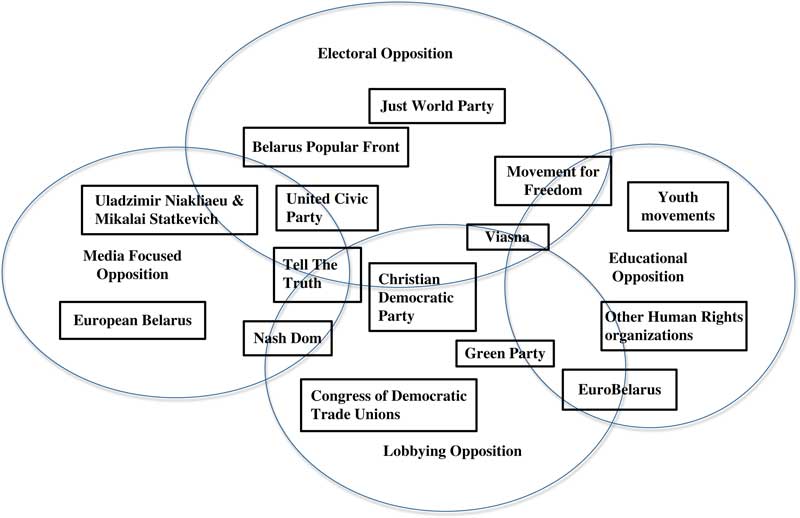
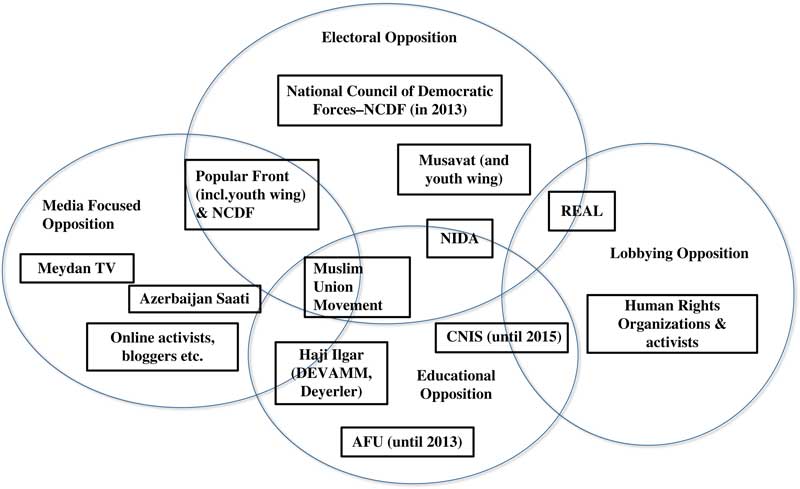
It is obvious that some of the above categories overlap and it is rare that an actor limits itself to one particular strategy (see Figures 1 and 2).Footnote 50 Certainly parties and movements also change, adapt and evolve over time, depending on those involved and government impositions. In election years, for instance, most opposition structures would unsurprisingly tend towards the electoral model. It should be noted that in both the countries under review the leading opposition groups could fit in almost all categories. The aim of the suggested typology is neither to strictly confine any of the actors to a predetermined model nor to claim that we have provided a complete and permanent overview of all the existing actors. Nonetheless we believe that classifying the major opposition actors operating during the years of our study according to the one or two major strategic orientations of their activities is a useful exercise that can give a sense of the character and role of opposition activities and actors in these countries and highlight the dominant feature of the opposition’s resistance processes.
Belarus: Opposition Resistance Models

Azerbaijan: Opposition Resistance Models
CONCLUDING DISCUSSION
In this article we have tried to examine ‘opposition’ in authoritarian contexts by looking at two post-Soviet states – Azerbaijan and Belarus. We have argued that, although our findings will not produce universally applicable knowledge, there are enough interesting similarities between these two contexts to make some of our observations relevant for the study of hegemonic electoral authoritarian regimes in general, and the role of opposition in such contexts in particular. Schedler’s research (for example 2006, 2009, 2013) on this type of regime, as well as others – for example, Lisa Anderson’s account (Reference Anderson1987) of the relations between state and opposition in the Middle East – show that ‘opposition ghettos’, such as the ones we have identified in this article, exist beyond the post-Soviet space. In a conscious attempt not to analyse the ‘success’ or ‘failure’ of opposition strategies, we identified four main ‘resistance models’ (electoral, media-focused, lobbying and educational) used by opposition actors that highlight specific, and strikingly similar, roles of ‘opposition’ in our two cases.
Taken to its extreme, our study asks whether it is relevant to use this concept at all under these circumstances, as ‘opposition’ in these states is either considered a pejorative term or seen as an abstract collective expected to overthrow an undemocratic regime. Both these understandings seem to be a far cry from conventional perceptions of ‘opposition’ as an inseparable part of a political system. Perhaps even more importantly, a consequence of the authoritarian regimes in these states having full control over political and ideological spaces, forcing the opposition actors into what we call a ghetto, is that much of the discussion about ‘the bigger picture’ and the over-arching purpose of the ‘opposition’ has become more or less redundant. Elections, media coverage, collecting signatures and conducting training courses are all useful and important activities for the opposition as they facilitate its mission to question the legitimacy of the authorities and avoid being integrated in the regime, to use Stepan’s terminology (Reference Stepan1997).
A common characteristic of all the ‘models of resistance’ described above is that the main aim of opposition activities is to challenge the authorities’ hegemony in the present time rather than being focused on achieving any (impossible) long-term political goal. Thus, to a certain extent the opposition actors’ work becomes ‘oppositional for the sake of it’, which resonates well with the electoral authoritarian system that needs ‘opposition for the sake of opposition’ in order to legitimize the democratic illusion. By joining the ‘fake’ elections, the opposition’s participation is deemed ‘fake’ as well, which contributes to its negative reputation within society. The result is a situation where all players (both government and opposition) tend to reinforce the existing ghettoization by continuing to move and act within the system.
The various types of resistance discussed above can only to a small degree be considered ‘political’ or have the potential to be translated into real progress in the political arena. We might even say that it is characteristic of the authoritarian context that ghettoized opposition movements are removed from being political actors. Another view could be to see the authoritarian power as having transformed, devalued and ‘reduced’ politics to activities such as media activism, lobbying, collecting signatures or organizing civic training courses. In light of this, an interesting and important task for those interested in the processes of democratization is the issue of how to rehabilitate ‘politics’ – and opposition – in authoritarian states. We suggest that the key question here is how ‘opposition’ can become active in a way that it can operate independently of the government-controlled framework. One interesting example of such a development is in Rosefsky Wickham’s account (Reference Wickham2002) of how – in a situation much resembling our cases, where opposition parties were discredited and marginalized – Islamic movements in Egypt managed to mobilize the previously apolitical educated youth and make them an important opposition force through creating a credible ‘parallel sector’ based on religious ideology. While such a scenario is theoretically, albeit presently not realistically, possible in Azerbaijan, our premonition (which needs further investigation) is that for any opposition to become independent it has to be backed up by a ‘counter-elite’ – a group which neither the ruling authorities nor the population can dismiss – that could convince the government to negotiate new, approved, ‘rules of the game’. In our view, the possible existence, features, development and mobilization of such an ‘alternative elite’ is an important and intriguing matter for further research.
ACKNOWLEDGEMENTS
The research for this article was funded by the Swedish Research Council (grant numbers 2014-05974 and 2014-05970). The authors also acknowledge a travel grant for Belarus generously provided by the Swedish Institute (SI). Further, we would like to thank the two anonymous reviewers for their careful reading of our text and their many insightful remarks and suggestions, as well as everyone else who on various occasions has commented on previous versions of this article. Last but not least we are deeply indebted to all our respondents who kindly and patiently agreed to discuss these issues with us.