INTRODUCTION
Observations such as children's optional use of finite sentences alongside non-finite ones have puzzled researchers for many years. The rise of the Optional Infinitive (OI) hypothesis (or Root Infinitive (RI,) following Rizzi, Reference Rizzi1994) has led to the reanalysis of certain child language data (Harris & Wexler, Reference Harris, Wexler and Clahsen1996; Wexler, Reference Wexler, Lightfoot and Hornstein1994, Reference Wexler and Rice1996, Reference Wexler1998). The argument is that children at some stage between 1 ; 10–2 ; 7 use the infinitival verb form in a root clause, where the target language requires a finite form. However, it has been observed (Harris & Wexler, Reference Harris, Wexler and Clahsen1996: 36, footnote 1; Rice, Wexler & Cleave, Reference Rice, Wexler and Cleave1995) that normal English-speaking children older than 2 ; 7 continue to use the infinitive verb in root clauses. The non-finite forms co-occur with finite ones and disappear early in the course of language acquisition, and are considered as properties of the OI (Rice et al., Reference Rice, Wexler and Cleave1995).
Due to the differences in the proportion of the OI across languages and its appearance for a brief period of time, it is argued that this phenomenon is subject to cross-linguistic variation. The cross-linguistic data show that the OIs have not been reported in all languages, including Italian, Spanish, Tamil, Catalan and Polish (Hoekstra & Hyams, Reference Hoekstra and Hyams1998; Wexler, Reference Wexler1998) or Latvian (Garman, Schelletter & Sinka, Reference Garman, Schelletter and Sinka1997). Comparison of the proportion of the OI in different languages shows the productive rate of the non-finite forms in OI languages such as French, German, etc. (30–70%), Russian (Bar-Shalom & Snyder, Reference Bar-Shalom, Snyder, Lindseth and Franks1997) and Icelandic (Sigurjónsdóttir, Reference Sigurjónsdóttir, Greenhill, Littlefield and Tano1999), while such forms are exceedingly rare (0–10%) in non-OI languages such as Italian, Spanish, etc. Hebrew-speaking children, before the age of two, produce a fairly large number of RIs and older children don't show an extensive use of RIs (Schaeffer & Ben-Shalom, Reference Schaeffer and Ben-Shalom2004). Wexler (Reference Wexler1998) concludes that this typological difference coincides with that of the pro-drop phenomenon. Wexler (p. 56) states that ‘children in a language go through an OI stage if and only if the language is not an INFL-licensed null-subject language’. He argues that Hebrew allows the OI only in the part of the inflectional paradigm which does not license a null subject. In the pro-drop languages, where there is no OI stage, it has been claimed that there is an analogue to the OI: the imperative in Italian (Salustri & Hyams, Reference Salustri, Hyams, Beachley, Brown and Conlin2003) and the bare perfective in Greek (Hyams, Reference Hyams, Kempchinsky and Slabakova2005).
The literature contains several studies on the OI stage across languages, as mentioned above, but Arabic is a language which has received very little attention. As a frame of reference, I outline in this paper some of Omar's (Reference Omar1973) and Abdalla's (Reference Abdalla2002) findings, which are relevant to the current study. Omar (Reference Omar1973) investigated the acquisition of Egyptian Arabic. She found that children's syntactic development from single-word to multiword utterances occurred at about the age of 2 ; 6–3 ; 0, and this seems considerably late in comparison to children speaking English, between 1 ; 6–2 ; 0 (Brown, Reference Brown1973). Omar also found that children used different verbal inflections. In elicited items, although statistical data were not provided, Omar (Reference Omar1973: 140) indicated that not all verbs were morphologically marked with verbal inflections as required in the adult language and that lack of marking appeared to be more frequent than the substitution errors. For example, one child said:
(1)


These examples show that the children deleted the imperfective prefix yi- and used the verbal stems ħibb ‘like’, darab ‘beat’ and sgi ‘water’ instead. In the elicited imitation and in response to the stimulus yi-šrab-u ‘they drink’, for example, children said:
(2)
These children did not leave the three consonantal root verbs CCC šrb unmarked or use the verbal stem šrab. It seems that children did not treat the verbs equally and there seems to be a tendency to not use the ‘unmarked’ stem of certain verbs.
The use of morphosyntactic inflection was investigated in Hijazi Arabic children with specific language impairment (SLI) (4 ; 0–5 ; 3) compared with two control groups, mean length of utterance (MLU)-matched (age 2 ; 0–3 ; 0) and chronological age-matched (Abdalla, Reference Abdalla2002). The results showed that of the percentage of correct use of verb inflections, children with SLI were significantly different from the other control groups. Abdalla points out that substitution with an incorrectly tensed form occurred rarely across the children (4 instances out of 97). The results also showed that the imperative was substituted for tensed target forms. For example, a child said ilmooya šiil, instead of ye-šiil il-mooya ‘(he) carries the water’, by deleting the third person masculine imperfective prefix ye-. Abdalla found that children used imperative verb forms, whether the masculine imperative or feminine imperative or plural imperative. This type of behavior was found with a different root verb, such as the three consonantal root CCC ktb, and klm, which is partially inconsistent with Omar's (Reference Omar1973) study. Abdalla (Reference Abdalla2002: 89) found that children used imperative verb forms in both past and present tense contexts. For example, a child said walad rooħ for walad raaħ ‘the boy went’. That is, the child used the masculine imperative rooħ ‘go’ for the third person masculine perfective verb form raaħ ‘went’.
The current acquisitional study was prompted by the variation across languages in light of the OI phenomenon. We would like to explore this phenomenon in Arabic, a typologically distinct language which is particularly interesting for the study of the OI because it is a pro-drop language and the verbal inflection is relatively rich. The study contributes empirical child data from Kuwaiti Arabic (KA), which has not been studied before. The present study explores how Kuwaiti children implement the verb inflections and whether they treat the verbs equally in light of the observations reported in Omar (Reference Omar1973) and Abdalla (Reference Abdalla2002). Further, if we assume that Wexler's (Reference Wexler1998) generalization is correct, then we predict that Kuwaiti children pattern with children acquiring Italian and produce less non-finite verb forms than children acquiring German, for example.
This paper is organized as follows. The following section will introduce KA verbal paradigms and the implications of the language properties on children's use of these inflections, followed by the method. The results are discussed next, with the focus being particularly on the correct use of the verb inflections and the substitution errors. The last part of the results focuses on the omission of the verb inflections as required in the adult language and explains this behavior and its implications for the theory of OI and Arabic morphology. The paper concludes by addressing the importance of the Arabic data to our understanding of the theory of OI.
DESCRIPTION OF KUWAITI ARABIC
We focus in this description on KA to show the implications of the properties of KA on the process of language development. The characteristic feature of Semitic languages is their basis of consonantal roots (CCC), which mostly consist of three consonants (triconsonantal) (Beeston, Reference Beeston1970) that carry the primary lexical meaning. The triconsonantal root is the most common type in the language (Erwin, Reference Erwin1963). Erwin categorizes triconsonantal roots into two types. The first type is the ‘strong’ root (CCC) which includes ‘sound’ roots (second and third root consonants are not identical, e.g. ktb ‘write’, and ‘double’ roots (second and third root consonants are identical, e.g. skk ‘close’). The second type is the ‘weak’ root, where one or more root element is unstable with either ?, w or y in initial (VCC) or middle (CVC) or final (CCV) position, e.g. /kl ‘eat’, nVm ‘sleep’ and swV ‘do’ (using V to stand for the weak root element).
Fundamentally, the imperfective and perfective are the two verb forms in the language distinguished by their inflectional patterns (Benmamoun, Reference Benmamoun2000: 24). In all the varieties of Arabic there is no form such as the infinitive in English (Bulos, Reference Bulos1965). Every verb form includes the stem (consonantal root and vocalic pattern) and affixes, which occur in three forms: as suffixes, prefixes or both. For example, the vocalic pattern a-a, which denotes a past time reading, is infixed into the consonantal root pattern such as k-t-b which has the underlying meaning ‘write’ (Erwin, Reference Erwin1963); Erickson (Reference Erickson, Rauch and Scott1967) considers the first vowel likely to be a cluster-breaker in the perfective stem. Bakalla (Reference Bakalla1979), Erickson (Reference Erickson, Rauch and Scott1967), Ouhalla (Reference Ouhalla1993) and Mohammad & Ouhalla (Reference Mohammad, Ouhalla and Eid1995) suggest that the vowel in the verb stem stands for aspect (perfective and imperfective). Most importantly, there is no general rule which allows a prediction of the stem vowel patterns; therefore, speakers have to learn them individually (Holes, Reference Holes1986; MECAS, 1965).
Like other inflectional languages, Arabic is a pro-drop language that permits both finite null-subject and inverted subject–verb declarative sentences, such as the following examples from KA:
Subject–verb ohwa ye-rooħ il-beet
‘he goes home’
Null subject ye-rooħ il-beet
‘he goes home’
Verb–subject inversion ye-rooħ ohwa il-beet
‘he goes home’
The imperfective
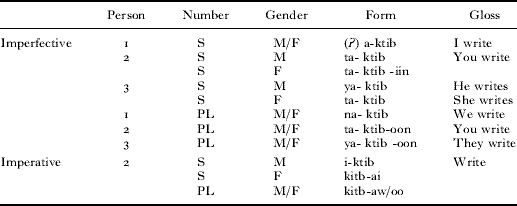
The inflectional imperfective paradigm is realized by either prefixes or a combination of a prefix and a suffix. Table 1 presents the imperfective and imperative paradigms in KA. It is clear that the verb stem is ktib, to which the imperfective inflections are affixed as in a-ktib, ta-ktib, ya-ktib-oon, etc.
Imperfective and imperative paradigms in KA of the verb root (k-t-b)
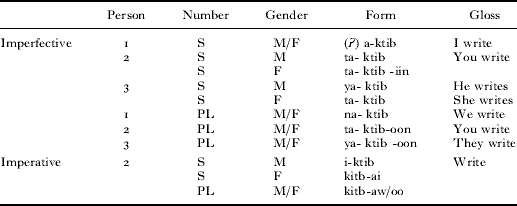
S=Singular; PL=Plural; M=masculine; F=feminine.
Person, number and gender are encoded by a single morpheme and they are not segmentable except in the imperfective second person feminine, the second person plural and the third person plural inflections, where the grammatical features are marked by both prefix and suffix. Benmamoun (Reference Benmamoun2000) argues that person is realized in these discontinuous morphemes by the prefix, while the suffix marks gender in the second person feminine and number in the second and third person plural inflections.
The imperative
Different paradigms are used in positive imperatives and negative imperatives. The former is simple and it is not marked for tense due to the fact that ‘the required action is always in the future’ (Palmer Reference Palmer1986: 108), as presented in Table 1. In the latter the imperfective verb form, as described in Table 1, is preceded by the negative particle la (/) ‘no’.
There are two important features of the KA imperative that need to be highlighted. First, a prefix /i-/ is introduced to make the syllabic pattern acceptable by breaking the initial cluster in the strong root (CCC), thus, ktb ‘write’ will become i-ktib, kitb-ai, kitb-aw, and some weak final (CCV) root structures, e.g. mšV ‘walk’, have the imperative forms i-mš, i-mš-ai and i-mš-aw. However, in the weak middle verb of the root CVC, a prefix vowel is not required, as in rVħ ‘go’ rooħ, rooħ-ai and rooħ-aw (masculine, feminine and plural, respectively).
Second, the imperative forms in KA for root verbs such as swV ‘do’ and slV ‘pray’, are saw, saw-ai/sawi and saw-aw, and sal, sal-ai/sali and sal-aw for the masculine, feminine and plural respectively. However, in Modern Standard Arabic (MSA), the masculine imperative is sawwi and salli, where the root structure is maintained. Apparently, Kuwaiti speakers of Arabic delete the final vowel, which is part of the root structure, in order to mark a distinction between the masculine and feminine imperative forms.
The perfective
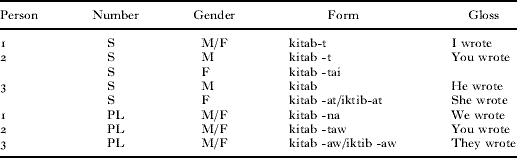
Turning now to the perfective verb form, Table 2 illustrates the inflectional paradigm in KA. Table 2 reveals the suffixal nature of the paradigm. The first person singular and second person masculine are homonymous, so an overt subject or covert subject in appropriate contexts determines their inflectional properties.Footnote 1
Perfective paradigm in KA verb root (k-t-b)
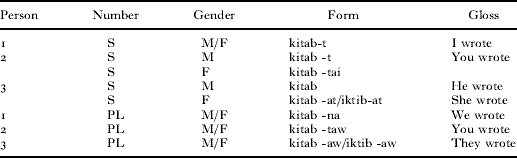
S=Singular; PL=Plural; M=masculine; F=feminine.
Another point that needs to be mentioned is the fact that the KA third person masculine perfective (Table 2) has no specific grammatical inflection (it may be possible to say that it has a zero morpheme). Thus, the third person masculine verb form in KA is an unmarked form. It is obvious that the stem is kitab, to which the grammatical inflections affix, as in kitab-t ‘I wrote’.
Before bringing the discussion on the verbal forms to a close, we turn to two other issues that arise in this context: the distribution of both imperfective and perfective verb forms, and whether a default form exists in the language.
As for the perfective verb form, it is restricted to past tense contexts, as in the following examples of KA. This has been the case in MSA (Benmamoun, Reference Benmamoun1999) but the same fact obtains in KA.
(3) kitab-twrite-past-2M ‘You wrote’
The imperfective, as opposed to the perfective, does not invariably have a present tense reading. The imperfective can be found in a wide variety of contexts.
(4) In the context of present tense reading with no modal particles or auxiliaries: ya- dris 3MIMP-study ‘He studies/is studying’
(5) In the context of the future: raaħ ya- dris go 3MIMP-study ‘He will study’
(6) In an embedded non-finite clause: ħaawal (?an-ah) y- inħaaš try(per) (to-Pro3m) 3MIMP- escape ‘He has tried to escape’
The assumption that the perfective always appears in a past tense context comes from the fact that it carries a past tense feature. On the other hand, the imperfective does not carry any temporal feature, which accounts for the wide distribution of that form: in the present tense (4); in the future tense where the temporal or modal feature is realized by the particle raaħ (5); and in non-finite clauses after the particle /an ‘to’ (6). These examples show that the imperfective does not carry any temporal or aspectual information and it is difficult to come up with a temporal or aspectual feature to account for the various distribution of this verb form (Benmamoun, Reference Benmamoun1999, Reference Benmamoun2000). Benmamoun (Reference Benmamoun1999) provides additional evidence from the syntax of idiomatic expressions and copular constructions to support the argument that the so-called imperfective has a default status in Arabic.
Due to the absence of a distinct infinitival form in Arabic and the fact that roots in the language cannot stand alone, the prediction is that children acquiring Arabic would select a default form in place of fully inflected one. This could mean that children would use the imperfective bare verb as a default form, according to Benmamoun's (Reference Benmamoun1999) argument. Following Benmamoun's analysis, in this paper the imperfective will be treated as a non-finite verb form. In the following, we will try to address these issues. It should be noted that there is a debate within Arabic and Semitic linguistics in general with regard to whether the system should be characterized as an aspect or tense system. For the present purposes, the exact characterization is not critical. What matters is the fact that completive aspect, the perfective, correlates with events that precede the moment of speech, while the imperfective correlates with the moment of speech or events that are subsequent to the moment of speech, particularly when they are accompanied by future modality particles.
METHOD
Subjects
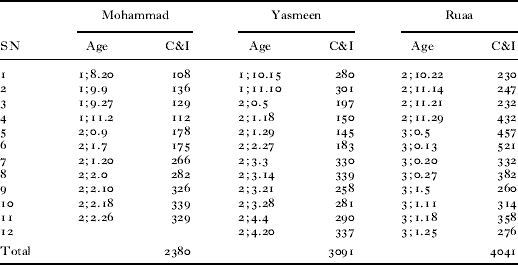
Three subjects, two girls (Yasmeen and Ruaa) and one boy (Mohammad), were recorded for a period of six months. Mohammad and Yasmeen were recorded at home where their mothers were present most of the time during the recording sessions. Ruaa, on the other hand, was recorded all the time at a nursery school and occasionally she was joined by another classmate. Table 3 presents the profile of the three subjects, the average of the MLU and the complete and intelligible utterances (C&I).
Participants characteristics

M=male; F=female.
Coding
The investigator used the SALT (Systematic Analysis of Language Transcripts) program developed by Miller & Chapman (Reference Miller and Chapman1993), which provides frequencies and general measures such as MLU. The database includes all C&I utterances. An utterance was omitted from the final account if it was an imitation of a previous adult utterance, if it was an exact repetition of the child's own previous utterance, or if it was not fully intelligible or complete. The entire sessions were read and then the obligatory contexts were coded as follows: correct use of verbal inflection, incorrect use or substitution and the omission of a verbal morpheme. In order to credit the child with correct use of any verbal inflection, the marking had to be appropriate according to the context, and whether the subject was overtly realized, as well as prosodic clues such as stress and intonation. If the utterance was clear but neither the linguistic nor non-linguistic information resolved the issue as to whether the form was correct or not, the structure was coded as not clear (NC), without giving it a specific description, and was excluded from the analysis. Table 4 shows the child's chronological age at each recording session and the C&I utterance totals for each child during the data collection period.
The longitudinal data used in the study
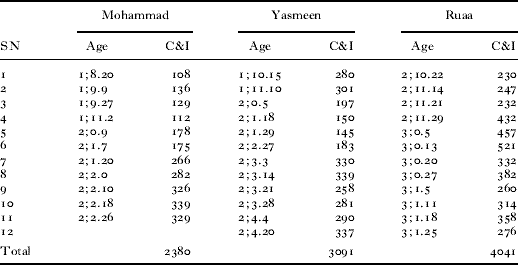
SN=session number; C&I=complete and intelligible.
RESULTS AND DISCUSSION
Analysis of tense was restricted to the present and past tense obligatory contexts since the future forms rarely emerged during the study period of the three children. All errors are agreement errors, and we did not find any aspect errors. That is, the children did not use imperfective verb inflection instead of the perfective one or vice versa.
Quantitative data: correct marking vs. agreement errors
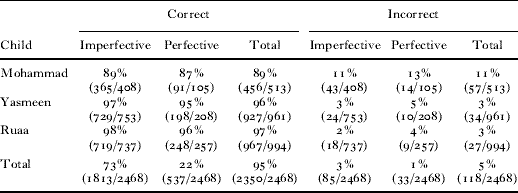
Table 5 shows the frequency of imperfective and perfective verb inflection and the number of obligatory contexts. That is, the number of finite forms whether correct or incorrect analyzed for Mohammad, Yasmeen and Ruaa.
Frequency of the finite forms across the three children
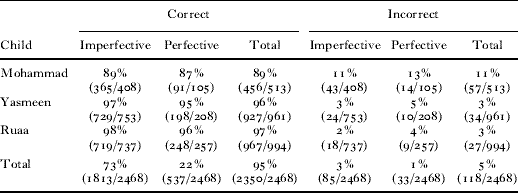
Since the data were spontaneous, frequency of occurrences for the imperfective versus perfective forms varied. That is, there was a greater number of present than past contexts. The proportion of imperfective forms is high (73%), as compared to the perfective verb forms (22%).
Typical examples with correct implementation of both imperfective and perfective verbal inflections are provided in (7a–d).
(7)
The resulting counts of the correct marking as compared to agreement errors are also given in Table 5, which shows that the verbal inflections appeared correct during the study period across the three children, 89–97% of the time. That is, the three children marked syntactic gender where they use the feminine for feminine subjects and the masculine for masculine ones. Agreement errors occurred about 3–11% of the time.
Table 5 shows a slight difference in the percentage of agreement errors in the imperfective verbal inflections (ranged between 2–11%) over the perfective ones (ranged between 4–13%) across the three children. The same small difference, in the same direction, is found in each of the three children.
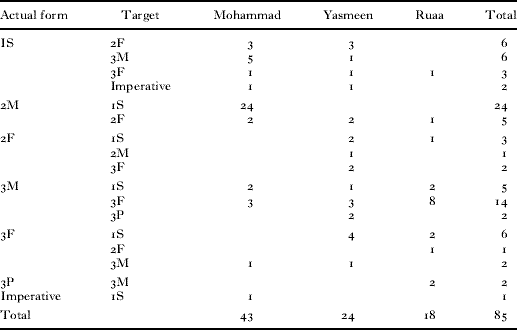
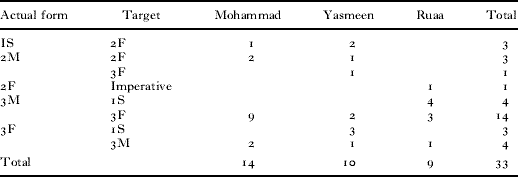
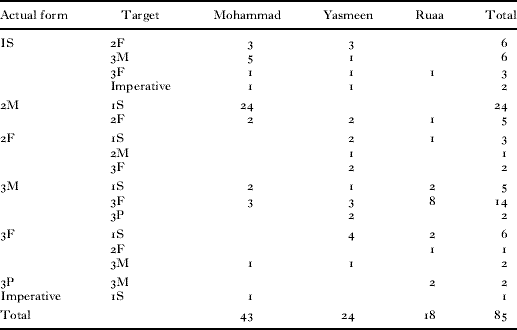
A breakdown of the agreement errors that occurred in the data of the three children appears in Tables 6 and 7. Actual data is provided in the Appendix.
The imperfective substitution errors of the three children
The perfective substitution errors of the three children
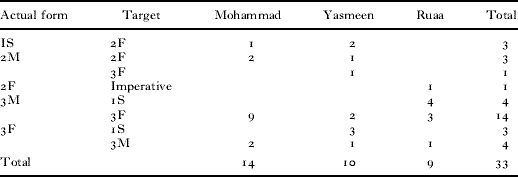
A closer inspection of Tables 6 and 7 reveals the following points. First, more masculine forms were substituted for feminine forms (19 and 17 errors) than feminine for masculine (3 and 4 errors) in the imperfective and perfective forms respectively. Studies of Hijazi Arabic-speaking children (Abdalla, Reference Abdalla2002) and Hebrew-speaking children (Berman, Reference Berman and Slobin1985; Levy, Reference Levy1983) show preference of the less marked, more neutral, masculine form over the feminine counterpart, which is a strongly and consistently marked gender.
Second, children's responses appear to have been influenced by the adult speech which was directed to them. Table 6 shows that the three children used second person singular depending on the child's gender instead of the first person singular. That is, Ruaa and Yasmeen used the second person feminine instead of the first person singular (in three instances), and in twenty-four instances Mohammad used the second person masculine imperfective prefix instead of the first person singular imperfective one, as in example (8). This seems similar to the attested pattern of pronoun reversal (Chiat, Reference Chiat, Fletcher and Garman1986) in English, though it should be noted that English, unlike Arabic is, a non-pro-drop language.
In other contexts, Mohammad, Yasmeen and Ruaa, once each, used either the first person singular imperfective form or the second person feminine perfective in place of the feminine imperative. This is exemplified in (9).
(8)
(9)
Third, Table 7 shows that the perfective errors are mainly gender errors, and the children usually used the third person masculine, which has the least or zero morpheme instead of the other perfective verb forms. This is illustrated in (10):
(10)
Last, the three children did not use imperfective verb form for the perfective counterpart throughout the study period.
Omission
Although the three children correctly inflected the verb in both present and past tense contexts, the results show that they occasionally used inappropriate forms in describing ongoing action. It appears that they used a non-finite form in place of an inflected one as required in the adult language.
The following examples focus on the use of non-finite forms in contexts where the child described her/his own, ongoing action. Judging from the contexts of the utterances, and in terms of their meaning, the non-finite forms appearing in the data correspond to the declarative. For example:
(11)
In session 7, Yasmeen wants to build the interlocutor a house out of blocks, and asks her:
(12)
However, in another context in the same session, exemplified in (12b), she used the finite form of the same verb. This shows that non-finite forms appeared alongside finite ones in the same stage of the child's language development.
(12)
On one isolated occasion, Mohammad used a form which is similar to the imperative instead of the imperfective verb forms. The context for (13) was that Mohammad was asked whether he wanted to drink juice or not. The child used a masculine imperative verb form after the modal verb abi ‘want’, where adult Kuwaiti Arabic would require the imperfective verb form.
(13)
In example (13), i-šrab is an imperative form for ‘drink’, where finite imperfective forms are required in these contexts, as in a-šrab ‘I drink’.
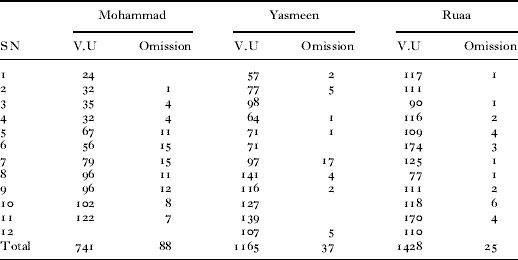
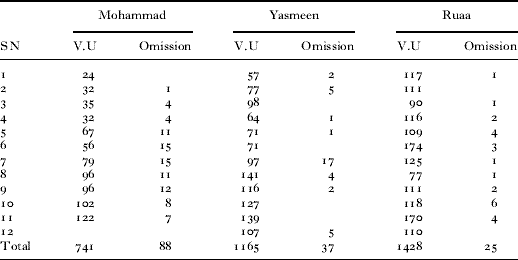
The proportion of the non-finite forms was variable, depending upon the child's age, yet they were consistently found in the corpora of the three children. That is, the eldest subject, Ruaa's, use of non-finite forms is somewhat less frequent than the other two children's, and the incidence of such forms occurred even when she was at the age of 3 ; 1 at the end of the study period. The inference could be made that this type of behavior becomes less frequent as the children get older. The percentage of the non-finite forms is calculated by dividing the number of these forms by the number of finite verb forms uttered, whether correct or incorrect (including imperatives). Table 8 shows the low proportion of the non-finite forms (2–12%) which occurred across the three children.
The proportion of non-finite forms in the three children's data

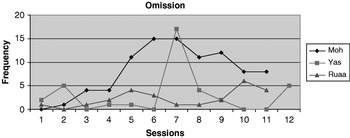
Table 9 shows the frequency of the non-finite forms throughout the study period across the three children. It is clear that the non-finite forms used to describe ongoing action appeared throughout the six months, and this behavior fluctuated in Mohammad's and Yasmeen's corpora, while it appeared relatively low in Ruaa's data.
Frequency of the non-finite forms during the sample period
SN=session number; V.U.=verbal utterances.
As can be seen in Figure 1, Mohammad's use of non-finite forms is considerably higher than that of the two girls. The frequency of non-finite forms reaches its peak in sessions 6–7 and in session 7 in Mohammad's (age 2 ; 1.20) and Yasmeen's (age 2 ; 3) corpora, respectively, and then declines dramatically in Yasmeen's corpus.
The frequency of non-finite form throughout the study period.

In sum, although the verbal inflections increased in frequency and accuracy with age, marked forms co-occurred with some unmarked forms in both present and past tense contexts during the data collection period. The frequency of the unmarked forms was variable depending upon the child's age. As shown from the above examples, Kuwaiti children used the non-finite forms in all environments. The non-finite forms the children used to describe ongoing action are identical to both the imperative (masculine or feminine) and the verb stems.
In Sano's (Reference Sano, Agbayani and Tang1997) analysis comparing languages with or without RI, he found that there is a morphological difference. In RI languages the bare verbal root is a well-formed finite form, as it is as in the Dutch language. On the other hand, in the non-RI languages, the bare verbal root is not a well-formed finite form, as in Italian. Therefore, the cross-linguistic variation of RIs in early child language might stem from the morphological properties of the languages.
This is exemplified in the following paradigm (*: not well-formed word), (Sano Reference Sano, Agbayani and Tang1997: 465):
Dutch ‘work’
Infinitive=werk-en, root=werk-, imperative=werk
Present (from left: 1s, 2,3s, 1,2,3pl)
werk, werk-t, werk-en
Past (from left: 1,2,3s, 1,2,3pl)
werk-te, weke-ten
Italian ‘live’
Infinitive=abit-are, root=*abit-, imperative=abit-a/i
Present (from left: 1,2,3s, 1,2,3pl)
abit-o, abit-i, abit-a, abit-iamo, abit-ate, abit-ano
To answer the question of whether the verbal root is a well-formed finite form in KA, we present the paradigms of different verb types (C=consonant; V=vowel):
Class 1: KA verb root CCC ktb ‘write’
Infinitive=ø, root=*ktib, imperative=i-ktib/kitb-ai/kitb-aw (m,f,pl)
Imperfective (from left; 1s,2m,2f,3m,3f, 1,2,3pl)
a-ktib, ta-ktib, ta-ktib-iin, ya- ktib, ta- ktib, na- ktib, ta- ktib -oon, ya- ktib -oon
Class 2: KA verb root CCC sfr ‘travel’
Infinitive=ø, root=safir, imperative=safir/safr-ai/safr-aw (m,f,pl)
Imperfective (from left; 1s,2m,2f,3m,3f, 1,2,3pl)
a-safir, te- safir, te- safr-iin, ye-safir, te-safir, en-safir, te-safr-oon, ye- safr-oon
Class 3: KA verb root CCV bcčV ‘cry’
Infinitive=ø, root=*bči, imperative=i-bči/i-bč -ai/i-bč -aw
Imperfective (from left; 1s,2m,2f,3m,3f, 1,2,3pl)
a- bči, ta- bči, ta- bči -iin, ya- bči, ta- bči, na- bči, ta- bč-oon, ya- bč-oon
Class 4: KA verb root CCV swV ‘do’
Infinitive=ø, root=sawi, imperative=saw/sawi or saw-ai/saw-aw (m,f,pl)
Imperfective (from left; 1s,2m,2f,3m,3f, 1,2,3pl)
a-sawi, te-sawi, te-saw-iin, ye-sawi, te-sawi, en-sawi, te-saw-oon, ye-saw-oon
Class 5: KA verb root CVC nVm ‘sleep’
Infinitive=ø, root=naam, imperative=naam/naam-ai/naam-aw (m,f,pl)
Imperfective (from left; 1s,2m,2f,3m,3f, 1,2,3pl)
a-naam, ta- naam, ta- naam -iin, ye- naam, te- naam, en- naam, te- naam -oon, ye- naam –oon
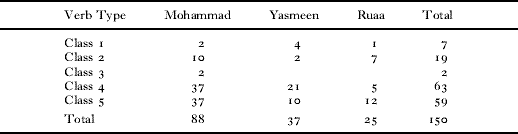
Looking at the paradigm of the five verb classes, the verb stems are invariably morphologically marked. It is clear that the verbal root forms of the Class 1 and Class 3 verbs such as ktib ‘write’ and bči ‘cry’, respectively, are not permissible forms. Most importantly, the imperative paradigm shows that the masculine imperative of the Class 2 and Class 5 verbs such as safir and naam, respectively, and the feminine form Class 4 verb such as sawi, are homophonous with their imperfective bare stem verbal form. For the majority of verbs, the imperative form is identical to the bare stem. Bare verbs are ungrammatical in Classes1 and 3, but permissible in Classes 2, 4 and 5.
The data from the current study show that the three children used verbal inflection with verbs of Classes 1 and 3, but produce significant non-finite forms in Classes 2, 4 and 5. It seems that they used imperfective verbal bare stems if they are permissible words in the adult language, such as safir, sawi and naam. However, if they are not a permissible form such as ktib, and bči, they always morphologically marked the verb, even inappropriately. That is, children would say *sawi lič instead of a-sawi lič ‘I do/make’ (as in example 12a). On the other hand, they did not say *oha ktib for oha ye-ktib ‘he writes’, instead they said *oha a-ktib, where they substituted the first person imperfective prefix a- for the third person imperfective prefix ye-. If the imperative is taken as the default form, then we would expect them to say something like ohwa saw instead of ohwa ye-sawi ‘he does’ and ohwa i-ktib instead of ohwa ya-ktib ‘he writes’. In the former, saw is the masculine imperative and it is not identical to the verb stem, whereas sawi is identical to the feminine imperative and verb stem. The data show that children used sawi rather than saw. However, for the latter verb, where i-ktib is the imperative and ktib is the bare stem, one instance occurred in the data, as shown in example (13) above, where Mohammad used the imperative verb, therefore we cannot conclude, based on one occurrence, that the imperative is the default form in KA. Further evidence to the contrary is obviously necessary. Therefore, it is plausible to say that children used the verb stems, which are non-finite forms, as a default form to describe ongoing action.
Table 10 shows that the three children use non-finite forms of Class 2, 4, and 5 verbs significantly more (19, 63 and 59 times, respectively) than Class 1 and 3 verbs (7 times and twice, respectively). However, it is important to indicate that even when these children used the non-finite form of Class 1 and 3 verbs, they did not use the impermissible form. For example, Yasmeen said teħha instead of ye-ftaħ-ha ‘it opens’, and the verbal bare stem is ftaħ. It appears that Yasmeen changed the verb root and avoided using the non-finite form, as it is not permissible in the language. Mohammad also said kib instead of ?a-ktib ‘I write’. Therefore, he reduced the verb stem ktib to kib, as it is an impermissible form.
Frequency of bare verb across the three children
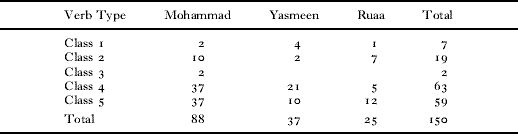
In line with Benmamoun's (Reference Benmamoun1999) proposal that the imperfective bare verb is the default form that is resorted to whenever the verb does not carry tense, the data in the current study strongly support that. As predicted, children acquiring KA select a default form, which is the non-finite form (imperfective verb stem), in place of a fully inflected one.
CONCLUSION
In spite of the complexity of the Arabic verb morphology that the children were attempting to use during the six months of observation, and the fusional property of the grammatical inflections whereby tense, number, person and gender features are conflated into a single infix, which is likely to cause difficulty for the child as suggested by Peters (Reference Peters, Fletcher and MacWhinney1995) and Slobin (Reference Slobin, Ferguson and Slobin1973), our data reveal the early appearance of the verbal inflections. This strongly suggests that children have no problem in identifying morpheme boundaries where grammatical inflections are used with word stems from quite an early age, which suggests that both the stem forms and their inflections are evidently psychologically real units (Slobin, Reference Slobin, Smith and Miller1966, Reference Slobin, Ferguson and Slobin1973).
The results show that the three children started using predominantly and productively diverse imperfective and perfective verb forms quite early most of the time (89–97%). The substitution errors were low in their speech production (3–11% of the time), which is consistent with what is found in other non-OI languages (see Hoekstra & Hyams (Reference Hoekstra and Hyams1998) for a survey of the literature of OI and non-OI languages).
Our research shows that the three children occasionally, in only a small percentage of their matrix sentences (2–12%), employed non-finite forms to describe an ongoing action. The three children clearly demonstrated that the OI is not productive at all in Kuwaiti Arabic child language and the low proportion of the non-finite forms is consistent with the results from other non-OI languages. It seems that KA is a non-OI language, which supports Wexler's (Reference Wexler1998) prediction that OI appears only in non-null-subject languages. Though we cannot conclude when the RI stage ends, based on our data, it is important to examine the language of older children to test the frequency of non-finite forms and when these forms disappear.
Based on the properties of Arabic, the absence of a distinct infinitival form, and the fact that roots in the language cannot stand alone, as predicted, children acquiring Arabic select a default form in place of fully inflected forms. The current study shows that children used the imperfective bare verb form as a non-finite form. This supports Benmamoun's (Reference Benmamoun1999, Reference Benmamoun2000) argument that the imperfective verb is the default form of the language. Further, the fact that the non-finite form is non-tensed makes this type of behavior consistent with the OI (Harris & Wexler, Reference Wexler and Rice1996; Wexler, Reference Wexler, Lightfoot and Hornstein1994, Reference Wexler and Rice1996, Reference Wexler1998).
The results, in part, confirm what was found for Egyptian Arabic (Omar, Reference Omar1973) and extend the finding that Kuwaiti children avoid unmarking certain verb roots when the unmarked form is not permitted in their language, as reported above. It shows that although children's grammar diverges from adult grammar, they do observe the language constraints. Besides, the data cannot be interpreted as lack of knowledge of the language and of the verb morphology; children observe the distinctions of the verb types. In terms of the Stem Parameter (Hyams, Reference Hyams1986), it seems that Kuwaiti children set the parameter at an early age, and therefore they do not use verbal bare stems such as ktib since they are not permissible forms in the adult language. It strongly suggests that the Stem Parameter is set and operative at an early stage.
On the other hand, the use of the imperfective verb form as a non-finite form in this study disagrees with what is found in Russian (Bar-Shalom & Snyder, Reference Bar-Shalom and Snyder2001) and Saudi Arabic (Abdalla, Reference Abdalla2002), where the imperative form is used to describe ongoing action.
The analysis of KA, in the present study, and Russian (Bar-Shalom & Snyder, Reference Bar-Shalom and Snyder2001) and Saudi Arabic (Abdalla Reference Abdalla2002) strongly suggest that the OI phenomena is specific to the use of infinitives, and needs to be distinguished from the optional use of other forms such as imperatives, as suggested by Bar-Shalom & Snyder (Reference Bar-Shalom and Snyder2001) or verbal stems. It also shows the role of the imperfective verb form in the language. The results enhance the significance of the empirical analysis of child language not only to test theories of language acquisition but also the properties of the language itself.
APPENDIX: ACTUAL DATA FROM KA CHILD LANGUAGE
(1)
(2)
(3)