Introduction
In the United States, cover crop acreage has substantially increased over the last few years due to the intent of growers to capitalize on federal conservation payments and incorporate sustainable practices into agricultural systems (SARE 2015). Various reports have been published about benefits of cover crops in diverse areas of agriculture (Hartwig and Ammon Reference Hartwig and Ammon2002). The weed suppression provided by cover crops has been widely researched as a means to decrease selection pressure placed on herbicides for weed control (Creamer et al. Reference Creamer, Bennett, Stinner, Cardina and Regnier1996; Teasdale Reference Teasdale1996). The evolution and spread of glyphosate-resistant Palmer amaranth (Amaranthus palmeri S. Wats.) and the recent confirmation of protoporphyrinogen oxidase–resistant Palmer amaranth in the Midsouth threatens the ability of growers to manage weeds by using currently available herbicide technologies (Culpepper et al. Reference Culpepper, Whitaker, MacRae and York2008; Salas et al. Reference Salas, Burgos, Tranel, Singh, Glasgow, Scott and Nichols2016). Hence, successful weed management strategies must rely heavily on integrated management approaches using cultural, mechanical, and chemical methods of control (Jha and Norsworthy Reference Jha and Norsworthy2009; Price et al. Reference Price, Balkcom, Culpepper, Kelton, Nichols and Schomberg2011). Despite all the known benefits, widespread adoption of cover crops still remains limited due to potential cost and management requirements.
Termination of the cover crop is a critical component of management, because a poorly controlled cover crop can become a weed and lessen the yield potential of the current cash crop (Nascente et al. Reference Nascente, Crusciol, Cobucci and Velini2013). In no-till production systems, cover crop termination is commonly achieved by herbicides, but mechanical methods can also be used. Mowing can be used to control cover crops without soil disturbance, but problems such as cover crop regrowth and uneven residue distribution often arise with this method (Creamer and Dabney Reference Creamer and Dabney2002). A roller-crimper is another option for cover crop termination in a no-till system. This implement crushes the cover crop to form a flat, uniform layer of residue over the soil surface (Ashford and Reeves Reference Ashford and Reeves2003; Kornecki et al. Reference Kornecki, Price and Raper2006); however, termination of cover crops with a roller is not effective unless the cover crop has entered reproductive development (Creamer and Dabney Reference Creamer and Dabney2002). Furthermore, this technique may be difficult in the Midsouth, because most agronomic crops are grown in raised beds.
Chemical termination of cover crop has been achieved by application of herbicides several weeks before planting. The efficacy of preplant herbicides on cover crops is likely to differ depending on the cover crop species planted (Cornelius and Bradley Reference Cornelius and Bradley2017). White and Worsham (Reference White and Worsham1990) reported that application of glyphosate alone at 1.7 kg ae ha−1 controlled hairy vetch and crimson clover 65% and 70%, respectively, but the addition of 2,4-D increased hairy vetch control to 99% and crimson clover to 82%.
In soybean [Glycine max (L.) Merr.], Reddy (Reference Reddy2001) observed that inadequate desiccation of Italian ryegrass [Lolium perene L. ssp. multiflorum (Lam.) Husnot] resulted in a yield reduction of 29% compared with plots without any cover crop. Price et al. (Reference Price, Arriaga, Raper, Balkcom, Kornecki and Reeves2009) also showed that inadequate termination of wheat, cereal rye, and black oats (Avena strigosa Schreb.) can significantly decrease seed cotton (Gossypium hirsutum L.) yield. White and Worsham (Reference White and Worsham1990) reported that 65% control of crimson clover reduced corn (Zea mays L.) yield by 38% compared with conventional tillage. Seed germination and early seedling development can also be affected by a poorly controlled cover crop because of continued uptake of water from the soil, which depletes moisture available to crops at time of germination and seedling development (Price et al. Reference Price, Arriaga, Raper, Balkcom, Kornecki and Reeves2009).
Another problem, commonly known as “hair pinning,” has been linked to poorly controlled cover crops. In this case, cover crop residue is pushed into the soil by the disk openers or coulter, creating a condition in which the seed does not have appropriate soil coverage. As a result, stand loss can occur and may have a negative impact on yield (Kornecki et al. Reference Kornecki, Price and Raper2006). To avoid such problems, it is recommended that herbicides be applied 2 to 3 wk before row-crop planting to allow sufficient time for cover crop desiccation (Clark Reference Clark2008). In case of inadequate cover crop control, paraquat can be applied immediately before planting to improve control (Bruce and Kells Reference Bruce and Kells1990). With a recent increase in cover crop use in the United States, information about herbicide efficacy for controlling cover crops is needed. Hence, a field study was conducted to determinate appropriate herbicide options for satisfactory cover crop control.
Materials and Methods
A field study was conducted in 2014 through 2016 at the University of Arkansas Agricultural Research and Extension Center in Fayetteville on a Captina silt loam soil (Fine-silty, siliceous, active, mesic Typic Fragiudults) with 33% sand, 49% silt, 18% clay, pH of 6.0, and 1.0% organic matter. Treatments were arranged in a randomized complete block design with a strip plot. The cover crop served as the strip plot, with herbicide treatments as the main plot. Four replications were used with plot sizes of 1.9 by 11.4 m. Cover crops were planted on September 9, 2014, and September 19, 2015. Cover crops were sown after harvest of a corn crop. Before cover crop was sown, the field was lightly tilled with a disk. Cover crops were broadcast in strips of 1.9 by 90 m followed by one more tillage operation to provide adequate soil coverage of the cover crop seeds. Monthly rainfall data for the period of this experiment are presented in Table 1.
Monthly rainfall data for 2014–2015 and 2015–2016.

a Experiments were conducted under dryland conditions.
b Cover crop planting date: September 9, 2014.
c Cover crop planting date: September 19, 2015.
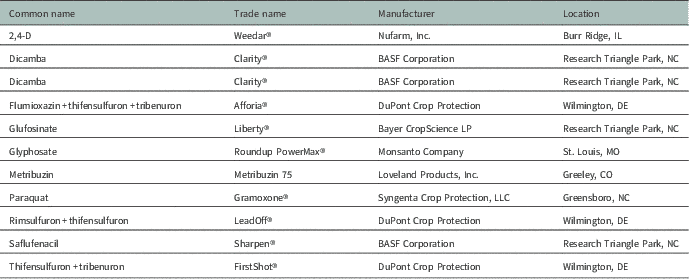
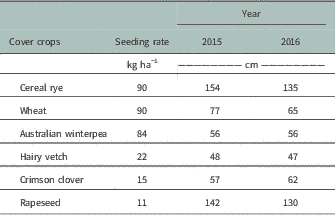
Treatments were composed of herbicides used alone or in mixtures, typical preplant options in Arkansas (Table 2). Herbicides were applied at 143 L ha−1 using a three-nozzle CO2-pressurized backpack sprayer on April 12, 2015, and April 14, 2016. Cover crop species, seeding rates, and the average height of each cover crop for both years at time of herbicide application are shown in Table 3. Effectiveness of the herbicide treatments was evaluated at 2 and 4 wk after treatment (WAT). Fresh aboveground biomass was harvested from a 1-m2 quadrat and measured at 4 WAT. Samples were placed in a drier (65º C) for 5 d and weighed to assess dry biomass.
Herbicide information for all products used in experiment.

List of cover crops with their respective seeding rate and cover crop height at termination with herbicide treatments.

All data were subjected to ANOVA using JMP 12 PRO (SAS Institute, Cary, NC). The analysis of percent control and biomass were performed by cover crop, because the objective of the study was to identify the adequate herbicide option for each cover crop. Herbicide treatment was considered a fixed effect in the model, while replication was considered a random effect. No interaction was observed between herbicide treatment and year for percent control and biomass; hence, year was also considered a random effect. Means were separated using Fisher’s protected LSD at α=0.05, and orthogonal contrasts were conducted for unique groups of herbicide programs (α=0.05).
Results and Discussion
Legume Cover Crops
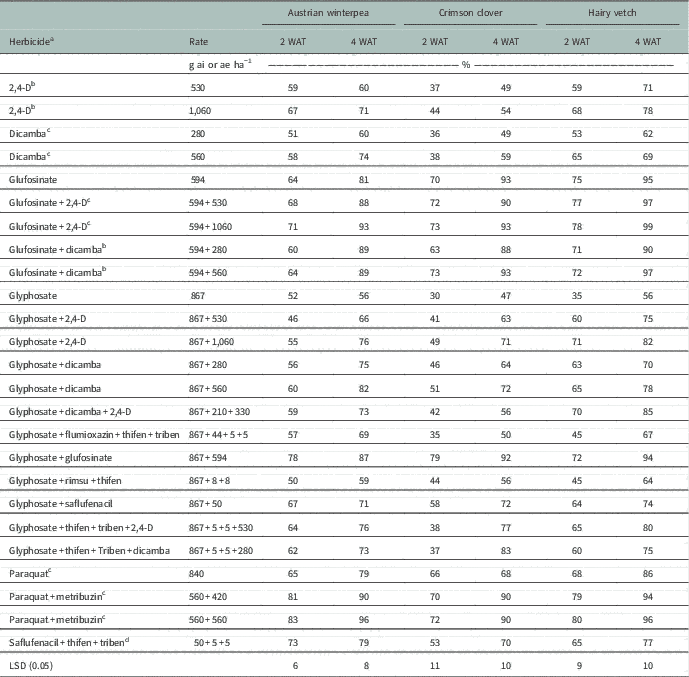
Paraquat in combination with metribuzin often provided the highest control of the legume cover crops (Table 4). Austrian winterpea, crimson clover, and hairy vetch were controlled 96%, 90%, and 96%, respectively, at 4 WAT by paraquat plus the high rate of metribuzin. Putnam and Ries (Reference Putnam and Ries1967) reported that application of paraquat with a photosystem II (PSII)-inhibiting herbicide such as simazine or diuron was more effective for controlling quackgrass [Elymus repens (L.) Gould] than either herbicide applied alone. Additionally, Norsworthy et al. (Reference Norsworthy, Smith and Griffith2011) showed that both translocation and efficacy increase when paraquat is mixed with PSII-inhibiting herbicides. Increasing the rate of metribuzin mixed with paraquat did not further improve control of the legume cover crops.
Control of legume cover crops at 2 and 4 wk after treatment (WAT) averaged over 2015 and 2016.

a Abbreviations: rimsu, rimsulfuron; thifen, thifensulfuron; triben, tribenuron.
b Nonionic surfactant: 0.25% v/v.
c Crop oil concentrate: 1.0% v/v.
d Methylated seed oil: 1.0% v/v.
Glufosinate alone was an effective option for legume cover crop termination, as evidenced by >90% control of hairy vetch and crimson clover at 4 WAT (Table 4). Austrian winterpea was controlled 81% by glufosinate at 4 WAT, with this lower control being attributed to inadequate coverage of dense biomass with the contact herbicide. With the exception of Austrian winterpea, the addition of 2,4-D or dicamba to glufosinate did not offer improved control compared with glufosinate alone, regardless of the auxin herbicide rate in most cases. The mixture of glyphosate and glufosinate also did not differ from glufosinate alone, yet it was superior to glyphosate alone.
Both dicamba and 2,4-D alone, regardless of rate tested, provided less than 80% control of each legume cover crop through 4 WAT (Table 4). Doubling the rate of either dicamba or 2,4-D often improved control of Austrian winterpea; however, neither of these herbicides would be deemed as a stand-alone option for termination of legume cover crops at the rates tested. White and Worsham (Reference White and Worsham1990) reported that application of 2,4-D and dicamba on crimson clover at a similar growth stage to that evaluated here (flowering and 51- to 61-cm height) provided only 70% and 72% control, respectively.
Glyphosate alone also did not control legume cover crops effectively. The control provided by glyphosate on all three legume cover crops ranged from 47% to 56% at 4 WAT (Table 4). The addition of dicamba or 2,4-D increased control (from 63% to 85%), but the same effect was not observed when compared with the auxin herbicides alone. The three-way mixture of glyphosate, dicamba, and 2,4-D provided similar control compared with the two-way mixture of glyphosate plus dicamba or glyphosate plus 2,4-D, regardless of the rate of the auxin herbicide. The only exception was the superior control provided by the three-way tank mix compared with glyphosate plus the lower rate of dicamba on hairy vetch.
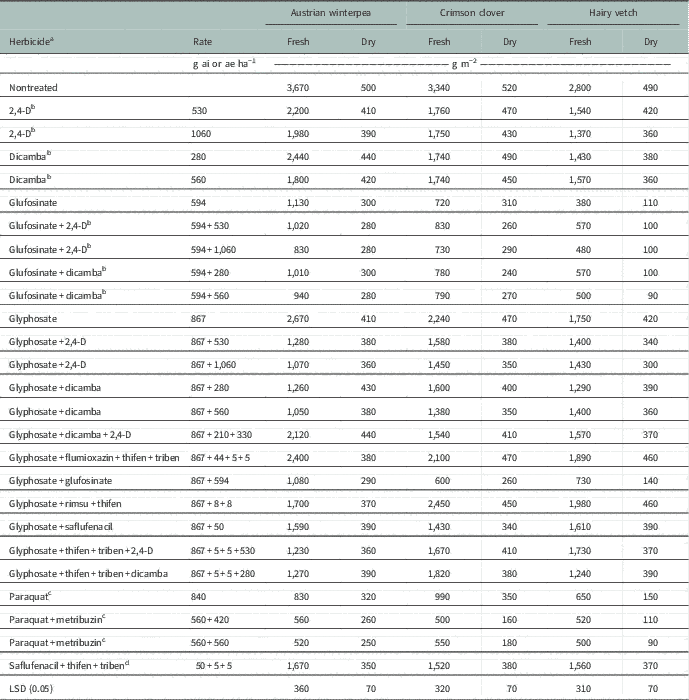
Fresh biomass varied in response to herbicides for each legume cover crop (Table 5). All herbicide treatments reduced the fresh biomass weight of legume cover crops compared with the nontreated check. Fresh Austrian winterpea biomass treated with paraquat or paraquat plus metribuzin was the lowest among herbicide treatments. Similar results were observed for crimson clover and hairy vetch; however, glufosinate and glufosinate-containing treatments did not differ from paraquat and paraquat-containing treatments for fresh biomass weight. The addition of an auxin herbicide to glyphosate decreased the fresh weight of Austrian winterpea and crimson clover compared with glyphosate alone, regardless of the rate of 2,4-D and dicamba. Comparable results were not observed with hairy vetch. Glyphosate plus dicamba at both rates did not differ from glyphosate alone for fresh weights.
Effect of herbicides on cover crop biomass 4 WAT, averaged over 2015 and 2016.

a Abbreviations: rimsu, rimsulfuron; thifen, thifensulfuron; triben, tribenuron.
b Nonionic surfactant: 0.25% v/v.
c Crop oil concentrate: 1.0% v/v.
d Methylated seed oil: 1.0% v/v.
Dry biomass, likewise, varied among herbicide treatments for each legume cover crop (Table 5). Austrian winterpea dry biomass when treated with dicamba (280 g ae ha−1), glyphosate plus dicamba (280 gaeha−1), and glyphosate plus dicamba (210 g ae ha−1) plus 2,4-D (330 g ae ha−1) did not differ from the nontreated check. All remaining treatments had significantly less dry biomass than the nontreated check. However, treatments containing paraquat and glufosinate showed greater dry biomass weight reduction. The dry biomass weight of crimson clover did not differ from the nontreated check for 2,4-D (530 g ae ha−1), dicamba (280 gaeha−1), glyphosate, and glyphosate plus flumioxazin plus thifensulfuron plus tribenuron (44 g ai ha−1, 5 g ai ha−1, and 5 g ai ha−1) treatments. Paraquat plus metribuzin at both rates provided the lowest amounts of dry crimson clover biomass. Compared with the nontreated check, hairy vetch dry biomass was not negatively affected by dicamba (280 g ae ha−1), glyphosate, and glyphosate plus flumioxazin plus thifensulfuron plus tribenuron (44 g ha−1, 5 g ha−1, and 5 g ha−1). Conversely, glufosinate- and paraquat-containing treatments effectively reduced the dry weight of hairy vetch.
Orthogonal contrasts performed between contact and systemic herbicides showed that using a contact herbicide alone or in a tank mixture provided superior results for all parameters evaluated (Table 6). The efficacy of a systemic herbicide is linked to the ability of the active ingredient to move thorough the plant, whereas contact herbicides are relatively immobile and quick acting and rapidly desiccate foliage (Dodge and Harris Reference Dodge and Harris1970; Young Reference Young1994). When applied to foliage, systemic herbicides will be translocated throughout the plant; however, such movement is dependent on the translocation capacity of the target plant at a specific growth stage (Foy Reference Foy1961). The translocation of systemic herbicides is often greatest when plants are actively growing. In addition, the degradation of herbicides within older plants is often greater than in young plants (Singh and Singh Reference Singh and Singh2004). Considerations of these two factors might explain why systemic herbicides have low activity on high biomass cover crops (Ahmadi et al. Reference Ahmadi, Haderlie and Wicks1980; Culpepper and York 2001). It is likely that earlier application of these systemic herbicides would at least have improved control, but in turn, there would be less biomass production, which would limit weed suppression.
Orthogonal contrasts of percent control and biomass weight.

a Indicates chemical treatments containing contact herbicide alone or in mixture with systemic herbicide. Contact herbicides included paraquat, glufosinate, and saflufenacil.
b Indicates treatments containing only systemic herbicides such as glyphosate, dicamba, and 2,4-D.
c Indicates treatments containing 2,4-D.
d Indicates treatments containing dicamba.
e “Low dicamba” indicates treatments that contained dicamba at 280 g ae ha−1; “high dicamba” indicates treatments that contained dicamba at 560 g ae ha−1.
f “Low 2,4-D” indicates treatments that contained 2,4-D at 530 g ae ha−1; “high 2,4-D” indicates treatments that contained 2,4-D at 1,060 g ae ha−1.
*Significant at P=0.05 to 0.01 levels.
**Significant at P=0.01 to 0.001 levels.
***Significant at P≤0.001 levels.
Unlike systemic herbicides, contact herbicides are nonmobile and require adequate coverage of all foliage to obtain a high level of control. Developing plants might eventually show regrowth, because the roots and shoot system are generally unaffected (Bruce and Kells Reference Bruce and Kells1990). However, in this experiment, the overall performance of contact herbicides on legume cover crops at 4 WAT was superior to systemic herbicides (Table 6). Based on orthogonal contrasts, the efficacy of auxin herbicides, specifically 2,4-D and dicamba, differed among legume cover crops.
Cereal Cover Crops
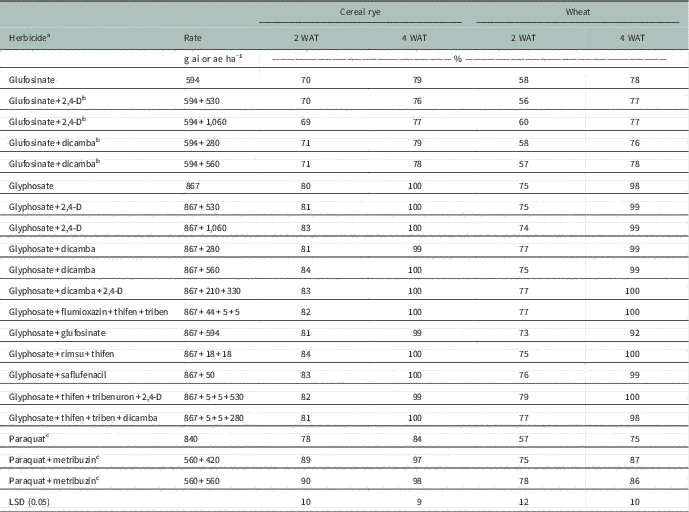
Both cereal cover crops were easily controlled by any glyphosate-containing treatment. Glyphosate alone at 867 g ae ha−1 or in mixture with other herbicides delivered at least 99% control of cereal rye at 4 WAT (Table 7). Similar results were observed with winter wheat; however, the mixture of glyphosate and glufosinate appeared antagonistic based on only 92% control from the tank mixture compared with 99% control from glyphosate alone. Whitaker et al. (Reference Whitaker, York, Jordan and Culpepper2011) also observed a reduction in glyphosate plus glufosinate efficacy on grasses compared with glyphosate alone. According to Everman et al. (Reference Everman, Mayhew, Burton, York and Wilcut2009), such a decrease in efficacy of glyphosate by glufosinate is due to reduced translocation of glyphosate within the plant.
Control of cereal cover crops at 2 and 4 wk after treatment (WAT), averaged over 2015 and 2016.

a Abbreviations: rimsu, rimsulfuron; thifen, thifensulfuron; triben, tribenuron.
b Nonionic surfactant: 0.25% v/v.
c Crop oil concentrate: 1.0% v/v.
d Methylated seed oil: 1.0% v/v.
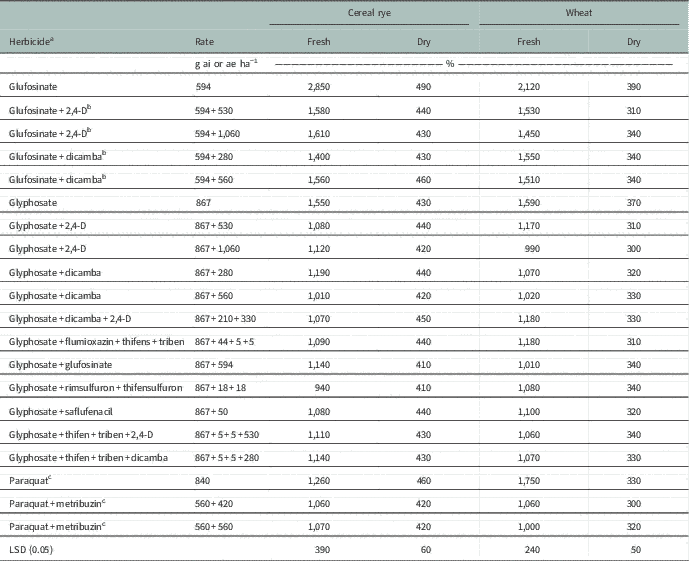
Paraquat or glufosinate alone demonstrated limited efficacy and biomass reduction on the cereal cover crops (Tables 7 and 8). However, similar to legume cover crops, the paraquat plus metribuzin mixture increased control of cereal rye and wheat over paraquat alone. Similar results were observed by Norsworthy et al. (Reference Norsworthy, Smith and Griffith2011) when evaluating herbicide options for control of failed stands of corn. Eubank et al. (Reference Eubank, Nandula, Poston and Shaw2012) also observed this synergistic effect with the addition of metribuzin to paraquat on control of glyphosate-resistant horseweed [Conyza canadensis (L.) Cronq.]. It is well established that contact herbicides are less effective than glyphosate in controlling grasses (Riar et al. Reference Riar, Norsworthy and Griffith2011; Whitaker et al. Reference Whitaker, York, Jordan and Culpepper2011). Although significantly less fresh biomass weight was observed in the glufosinate-treated plots compared with the nontreated check, dry biomass weights did not show such differences among treatments on both cover crops (Table 8). The fact that cereal rye and wheat are erect plants and have a wide carbon:nitrogen ratio and a low rate of decomposition may explain the narrow differences in dry biomass weight between treated and nontreated plots.
Effect of herbicides on cover crop biomass 4 WAT, averaged over 2015 and 2016.

a Abbreviations: rimsu, rimsulfuron; thifen, thifensulfuron; triben, tribenuron.
b Nonionic surfactant: 0.25% v/v.
c Crop oil concentrate: 1.0% v/v.
Rapeseed
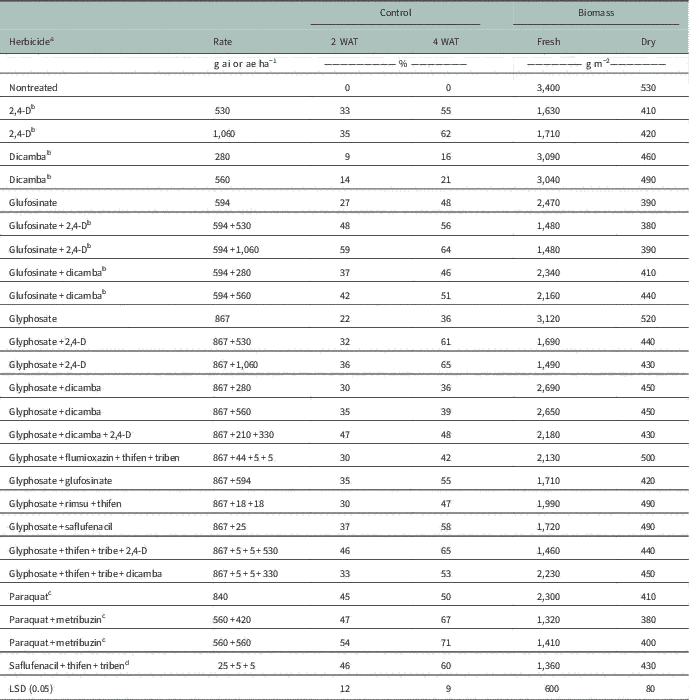
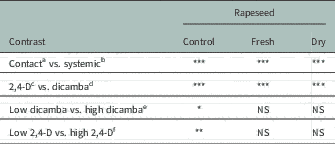
Overall, rapeseed was the most difficult to kill cover crop. None of the herbicide treatments controlled rapeseed adequately, as evident by control ratings of 71% or less at 4 WAT (Table 9). The fresh weight of rapeseed when treated with glyphosate or dicamba alone was not different from the nontreated check; hence, individuals planting a cover crop blend that contains rapeseed may have difficulty terminating this cover crop. Similar to legume cover crops, orthogonal contrasts conducted with rapeseed data showed that contact herbicide–containing treatments were superior to the systemic treatments in all parameters evaluated (Table 10). In addition, rapeseed was more sensitive to 2,4-D than dicamba. Beckie et al. (Reference Beckie, Séguin-Swartz, Nair, Warwick and Johnson2004) reported that 2,4-D applied at 560 g ae ha−1 effectively controlled volunteer rapeseed at the 6-leaf stage. Hence, earlier application of the preplant herbicides might further enhance rapeseed control.
Rapeseed control at 2 and 4 wk after treatment (WAT), averaged over 2015 and 2016.

a Abbreviations: rimsu, rimsulfuron; thifen, thifensulfuron; triben, tribenuron.
b Nonionic surfactant: 0.25% v/v.
c Crop oil concentrate: 1.0% v/v.
d Methylated seed oil: 1.0% v/v.
Orthogonal contrasts of percent control and biomass weight.

a Indicates chemical treatments containing contact herbicide alone or in mixture with systemic herbicide. Contact herbicides included paraquat, glufosinate, and saflufenacil.
b Indicates treatments containing only systemic herbicides such as glyphosate, dicamba, and 2,4-D.
c Indicates treatments containing 2,4-D.
d Indicates treatments containing dicamba.
e “Low dicamba” indicates treatments that contained dicamba at 280 g ae ha−1; “high dicamba” indicates treatments that contained dicamba at 560 g ae ha−1.
f “Low 2,4-D” indicates treatments that contained 2,4-D at 530 g ae ha−1; “high 2,4-D” indicates treatments that contained 2,4-D at 1060 g ae ha−1.
*Significant at the P=0.05 to 0.01 levels.
**Significant at the P=0.01 to 0.001 levels.
***Significant at the P≤0.001 levels.
Practical Implications
Cover crop termination by herbicides can be challenging depending upon the cover crop species. The use of herbicides such as glyphosate, paraquat, 2,4-D, and dicamba alone to control cover crops might not provide sufficient control of legume cover crops. However, based on these data, effective control of legume cover crops can be obtained with mixtures of glufosinate plus dicamba or 2,4-D and paraquat plus metribuzin. The use of a contact herbicide for controlling legume cover crops at the bloom stage proved to be superior to use of systemic herbicides.
In contrast, cereal cover crops can be easily controlled with glyphosate. The addition of auxin herbicides to glyphosate in an attempt to broaden the spectrum of winter weed control will negatively impact cereal rye and wheat control. Paraquat plus metribuzin is also effective in terminating both cereal cover crops and would be an option when planting soybean following cover crop termination. The use of other PSII-inhibiting herbicides like atrazine, diuron, or fluometuron also are known to cause a synergistic affect when tank mixed with paraquat; hence, these herbicides would be additional options depending on the subsequent crop to be planted (Norsworthy et al. Reference Norsworthy, Smith and Griffith2011).
Growers should avoid planting rapeseed based on the difficulty in successfully terminating this cover crop. If rapeseed is included in a cover crop blend, alternative methods of cover crop termination may be needed. Based on the lack of response of rapeseed to herbicides, further research is needed to evaluate termination options for other mustards (Sinapis spp.) and radishes (Raphanus spp.) that could serve as a cover crop replacements for rapeseed.
Another important factor to consider is the interval needed between cover termination and crop planting. Most of the treatments showed substantial differences in control between 2 and 4 WAT (Tables 4, 7, and 9). Allowing sufficient time between application and complete kill of the cover crop can help with avoiding problems with lack of available soil moisture during the crop germination period and negative effects on crop establishment (Clark et al. Reference Clark, Decker, Meisinger and McIntosh1997). In this experiment, to ensure maximum biomass production, all cover crops were sprayed at the bloom stage. Perhaps an earlier application would improve control of these difficult to kill cover crops, although the amount of biomass produced by the cover crops would be lessened.