One direct result of the Help America Vote Act, passed in response to the irregularities associated with the 2000 election, was the replacement of old-fashioned punch card and lever voting systems with optical scan and Direct Record Electronic (DRE) systems. Then, beginning in 2003, an Internet-based movement among computer scientists led to questions about the security of electronic voting systems and potential for electronic corruption of DREs. Skeptics established Web sites such as www.verifiedvoter.org and then moved into more traditional forms of advocacy in opposition to paperless electronic systems. By 2007, twenty-seven states had adopted provisions mandating a paper trail.Footnote 1 This story has been interpreted as a textbook example of one of the democratizing consequences of the Internet: its capacity to facilitate political participation. From another perspective, however, there is nothing unexpected about the political success of what began as an Internet-based movement among computer professionals. While computer nerds are hardly the most visible group in American politics, they have characteristics—in particular, high levels of education—that predispose them to take part in politics should the occasion arise.
The Internet is changing democratic politics in America in many ways—ranging from the civility (or not) of civic discourse to the methods that candidates use to raise money.Footnote 2 The story about electronic vote systems raises important questions about the potential impact of the Internet on one central aspect of American democracy: citizen political participation. Researchers have been inquiring whether the opportunities provided by the Internet to learn about, talk about, and take part in politics are bringing new people into politics. However, political scientists demonstrate that successful innovations designed to raise levels of citizen political participation do not necessarily ameliorate inequalities of participation.Footnote 3
Therefore, we take this question one step further and inquire whether, if the Internet is bringing new people into politics, is it bringing in new kinds of people? That is, even if the Internet is effective in generating political participation, what are the implications of Internet-based political activity for democratic equality? One of hallmarks of democracy is that the preferences and interests of all citizens be given equal consideration in the policy formation and the policy implementation process. As Robert A. DahlFootnote 4 has put the democratic ideal, “the good or interests of each person must be given equal consideration.” That ideal is rarely if ever achieved; and the United States is further from it than are most advanced democracies. It is well known that political participation in the United States is unequal and that, in particular, those who are disadvantaged in terms of education and income are likely to take less part politically, a theme with which our work has been associated.Footnote 5 It is also well known that younger people are less likely to be politically active. Does participation on the Internet reduce the participatory gaps associated with SES and age?
We bring mixed expectations to this question. On the one hand, online politics had been seen to hold such great promise for improving various aspects of democratic governance that we hoped that the Internet would act as the circuit breaker disrupting the pattern of association between socioeconomic advantage and political activity. In addition, the young are clearly much more willing and able to use electronic technologies than their elders. On the other, in our own work, we had found the association between SES and participation to be powerful and durable—resilient in the face of reforms meant to temper it. Besides, we knew that Internet access is far from universal among American adults, a phenomenon widely known as the “digital divide,” and that the contours of the digital divide reflect in certain ways the shape of participatory input. Moreover, access to the Internet does not necessarily mean use of the Internet and, even more important, use of the Internet for political activity.
While researchers have investigated the impact of the Internet on levels of political activity, the extent to which the biases in online political activity ameliorate or merely reflect or, even, exaggerate the familiar biases in offline political activity has been a distinctly secondary concern. In order to investigate this matter, during the summer of 2008 we collaborated with Lee Rainey, Scott Keeter, and Aaron Smith of the Pew Internet and American Life Project to design a survey to collect information about Internet use and about political activity both off and on the Internet. The survey, which was conducted in August 2008, provides a unique opportunity to consider whether online political activity—including newer forms of online activity on blogs and social networking sites—has the potential to remedy the inequalities of political voice so characteristic of traditional, offline participation.
Like all studies of the impact of the Internet on some aspect of democratic politics, this one reports on a phenomenon that is very much a moving target—a technology that is, according to Matthew Hindman, “in its adolescence.”Footnote 6 Not only does the set of people with Internet access continue to expand—a development with potential consequences for participatory stratification—but there is a rapid increase in the amount of political material from a variety of sources. Moreover, technology has continued to develop. Improvements in Web browsers make it much easier to find information and to locate Web sites. More recent phenomena such as social networking sites and Twitter, which have powerful capacities to link like-minded people, and YouTube, which facilitates the instantaneous dissemination of audio and visual material, have potential impact on politics that is currently unfolding. In 1998 Bruce Bimber observed cautiously that it would be some time before the full political impact of the Internet would become apparent.Footnote 7 That modest assessment continues to be appropriate.
In view of our focus on inequalities in political participation, the timing of the single survey on which we rely might not, in fact, be cause for concern. The survey was conducted in August 2008, after the presidential candidates had been selected but before they had been nominated and before the campaign was in its final autumn sprint. Surely the 2008 presidential campaign had some unusual characteristics, including significant activity by younger adults and a candidate who made self-conscious efforts to incorporate the Internet into his campaign. Still, it is plausible to argue that Obama's experience as a community organizer and his obvious appeal to the young and to persons of color imply that this single survey would be more likely to understate than to overstate the extent of class- and age-based participatory inequalities.
Does the Internet Increase Citizen Participation?
In our search to understand the roots of political participation, we have found it helpful to invert the question of why people might become politically active and to ask instead why they might not take part. We argue that there are three reasons that people might not become active in politics: They can't; they don't want to; and nobody asked.Footnote 8 That is, political participation is inhibited when individuals face deficits in time, money, or skills, thus making it difficult for them to take part; when they lack the motivation to be active because they are not politically interested or knowledgeable and are not concerned about political issues and outcomes; and when they are not exposed to attempts to mobilize them to political action.
Because the Internet lowers each of these barriers to citizen political activity, it would seem to provide multiple avenues by which political participation might be enhanced.Footnote 9 With respect to the capacity to participate, certain forms of political participation are simply easier on the Internet. Because activity can be undertaken any time of day or night from any locale with a computer and an Internet connection, the costs of taking part are reduced. Making campaign donations is particularly convenient over the Internet,Footnote 10 as is contacting public officials. The networking capacities of the Internet also facilitate the process of the formation of political groups. The Internet reduces almost to zero the additional costs of seeking to organize many rather than few potential adherents even if they are widely scattered geographically, thus ameliorating the extent to which the free rider problem dampens participation.Footnote 11 As for the various psychological orientations that are also conducive to political participation, the Internet provides a wealth of political information and opportunities for political interaction, discussion, and position-taking.Footnote 12 Those with high levels of political information are more likely to be politically interested, to feel that they can have an impact on political outcomes, and to take part in politics. These relationships do, of course, raise questions of direction of causality. Still, it is reasonable to speculate that the availability of opportunities to acquire political information and to take part in political conversations on the Internet would have a positive impact on levels of political participation. Finally, it is well known that the Internet facilitates political mobilization. Candidates, parties, and political organizations not only use the Internet as a way of disseminating information, they also use its capabilities to recruit adherents and sympathizers to take political action—either on or offline. Once again, the particular utility of the Internet derives from the capacity to communicate with large numbers of geographically dispersed people at little cost.
However, the effect of the Internet may be not to raise political activity but instead to repackage it.Footnote 13 That is, instead of citizens undertaking political action that they ordinarily would not, people who would have participated anyway might simply be taking their activity online. For example, between early 1996 and late 2007, the proportion of Americans who reported that the Internet was one of their two most important sources of campaign news rose from 2 to 26 percent; at the same time the proportion who made the equivalent assessment of newspapers as a source of campaign news declined from 49 to 30 percent.Footnote 14 In fact, investigations of whether Internet use enhances political activity show mixed results.Footnote 15
Internet Political Activity and Participatory Inequality
Our concern—the consequences of the participatory opportunities afforded by the Web for the representativeness of activist publics—is a different one. Even if it were unambiguous that Internet use increases political participation, a higher level of political participation does not necessarily imply a less unequal distribution of political activity.Footnote 16 It is clear, for example, that processes through which citizens are mobilized to take part in politics do result in more political activity.Footnote 17 However, since those who seek to get others involved in politics act as “rational prospectors,” targeting those who are likely to assent to a request for participation and to take part effectively, the everyday processes of mobilization that bring people into politics end up recruiting a set of activists who are more skewed in their participatory characteristics, especially SES, than is the set of activists who take part spontaneously on their own initiative.Footnote 18 Analogously, while we often associate the use of the Internet as a tool of citizen activation with emergent groups and underdog candidates needing to operate on a shoestring, such use of the Internet is now common among established as well as emergent interests. In short, as Pippa Norris notes, if the increase in political participation derives from the same people, or the same kinds of people, who are already active, then a possible consequence of the process is the replication—or, even, exacerbation—of existing political inequalities.Footnote 19
The Digital Divide
For more than a decade, social observers have been concerned that the “Digital Divide” is leaving behind a substantial portion of the public—with implications for equal opportunity in economic life and equal voice in political life.Footnote 20 Although the metaphor of the divide originally referred to lack of hardware access and suggests a chasm separating cyber-haves from the cyber-have nots, it is more appropriate to think of a continuum ranging from, at one end, those who have no Internet access or experience to those, at the other, who have broadband access at home, use the Internet frequently, and are comfortable with a variety of online techniques.Footnote 21 Use of the Internet to learn about politics and to be politically active requires not simply access to hardware but an array of skills: the capacity both to operate the computer and to seek and understand political information on the Web.Footnote 22 But what is critical for our concern with participatory inequalities is not simply that some Americans have been left out of the technological advances of recent decades but that the contours of the digital divide hew so closely to the socio-economic stratification that has been widely observed as characteristic of political activity in the United States.Footnote 23
Data from the 2008 Pew Internet and American Life survey that provide the basis for our analysis confirm the unevenness in access to the Internet. Reflecting patterns that have emerged from earlier studies, these data show that the attributes associated with access to hardware are in many ways familiar ones that, in important respects, track the individual characteristics that predict political participation—in particular, the class stratification that has such powerful implications for political participation.Footnote 24 Roughly half of those in the lowest income category—who had family incomes below $20,000 in 2007—are online; that is, they either use the Internet or send or receive e-mail, at least occasionally. In contrast, at least occasional Internet or e-mail use is nearly universal among those in the highest income category who had 2007 family incomes of $150,000 or more. Similarly, only 38 percent of those who did not graduate from high school, compared to 95 percent of those with at least some graduate education, are online.
In terms of the Internet's political capacities for providing opportunities for participation, access to information, and requests for activity, there is a difference between having Internet access at home and elsewhere—say, at work or the local library. In addition, even for those with Internet at home, there is a difference between dial-up and broadband access. The Pew data indicate that three-quarters of those who are online—or 56.5 percent of all respondents—have high-speed Internet at home. Once again, there is a sharp socioeconomic gradient: 30 percent of those in households with annual incomes below $20,000, compared to 88 percent in households with annual incomes above $150,000, reported having high-speed Internet access at home; the analogous figures for education are 22 percent for respondents who did not finish high school, as opposed to 81 percent for those with education beyond college.Footnote 25 Figure 1A summarizes the data for five categories of socioeconomic status and makes clear that Internet use and access rise steadily with SES.Footnote 26
Internet utilization

By and large, Internet use and broadband access are associated with characteristics that predict political participation; there is, however, an important exception to this pattern. It is well known that the young are quite politically inactive—and more likely than their elders to use the Internet. In contrast, every study of Internet access and use, no matter what the measure, shows a steady, sharp decline with age. In figure 1B, 90 percent of those between eighteen and twenty-four, compared with only 32 percent of those seventy-one and over, use the Internet or e-mail at least occasionally. The corresponding figures are 70 percent and 19 percent for having broadband at home.Footnote 27 In light of the wide and unexplained disparities in participation between the young and their elders, this constitutes a potentially significant counter-stratificational effect of the Internet. Moreover, as members of the younger generation come of age and replace their tech-phobic elders, the extent to which there is an age-related digital divide may be ameliorated.Footnote 28
Using the Internet/Using the Internet for Politics
Beyond access to and skillful use of the Internet is the inclination to use it for political purposes. The overwhelming share of Internet use is for non-political activities that range from finding directions to viewing pornography to keeping up on a social networking site. Studies of political participation make clear that the predisposition to devote leisure time—that is, time not spoken for by obligations at home, school, or work—to political activity is structured by both age and socioeconomic status. We were suspicious that, beyond the demographic biases in access to hardware, online political participation might not function to redefine the kinds of people who are active politically but might instead replicate the widely acknowledged stratification in offline participation.Footnote 29
The Representativeness of Online and Offline Political Participation
The 2008 Pew survey makes it possible to investigate whether political participation on the Internet overcomes the representational biases that have long been observed to characterize offline political activity. The survey asked about a series of political activities, five of which can be performed either online and offline: contacting a national, state, or local government official; signing a petition; sending a “letter to the editor”; communicating with fellow members of a political or community group; and making a political contribution. Using these items, we constructed three activity scales: the first two contain five items each and measure either online activity or offline activity in the acts having online counterparts; the third contains eleven items and measures overall activity.Footnote 30 Sixty-three percent of respondents take part in at least one of the eleven acts on the overall measure of political participation, and the average is 1.87 acts. With respect to the five political activities for which there are online and offline counterparts, respondents average .64 on the scale of five online acts, and about a third, 34 percent, engage in at least one of them. For offline political acts, the analogous figures are somewhat higher: the average is .97, and just over half of respondents, 52 percent, engage in at least one of the five offline acts. Online and offline activity are associated with one another.Footnote 31 What is interesting is that those who are active online are much more likely also to be active offline than vice versa: 87 percent of the online activists engaged in at least one activity offline; in contrast, 57 percent of the offline activists engaged in at least one activity online.
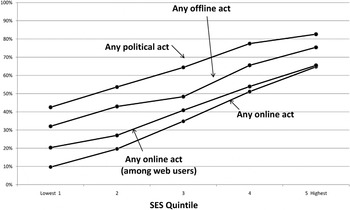
Figure 2 presents data for five groups based on socioeconomic status and makes obvious that, no matter how political participation is measured, political activity rises sharply with socio-economic status. Figure 2 shows the percentage who engage in at least one participatory act as measured by these three scales; the top line shows the proportion who engage in at least one of the eleven activities on the scale of overall participation; the next line shows the proportion who undertake offline at least one of the five activities having online and offline versions; the bottom line shows the proportion who take part in at least one of the online counterparts of these five activities.
Political activity by SES quintile

The additional line on figure 2, which is between the second line and the bottom line, shows the proportion who engage in at least one of the five Internet-based political activities among Web users—that is, among those who use the Internet or e-mail at least occasionally.Footnote 32 On one hand, because access to and use of the Internet has a social class component, when we consider the online political activity of Internet users only, the SES gradient is less sharp than when we consider all respondents. On the other, figure 2 makes clear that lack of access is only part of the story of the SES structuring of online political activity. Even when we omit those who are not online and consider only those who use the Internet or e-mail, we see a strong association between political participation and SES. Among those who use the Internet or e-mail, the percentage who undertake at least one online political act is substantially lower at the bottom of the SES hierarchy than at the top. Because fewer than half of those at the lower end of the SES rankings use the Internet or e-mail, their levels of Internet-based political activity show the potential effects of lack of Web access. While lack of access to the Internet obviously makes online political activity impossible, we suspect that those who lack Internet access would not necessarily use it for political activity if they were to get connected. Still, the digital divide presumably depresses levels of online political activity further down the SES ladder. In contrast, at the upper end, where Internet use is nearly universal, the level of online activity is not affected by lack of access to hardware. Thus, it seems that, far from acting as a great equalizer, the possibility of political activity on the Internet replicates familiar patterns of SES stratification not only because the digital divide has an SES component but because the SES-disadvantaged among those online are not using the Internet for political participation.
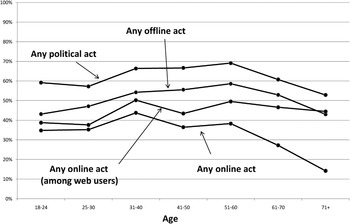
The patterns for age groups, shown in figure 3, are quite different. Consider the top line which shows, for overall political participation, a roughly curvilinear pattern over the life cycle. Those in the younger groups, who are between eighteen and thirty, are less likely to be active than their elders. The likelihood of taking part rises through the thirties and forties, peaks among those in their fifties, and then falls among the sixty-somethings and those over seventy. Still, age is much less powerful in structuring political activity than is SES: the distance between the most active of the seven age groups and the least active age group is much smaller than the distance between the lowest and highest of the SES quintiles.
Political activity by age

The curvilinear pattern is replicated for the scale of five offline acts for which there are online counterparts, shown in the second line. However, when it comes to online activity, shown in the bottom line, we see a contrasting pattern that contains an unusual element of counter-stratification. For online political activity, the participatory gap between the youngest group and their elders is relatively small, and for all those under sixty, there is little relationship between age and online political activity. The likelihood of undertaking online political activity is, however, lower among the elderly, especially among those over seventy. In contrast to what we observed for offline political activity, the absence of online activity among the elderly represents, we assume, not a fall-off from previous Internet-based participation, but instead a never-was. This suspicion gains credence when we consider the online activity of those who use the Internet or e-mail at least occasionally, shown in the third line. Among those who use the Internet and e-mail, the young are actually the least likely to be politically active online. Thus, the digital divide has its greatest impact among older respondents. The small number of Web users among older respondents—a group that surely is not a random selection—are actually quite politically active on the Internet.
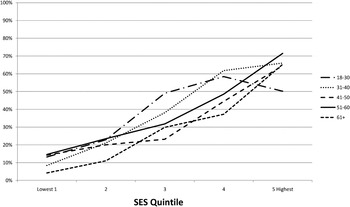
These findings are underscored by the data in figure 4. Each line represents the proportion engaging in at least one act of online political participation for the SES quintiles of a single age group for respondents who use the Internet or e-mail at least occasionally.Footnote 33 The overall pattern suggests the influence of SES and the irrelevance of age. Even after we have accounted for lack of Internet access and use, the five lines are bunched quite closely and rise in tandem with SES. For all the age groups there is the expected association between SES and political activity, but within any SES quintile, there is much less variation among age groups and little consistent pattern as to which age group is the most active.
Percent of any online political activity (among web users)

These straightforward figures speak to our concern with whether it matters for inequalities of participatory voice whether political activity takes place on the Internet or off the Web. The data suggest that offline and online participant publics will not be appreciably different with respect to SES but that, in contrast, the age profile of political participation on the Web differs from the age profile of offline activity. To nail down these findings, we sought statistical confirmation of these observations.Footnote 34 Our techniques permit us to differentiate between two processes: the impact of the factors related to Web access and the impact of the factors related to political participation.
That analysis demonstrates that income and education look like they have the same stratificational impact for online acts as for offline acts: there is no evidence that the relationship between Web-based participation, on the one hand, and education or income, on the other, is different from the relationship between offline political participation and these SES factors. In contrast, age affects access to the Internet (and, thus, political participation based upon the Internet), but once someone has access to the Internet, there is no difference in how age affects offline or online political activity. Thus, the extent to which the young are less underrepresented with respect to political participation via the Internet is related to their greater likelihood to be Web users rather than to any enhanced propensity to use the Internet politically once on the Web.
We should add one caveat. This survey was conducted during a particular campaign—a campaign notable both for its special attempts to use electronic technologies to mobilize young activists and for its historic outcome. If the overall shape of participatory input was somehow unusual during the 2008 campaign, we might speculate that it would have been less stratified with respect both to age and to SES. We find it difficult, however, to speculate how any amelioration of SES and age bias in political activity would have been expressed in the relative weight of offline and online participation. When it comes to SES, lack of access to and use of the Internet reinforces for online political activity the well-known SES stratification of conventional offline participation. In contrast, when it comes to age, the group that is typically underrepresented in political activity, young adults, is more likely to use the Internet. Teasing out this logic requires complex models and longitudinal data about online and offline political activity that have not at this point ever been collected. In the meantime, we would not expect conclusions drawn from a survey conducted in 2008 to exaggerate the extent of either age or SES bias in political participation.
Political Contributions On and Offline
Because making political contributions is the form of political activity most obviously dependent upon access to financial resources, and because a great deal of attention has been paid to the success of some candidates in raising large numbers of small donations over the Web, we were particularly interested to look more carefully at political giving. The Pew data—which, we should recall, were collected in August of 2008, before Obama's Web-based September fundraising blitz—contain helpful items about political giving that allow us to ascertain not only whether but also how much respondents gave in political contributions, both offline and on the Web.Footnote 35 These data show that Internet contributions are less common than offline donations: 6 percent of respondents made an online—and 15 percent an offline—contribution. They also suggest that behind the widely discussed success of Internet-based fundraising in collecting political money in smaller amounts is a more complex pattern. On one hand, the average total offline contribution is larger than the average total online contribution and 74 percent of the political dollars donated offline—in contrast to 49 percent of the political dollars contributed on the Internet—were given in amounts over $250. On the other, the percentage of contributions that were $50 or less—38 percent for online and 39 percent for offline—is virtually identical as is the proportion of contributions that were between $51 and $100—28 percent for online and 29 percent for offline.
What is clear is that the very large donations that figure so importantly in campaign war chests are much less likely to come over the Web: less than 1 percent of the online contributions—as opposed to nearly 5 percent of the offline contributions—were for amounts over $1,000. We are not certain why big givers are less likely to use the Internet. One speculation is that, out of security concerns, they are reluctant to put a credit card number attached to a large donation on the Web. Others are that big donors like to be invited to events where they can rub elbows with politicos and celebrities or that they like to contribute in such a way as to allow a friend or political ally to get credit for the donation.Footnote 36
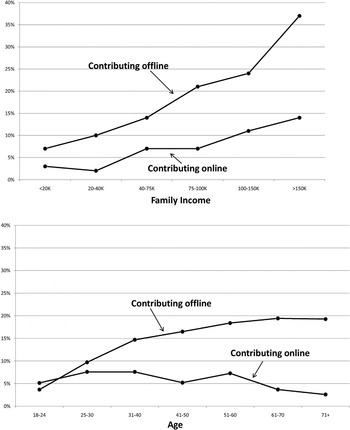
Figure 5 allows us to probe the differences between those who make donations over the Internet and the larger group of traditional donors who write checks. Figure 5A presents data about the proportion of respondents in various family income groups who make political contributions and shows a familiar pattern.Footnote 37 Regardless of whether we are considering offline or online political donations, the share of respondents who contribute rises sharply with family income and is more than five times greater in the highest family income group than in the lowest. When it comes to age, figure 5B shows that the proportion making donations offline starts at a low level among the young—with only 4 percent of those under twenty-five making offline contributions—and rises fairly steadily across the age groups and even stays high among those over seventy, a group that is otherwise not especially politically active. In contrast, when it comes to making contributions online, there is no particular pattern among younger and middle-aged groups. However, the proportion of respondents that use the Internet to make political donations is much lower among the oldest respondents, those over seventy.Footnote 38
Percent making a campaign contribution

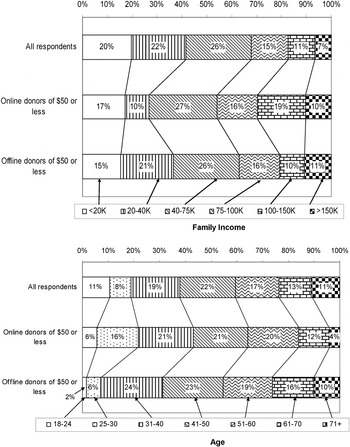
Many analysts of campaign finance emphasize expanding the ranks of small donors as the solution to the conundrum of money in democratic politics. Because small donations are unlikely to arrive with a set of policy instructions attached and can exercise limited leverage even when they do, small donations seem to ameliorate the possibilities for compromise of political equality in a campaign finance system that relies so heavily on contributions from individuals. Hence, we were concerned to learn whether small donors—especially those who contribute over the Web—are distinctive in their characteristics. The bar charts in figure 6 present distributions for family income and age for three groups: all respondents; those who made donations of $50 or less offline; and those who made donations of $50 or less over the Internet. Two patterns emerge from the data about income. First, higher income groups are overrepresented among those who make campaign donations, even what would seem to be very small ones.Footnote 39 While they are less exclusively affluent than big donors, those who make small donations are relatively unlikely to be drawn from the lower rungs of the income ladder. Second, and more germane to our immediate concerns, online contributors who donate small amounts are not markedly less affluent than their offline counterparts. If anything, they are actually somewhat better off financially. Thus, it seems that the Internet may be bringing in more small donors but it is not bringing in a less affluent set of small donors. With respect to age, the youngest respondents, those between eighteen and twenty-four, are underrepresented among those making political contributions of $50 or less. However, while they are nearly invisible among offline small donors, the extent of their underrepresentation is much less substantial when it comes to online contributions. While the next age group, those between twenty-five and thirty, is also underrepresented among those who make small contributions offline, these late-twentysomethings are actually overrepresented among those who make small donations on the Web. Thus, it seems that, although making campaign contributions, even small ones, is not an activity of the young, the possibility of making those donations online renders small donors a somewhat more representative group with respect to age.
From where do small donors come?

Alternative Paths to Participation via the Internet
Earlier we mentioned that the Internet has potential for indirect influence on political participation—either online or offline—in other ways: by acting as a venue for political conversation; by providing easy access to political information; and by facilitating recruitment to political activity.Footnote 40 However, we have also made clear that to raise the level of political participation is not necessarily to ameliorate inequalities in political participation.
Engaging in political discussions has a complex relationship to political participation. For one thing, it occupies a space at the penumbra of political activity: though not aimed at direct or indirect influence on public authorities, talking about politics is still more active than such psychological orientations as being politically interested or efficacious. For another, its causal relationship to political activity is presumably reciprocal: while discussions about politics stimulate political participation, actual experiences as a political activist also generate political talk.
The Pew survey asked respondents how often they discuss politics and public affairs on the Internet (by e-mail or instant message, on a social networking site, or in an online chat) as well as offline (in person, by the phone, or by a letter). Replicating our analysis for political discussion yields results parallel to what we have seen for political participation. People are much more likely to engage in political discussions offline than on the Internet. In addition, the propensity to engage in political discussion, whether online or offline, is positively associated with socio-economic status. As with actual political participation, some of the SES gradient with respect to online political conversations results from the association between Internet use and socio-economic status. However, even among Internet users, those at the top of the SES ladder are roughly twice as likely as those at the bottom to engage in Web-based political discussion. There is no such clear pattern when it comes to the relationship of age to talking about politics. With respect to offline political discussion, other than that those under twenty-five are the least likely to engage in political discussions, there is no other discernable pattern. Political discussions online, which are markedly less frequent than political conversations in person or on the phone, diminish sharply with age—a pattern that is not repeated among Internet users.
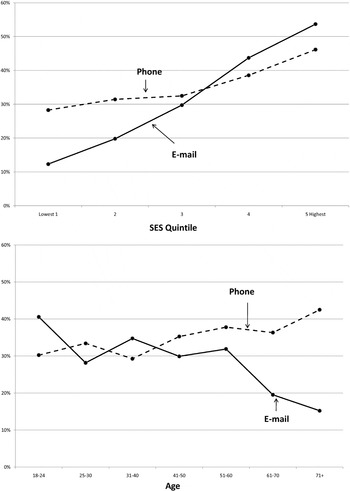
Still another mechanism by which the Internet might function to raise overall levels of participation is by facilitating the recruitment of political activists. Citizens are more likely to take part in politics if someone asks, and the various Web-based capacities ranging from e-mail to social networking sites make it nearly costless to multiply the number of specially crafted messages to selected publics. In fact, the level of Internet-based political recruitment has already expanded to the point that it approaches that for offline recruitment: 29 percent of respondents indicated that they receive an e-mail—and 35 percent that they receive a phone call—at least once a month asking them to get involved politically. Furthermore, processes of rational prospecting by those who seek to get others involved in politics imply that requests for political participation are structured by the same variables, including socio-economic status, that predict offline political participation. That is, those who seek to get others involved in politics target their requests at people with characteristics that make it likely that they will be likely to assent when asked and that they will be effective when they take part.
When we consider requests for political activity that come by phone or by e-mail in the top portion of figure 7, what we find parallels what we have seen so far with respect to the SES and age stratification of political participation. The probability that a respondent reports a request for political activity by phone at least once a month rises steadily with socio-economic status. For monthly e-mail requests to take part politically, the curve is, in fact, much steeper. Once again, we see evidence that the Internet may have a counter-stratificatory impact when it comes to age. As shown in the bottom portion of figure 7, while those under twenty-five are somewhat less likely than their elders to receive a phone call at least once a month asking them to take political action, they are considerably more likely to have received monthly e-mail requests to take part politically. In short, what we have seen about the capacities of the Internet to stimulate political participation by providing a forum for political discussion or by serving as a medium through which requests for political activity are transmitted reinforces what we saw earlier with respect to online political activity. On one hand, we find no evidence that politics on the Web is ameliorating the class-based inequalities in political participation that have so long characterized American politics. On the other, the generational digital divide may have the consequence of reducing the participatory underrepresentation of the young.
Requests for political activity by phone or e-mail.

Citizen Politics on the Changing Web
These results make clear that political activity on the Internet ameliorates somewhat the long-recognized overrepresentation of the middle-aged among political activists but leaves undisturbed the fundamental socio-economic stratification of participation. However, just as campaign ads on television evolved from an early phase in which they essentially added talking heads to radio scripts into a powerful medium in which words take second place to visual images, the distinctive political capacities of the Internet are still being realized. Let us consider two developments with potential implications not only for the amount and forms of activity but for the SES and age stratification of political involvement: blogging and the incorporation of politics into social networking. Of the two, blogging seems to require skills analogous to those needed for offline position taking. Writing one's own blog has affinities to being an op-ed columnist—though with lower barriers to entry.Footnote 41 Posting comments on someone else's blog is akin to writing a letter to the editor—though with guaranteed publication and minimal requirements for civility of tone, coherence of argument, or the niceties of grammar and spelling.
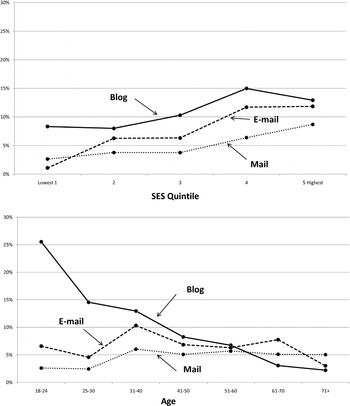
Figure 8 allows us to compare the SES and age stratification of three forms of public position taking: mailing a letter to the editor of a newspaper or magazine; sending such a letter by e-mail; and writing about a political or social issue on a blog—either by writing in one's own blog or, more frequently, by posting comments on someone else's blog. Consistent with the other results presented, all three, including blogging, are structured by socio-economic status. It is interesting that it is sending a letter to the editor by e-mail for which the SES gradient is most pronounced. With respect to age, the results for writing letters to the editor, once again, reflect what we have seen so far. The youngest respondents are less likely to take part in this way offline. Their underrepresentation is reduced for sending letters to the editor via e-mail, a form of involvement that is most rare among those over seventy. When it comes to blogging, however, the proportion who write about political and social issues is highest among the young and sinks rapidly with age.Footnote 42
Percent taking public position.

Political Engagement on Social Networking Sites
While blogging originated around the turn of the twenty-first century and came into its own during the 2004 election, social networking is a more recent and rapidly evolving phenomenon. At this point, the possibilities for political engagement through social network sites such as Facebook do not simply reproduce participation as we have always known it but instead reflect some of the distinctive civic tastes of post-Boomer cohorts: their preference for participatory forms that are anchored in non-hierarchical and informal networks and that eschew such traditional political intermediaries as campaigns, parties, and interest groups.Footnote 43
In order to illustrate the political possibilities of social networking, let us begin by considering the relatively conventional political experience of the early March 2009, Web surfer who clicked on www.whitehouse.gov—an easily navigable site containing civic and political information that could, in an earlier day, have been collected from the media and print sources in a library. The home page featured a series of pictures of the president signing legislation, standing at a podium hosting a question-and-answer session, and so on; links to material about policy issues, pending and passed legislation, the members of the administration, the history of the presidency and the White House, and textbook-like material about the institutions of the federal government; and a blog in which members of the administration post material, including video clips, about what is happening at the moment.
In contrast, Facebook members who landed on President Obama's Facebook page the same day might immediately notice pictures of a few of their own Facebook “friends”—should there be any among the nearly six million Facebook members, in the United States and abroad, who have signed up as Obama “supporters.” If they scanned his biographical information, presented in exactly the same format as if he were still an undergraduate at Columbia, they would learn, among other things, that his occupation is President of the United States; that he is male, married to Michelle Obama, and Christian; that his interests include basketball, writing, spending time with kids; that his favorite music includes Miles Davis, John Coltrane, Bob Dylan, Stevie Wonder, and Johann Sebastian Bach (cello suites); and that among his favorite books are Song of Solomon (Toni Morrison), Moby Dick, Shakespeare's Tragedies, Parting the Waters, Gilead (Robinson), “Self-Reliance” (Emerson), The Bible, Lincoln's Collected Writings. Should they scroll through the two dozen most recent entries on the blog—ten minutes of postings—they would find only one that bears any resemblance to the kinds of policy-relevant messages we associate with offline contacting: “I'm upset about your decision to delist [from the Endangered Species list] the gray wolf. You promised that your decisions would be based on science, but science does not support wolf delisting. Please reverse this decision.” An unedited sampling of the others shows a varied, if quite different character:
Yes we can, vous faites du bon boulot, continuez, merci …
help me I need a Job
President Obama, I am so proud of you and thankful that you became #44 and that it happened in my life time. I am a white 69 year old retired teacher. I will keep you and your hopes for America in my prayers. God Bless and keep you and also your wife and beautiful daughters.
omg i love obama
OBAMA ROCKS
In short, politicians' Facebook pages embed politics in a social context and turn political supporters into electronically linked friends and fans.
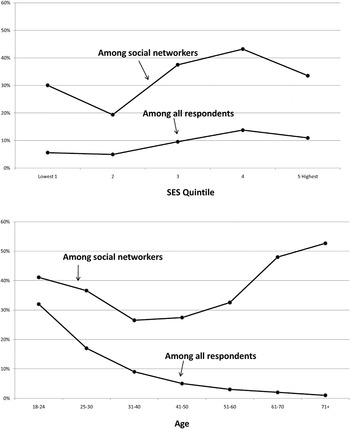
Figure 9 presents data about the proportion of respondents who report using a social networking site like MySpace or Facebook for political purposes: that is, who get any campaign or candidate information on the sites; start or join a political group or group supporting a cause on a social networking site; sign up as a “friend” of any candidates on a social networking site; or post political news for friends or others to read on a social networking site. Although it falls off in the highest SES category, overall the share of all respondents who indicated using a social networking site for at least one of the forms of political engagement rises with SES. When the denominator is changed to include just those respondents who use social networking sites, this pattern is less clear.
Percent politically engaged on social networking sites.

The data about age groups, shown in the bottom portion of the figure, are much more striking. In contrast to many forms of voluntary activity—in particular, offline political participation—social networking is the domain of the youngest adults. More than three-quarters, 78 percent, of those under twenty-five are social networkers. After that, the proportion who use social networking sites drops off sharply until it reaches a mere 3 percent among those over sixty. This age gradient in social network use is reflected in the proportion in each age group that are politically engaged on social network sites, which decreases sharply with age. When we consider the percentage of those on social networking sites who take advantage of their political functions, except for an unexpected shallow U-shape, there is no clear pattern linking age to social networkers' politically related use of social networking sites.
For several reasons, any conclusions about the extent to which Web 2.0 phenomena such as blogging and social networking have the potential to overcome the structuring of political participation by age and SES must be tentative. For one thing, many forms of political engagement on these venues do not fall squarely under the rubric of a definition of political participation as “activity that has the intent or effect of influencing government action—either directly by affecting the making or implementation of public policy or indirectly by influencing the selection of people who make those policies.”Footnote 44 At present, a social networking site like Facebook is more a forum for political talk than for organized political effort and the political groups formed are more about affinity than concerted political action. “Friending” a candidate is not the same as working in a campaign. What is written about political or social issues on Facebook pages or as comments on blogs may be read by friends or by no one at all and is less likely to be viewed by public officials or their staffs than are ordinary communications—whether those communications arrive by phone, mail, or e-mail. However, these interactive forms of political engagement may lead to modes of online and offline political participation, as conventionally understood. Besides, these modes of involvement, in particular on social networking sites, are changing so rapidly that they may well morph into new forms of activity aimed at political influence.
With respect to age and SES stratification, we are similarly cautious. At present, political engagement on blogs and social networking sites clearly overcomes the historical underrepresentation of younger citizens with respect to political activity. Since social networking is diffusing quickly among older cohorts, the extent to which the young will dominate in these venues is less certain. Besides, we cannot know whether the current techno-savvy generation will be trumped by their successors who are now in elementary school. That these forms of political engagement are used so disproportionately by the young makes it harder to know what to expect about their influence on the long-standing association between political activity and socio-economic status. Measuring SES among younger respondents is tricky. They may consider their family income to be that of their birth family, especially if they are still living at home, or that derived from their own earnings. Particularly among those who have not finished their educations, their own current incomes may not be especially predictive of their future earning power. Among those who are politically engaged on social networking sites, 44 percent are students, and 33 percent are students under twenty-five. For them, socio-economic status is under construction: if they graduate, the educational component of their eventual SES will, by definition, rise; their earning power will probably also increase. Thus, we consider it premature to conclude, as others have suggested, that interactive forms of online political participation hold the key to unlocking the association between political participation and socio-economic status.
Conclusion
If we began this inquiry hopeful that the political possibilities of the Internet might disrupt long-standing patterns of participatory inequality in American politics, what we have found has, by and large, showed those expectations to be unfounded. Whether we considered participatory acts—including the making of political contributions—that can be undertaken online, political discussions on the Internet, or political recruitment by e-mail, we have found little evidence that the association between SES and political activity is any different when politics is on the Internet. Not only does the digital divide mean that those who are lower on the socio-economic ladder are less likely to use the Internet or e-mail at least occasionally or to have broadband access at home, but among Internet users, there is a strong positive relationship between SES and—with the possible exception of political social networking—every measure of Internet-based political engagement we reviewed.
In contrast, the Internet seems to have the potential to ameliorate the well-known participatory deficit among those who have just joined the electorate. When it comes to online politics—whether political activity, political discussion, or requests for political action on the Internet—younger respondents are less underrepresented than they are offline. In fact, they are more likely than their elders to receive requests for political activity by e-mail and they dominate on blogs and politically relevant uses of social networking. However, we should note that these counter-stratificational tendencies are anchored in the digital divide. As is well known, young adults are much more likely than their elders to be comfortable with electronic technologies and to use the Internet. Their advantage is less obvious when those who do not use the Internet are eliminated from the analysis. In fact, the relatively few elderly Web users are particularly likely to exploit the political capacities of the Internet. Moreover, within generational groups, we found sharp SES stratification in online activity.
We cannot conclude without returning to our admonition that our findings, while quite consistent, are derived from a survey conducted during a historic presidential campaign. With respect to the particularities of the 2008 campaign, we might expect the campaign to have had a special appeal both to younger citizens and to those who are lower down on the SES ladder, thus ameliorating both forms of stratification ordinarily associate with political activity. Yet, when it comes to online activity, the consequences are more complicated, for younger citizens are advantaged—and those in lower SES groups disadvantaged—by the digital divide. Moreover, we should repeat that our findings might soon be considered obsolete. The political capacities of the Internet continue to develop with astonishing rapidity. In particular, we do not yet know the full implications for political involvement—and for the SES stratification of political participation—of political social networking. Moreover, the consequences of the Internet for inequalities of political voice depend upon what happens with the aging of the current cohort of younger adults. Are we witnessing a generational or a life-cycle phenomenon? Will the digital divide close, or will rapidly evolving technologies continue to leave behind those with low SES or high age? When middle-aged, will those now in their twenties announce their divorces on social networking sites? Will social networking provide a less class-stratified venue for politics or will income and education continue to exert their traditional power in structuring political involvement into new environments? Stay logged on.
Supplementary Materials
Explanatory File http://journals.cambridge.org/pps2010015
Statistical Tests of Differences between Offline and Online Participation http://journals.cambridge.org/pps2010016
SPSS Code for all Results http://journals.cambridge.org/pps2010017