Introduction
Post-operative haemorrhage is the most common major complication of endoscopic sinus surgery, with significant haemorrhage occurring in 1 per cent of procedures.Reference Stankiewicz, Lal, Connor and Welch1, Reference Ramakrishnan, Kingdom, Nayak, Hwang and Orlandi2 Bleeding leads to delayed patient discharge, which may extend to unplanned hospital admission, with associated hospital costs and patient inconvenience. More serious bleeding may require blood transfusion. Haemorrhage after sinus surgery is more likely to occur in patients with extensive nasal polyposis, or in those undergoing revision sinus surgery.Reference Stankiewicz, Lal, Connor and Welch1
A number of peri-operative interventions have been devised to reduce the risk of bleeding during or after sinus surgery. Pre-operative oralReference Sieskiewicz, Olszewska, Rogowski and Grycz3 or topicalReference Albu, Gocea and Mitre4 steroids can reduce bleeding in nasal polyposis patients, as can oral tranexamic acid.Reference Yaniv, Shvero and Hadar5 During surgery, the surgeon can employ the reverse Trendelenburg position,Reference Ko, Chuang and Su6 and use topical or locally injected adrenaline.Reference Panda, Verma and Panda7 Intra-operative beta-blockersReference Shen, Weitzel, Lai, Wormald and Ho8 or clonidineReference Mohseni and Ebneshahidi9 will reduce sinonasal blood flow, and intravenous tranexamic acidReference Alimian and Mohseni10 can help to promote coagulation. These interventions reduce intra-operative blood loss and improve the operative field, but do not prevent the risk of post-operative haemorrhage.
Many surgeons advocate the insertion of non-absorbable nasal packing following endoscopic sinus surgery. This can be removed hours or even days after surgery. However, nasal packing is not always required after nasal surgery.Reference Suzuki, Nakagawa, Yao, Sakamoto and Ito11 Moreover, removal of the packing is painful and delays patient discharge.Reference Saedi, Sadeghi and Farschi12 These factors have driven a search for alternative methods of haemostasis after sinus surgery, including the development of absorbable nasal packs and pro-thrombotic gels.
Absorbable nasal packs are made from biodegradable polymers. Packs made from gelatine,Reference Wee, Lee, Rhee and Kim13 hyaluronic acid,Reference Berlucchi, Castelnuovo, Vincenzi, Morra and Pasquini14–Reference Miller, Steward, Tami, Sillars, Seiden and Shete16 polyurethaneReference Shoman, Gheriani, Flamer and Javer17 and cellulose foamReference Szczygielski, Rapiejko, Wojdas and Jurkiewicz18 have been successfully trialled and shown to reduce post-operative haemorrhage. However, it is not clear whether they affect the risk of post-operative synechiae (adhesion) formation. Absorbable packs still cause significant pain, pressure and blockage. In addition, patients are divided over their preference for absorbable or non-absorbable packs.Reference Shoman, Gheriani, Flamer and Javer17
Gels or powders containing thrombin,Reference Beyea and Rotenberg19 fibrinReference Vaiman, Eviatar, Shlamkovich and Segal20 or tranexamic acidReference Athanasiadis, Beule and Wormald21 promote the formation of a fibrin and platelet clot at the site of application, and effectively reduce post-operative haemorrhage. They can also be applied to contoured or irregular mucosal surfaces. However, the fibrin and platelet clot induces a vigorous inflammatory reactionReference Lawson22 that increases the risk of post-operative synechiae.Reference Weitzel and Wormald23
More recent research has focused on gels and powders made from polysaccharides. These have the potential advantage of easy application to irregular mucosal surfaces, without obstructing the nose or inducing a vigorous inflammatory reaction. Both chitosan-dextran gelReference Valentine, Athanasiadis, Moratti, Hanton, Robinson and Wormald24 and microporous polysaccharide hemospheres (based on plant starch)Reference Antisdel, West-Denning and Sindwani25, Reference Antisdel, Matijasec, Ting and Sindwani26 are effective in achieving haemostasis after sinus surgery. In addition, both are rapidly absorbed with minimal tissue reaction. However, these products are not yet widely available.
Oxidised cellulose has long been used as a haemostatic agent but, surprisingly, has never been trialled in powder form in sinus surgery. Oxidised cellulose is widely available and comparatively inexpensive. We believed this could be a cost-effective method for promoting haemostasis after sinus surgery. We therefore undertook a randomised trial to investigate the effectiveness of oxidised cellulose powder in reducing the risk of post-operative complications following sinus surgery.
Materials and Methods
We recruited 50 consecutive adult patients undergoing bilateral endoscopic sinus surgery at Kettering General Hospital. This cohort included patients undergoing surgery for chronic rhinosinusitis with or without nasal polyps. Patients undergoing revision surgery, and those with coagulopathy, were excluded. We recorded the patient demographics and indication for surgery. A sample size of 50 was selected to allow us to ascertain whether or not bleeding with oxidised cellulose powder is rare. Significant bleeding in none of the 50 patients would indicate a 95 per cent confidence interval (CI) for the true rate of bleeding of less than 6 per cent (using a modified Wald method for calculating proportions). We decided that this was an acceptable rate for significant post-operative bleeding, given that such patients could receive nasal packing if necessary.
Ethical approval for this study was granted by the Leicestershire, Northampton and Rutland Research Ethics Committee (reference 07/H0402/45).
We used a split-body study design. At the end of the procedure, one side of the nasal cavity was chosen at random (toss of a coin) to be packed using a non-absorbable Merocel polyvinyl alcohol pack (Medtronic, Connecticut, USA). The other side was treated with Bloodcare oxidised cellulose powder (Anser Medical, Saffron Walden, UK), which was sprayed onto bleeding mucosal surfaces using the tip of a Zoellner suction device (Figure 1). All patients remained in hospital after surgery.
Endoscopic view showing oxidised cellulose powder applied to the right middle meatus following endoscopic sinus surgery.

The primary outcome measure was volume of post-operative haemorrhage in the first week. Secondary outcome measures were post-operative pain, patient preference, and crusting and synechiae formation up to three months post-operatively.
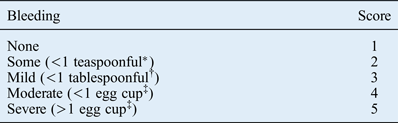
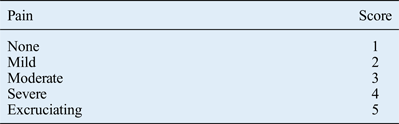
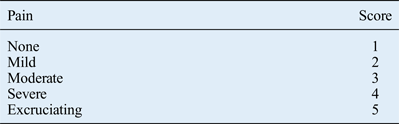
In the post-operative period, we estimated blood loss and recorded pain scores for each side of the nose. Both parameters were recorded using a five-point scale (Tables I and II). A nurse took recordings 2 hours after surgery, the morning after surgery (before removal of the polyvinyl alcohol pack), upon removal of the pack and 2 hours after removal of the pack (before hospital discharge). For the subsequent week, patients were asked to keep a diary of daily blood loss and pain, using the same five-point scale. We compared blood loss and pain in each side of the nose using the Wilcoxon signed-rank test.
Post-operative bleeding scoring system
*Approximately 5 ml; †approximately 20 ml; ‡approximately 40 ml
Post-operative pain scoring system
Patients were assessed by the operating surgeon at two to three weeks and at three months after surgery. At each visit, the surgeon endoscopically assessed the presence of crusting and synechiae in the nose, but was blind to which side had received each treatment. We compared the presence or absence of crusting and synechiae in both sides of the nasal cavity using a two-tailed Fisher's exact test. At the first post-operative visit, patients were also asked which method of haemostasis they preferred.
Results
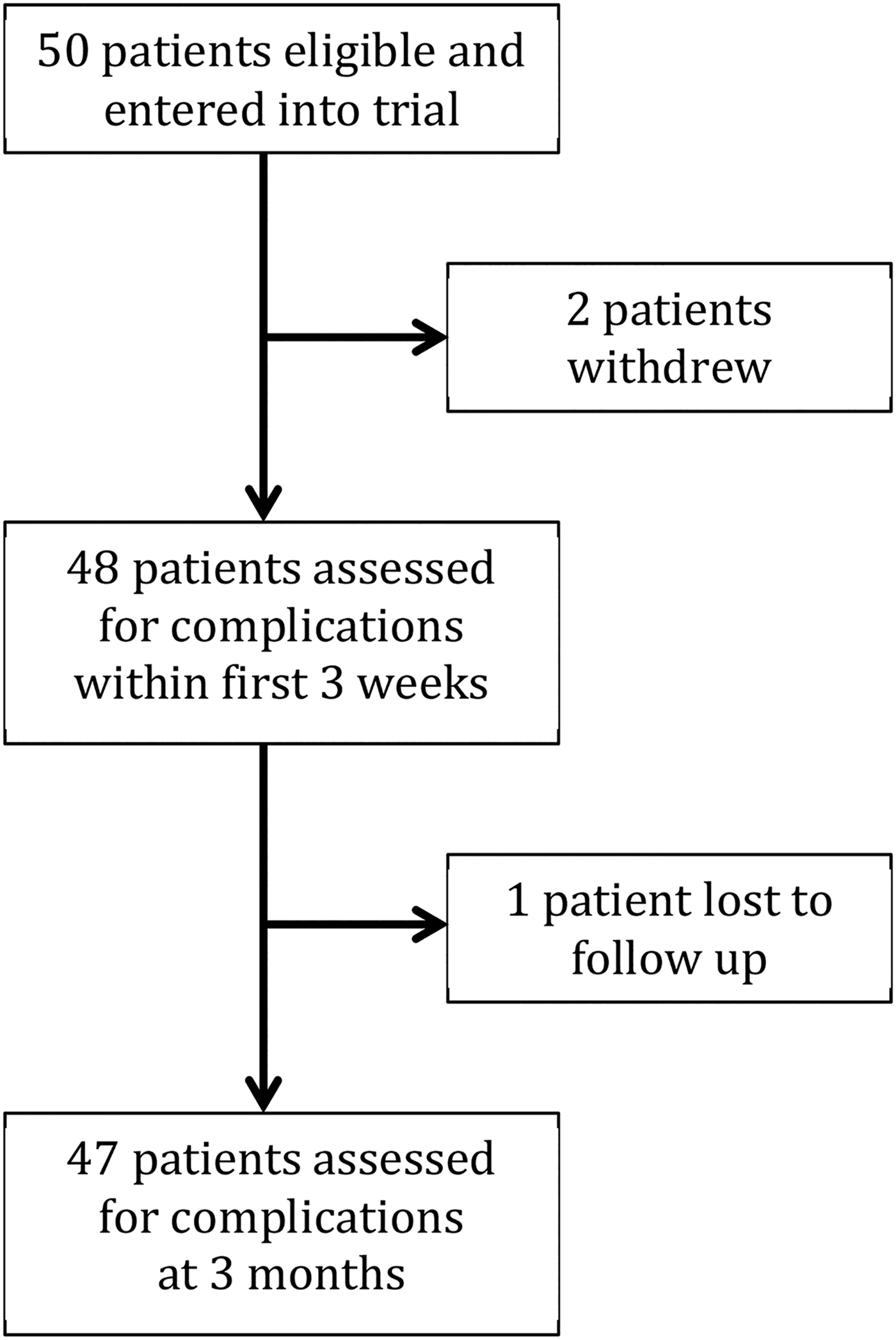
Two patients decided to withdraw from the study (for non-medical reasons), leaving 48 patients' data for analysis (Figure 2). One of the remaining patients did not attend the three-month follow up.
Flowchart for trial participants.
There were 26 males and 22 females; mean patient age was 49 years (range, 28–78 years). The indication for surgery was nasal polyposis in 19 patients, chronic mucopurulent rhinosinusitis in 16 patients, and both conditions in 13 patients.
All patients underwent bilateral endoscopic sinus surgery including uncinectomy, ethmoidectomy and middle meatal antrostomy, with nasal polypectomy where necessary. Oxidised cellulose powder was applied to the right nasal cavity in 27 cases and to the left in 21 cases.
Post-operative bleeding and pain scores are shown in Table III, together with p values for differences (obtained using the Wilcoxon signed-rank test). During the first 24 hours after surgery, both bleeding and pain scores were lower for the side treated with oxidised cellulose. There was also a trend for less bleeding in the side treated with oxidised cellulose at 4–7 days post-surgery. However, only four patients reported bleeding of more than a teaspoonful (bleeding score of 2) from either nostril after the fourth post-operative day. Most late bleeding was therefore clinically insignificant. No patient in this study had to return to the operating theatre.
Post-operative bleeding and pain scores by haemostasis method
Data represent mean score values unless indicated otherwise. *Wilcoxon signed-rank test. Surg = surgery; h = hours; OC = oxidised cellulose; PVA = polyvinyl alcohol; NS = not significant (p value too small to be assigned)
At 3 weeks after surgery, nasal crusting was present in 24 out of 48 of the nasal cavities treated with oxidised cellulose and in 22 out of the 48 treated with polyvinyl alcohol (Fisher's exact test, p = 0.838). Synechiae were present in 7 out of 48 nasal cavities treated with oxidised cellulose, and in 3 of the 48 treated with polyvinyl alcohol (p = 0.317).
After 3 months, nasal crusting was present in 3 out of the 47 nasal cavities treated with oxidised cellulose and in 3 out of the 47 treated with polyvinyl alcohol (Fisher's exact test, p = 1.0). Synechiae were present in 7 of the 47 nasal cavities treated with oxidised cellulose, and in 5 of the 47 treated with polyvinyl alcohol (p = 0.759).
Of the 48 patients, 41 (85 per cent; 95% CI = 75–95 per cent) preferred oxidised cellulose, 4 preferred the polyvinyl alcohol pack and 3 stated no preference.
Discussion
The best method for achieving haemostasis following sinus surgery is disputed.Reference Valentine and Wormald27 Biodegradable polymers have the advantage of not needing to be removed, but they can cause patient discomfort if administered as a solid pack.
In this study, we compared oxidised cellulose powder with non-absorbable packing (polyvinyl alcohol). Unsurprisingly, the use of oxidised cellulose powder led to significantly less pain in the immediate post-operative period. However, we also found oxidised cellulose powder to be better at preventing bleeding. None of the 48 patients in this study suffered significant post-operative bleeding. When questioned, 85 per cent of patients preferred oxidised cellulose powder to polyvinyl alcohol packing.
We found no evidence that oxidised cellulose powder causes more crusting or synechiae in the nose up to three months after surgery. Oxidised cellulose is known to induce minimal inflammatory reaction,Reference Chalupova, Suchy, Prazanova, Bartosova, Sopuch and Havelka28 and is usually absorbed from the surgical site within a few days of application. In this study, oxidised cellulose powder was compared with a polyvinyl alcohol pack, which is also known to induce little inflammatory reaction.
Our data suggest that oxidised cellulose powder is a good choice for haemostasis following sinus surgery. It is well tolerated by patients and does not cause nasal obstruction. It seems to be at least as effective as other currently available methods of absorbable nasal haemostasis, but is less expensive (Table IV). Other recently developed products, such as chitosan-dextran gel (PosiSep; Hemostasis, White Bear Lake, Minnesota, USA) and microporous polysaccharide hemospheres (Arista AH; Medafor, Minneapolis, Minnesota, USA) may offer similar efficacy, but are currently only available in the USA. Data on plans for marketing or pricing in the rest of the world are not yet available.
• Haemorrhage is the most common complication after sinus surgery
• Nasal packing is commonly used to reduce haemorrhage
• Its removal is painful and absorbable packing leads to nasal blockage
• Newer haemostatic agents are applied as powders or gels that coat bleeding mucosal surfaces
• Oxidised cellulose powder is an inexpensive, effective haemostatic agent after sinus surgery
Types and UK costs of common absorbable nasal haemostatic agents
NHS = National Health Service; Sept = September
This study has some limitations which may reduce the applicability of the findings. We included only 48 patients, and the study is therefore underpowered to detect low rates of haemorrhage. However, we feel that infrequent haemorrhage would not preclude the use of oxidised cellulose powder in a clinical context. A larger study would, of course, provide better estimates of the risks of haemorrhage and synechiae formation with cellulose powder. Further limitations are that the study was not conducted blind in the immediate post-operative period. However, this would be difficult, if not impossible, to achieve. In addition, our measurement tools have not been validated, but there are no agreed tools currently available to measure complications following sinus surgery. Our study does not include data on patient symptom outcomes, but that was not the intention of this study. It is also unclear whether our conclusions can be extended to other patient groups, such as those undergoing revision endoscopic sinus surgery or those presenting as an emergency with spontaneous epistaxis.
Despite these limitations, our data suggest that oxidised cellulose powder is a cost-effective and well-tolerated method for haemostasis following endoscopic sinus surgery. It appears to be at least as good as other currently employed methods of haemostasis, but has the following advantages: it is inexpensive, it can coat mucosal surfaces, it does not obstruct the nose after surgery and it is preferred (over non-absorbable packing) by the majority of patients.