Introduction
Approximately 10–14% of clinically recognized pregnancies end in pregnancy loss in Japanese and Caucasian populations. Notwithstanding progress in understanding the biology of early pregnancy and improving research methodology in reproductive epidemiology, the etiology of recurrent pregnancy loss (RPL) remains uncertain.Reference Cramer and Wise 1 – Reference Rai and Regan 4 Epidemiological studies have suggested that the condition may be multifactorial, with a possible genetic predisposition and involvement of environmental factors in its pathogenesis.Reference Cramer and Wise 1 , Reference Rai and Regan 4 , Reference Yamada, Sata, Saijo, Kishi and Minakami 5
Folate, which occurs naturally in food such as vegetables, beans, fruits, and whole grains, is necessary for the production and maintenance of new cells.Reference Kamen 6 This is especially important during periods of rapid cell division and growth, such as during pregnancy and infancy. The early embryo has an absolute requirement for folate that is met entirely from endogenous sources.Reference O'Neill 7 A deficiency in folate may also increase the levels of homocysteine, which is regarded as a marker of not only folate status but also risk for adverse pregnancy outcomes, such as RPL. The levels of homocysteine in RPL patients included in epidemiological studies have been inconsistent.Reference Vollset, Refsum and Irgens 8 – Reference Kumar, Govindaiah, Naushad, Devi and Jyothy 12 The common polymorphism C677 T (rs1801133) in the gene encoding methylenetetrahydrofolate reductase (MTHFR), which converts dietary folate to its active cofactor in homocysteine catabolism, results in reduced enzyme activity and in subsequently elevated homocysteine concentrations.Reference Frosst, Blom and Milos 13 , Reference Harmon, Woodside and Yarnell 14 Inconsistent associations between the genetic variant MTHFR C677 T and RPL have been reported.Reference Nelen, Blom, Steegers, den Heijer and Eskes 15 – Reference Ren and Wang 17 Other genetic polymorphisms of folate metabolism-related genes, such as those encoding 5-methyltetrahydrofolate-homocysteine methyltransferase (MTR) and 5-methyltetrahydrofolate-homocysteine methyltransferase reductase (MTRR), have few reports showing the relationship to RPL.
Fetal alcohol syndrome was first described by Jones and SmithReference Jones and Smith 18 as a pattern of mental and physical defects that can develop in a fetus in association with high levels of alcohol consumption during pregnancy. Recently, fetal alcohol spectrum disorders have been defined as a continuum of permanent birth defects caused by maternal consumption of alcohol during pregnancy.Reference Streissguth and O'Malley 19 Previous studies have reported that the relative risk of spontaneous abortion was significantly higher in women who were moderate alcohol drinkers.Reference Harlap and Shiono 20 – Reference Kesmodel, Wisborg and Olsen 22 However, genetic polymorphisms of alcohol metabolism-related genes, such as alcohol dehydrogenase 1B (ADH1B) and aldehyde dehydrogenase 2 (ALDH2), have few reports showing the relationship to RPL.
Several studies reported that obesity is associated with increased risk of RPL.Reference Lashen, Fear and Sturdee 23 – Reference Boots and Stephenson 25 Genetic polymorphisms of energy metabolism-related genes, such as the beta-3-adrenergic receptor (ADRB3) gene and the peroxisome proliferator-activated receptor gamma (PPARG) gene, are associated with obesity, especially when accompanied with high-energy intake.Reference Miyaki, Sutani and Kikuchi 26 – Reference Cecil, Watt, Palmer and Hetherington 30 Although ADRB3 and PPARG polymorphisms have little direct relationship to RPL in isolation, the combined effects of genetic and environmental factors on insulin resistance were suggested to be associated with reduced fetal growth in relation to ADRB3 and PPARG polymorphisms.Reference Jaquet, Trégouët and Godefroy 31 Moreover, given the important roles of ADRB3 and PPARG during pregnancy, a decline in their functions may predispose pregnant women to RPL. Enhanced expression of PPARG in abortive extravillous trophoblasts may be linked to miscarriage, and upregulation of PPARs appears to compensate for either activated immune response or disturbed cytotrophoblast differentiation in patients with RPL.Reference Toth, Bastug and Mylonas 32 , Reference Toth, Jeschke and Rogenhofer 33 The aim of this study was to elucidate the associations between the risk of RPL and maternal gene polymorphisms related to the generation of energy and the metabolism of folate and alcohol.
Materials and methods
This case–control study was performed in the city of Sapporo, Japan from 2003 to 2007. We conducted the self-administered questionnaire survey to 116 women with a history of RPL, and 306 women with pregnancies that resulted in live births. All patients were obstetrically managed in the Hokkaido University Hospital. Excluded from the study were the RPL women with either a uterine conformational abnormality or with couples’ balanced-type chromosomal translocation. Fertile women who had a history of endometriosis, infertility or who had delivered small-for-gestational-age babies were also excluded. The questionnaire provided information on medical and obstetric history, maternal age and smoking and alcohol habits before and during recent pregnancy. All of the patients with RPL and controls were native Japanese, and resided in Sapporo and the surrounding areas in Japan. In recent times, this geographical region has witnessed little immigration by different ethnic groups. We defined women as having RPL if they had a history of two or more consecutive pregnancy losses. All women with RPL were subjected to (i) examination by ultrasound and hysterosalpingography for detection of anatomical abnormalities of the genital tract, (ii) chromosome karyotypic analyses of peripheral blood and (iii) additional screening for RPL. The women who had RPL were significantly older than the control subjects (mean 34.2 v. 31.1 years, P < 0.01). This study was conducted with the informed consent of all subjects, and approved by the institutional ethical board for human gene and genome studies of Hokkaido University Graduate School of Medicine and National Institute of Public Health.
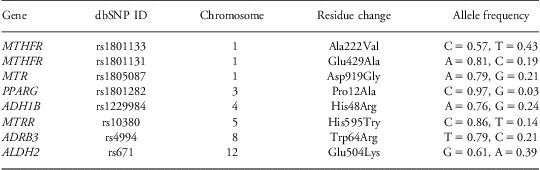
We selected eight single nucleotide polymorphisms (SNPs) of genes related to the metabolism of folate, alcohol and energy: rs1801133 (Ala222Val) and rs1801131 (Glu429Ala) in MTHFR, rs1805087 (Asp919Gly) in MTR, rs10380 (His595Try) in MTRR, rs1229984 (His48Arg) in ADH1B, rs671 (Glu504Lys) in ALDH2, rs4994 (Trp64Arg) in ADRB3 and rs1801282 (Pro12Ala) in PPARG. Except for PPARG, their minor allele frequency was at least 10% in the Japanese population according to the SNP database of the International HapMap Project (http://hapmap.ncbi.nlm.nih.gov/). Each polymorphism predicted a functional change because it caused an amino acid substitution in the coding region of the affected gene (Table 1).
Eight folate, alcohol and energy metabolism-related gene polymorphisms and allele frequencies in the control group

SNP, single nucleotide polymorphism; MTHFR, methylenetetrahydrofolate reductase; MTR, 5-methyltetrahydrofolate-homocysteine methyltransferase; PPARG, peroxisome proliferator-activated receptor gamma; ADH1B, alcohol dehydrogenase 1B (class I), beta polypeptide; MTRR, 5-methyltetrahydrofolate-homocysteine methyltransferase reductase; ADRB3, beta-3-adrenergic receptor; ALDH2, aldehyde dehydrogenase 2 family (mitochondrial).
Blood samples were collected at the Department of Obstetrics in the Hokkaido University Hospital. Genomic deoxyribonucleic acid (DNA) was extracted from the peripheral blood using the QIAamp or EZ1 DNA Blood kit (QIAGEN GmbH, Hilden, Germany), according to the manufacturer's instructions. We genotyped each polymorphism by allelic discrimination using fluorogenic probes and the 5′ nuclease (TaqMan) assay, as previously described.Reference Sata, Yamada and Suzuki 34 TaqMan SNP Genotyping Assays for each polymorphism were obtained from Applied Biosystems (Foster City, CA, USA). All probe–primer sets were designed to function using universal reaction and cycling conditions. Genotyping was performed in 10-μl reactions containing ∼40 ng genomic DNA, 0.5 μl 20× TaqMan SNP Genotyping Assay Mix [consisting of unlabeled polymerase chain reaction (PCR) primers, and 6-FAM and VIC dye-labeled TaqMan MGB probes], and 5.0 μl of 2× TaqMan Universal PCR Master Mixture. Real-time PCR was performed on a 7500 real-time PCR system (Applied Biosystems), using a protocol consisting of incubation at 50°C for 2 min and 95°C for 10 min, followed by 40 cycles of denaturation at 92°C for 15 s, and annealing/extension at 60°C for 1 min. The FAM and VIC fluorescence levels of PCR products were measured at 60°C for 1 min, resulting in clear identification of all three genotypes in these polymorphisms on a two-dimensional graph. The absence of contamination was confirmed using a control-lacking template. Samples that were not clearly classified into genotypes during the first experiment and a small number of samples were analyzed using positive controls as well as the control, which lacked template. Finally, at least two researchers or technicians confirmed that all the samples were clearly classified into genotypes.
The differences in frequency of each characteristic between the RPL and control groups were examined by a χ 2 test. An unconditional logistic regression model was used to evaluate the associations between each genotype and RPL. We calculated age-adjusted and multi-adjusted odds ratios (ORs) and 95% confidence intervals (CIs) for each genotype, together with dominant and recessive genotype models, by unconditional logistic regression analysis (Tables 2 and 3). The subjects’ ages (continuous), cigarette smoking status (none = 0 and continuous = 1) and alcohol use (none = 0 and continuous = 1) during pregnancy were considered as the confounding factors (Table 3). Hardy–Weinberg equilibrium analyses were performed to compare observed and expected genotype frequencies using a χ 2 test. Statistical analyses were performed using Statistical Package for the Social Sciences (SPSS) software for Windows, version 15.0 (SPSS, Chicago, IL, USA).
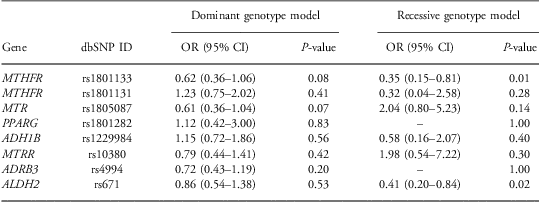
Age-adjusted associations between eight folate, alcohol and energy metabolism-related gene polymorphisms, and recurrent pregnancy loss

SNP, single nucleotide polymorphism; OR, odds ratio; CI, confidence interval; MTHFR, methylenetetrahydrofolate reductase; MTR, 5-methyltetrahydrofolate-homocysteine methyltransferase; PPARG, peroxisome proliferator-activated receptor gamma; ADH1B, alcohol dehydrogenase 1B (class I), beta polypeptide; MTRR, 5-methyltetrahydrofolate-homocysteine methyltransferase reductase; ADRB3, beta-3-adrenergic receptor; ALDH2, aldehyde dehydrogenase 2 family (mitochondrial).
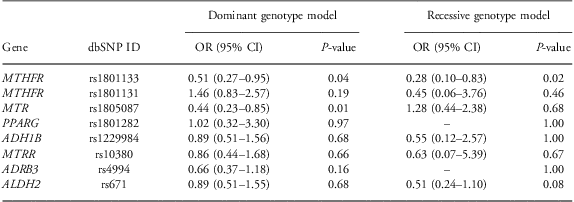
Multi-adjustedFootnote a associations between recurrent pregnancy loss and eight gene polymorphisms related to the metabolism of folate, alcohol and energy

SNP, single nucleotide polymorphism; OR, odds ratio; CI, confidence interval; MTHFR, methylenetetrahydrofolate reductase; MTR, 5-methyltetrahydrofolate-homocysteine methyltransferase; PPARG, peroxisome proliferator-activated receptor gamma; ADH1B, alcohol dehydrogenase 1B (class I), beta polypeptide; MTRR, 5-methyltetrahydrofolate-homocysteine methyltransferase reductase; ADRB3, beta-3-adrenergic receptor; ALDH2, aldehyde dehydrogenase 2 family (mitochondrial).
a Adjusted to subjects’ age (continuous), cigarette smoking status (none = 0 and continuous = 1) and alcohol use (none = 0 and continuous = 1) during pregnancy.
Results
Without consideration of cigarette smoking or alcohol use, the risk of RPL significantly decreased in women with MTHFR rs1801133 TT, MTR rs1805087 AG or ALDH2 rs671 AA genotypes, compared with homozygous wild-type genotypes (P < 0.05). In the recessive genotype model, the ORs for the risk of RPL of MTHFR rs1801133 and ALDH2 rs671 polymorphisms were 0.35 (95% CI, 0.15–0.81) and 0.41 (95% CI, 0.20–0.84), respectively (Table 2). Other polymorphisms had no significant association with RPL in the dominant or the recessive genotype models.
With consideration of cigarette smoking and alcohol use, the risk of RPL significantly decreased in women carrying either the MTHFR rs1801133 TT or MTR rs1805087 AG allele (P < 0.05). The ORs for the risk of RPL of MTHFR rs1801133 polymorphism in the dominant and recessive genotype models were 0.51 (95% CI, 0.27–0.95) and 0.28 (95% CI, 0.10–0.83), respectively (Table 3). Similarly, the OR of MTR rs1805087 polymorphism in the dominant genotype model was 0.44 (95% CI, 0.23–0.85; Table 3). Other polymorphisms, including ALDH2 rs671, were not significantly associated with RPL in the dominant or the recessive genotype models.
Discussion
Epidemiological studies have provided evidence that a series of lifestyle factors can increase the risk of miscarriage.Reference Christiansen, Nybo Andersen and Bosch 35 There is a good evidence that obesity,Reference Lashen, Fear and Sturdee 23 – Reference Boots and Stephenson 25 moderate-to-high alcohol consumptionReference Harlap and Shiono 20 – Reference Kesmodel, Wisborg and Olsen 22 and more than 300 mg daily caffeine intakeReference Rasch 36 – Reference Sata, Yamada and Suzuki 40 can each significantly increase the risk of miscarriage. Folate deficiency can occur because dietary folate intake is low or because the metabolic requirement for folate is increased by a particular genetic defect or defects.Reference Scholl and Johnson 41 A metabolic effect of folate deficiency is an elevation of blood homocysteine, which may be associated with increased RPL.Reference Nelen, Blom, Steegers, den Heijer and Eskes 15 , Reference Scholl and Johnson 41 Among eight lifestyle-related genetic polymorphisms investigated in the present study, only the MTHFR C677T polymorphism has been well investigated in relation to unexpected RPL. A meta-analysis of 26 studies, including 2120 cases with unexpected RPL and 2949 controls, revealed that OR values for 17 studies were >1.0 in the recessive genotype model, and estimated to be <1.0 for eight studies, with no OR values estimated for one study.Reference Ren and Wang 17 Overall random-effect ORs of 1.40 (95% CI, 1.11–1.77) were found for TT v. CT and CC genotypes combined (in the recessive genotype model). Stratified analysis showed that significant strong associations between the MTHFR C677T polymorphism and unexpected RPL were only present in the five Chinese studies (ORs = 2.30 for TT v. the CT + CC genotype). No such associations were observed in the other studies, including those conducted in European countries.Reference Ren and Wang 17
In contrast, there were two Japanese studies with an estimated ORs of 0.54 (95% CI, 0.23–1.29) or 0.51 (95% CI, 0.15–1.79). Although the OR values in these studies were <1.0, the differences with control subjects were not significant.Reference Makino, Nakanishi and Sugiura-Ogasawara 42 , Reference Kobashi, Kato and Morikawa 43 However, one study reported that the frequency of the T allele in the fetal loss group, consisting of 40 women with a history of one or more unexplained mid-trimester or third-trimester intrauterine fetal deaths and/or intrauterine growth restrictions, was significantly lower than in controls (P < 0.001).Reference Makino, Nakanishi and Sugiura-Ogasawara 42 Similarly, in the present study, the frequency of the T allele in the patients with RPL was significantly lower than in controls (P < 0.05). Thus, whereas the risk of RPL seemed rather reduced for the T allele compared with the C allele in a Japanese population, risk was increased for the same allele in a Chinese population. Additionally, there were no differences in the plasma homocysteine levels between the cases and the controls in the former study, which involved Japanese subjects.Reference Makino, Nakanishi and Sugiura-Ogasawara 42 In contrast, only a few studies investigated the MTHFR rs1801131 (A1298C) polymorphism compared with RPL, but most found no significant association by itself.Reference Hohlagschwandtner, Unfried and Heinze 44 , Reference Kim, Choi and Kang 45 To date, there is little known about how the MTR rs1805087 (Asp919Gly) or MTRR rs10380 (His595Try) polymorphism is related to RPL. However, serum folate and folate metabolism-related gene polymorphisms, such as MTHFR rs1801133 and MTR rs1805087, were determinants of total homocysteine levels.Reference Barbosa, Stabler and Machado 46 Low-dose folic acid supplementation provided the strongest decline of total homocysteine concentrations in women carrying the homozygous TT genotype in MTHFR rs1801133 polymorphism.Reference Nelen, Blom and Thomas 47 Dietary supplementation with folic acid might potentially prevent adverse programming in utero, particularly for susceptible pregnant women.
As previously mentioned, epidemiological studies have suggested that the condition of RPL may be multifactorial, with a possible genetic predisposition as well as environmental influences on its pathogenesis.Reference Cramer and Wise 1 , Reference Rai and Regan 4 , Reference Yamada, Sata, Saijo, Kishi and Minakami 5 Although there is considerable evidence that obesity and alcohol use significantly increase the risk of miscarriage, Reference Harlap and Shiono 20 – Reference Boots and Stephenson 25 little is known about the interaction between food intake and energy and alcohol metabolism-related genetic polymorphisms for RPL. Moreover, the risk of RPL in each patient is probably determined by the interaction of many genetic variants and environmental factors, only a few of which have been identified.Reference Christiansen, Steffensen, Nielsen and Varming 48 Recent investigations showed that RPL is a multifactorial-polygenetic disease.Reference Yamada, Sata, Saijo, Kishi and Minakami 5 , Reference Christiansen, Steffensen, Nielsen and Varming 48 Genome-wide association studies (GWAS) have led to a rapid increase in available data on common genetic variants and phenotypes and numerous discoveries of new loci associated with susceptibility to common complex diseases.Reference Khoury, Bertram and Boffetta 49 Integrating the evidence from GWAS and candidate gene studies depends on concerted efforts in data production, online publication, database development and continuously updated data synthesis.Reference Khoury, Bertram and Boffetta 49 Christiansen et al. (2008) proposed the optimal future scenario in which every couple can enter information into a computer-based algorithm, which would analyze relevant clinical factors in the context of results based on screening of 50–100 validated genetic biomarkers, their individual strengths of association with RPL and the extent of their epistatic interaction.Reference Christiansen, Steffensen, Nielsen and Varming 48 Recently, a few investigators conducted genome-wide studies of RPL.Reference Wang, Wang, Xie, Liu and Yang 50 , Reference Kolte, Nielsen and Moltke 51 We emphasize the importance of further investigations, such as GWAS, to conduct individual prevention and treatment of RPL based on sufficient information of each individual's susceptibility.
In conclusion, our findings suggested that the risk of RPL might be decreased due to gene polymorphisms related to maternal folate metabolism. Further molecular epidemiological studies are needed to unequivocally elucidate the multifactorial effects of both genetic and environmental factors on human fecundity.
Acknowledgments
This work was supported in part by Grants-in-aid for Scientific Research from the Japan Society for the Promotion of Science and the Japan Ministry of Health, Labour, and Welfare.