Introduction
Since publication of the theory of island biogeography (MacArthur and Wilson Reference MacArthur and Wilson1963, Reference MacArthur and Wilson1967), many authors have examined how area and isolation jointly influence island biodiversity (Kotze Reference Kotze2008). A common approach is to compare biotic communities on islands with their nearest mainland counterparts (MacArthur and Wilson Reference MacArthur and Wilson1963, Reference MacArthur and Wilson1967; Niemelä et al. Reference Niemelä, Haila, Ranta, Tiaine, Vepsäläinen and Ås1985; Kotze and Niemelä Reference Kotze and Niemelä2002). Island biotas are generally less species-rich than comparable mainland areas and this has been attributed among other things to island area, distance from mainland, and habitat diversity on islands (MacArthur and Wilson Reference MacArthur and Wilson1963, Reference MacArthur and Wilson1967; Järvinen and Ranta Reference Järvinen and Ranta1987; Niemelä et al. Reference Niemelä, Haila and Halme1987; Ås et al. Reference Ås, Bengtsson and Ebenhard1997).
Several hypotheses have been proposed to explain why diversity increases with island area (see Connor and McCoy Reference Connor and McCoy1979). The theory of island biogeography explains species number as a dynamic equilibrium between extinction and immigration rates, such that small, isolated islands have greater extinction rates and low immigration rates, and thus have lower diversity than larger more proximate islands (MacArthur and Wilson Reference MacArthur and Wilson1963, Reference MacArthur and Wilson1967). In contrast, the “passive sampling” hypothesis posits that large islands have higher diversity simply because they provide larger interception targets and hence simply receive larger samples from the mainland species pool (Connor and McCoy Reference Connor and McCoy1979). Under this latter hypothesis, island assemblages and species diversity on islands are strictly the product of a sampling phenomenon that fosters higher immigration rates for larger interception targets (Connor and McCoy Reference Connor and McCoy1979), and explanation does not require additional island factors like extinction rates being inversely related to island size from the theory of island biogeography (MacArthur and Wilson Reference MacArthur and Wilson1963, Reference MacArthur and Wilson1967).
In this study, we examined support for these two neutral biodiversity theories (theory of island biogeography and “passive sampling” hypothesis) using data about ground beetles on islands in Lac la Ronge, and contrasted the explanations with those from a non-neutral perspective where species traits influence occupancy and species richness.
Methods
Site description and island characteristics
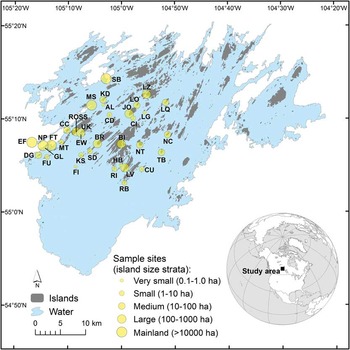
This study was conducted during summer 2013 on the islands and shoreline of Lac la Ronge, a 1413 km2 boreal lake in Saskatchewan, Canada (55°06'N, 105°01'W, Fig. 1). This region was covered by the Laurentide Ice Sheet and during melting of glacial ice ~10 200–9800 before present (Teller and Leverington Reference Teller and Leverington2004) this lake was the northwestern extent of Lake Agassiz. The southern margin of the Canadian Shield intersects the lake, creating geologically distinct regions to the north and south. The southern basin is formed by gravel, sand, and clay of glacial origin and thus has very few islands. In contrast, the central and northern reaches are characterised by rugged contours of Precambrian igneous and metamorphic bedrock (Rawson and Atton Reference Rawson and Atton1953) that give shape to ⩾1300 islands, ranging in size from <0.1 to 980.7 ha (Fig. 1). An embankment dam on the northeastern shoreline regulates the water level of the lake (surface elevation: 364.0 m±0.18 standard deviation, 1970–2008) such that island size does not vary much within and among years.
Map of islands (grey) and mainland (white) of Lac La Ronge, Saskatchewan, Canada. Yellow circles indicate sampling locations and size categories for each site. Refer to Table 1 for island abbreviations.

The rocky islands in the lake are similar forested rocky outcrops characterised by shallow soils of glacial origin and mixedwood forests, which are quite homogenous across the islands. Forest composition is characteristic of the transition between mid-boreal lowland and mid-boreal upland forest, with similar mixtures of Picea glauca (Moench) Voss (Pinaceae), Abies balsamea (Linnaeus) Miller (Pinaceae), and Betula papyrifera Marsh (Betulaceae) with occasional Populus tremuloides Michaux (Salicaceae), Populus balsamifera Linnaeus (Salicaceae), Picea mariana (Miller) Britton, Sterns, and Poggenburg (Pinaceae), and Pinus banksiana Lambert (Pinaceae) occurring on each island. Wildfire is common to the region, but noticeably less common on islands (Nielsen et al. Reference Nielsen, DeLancey, Reinhardt and Parisien2016).
We compared assemblages of forest-dwelling carabid beetles among 30 of these rocky islands that varied in size from 0.2 to 980.7 ha (Table 1), and with those from five forest stands on the adjacent mainland. We focussed on forest habitats because these relatively uniform forests comprise the majority of habitat available (80–90%) for carabid populations on the islands. Although there are ~250 cabins on the islands, most are on small parcels of leased land with disturbance of habitat surrounding cabins prohibited. Consequently, the islands have not experienced significant alteration of their habitat. Cabins were present on nine of islands sampled, and in these cases, our forest transects were a minimum of 200 m from the cabin to avoid any potential influence of anthropogenic impacts. Our focus on forest habitat reduced the influence of habitat heterogeneity as a factor in our study, and the likelihood of alternate explanations for species-area relationships (i.e., the “habitat diversity” hypothesis, Williams Reference Williams1964) that might confound our tests of the theory of island biogeography and “passive sampling” hypothesis as explanations for these island carabid assemblages.
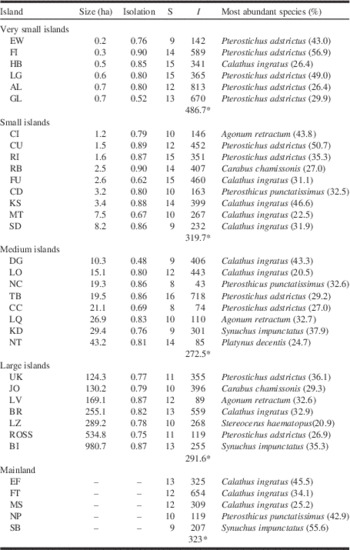
Number of islands within each island size category, their isolation index, raw species richness (S), and number of individuals captured per island (I).

Note: The most abundant species and their relative proportion of the total catch on the island are also given.
* Average number of individuals per island class. The islands are letter coded corresponding to Fig. 1.
Island area is a measure of interception target essential for evaluating both the explanatory ability of the theory of island biogeography and “passive sampling” hypothesis. Areas were determined using geographic information system (GIS) software (Table 1; ArcGIS 10.3, Environmental Systems Research Institute 2011) and categorised as very small (0.1–1.0 ha), small (1.01–10 ha), medium (10.01–100 ha), and large (100.01–1000 ha; Table 1) for the purpose of stratifying sampling effort with respect to island size.
Island isolation was measured two ways, as follows. (1) Nearest distance to mainland was measured to the perimeter of each island using the ruler tool in GIS software. Distance to mainland for islands varied from 0.1 to 10.7 km (Table 1). In general, there was equal representation of area-by-isolation combinations among study islands such that there was no trend for isolated islands to be small or vice versa (P=0.95). (2) Because of the natural “clustered” nature of the islands on Lac la Ronge and the possibility of individuals immigrating from both mainland and neighbouring-island species pools, we also used distance buffers to measure the amount (proportion) of water surrounding each island. To do this, we converted a vector shapefile for Lac la Ronge and the surrounding area (mainland included) to a binary raster grid (1 – water; 0 – land) with a cell size of 5 m and calculated the proportion of water within each buffer distance (5000 and 10 000 m). In an effort to consider both spatial scales, we used the average proportion of water between these two distance buffers and used this as an isolation index for each island. For analyses of carabid assemblages, islands were categorised as either “more isolated” (isolation index ⩾0.8, distance from mainland ⩾6.2 km) or “less isolated” (isolation index <0.8, distance from mainland <6.2 km) because this corresponded to a natural break of 15 sampled islands per category.
Sampling protocol and species identification
Carabid beetles were sampled continuously between 2 June and 23 August 2013 (the approximate frost-free period for La Ronge, Saskatchewan; http://climate.weather.gc.ca/climate_normals). Our sampling design compares carabids captured from equal areas within forest habitat on the islands in order to distinguish between the theory of island biogeography and the “passive sampling” hypothesis based on predictions that arise for data obtained by using equivalent sample effort/area (Kelly et al. Reference Kelly, Wilson and Mark1989; Gotelli and Graves Reference Gotelli and Graves1996). On the one hand, the theory of island biogeography predicts a positive correlation between species richness per unit area and island size, and an inverse relationship between species number and isolation. On the other hand, “passive sampling” hypothesis predicts no relationship between species richness per unit area and island size, and the presence of generally similar carabid assemblages among islands and between islands and the mainland.
Carabid assemblages were sampled using eight sleeved pitfall traps (1 L with a smaller 0.5 L inner cup; Spence and Niemelä Reference Spence and Niemelä1994) at each site, for a total of 280 pitfall traps. Traps were distributed along a 120-m transect at each site, with traps spaced at 15-m intervals, starting 7.5 m on each transect, thus ensuring a more representative catch (Digweed et al. Reference Digweed, Currie, Cárcamo and Spence1995). An opaque wooden lid (15×15 cm) was suspended 2–3 cm above the trap to prevent debris and excess rainwater from clogging the trap (Work et al. Reference Work, Buddle, Korinus and Spence2002). Traps were emptied at ~14–17-day intervals, depending on weather that affected lake conditions, and re-filled again at each check with 2–3 cm of propylene glycol. Samples were stored in 90% ethanol until identification.
Adult carabids were identified to species using Lindroth (Reference Lindroth1969) and names were applied according to Bousquet (Reference Bousquet2010). We included Trachypachus holmbergi Mannerheim (Coleoptera: Trachypachidae) in the analysis because of its abundance in our study, widespread interest in the species among coleopterists, and its similarity and apparently close relationship to carabids (Lindroth Reference Lindroth1969; Bell Reference Bell1982). Voucher specimens are deposited in the Strickland Museum, Edmonton, Alberta, Canada, and with the collection of the Water Security Agency in Saskatoon, Saskatchewan, Canada.
Data analysis
Multiple regression, performed in R (R Development Core Team 2013), was used to test the effect of island area and isolation on species richness and evenness given equal sampling effort per island. A global model was used to measure the effect of island area while accounting for the effect of isolation (and vice versa, see Table 3). Number of trap days was used as a covariate (mean=551 days, standard deviation=29 days) in the analysis of species richness to account for slight differences in trapping effort due to lost or damaged traps. Such loss occurred for only one or two traps in any given sampling interval, such that there was no systematic phenological bias reflected in our samples. Residuals for both the species richness and species evenness models met the assumptions of normality (Shapiro–Wilk test) and equal variance. Rank-abundance curves were calculated using the “BiodiversityR” package in R (Kindt and Coe Reference Kindt and Coe2005).
Carabid assemblages were compared among island classes and mainland, and between island isolation categories using non-metric multidimensional scaling with Bray–Curtis distances. For this analysis, carabid abundances were standardised (total individuals per trap day) to account for the few traps that were lost. Stress and optimal number of dimensions were calculated using the “vegan” package in R (Oksanen et al. Reference Oksanen, Blanchet, Kindt, Legendre, Minchin and O’Hara2015), with stress values ranging between 0.10 and 0.20, as considered to indicate adequate representation of two-dimensional non-metric multidimensional scaling solutions (Clarke and Warwick Reference Clarke and Warwick2001). Ellipses projected onto the ordination plot represented 95% confidence intervals for the mainland and island size categories. Centroids of the 12 most abundant species were calculated to estimate average locations of each species in the ordination space (Bergeron et al. Reference Bergeron, Spence and Volney2011).
Results
Carabidae dominance and diversity
In total, we collected 11 632 carabids representing 39 species (Supplementary Appendix 1). All species collected on the islands were previously known from Saskatchewan (Hooper and Larson Reference Hooper and Larson2012; Bousquet et al. Reference Bousquet, Bouchard, Davies and Sikes2013), except Pterostichus brevicornis (Kirby). The two female individuals of this species, one each collected from Love Island (55°04'48"N, 104°59'21"W) and Orr Island (55°07'13"N, 104°56'32"W; islands “NT” and “LV”, respectively; see Supplementary Appendix 1), are the first records from Saskatchewan. In general, the asymptotic shape of the species accumulation curves for each island class and the mainland indicates that the majority of species were sampled within the forested habitats that we targeted. However, a more steeply ascending curve suggests that the fauna was less well sampled for medium-sized islands (see Supplementary Appendix 2).
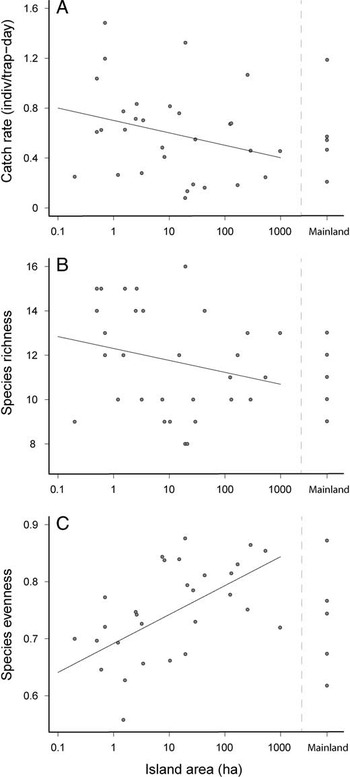
Two species, Calathus ingratus Dejean and Pterostichus adstrictus Eschscholtz, accounted for 47% of the overall sample, and one of them was also most abundant on 19 islands and at three mainland sites (Table 1). These species, together with the next 10 most abundant species (Platynus decentis (Say), Agonum retractum LeConte, Stereocerus haematopus (Dejean), Synuchus impunctatus (Say), Pterostichus punctatissimus (Randall), Carabus chamissonis Fisher von Waldheim, Carabus taedatus Fabricius, Pterostichus pensylvanicus LeConte, T. holmbergi, and Agonum gratiosum (Mannerheim)), accounted for 98.8% of the total catch. The total number of individual carabids caught and average number of individuals varied considerably and idiosyncratically among island classes (Table 1). Although average carabid abundance was greater on smaller islands (Table 1), variance was such that overall catch rate showed no significant linear relationship with island area (R 2=0.08, P=0.14, Fig. 2A).
Relationship between island area (log10) and (A) total catch rate (R 2=0.08, P=0.14; mainland: 0.60±0.16 standard error); (B) species richness (R 2=0.05, P=0.22; mainland: 11±1.58 standard error); (C) species evenness (R 2=0.33, P<0.001; mainland: 0.74±0.04 standard error) on the islands of Lac la Ronge.

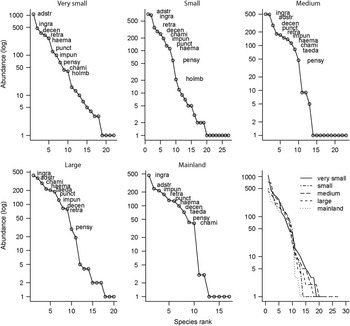
Rank-abundance graphs revealed a distinct shift in relative abundances of species with increasing island area (Fig. 3). Pterostichus adstrictus (body length: 11.3 mm, wing condition: macropterous) was the dominant species on very small (0.1–1.0 ha) and small (1.01–10.0 ha) islands, while relative abundances of C. ingratus (8.8 mm, dimorphic) increased to the point of dominating samples on medium (10–100 ha) and large (100–1000 ha) islands, as well as in mainland sites. The small-bodied species (see Supplementary Appendix 1), A. retractum (6.9 mm, dimorphic) was among the five most abundant species on very small, small, and medium islands, while declining to the ninth most abundant species on large islands, despite being caught in moderate abundance on the mainland. Similar patterns were observed for T. holmbergi (4.8 mm, macropterous), which was among the top 10 most abundant species on very small and small islands, but was less abundant in medium and large island classes, as well as mainland sites. The opposite pattern was observed for large-bodied species. For example, C. taedatus (21.5 mm, brachypterous), was relatively rare on very small and small islands, but was the ninth and fifth most abundant species on medium and large islands, respectively. Similarly, Carabus chamissonis (14.5 mm, brachypterous), was the third most commonly collected species on large islands, but only the ninth, fifth, and eighth most abundant on very small, small and medium islands, respectively (Fig. 3).
Rank-abundance curves for the 10 most abundant carabid species in each island class: very small (0.1–1.0 ha, n=6), small (1–10 ha, n=9), medium (10–100 ha, n=8), large (100–1000 ha, n=7), and mainland (n=5). Abbreviations of beetle species are as follows: adstr, Pterostichus adstrictus; chami, Carabus chamissonis; decen, Platynus decentis; impugn, Synuchus impunctatus; ingra, Calathus ingratus, haema, Stereocerus haematopus; holmb, Trachypachus holmbergi; pensy, Pterostichus pensylvanicus; punct, Pterostichus punctatissimus; retra, Agonum retractum; taeda, Carabus taedatus.

Presence of particular species varied considerably among islands. For example, P. adstrictus and C. ingratus were found on all islands where A. retractum, P. decentis, P. punctatissimus, S. haematopus, and S. impunctatus were also common (> 80% prevalence). In contrast, A. gratiosum and C. taedatus were only collected on 37% of the islands. Trachypachus holmbergi was collected on only 30% of the islands, and was not collected at mainland sites. Carabus chamissonis was present on most of the islands (80%) although four of the six islands where it was not collected were <2 ha in size. A similar pattern was observed in C. taedatus which, aside from a single individual collected on island “LG” (Table 1, Supplementary Appendix 1), was absent in samples from the 14 smallest islands (⩽7.5 ha). An opposite pattern was observed for the small-bodied, winged species, A. gratiosum (7.8 mm, macropterous), which was found only on islands <44 ha in size.
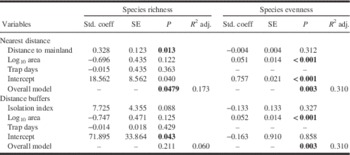
There was no evidence of interaction between island area and isolation for either species richness or species evenness. Species richness did not significantly vary with island area (P=0.12; Table 3, Fig. 2B), although evenness (Pielou’s J) significantly increased with island area (P⩽0.001; Table 3, Fig. 2C). Overall, more species were caught collectively from the islands than were found in the pooled catch from the adjacent mainland forests (37 versus 17). However, richness did not vary significantly among island size classes and the mainland, a comparison for which sample sizes were more equal (F(4,30)=1.06, P=0.39). Total numbers of species were 22, 27, 24, 20, and 17 for very small, small, medium, large, and mainland, respectively (Table 2). Several open habitat species (Amara erratica (Duftschmid), Amara littoralis Mannerheim, Amara patruelis Dejean, and Bradycellus lugubris (LeConte)) were collected in small numbers on the islands, likely reflecting the presence of small forest gaps. These species undoubtedly occur in similar forest gaps on the mainland, but such openings were not included in any of the five mainland sites sampled. Two species, Amara sinuosa (Casey) and Blethisa multipunctata (Linnaeus), were found only on the mainland, but only a single individual of each was collected.
Summary of pooled species richness among island size classes: very small (0.1–1.0 ha), small (1–10 ha), medium (10.–100 ha), large (100–1000 ha), and the mainland.

Note: Isolation classes are also listed: less isolated (0.1–6.19 km, <0.8 isolation index) and more isolated (⩾6.2 km, >0.8 isolation index).
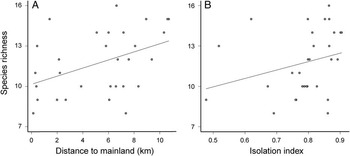
In general, there was no indication of an inverse species richness and isolation relationship as expected under the theory of island biogeography. In fact, species richness significantly increased with isolation. This relationship was significant for distance to mainland (P=0.01; Table 3, Fig. 4A) but only of marginal significance for the island isolation index (P=0.09; Fig. 4B), suggesting that larger population sizes of the adjacent mainland dominate the coloniser pool. Furthermore, among the seven Agonum Bonelli species collected in our study, only three (A. gratiosum, A. retractum, and Agonum sordens Kirby) were found on less isolated islands, while all seven were present on more isolated islands. A similar pattern was observed in C. taedatus, which was missing from the 11 islands closest to mainland (nearest distance measure) and the eight islands with the lowest isolation index.
Relationship between carabid species richness and two measures of isolation. (A) distance to mainland; (B) isolation index.

Summary of global regression models (interaction not included) including standardised regression coefficients (Std. coeff), standard errors (SE), and adjusted R 2 (R 2 adj.) for raw species richness and species evenness.

Note: Bold indicates significant values (ɑ = 0.05).
Carabidae assemblages
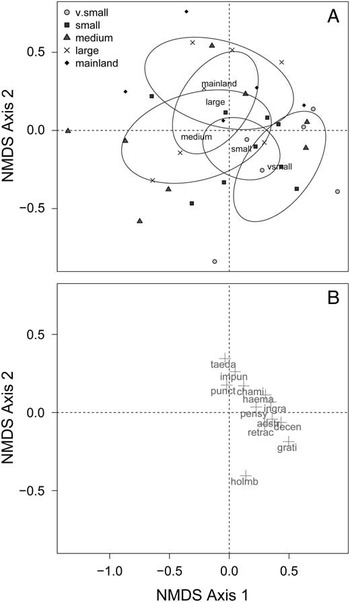
A two-dimensional non-metric multidimensional scaling ordination arranged the carabid assemblages of our study with an acceptable stress of 0.17 (Fig. 5A). According to the 95% confidence ellipses, species composition overlapped markedly among the mainland and large, medium, and small islands. However, species composition was notably distinct for very small islands, suggesting that assemblages on these islands are not the product of random samples from the mainland species pool.
Non-metric multidimensional scaling (NMDS) ordination illustrating the similarities in carabid beetle assemblage between island classes and mainland (ellipses: 95% confidence interval) and the centroids of the 12 most abundant species, stress=0.17. (A) The ellipses for site categories projected on the ordination of multivariate data about species composition and relative abundance; (B) the centroids for each species on the same ordination.

Centroids for C. chamissonis, C. taedatus, P. punctatissimus, and S. impunctatus, were concentrated in mainland sites, and large, and medium islands, while centroids for A. gratiosum, A. retractum, P. adstrictus, P. decentis, and T. holmbergi were concentrated in small or very small islands (Fig. 5B). Centroids for C. ingratus, P. pensylvanicus, and S. haematopus were clustered broadly to include both mainland and all island classes. Island isolation was also represented (figure not shown) by a two-dimensional non-metric multidimensional scaling solution for both nearest distance to mainland (stress 0.15) and isolation index (stress 0.16). The higher overlap of confidence ellipses in ordinations for nearest distance (37%) and isolation index (62%) than those for size (Fig. 5A) underscores that species composition was much less affected by isolation than by island size.
Discussion
Our data suggests that neither the theory of island biogeography nor the “passive sampling” hypothesis provide adequate explanations for carabid diversity on the islands of Lac la Ronge. Predictions from the theory of island biogeography were not supported because our data showed no significant species richness-island area relationship given equalised sampling effort, nor was there a positive effect of isolation on species richness. The consistent and distinct differences observed in carabid assemblages between very small islands and the mainland suggests that they are not simply the product of a sampling phenomenon, as predicted by the “passive sampling” hypothesis (Connor and McCoy Reference Connor and McCoy1979). In contrast to these two neutral theories (MacArthur and Wilson Reference MacArthur and Wilson1963, Reference MacArthur and Wilson1967; Connor and McCoy Reference Connor and McCoy1979), our findings suggest that species traits contribute to the observed differences in carabid assemblages on islands.
Although island carabid assemblages usually differ from their nearest mainland counterparts (Niemelä et al. Reference Niemelä, Haila, Ranta, Tiaine, Vepsäläinen and Ås1985; Kotze and Niemelä Reference Kotze and Niemelä2002), we found support for this on only the smallest islands in our study (<1 ha), which differed distinctly from those of both large islands and mainland sites. The smallest islands were characterised by few if any large-bodied, flightless species and comparatively higher densities of small-bodied, flying species than were present on the larger islands and mainland.
As island size increased, the structure of the carabid assemblage on islands gradually approached that of the mainland where relative abundances of large-bodied, flightless species and small-bodied, flying species were more similar. In contrast, carabid beetle assemblages on Baltic islands up to ~29 ha in size differed distinctly from the mainland (Niemelä et al. Reference Niemelä, Haila, Ranta, Tiaine, Vepsäläinen and Ås1985; Kotze and Niemelä Reference Kotze and Niemelä2002). Below, we suggest three possible explanations for differences that we observed in the structure of the assemblage between the smallest islands, on the one hand, and large islands and the mainland on the other.
First, limited availability of suitable habitat or resources on very small islands (MacArthur and Wilson Reference MacArthur and Wilson1963, Reference MacArthur and Wilson1967) may select against large-bodied species in favour of smaller-bodied carabids (Schoener and Janzen Reference Schoener and Janzen1968). Clearly medium-to-large sized islands and mainland sites support viable populations of large-bodied species, such as, C. chamissonis, C. taedatus, and P. punctatissimus. However, across the 14 smallest islands (⩽7.5 ha) only a single individual of C. taedatus was collected, suggesting that populations of this species do not establish and persist on small islands. Similarly, four of the six islands where C. chamissonis was not collected were <2 ha in size, and P. punctatissimus was not found on islands smaller than 2 ha in size. In contrast, smaller-bodied species like A. retractum, P. adstrictus, and P. decentis were present on all of the very small-to-small islands and were more abundant in pitfall samples than on either large islands or the mainland. Furthermore, four small-bodied species, A. gratiosum, Loricera pilicornis (Fabricius), Syntomus americanus (Dejean), and T. holmbergi, were each found on fewer than half of the islands and these were mostly small (see Supplementary Appendix 1).
Body size and the ability to fly are related in carabids such that flightlessness tends to evolve mainly in large-bodied carabids, while smaller-bodied species are usually active flyers (Blake et al. Reference Blake, Foster, Eyre and Luff1994). Mean carabid body size has been correlated with site stability in many studies (e.g., Blake et al. Reference Blake, Foster, Eyre and Luff1994; Szyszko et al. Reference Szyszko, Vermuelen, Klimaszewski and Schwerk2000), and larger-bodied, wingless species are typically found in more stable, continuous habitats (Szyszko et al. Reference Szyszko, Vermuelen, Klimaszewski and Schwerk2000; Šerić Jelaska and Durbešić Reference Šerić Jelaska and Durbešić2009). In contrast, smaller-bodied carabid species are more characteristic of disturbed (Blake et al. Reference Blake, Foster, Eyre and Luff1994; Szyszko et al. Reference Szyszko, Vermuelen, Klimaszewski and Schwerk2000) or isolated patches (Šerić Jelaska and Durbešić Reference Šerić Jelaska and Durbešić2009). Thus, the greater abundance of small-bodied species observed on small islands suggests that forest habitats on small islands are more unstable or less favourable for large-bodied species than on large islands.
A second explanation for our data may involve the association between greater dispersal ability of winged carabids and the ability to find and exploit limited or short-lived resources on small islands through repeated colonisation. Isolation did not influence the structure of assemblages at the scales examined in this study (distance to mainland 0.13–10.7 km, mean: 5.4, standard deviation: 3.4; isolation index 0.47–0.90, mean: 0.79, standard deviation: 0.10), suggesting that both winged and wingless species are capable of colonising even the most isolated islands. However, rates of immigration are likely higher for winged, flight-capable species than for wingless species that must colonise islands mainly by passively drifting on the water surface. Even if direct flight to islands is not the dominant form of colonisation, flight may promote arrival by drift as carabids collected from drift material are predominantly winged (Karjalainen Reference Karjalainen2000; Kotze and Niemelä Reference Kotze and Niemelä2002), and thus are likely to have been blown into water during flight. Colonisation ability may also include survival ability of carabids in lake water (see Renault Reference Renault2011), although it is unknown how this may vary with body size. Overall, higher immigration rates of small-bodied, winged species may result indirectly from their ability to fly. Thus, if large-bodied, wingless species both arrive less frequently and have greater turnover on smaller islands due to habitat or resource limitations (see above), they should be less well represented on smaller islands, as is consistent with our data.
A third hypothesis to explain the patterns we observed is that species interactions play a role in determining the composition of island assemblages. Several studies have suggested that competition does not significantly influence carabid assemblage structure (Niemelä Reference Niemelä and Spence1993; Shibuya et al. Reference Shibuya, Kubota, Masahiko and Kikvidze2011) except at high densities (Shibuya et al. Reference Shibuya, Kubota, Masahiko and Kikvidze2011) and through intra-guild predation (Currie et al. Reference Currie, Spence and Niemelä1996). Although carabid abundances did not vary significantly with island size in our study, activity densities were highest on the smallest islands where only one or two species dominated the catch (Table 1). Furthermore, the greater species evenness on large islands suggests that presence of large-bodied species maintains some form of regulatory control over carabid assemblages, possibly through competition or intra-guild predation. Interspecific competition has also been proposed to explain the absence of Pterostichus melanarius on small islands in the Baltics, despite availability of suitable habitat (Kotze Reference Kotze2008) and the greater ability of this species to expand into new areas (Niemelä and Spence Reference Niemelä, Ranta and Haila1991). Kotze et al. (Reference Kotze, Niemelä and Nieminen2000) and Kotze (Reference Kotze2008) suggested that its absence could be explained by direct competition with Pterostichus niger (Schaller), a slightly larger-bodied, more active species that is abundant on small islands. In our study, a post-hoc co-occurrence analysis (Supplementary Appendix 3) revealed that of the six negative pairwise species associations, five negative pairs included large-bodied and correspondingly smaller-bodied species. Unfortunately, interactions between species in this study are poorly understood. Experimental introductions to islands could help determine both why large-bodied species like C. taedatus are mainly absent or exist in relatively small populations on small islands, and the potential impact of their presence on the structure of the carabid assemblage.
In contrast to predictions of the theory of island biogeography, we observed a positive effect of distance to mainland on species richness. This finding is unusual because species richness is typically highest on islands closer to mainland (MacArthur and Wilson Reference MacArthur and Wilson1963, Reference MacArthur and Wilson1967). Indeed, Niemelä et al. (Reference Niemelä1988) showed that the number of carabid species was lowest on the most isolated Baltic Islands. One possible explanation for these results is that clustered (less isolated) islands have greater between-island colonisation than more isolated islands that tend to be colonised primarily by propagules arriving from the mainland (see Hanski and Gyllenberg Reference Hanski and Gyllenberg1997). Scattered islands in the Baltics, for example, accumulated species more quickly than did clustered islands (Kotze et al. Reference Kotze, Niemelä and Nieminen2000). This process may explain why more isolated islands in our study contained several species not found on less isolated islands.
Conclusions
Our findings do not support predictions of either the “passive sampling” hypothesis or the theory of island biogeography, but suggest instead that species traits are an important factor in the colonisation and persistence of carabid populations on islands in freshwater boreal lakes of central Canada. Carabid assemblages on islands less than 1 ha distinctly differed from those on large islands and the nearest mainland. Large-bodied species were both less abundant and occurred less frequently on small islands, suggesting that populations of these species are more difficult to sustain. In contrast, relative abundances of small-bodied species were greater on small islands; possibly due to a “release” from regulatory processes such as intra-guild predation in the absence of large-bodied species. Furthermore, the structure of the carabid assemblage was not influenced as we expected by isolation. In fact, species richness was highest on the most isolated islands where colonisation is more likely from the mainland than from nearby islands. We suggest that population processes on small islands, leading to greater extinction rates and lower immigration of large-bodied, wingless species, likely contribute to the observed structure of the carabid assemblages on boreal lake islands.
Acknowledgements
The authors are fortunate to have had the support of many people throughout this study. They thank A. Van Meppelen, B. Hoemsen, B. White, C. Dubnick, E. Boyes, E. Waite, and K. Spooner who helped with field work or with collecting material. The authors thank D. Shpeley and G. Ball for their assistance in verifying specimen identifications. Logistical support was provided by the Bell brothers and C. Dallyn, D. Turner, and M. Duffy from the Saskatchewan Ministry of Environment. Special thanks to C. Bergeron, E. Hedlin, E. Neilsen, G. Oltean, and J. Pinzon for their knowledge and expertise. Funding for this project was provided by the Ministry of Environment through the Boreal Initiative Fund, National Science and Engineering Research Council to S.E.N., J.R.S., and A.J.B. and Walter H. Johns Graduate Fellowship awarded to A.J.B., the Saskatchewan Fish and Wildlife Development Fund, Alberta Government Graduate Student Scholarship awarded to A.J.B., the Saskatchewan Wildlife Federation, and the Saskatchewan Student Summer Works programme.
Supplementary material
To view supplementary material/s for this article, please visit https://doi.org/10.4039/tce.2017.12 Footnote *