





The war in Ukraine has generated one of the largest displacement crises in recent history, with more than 6.9 million people forced to flee and 6.3 million currently residing in European host countries. 1 Displaced individuals experience multiple pre- and post-migration stressors, including trauma exposure, separation and acculturation difficulties, and these substantially increase risk for depression, anxiety and post-traumatic stress disorder (PTSD). Reference Blackmore, Boyle, Fazel, Ranasinha, Gray and Fitzgerald2 Women constitute the majority of the displaced population because of wartime conscription restrictions and face elevated exposure to gender-based violence (GBV) and family separation. Reference Tadesse, Andualem, Rtbey, Nakie, Takelle and Molla3 Scalable psychosocial interventions are therefore essential to mitigate the mental health consequences of displacement. Reference Miller and Rasmussen4
Group-based psychosocial programmes can reduce distress and strengthen coping in trauma-exposed populations. Reference Worrall, Schweizer, Marks, Yuan, Lloyd and Ramjan5 Nevertheless, geographic dispersion, stigma and language barriers often limit access. Reference Byrow, Pajak, Specker and Nickerson6 Digital interventions may overcome these barriers, but many online formats lack immediacy and emotional presence. Immersive virtual reality environments replicate shared spaces that foster social engagement and have demonstrated effectiveness across disorders including PTSD and phobias, as well as in trauma recovery. Reference Emmelkamp and Meyerbröker7–Reference Wiebe, Kannen, Selaskowski, Mehren, Thöne and Pramme9 Recent developments have extended virtual reality into multi-user ‘metaverse’ platforms that allow real-time interaction via avatars. Preliminary evidence suggests benefits among individuals with social anxiety, autism and trauma-related symptoms. Reference Cerasa, Gaggioli, Pioggia and Riva10–Reference Vila, Ardoy-Cuadros, Romero-Moreno, Nogales-Gonzalez, Ritchey and Sansoni12 Recent evidence from randomised controlled trials of lower-intensity digital psychological interventions for conflict-affected and displaced populations has also reported reductions in psychological distress among Ukrainian refugees and related populations, even without immersive delivery. Reference Asanov, Asanov and Buenstorf13,Reference Rajkumar, Hareesh, Sri Lakshmi, Shaza, Gopi and Romate14 Accordingly, it is important to consider not only whether metaverse-based support is feasible, but whether it offers meaningful advantages compared with simpler digital approaches in terms of engagement, therapeutic process or clinical benefit. The present trial was designed to contribute evidence in that regard by comparing metaverse-based support groups with both in-person support and a waitlist control.
Study objective
This study examined the efficacy of metaverse-based psychosocial support groups for Ukrainian refugees in Romania compared with in-person groups and a waitlist control, focusing on depressive and anxiety symptoms, well-being, perceived social support and GBV awareness.
Method
Design
This was a parallel, three-arm randomised controlled trial comparing metaverse-based groups, in-person groups and a waitlist control (1:1:1). Assessments were carried out at baseline, mid intervention, post intervention and at 3-month follow-up.
The authors assert that all procedures contributing to this work comply with the ethical standards of the relevant national and institutional committees on human experimentation and with the Helsinki Declaration of 1975, as revised in 2013. The study was approved by the Research Ethics Committee of the University of Bucharest (Comisia de Etică a Cercetării, Universitatea din București; decision no. 98/01.11.2023; registration no. CEC 291/01.11.2023). The trial followed CONSORT Reference Schulz, Altman and Moher15 and SPIRIT Reference Chan, Tetzlaff, Altman, Laupacis, Gøtzsche and Krleža-Jerić16 guidance. Trial registration: NCT06142032 (8 November 2023).
Participants
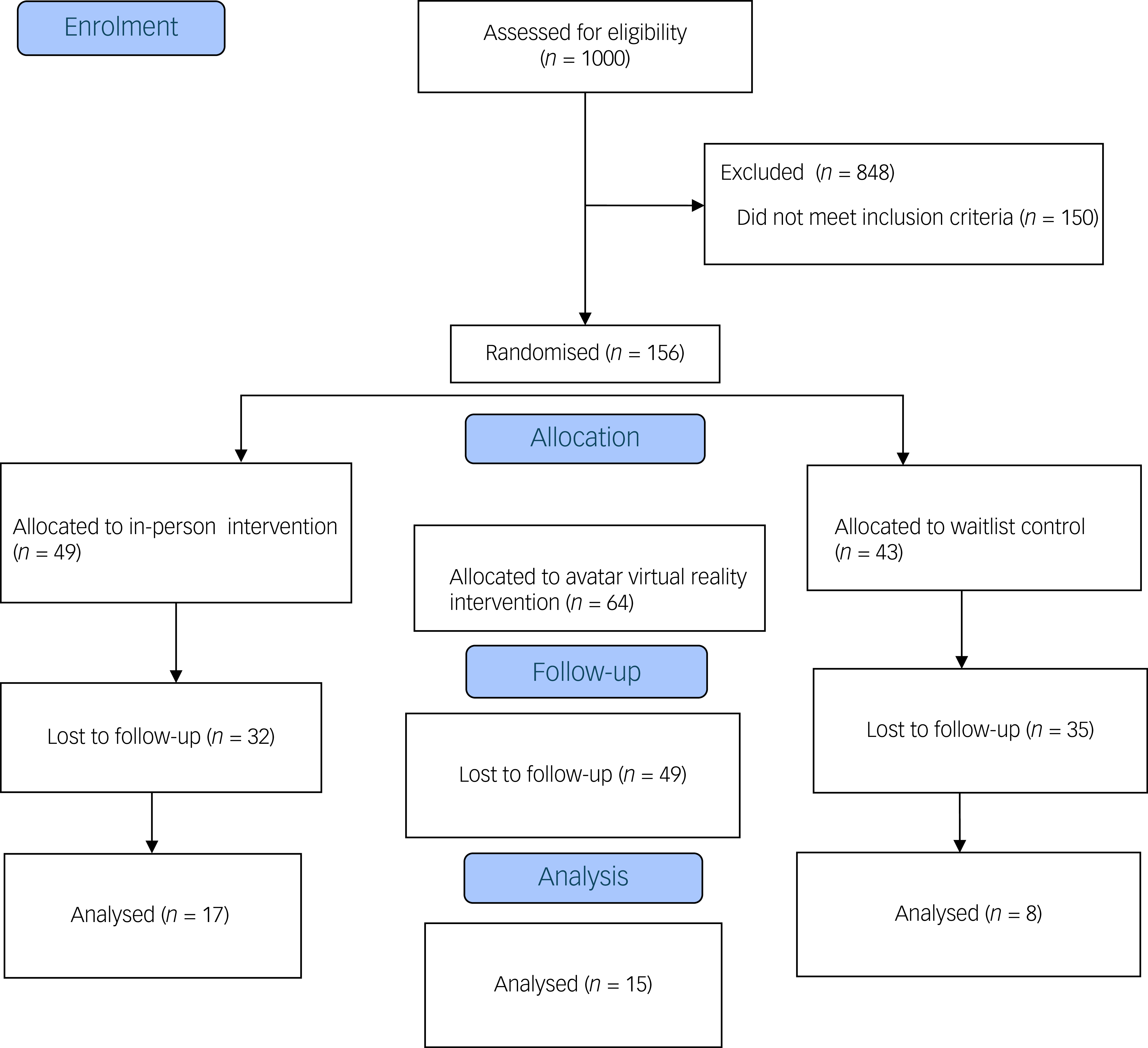
Adults (≥18 years old) were recruited in Bucharest through Romanian- and Russian-speaking licensed psychologists affiliated with non-governmental organisations (NGOs) serving Ukrainian refugees (e.g. the Dr Max Foundation and regional refugee centres), using NGO networks, social media and community outreach (11 January 2024 to 18 March 2025). The eligibility criteria were: no formal mental health diagnosis, no current psychotherapy or psychiatric treatment, and subclinical PTSD at baseline. Screening was conducted by phone or in person; written informed consent preceded enrolment. Of approximately 1000 individuals screened for eligibility, 156 participants met inclusion criteria and were included in the intention-to-treat (ITT) sample. Participants were randomised to avatar virtual reality support groups (n = 64), in-person support groups (n = 49) or a waitlist control (n = 43). The analytic data-set included 156 baseline observations, 86 mid-intervention observations, 70 post-intervention observations and 43 follow-up observations. Participant flow is shown in Fig. 1 and baseline characteristics in Table 1.
CONSORT 2010 flow diagram.

Fig. 1 Long description
A flowchart illustrating the stages of a study from enrolment to analysis. The process begins with the enrolment phase where 1000 individuals are assessed for eligibility. 848 individuals are excluded because they did not meet the inclusion criteria, leaving 156 individuals to be randomised. The allocation phase follows, where the 156 individuals are divided into three groups: 49 allocated to in-person intervention, 64 allocated to avatar virtual reality intervention, and 43 allocated to waitlist control. In the follow-up phase, 32 individuals from the in-person intervention group and 35 individuals from the waitlist control group are lost to follow-up. 49 individuals from the avatar virtual reality intervention group are also lost to follow-up. In the analysis phase, 17 individuals from the in-person intervention group, 15 individuals from the avatar virtual reality intervention group, and 8 individuals from the waitlist control group are analysed.
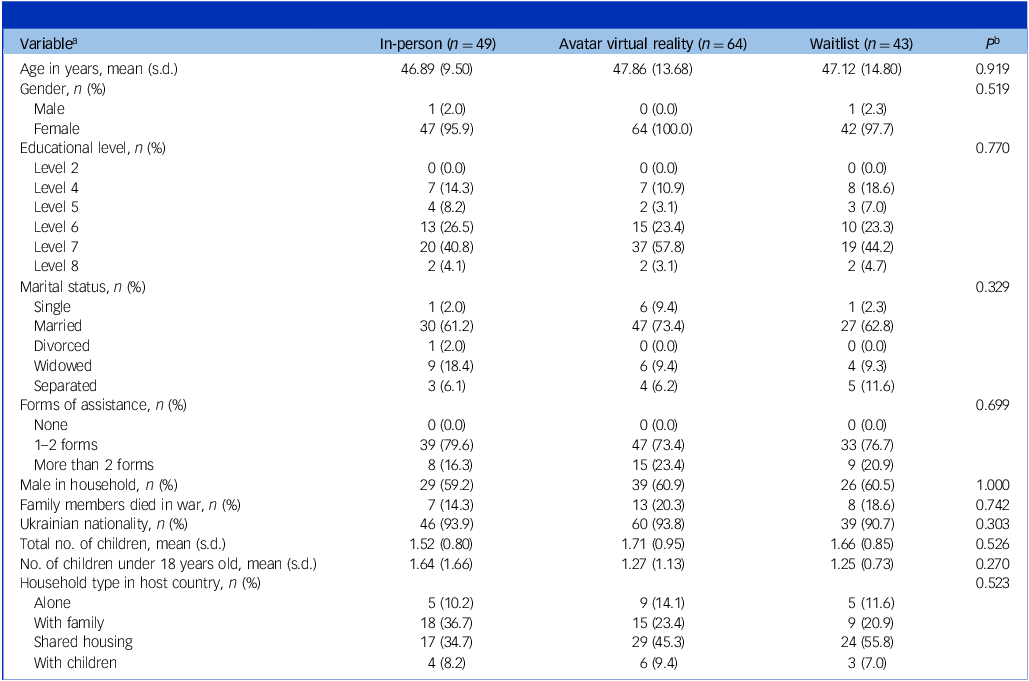
Baseline participant characteristics

Table 1 Long description
A table comparing baseline characteristics of participants across three groups: in-person, avatar virtual reality, and waitlist. The table has 15 rows and 5 columns, including headers. The columns are labeled as Variable, In-person (n=49), Avatar virtual reality (n=64), Waitlist (n=43), and P. The rows include variables such as Age in years (mean and standard deviation), Gender (percentage of male and female), Educational level (percentage distribution across levels 2 to 8), Marital status (percentage distribution across single, married, divorced, widowed, and separated), Forms of assistance (percentage distribution across none, 1-2 forms, and more than 2 forms), Male in household (percentage), Family members died in war (percentage), Ukrainian nationality (percentage), Total number of children (mean and standard deviation), Number of children under 18 years old (mean and standard deviation), and Household type in host country (percentage distribution across alone, with family, shared housing, and with children). Each row provides specific values for each group and a P-value for statistical comparison.
a. Percentages use randomised arm denominators.
b. P-values are from one-way analysis of variance for continuous variables and chi-squared or Fisher tests for categorical variables.
Treatment conditions
The intervention was based on evidence-informed support group practices integrating cognitive–behavioural principles Reference Beck17 and trauma-informed care, Reference Butler, Critelli and Rinfrette18 consistent with UNHCR 19 and World Health Organization (WHO) 20 recommendations. Sessions were conducted in Russian to ensure accessibility for Ukrainian refugees. Russian was used as the language of delivery, as it is widely spoken among Ukrainian refugees (particularly individuals from eastern and southern regions) and was considered to be the most practical shared language for group-based intervention in this context. Participants had previously been consulted by NGO collaborators regarding their preferred language of communication, and the final decision was made in collaboration with local NGO partners and community centres to ensure accessibility, cultural appropriateness and participant comfort.
Participants in both active conditions attended five weekly 90 min sessions co-facilitated by licensed psychotherapists. Each followed a structured sequence (check-in, thematic discussion, psychoeducation, peer sharing and reflection) and was focused on well-being, social support, mental health literacy and GBV awareness. Groups of six to eight participants remained together across all sessions to support cohesion.
The metaverse condition was delivered in a secure browser-based three-dimensional environment modelled on a central Kyiv community space (Fig. 2). Participants joined as avatars (Fig. 3) using proximity-based voice communication and optional private messaging with facilitators, and anonymity was maintained throughout. Technical support was available as needed.
The metaverse environment. For a video of the metaverse environment, see https://giosan.com/UkraineMetaverse.mp4.

Example of an avatar.

Participants in the waitlist control group completed assessments on the same schedule but did not receive group sessions during the intervention period. Following the final follow-up, these participants were offered in-person groups.
Outcomes and measures
Measures
All instruments were translated into Russian using standard forward–backward translation and reviewed by two bilingual psychologists for accuracy.
For screening, general mental health symptoms were assessed using the DSM-5-TR Level 1 Cross-Cutting Symptom Measure, 21 covering 13 psychiatric domains on a 5-point scale (0–4); and war-related stressors were measured with the Experiences of War and Symptoms of Trauma Scale , Reference Karatzias, Shevlin, Ben‐Ezra, McElroy, Redican and Vang22 which assesses exposure to 34 war-related events (yes/no; total score 0–34). Primary outcomes, comprising depressive and anxiety symptoms, were evaluated with the nine-item Patient Health Questionnaire (PHQ-9 Reference Kroenke, Spitzer and Williams23 ) and the Generalized Anxiety Disorder-7 (GAD-7 Reference Spitzer, Kroenke, Williams and Löwe24 ), respectively.
With respect to secondary outcomes, perceived social support was measured with the Multidimensional Scale of Perceived Social Support (MSPSS Reference Zimet, Dahlem, Zimet and Farley25 ); well-being with the WHO-5 Well-Being Index, 26 with higher scores indicating greater well-being; and GBV awareness with a five-item multiple-choice questionnaire co-developed with NGO partners.
Additional measures
Demographic variables that were collected included age, gender, marital status, education, displacement setting and type of humanitarian assistance. Therapeutic alliance was measured with the Working Alliance Inventory–Short Form, Reference Munder, Wilmers, Leonhart, Linster and Barth27 and PTSD symptoms were screened with the National Stressful Events Survey PTSD Short Scale (NSESSS). Reference LeBeau, Mischel, Resnick, Friedman and Craske28
Procedure
Trained research assistants completed screening and obtained written informed consent in collaboration with NGO partners before study enrolment. Eligible participants were randomised (1:1:1) to avatar virtual reality, in-person, or waitlist groups using a computer-generated sequence (randomizer.org). Allocation was concealed until baseline completion.
Although the original protocol excluded participants with probable PTSD (NSESSS score > 27), most screened refugees exhibited elevated trauma scores. Following ethical consultation, these individuals were retained in the study to preserve ecological validity. Sensitivity analyses excluding them produced consistent results. Facilitators received structured training and ongoing supervision to maintain intervention fidelity.
Statistical analyses
All statistical analyses were conducted in R (version 4.5.2 for Windows; R Foundation for Statistical Computing, Vienna, Austria; https://www.r-project.org/) using the RStudio integrated development environment (Posit Software, PBC, Boston, Massachusetts, USA; https://posit.co/download/rstudio-desktop/). An a priori power analysis conducted in G*Power version 3.1.9.7 for macOS (Heinrich Heine University Düsseldorf, Düsseldorf, Germany; https://www.psychologie.hhu.de/arbeitsgruppen/allgemeine-psychologie-und-arbeitspsychologie/gpower) suggested that approximately 15 participants per study arm would be required to detect moderate between-group effects at α = 0.05 and 80% power. The assumed effect size was informed by both conventional behavioural science benchmarks and prior meta-analytic evidence indicating that psychological interventions for refugee populations may produce moderate effects on depression and post-traumatic stress outcomes. Reference Kip, Priebe, Holling and Morina29 However, the original calculation did not account for clustering within intervention cohorts or sessions, or for the substantial attrition observed across follow-up assessments, both of which reduced the effective sample size and statistical precision. Accordingly, the findings should be interpreted with caution, particularly with respect to follow-up and subgroup analyses.
Primary analyses followed an ITT framework using constrained longitudinal data analysis (cLDA) mixed-effects models with cluster-robust standard errors to account for repeated measures nested within intervention cohorts. As participants remained in fixed groups of six to eight individuals across sessions, clustering at the cohort level was incorporated to address potential within-group dependence and inflation of type I errors. Complementary baseline-adjusted analysis of covariance (ANCOVA) models were also applied post-intervention and at follow-up to improve statistical precision and facilitate direct interpretation of treatment effects. Given the substantial attrition, sensitivity analyses were conducted. These included (a) completer-only analyses restricted to participants who completed the intervention protocol; (b) analyses excluding participants with elevated baseline PTSD symptom burden (NSESSS score > 27); (c) inverse probability weighting (IPW) based on predictors of attrition; (d) Lee bounds analyses to evaluate the robustness of findings under differential attrition assumptions; and (e) multiple imputation using chained equations (MICE) as pooled sensitivity analyses, with estimates combined according to Rubin’s rules. Multiple imputation analyses were retained as supplementary sensitivity analyses rather than primary analytic models owing to concerns regarding the plausibility of missing-at-random assumptions under high attrition. Sensitivity estimates derived from ANCOVA, IPW and MICE models were also compared visually to assess consistency of treatment effects across analytic approaches.
Results
Participant retention and attendance
A total of 156 participants were included in the ITT sample (153 women, 2 men, 1 individual with missing gender data; M = 47.37 years; s.d. = 12.66). The analytic data-set included 156 baseline observations, 86 mid-intervention observations, 70 post-intervention observations and 43 follow-up observations. Attrition was substantial across assessment waves. At post-intervention, attrition was 57.8% in the avatar virtual reality arm, 53.1% in the in-person arm and 60.5% in the waitlist arm. At follow-up, attrition was 76.6% in the avatar virtual reality arm, 65.3% in the in-person arm and 81.4% in the waitlist arm.
Baseline predictors of end-point observations were examined using bias-reduced logistic regression. Treatment condition was not significantly associated with post-intervention observation for either in-person versus waitlist (odds ratio = 1.34, 95% CI [0.59, 3.08], P = 0.486) or avatar virtual reality versus waitlist (odds ratio = 1.11, 95% CI [0.51, 2.44], P = 0.794). Similarly, treatment condition was not significantly associated with follow-up observation for either in-person versus waitlist (odds ratio = 2.25, 95% CI [0.86, 5.86], P = 0.097) or avatar virtual reality versus waitlist (odds ratio = 1.31, 95% CI [0.51, 3.38], P = 0.580). Baseline symptom severity was not consistently associated with end-point observation, although baseline GBV knowledge predicted post-intervention observation (odds ratio = 1.45, 95% CI [1.01, 2.08], P = 0.045). Given the small end-point samples, the results of attrition analyses should be interpreted cautiously. Baseline demographic and symptom comparisons between completers and non-completers are presented in Supplementary Table 14 available at https://doi.org/10.1192/bjp.2026.10755.
Demographic characteristics
Demographic characteristics are presented in Table 1. Participants were predominantly middle-aged women, most of whom were married or cohabiting and held at least a high school or undergraduate degree. Most lived with family members in Romania and received two to three forms of assistance, commonly financial aid, basic goods or psychological support. Approximately 18% reported the death of a family member due to the war. Although qualitative reporting was optional, several participants described experiences of separation, loss and direct exposure to violence, consistent with the trauma background of the sample.
Primary and secondary outcomes
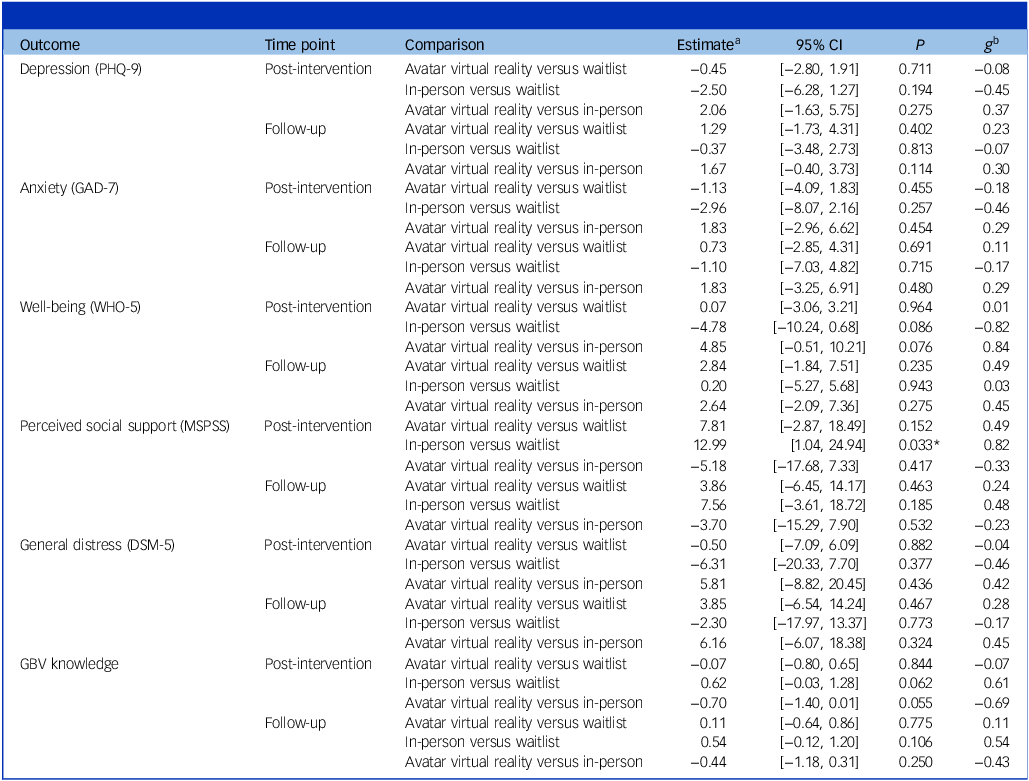
Primary clustered ITT analyses focused on between-group treatment effects estimated using cLDA mixed-effects models with cluster-robust standard errors (Fig. 4 and Table 2). At post-intervention, the in-person arm reported significantly higher perceived social support than the waitlist arm (β = 12.99, 95% CI [1.04, 24.94], P = 0.033, g = 0.82). The other post-intervention comparisons did not show conventional statistically significant differences in the primary ITT model. For depressive symptoms, the in-person arm showed a non-significant reduction relative to the waitlist arm (β = −2.50, 95% CI [−6.28, 1.27], P = 0.194, g = −0.45), whereas avatar virtual reality did not differ significantly from waitlist (β = −0.45, 95% CI [−2.80, 1.91], P = 0.711, g = −0.08). For anxiety, neither the in-person nor the avatar virtual reality arm differed significantly from waitlist at post-intervention (β = −2.96, 95% CI [−8.07, 2.16], P = 0.257, g = −0.46; and β = −1.13, 95% CI [−4.09, 1.83], P = 0.455, g = −0.18, respectively).
ITT treatment effects (cluster-robust): post-intervention and follow-up comparisons. PHQ-9, nine-item Patient Health Questionnaire; GAD-7, Generalized Anxiety Disorder-7; WHO-5, World Health Organization Well-Being Index; MSPSS, Multidimensional Scale of Perceived Social Support; GBV, gender-based violence.

Fig. 4 Long description
The image contains multiple forest plots comparing the effects of different interventions on various mental health metrics among displaced individuals. The plots are divided into three main sections: Avatar virtual reality versus waitlist, In-person versus waitlist, and Avatar virtual reality versus in-person. Each section includes post-intervention and follow-up comparisons. The metrics assessed include Depression (PHQ-9), Anxiety (GAD-7), Well-being (WHO-5), Social support (MSPSS), General distress (DSM-5), and GBV knowledge. The x-axis represents the adjusted difference (estimate, 95% CI), ranging from -20 to 20. Each plot shows the point estimate and the 95% confidence interval for the adjusted difference. The vertical dashed line at zero indicates no effect. The plots reveal the impact of the interventions on each metric, with varying degrees of effect sizes and confidence intervals. The data points and confidence intervals provide insights into the effectiveness of the interventions over time.
Main intention-to-treat treatment effects from cLDA mixed-effects models

Table 2 Long description
The table presents the main intention-to-treat treatment effects from cLDA mixed-effects models, focusing on various outcomes such as depression, anxiety, well-being, perceived social support, general distress, and GBV knowledge. The table has 6 rows and 7 columns. The columns are labeled Outcome, Time point, Comparison, Estimate, 95% CI, P, and g. The rows list different outcomes and comparisons between avatar virtual reality, in-person, and waitlist groups at post-intervention and follow-up time points. Each row provides the estimate, 95% confidence interval (CI), P-value, and effect size (g) for the comparisons. Notable trends include a significant increase in perceived social support for the in-person group compared to the waitlist at post-intervention, with an estimate of 12.99, 95% CI [1.04, 24.94], P 0.033, and g 0.82. Other comparisons did not show conventional statistically significant differences. For depressive symptoms, the in-person group showed a non-significant reduction compared to the waitlist, while avatar virtual reality did not differ significantly from the waitlist. For anxiety, neither the in-person nor the avatar virtual reality group differed significantly from the waitlist at post-intervention.
cLDA, constrained longitudinal data analysis; PHQ-9, nine-item Patient Health Questionnaire; GAD-7, Generalized Anxiety Disorder-7; WHO-5, World Health Organization Well-Being Index; MSPSS, Multidimensional Scale of Perceived Social Support; GBV, gender-based violence.
a. Estimates represent adjusted mean differences from cLDA linear mixed-effects models with robust standard errors clustered at the intervention group level. Negative estimates indicate lower symptom severity for depression, anxiety and general distress outcomes. For WHO-5, positive estimates indicate higher well-being scores and negative estimates indicate lower well-being scores. Positive estimates for MSPSS and GBV knowledge indicate higher levels of perceived social support and GBV knowledge, respectively.
b. Hedges’ g values were approximated using pooled baseline standard deviations.
*P < 0.05.
The differences in well-being identified in the in-person versus waitlist comparison approached but did not reach statistical significance (β = −4.78, 95% CI [−10.24, 0.68], P = 0.086, g = −0.82), with lower WHO-5 well-being scores in the in-person arm relative to waitlist at post-intervention. For general distress, neither in-person nor avatar virtual reality differed significantly from waitlist at post-intervention (β = −6.31, 95% CI [−20.33, 7.70], P = 0.377, g = −0.46; and β = −0.50, 95% CI [−7.09, 6.09], P = 0.882, g = −0.04, respectively). For GBV, post-intervention, the in-person arm showed higher GBV knowledge than the waitlist arm, although this difference did not reach conventional statistical significance (β = 0.62, 95% CI [−0.03, 1.28], P = 0.062, g = 0.61). The avatar virtual reality versus in-person comparison also showed a difference that approached significance (β = −0.70, 95% CI [−1.40, 0.01], P = 0.055, g = −0.69), indicating greater GBV knowledge in the in-person arm than the avatar virtual reality arm. Avatar virtual reality did not differ significantly from waitlist (β = −0.07, 95% CI [−0.80, 0.65], P = 0.844, g = −0.07).
At follow-up, no primary ITT treatment comparisons found statistically significant differences. Follow-up estimates were generally imprecise, with wide confidence intervals reflecting reduced end-point sample sizes. Observed outcome trajectories across study time points are presented in Fig. 4 and Supplementary Table 1.
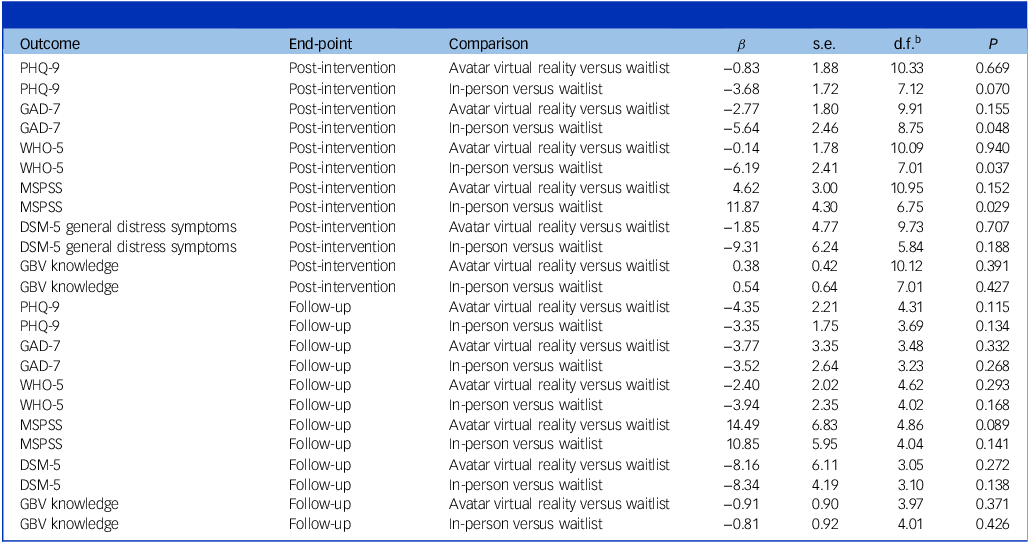
Importantly, completer-only and end-point-specific analyses were interpreted as complementary sensitivity analyses rather than replacements for the primary clustered ITT framework. Consistent with current recommendations for randomised clinical trials with missing longitudinal observations, the primary inferential emphasis remained on the clustered ITT cLDA models; the completer-only analyses were included to estimate outcomes under more optimal engagement conditions and to facilitate interpretation of intervention retention and adherence patterns. Complementary baseline-adjusted end-point ANCOVA models showed stronger short-term between-group differences than the primary cLDA models for several outcomes. At post-intervention, the in-person arm showed lower levels of anxiety symptoms than the waitlist arm (β = −5.64, s.e. = 2.46, P = 0.048), lower WHO-5 well-being scores (β = −6.19, s.e. = 2.41, P = 0.037) and higher levels of perceived social support (β = 11.87, s.d. = 4.30, P = 0.029). The in-person versus waitlist comparison for depressive symptoms identified a difference that approached statistical significance (β = −3.68, s.e. = 1.72, P = 0.070). Avatar virtual reality did not differ significantly from waitlist in post-intervention ANCOVA comparisons. At follow-up, no ANCOVA comparison found differences that reached conventional statistical significance (Table 3).
Baseline-adjusted end-point ANCOVA treatment effects versus waitlista

Table 3 Long description
A table comparing treatment effects versus waitlist for various outcomes. The table has 30 rows and 6 columns. The columns are labeled Outcome, End-point, Comparison, β, s.e., d.f.b, and P. The rows list different outcomes and their respective data points. Row 1: PHQ-9, Post-intervention, Avatar virtual reality versus waitlist, -0.83, 1.88, 10.33, 0.669. Row 2: PHQ-9, Post-intervention, in-person versus waitlist, -3.68, 1.72, 7.12, 0.070. Row 3: GAD-7, Post-intervention, Avatar virtual reality versus waitlist, -2.77, 1.80, 9.91, 0.155. Row 4: GAD-7, Post-intervention, in-person versus waitlist, -5.64, 2.46, 8.75, 0.048. Row 5: WHO-5, Post-intervention, Avatar virtual reality versus waitlist, -0.14, 1.78, 10.09, 0.940. Row 6: WHO-5, Post-intervention, in-person versus waitlist, -6.19, 2.41, 7.01, 0.037. Row 7: MSPSS, Post-intervention, Avatar virtual reality versus waitlist, 4.62, 3.00, 10.95, 0.152. Row 8: MSPSS, Post-intervention, in-person versus waitlist, 11.87, 4.30, 6.75, 0.029. Row 9: DSM-5 general distress symptoms, Post-intervention, Avatar virtual reality versus waitlist, -1.85, 4.77, 9.73, 0.707. Row 10: DSM-5 general distress symptoms, Post-intervention, in-person versus waitlist, -9.31, 6.24, 5.84, 0.188. Row 11: GBV knowledge, Post-intervention, Avatar virtual reality versus waitlist, 0.38, 0.42, 10.12, 0.391. Row 12: GBV knowledge, Post-intervention, in-person versus waitlist, 0.54, 0.64, 7.01, 0.427. Row 13: PHQ-9, Follow-up, Avatar virtual reality versus waitlist, -4.35, 2.21, 4.31, 0.115. Row 14: PHQ-9, Follow-up, in-person versus waitlist, -3.35, 1.75, 3.69, 0.134. Row 15: GAD-7, Follow-up, Avatar virtual reality versus waitlist, -3.77, 3.35, 3.48, 0.332. Row 16: GAD-7, Follow-up, in-person versus waitlist, -3.52, 2.64, 3.23, 0.268. Row 17: WHO-5, Follow-up, Avatar virtual reality versus waitlist, -2.40, 2.02, 4.62, 0.293. Row 18: WHO-5, Follow-up, in-person versus waitlist, -3.94, 2.35, 4.02, 0.168. Row 19: MSPSS, Follow-up, Avatar virtual reality versus waitlist, 14.49, 6.83, 4.86, 0.089. Row 20: MSPSS, Follow-up, in-person versus waitlist, 10.85, 5.95, 4.04, 0.141. Row 21: DSM-5, Follow-up, Avatar virtual reality versus waitlist, -8.16, 6.11, 3.05, 0.272. Row 22: DSM-5, Follow-up, in-person versus waitlist, -8.34, 4.19, 3.10, 0.138. Row 23: GBV knowledge, Follow-up, Avatar virtual reality versus waitlist, -0.91, 0.90, 3.97, 0.371. Row 24: GBV knowledge, Follow-up, in-person versus waitlist, -0.81, 0.92, 4.01, 0.426.
PHQ-9, nine-item Patient Health Questionnaire; GAD-7, Generalized Anxiety Disorder-7; WHO-5, World Health Organization Well-Being Index; MSPSS, Multidimensional Scale of Perceived Social Support; GBV, gender-based violence.
a. Models adjusted for baseline outcome score and prespecified baseline covariates, with robust standard errors clustered by intervention cohort.
b. Satterthwaite degrees of freedom.
Sensitivity analyses
Sensitivity analyses excluding participants with elevated baseline trauma symptom burden (NSESSS score >27) produced stronger post-intervention effects for the in-person arm. In the cLDA sensitivity sample, in-person participants showed significantly lower levels of depressive symptoms than waitlist participants at post-intervention (β = −3.39, 95% CI [−6.36, −0.41], P = 0.026, g = −0.68) and significantly higher levels of perceived social support (β = 12.71, 95% CI [0.79, 24.63], P = 0.037, g = 0.79). In-person participants also had significantly greater GBV knowledge than waitlist participants (β = 0.89, 95% CI [0.31, 1.48], P = 0.003, g = 0.85). The avatar virtual reality versus waitlist comparison did not find a significant difference for GBV knowledge (β = 0.07, 95% CI [−0.66, 0.79], P = 0.856), whereas avatar virtual reality participants had significantly less GBV knowledge than in-person participants post-intervention (β = −0.83, 95% CI [−1.39, −0.26], P = 0.004, g = −0.79).
Covariate-adjusted cLDA sensitivity models were broadly consistent with the primary ITT models. Post-intervention, the in-person arm showed significantly higher levels of perceived social support than the waitlist control (β = 13.72, 95% CI [0.71, 26.73], P = 0.039) and significantly lower WHO-5 well-being scores (β = −5.35, 95% CI [−10.49, −0.21], P = 0.041). Other covariate-adjusted comparisons did not show differences that reached conventional statistical significance. The results of attrition-robust analyses were broadly consistent with those for short-term treatment-related differences, particularly for the in-person arm, although findings with respect to WHO-5 scores remained directionally inconsistent with symptom and social support outcomes. Inverse-probability-weighted end-point ANCOVA analyses showed significant post-intervention effects for the in-person versus waitlist groups with respect to PHQ-9 (β = −4.65, s.e. = 1.66, P = 0.025), GAD-7 (β = −6.76, s.e. = 2.49, P = 0.027), WHO-5 (β = −7.16, s.e. = 2.21, P = 0.015) and MSPSS (β = 12.75, s.e. = 4.48, P = 0.004). MICE pooled sensitivity analyses, combined according to Rubin’s rules, showed significant post-intervention effects for the in-person intervention versus the waitlist control for PHQ-9 (β = −2.98, s.e. = 1.28, P = 0.026), GAD-7 (β = −4.76, s.e. = 1.25, P = 0.001), WHO-5 (β = −5.36, SE = 1.29, P < 0.001) and MSPSS (β = 10.75, s.e. = 2.90, P = 0.001). Across sensitivity models, negative WHO-5 coefficients reflected lower well-being scores in the in-person arm relative to the waitlist control. In the MICE analyses, follow-up effects for the in-person versus waitlist comparison were also significant for GAD-7 (β = −3.07, s.e. = 1.36, P = 0.038) and WHO-5 (β = −2.97, s.e. = 1.05, P = 0.012).
Lee bounds analyses post-intervention supported the robustness of several short-term effects under differential attrition assumptions. For the in-person intervention versus the waitlist control, Lee bounds were entirely below zero for PHQ-9 [−5.54, −2.27], GAD-7 [−5.63, −2.31] and DSM-5 [−14.42, −3.76] and entirely above zero for MSPSS [14.99, 21.63] and GBV knowledge [0.46, 0.83]. WHO-5 bounds were also entirely negative [−8.39, −5.24], indicating lower well-being scores in the in-person arm relative to the waitlist. These findings suggest that several post-intervention effects, particularly for the in-person arm, were not solely attributable to differential attrition. However, uncertainty remained substantial, particularly at follow-up. Completer-only analyses restricted to participants with post-intervention data showed significantly lower WHO-5 well-being scores in the in-person arm relative to waitlist participants (β = −6.38, 95% CI [−12.01, −0.74], P = 0.027, g = −1.12) and higher levels of perceived social support (β = 18.32, 95% CI [2.58, 34.06], P = 0.023, g = 1.17). The avatar virtual reality intervention did not differ significantly from the waitlist in completer-only post-intervention models.
Full complementary end-point ANCOVA contrasts are presented in Supplementary Fig. 2 and Supplementary Table 2; completer-only and follow-up completer analyses are presented in Supplementary Figs 3–5 and Supplementary Tables 3 and 4; NSESSS sensitivity analyses are presented in Supplementary Figs 6 and 7 and Supplementary Tables 5 and 6; and attrition-robust sensitivity analyses using IPW, MICE and Lee bounds are presented in Supplementary Figs 8–11 and Supplementary Tables 7–9.
Exploratory moderation analyses
Exploratory moderation analyses did not provide consistent evidence that age or therapeutic alliance significantly moderated intervention effects. Age moderation of avatar virtual reality versus in-person treatment effects is reported in Supplementary Fig. 13 and Supplementary Table 11. In the global composite model, the age-by-delivery interaction was not significant post-intervention (β = 0.05, 95% CI [−0.26, 0.36], P = 0.766), although the follow-up estimate suggested a non-significant trend favouring in-person delivery with increasing age (β = −0.34, 95% CI [−0.73, 0.05], P = 0.084) (Supplementary Fig. 14 and Supplementary Table 12). Exploratory therapeutic alliance moderation analyses are presented in Supplementary Fig. 12 and Supplementary Table 10. Exploratory WAIS × age × delivery mode process analyses are presented in Supplementary Fig. 15 and Supplementary Table 13. These moderation and process analyses were exploratory and underpowered and should not be interpreted causally.
Discussion
This randomised controlled trial was among the first to examine avatar virtual-reality-based psychosocial support groups for forcibly displaced populations. Among Ukrainian refugees in Romania, primary clustered ITT analyses showed that most treatment differences were in the expected direction, but effects were modest and did not consistently reach statistical significance after we had accounted for intervention–cohort clustering and substantial attrition. The clearest primary ITT finding was for perceived social support, for which the in-person arm outperformed the waitlist condition post-intervention. GBV knowledge also showed a near-significant post-intervention pattern favouring the in-person arm relative to both the waitlist and avatar virtual reality conditions, with stronger effects emerging in sensitivity analyses that excluded participants with elevated baseline trauma burden. By contrast, the effects for the avatar virtual reality intervention were generally smaller and less consistent and statistically non-significant in the primary ITT models. These findings therefore support the feasibility and potential promise of immersive psychosocial delivery but do not establish superiority or consistent efficacy of avatar virtual reality relative to either a waitlist control or in-person support. From this perspective, the present study may be more informative as an implementation-oriented trial than as a definitive efficacy trial, particularly given the combination of substantial attrition, cohort clustering, ongoing war-related instability and the relatively older age profile of the recruited refugee population. Accordingly, the present findings may underestimate the potential effectiveness of avatar virtual reality interventions in younger or more digitally fluent refugee populations.
This pattern is important because it suggests that the present trial is not a simple demonstration that immersive care ‘works’ in the same way as in-person care but rather provides a more nuanced account of when, for whom and under what conditions avatar virtual reality may be useful. The in-person arm showed the strongest and most consistent short-term effects across the primary and sensitivity analyses, particularly for perceived social support, anxiety symptoms and GBV knowledge; however, WHO-5 findings were directionally inconsistent, with lower well-being scores observed in the in-person arm in several models. Complementary ANCOVA, IPW, MICE, Lee bounds and completer-only analyses generally reinforced this pattern, suggesting that short-term benefits were not solely attributable to modelling choices or differential attrition. However, these effects were attenuated at follow-up, and follow-up estimates were imprecise because of reduced end-point sample sizes. The findings therefore indicate meaningful short-term psychosocial gains, especially in the in-person condition, but more caution is required about conclusions regarding sustained effects.
The pattern observed for WHO-5 well-being outcomes was unexpected; the in-person arm showed lower well-being scores relative to the waitlist control in several analyses. This was inconsistent with the broader pattern of findings observed for anxiety symptoms, social support and GBV knowledge. Several explanations for this inconsistency are possible, including measurement instability under high attrition, increased emotional activation and self-awareness immediately following intensive group discussions, regression effects, or sampling variability in a relatively small and highly distressed refugee sample. Given the inconsistency of these findings across outcomes and the substantial missingness at follow-up, the WHO-5 results should be interpreted cautiously and require replication in larger trials.
The findings for the avatar virtual reality condition remain clinically and scientifically important despite weaker primary treatment effects. For forcibly displaced populations, barriers to care include mobility constraints, stigma, caregiving demands, transportation costs, language barriers and shortages of trained providers. Immersive environments may still offer a scalable and stigma-sensitive pathway to psychosocial support, particularly where in-person services are unavailable or unsafe. Previous research has suggested that avatar-mediated environments can reduce social evaluative threat, support disclosure, and create a sense of psychological safety through partial anonymity and controlled self-presentation. Reference Lucas, Rizzo, Gratch, Scherer, Stratou and Boberg30,Reference Mozgai, Lucas and Gratch31 Consistent with theories of stigma and self-presentation, Reference Goffman32,Reference Goffman33 avatar virtual reality may allow participants to engage with distressing material while retaining greater control over visibility, identity cues and interpersonal exposure. However, the present findings suggest that these potential advantages may not automatically translate into stronger clinical effects without sufficient technological familiarity, engagement support and adaptation to participant characteristics.
Age and digital familiarity may be particularly important in interpreting the avatar virtual reality findings. Exploratory moderation analyses did not show statistically significant age moderation effects. These results should not be overinterpreted. Specifically, the findings should not be interpreted as evidence that older refugees are inherently less suitable for immersive interventions but rather that usability burden, digital familiarity and technological adaptation may meaningfully shape intervention engagement and response in conflict-affected populations. However, the direction and magnitude of some exploratory patterns suggested that older participants may have derived less relative benefit from avatar virtual reality compared with in-person support, especially at follow-up. This is clinically plausible. Many participants were middle-aged or older and had limited previous experience with immersive technologies. For such participants, navigating the metaverse may have introduced additional cognitive and emotional load, potentially competing with therapeutic engagement. In this sense, the present trial may represent a conservative test of avatar virtual reality delivery: the intervention was delivered to a population for whom the technology itself may have been unfamiliar, effortful and at times distracting. Future trials with younger or more digitally fluent displaced populations may show different effects and should explicitly examine digital literacy, usability and technological confidence as moderators of treatment response.
The age-related findings also raise a broader methodological point with respect to digital mental health trials. Therapeutic alliance and perceived support may not always reflect the same processes in immersive interventions as they do in traditional care. Older participants may report high levels of support because facilitators and technical staff provide extensive guidance, reassurance and practical assistance. This support may be relationally meaningful, but it may also indicate that the intervention requires substantial scaffolding to be usable. Therefore, high levels of alliance or perceived support in the avatar virtual reality arm should be interpreted alongside engagement, usability and digital burden indicators. Future studies should include explicit engagement metrics such as attendance, headset tolerance, technical support needs, time spent actively participating, perceived usability and digital confidence before and after the intervention.
The findings also offer insight into trauma-related barriers to psychoeducation and engagement. GBV knowledge improved most clearly in the in-person arm and became significant in the NSESSS sensitivity analysis that excluded participants with elevated baseline trauma burden. This suggests that trauma symptoms may interfere with an individual’s ability to process, retain or apply psychoeducational content, particularly when the content is emotionally salient. Trauma-related hyperarousal, avoidance, dissociation or cognitive overload may reduce participants’ ability to engage with GBV-related material, even when the intervention is supportive. Future adaptations should therefore incorporate trauma-informed pacing, grounding exercises, optional one-to-one support, and clearer distinctions among psychoeducation, emotional processing and crisis-oriented safeguarding.
Therapeutic alliance remains a key mechanism to consider, although the moderation findings should be treated as exploratory. The results of the present analyses suggest that alliance-related processes may matter for symptom change, particularly in digital or hybrid formats, but interaction effects were not consistently statistically significant. This was nevertheless consistent with broader psychotherapy research showing that relational processes remain central across intervention modalities. Reference Munder, Wilmers, Leonhart, Linster and Barth27 The implication is not that avatar virtual reality can replace human connection, but that immersive technology may depend even more heavily on skilled facilitation. Avatar-based environments require facilitators to manage emotional safety, group cohesion, technological disruption and non-verbal communication in a setting in which usual interpersonal cues are altered.
Our findings were consistent with prior evidence supporting group-based psychosocial interventions in trauma-exposed populations, Reference Worrall, Schweizer, Marks, Yuan, Lloyd and Ramjan5,Reference Block, Aizenman, Saad, Harrison, Sloan, Vecchio and Wilson34 in addition to extending this literature into immersive digital delivery. However, they also suggest caution against assuming that technologically advanced formats are inherently more effective than simpler interventions. Avatar virtual reality may offer specific advantages related to anonymity, social presence and remote access, but it also introduces infrastructure requirements, usability challenges and potential digital exclusion. Recent evidence from a randomised controlled trial of lower-intensity digital interventions for Ukrainian refugees suggested that scalable digital care could reduce distress even without immersive hardware or avatar-based delivery. Reference Asanov, Asanov and Buenstorf13 The present study therefore supports avatar virtual reality as a potentially valuable complement to in-person or lower-intensity digital support, rather than a replacement for these forms of support. Future implementation models could also benefit from integration of extended reality technologies into community-based delivery ecosystems. For example, centralised extended reality access points located in refugee centres, NGOs, churches, schools or community hubs could reduce hardware and infrastructure barriers while preserving some of the accessibility and anonymity advantages of immersive delivery. Similarly, future interventions could evaluate whether brief home-based virtual reality modules focusing on mindfulness, grounding, stress regulation, or coping strategies informed by cognitive–behavioural therapy might help to reinforce therapeutic gains between sessions and improve maintenance of effects over time. Such approaches may be particularly relevant for populations exposed to ongoing displacement-related stressors, including refugees and overburdened healthcare workers in conflict settings. However, these possibilities remain speculative in the context of the present study and require direct empirical evaluation.
Limitations
Several limitations should be acknowledged. First, attrition was substantial, and this limited statistical power and reduced confidence in follow-up estimates. Although such attrition is understandable in an actively displaced refugee population experiencing ongoing war-related stressors, housing instability, relocation and legal uncertainty, it remains a major limitation. Notably, the original power calculation did not account for intervention–cohort clustering or the degree of attrition observed during the trial; consequently, the effective sample size and statistical power for treatment comparisons, particularly at follow-up, were lower than initially anticipated. Second, cohort clustering reduced the effective sample size, particularly for between-group comparisons. Third, the waitlist design limited causal interpretation, because participants were aware of allocation, and some improvement occurred over time in the control arm. As participants and facilitators could not be blinded to allocation, expectancy effects and differential engagement may have contributed to observed between-group differences. Fourth, although IPW, Lee bounds, MICE and completer-only analyses broadly supported several short-term findings, these approaches rely on different assumptions regarding attrition and missingness and cannot fully eliminate uncertainty introduced by missing data, particularly given the possibility that missingness was not fully random. Finally, the study did not evaluate cost-effectiveness; therefore, it remains unclear whether avatar virtual reality delivery provides sufficient incremental benefit compared with lower-intensity digital or in-person interventions to justify its greater infrastructure and implementation requirements.
Future implications
Given that avatar virtual reality delivery was feasible and showed some favourable directional effects, the most important implication may be developmental rather than definitive: immersive interventions should be further tested with stronger engagement supports, clearer digital literacy screening, younger or more digitally fluent samples, and hybrid models that combine technological access with human facilitation. Carefully designed extended reality hubs in refugee centres, NGOs, churches or community spaces may help reduce hardware barriers, whereas brief home-based virtual reality modules could support practice between sessions. Future research should determine whether immersive environments add incremental value beyond simpler digital interventions and for whom this added value is most likely to emerge.
Supplementary material
The supplementary material is available online at https://doi.org/10.1192/bjp.2026.10755
Data availability
The data supporting the findings of this study are available from the corresponding author upon reasonable request.
Acknowledgements
The metaverse platform was developed/maintained by George Deac; no commercial funding was received.
Author contributions
C.G.: project design and conceptualisation, project supervision, manuscript writing. C.-M.P.: project design and conceptualisation, project management and implementation, manuscript writing. S.Z.: Intervention protocol development, recruitment, intervention delivery. I.Z.: recruitment, intervention delivery. G.D.: metaverse world development and maintenance. A.S.R.: manuscript editing, conceptualisation.
Funding
This research received no specific grant from any funding agency, commercial or not-for-profit sectors.
Declaration of interest
None.




 Open access


eLetters
No eLetters have been published for this article.