INTRODUCTION
What drives population abundance and habitat selection are fundamental questions in ungulate ecology, especially on the African continent. Spanning the years, researchers have investigated how ungulates are influenced by rainfall (Coe et al. Reference COE, CUMMING and PHILLIPSON1976, Valeix et al. Reference VALEIX, FRITZ, CHAMAILLE-JAMMES, BOURGAREL and MURINDAGOMO2008), competition (Kleynhans et al. Reference KLEYNHANS, JOLLES, BOS and OLFF2011, Lamprey Reference LAMPREY1963) and fire (Norton-Griffiths Reference NORTON-GRIFFITHS, Sinclair and Norton-Griffiths1979, Sensenig et al. Reference SENSENIG, DEMMENT and LACA2010). Syntheses of these various influences on ungulate communities are rare and consist of analyses of disparate historical data (Owen-Smith & Mills Reference OWEN-SMITH and MILLS2006). Here, using a coherent dataset gathered over four consecutive years, we describe the differential effect these varied influences have on wildebeest Connochaetes taurinus johnstoni Burchell and impala Aepyceros melampus Lichtenstein, the prevalent pure grazer and mixed-feeder of the Southern and East African regions.
Standing crop biomass and production by large mammalian herbivores in African savannas show a high degree of correlation with mean annual precipitation, particularly where it is < 700mm (East Reference EAST1984). Community or habitat type has been shown to be the principal influence on the distribution of large mammalian herbivores (Dekker et al. Reference DEKKER, VAN ROOYEN and BOTHMA1996, Field & Laws Reference FIELD and LAWS1970), with interspecific competition known to influence seasonal habitat selection specifically in savanna grazers (Kleynhans et al. Reference KLEYNHANS, JOLLES, BOS and OLFF2011) and browsers (O'Kane et al. Reference O'KANE, DUFFY, PAGE and MACDONALD2013a). The attractiveness of newly burnt areas to large herbivores is extensively recognized (Moe et al. Reference MOE, WEGGE and KAPELA1990, Rowe-Rowe Reference ROWE-ROWE1982) and has been investigated in terms of interspecific comparative utilization of the resource (Sensenig et al. Reference SENSENIG, DEMMENT and LACA2010). Thus rainfall, competition and fire all influence resource availability for ungulates.
Variation in the availability of resources would be expected to influence differently the demographics and habitat occupancy of grazing as opposed to browsing herbivores (Owen-Smith & Mills Reference OWEN-SMITH and MILLS2006). We collected detailed demographic (over 4 y) and habitat-selection (over 2 y) data on wildebeest and impala, hypothesizing that consequent on the wildebeest being a pure grazer and impala a mixed-feeder (1) wildebeest demographics would be more sensitive than those of impala to short-term variation in rainfall (as grass is more sensitive than woody plants to such variations), (2) wildebeest would forage throughout the year on grasslands, whilst impala would forage on grasslands in the wet season but incorporate browse habitats over the dry season, (3) both species would be attracted to dry-season grass flushes and, consequent on the body surface area/volume relationship (Owen-Smith Reference OWEN-SMITH1988), (4) impala juvenile mortality would be greater than wildebeest mortality during cold weather.
METHODS
Study area
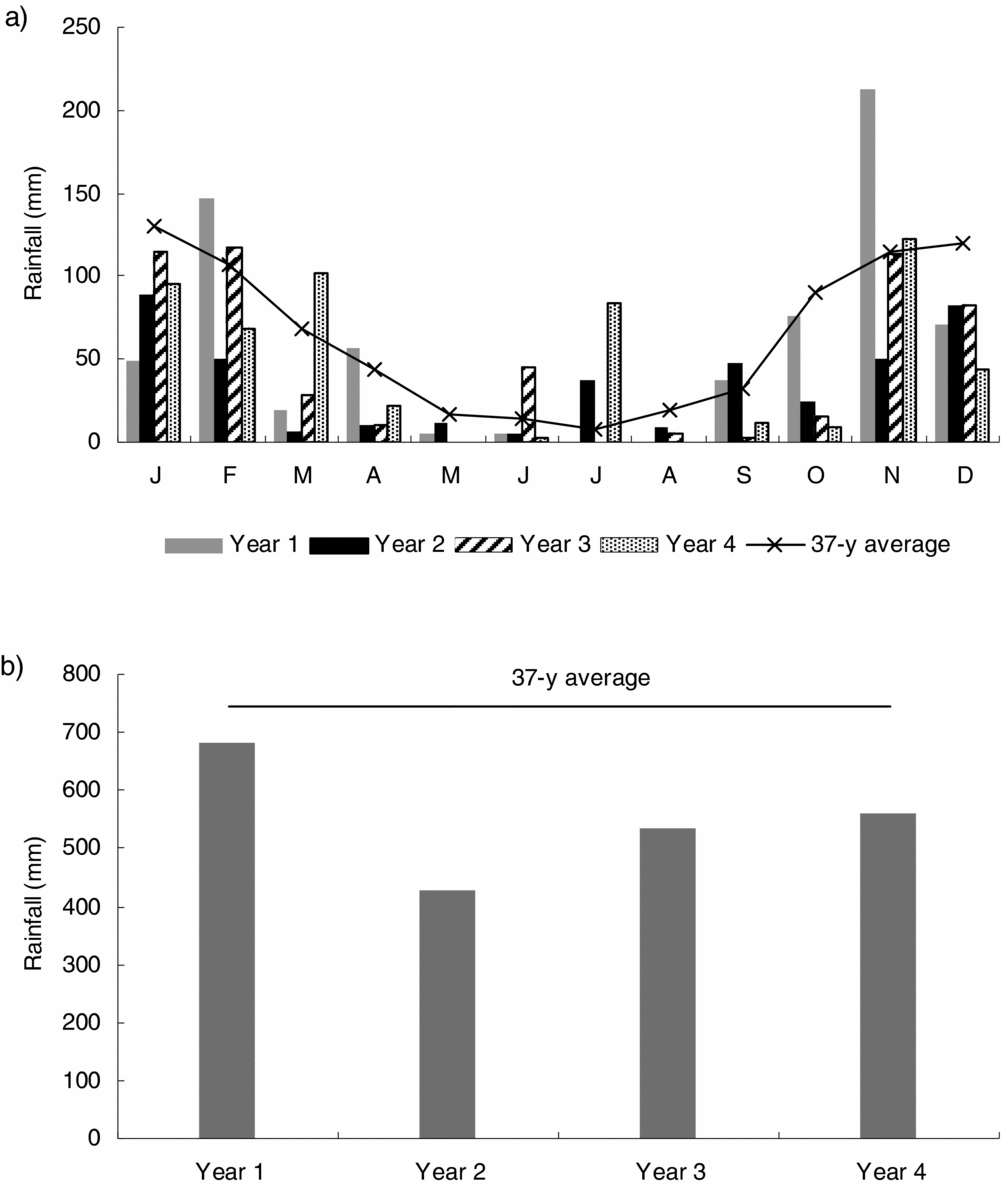
Ithala Game Reserve (29653 ha) is situated in northern KwaZulu Natal, South Africa (27°30′S, 31°25′E). It is typical of the increasingly popular model for game reserves in the region – medium to small in size, completely fenced and lacking large predators. Altitude ranges from 350 to 1550 m asl. Long-term annual rainfall is 791mm, falling mainly during the wet season (October–March). Wet seasons are warm to hot (daily average of 18–30°C), with dry seasons being warm to mild (15–25°C) (Porter Reference PORTER1983). Over the study mean annual rainfall (632mm) was below average, with annual rainfall in Year 2 noticeably lower (427mm). Unusually, temperatures approached freezing in June of Year 2 and in April and October of Year 3. There is an extensive network of naturally occurring surface water throughout the year but no artificial water-holes. The reserve is located in steep, dissected terrain, interspersed with grassy plains. Soil types are varied, with shallow, rocky (lithosols) of the Mispah form predominating (Turner Reference TURNER1980). The vegetation is a mix of north-eastern mountain grassland at high elevations, Natal central bushveld at mid-elevations and Natal lowveld bushveld at low elevations (Low & Rebelo Reference LOW and REBELO1996). Structurally it is a mosaic of grasslands, open savanna dominated by Acacia species and more or less closed thickets of broad-leaved shrubs and trees. The vegetation communities, or habitat types, may be described in more detail as follows, with plant nomenclature after Pooley (Reference POOLEY2003): (1) riverine and scree forest (continuous, riverine vegetation), (2) wetlands (sparse, wetland vegetation), (3) undulating tall grassland (sparse, old croplands not on flood plain, dominated by Hyparrhenia and Hyperthelia sp. with smaller areas dominated by Themeda triandra; where woody species present these include Dichrostachya cinerea, Rhus lucida and Acacia nilotica), (4) basin bushveld and thicket (closed, Euclea racemosa, D. cinerea, A. nilotica, Faurea saligna, Euphorbia ingens – sparse F. saligna and E. ingens < 2.5m in height), (5) mixed thornveld (ranges from open, through continuous to closed; disturbed lands, often old kraal sites, A. nilotica, Aloe marlothii, Maytenus heterophylla and Dombeya rotundifolia), (6) sparsely wooded hill slopes (open, Combretum apiculatum, D. rotundifolia, M. heterophylla, A. nilotica – C. apiculatum seldom found at heights < 2.5 m), (7) tall deciduous woodland (closed, Acacia nigrescens, A. tortilis, A. robusta, Spirostachys africana, Maytenus senegalensis), (8) woody rocky outcrops (ranges from open to closed; patchy unit composed of grassland with granite outcrops on which woodies found, Terminalia phanerophlebia, Sclerocarya birrea subsp. caffra, A. nilotica, Lannea discolor).
Indigenous animal populations had largely been destroyed by the 1950s by farming (since 1884), a rinderpest epidemic (1896) and hunting, including that to control tsetse fly (1919–1950) (Johnson Reference JOHNSON1990). The Natal Parks Board purchased the land in 1972 and stocked it with mammals typical of the south-eastern African savanna, including warthog Phacochoerus aethiopicus Pallas, impala, black rhinoceros Diceros bicornis Linnaeus and white rhinoceros Ceratotherium simum Burchell, zebra Equus burchelli Gray, buffalo Syncerus caffer Sparrman, wildebeest, kudu Tragelaphus strepsiceros Pallas, giraffe Giraffa camelopardalis Linnaeus and elephant Loxodonta africana Blumenbach. The reserve is entirely fenced except to the north where animal movement is limited by the substantial Pongola River. Consequently no significant immigration/emigration of animals occurs. The reserve does not contain any large mammalian predators (lion, leopard, hyaena, cheetah or wild dogs). Impala are carried at 10 km−2, a moderate density for impala (Brooks Reference BROOKS1975, O'Kane et al. Reference O'KANE, DUFFY, PAGE and MACDONALD2013b), whilst wildebeest are at a density of 6 km−2 (KZN Wildlife, unpubl. data) – a comparatively high density for the species (Attwell & Hanks Reference ATTWELL and HANKS1980, Mason Reference MASON1990).
Data collection
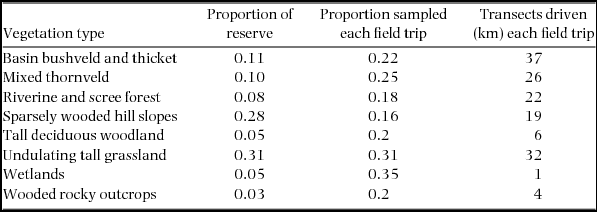
Data were collected over a 4-y period, encompassing four wet and dry seasons. Road transects, encompassing 23% of the reserve's total area, were carried out monthly over a 6-d period (Table 1). Transects were driven at the same time during the morning and afternoon on each field trip, with midday avoided. Once within a classifiable distance with an unobstructed view of the individual/group of herbivores, the total number of animals, their age and sex were determined. Wildebeest and impala are seasonal breeders and, as previously observed (Brooks Reference BROOKS1985), calve/lamb at Ithala over a few weeks in November and December. Therefore, for convenience, 1 November was taken as the start of the breeding season, so as of that date animals will be newborn (juveniles, up to 12mo), >12mo (yearlings, 13–24mo) or >24mo (adults). Whilst wildebeest females bear horns, impala females do not. Due to the increasing difficulty (except at close range) in the second half of the breeding year to distinguish female impala juveniles from female yearlings or adults, from 1 May–31 October no attempt was made to record the age grouping of female impala. However, as in southern Africa juvenile impala of both sexes remain within their natal herd throughout the first year of life (Jarman & Jarman Reference JARMAN and JARMAN1973, Murray Reference MURRAY1982), for the period 1 May–31 October the number of juvenile females was taken to be the same as the number of (easily distinguishable) juvenile males, as it seems reasonable to assume there is no significant difference in their mortality while both sexes remain within the herd (Brooks Reference BROOKS1975, Reference BROOKS1985). The precise criteria for age and sex classification are as per Brooks (Reference BROOKS1985). Post-fire dry-season grass flushes, consisting of bright green, newly sprouted shoots on ground recently burnt, are very distinctive in the field – where herbivores were grazing on such flushes, this was recorded.
Road transects driven in Ithala Game Reserve, showing vegetation type sampled. The proportion of the reserve each vegetation type forms is shown, together with the proportion of that vegetation type sampled, and the length of transects driven, on each field trip.

As the topography of IGR, characterized by hills and valleys, frequently results in visibility being abruptly cut off leading to areas of dead ground where animals cannot be seen, the classical Distance Sampling technique (Buckland et al. Reference BUCKLAND, ANDERSON, BURNHAM, LAAKE, BORCHERS and THOMAS2001) could not be reliably used in this ecosystem. We therefore developed a GIS-based method for determining herbivore densities by habitat type, utilizing the detailed and current GIS vegetation layer available for the whole of IGR (Balcomb Reference BALCOMB1996). This method (see O'Kane et al. Reference O'KANE, DUFFY, PAGE and MACDONALD2013a for a full description) determines the actual area sampled in each vegetation type, thus accounting for variation in visibility amongst different vegetation types. Positional data were gathered during the final 2 y of the study.
Data analysis
Wildebeest and impala demographics assessed were total numbers and numbers of adults, the percentage of the total population juveniles formed and fecundity. Strictly speaking, fecundity relates to the ratio of juveniles to adult females immediately after parturition but this is difficult to determine in the field and greatly limits the data sample (Attwell Reference ATTWELL1977). We therefore determined the number of juveniles per 100 adult females averaged over the entire breeding year (juvenile/female ratio), which encompasses fecundity and juvenile deaths during the first year of life, and then used our monthly figures on the percentage of the population juveniles formed to disentwine fecundity from juvenile deaths. We performed multiple regressions to determine if there were significant relationships between wildebeest and impala in terms of (1) total numbers and the annual rainfall for the same and the previous year, and (2) juvenile/female ratio and the rainfall over (a) the previous year, (b) the height of the previous dry season (June–August), (c) the previous rut (February–April) and (d) the perinatal period (November–December).
Whether occupancy of individual habitat types significantly varied from random occupancy, or whether occupancy of individual habitat types in the dry season varied significantly from that in the preceding wet season, was tested by apply Pearson's Chi-square test with Yates’ continuity correction (Crawley Reference CRAWLEY2005), with P < 0.05 taken as significant.
All statistical procedures were carried out in S-PLUS (Mathsoft, Lucent Technologies, Inc., Murray Hill, USA).
RESULTS
We obtained 8742 sighting records, encompassing a total of 8400 wildebeest and 10071 impala. Over the 4 y total numbers of wildebeest and impala counted increased annually – however there was no significant relationship between these total numbers and total annual rainfall over either the same year (wildebeest: r2 = 0.037, P = 0.81; impala: r2 = 0.017, P = 0.87), or the previous year (wildebeest: r2 = 0.58, P = 0.24; impala: r2 = 0.65, P = 0.2).
Fecundity
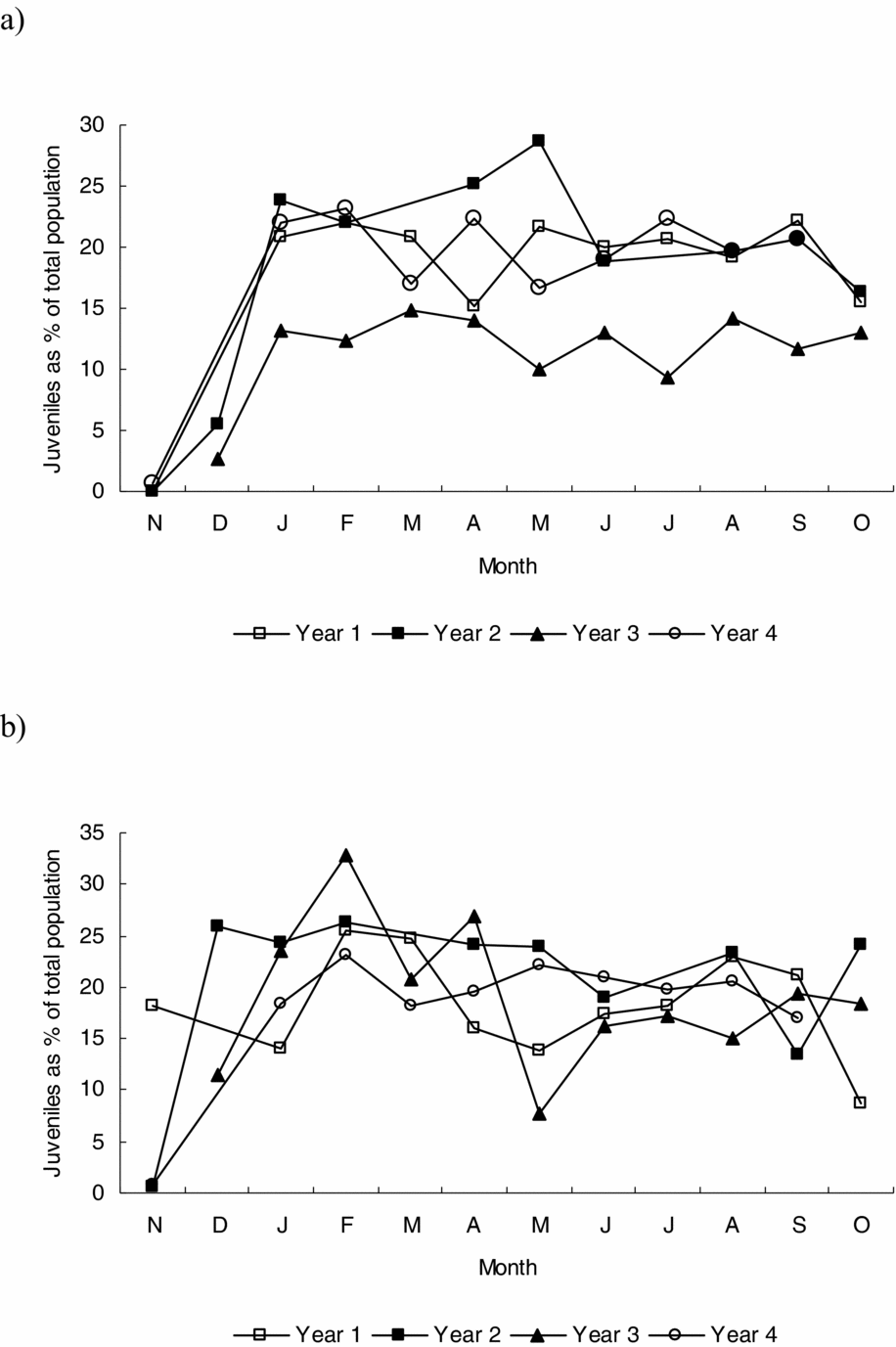
Wildebeest number of juveniles per 100 adult females showed a highly significant positive relationship with rainfall (mm) over the perinatal period (November–December) (y = 19 + 0.068x (SE = 0.51 (intercept), 0.002 (rainfall)), df = 2, r2 = 0.998, P = 0.0008). Comparison of rainfall (Figure 1) and the percentage wildebeest juveniles formed of the total population (Figure 2a) show this finding does relate to cows’ actual fecundity, rather than being a distortion due to juvenile survival rates over the year, as lower rainfall is associated at the outset of the breeding year (November–December) with fewer newborn juveniles. Wildebeest juvenile/female ratio was not significantly related to rainfall over the previous year, the previous height of the dry season (June–August) or the previous rut (February–April), although the latter regression approached significance (y = 27.3 + 0.042x (SE = 2.75 (intercept), 0.012 (rainfall)), df = 2, r2 = 0.87, P = 0.065) (Figure 3a). Impala juvenile/female ratio was not significantly related to rainfall over the previous year (r2 = 0.027, P = 0.84), the previous 2 y (r2 = 0.15, P = 0.62), the previous height of the dry season (r2 = 0.053, P = 0.77), the previous rut (r2 = 0.0018, P = 0.96) or that over the perinatal period (r2 = 0.001, P = 0.97) (Figure 3b).
Rainfall in Ithala Game Reserve, South Africa. Monthly rainfall (a) and annual rainfall (b) for the 4-y study period are shown, each also showing the 37-y average rainfall.

Juvenile wildebeest (a) and juvenile impala (b) as a percentage of the total observed population over the breeding year (November to October), in Ithala Game Reserve, South Africa. Attention is drawn to (i) the markedly lower percentage of the total population that wildebeest juveniles form in Year 3, both at the outset of and throughout that breeding year (a), and (ii) the large and maintained reduction in wildebeest juveniles as a percentage of total population over May–June, Year 2 (a), and in impala juveniles over April–May, Year 3 (b).

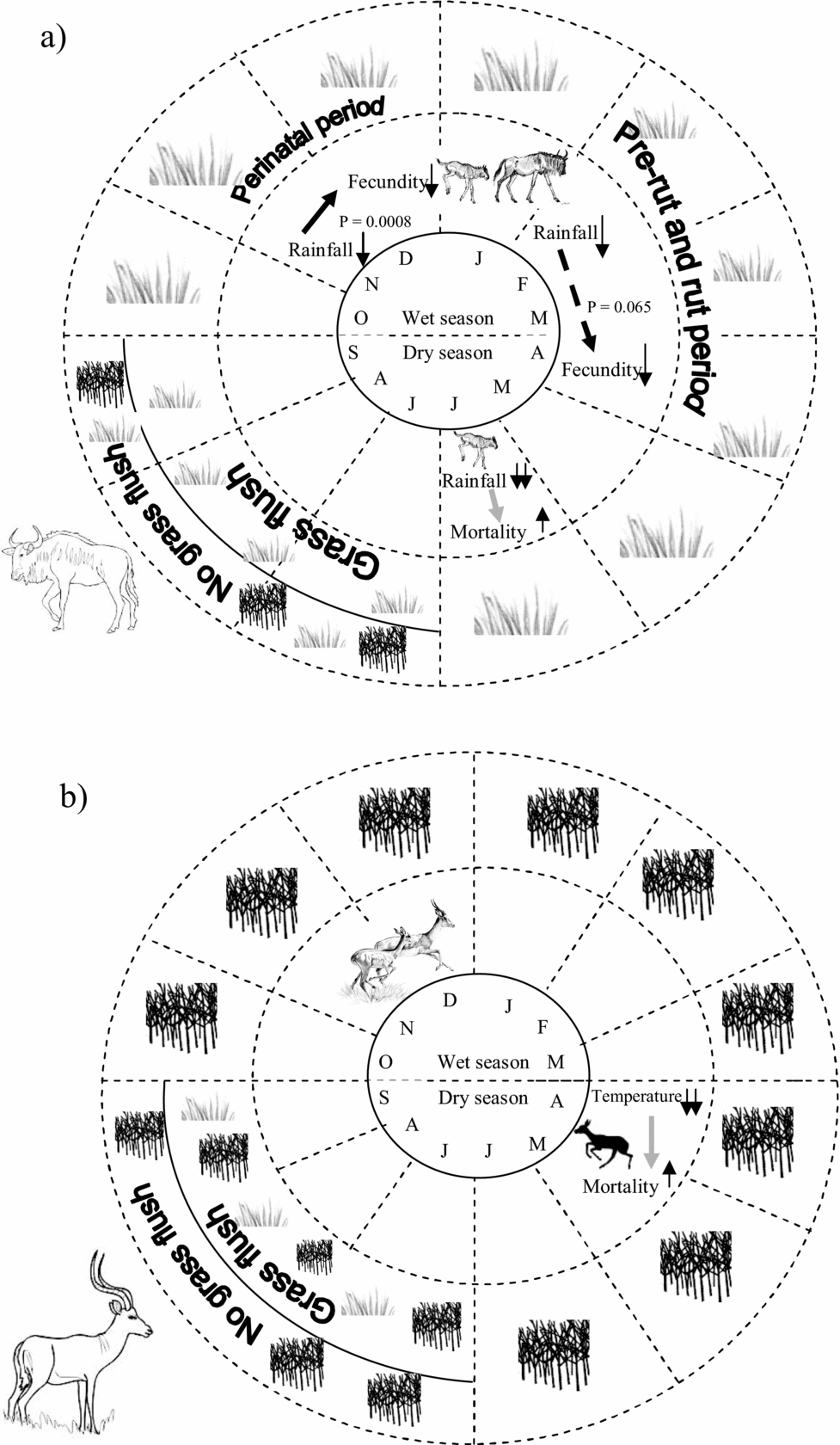
Pictorial representation of the influences of rainfall, fire, competition and temperature on grazers and mixed-feeders in Ithala Game Reserve, South Africa. For wildebeest (a) and impala (b), moving outwards from the innermost circle (depicting months/seasons), the middle circle depicts influences on fecundity and juvenile mortality, and the outer circle habitat usage. In the latter the repeated light grey schematic represents grassland, the dark grey bushveld and thicket.

Juvenile mortality
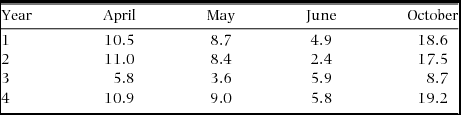
Over the middle of the dry season (June) of the driest year, Year 2, mortality of juvenile wildebeest was higher than in other years (Figures 2a and 3a) – average daily temperatures were unusually low over this period (Table 2). Impala juveniles show a less marked reduction over this period (Figure 2b). Impala, unlike wildebeest, show an additional and marked reduction in juveniles earlier (April–May) in the dry season of Year 3 (Figure 3b) – when rainfall was average during the year and over the dry season, but daily temperatures were unusually low. Neither wildebeest nor impala juvenile mortality appeared to be influenced by exceptionally cold weather during the early wet season (October) of Year 3.
Average daily minimum temperatures (ºC), by month, in the vicinity of Ithala Game Reserve (Vryheid). Over one week of October in Year 3 there was a period of exceptionally unseasonal cold weather, sufficient to cause frost damage to low-lying Acacia (pers. obs.).

Habitat selection
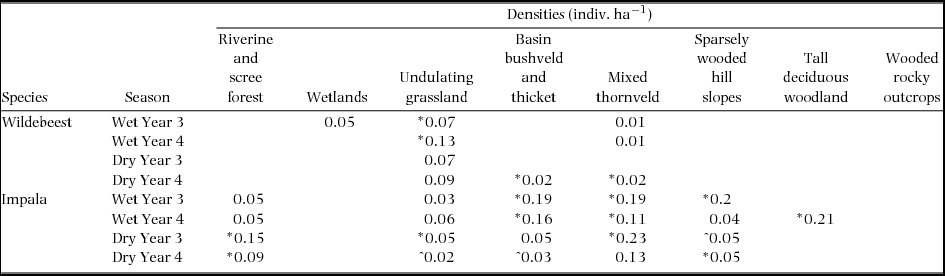
Wildebeest significantly selected grasslands throughout both wet and dry seasons, and significantly selected browse habitats (basin bushveld and thicket, mixed thornveld) over the dry season of Year 4 (Table 3, Figure 3a). Impala significantly selected browse habitats throughout both wet and dry seasons (Table 3, Figure 3b). Over the same dry season that wildebeest selected the basin bushveld and thicket habitat type (Year 4), impala showed a significant reduction in density in that habitat type. Impala did not significantly select grasslands in any season, but did show a significant move to grasslands compared with the previous wet season over the dry season of Year 3 (Table 3). Both wildebeest and impala were observed to make marked use of the grass flushes (Figure 3a, b) that occurred on the grasslands during the dry season of Year 3; no such flushes occurred during the dry season of Year 4.
Habitat type selection by wildebeest and impala in Ithala Game Reserve, showing herbivore densities over two wet and dry seasons. For wet seasons, *indicates significant positive selection (Chi-square, P < 0.05) for that habitat type compared with random selection. However, for dry seasons significance (Chi-square, P < 0.05) of selection is defined in terms of comparison to the same habitat type in the preceding wet season, with *indicating positive selection and ^negative selection compared with the previous wet season. A blank entry indicates that there were no sightings of that species in that habitat type.

DISCUSSION
Although a longer time series of data is needed to draw firm conclusions, the ability of wildebeest to increase its numbers throughout the study and wildebeest numbers not being correlated with annual rainfall, even over a relatively dry year, suggests the population is not resource limited. However the significant correlation between rainfall and wildebeest fecundity, albeit a weak slope in the regression, suggests the latter is a demographic more sensitive to fluctuations in rainfall. Although others (Owen-Smith et al. Reference OWEN-SMITH, MASON and OGUTU2005) have linked juvenile survival to rainfall in general, our finding that specifically rainfall over the perinatal period is of prime importance for wildebeest calf survival is, as far as we are aware, novel. Since juveniles are dependent on their mother's milk during this period (Attwell Reference ATTWELL1977), it appears the quantity/quality of grass available to lactating wildebeest immediately post-partum is of central importance to their calves’ survival. Kreulen (Reference KREULEN1975), studying Serengeti wildebeest, concluded older, longer grass provides insufficient calcium for lactating wildebeest and that their move to the eastern plains related to the acquisition of sufficient calcium. Presumably relative failure of the early wet-season rains, depriving wildebeest in Ithala of sufficient quantities of new grass growth, might therefore be having a detrimental effect on fecundity, at least in part, via insufficient calcium. That the correlation between wildebeest fecundity and rainfall over the rut approached significance, suggests that a larger dataset might demonstrate that rainfall over this period, when conception occurs, is also important. Rasmussen et al. (Reference RASMUSSEN, WITTEMYER and DOUGLAS-HAMILTON2006) found that season-specific variation in vegetation productivity, measured by NDVI, is strongly correlated with conception rates in the African elephant.
The browse, composed of woody plants, is less vulnerable to short-term fluctuations in rainfall than grass and hence links between browser demographics and rainfall are more cryptic (Owen-Smith & Mills Reference OWEN-SMITH and MILLS2006). The impala, a mixed-feeder which is adept at switching between browse and grass (Smithers Reference SMITHERS1983) to an optimal extent (Meissner et al. Reference MEISSNER, PIETERSE and POTGIETER1996), would thus be expected to be less affected than pure grazers by the muted and relatively short-term variation in rainfall recorded over the study – as demonstrated by, and supporting our first hypothesis, the lack of any significant relationship between rainfall and impala fecundity, and the lower mortality of impala juveniles, compared with wildebeest juveniles, over the severest dry season. Moe et al. (Reference MOE, RUTINA and DU TOIT2007), however, demonstrated that rainfall variation does have some effect, as would be expected, on impala juveniles, reporting that in Chobe, Botswana impala lamb condition was higher in years with better rain the preceding wet season. Our finding that 8-mo-old impala juveniles suffered higher mortalities than similarly aged wildebeest juveniles during unusually cold weather in the early dry season supported our fourth hypothesis. This may be due to their smaller size and hence, consequent on the body surface area/volume relationship (Owen-Smith Reference OWEN-SMITH1988), increased proportional heat loss and susceptibility to cold. A lack of mortality amongst either species’ 11-mo-old juveniles over severe cold weather in the early wet season, suggests both species are more robust at this stage of the breeding year – sharply contrasting with local livestock (cows and goats) which died in large numbers over this period (pers. obs.).
The wildebeest is a pure grazer (Smithers Reference SMITHERS1983), favouring plains covered by stoloniferous grasses which respond to grazing, trampling and manuring by rapid regrowth (McNaughton Reference MCNAUGHTON1985), and heavily utilized grasslands throughout both years and seasons, thus supporting our second hypothesis. Use of other vegetative communities varied between the two years. In Year 3 management burning started on 8 May; substantial (for the dry season) rain fell following this burning in June promoting marked green flushes. In Year 4, in contrast, burning did not start until 30 July after the only sizeable dry-season rains; consequently no dry-season flush occurred. Lending support to our third hypothesis, wildebeest made marked use of this dry season Year 3 flush which, since they did not use any other habitat, presumably ensured the grasslands alone continued to provide sufficient nutrition throughout the dry-season months. Over the dry season of Year 4, with the absence of any flush, wildebeest additionally selecting predominantly browse communities, most probably to utilize the sparse grass found there, implies the grasslands alone could no longer provide maintenance nutrition.
Although the impala feeds on a wide range of grasses, herbs, shrubs and trees, it prefers to graze (Dunham Reference DUNHAM1980, Wronski Reference WRONSKI2003). Poor grass quality in the dry season enforces less time spent grazing and more browsing (Wronski Reference WRONSKI2002). An increase of browse over grass in the diet of impala in the dry season is widely reported in the literature (Hansen et al. Reference HANSEN, MUGAMBI and BAUNI1985, Rodgers Reference RODGERS1976). As well as changing its diet between seasons, impala can adapt to different environments by being mainly a grazer in one whilst mainly a browser in another (Smithers Reference SMITHERS1983, Sponheimer et al. Reference SPONHEIMER, RUITER, LEE-THORP, CODRON and CODRON2003). Given that large areas of both grass and browse are available in Ithala, one would expect impala to occupy mainly grasslands in the wet season and move to browse habitats in the dry season (Jarman Reference JARMAN1972). Unexpectedly and in contrast to our second hypothesis, impala instead consistently, in both wet and dry seasons, favoured browse communities, significantly selecting grasslands only in the dry season of Year 3 in response to the marked green flush at that time, thus supporting our third hypothesis. Wildebeest and impala both prefer short grass; the high density of wildebeest in the reserve probably creates potential competition between the two herbivores (Keddy Reference KEDDY2001), with impala avoiding this competition by reducing niche overlap (Pianka Reference PIANKA1972, Reference PIANKA and May1976) by utilizing browse – a resource wildebeest cannot access. As far as we are aware this is the first record in the literature of impala, that is sympatric with high densities of mesograzers, significantly selecting browse-rich habitats in preference to grass-rich habitats throughout the year.
Owen-Smith & Mills (Reference OWEN-SMITH and MILLS2006) concluded that the manifold influences on ungulate communities are characterized by a ‘complex interplay’. Our findings support this view in regard to possible interspecific competitive pressures and in relation to whether minor variation in annual rainfall have any influence on overall population dynamics. Contrastingly, our work clearly identifies that low rainfall over the perinatal period decreases wildebeest (and therefore possibly other pure grazers’) fecundity, and that dry-season grass flushes influence the habitat selection, and hence impact, of both grazers and mixed-feeders. The differing response of grazers versus mixed-feeders to resource availability, and the importance of timing burning before, not after, the dry-season rains, is highlighted. Our study also emphasizes that however keenly sought by ecologists and management alike, an overall synthesis of the factors that shape ungulate communities will invariably be modified, to a greater or lesser extent, by local conditions.
CONCLUSIONS
Over 4 y of below-average rainfall, but not drought, population sizes of grazers and mixed-feeders did not correlate with annual rainfall. Fecundity of grazers, in contrast to that of mixed-feeders, correlated with rainfall specifically over the perinatal period. Mixed-feeders demonstrated atypical habitat selection, probably consequent on high densities of grazers limiting availability of grasslands. Dry-season grass flushes significantly affected both groups’ habitat selection, and hence impact on the browse by the mixed-feeders. Resource availability, whether influenced by rainfall, competition or management, thus results in differential pressures on grazers versus mixed-feeders, with implications for management and multiple-use stakeholders.
ACKNOWLEDGEMENTS
We thank the reserve management of Ithala Game Reserve, South Africa. We are grateful to Marion Valeix, Andrew Beckerman, Michael Craig and two anonymous reviewers for comments on an earlier draft. Dr O'Kane holds the Kadas Research Fellowship at WildCRU, Department of Zoology, University of Oxford and is deeply grateful to Gyongyver and Peter Kadas for their support.