Introduction
Safe microsurgical skills training has its own unique challenges in the attainment of skills not easily transferable from open surgical procedures. The traditional apprenticeship model of training has changed, at least partly in response to a reduction in working hours and altered patient expectations. The need for a surgeon to ‘be dexterous and have steady un-trembling hands, and clear sight’ is arguably even more important today than when it was written, around the mid-1400s.Reference Kirkpatrick and Naylor 1
Working in the confines of the ear canal and down a microscope is a skill that the experienced may take for granted, but one that the uninitiated find difficult, with limited room for instrumentation in what can best be described as an anatomical minefield. Hand movements are not performed under direct vision, but with hand–eye dissociation, which exacerbates the challenge. Junior trainees need to develop these skills, often first learning them in the out-patient clinic setting, performing procedures such as aural microsuction and cerumen debridement. Most otolaryngology and head and neck surgeons will recall having caused some ear canal trauma in their junior years, and experienced the resultant apprehension that patients can have towards this procedure. A reduction in junior trainee hours has highlighted the need for alternative training models that facilitate efficient acquisition of microsurgical skills in a way that does not put the patient at risk of harm.
The provision of safe surgical care for all is challenged by a lack of human and physical resources in low-resource settings.Reference Meara, Leather, Hagander, Alkire, Alonso and Ameh 2 Many humanitarian efforts are attempting to help address this deficiency throughout the world. An important goal of these efforts should be to help local surgeons perform safe surgery, whilst acknowledging the setting and infrastructure within which they work. The use of a validated training model in a low-resource setting could help local surgeons develop the microsurgical skills necessary to perform safe otological surgery.
The present study aimed to develop a low-fidelity Ear Trainer, and assess its face and construct validity as an ear-training simulator that can be used to train surgeons in procedures performed via the ear canal.
Materials and methods
The Gloucestershire Royal Hospitals NHS Trust Research and Development team assessed and approved this study.
Simulator development
Adherence to certain pre-defined principles was felt necessary in order for a training model to be effective and sustainable in low-resource settings. These principles include: (1) low fidelity, such that the training model is simple yet effective to use in any worldwide setting; (2) low cost and lacking ongoing costs for consumables, such that any replaceable parts are readily available in any clinical setting; (3) robustness, to ensure longevity; (4) having realistic dimensions and layout, such that there is a reasonably accurate facsimile of the real anatomy which a surgeon will encounter; (5) aiding the acquisition of hand–eye co-ordination skills when performing tasks with a head torch or an operating microscope; and (6) providing a range of tasks, such that trainees at different stages of their development will find the simulator useful for training and for assessment to show progress in task performance.
Working with an engineer knowledgeable of the technical requirements (Matt d'Entremont from the iD Lab, Dalhousie University, Halifax, Canada), our ear surgery training simulator was developed with the following listed requirements. It needs to have the ability to be angled in position, to represent the head during ear operations or clinic-based aural procedures. The simulator should incorporate a reproduction of the external auditory canals; these should be 2.5 cm in length and show variation (some straight and wide, others tortuous and narrow). A representative external auditory canal facsimile should be able to accommodate a standard ear speculum available in most or all clinical settings. The middle-ear space chamber should have a depth of approximately 5 mm, similar to the human middle-ear dimensions, and be adaptable for different tasks. The unit should be fixable to any hard surface, such as a table, by way of a simple clamp for example. No replaceable parts should be required, other than those readily available at any medical centre worldwide. Finally, the ear surgery training simulator needs to be low-cost to develop.
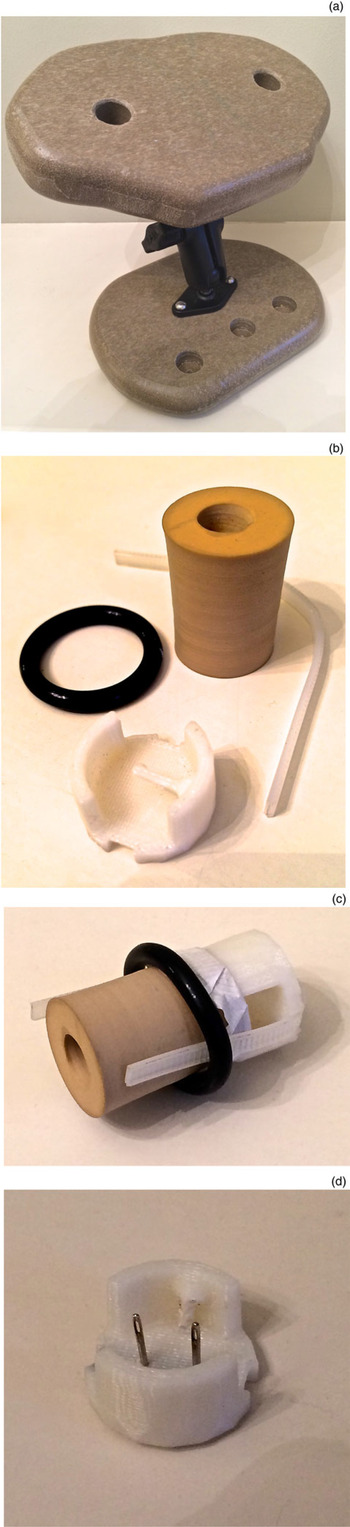
The Ear Trainer base unit and inserts were created (Figure 1). The arrangement of the O-ring and zip-tie allows for simple replacement of the ‘tympanic membrane’, which is placed between the ear canal and middle-ear segments. The tympanic membrane was usually created with a cigarette paper, as this proved to demonstrate ‘iatrogenic’ damage most readily if inadvertently touched during a procedure. For some tasks, the end of a latex glove performed well as a more robust alternative that was equally readily available.
The Ear Trainer with task-specific inserts: (a) base unit, (b) ear canal insert, with middle-ear chamber, zip-tie and O-ring, (c) example of assembled insert, with cigarette paper tympanic membrane in situ, and (d) middle-ear component used for task six (middle-ear suture manipulation).

Validation study participants
The Ear Trainer was assessed on a convenience sample of participants with variable microsurgical experience. The unit was taken to various venues and meetings (the British Academic Conference in Otolaryngology 2015 clinical skills centre, the ENT-UK New Registrar Induction Simulation Course and regional training days in the UK), where delegates were asked to trial the simulator and complete a short questionnaire to assess face validity. These individuals, all of whom consented to partake in the trial, were grouped according to their level of experience: medical students with no prior experience in performing tasks in the external auditory canal or using a microscope; junior otolaryngology and head and neck surgery trainees, who had limited (3–12 months’) experience in otolaryngology and head and neck surgery; and otolaryngology and head and neck surgery consultants or senior trainees with at least 6 years’ experience in otolaryngology and head and neck surgery.
Sample size
Using a two-sample, two-sided study design, a minimal sample size of 12 (6 novices and 6 experienced surgeons) was deemed necessary to be able to reject the null hypothesis that the performance level between novices and advanced surgeons is equal after training with the Ear Trainer, with a power of 80 per cent. The type I error probability associated with this null hypothesis was 0.05.
Face validity assessment
The Ear Trainer was required to have realistic dimensions and layout, such that there is an accurate (low-fidelity) representation of the real anatomy that a surgeon will encounter. Anatomical dimensions found in normal patients were used, with some variation allowed for, which was achieved by creating inserts with differing ear canal diameters and tortuosity. The degree of realism of the Ear Trainer was assessed using four questions linked on a five-point Likert scale (Appendix 1).
Construct validity assessment
Each participant was shown a short video clip demonstrating each of the tasks (Appendix 2), performed by an ‘expert’. As this was played, the key points of each task were explained verbally. Correct set-up of the microscope was ensured (inter-pupillary distance, eye focus, seat height), but not assessed. A time limit for each task was set, after which it would be abandoned as incomplete. The first task was performed with a headlight; all others were performed with the operating microscope. It was explained that whilst the tasks did not always exactly mirror real life, they were designed to replicate realistic hand-motion tasks utilised during ear procedures and in this way provided a simulated learning experience.
The following six tasks were created. The first task was foreign body removal from the ear canal using a headlight. This was developed to create a non-microscope task (which might help train village health aids or clinical officers, as well as otolaryngology and head and neck surgery doctors). A round bead was inserted, and a blunt right-angled hook and headlight were supplied for removal. The second task was foreign body removal from the ear canal using an operating microscope. A round bead was inserted, and a speculum and blunt right-angled hook were supplied for removal. The third task was myringotomy and ventilation tube insertion. A speculum, myringotome and micro-needle (straight) were supplied with a Shah grommet (Gyrus ACMI®). The fourth task was tympanomeatal flap raising. A speculum, myringotome and micro-needle (straight) were supplied. The fifth task was myringoplasty. A speculum, needle, crocodile forceps and Spongostan™ dressing were supplied. In this case, the tympanic membrane was a latex glove end with a hole punched through it; the graft material was cigarette paper. The sixth task was a middle-ear task. This was developed to create a task involving manipulation of micro-instruments in the middle ear, akin to skills required for ossiculoplasty for example. A middle-ear chamber with a sewing needle inserted was attached (Figure 1d). A speculum, crocodile forceps, ear suction and size 4.0 Prolene® suture were supplied.
Participants were video-recorded performing the tasks, such that only their gloved hands were seen, allowing blinded assessment. Each video was assessed by the senior author (MPAC), who was not involved in recording the videos. Only after all videos were assessed was the code broken to identify the experience of each participant.
Surgical performance was assessed using a validated measurement tool, which included the global rating scale and task-specific checklist. This tool was based on the model of objective structured assessments of technical skills, a validated method for evaluating technical and non-technical skills.Reference Reznick, Regehr, MacRae, Martin and McCulloch 3 The task-specific checklist was adapted according to the limits of this low-fidelity simulator using five-point Likert rating scales (Appendix 3).
Results
We aimed to produce a simulator of low cost with no ongoing cost requirement for consumables. The cost of producing a single Ear Trainer simulator is approximately £100 (if made in sufficient quantity). Ongoing costs are minimal – the use of latex gloves and cigarette papers for example. The device also needed to be robust. Whilst not formally assessed, the Ear Trainer is made of hard plastic, with simple parts, to ensure longevity.
Face validity
Twenty participants, ranging from novices (9 out of 20) to experts, completed the face validity questionnaires.
The specific questions and associated results included: (1) ‘Does the Ear Trainer have dimensions and layout similar to those found in the real ear?’, for which the average score was 3.9 out of 5; (2) ‘Do you think that training on such a simulator will help with the acquisition of hand–eye co-ordination when performing tasks using an operating microscope?’, which had an average score of 4.6 out of 5; (3) ‘Do you think the skills acquired from the simulator will translate to improvement with live surgery?’, for which the average score was 4.3 out of 5; and (4) ‘Do you think that more senior trainees will perform the tasks better than more junior or inexperienced trainees?’, which had an average score of 4.2 out of 5.
Based on these results, one can conclude that face validity was demonstrated.
Construct validity
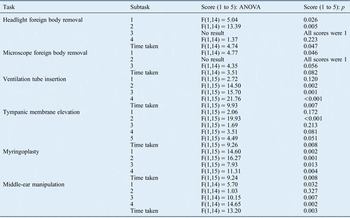
Video analysis and task scoring allowed for the assessment of construct validity. One-way analysis of variance with a linear contrast tested the single proposition ‘the most experienced are better than the middle experienced, who in turn are better than the least experienced’. Statistical tests were also performed to analyse trends in the time taken for the task as well as subtask 1–5 scoring (Table I).
Testing for a trend in score from least to most experienced surgeons*

A p-value of 0.01–0.05 indicates probable significance; a p-value less than 0.01 indicates high significance. *Using a one-way analysis of variance. ANOVA = analysis of variance
The Ear Trainer was able to differentiate between novices, those with middling experience and experts in tasks performed in the simulated ear canal or middle-ear space. The time taken to perform the tasks proved to be a useful differentiator. In all tasks, there was a clear trend favouring the experts completing the task more quickly, with statistically significant differences in all but the foreign body removal tasks (where all groups performed well).
Discussion
We developed an Ear Trainer specifically designed for use in low-resource settings. It was designed to be low-cost, robust and relatively maintenance-free, without the need for expensive replacement parts. Both face validity for emulating the real human ear and construct validity for differentiating users’ level of experience were demonstrated.
Like high-fidelity simulators, low-fidelity simulators still need to allow the trainee to practise tasks reminiscent of relevant clinical skills transferrable to patient care, but in an environment where they can make mistakes without risk to the patient. With these restraints considered, there are limitations to what a low-fidelity simulator can achieve. However, it should be able to improve the skill of performing dexterously challenging tasks down a microscope, such as realistic practice in ventilation tube insertion, the acquisition of skills required for otitis externa aural care and the debridement skills needed for post-operative management.
Simulated surgery models enable a procedure to be practised in an unhurried environment, without issues of patient safety or the difficulties associated with the use of cadaveric or animal tissue models. Some very sophisticated computer-based ear-training devices already exist, which include haptic feedback and which simulate three-dimensional temporal bone anatomy and pathology.
Various inexpensive training tools have also been described for practising ventilation tube insertion. Owa and Farrell described a model to simulate ventilation tube (grommet) insertion using a modified 1 ml syringe and Mepore® tape held in a cardboard kidney dish.Reference Owa and Farrell 4 Carr and Benjamin described a similar set-up with a 2 ml syringe and section of latex glove.Reference Carr and Benjamin 5 Ismail-Koch et al. reported another syringe-based model, within which artificial wax was also placed for the practice of microsuction removal.Reference Ismail-Koch, Marshall, Alabi and Buckland 6 Jesudason and Smith utilised a disposable auricular temperature probe cover,Reference Jesudason and Smith 7 Singh et al. employed the container in which a Shah grommet is packaged,Reference Singh, De and Vaughan-Jones 8 and Leong et al. found a substitute for glue ear fluid.Reference Leong, Kundu, Martinez-Devesa and Aldren 9 Plastic surgeons similarly use the operating microscope for performing neurovascular anastomoses, and have described a simple training model in which a thread is passed through the eye of consecutive sewing needles, positioned under an operating microscope; this model aims to improve dexterity with microsurgical instruments.Reference Chan, Mishra, Srinivasan and Ramakrishnan 10 These models all represent an inexpensive means of reproducing an environment where relevant manual skills can be developed. We took the best of these designs, added a more formal appreciation of the anatomical dimensions and variability seen in the ear canal, whilst increasing the range of tasks that could be practised.
The Ear Trainer has been developed to be versatile. In this study, the ear canal was standardised; however, a variety of ear canal inserts have been created – some wide and straight, some narrow and tortuous. Foreign bodies of different types and consistency can easily be inserted, other than just the round bead used in this study. In this way, the tasks can be modified to provide progressive learning uniquely applicable to the local environment. Headlight tasks allow for diversity in ability; community health workers, for example, would not have access to a microscope but are still required to do procedural work in the ear canal. Additional tasks can be created – the tasks used in this study only form an example of what is possible with the simulator.
The Ear Trainer has already been successfully used in the ENT-UK New Registrar Induction Simulation Course, developed to help new specialty trainees in the UK.Reference Parmar 11 In this setting, the grommet insertion task was employed in a ‘real world’ setting of a simulated operating theatre, with an anaesthetist and other operating theatre staff present. The use of distractions (e.g. loud music, patient being moved at critical points, repetitive bleeping) allowed the surgeon to practice performing a task whilst having to manage the situation and prioritise actions.
In April 2015, the Lancet Commission on Global Surgery was published; this highlights issues in providing safe, affordable surgical and anaesthesia care where needed, in low and lower-to-middle income countries.Reference Meara, Leather, Hagander, Alkire, Alonso and Ameh 2 This Commission examined a wealth of issues related to the provision of such care, and in doing so recognised the requirement for a trained surgical provider and the need to scale-up the surgical workforce. Although surgical capacity is developed in these countries, international non-governmental organisations need to integrate with local training programmes and accept an educational role to their work. The Commission considers that ‘NGOs [non-governmental organisations] should have a training component hardwired into their programmes to ensure the durability of their effect’, but states that ultimately high-quality training should be achieved in-country in a self-sufficient manner. In exploring opportunities for innovation, it is noted that equipment in low-resource countries needs to be affordable and yet durable to withstand infrequent maintenance and harsh environments. Low-cost simulation is recognised as one way to develop and ensure competency that is not at the expense of patients or scarce hospital supplies. The acquisition of competencies can be accelerated by skill practice in simulation, thereby reducing training time. It can be made available to students and trainees otherwise excluded from operating theatres owing to a shortage of supplies. We believe that the Ear Trainer addresses these goals well for what is an important health problem.
-
• Chronic suppurative otitis media (CSOM) represents a huge burden of disease worldwide, with greatest prevalence in low-income countries
-
• Simulated surgery has increased across all specialties; this need is extended to low-resource settings
-
• The Ear Trainer is an ear microsurgery trainer applicable for use in low-resource settings; it aims to help train those managing CSOM
-
• Six training tasks have been developed, and can be assessed using a global rating scale and task-specific checklist
-
• Face and construct validity results show that the Ear Trainer provides a realistic representation of the ear
-
• The Ear Trainer was able to differentiate between novice and expert task performance
The World Health Organization (WHO) has highlighted that anywhere between 65 and 330 million people worldwide suffer from chronic suppurative otitis media (CSOM), with the highest rates being in impoverished regions.Reference Li, Hotez, Vrabec and Donovan 12 The Global Burden of Disease Study 2010 assigned 4.68 million disabling adjusted life years to otitis media.Reference Horton 13 As a result, the WHO now recognises CSOM as a neglected condition beyond its group of 17 neglected tropical diseases. There is a well-documented link between hearing loss and academic achievement in children, which in turn leads to reduced wage-earning and economic prosperity, and which therefore has a significant economic impact in developing countries. Although social embarrassment has been reported in those with otorrhoea, it is probably of greater concern that in developing countries such a symptom is often considered a ‘normal’ part of childhood, so greater public awareness is crucial. Being able to manage otorrhoea can potentially lead to huge health and socioeconomic benefits, and the Ear Trainer can hopefully help to achieve the training required.
Further studies are currently underway to document the utility of the Ear Trainer in low-resource settings. It is currently being evaluated for its usefulness to village health workers who screen patients with ear problems in Cambodia, in collaboration with the non-governmental organisation ‘All Ears Cambodia’. We are also in the early days of evaluating its value to surgical otolaryngology and head and neck surgery trainees at Mbarara University of Science and Technology in Uganda. Future studies hope to demonstrate that the Ear Trainer is truly useful in the type of setting for which it was designed.
Acknowledgments
The authors would like to acknowledge: Matt d'Entremont (iD Lab, Dalhousie University, Halifax, Canada) for prototype Ear Trainer design and production; Manohar Bance, who provided expert commentary on model design during early development of the Ear Trainer; and Chris Foy (medical statistician at Gloucestershire Hospitals NHS Foundation Trust, Gloucester, UK). Funding for development of the Ear Trainer was obtained through unrestricted grants from Cochlear Corporation (Canada) and Medtronic Corporation (Canada). Funds were used for supplies only. None of the authors received financial remuneration for their contributions.
Appendix 1. Face validity assessment questionnaire
Face validity assessment for the Ear Trainer
We have produced an ear-training simulator to help teach the skills required to perform procedures via the ear canal. Our specific goals were:
-
• To produce a simulator that is low-fidelity, such that once introduced to a training department, there are no ‘running costs’ or need to provide spare parts (other than items always available, such as latex gloves).
-
• To produce a simulator that helps a trainee acquire hand–eye co-ordination when performing skills down an operating microscope.
-
• To produce a simulator that has dimensions and layout similar to those found in real ears, including the differences found in orientation between left and right ear canals.
-
• To produce a simulator with a range of tasks such that it can be a useful training tool for those at different stages of their career.
Questions
With these aims in mind, we would ask you to enjoy using the simulator then rate the following statements:
1. Does the Ear Trainer have dimensions and layout similar to those found in the real ear?
Highly disagree (1) Disagree (2) Neutral (3) Agree (4) Highly agree (5)
2. Do you think that training on such a simulator will help with the acquisition of hand–eye co-ordination when performing tasks using an operating microscope?
Highly disagree (1) Disagree (2) Neutral (3) Agree (4) Highly agree (5)
3. Do you think the skills acquired from the simulator will translate to improvement with live surgery?
Highly disagree (1) Disagree (2) Neutral (3) Agree (4) Highly agree (5)
4.Do you think that more senior trainees will perform the tasks better than more junior/inexperienced trainees?
Highly disagree (1) Disagree (2) Neutral (3) Agree (4) Highly agree (5)
Background information
-
• Please indicate if you are a trainee or independent practitioner:
-
• Please indicate the number of years you have been in the specialty of ENT:
-
• Please indicate if the majority of your work is in Otology:
-
• Please indicate if you have a specific role in training:
-
• Please provide any feedback or suggestions that you think might help us to improve this simulator:
The purpose of this questionnaire is to collect information as part of a study to evaluate the effectiveness of the Ear Trainer. Participation is strictly voluntary. By completing this form, you are implicitly agreeing to participate. Any published data will be presented without any identifying markers.
Appendix 2. Task videos
The video demonstrations of each task are available online at The Journal of Laryngology & Otology website, at http://dx.doi.org/10.1017/S0022215116008811.
Appendix 3. Task-specific checklist; each rating is on a 5-point scale
Task 1: FB removal EAC (no microscope)
-
• Performed with illumination using a headlight, a foreign body is removed with a blunt right-angled hook from the ear canal
Ratings:
-
1. Torch light correctly positioned in participant's line-of-sight to illuminate the outer aspect of the ear canal (5-point scale assessment, from rarely correctly directed to correctly positioned)
-
2. Number of times wax hook/instrument is passed past the opening of the ear canal, to demonstrate ‘flow’ or economy of movement (from 5+ to 1)
-
3. State of TM at end of task (from significant injury to no injury)
-
4. Overall global rating of task completion (from unable to perform to smooth and accurate)
-
5. Time taken to complete task (maximum allowed 300 seconds)
Tasks 2–6 require a speculum to be held in the ear canal insert during the procedure.
Task 2: FB removal from EAC with microscope
-
• Performed with the operating microscope, a foreign body is removed with a blunt right-angled hook from the ear canal
Ratings:
-
1. Number of times wax hook is passed past the opening of the ear canal
-
2. State of TM at end of task
-
3. Overall global rating of task completion
-
4. Time taken to complete task
Task 3: Myringotomy and VT insertion
-
• Performed with the operating microscope, a myringotomy is performed with a myringotomy blade through a latex finger mounted as the TM; a Shah grommet (VT) is inserted into this incision
Ratings:
-
1. Number of times myringotomy knife is passed past the opening of the ear canal
-
2. Successful siting of myringotomy incision antero-inferiorly (from grossly incorrect/TM damage to correct antero-inferior, tidy incision)
-
3. Number of attempts to place VT (from failure to place to 1 attempt)
-
4. Overall global rating of task completion
-
5. Time taken to complete task
Task 4: TM elevation
-
• Performed with the operating microscope, with cigarette paper mounted as the TM
-
• A circumferential incision from 12 to 6 o'clock is made with the myringotome at the TM/ear canal junction
-
• The TM is folded forward with a blunt right-angled hook
Ratings:
-
1. Number of times myringotomy knife is passed past the opening of the ear canal
-
2. Correct position of the incision
-
3. Number of times hook is passed past the opening of the ear canal
-
4. Successful forward folding of the TM (from grossly incorrect to neatly and correctly folded)
-
5. Overall global rating of task completion
-
6. Time taken to complete task
Task 5: Myringoplasty
-
• Performed with the operating microscope, with a latex finger mounted as the TM; this has a pre-made hole centrally within it
-
• Edges of perforation pierced by ME needle (to simulate freshening of edges)
-
• Pieces of Spongostan are placed through the perforation onto the ‘promontory’, underneath the perforation
-
• The ‘graft’, a piece of cigarette paper, is tucked through the perforation and positioned such that it is supported by the underlying Spongostan
Ratings:
-
1. Successful edge freshening (from un-coordinated stabs with TM or EAC damage to neat accurate needle stabs)
-
2. Successful placement of Spongostan into ME (from unable to do/damage to TM to neatly and correctly done)
-
3. Successful manipulation and placement of graft
-
4. Overall global rating of task completion
-
5. Time taken to complete task
Task 6: Suture manipulation
-
• Performed with the operating microscope, with no TM, but with a middle-ear chamber with a sewing needle inserted
-
• A Prolene suture thread is picked up with crocodile forceps, whilst an ear sucker is held in the non-dominant hand
-
• The suture is passed through the eye of the needle and collected the other side with the aid of the sucker
Ratings:
-
1. Successful threading of the needle with crocodile forceps (from unable to do to smooth and accurate)
-
2. Successful picking up of the thread with the sucker
-
3. Ability to handle the speculum and sucker in the non-dominant hand (from so unsteady to not allow task to be performed to steady)
-
4. Overall global rating of task completion
-
5. Time taken to complete task