Introduction
According to the literature, the active role of street-level bureaucrats in the implementation of politics is being challenged and disputed. The work environment of welfare services is changing, resulting in more prescription of policy, increased management of aims and methods and more regulation and control of procedures, outputs and costs (Clark, Reference Clark2005). As professionals, street-level bureaucrats are subject to management reforms and new policies for public service delivery, as well as to the threats posed by stronger regulation and reduction in their opportunities for exercising control (Freidson, Reference Freidson2001; Evetts, Reference Evetts2003). The potential consequences are decreased professionalism and increased bureaucracy for welfare services (De Bruijn, Reference De Bruijn2011). This change has taken place in several countries and has become a ‘universal trend’ affecting the majority of state social workers (Healy and Meagher, Reference Healy and Meagher2004). Studies in countries like Australia, the United Kingdom and Canada indicate an erosion of opportunities for professional discretion in front-line practice and a loss of workplace conditions that enable professional development (Harris and McDonald, Reference Harris and McDonald2000; Jones, Reference Jones2001). The changes taking place are characterised by a shift in ideology towards managerial forms of organisational control, regulations and methods of coordinating public services (Clarke et al., Reference Clarke, Gewirtz and McLaughlin2000). Former administrators of welfare organisations are being replaced by managers responsible for organisational goals and by regimes of performance measurement and inspections (Harris and White, Reference Harris and White2009). This growth of management regimes entails a decisive power shift in public services away from practitioners’ discretion and towards a practice defined by guidelines and procedures – designed by administrators and driven by managers (Howe, Reference Howe and Davies1991). Theorists disagree as to the extent that public service reforms and managerial regulations have changed the autonomous position of professionals and restricted their opportunities for making discretionary decisions (Evans and Harris, Reference Evans and Harris2004).
Contrary to predictions of curtailment, Hupe and Hill (Reference Hupe and Hill2007) argue that the discretion of front-line officers still plays a key role in the translation of social objectives into actual service delivery. According to studies, activation policies imply a wide scope for discretion, adding opportunities to judge and control behaviour and exercising influence over what activation actually means (Handler, Reference Handler2003; Jewell, Reference Jewell2007; Thorén, Reference Thorén2008; Fletcher, Reference Fletcher2011; Van Berkel and Van der Aa, Reference Van Berkel and Van der Aa2012). Tailor-made services have gained more weight, and social protection schemes have become more individualised and less standardised (Van Berkel and Valkenburg, Reference Van Berkel and Valkenburg2007). Several activation programmes make new demands on local administrations to make individualised choices regarding obligations and to monitor sanctions. Allowing for discretion in street-level bureaucracies may therefore be part of an implementation strategy to enhance the effectiveness and efficiency of activation services. Thus, street-level discretion will have continuing importance and cannot be eradicated from organisations responsible for activation.
This paper addresses the issues of autonomy and street-level discretion by investigating the perceived opportunities of welfare workers within a context of organisational and policy reforms. The empirical data come from two surveys conducted among practitioners and local managers before and after the Norwegian labour and welfare reform was implemented in 2006. A main issue is to investigate the opposite hypotheses predicting continuing or declining discretion of street-level bureaucrats by empirically examining the direction of change in front-line services.
The context of changing policies and welfare state reforms
In several countries, major welfare state reforms aimed at promoting interagency co-operation have been implemented (Van Berkel, Reference Van Berkel, Betzelt and Bothfeld2011). The reforms represent increasingly important aspects of the delivery of income protection and activation programmes for unemployed people. To increase the capacity and efficiency of the public administration, the Norwegian employment and welfare reform was passed by the Norwegian Parliament in 2006 and a joint front-line service (one-stop shops) was established in all municipalities.Footnote 1 A ‘one-door’ policy was established through the coordination of comprehensive services (Ministry of Health and Care Services, 2004: 13). On the one hand, the central government was strengthened by uniting the two national administrations of social insurance and labour market services into one governmental administration. On the other hand, the division of tasks between the central state and the municipalities was maintained by establishing local partnerships and keeping social services as a local responsibility. The reform implies a change towards the whole-of-government approach that has taken place in several countries as a means to achieve shared goals, performance regulation and increased coordination of service delivery (Christensen and Lægreid, Reference Christensen and Lægreid2007).
The main goals of this reform were to get clients off welfare and into work, to create a more efficient administrative apparatus and to make the administration more service oriented (Ministry of Labour and Social Affairs, 2004–05). The employment and welfare administration was expected to provide an entire range of integrated services, making it responsible for many services including employment, sick leave, medical and occupational rehabilitation, disability pensions, financial social assistance, family benefits and pension services. A reorganisation of the social security benefit schemes was announced to change the utilisation of resources from administrative allocation to active measures (Ministry of Labour and Social Affairs, 2006–07).
Traditionally, social assistance in Norway has had a strong element of work testing (Lødemel, Reference Lødemel, Lødemel and Trickey2001). The main responsibility for social assistance services is to provide a final safety net for individuals in need by ensuring adequate resources are available and helping clients become self-supporting.Footnote 2 Claimants must seek and be willing to take work offered and are expected to participate in work training programmes organised by labour market authorities. The enactment of the Social Services Act in 1991 introduced a new principle into modern Norwegian social assistance, allowing local authorities to require recipients of social assistance to work in exchange for benefits or participate in educational training programmes. Selectivity and targeting within social assistance were restored as desirable features of welfare provisions (Lødemel, Reference Lødemel1997). During the reform, a new qualification programme related to social services was introduced, targeting social assistance recipients with substantially reduced work and earning capacity. The programme requires work-related activity and provides close and binding follow-up in a contractual way that involves opportunities for independent discretion.
In general, the activation policies are intended to influence individual action and to connect social rights to conditions. In several new welfare regimes, active labour market benefits have become conditional; rights and benefits begin if obligations are fulfilled, and the recipients are obliged to participate in work activities (Handler, Reference Handler2003).Footnote 3 An important feature of the Norwegian activation policies has been the emphasis on the so-called ‘work-line’, expressed by strengthening the qualifying conditions for unemployment, disability and sickness benefits (Drøpping et al., Reference Drøpping, Hvinden, Vik, Kautto, Heikkilä, Hvinden, Marklund and Ploug1991). One main intention is to bring people who are in marginal employment situations into the workforce by offering support in the sense of close follow-up, adapted training and qualification and activation programmes (Ministry of Labour and Social Affairs, 2006–07). The recipients are enabled through activation programmes, using instruments for testing work capability and readiness and stricter follow-up through individual plans. As opposed to stricter policies (as in the United Kingdom), this approach is based on the generous type of activation policies that emphasise education and training over direct labour market participation; it is often characterised as social investment or enabling activation policies (Gilbert, Reference Gilbert2002; Aurich, Reference Aurich2011). The work-line, however, has led to a renewed emphasis on the obligations and sanctions within the social protection system, as well as within social assistance (Hvinden and Johansson, Reference Hvinden and Johansson2007). Thus, some of the requirements for receiving public benefits and financial assistance are to meet the terms and conditions set by the local welfare administration.
Theoretical approaches
Professionals traditionally possess autonomy in the performance of their work and the authority to make independent decisions on certain technical issues, such as what tasks to perform, how to carry them out and what the aim of the work should be. According to theory, discretion occurs whenever ‘the effective limits on his [the public official's] power leave him free to make a choice among possible courses of action or inaction’ (Davis, Reference Davis1969: 4). In social work literature, a distinction is drawn between the kind of discretionary freedom that occurs in the circumstance of practice and the freedom that is formally allocated by the authorities (Evans, Reference Evans2010). The former dimension, referred to as de facto discretion, involves the capacity to act and decide without officially recognised entitlement. This may be caused by ambiguous rules and the absence of effective control; in the literature, it is also called relative autonomy by default (Hvinden, Reference Hvinden1994). The latter dimension, referred to as de jure discretion, involves the official approval to decide a social right or to assess needs and measures. Discretionary power is then allocated by the central administration or by the policymakers, relative to standards set by the same authority. Traditionally, the delegation of discretionary power – a space left open by an authority – is based on the assumption that professionals are capable of passing judgements and making reasonable decisions (Molander and Grimen, Reference Molander, Grimen, Svensson and Evetts2010). In the public welfare administration, discretionary decision-making may involve simple interpretations of rules to decide who satisfies the eligibility criteria, or types of judgements where the rules are ambiguous or require complex assessments (Ham and Hill, Reference Ham and Hill1993).
According to Lipsky (Reference Lipsky1980), discretion is an inevitable and continuing component of social welfare policy administration, related to unclear goals, conflicts of interest and technical limits to monitoring. Because front-line workers have an active role in implementing and interpreting policy, they must interact with and make discretionary decisions about clients, determining eligibility claims and choosing the course of action. Discretionary reasoning is also regarded as necessary for flexible and individualised treatment and is needed to ensure that means are responsive to individual needs. The definition of workers’ tasks often calls for sensitive observation and de facto discretionary judgements that are unavoidable if they are to be able to respond to unexpected situations (Thorén, Reference Thorén, Johansson and Møller2009). The continuing importance of discretion has also been augmented by studies concerned with the existence of professional discretion in social services (Ellis et al., Reference Ellis, Davis and Rummery1999; Baldwin, Reference Baldwin2000). The Lipsky approach to street-level discretion, however, only partly explains the pattern of discretion that legally occurs in modern decentralised welfare services. Discretion occurs not only because technical limits are in place to monitor street-level performance, but also because professionals are required to develop a workable policy in practice (Evans, Reference Evans2011).
Contrary to the thesis predicting the continuing importance of discretion in street-level bureaucracies, critics foretell the curtailment of professional autonomy and decreased discretion as management regimes and managers seize control over street-level practice (Clarke and Newman, Reference Clarke and Newman1997; Harris, Reference Harris1998; Jones, Reference Jones2001). Increasing criticism of professional discretion in public administration has led to demands for a reduction in professional power and for increased control of processes requiring discretionary decisions (Evetts, Reference Evetts2006). The answer has been stricter rules and administrative procedures, management tools and budgetary controls and new policies for public service delivery. According to several theorists, the management reforms decrease opportunities for exercising discretion through formal regulation and standardisation and give professionals fewer opportunities to choose broad objectives (Healy and Meagher, Reference Healy and Meagher2004; Clark, Reference Clark2005). The alleged curtailment is caused by the changing context of welfare services, emphasising the role of managers as key players in implementing politics and prescription by management of aims and methods of intervention (Clark, Reference Clark2005).
In addition, new information and communication technologies (ICT) introduced into welfare services brings important changes for civil servants’ work. They are assumed to transform street-level bureaucracies and agencies into screen-level or system-level bureaucracies, implying curtailing effects on discretion (Bovens and Zouridis, Reference Bovens and Zouridis2002). The authors argue that contact with citizens no longer takes place in meeting rooms, but through modems and web sites (2002: 180). The active role of street-level bureaucrats in the implementation and interpretation of politics is thereby challenged and disputed by theorists claiming curtailment of discretionary power.
Assumptions
We investigate the predictions of curtailment and continuation of street-level discretion by empirically examining the experiences of front-line workers within the Norwegian welfare administration at different points in time. Given the increased focus on activation – allowing for conditional claims and the closer follow-up of clients – (i) we assume that opportunities for discretion and independent decision-making remain unchanged for front-line workers responsible for activation.
According to the literature, managers are the key regulators of discretion, accountable for the quality of services provided and decisions made (Lipsky, Reference Lipsky, Adler, Bell, Clasen and Sinfield1991). In the wake of public sector reforms, management tools and managerial power have increased (De Bruijn, Reference De Bruijn2011). Managers are committed to the organisation for which they work rather than the profession to which they belong and thus are obliged to implement and enforce hierarchically directed policy (Harris and White, Reference Harris and White2009). Therefore, (ii) we expect the organisational reform to change the scope for autonomy to the advantage of local managers.
In line with current studies, we also expect the professional identity and knowledge-based status of social workers to influence the nature of their discretion and the way in which it is perceived and managed (Evans, Reference Evans2011). Increasing governmental control and standardising of employment and welfare services probably make it more difficult for trained social workers to follow professional standards related to a knowledge-based culture. According to the curtailment perspective, predicting an increase in administrative and managerially driven practice for professionals, (iii) we assume that trained social workers will report fewer opportunities for de jure discretion and independent decision-making.
Data and variable constructions
The empirical data come from two surveys of public welfare workers, conducted in 2004 and 2011, from a random sample of all 435 Norwegian municipalities. To obtain a representative sample, the municipalities were stratified into two groups, based on a population size above or below 100,000 people, resulting in groups of five and 430 municipalities, respectively. A 25 per cent sample of municipalities with a population below 100,000 people was randomly selected, and a 40 per cent sample of the local district administrations in each of the municipalities with a population above 100,000 people was randomly selected. Oslo, the largest municipality, was not included because its administration was being reorganised at that time. This selection of survey locations was created for the 2004 survey and reused for the 2011 survey. All front-line workers in the selected survey locations were invited to participate in both surveys.
The 2004 data are based on a postal questionnaire with a response rate of 68.0 per cent (1,146 respondents). Overall, 60 per cent of the respondents were central government employees working within the social insurance administration, and 40 per cent were workers employed in social services (local authority administrations). The gender distribution shows a predominance of female workers (80 per cent). The sample has a predominance of practitioners (83 per cent), compared to a smaller group of local managers (17 per cent).
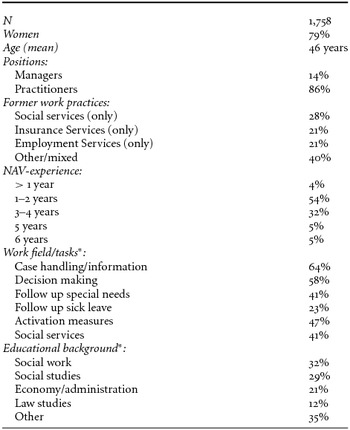
The 2011 data are based on an online questionnaire with a response rate of 59.5 per cent (1,758 respondents). The respondents were from the new employment and welfare agencies (Norwegian Labour and Welfare Administration [NAV]) covering the joint services of both governmental and municipal authorities. Background information on the 2011 respondents is presented in Table 1.
Frequency distributions of background information 2011

Note: *Multiple responses allowed.
Dependent variables
The dependent variables capture the structural dimensions of autonomy and discretion for front-line workers in terms of perceived opportunities and direction of change. To analyse the trend of continuation or curtailment of discretionary decision-making, we compare the perceptions of front-line workers in 2004 (before the reform) and 2011 (after the reform). The following questions/prompts were used in the analyses:
-
• In my job I have very little freedom to decide how I will carry out my tasks.
-
• To what extent do you have the opportunity to exercise independent discretion?
Respondents were asked to indicate to what extent they agreed with the first statement, based on a four-point scale ranging from 1 (‘disagree completely’) through 4 (‘agree completely’). The second question had a five-point scale ranging from 1 (‘not at all’) through 5 (‘very often or always’).
In 2011, the following question was used to examine the perceived direction of change:
-
• Do you experience more or fewer opportunities to make independent decisions since the NAV reform was implemented?
This question is related to the period after the two separate governmental administrations of social insurance and unemployment were merged with social services at the local authority level. The question was formulated with five response categories ranging from ‘much more’ to ‘much fewer’ opportunities and was recoded into three main categories in the statistical analyses.
Independent variables (2011)
Occupational position
This dichotomous variable distinguishes between the two positions of managers and practitioners (cf. Assumption ii).
Work fields
These variables differentiate among the tasks related to (1) case handling, (2) decisions-making, (3) follow-up of clients with special needs, (4) follow-up of sick leave recipients and (5) employment and activation measures. The work fields differentiate among the five municipal social services and the governmental insurance and employment services (used as a reference category in the regression analysis). The main tasks of social services are activation work, financial social assistance and case work related to psychiatric health care, drug abuse and child welfare. In the new joint services, most practitioners are responsible for handling cases and applications for various benefits, whereas others are specifically responsible for the provision of advice to clients and the follow-up of recipients (vocational rehabilitation, sick leave, disability, social assistance, etc.). The front-line workers responsible for employment and activation measures assessing and improving the labour market participation of various groups of recipients are expected to have a wider scope of discretion than others (cf. Assumption (i)).
Profession/educational background
This dichotomous variable distinguishes between trained social workers and officers with other types of educational backgrounds (cf. Assumption (iii)). In addition, age, gender and years of former and current work practices are included as control variables. The main categories of former practices (obtained in social services, social insurance and employment services before the reform) are constructed into mutually exclusive dummy variables. Table 1 shows the frequency distributions for the independent variables.
Method
The first part of the study investigates changes in perceived opportunities for autonomy and discretion from 2004 to 2011 by cross-tabulations. In the second part of the study, we investigate whether front-line workers in 2011 experience an increase (more and much more), a decrease (fewer and much fewer) or no change (unchanged) in the number of opportunities for making independent decisions after the reform. The dependent variable has three categories, and a multi-nominal logistic regression model that assumes the dependent variable to be at the nominal level is used.Footnote 4 This model allows us to examine how different variables influence whether front-line workers experience an increase, a decrease or no change in the number of opportunities available.
The multi-nominal regression model is performed with unchanged opportunities as the base category, to which the log likelihoods of the other two opportunity categories are compared. The analysis produces two sets of coefficients. The first set consists of the log odds for fewer versus unchanged opportunities. The other set of coefficients consists of the log odds for more versus unchanged opportunities. In addition to the coefficients, we present predicted probabilities showing the effect of important independent variables when all other independent variables are set to the mean value (this is also the case for dichotomous variables).
Results
Changing opportunities for autonomy and discretion?
To examine the question of changing opportunities for autonomy and discretion, we first compared the responses of different categories of workers, collected before and after the implementation of the administrative reform. Figure 1 shows the responses of practitioners compared to those of managers and the responses of workers in the municipal social services compared to those of workers responsible for governmental services (social insurance officers in 2004 and NAV officers in 2011).
The scope for autonomy and discretion of front-line workers before and after the employment and welfare reform, by positions and services (per cent) Note: The responses shown are ‘high degree’ (combining the two highest response categories 4+5 on the five-point scale), and ‘agree’ (combining the highest two response categories 3+4 on the four-point scale). In 2011, the governmental services included both the employment and social insurance. In 2004, the governmental services included the social insurance services only. The differences between social services in 2004 and 2011 are significant at p<0.001 for ‘exercise discretion independently’, and at p<0.05 for ‘freedom to decide how to carry out the tasks’. The difference for governmental services are significant at p<0.01 for ‘exercise discretion independently’ (Fisher's exact test was used).

A comparison of the surveys conducted in 2004 and 2011 indicates little or no change in the front-line workers’ perceptions of their own degree of autonomy and discretion. Despite different occupational positions, a large majority of both managers and practitioners reported a high degree of freedom in deciding how they would carry out their tasks in both time periods. The proportion reporting that they, to a large extent, can independently exercise discretion is somewhat lower in both groups but still relatively high. A relatively higher proportion of managers reported a high degree of autonomy and discretion than practitioners. The differences between the two positions reflect the fact that managers are delegated a relatively high degree of decision-making authority owing to their administrative position.
When we compared governmental services and municipal social services, a relatively high proportion among both groups of employees reported a high degree of autonomy regarding how they carry out their tasks in both time periods. However, the findings indicate a small decrease in the degree of autonomy for workers in the social services. The proportion of workers in the governmental services reporting a high degree of discretion was significantly higher in 2011 than in 2004, indicating a shift towards an increase in the number of opportunities available to exercise discretion. For social service workers, however, the findings indicate a decrease in the opportunities available to exercise discretion during the same time period. Thus, the gap between workers within the two services concerning the question of discretion was narrowed during the time period, calculated in terms of decreasing percentage differences (amounting to 36 per cent in 2004 and 18 per cent in 2011; p < 0.001).
Continuing or decreasing opportunities for independent decision-making?
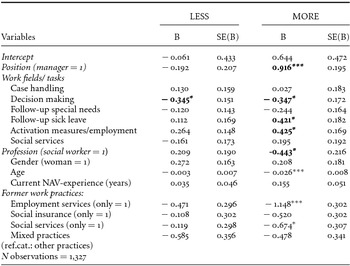
To elaborate further on the issue of changes in the number of opportunities available for discretionary decision-making, we investigated the workers’ experiences of continuing or decreasing opportunities after the reform. The results are presented in Table 2 in terms of estimated coefficients from the multi-nominal logistic regression analysis of changes (fewer or continuing) in the number of opportunities available to make independent decisions in the NAV agencies. The dependent variable has three categories, in which the unchanged (same) opportunity of making independent decisions represents the category to which the other opportunity outcomes are compared. Values in bold indicate statistically significant results for the responses of ‘fewer’ and ‘more’ opportunities. Figure 2 shows predicted probabilities for the significant variables.
Multi-nominal regression analyses predicting changing opportunities (less/unchanged/more) to make independent decisions, by age, gender, work position, current and former work experience, work fields/tasks and profession (2011).

Notes: Significance levels: *p < .05, **p < .01, ***p < .001. PseodoR2 = ,093 (Nagelkerke). Reference category = unchanged (same) opportunities. Bold values indicate significant differences between ‘less’ and ‘more’ opportunities of making independent decisions, in comparison to ‘unchanged’. (Missing: N = 431, including the category ‘do not know/not relevant’).
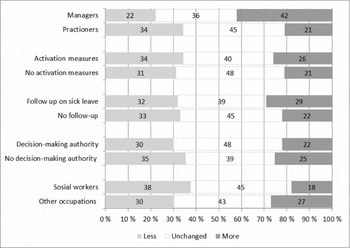
The probability of changing opportunities (fewer, unchanged or more) to make independent decisions, by positions, work fields/tasks (activation measures, follow-up sick leave, decision making) and professions (per cent), based on logistic regression Note: The rate of those who answered ‘did not know’ has been included in the missing category and is not shown in the figure.

As shown in Table 2, there are statistically significant coefficients for occupational position, profession and work fields (decision-making, follow-up/sick leave, activation measures) and age. Because coefficients from multi-nominal logistic regressions are difficult and less intuitive to interpret, estimated probabilities are presented in Figure 2. Probabilities for the different outcomes for changing (more/unchanged/fewer) opportunities are reported along the x-axis, and work practice, position, various work fields and professional group are listed along the y-axis.
According to Figure 2, the analysis indicates continuities in terms of unchanged and more opportunities for independent decision-making in both positions (managers and practitioners) after the reform. The probability of increasing decision-making for the job categories in terms of more opportunities is perceived chiefly by managers. About 42 per cent are estimated to report more opportunities for making independent decisions after the NAV reform. Correspondingly, the predicted probability of reporting more opportunities among practitioners is 21 per cent. Despite a stronger regime of management, the estimated probability of perceiving continuing (unchanged) opportunities for practitioners in general is 45 per cent.
The predicted probabilities for perceiving autonomous decision-making and independent choices are, however, increasingly altered for workers responsible for implementing the policy of activation in various fields. Those responsible for follow-up of sick leave and for activation measures and employment programmes are more likely to be assigned a higher degree of autonomy compared to other NAV workers. Still, the predicted opportunities for workers responsible for social services and the follow-up of clients with special needs are the same (unchanged) over the time period before and after the reform (2006–11). The probability of reporting decreasing decision-making is higher for trained social workers (38 per cent) than for the other occupations (30 per cent) represented.
Discussion
The empirical findings (Figures 1 and 2) confirm the assumption that there are persisting opportunities for discretion and independent decision-making for front-line workers within the Norwegian welfare administration in general. Despite the impact of managerial standards and regulations, front-line workers are still able to make independent decisions concerning how to carry out their work within the frame of the new administrative regime. This result is in part caused by the implementation of the Norwegian activation policies that restricted eligibility rules and encouraged vocational rehabilitation and job training instead of social benefits and long-term insurance (Ministry of Labour and Social Affairs, 1991–1992). Front-line workers responsible for activation measures and follow-up (particularly for sick leave) are significantly more likely to perceive increased opportunities for independent decision-making (Table 2 and Figure 2). The perceived direction of change is in accordance with the priority area of Norwegian welfare policy emphasising inclusion, active intervention and rehabilitation of individuals on long-term sick leave and those on disability benefits (Ministry of Labour, 2000). According to the national agreement on a more inclusive working life and the National Insurance Act of 2007, stronger requirements are set for more activity-oriented measures early in the sick leave period. During this period, advisors are obliged to follow up by initiating dialogue meetings and a follow-up plan in cooperation with the employee so as to prevent long absences. A policy of inclusive working life thus involves increased opportunities for independent decision-making in the governmental front-line services.
In addition, more requirements were established for activity-oriented measures and profiling tools during the reform so as to assess whether the claimants are employable or have a limited capacity to seek work. Because the range of measures and programmes has been more differentiated, and the provision of services has become more tailor-made, opportunities for front-line decision-making and a more personalised approach have increased. The results are in line with European studies suggesting that front-line workers have considerable room to exercise discretion when providing activation services, thus exercising influence over what activation actually means (Van Berkel and Van der Aa, Reference Van Berkel and Van der Aa2012).
The findings also suggest an increase in the degree of discretion exercised by core workers within the governmental services over the time period (Table 2). The increase partly results from the merger of the employment and social insurance administrations, expanding the work fields and task responsibilities of both practitioners and managers. The ‘whole-of-government’ approach brought an extended delegation of tasks and authorities to the new joint services, involving additional responsibilities for counselling and closer interaction when following up on beneficiaries. The increasing emphasis on closer follow-up for the long-term unemployed, those on sick leave and for disability benefit recipients presupposes involvement in client relations and more decisions based on means–ends judgements, in line with the traditional mandate of the social services. In summary, the findings indicate that independent decision-making has become more similar in scope for professional and non-professional workers employed within different parts of the new employment and welfare administration.
The comparative data, collected before and after the welfare reform, mainly suggest continuing discretion for practitioners in general and increasing autonomy for local managers in particular (Figure 1). The high degree of discretionary opportunities and the high degree of autonomy reported in both periods are mainly part of the management reforms within public services. In addition to controlling the work of staff members to ensure that routines are followed, local managers are accountable for achieving results in accordance with political goals. The transformation of joint services into the new administration called for managerial interventions and new strategies to meet the challenges involved (Klemsdal, Reference Klemsdal, Andreassen and Fossestøl2011). Because the reform was designed according to a minimum of critical specification goals, the concepts and requirements had to be translated into concrete procedures and routines by local managers (Askim et al., Reference Askim, Christensen, Fimreite and Lægreid2010). Thus, managers were granted a key role in implementing the reform. They were responsible for coordinating the services and promoting the developmental changes required. Most likely, the increase in perceived autonomy (Figure 2) results from the assigned responsibilities for administering the multiple tasks and the expanded laws and regulations following the reform.
Despite this overall trend of continuing discretion, the data indicate decreasing opportunities to exercise street-level discretion in the municipal social services, as reported by employees prior to and after the reform (Figure 1). In the case of social assistance, ordinary claims are regulated by departmental guidelines, and more procedures and guidelines are adapted to assess the needs and work capability of claimants. Because of increasing standardisation, case workers have limited influence on the outcome of social assistance in cases not covered by delegation rules.
Similarly, the probability of decreasing opportunities for decision-making is higher for trained social workers than for other occupations and non-professional groups (Figure 2). Increasing pressure on organisational guidelines probably makes it more difficult for social workers to practise in accordance with their professional standards and comprehensive holistic approach of social work (Røysum, Reference Røysum2012). The complexity of problems related to the provision of social assistance to long-term recipients often presupposes a holistic approach, where social workers must relate to several aspects of the life situation of clients. Following the reform, social workers experience more detailed and formalised requirements and increased expectations to simplify work. The assessment made for providing the appropriate type of activation services in terms of benefit and follow-up, however, has become partly standardised, based on a more structured procedure for collecting information on the needs, life situation and resources of claimants. Seemingly then, the traditional social work approach is challenged by the administrative elements of activation work, which regulate both professional practice and the social services.
Conclusions
This article explores the changing opportunities for street-level discretion within a context of organisational and policy reforms. On the whole, the perceived direction of change confirms the thesis of ‘continuation’ predicting unchanged opportunities for street-level discretion in the Norwegian public employment and welfare services. In line with Lipsky's theories (Reference Lipsky1980, Reference Lipsky, Adler, Bell, Clasen and Sinfield1991), street-level bureaucrats still exercise considerable discretion in determining the claims, means and sanctions required. As discussed, the continuing course is closely related to the delegation of authorities to local administrations and the co-ordination between different tasks and activation measures, involving a greater variety of working processes to be managed by front-line workers. Working in the front-line of public services, street-level bureaucrats mediate between institutions and citizens, participating in decision-making regarding what services to provide and how to respond to issues that arise (Hjörne et al., Reference Hjörne, Juhila and van Nijnatten2010).
To implement the goals of the Norwegian employment and welfare reform, local managers were granted the key role as reform agents, subject to the main efficiency targets of the modern welfare administration. Although management control takes different forms in various settings, greater emphasis has been placed in recent years on the responsibilities of managers with regard to budgetary control, performance monitoring and quality of service. The results signal a shift towards managerial forms of control and organisational regulations, including an increase in managing professional discretion (White, Reference White, Harris and White2009).
Moreover, activation policies are strongly emphasised as part of the reform process, involving individualised and mandatory services aimed at increasing participation and responsible behaviour that potentially enlarges the scope for street-level discretion (Jewell, Reference Jewell2007; Bonvin, Reference Bonvin2008). Activation strategies imply stricter follow-up of recipients and individual plans, presupposing frequent interactions associated with increased decisions and, again, an enlarged scope for activation measures for both professionals and non-professionals. The Norwegian policy allows case workers to use their expertise and authority in a flexible and pedagogical way, an ‘enabling approach’ rather than a coercive one. Activation measures have become more diversified than previously, making available a range of programme offerings and targeting several groups of beneficiaries. Consequently, more choices have to be made about the kind of services required, extending the use of discretionary tools by practitioners responsible for labour market measures.
However, comparisons of front-line practices in different countries undertaking similar reforms suggest that activation policies and service provision models can affect social work in different ways (Marston et al., Reference Marston, Larsen and McDonald2005). According to our findings, the perceived decrease of discretionary opportunities among Norwegian social workers raises the prospect of curtailment rather than continuity for this professional group. Recent studies show that Norway has become eager to implement NPM reforms over the last few years, moving towards market, management and efficiency (Christensen et al., Reference Christensen, Lie, Lægreid, Christensen and Lægreid2007). Most likely, the increase in regulations, new procedures and performance measurements will limit the opportunities of choosing broad objectives and social treatment methods. Managerial tools and indicators of performance are increasingly regulating professional practice through guidelines and procedures that define the assessment processes more strictly (Sol and Westerveld, Reference Sol and Westerveld2005). The technical subordination of social services to a governmental and administrative rule-oriented culture makes social work more exposed to transformations. The changes involve a move towards a more managerially regulated role that challenges the professionally regulated role of social workers in particular.
As part of the reform, the services are both subjected to the governmental management regime, emphasising stricter rules and administrative procedures, and to the new information and communication technology (ICT), regulating social work practice. When the decision-making process is automated by electronic tools and applications, the intervention and discretionary power of professionals may decrease. However, the information technology system also provides agents with a whole range of data on clients, thus allowing them to exert closer control over the beneficiaries (Buffat, Reference Buffat2013). In this way, the new technology may both have a restraining and an enabling effect on the agent's discretionary power over clients.
In addition, the traditional role of front-line workers is changing as they become more directly involved in supporting job activation. By moving away from the ‘caseworker’ role that mainly controls eligibility criteria for income protection and welfare services, activation workers also decide the eligibility rights of activation measures and programmes. The increasing emphasis on activation and tailor-made assistance to help people find and sustain employment requires front-line workers to focus on work readiness and labour market outcomes. As providers of activation services, they are instructed to assess needs and work ability, considering conditions and the utility of different activation means and work programmes. The changes involved indicate that conditional requirements and norms of self-support have become the legitimate institutional standard for follow-up of applicants, making the social work approach less creative and more disciplinary. In brief, a ‘regulatory approach’ embedded in activation services and policy reforms may signify a process of transformation and fragmentation of street-level practice.