Introduction
Thereare hundreds of species of paramphistomes, which often inhabit the gastrointestinal tract of fishes, reptiles, birds and mammals. Damage caused by paramphistomes can lead to significant economic losses for the breeding industry, due to productivity loss, diseases and death (Hanna et al., Reference Hanna, Williamson, Mattison and Nizami1988; Sharma & Hanna, Reference Sharma and Hanna1988). Many countries have reported the prevalence of paramphistomes, including Bulgaria, France, Italy, Russia and Yugoslavia (Horak, Reference Horak1971).
Orthocoelium streptocoelium (Yamaguti, Reference Yamaguti1975) is one of the most important paramphistomes, parasitizing the rumen and/or reticulum of small ruminants. Ruminants infected with O. streptocoelium do not exhibit obvious symptoms and consequently this species can be easily overlooked. Therefore, the accurate identification of O. streptocoelium infection is essential for the prevention and diagnosis of this species.
Although traditional microscopic examinations are the most common methods for the identification of paramphistome infection, these methods are time consuming and inaccurate. As useful molecular markers, the ribosomal genome (internal transcribed spacer (ITS) and 18S) and mitochondrial genome (cox1) have been widely used for species identification (Huffman & Fried, Reference Huffman and Fried1990; Bott et al., Reference Bott, Campbell, Beveridge, Chilton, Rees, Hunt and Gasser2009; Gasser et al., Reference Gasser, Jabbar, Mohandas, Hoglund, Hall, Littlewood and Jex2012; Ramesh et al., Reference Ramesh, Small, Kloos, Kazura, Nutman, Serre and Zimmerman2012; Ghatani et al., Reference Ghatani, Shylla, Roy and Tandon2014). However, the absence of knowledge about the O. streptocoelium mt genome limits the diagnosis of, and studies of population variation within, this species.
In the present study, the full sequence and gene arrangement of the O. streptocoelium mt genome were first reported. Phylogenetic analyses were accomplished using concatenated mt genome sequences of 12 protein-coding genes of digeneans available in GenBank, to assess the phylogenetic relationships between O. streptocoelium and other digeneans. The mitochondrial genome of O. streptocoelium will provide useful information for species identification, determination of population diversity and phylogenetic analysis.
Materials and methods
Orthocoelium streptocoelium adults were collected from the rumen of a naturally infected cow in Tianmen. Worms were washed thoroughly with physiological saline, and identified to species (Li, Reference Li2011; Wang, Reference Wang2013). Later, total genomic DNA of O. streptocoelium was isolated from a single worm (Gasser et al., Reference Gasser, Hu, Chilton, Campbell, Jex, Otranto, Cafarchia, Beveridge and Zhu2006), and the remaining worms were stored in 75% alcohol (v/v) at −20°C until use (Liu et al., Reference Liu, Wang, Song, Li, Ai, Yu and Zhu2013).
Molecular analysis
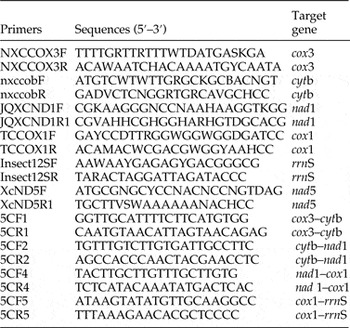
To begin with, 12 oligonucleotide primers (table 1) were designed to amplify short fragments from the cox3, cytb, nad4, cox1, rrnS and nad5 genes according to the relatively conserved regions of the mt genome from Fasciola hepatica (Le et al., Reference Le, Blair and McManus2001), Clonorchis sinensis (Shekhovtsov et al., Reference Shekhovtsov, Katokhin, Kolchanov and Mordvinov2010) and Paramphistomum cervi (Yan et al., Reference Yan, Wang, Lou, Li, Blair, Yin, Cai, Dai, Lei and Zhu2013). Then, polymerase chain reactions (PCRs) (25 μl) were performed with the following reagents: 10 mm Tris–HCl (pH 8.4), 50 mm KCl, 4 mm MgCl2, 200 mm each deoxynucleoside triphosphate (dNTP), 50 pmol of each primer, 2 U Taq polymerase (Takara, Shiga, Japan) and 2.5 μl genomic DNA. Reactions were run under the following conditions: 94°C for 5 min; followed by 35 cycles of 94°C for 30 s, 50°C for 30 s and 72°C for 1 min. Positive amplicons were sequenced directly by Sangon Company (Shanghai, China).
Primers used in the present study.

Later, 12 additional primers (table 1) were designed based on the obtained fragments to amplify the remaining large fragments from O. streptocoelium mt genomic DNA (~40–80 ng) by long-PCR. PCRs (50 μl) were performed in reaction mixes containing 0.4 mm each dNTP, 5 μl 10 × LA Taq buffer II (Mg2+ Plus), 2.5 μm each primer, 2.5 U LA Taq polymerase (Takara) and 2.5 μl genomic DNA. The reactions were run under the following program: 94°C for 5 min; followed by 35 cycles of 94°C for 30 s, 50°C for 30 s and 72°C for 1–5 min (depending on the size of F. hepatica fragments). Then, positive amplicons were purified and cloned into pGEM-T-Easy vector (Promega, Madison, Wisconsin, USA), and sent for sequencing using a primer-walking strategy (Hu et al., Reference Hu, Jex, Campbell and Gasser2007) by Sangon Biotech (Shanghai, China).
The full O. streptocoelium mt genome sequence was obtained by manually assembling, and aligning with F. hepatica, C. sinensis and P. cervi using the program Clustal X 1.83 (Thompson et al., Reference Thompson, Gibson, Plewniak, Jeanmougin and Higgins1997). Twelve protein-coding genes, 22 transfer RNA genes, two ribosomal RNA genes and two non-coding regions were predicted as reported (Yan et al., Reference Yan, Wang, Lou, Li, Blair, Yin, Cai, Dai, Lei and Zhu2013). Amino acid sequences of the 12 protein-coding genes were inferred by ExPASy Translate tool (http://web.expasy.org/translate/) using the echinoderm mitochondrial code, and phylogenetic analysis was conducted by MEGA 5.0 with default settings (Tamura et al., Reference Tamura, Peterson, Peterson, Stecher, Nei and Kumar2011).
Phylogenetic analysis
Amino acid sequences translated from individual genes of the mt genome of O. streptocoelium were concatenated and aligned with those of other digeneans, including C. sinensis (NC_012147) (Shekhovtsov et al., Reference Shekhovtsov, Katokhin, Kolchanov and Mordvinov2010), Dicrocoelium chinensis (NC_025279.1) (Liu et al., Reference Liu, Yan, Otranto, Wang, Zhao, Jia and Zhu2014a), Fasciola gigantica (NC_024025) (Liu et al., Reference Liu, Gasser, Young, Song, Ai and Zhu2014b), F. hepatica (NC_002546) (Le et al., Reference Le, Blair and McManus2001), Fischoederius elongatus (KM_397348) (Yang et al., Reference Yang, Zhao, Wang, Feng, Tan, Lei, Zhao, Hu and Fang2015a), Haplorchis taichui (NC_022433.1) (Lee et al., Reference Lee, Choe, Park, Jeon, Chai, Sohn, Yong, Min, Rim and Eom2013), Metagonimus yokogawai (KC330755.1), Hypoderaeum conoideum (KM_111525) (Yang et al., Reference Yang, Gasser, Koehler, Wang, Zhu, Chen, Feng, Hu and Fang2015b), Opisthorchis viverrini (JF739555.1) (Anderson, Reference Anderson1998), P. cervi (NC_023095.1) (Yan et al., Reference Yan, Wang, Lou, Li, Blair, Yin, Cai, Dai, Lei and Zhu2013), Paragonimus westermani (AF219379.2), Schistosoma haematobium (NC_008074) (Littlewood et al., Reference Littlewood, Lockyer, Webster, Johnston and Le2006), Schistosoma japonicum (AF215860) (Le et al., Reference Le, Blair and McManus2001), Schistosoma mekongi (NC_002529) (Le et al., Reference Le, Blair, Agatsuma, Humair, Campbell, Iwagami, Littlewood, Peacock, Johnston and Bartley2000), Schistosoma spindale (NC_008067) (Littlewood et al., Reference Littlewood, Lockyer, Webster, Johnston and Le2006), and the cestode Taenia solium (outgroup) (NC_004022.1) (Nakao et al., Reference Nakao, Sako and Ito2003). The phylogenetic analysis of O. streptocoelium and other digeneans was conducted using the neighbour-joining method employing the Tamura–Nei model in MEGA 5 (Tamura et al., Reference Tamura, Peterson, Peterson, Stecher, Nei and Kumar2011). Confidence limits were assessed by the bootstrap procedure (number of bootstrap replications = 1000) for the neighbour-joining tree, and the remaining settings were in default values (Tamura et al., Reference Tamura, Peterson, Peterson, Stecher, Nei and Kumar2011).
Results and discussion
The complete mitochondrial genome of O. streptocoelium (deposited in GenBank, accession number KM659177) is 13,800 bp in length, which is the smallest genome among our ten selected digeneans, except for O. viverrini, since only the partial mt sequence is available for the latter (13,510 bp).
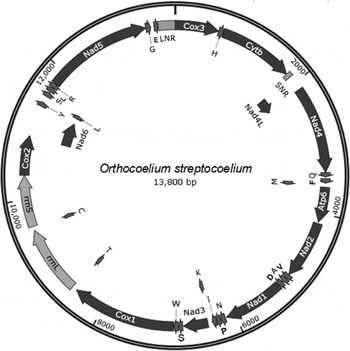
The circular mt genome of O. streptocoelium consists of 12 protein-coding genes (atp6, cox1–3, cytb, nad1–6 and nad4L), 22 tRNA genes, two rRNA genes (rrnS and rrnL) and two non-coding regions (SNR and LNR) (fig. 1). All genes are transcribed in the same direction as in other digeneans, such as F. hepatica (Le et al., Reference Le, Blair and McManus2001), C. sinensis (Shekhovtsov et al., Reference Shekhovtsov, Katokhin, Kolchanov and Mordvinov2010) and P. cervi (Yan et al., Reference Yan, Wang, Lou, Li, Blair, Yin, Cai, Dai, Lei and Zhu2013). The order of the 12 protein-coding genes and two rRNA genes is: cox3–cytb–nad4L–nad4–atp6–nad2–nad1–nad3–cox1–rrnL–rrnS–cox2–nad6–nad5, and the order is identical to that of F. hepatica, O. felineus, P. cervi, S. japonicum and S. mekongi, but different from S. haematobium and S. spindale (Littlewood et al., Reference Littlewood, Lockyer, Webster, Johnston and Le2006).
Arrangement of the mitochondrial genome of Orthocoelium streptocoelium.

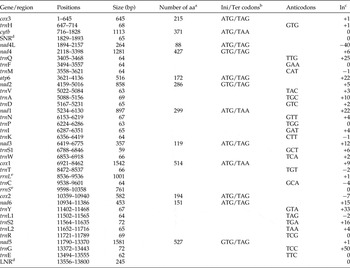
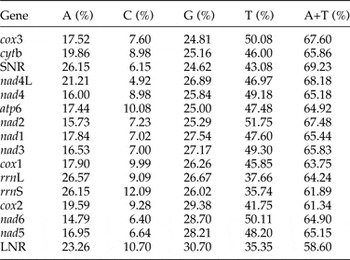
Overlapping nucleotides between mt genes of O. streptocoelium range in length from 1 to 40 bp (table 2), and it is common to find a 40 bp overlap between nad4L and nad4 in other digeneans. As to intergenic spacers, there are 26 intergenic spacers ranging in length from 1 to 50 bp in the O. streptocoelium mt genome. The nucleotide composition of the O. streptocoelium mt genome is biased toward T and G, and T is the most favoured nucleotide, followed by G, A and C, which is also the same as in other digeneans. The four nucleotides in the O. streptocoelium mt genome are 44.93% (T), 26.73% (G), 19.67% (A) and 8.67% (C) (table 3). Overall A+T content of the mt genome is 64.60%, similar to that of mt genomes of other digeneans, such as P. cervi (63.40%). The A+T content of the 12 protein-coding genes, two rRNA genes and two non-coding regions of O. streptocoelium ranges from 58.60% (LNR) to 69.23% (SNR).
The organization of the mitochondrial genome of Orthocoelium streptocoelium.

The inferred length of the amino acid sequence of 12 protein-coding genes: aamino acid; binitiation and termination codons; cintergenic nucleotides; dshort or long non-coding region; einitiation or termination positions of ribosomal RNAs defined by adjacent gene boundaries.
Comparisons of A+T content of 12 protein-coding genes, two rRNA genes, and two non-coding regions of the mitochondrial genome of Orthocoelium streptocoelium.

Protein-coding genes
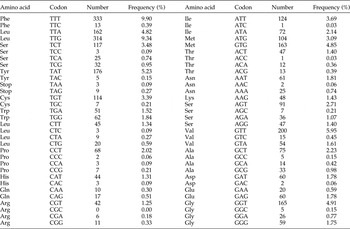
If ordered by the size (from the largest to the smallest), these are nad5, cox1, nad4, cytb, nad1, nad2, cox3, cox2, atp6, nad6, nad3 and nad4L. Excluding the termination codons, 3363 amino acids are encoded in the O. streptocoelium mt genome. TTT (Phe) is the most frequently used amino acid, with a frequency of 9.90%, followed by TTG (Leu, 9.34%), GTT (Val, 5.95%) and TAT (Tyr, 5.23%) (table 4). The least-used codon is CGC (Arg, 0), followed by ATC (Ile, 0.03%) and ACC (Thr, 0.03%) (table 4).
Codon usage for 12 protein-coding genes in the mitochondrial genome of Orthocoelium streptocoelium.

As for the initiation and termination codons, there are two initiation codons for O. streptocoelium, one is ATG (nine of 12 protein genes) and the other is GTG (three of 12 protein genes). TAG (nine of 12 protein genes) and TAA (three of 12 protein genes) are termination codons. There are also two initiation and two termination codons in protein-coding genes of other digeneans, except for P. cervi, which has only one termination codon (TAG) (Yan et al., Reference Yan, Wang, Lou, Li, Blair, Yin, Cai, Dai, Lei and Zhu2013).
Transfer RNA genes, ribosomal RNA genes and non-coding regions
The lengths of the 22 tRNA genes of O. streptocoelium mt genome range from 59 to 72 bp, and it should be noted that trnG and trnE switch positions in O. streptocoelium compared with C. sinensis (Shekhovtsov et al., Reference Shekhovtsov, Katokhin, Kolchanov and Mordvinov2010), F. hepatica (Le et al., Reference Le, Blair and McManus2001) and O. viverrini (Anderson, Reference Anderson1998), but are the same as those of P. cervi (Yan et al., Reference Yan, Wang, Lou, Li, Blair, Yin, Cai, Dai, Lei and Zhu2013) and F. elongatus (Yang et al., Reference Yang, Zhao, Wang, Feng, Tan, Lei, Zhao, Hu and Fang2015a). This may be a common feature in Paramphistomidae. A previous study has reported that this change may involve a phylogenetic signal (Littlewood et al., Reference Littlewood, Lockyer, Webster, Johnston and Le2006).
The two ribosomal RNA genes (rrnL and rrnS) of O. streptocoelium were predicted by comparison with those of F. hepatica (Le et al., Reference Le, Blair and McManus2001) and P. cervi (Yan et al., Reference Yan, Wang, Lou, Li, Blair, Yin, Cai, Dai, Lei and Zhu2013). The lengths of rrnL and rrnS genes are 1001 bp and 761 bp, respectively, for the O. streptocoelium mt genome, and their A+T contents are 64.24% and 61.89%, which are higher than those of P. cervi, but lower than those of other digeneans.
Non-coding regions are common in many digeneans, and usually there are two non-coding regions – one long non-coding region (LNR) and one short non-coding region (SNR) – but there is only one non-coding region in the mt genome of H. conoideum. For O. streptocoelium, the SNR is located between cytb and nad4L, with 69.23% A+T content, and the LNR is between trnE and cox3, with 58.60% A+T content. Notably, the LNR has obvious homopolymer sequences, such as (T)n (n < 6). Non-coding regions are predicted based on their AT-richness and they may function in the initiation of replication (Littlewood et al., Reference Littlewood, Lockyer, Webster, Johnston and Le2006).
Genetic relationships
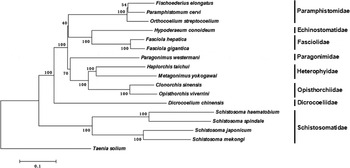
Full mt sequences are reported to be more reliable for determination of genetic relationships (Waeschenbach et al., Reference Waeschenbach, Webster and Littlewood2012). Therefore, concatenated nucleotide sequences of the 12 protein-coding genes of the 17 digenean species and one tapeworm (T. solium) were used for genetic relationship analysis (fig. 2). Most nodes are supported by high posterior probabilities (100%). The tree is divided into two large clades: one clade consists of four members of the Schistosomatidae, and the other clade consists of 12 members from seven families (Paramphistomidae, Echinostomatidae, Fasciolidae, Paragonimidae, Heterophyidae, Opisthorchiidae and Dicrocoeliidae). According to the tree, the sequence of families in order of increasingly derived status is: Dicrocoeliidae, Opisthorchiidae, Heterophyidae, Paragonimidae, Fasciolidae, Echinostomatidae and Paramphistomidae. The tree indicates that Paramphistomidae has a close genetic relationship with Fasciolidae and Echinostomatidae. Additional digenean mt genomes are needed to make the phylogenetic analysis more reliable in the future.
The phylogenetic relationships of Orthocoelium streptocoelium and other digeneans based on concatenated amino acid sequence data representing 12 protein-coding genes, using Taenia solium as an outgroup.

In conclusion, this study determined the complete mt genome sequence of O. streptocoelium. The mt genome cox1 gene has been widely used for species identification, and the present results for O. streptocoelium will help in distinguishing it from other digeneans. This complete mt genome of O. streptocoelium will enrich the mitochondrial genome data of paramphistomes, and provides important molecular markers for diagnostics and studies of population variation, epidemiology, ecology and evolution of O. streptocoelium and other digenean species. The identification could be improved by combining the mt genome (cox1) data with that of the ribosome genome genes (ITS1, 18S and ITS2).
Financial support
This work was supported by the National Key Basic Research Program (973 Program) of China (grant no. 2015CB150300), the Special Fund for Agro-scientific Research in the Public Interest (grant no. 201303037), the Fundamental Research Funds for the Central Universities (grant no. 2662015PY048) and the Huazhong Agricultural University Students Research Fund (grant no. 2015054).
Conflict of interest
None.
Ethical standards
Orthocoelium streptocoelium adults were collected from cattle according to the animal ethics guidelines of Huazhong Agricultural University.