Introduction
Tobacco smoking is one of the leading causes of preventable death worldwide. In recent years, alternatives to tobacco smoking have been introduced, such as nicotine replacement therapy, nicotine receptor antagonists and anti-depressants. However, these are associated with a low success rate, whereby only 6 per cent of those trying such alternatives will be successful in the absence of any assistance.Reference Zhu, Melcer, Sun, Rosbrook and Pierce1 Electronic cigarettes (e-cigarettes) were introduced in China in 2003, and later to the American market in 2007.Reference Harrell, Simmons, Correa, Padhya and Brandon2 With aggressive marketing and rapidly expanding demands, e-cigarettes are gaining popularity among younger generations. In Malaysia, the national health survey in 2015 reported the prevalence of e-cigarette users as 10.9 per cent, an increase from 3.9 per cent in 2011.Reference Palipudi, Mbulo, Morton, Mbulo, Bunnell and Blutcher-Nelson3,4
E-cigarettes are battery-powered devices that utilise an atomiser to vaporise liquid nicotine into aerosols which users inhale and exhale like cigarette smoke. Apart from nicotine, they also contain glycerol, propylene glycol, water and optional flavourings. E-cigarettes do not produce smoke like conventional cigarettes, but generate an aerosol primarily comprising propylene glycol. Analysis of the e-cigarette vapour by Schroeder and Hoffman showed that the amount of toxins is 9- to 450-fold less than that of conventional cigarettes.Reference Schroeder and Hoffman5
While the effects of conventional cigarette smoke on the respiratory tract have been widely studied, the potential long-term effects of e-cigarette aerosol on the respiratory system remain unknown. Few studies have investigated the safety and potential effects of e-cigarettes.Reference Kumral, Saltürk, Yildirim, Uyar, Berkiten and Atar6–Reference McQueen, Tower and Sumner8 Cigarette smokers are likely to have increased nasal resistance as a result of inhaling tobacco smoke.Reference Dessi, Sambuc, Moulin, Ledoray and Cannoni9 However, to date, no objective studies have investigated the potential effect of e-cigarette vapour on total nasal airway resistance.
Materials and methods
Subjects
Participants aged 18–60 years, who fulfilled the inclusion criteria, were enrolled into this study after providing written informed consent. The subjects were divided into two groups: e-cigarette smokers (vapers group) and non-vapers (control group).
Regarding inclusion criteria, the vapers group participants had been smoking e-cigarettes for at least three months, and included ex-conventional cigarette smokers who had stopped smoking for at least six months and those who were purely vapers. Inclusion criteria for the control group were healthy volunteers who had never smoked conventional cigarettes or e-cigarettes. Exclusion criteria were: individuals who had underlying sinonasal diseases, anatomical deformities of the nasal structures, a history of sinonasal surgery, chronic lung disease, or a history of acute illness in the previous two weeks; pregnant or breastfeeding women; and those taking any medications, including antihistamines or intranasal sprays.
Study design
This cross-sectional study was conducted at the Department of Otorhinolaryngology of the University of Malaya Medical Centre over one year, between July 2019 and June 2020. The study was approved by the Medical Research Ethics Committee of the University of Malaya Medical Centre (number: 2019917-7841).
All participants were examined with rigid nasoendoscopy as part of the assessment to detect for any nasal septal perforations, nasal polyps or masses that may preclude them from taking part. The participants were instructed not to perform any vigorous activities prior to the study, as this may affect nasal airway resistance. The vapers group was informed not to smoke for at least 1 hour before the measurements were taken.
The study was carried out in a room with an ambient temperature. The vapers group was instructed to vape ad lib for 5 minutes, with a minimum of 10 puffs. The control group were asked to breathe as they normally would, for 5 minutes. For both groups, nasal airway resistance measurements were carried out with the participants seated comfortably on a chair and after a rest period of 15 minutes, prior to the start of procedure. Blinding was not possible, as there was no vapour production involved in the non-smoker group.
Nasal resistance was measured objectively using an active anterior Merz Rhino rhinomanometer (Merz Medizintechnik, Metzingen, Germany). The total nasal airway resistance of each subject was assessed pre-procedure and at 1 and 5 minutes post-procedure. Resistance was expressed in Pa/cm3/second at a pressure of 150 Pascals. The measurements were conducted according to the 2005 International Standardization Committee on the Objective Assessment of the Nasal Airway guidelines.
Statistical analysis
The Shapiro–Wilk test was applied to assess the normality of the data. All measurements were found to be normally distributed except for gender. The age and weight of the smoker and non-smoker groups were analysed for homogeneity, which revealed no significant differences between the groups. The effect of gender as a covariate was excluded in all analysis.
Repeated measures analysis of variance was used to compare nasal resistance between the smoker and non-smoker groups. All data were presented in means and 95 per cent confidence intervals. A p-value of less than 0.05 was considered to be statistically significant. Statistical analysis was performed using IBM SPSS® software, version 26.0.0.
Results
Participants
A total of 65 subjects aged over 18 years were initially enrolled into this study. Four participants were excluded as they were found to have nasal polyps (n = 1) and adenoid hypertrophy (n = 3) during initial screening.
The included participants were aged 18–48 years (mean age of 30.9 years). There were 31 individuals (all male) in the vapers group, comprising 23 ex-conventional cigarette smokers and 8 pure e-cigarette smokers. The control group had 30 non-vapers (9 females and 21 males).
Participants’ weight ranged from 55 kg to 92 kg (mean of 71.44 kg). All participants reported having no nasal symptoms at the time of the procedure. In the vapers group, 18 participants used nicotine salt for vaping (mean nicotine strength of 33.5 ± 9.43 mg/ml) and 13 used freebase nicotine (mean nicotine strength of 11 ± 2.43 mg/ml).
Outcomes
Group comparison
The nasal airway resistance measurements were compared between the vapers and control groups at pre-procedure and at 1 and 5 minutes post-procedure. The vapers group had lower readings compared to the control group after the procedure (Table 1). The effect size of the changes over time in both groups was small to medium (d = 0.38). There was no significant difference in nasal airway resistance between both groups over time (p = 0.118).
Comparison of nasal airway resistance between the vapers and control groups at each assessment time

CI = confidence interval
Nasal airway resistance
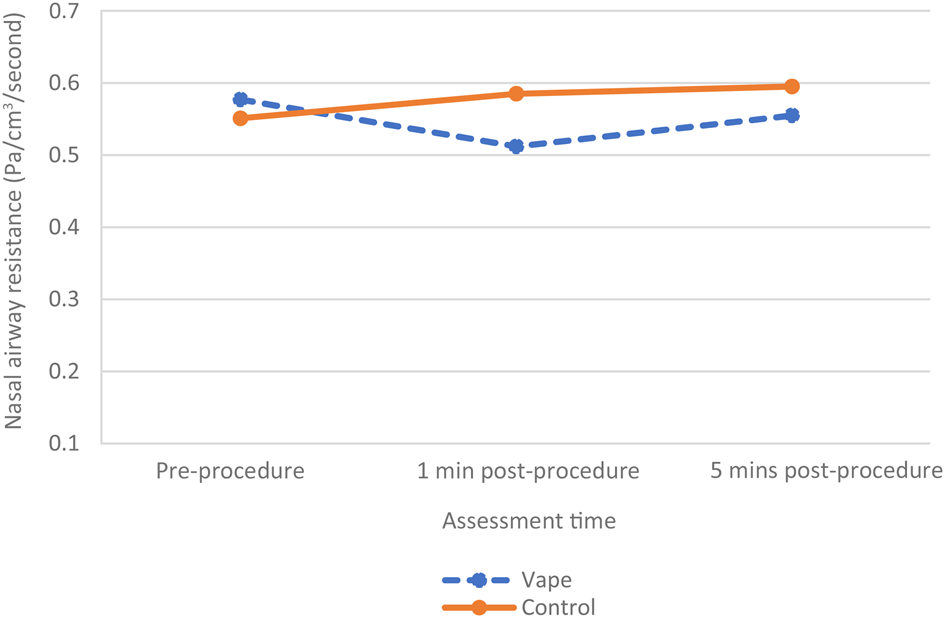
At 1 minute post-procedure, mean nasal airway resistance had decreased in the vapers group and increased in the control group (Figure 1); however, the difference was not significant (p = 0.382). Mean nasal airway resistance of the vapers group increased to 0.52 Pa/cm3/second at 5 minutes post-procedure, which was not statistically significant when compared to mean nasal airway resistance at 1 minute post-procedure (p = 0.375). There was no change in mean nasal airway resistance of the control group at 5 minutes post-procedure. No significant difference was seen when comparing mean nasal airway resistance of both groups at 5 minutes post-procedure (p = 0.672).
Total nasal airway resistance during pre-procedure and at 1 and 5 minutes post-procedure.

The control group demonstrated an increase in mean nasal airway resistance at 1 and 5 minutes post-procedure, but the increment was not statistically significant (p > 0.05).
There was no correlation when comparing pre-procedure nasal airway resistance to mean nasal airway resistance at 1 and 5 minutes post-procedure within the vapers group (Table 2).
Correlation between nicotine strength and nasal airway resistance in the vapers group at each assessment time

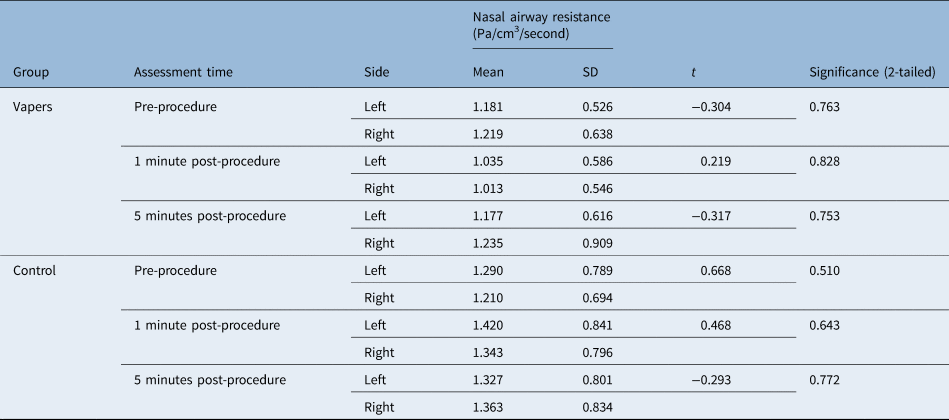
There was no significant difference between nasal airway resistance of the left and right nostrils in both groups during pre-procedure and at 1 and 5 minutes post-procedure (Table 3). Nicotine strength did not affect nasal airway resistance significantly; however, the Spearman correlation test showed a weak correlation between nicotine strength and nasal airway resistance. The other two co-variables, namely age and weight, did not affect nasal airway resistance (p = 0.835 and 0.147, respectively).
Paired samples t-test comparing left and right nasal airway resistance for the vapers and control groups at each assessment time

SD = standard deviation
Discussion
This study demonstrated that vaping has no statistically significant effect on total nasal airway resistance. Compared to cigarette smokers, Dessi et al. reported that heavy smoking significantly increased total nasal airway resistance when compared to normal subjects, and no heavy smokers had symptoms of nasal blockage. They concluded that this was primarily because the tobacco smoke impaired the sensitivity of the nasal mucosa.Reference Dessi, Sambuc, Moulin, Ledoray and Cannoni9 In comparison to tobacco smoke, the aerosol generated by e-cigarettes contains mainly propylene glycol, which makes up 80–92 per cent of the liquid content.Reference Kumral, Saltürk, Yildirim, Uyar, Berkiten and Atar6 The effect of propylene glycol on the nasal mucosa remains debatable. Palazzolo et al. discovered that the aerosolised propylene glycol has a dehydrating effect on the epithelial of bullfrog palates, thereby increasing its epithelial thickness.Reference Palazzolo, Nelson, Ely, Crow, Distin and Kunigelis10 This effect is smaller when compared to the smoke produced by conventional cigarettes. A study by Kumral et al. found that vaping actually improves sinonasal symptoms in ex-conventional cigarette smokers, based on Sinonasal Outcome Test (SNOT-22) scores.Reference Kumral, Saltürk, Yildirim, Uyar, Berkiten and Atar6 One study evaluating the effect of exposure to propylene glycol mist reported no significant changes in the nasal airway patency measured using acoustic rhinometry after subjects were exposed to propylene glycol mist for 1 minute.Reference Wieslander, Norbäck and Lindgren11
The vapers group had a higher nasal airway resistance baseline level compared to the control group, as shown in their pre-procedure measurements. After exposure to e-cigarettes aerosol, nasal airway resistance of the vapers group showed improvement as compared to the controls. This result was contrary to our hypothesis, as the aerosols generated by the e-cigarettes are irritants and may induce inflammation, such as was found in research on the short-term pulmonary effects of vaping.Reference Vardavas, Anagnostopoulos, Kougias, Evangelopoulou, Connolly and Behrakis12 That study reported that 5 minutes use of e-cigarettes was enough to cause an increase in lung flow resistance. Suber et al. found that the nasal epithelium of Sprague Dawley rats thickened, with an increased number of goblet cells, after 90 days’ exposure to propylene glycol.Reference Suber, Deskin, Nikiforov, Fouillet and Coggins13 This is unlikely to have occurred in our study as the vapers group was only exposed to the aerosol for a short duration of time. Subjectively, our finding correlates with an online survey of ex-smokers who switched to vaping, where 66 per cent of the 941 responders claimed that their respiratory health improved after the switch.Reference Miler, Mayer and Hajek14 The findings in that study were based on subjective questionnaire responses rather than objective measurements. Palazzolo et al. reported that the mucociliary clearance of the frog palate was dampened after exposure to the aerosol generated by e-cigarettes.Reference Palazzolo, Nelson, Ely, Crow, Distin and Kunigelis10
The present study showed that nicotine has a very weak correlation with nasal airway resistance. Nicotine is a ganglionic stimulant drug, which, when exposed to the respiratory mucosa, has been shown to produce mucosal exudation of plasma in the guinea pig.Reference Greiff, Wollmer, Erjefält, Andersson, Pipkorn and Persson15 However, nicotine was found to have a negative effect on the mucosal exudation of plasma in human airways, and does not increase the inflammatory response of nasal mucosa when given at higher doses.Reference Greiff, Wollmer, Erjefält, Andersson, Pipkorn and Persson15 The oxidative stress produced by chronic exposure to nicotine can significantly impair the mucociliary clearance of the respiratory system, although tobacco smoke demonstrated a more dramatic effect when compared to the aerosol generated by e-cigarettes.Reference Kumral, Saltürk, Yildirim, Uyar, Berkiten and Atar6,Reference Palazzolo, Nelson, Ely, Crow, Distin and Kunigelis10
• Electronic cigarettes are a popular alternative to tobacco smoking
• Few studies have investigated the safety and potential effects of vaping
• Electronic cigarette smokers have a higher nasal airway resistance baseline level than non-smokers
• E-cigarette use may improve nasal airway resistance in smokers in the short term
• E-cigarette nicotine concentration has a small correlation with nasal airway resistance
The sample size for this study was small, although we started with 65 subjects as determined during the initial sample size calculation. The effect size produced based on this sample was small to medium (d = 0.38). We encountered difficulties in standardising the amount of nicotine during the procedure, as each subject was using their own e-cigarettes, and the range of nicotine content in the products available on the market is wide (3–50 mg/ml). Most of our subjects are ex-smokers (75 per cent) of at least six months. This raises the possibility of a residual effect of conventional cigarette smoking on the nasal mucosa, which may affect the accuracy of the study.
Conclusion
Our study showed that the short-term use of e-cigarettes may improve total nasal airway resistance in smokers in the short term. The differences between the vaping and control groups were not statistically significant, and the effect size is moderate. Nevertheless, to our knowledge, this is the first study to investigate the short-term effects of vaping on total nasal airway resistance.
Competing interests
None declared