Introduction
Out-of-hospital cardiac arrest (OHCA) survival remains dismal across all ages. In children, it is estimated that OHCA incidence is over 16,000 per year. Reference Topjian, Nadkarni and Berg1 Survival in OHCA in children ranges from 5 to 10%, Reference Atkins, Everson-Stewart and Sears2–Reference Fink, Prince, Kaltman, Atkins, Austin and Warden4 while survival in in-hospital cardiac arrest in children is much higher ranging from 12 to 80%. Reference Bimerew, Wondmieneh and Gedefaw5 Children in OHCA settings are at high risk of complications considering that it is incumbent upon the parents and bystanders to perform proper cardiopulmonary resuscitation (CPR). Reference Topjian, Raymond and Atkins6 High-quality CPR is indicated for cardiac arrest with the primary goal being to provide prompt and efficient restoration of circulation. Reference Berg, Schexnayder and Chameides7 However, only 30–50% of infants and children in cardiac arrest receive CPR prior to the arrival of emergency medical services, and only 5–10% survive. Reference Waalewijn, Tijssen and Koster8 Although prompt CPR initiation is associated with better neurological outcomes, a significant reason for not initiating CPR was identified as fear of not performing CPR properly or even hurting the child. Reference Berg, Schexnayder and Chameides7,Reference Abella, Aufderheide, Eigel, Hickey, Longstreth, Nadkarni and Hazinski9
CPR education can improve delivery of high-quality CPR, thereby improving outcomes and increasing survival rates. Unfortunately, CPR education is not consistently provided to parents and guardians. Parental anxiety around discharge and parental fear to cause harm to their own child have been identified as some of the barriers to consistently teaching CPR to parents. Reference Waalewijn, Tijssen and Koster8 Pierick and collaborators studied a self-instructional CPR education programme for high-risk infants over 12 months. Reference Pierick Trudy, Van Waning, Patel Sonali and Atkins Dianne10 They showed parent level of comfort increased over the study period, even with 2.5% of the parents having to perform either CPR or choking relief manoeuvres (CRM) post-hospital discharge, with patients surviving with good or stable neurological outcomes.
In this study, the impact of CPR teaching (CPRt) for parents and guardians of infants with CHD) was evaluated. Infants and children with heart disease have a higher risk of cardiac arrest, with a variety of anatomies and physiologies may respond differently from resuscitation interventions compared to children with normal hearts. Reference Marino, Tabbutt and MacLaren11 CPRt to parents of infants and children with CHD is inconsistent, largely adopted by programmes caring for high risk (e.g. single ventricle population) as part of discharge preparation education and checklist. Reference Marino, Tabbutt and MacLaren11,Reference Rudd, Ghanayem and Hill12 The purpose of this study was to assess the effect of the CPRt on comfort levels, anxiety, and stress levels, in parents/guardians of infants with CHD. We hypothesised that the CPRt would improve comfort levels and decrease anxiety and stress levels in parents/guardians of infants with CHD.
Materials and method
This prospective observational study was approved by the University of Florida Institutional Review Board, under IRB 201600438. Parents or caregivers of infants below the age of 1-year-old were screened, even if they reported previous CPRt. Forty-eight hours before hospital discharge, families of infants with CHD were approached for enrolment. If study participation was declined, families were still taught infant CPR, unless they declined for other non-study reasons. If families consented and enrolled in this study, they were requested to complete surveys at baseline, immediately post-training, and 3 months post-training. The families were given the option to opt out of study participation at any time.
CPR teaching (CPRt)
Infant CPR Anytime Kit® is a self-directed training programme developed by the American Heart Association and endorsed by the American Academy of Pediatrics. 13 The kit consists of a 22-minute DVD, a printed visual aid with the summarised recommendations, and a flow-inflating manikin. Participating families were instructed to watch a video while practising with the CPR Anytime® kit. The video and training manual are bilingual (English and Spanish). After practising, one healthcare provider from the study team (DM, LB, KM, JP) reviewed scenarios- teaching back method, answered questions from family or caregiver, and verified the simulated steps and skills taught in the video to improve the efficacy of basic life support training. Reference Rephaeli, Gafanovich, Shchors and Weiser14,Reference Michel, Hofbeck, Neunhoeffer, Müller and Heimberg15,Reference Zackoff, Tegtmeyer and Dewan16 The families who agreed to participate in the study were also gifted an Infant CPR Teaching Anytime kit to take home.
Measurements
Three surveys were administered before, immediately after CPRt, and at 3 months post-CPRt:
CPR teaching questionnaires: The CPR questionnaires included questions related to previous CPR learning experiences, level of comfort performing CPR, level of comfort performing CRM, and level of comfort knowing what to do. For the post-teaching assessments, questionnaires were modified additionally to include skills retention recall. The level of comfort answers was recorded using a Likert grading scale (0 = not comfortable to 10 = very comfortable).
State-Trait Anxiety Inventory: The State-Trait Anxiety Inventory (STAI) is a brief 40-item questionnaire assessing both “state” (i.e. contextual) anxiety (20 questions) and “trait” (i.e. generalised) anxiety (20 questions). Participants rated how they felt on a 4-point Likert scale ranging from “Not At All” to “Very Much So.” Higher scores indicate greater anxiety. The STAI is appropriate for those who have at least a sixth-grade reading level. Some studies have also shown that the STAI is a sensitive predictor of caregiver distress over time. Reference Elliott, Shewchuk and Richards17 It also aids in differentiating between general “anxious tendencies” from situational anxiety, which was especially relevant for this study.
Parenting Stress Index: The Parenting Stress Index (PSI) is a brief 36-item questionnaire that assesses parental/caregiver stress using a 5-point Likert scale. Participants rated how they felt from “Strongly Agree” to “Strongly Disagree.” The PSI is appropriate for those who have at least a fifth-grade reading level. This measure provides a thorough assessment of parental/caregiver stress, including subscales of parental/caregiver distress, parent–child dysfunctional interaction, and perception related to whether a child is “difficult.” It also contains a validity scale that is sensitive to a defensive response pattern.
For parents or caregivers exhibiting clinically significant levels of anxiety and/or stress at the completion of the CPRt, relaxation techniques (i.e. diaphragmatic breathing and/or progressive muscle relaxation) were offered, as well as exiting from the study.
Follow-up
Participants were contacted via phone call for a 3-month post-teaching follow-up. The STAI and PSI questionnaires were administered, followed by a short survey on their level of confidence, whether they sought additional CPR training, and whether they had to perform CPR or CRM on their child or any person.
Statistical analyses
Continuous variables are presented as means and standard deviations, and categorical variables are presented as frequencies and percentages. Continuous and ordinal variables were analysed at baseline using Spearman correlations. Categorical variables were analysed at baseline using Wilcoxon rank-sum and Kruskal–Wallis tests. Longitudinal analyses were completed using Friedman tests. Respective pairwise contrasts were analysed using a Wilcoxon signed-rank test with a Bonferroni adjustment for multiple tests. P-values less than 0.05 (two-sided) were considered statistically significant. All analyses were performed using R statistical software (3.6.1), R Core Team (2020), Vienna, Austria (https://www.R-project.org). We utilised the STAT score (the Society of Thoracic Surgeons-European Association for Cardio-Thoracic Surgery) to better describe the patient population risk for mortality associated with surgical procedures. We then analysed the impact of lower and higher STAT scores on parental stress and anxiety parental scores (low STAT scores 1–3 and high scores 4 and 5). Reference O’Brien, Clarke and Jacobs18
Results
In this prospective observational study, data on 97 participants were initially collected between 2018 and 2020. These included 76 mothers, 2 grandmothers, and 19 fathers. There were 77 unique children from which parental data were extracted. Hence, there were 19 pairs of individuals reporting to their respective children. To avoid issues with statistical dependence of observations and ensure the statistical integrity of our analyses, the following method was undertaken: (1) data from grandparents were excluded, and (2) a single individual was randomly selected from each pair. The final data set had 77 parent–child dyads: 65 mothers and 12 fathers.
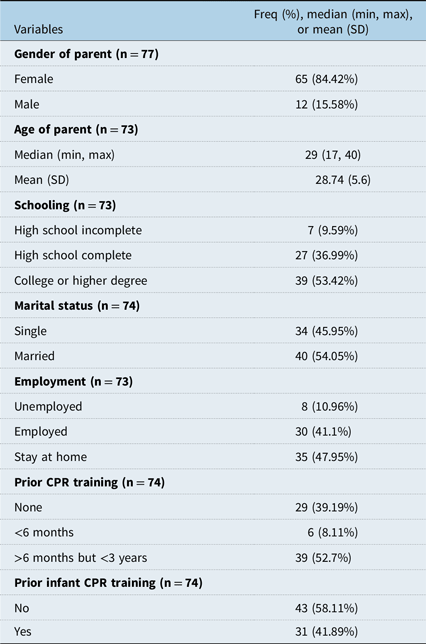
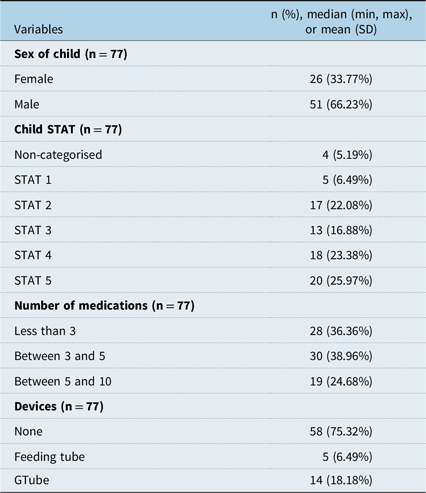
Demographic information of parents and children are presented in Tables 1 and 2. The mean (SD) age of the parents was 28.7 (5.6) years. Forty (54%) participants were married, and 39 (53%) had a college degree or higher. Twenty-nine (39%) participants had no prior CPR training with 43 (58%) having no infant CPR training. The infants in this study were primarily male (66%). Thirty-eight (49%) infants had a STAT categorisation of four or higher. At discharge, 49 (63%) were on 3 or more medications, and 19 (25%) were on 5 or more; 19 (25%) of the children had at least one type of corporeal tube (tracheostomy, gastric, or feeding tube).
Parent demographics

CPR = cardiopulmonary resuscitation.
Infant demographics

The primary aim of the study was to evaluate the effect of infant CPRt on levels of anxiety and stress across three time points as measured by STAI and PSI, respectively. The longitudinal analysis showed a significant decrease in STAI across the three time points (p < .0001). STAI decreased by 12% from baseline to immediately post-CPRt and 19% from baseline to 3 months post-CPRt. There were no significant changes in PSI across the time points (Figure 1). During study enrolment, one parent became overwhelmed with the thought of performing CPR in a child and was excluded from the study. Psychological assistance was provided as well as a CPR kit to take home.
STAI and PSI scores over time. STAI = State-Trait Anxiety Inventory; PSI = Parenting Stress Index; post-CPRt = cardiopulmonary resuscitation teaching.

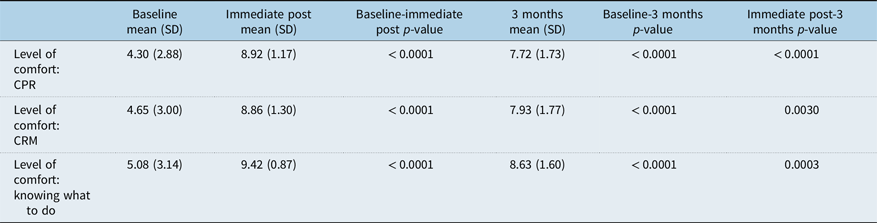
The effect of CPRt on level of comfort variables, performing CPR, performing CRM, and comfort knowing what to do is demonstrated on Figure 2. The longitudinal analysis suggested significant differences among the time points for all three measures (p < 0.0001, p < 0.0001, p < .0001) (Table 3). The level of comfort variables all increased by at least 229% from baseline to immediately post-CPRt and at least 191% from baseline to 3 months post-CPRt.
Level of comfort over time. CPR = cardiopulmonary resuscitation; CRM = choking relief manoeuvre; post-CPRt = cardiopulmonary resuscitation teaching.

Level of comfort measurements over study time

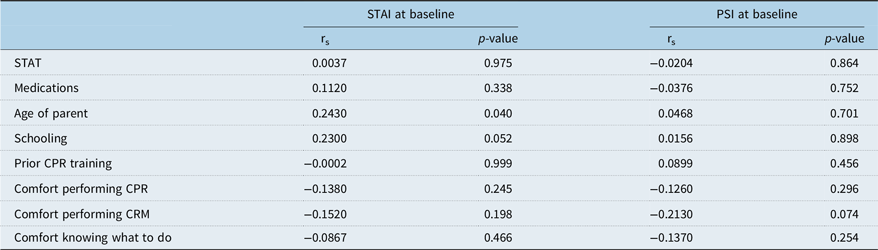
We examined the relationship between STAI and PSI with the following variables: parental age, parental education, marital status, employment, child STAT categorisation, number of medications the child was on, devices, prior CPR training, comfort performing CPR, comfort performing CRM, and comfort knowing what to do. Parental age had a significant positive correlation with STAI at baseline (rs = 0.24, p = .040). There was a significant relationship between marital status and both STAI and PSI such that scores were higher for married parents (p = 0.014 and p = 0.018, respectively). All other predictors were not found to have significant relationships with either STAI or PSI. The results of the baseline testing are presented in Table 4.
Spearman correlation STAI and PSI

STAI = State-Trait Anxiety Inventory; PSI = Parenting Stress Index; CPR = cardiopulmonary resuscitation; CRM = choking relief manoeuvre.
During this study, three patients received CPR performed by their own parents in an out-of-hospital setting. Two of them had single ventricle anatomy, and all of them survived the event without neurological sequelae. None of the parents had CPRt prior to study participation. At the end of the study, seven parents reported having deployed CRM at least once, 37% of parents had watched the video at least one more time, and 67% of respondents had shared the kit with additional friends and family.
Discussion
In this prospective study, the primary aim was to evaluate the effect of infant CPRt on parents’ anxiety and stress levels across three time points: baseline, immediately post-CPRt, and 3 months post-CPRt. We observed a significant decrease in anxiety, by using STAI, from baseline to immediately post-CPRt (12%) and from baseline to 3 months post-CPRt (19%). When stress levels were evaluated, we did not find a statistically significant difference across the three time points. Our secondary aim was to evaluate if there was an effect of infant CPRt on level of comfort, which was also statistically significant among all three time points.
We initially hypothesised that both parental anxiety and stress levels would decrease because of CPRt. Interestingly, our findings revealed a decrease in anxiety levels, but stress levels remained unchanged. According to the World Health Organization, stress is defined as a “state of worry or mental tension caused by a difficult situation. Stress is a natural human response that prompts us to address challenges and threats to our lives.” While our study did not investigate specific causes of stress, the ongoing stress associated with parenting a child with heart disease and dealing with a child’s hospital admission might contribute to a prolonged state of stress. The ability to effectively respond to stress significantly impacts one’s well-being. Therefore, offering additional coping strategies for parental stress may be required and may have a more enduring impact on parents of children with heart disease. It is commonplace for parents and caretakers to experience anxiety regarding their proficiency in performing CPR, especially in a child. Reference Schlessel, Rappa, Lesser, Pogge, Ennis and Mandel19,Reference Moran and Stanley20 In our study, while the training did not eliminate the stress linked to emergencies, it did demonstrate a noticeable reduction in associated anxiety.
We also found improvement in comfort performing CPR, CRM, and knowing what to do (rs = 0.24, p = .04). Similar to our findings, Tomatis Souverbielle et al. Reference Tomatis Souverbielle, González-Martínez and González-Sánchez21 found an increase in confidence and knowledge after training that remained for 3 months as well as parental training satisfaction. It could be further hypothesised that the improvement in anxiety and comfort knowing what to do could lead to better mental clarity and decision-making at the time of an emergency.
Patient complexity, such as those with a higher STAT category and/or having a tracheostomy or gastrostomy tube, was not found to be statistically significant regarding any of the variables measured. Parents of patients with complex medical conditions are most likely accustomed to emergency situations, leading to increased exposure and less anxiety. We found a significant relationship between marital status and both STAI and PSI such that scores were higher for married parents ( p = 0.014 and p = 0.018, respectively), an unexpected finding. Unfortunately, no additional correlations were made, and further research will be needed to contextualise similar findings.
Neonatal and infant heart surgery has evolved over the past three decades, as well as the complexity of operations and improvement in care to patients and support to families. Despite these advancements, the population of infants with CHD remains at increased risk for cardiac events, especially in higher-risk patients. In the event of OHCA, the time to receive first assistance is of prime importance. In children, parents, as main caregivers, are frequently the first responders in the event of an OHCA. Training parents to perform CPR increases the likelihood of receiving the first assistance and potentially improving outcomes.
However, there is very limited data on the impact of CPRt on families as part of the standard of care. Since parents of children with CHD are regularly seeing their paediatricians, this is a perfect opportunity to intervene with CPR education, similar to how we structured the CPRt intervention in this study. This kind of intervention could be standardly provided to every parent at pre-hospital discharge.
During our study, it was interesting to see the application of learnt CPR skill in the three cases where parents in this study performed CPR on their infants with good outcomes at an OHCA setting. None of these parents had former CPR training before study participation. All patients survived without neurologic sequelae. This supports the idea of standardising this care for all patients prior to discharge from the hospital.
Limitations
There are some limitations in our study. This study was performed specifically in caretakers of children with CHD, although pathophysiologic features differ from children with anatomically normal hearts, it does not decrease the potential scalability to high and non-high-risk children. This study was relatively short term, in that we did not assess changes in a longer period regarding retention skills (i.e. 6 months or 1 year), although evidence supports skills retention and quality of chest compressions when CPRt provided with the model adopted by this study (G). Next, it is possible that, despite attenuation of situational anxiety around discharge time, stress caring for a chronically ill child at home may be persistent and not effectively measurable by conventional questionnaires.
Future directions
Parental CPRt is not a requirement for hospital discharge, and practices are inconsistent through institutions. CPRt is a low-cost intervention with the potential of leading to an improvement in knowledge, a decrease in anxiety and stress levels in emergency situations, and, most importantly, a potential impact on outcomes of OHCA survivors. Hence, the impact of CPRt scalable to all parents and caregivers remains to be defined.
Conclusion
CPRt aids in improving contextual anxiety levels of parents of infants with CHD at the time of discharge from the hospital. Parent-reported outcomes of infants with CHD can be improved by simple training, such as CPRt, which outlines steps to follow, thereby increasing the potential to improve CHD infant outcomes in an emergency scenario.
Acknowledgements
The authors would like to acknowledge Dr Jennifer Hunnicutt of Hunnicutt Writing and Consulting, LLC, for her assistance with editing and technical support.
Financial support
The author received a Children’s Miracle Network award to support the execution of this study.
Competing interests
All authors declare no conflict of interest to disclose.
Ethical standards
The authors assert that all procedures contributing to this work comply with the ethical standards of the relevant national guidelines on human experimentation from the University of Florida and with the Helsinki Declaration of 1975, as revised in 2008, and has been approved by the institutional committees from the University of Florida.